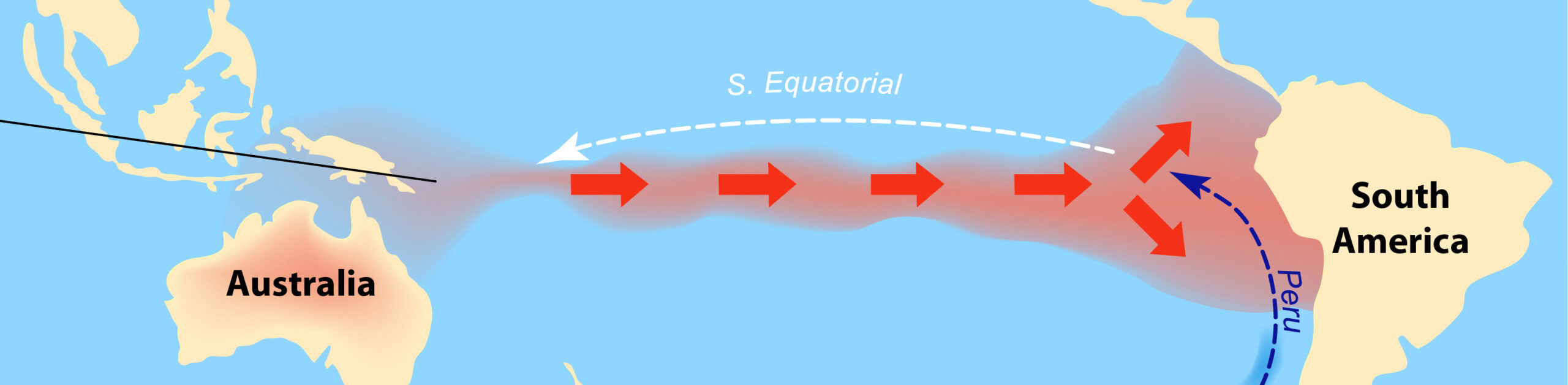
The World Meteorological Organization predicts that a ‘super El Niño’ is building. This has been nicknamed ‘Godzilla’. If forecasts are correct, this will be the most extreme El Niño in 1000 years.
El Niño is a natural phenomenon. It occurs when the surface temperatures in the central and eastern tropical Pacific Ocean warm and cause the trade winds that typically blow from east to west across the Pacific Ocean to weaken or even reverse direction. As well as increasing global temperatures and causing intense heatwaves, it can result in droughts in some parts of the world, such as eastern Australia, south-east Asia and southern Africa, and intense rain and flooding in parts of South America, eastern Africa and south-western North America.

Typically, in an El-Niño event, the surface temperature of the central-eastern equatorial Pacific Ocean rises by 1°C to 1.5°C above the average. In the current El Niño, it is forecast to rise by up to 4°C by the end of 2026 and into 2027. It is already between 2.2°C and 2.6°C above the average. The effects could be catastrophic and hence the term ‘Godzilla’.
Although El Niño is a natural phenomenon, its severity is a direct result of climate change. This in turn is a direct result of economic decisions, and the effects will have severe economic consequences.
The economic causes
Climate change is an external cost of private economic decisions. When people or organisations burn fossil fuels, the climate costs of the CO2 emissions are not borne by the emitter. They are an external cost. This is illustrated in the diagram below, which shows the costs and benefits of electricity production from fossil fuels. (Click here for a PowerPoint.)
In this example, to make things simple, we assume that the external climate costs begin with the first unit of electricity generated and increase at a constant rate. The marginal social cost (MSC) of electricity generation equals the marginal private costs (MPC) to the generating company plus the marginal external cost in production MECP.
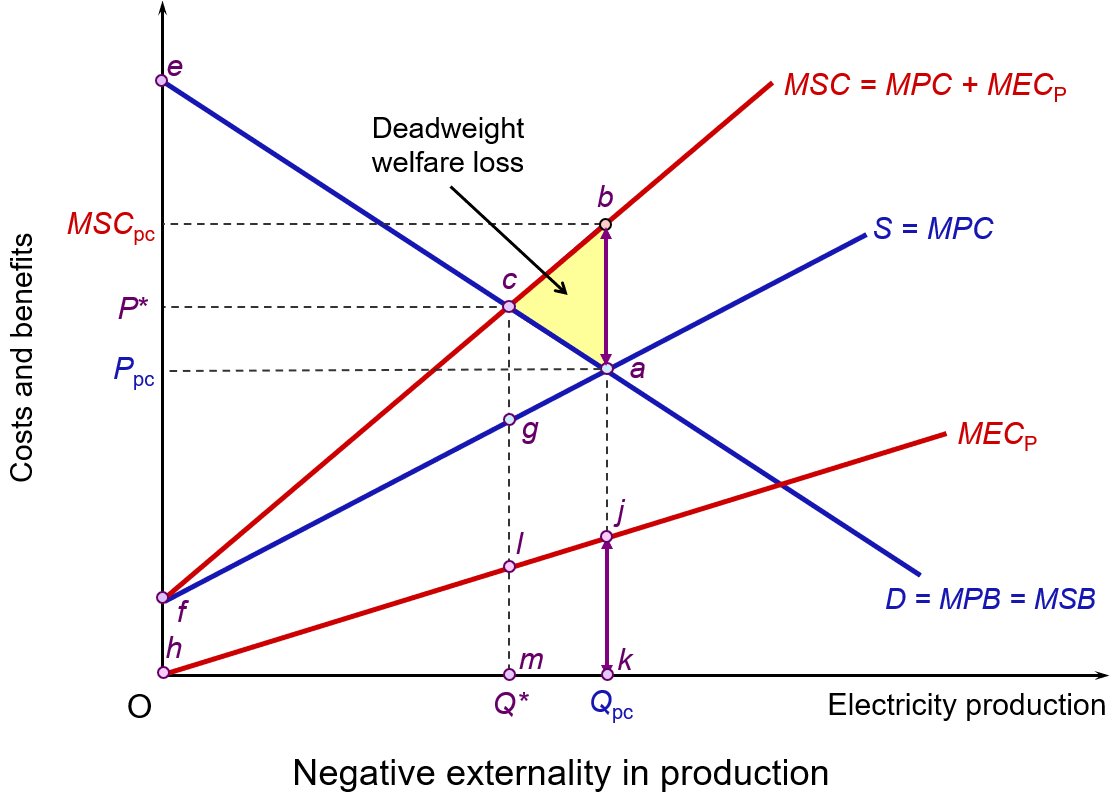 As you can see, the MSC curve is above the MPC curve. The vertical distance between them is equal to the MECP. It is also assumed that there are no externalities in consumption, which means that the marginal social benefit (MSB) curve is the same as the marginal private benefit (MPB) curve.
Competitive market forces, with producers and consumers responding only to private costs and benefits, will result in a market equilibrium at point a: i.e. where demand equals supply. The market equilibrium price is Ppc, while the market equilibrium quantity is Qpc. At Ppc, with no externalities on the consumption side, MPB is equal to MSB. The market price reflects both the private and social benefits from the last unit consumed. However, the presence of external costs in production means that MSC > MPC.
The socially optimal output would be Q*, where P = MSB = MSC, achieved at the socially optimal price of P*. This is illustrated at point c and clearly shows how external costs of production in a perfectly competitive market result in overproduction: i.e. Qpc > Q*. From society’s point of view, too much electricity is being produced from fossil fuels.
Total social surplus equals consumer surplus plus producer surplus minus the external costs. At the market equilibrium (Qpc) this is areas eaPpc+ Ppcaf – fba (or hjk, as it is the same size). At the socially optimal level of output (Q*) total social surplus is areas ecP* + P*cgf – fcg (or hlm).
Although consumer-plus-producer surplus is higher at the market equilibrium (Qpc) than at the socially optimum output (Q*) by the area cag, the external costs are higher still by the area cbag (or ljkm). Therefore, total social surplus at the market equilibrium is smaller than at the socially optimal point by area abc. This is a deadweight welfare loss and represents the excess of social costs over social benefits at all outputs above Q*. Put another way, moving from Qpc to Q* would represent a gain in social surplus of the area abc, as the fall in external costs outweighs the fall in consumer-plus-producer surplus.
One of the reasons why external environmental costs cause problems in a free-market economy is that no one has legal ownership of the atmosphere. Therefore, nobody has the ability either to prevent or to charge for their use as a ‘dumping ground’ for CO2. Such a ‘market’ is missing. Control must, therefore, be left to the government, international organisations, local authorities or regulators.
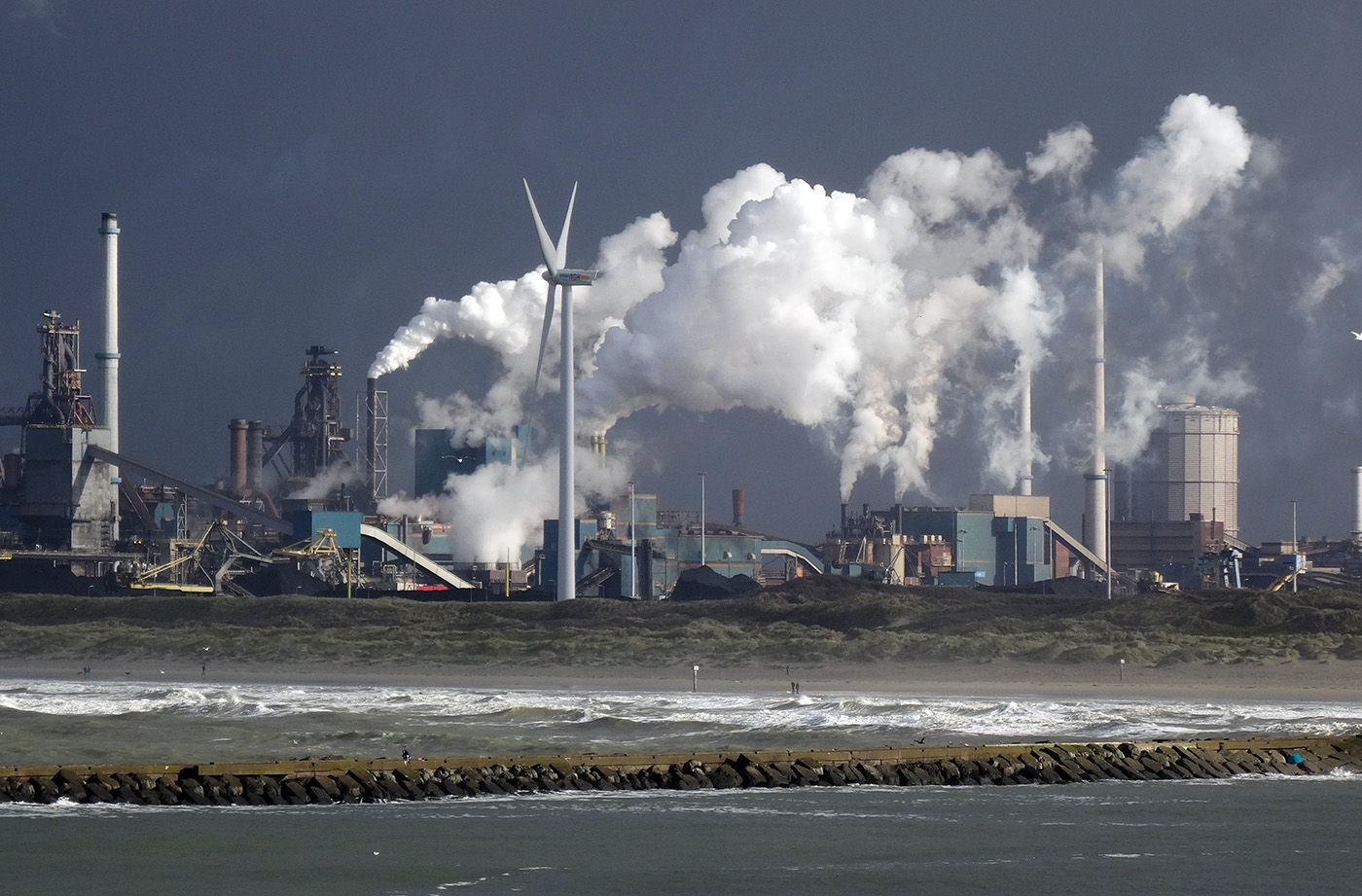 But such control is often too little. For example, when President Trump came to office in January 2025, he announced that the USA would withdraw from the UN’s Paris Agreement on climate change and that his policy towards oil production would be to ‘drill, baby, drill’. Indeed, governments globally spend hundreds of billions of dollars a year in subsidising oil, gas and coal production and its use, partly from pressure from the fossil fuel industry and partly to reduce the cost of living for consumers. This embeds fossil fuel dependence.
Game theory can help to explain the slow process of carbon reduction. For an individual country, such as the USA, it might argue that its optimum solution would be for other countries to cut their emissions, while maintaining its own levels. This approach would yield most of the benefits to the USA and none of the costs. However, when all countries argue like this, no progress is made. It’s a prisoners’ dilemma. Only if countries believe that the other countries will (a) ratify an agreement to cut emissions and (b) stick to the approved terms, is the agreement likely to succeed. This requires trust on all sides as well as the ability to monitor the outcomes.
Another major problem area concerns equity. Most countries will feel that they are being asked to do too much and that others are being asked to do too little. High-income countries will want to adopt a grandfathering approach. The starting point with this approach would be current levels of pollution. Every country would then be required to make the same percentage cut. Low-income countries, on the other hand, will want the bulk of the cuts, if not all of them, to be made by the rich countries. After all, the rich countries produce much higher levels of pollutants per capita than do the poor countries, and curbing growth in low-income countries would have a far more serious impact on levels of absolute poverty.
But will a supersized El Niño persuade countries to make deeper cuts in carbon emissions? In recent months commitments to achieving net zero emissions have waned. But the following economic consequences may encourage some countries to make deeper emissions cuts.
Economic consequences of a Godzilla El Niño
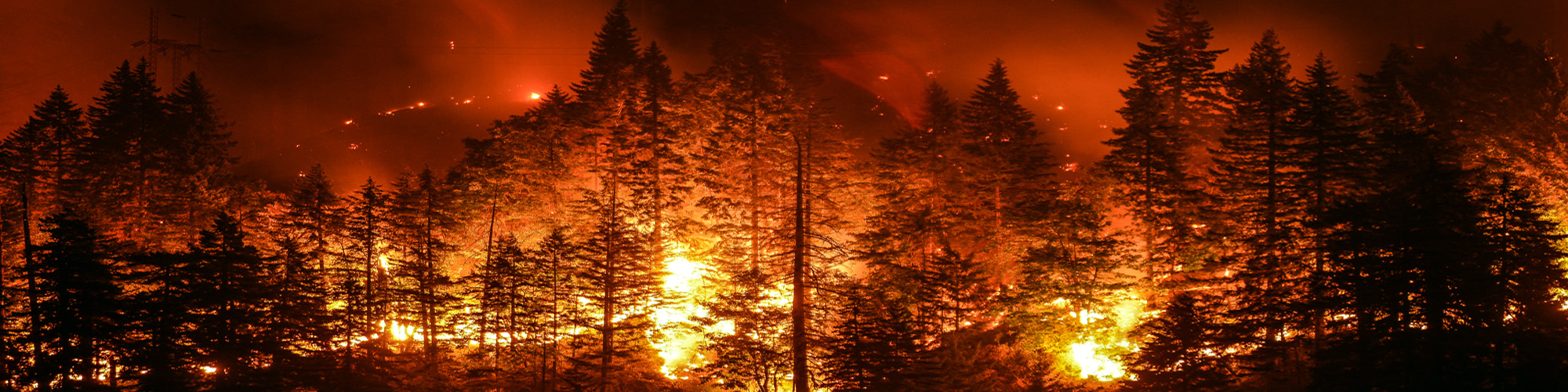
Extreme droughts, heat, wildfires and harvest failures in some areas and extreme rainfall and flooding in others will have severe economic consequences, often for the poorest people. There will be reductions in crop yields and loss of livelihood. Food prices will rise globally. This will add to the inflationary pressures from higher oil prices caused by the Iran war.
Droughts and wildfires in south-east Asia and Australia could have disastrous effects on harvests of palm oil, coffee, cocoa, rice, maize, wheat and various tropical fruits. Droughts and heat reduce output from hydropower and possibly wind energy, and industrial production may slow as a result of extreme heat in workplaces.
In Europe, warmer winters and unusually wet springs promote rapid plant growth. When this is followed by summer heatwaves, the undergrowth dries out and provides fuel for the wildfires. A super El Niño will amplify this. France and Spain have experienced massive wildfires these past few months. In the UK, the 2026 summer has been the hottest on record. The costs in Europe of the heat and wildfires in terms of lost crops and animals have been immense.
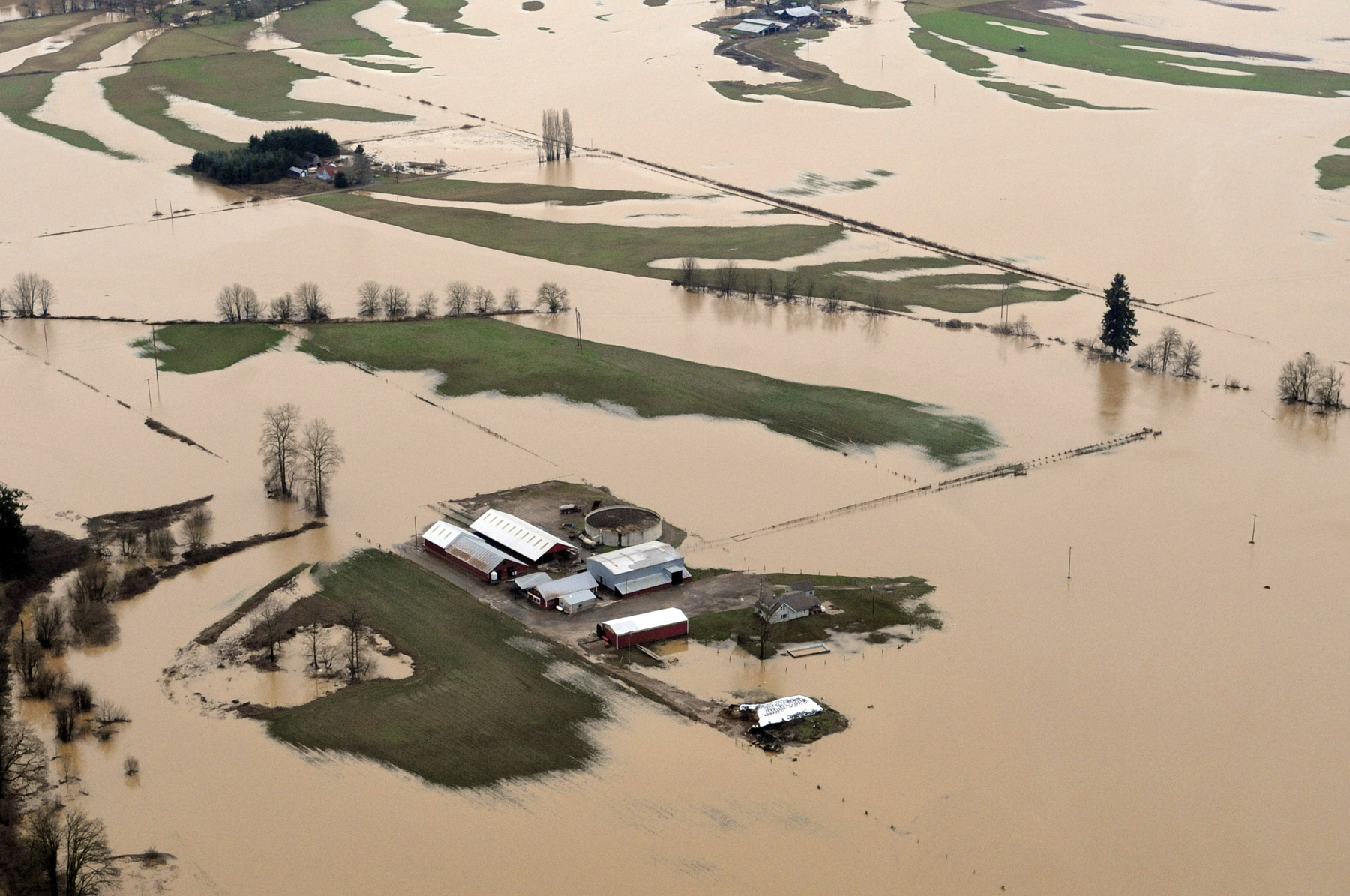 Floods and storms damage roads, power grids, railways and buildings. This forces governments to spend money on repairs instead of long-term investments. People are displaced and many are likely to lose their lives.
Fortunately, El Niños fade after a few months to be replaced by the cooler La Niña. The problem is that, with global warming, the next El Niño in a few years could be even more extreme with even more serious economic consequences.
The hope is that governments wake up to the pressing need to reduce carbon emissions.
Videos and podcast
Information
Articles
- Building climate-resilient agriculture in Europe: an economic perspective
European Environment Agency (17/3/26)
- What Super El Niño Means For Business Supply Chains And The Economy
Forbes, Chloe Demrovsky (25/8/26)
- A summer of extremes: Weathering a hotter world
CBS News, Jonathan Vigliotti (16/8/26)
- Area in Europe affected by wildfires could triple due to climate change
The National (UAE), Tariq Tahir (20/8/26)
- El Niño could drag down the global economy by almost $1 trillion or at least $7 trillion—and the choice is ours
Peterson Institute for International Economics, Cullen S Hendrix (26/7/26)
- UN warns of ‘supersized’ El Niño as countries prepare for impact
BBC News, Esme Stallard, Mark Poynting, Becky Dale, Yvette Tan, Tiffanie Turnbull and Nikita Yadav (3/9/26)
- Toxic haze from wildfires spreads across South East Asia as ‘super’ El Niño intensifies
BBC News (2/9/26)
- A Super El Niño is coming: 5 hard‑won lessons the world can learn from Africa
The Conversation, Tafadzwanashe Mabhaudhi and Mendy Ndlovu (5/7/26)
- ‘Supersizing before our eyes’: UN warns of record El Niño approaching
The Guardian, Damian Carrington (3/9/26)
- ‘Super’ El Niño could cause global food price shock lasting into 2028, analysts say
The Guardian, Richard Partington (12/7/26)
- Without action wildfires in Europe will increase 39% even in best-case climate scenario, study finds
The Guardian, Ajit Niranjan (20/8/26)
- From classrooms to climate action: ICSE 2026 charts new path for sustainability
Economic Times (Times of India) (2/9/26)
Questions
- What is the current state of progress towards meeting the goals of the UN Paris Climate Agreement?
- Are there any externalities in consumption that affect global warming?
- How might technological progress make it privately profitable to reduce carbon emissions?
- How might global supply chains and shipping be affected by a super El Niño?
- What role can education play in tackling climate change and its effects?
 Global long-term economic growth has slowed dramatically since the financial crisis of 2007–8. This can be illustrated by comparing the two 20-year periods 1988 to 2007 and 2009 to 2028 (where IMF forecasts are used for 2024 to 2028: see WEO Database under the Data link below). Over the two periods, average annual world growth fell from 3.8% to 3.1%. In advanced countries it fell from 2.9% to 1.6% and in developing countries from 4.8% to 4.3%. In the UK it fell from 2.4% to 1.2%, in the USA from 3.1% to 1.8% and in Japan from 1.9% to 0.5%.
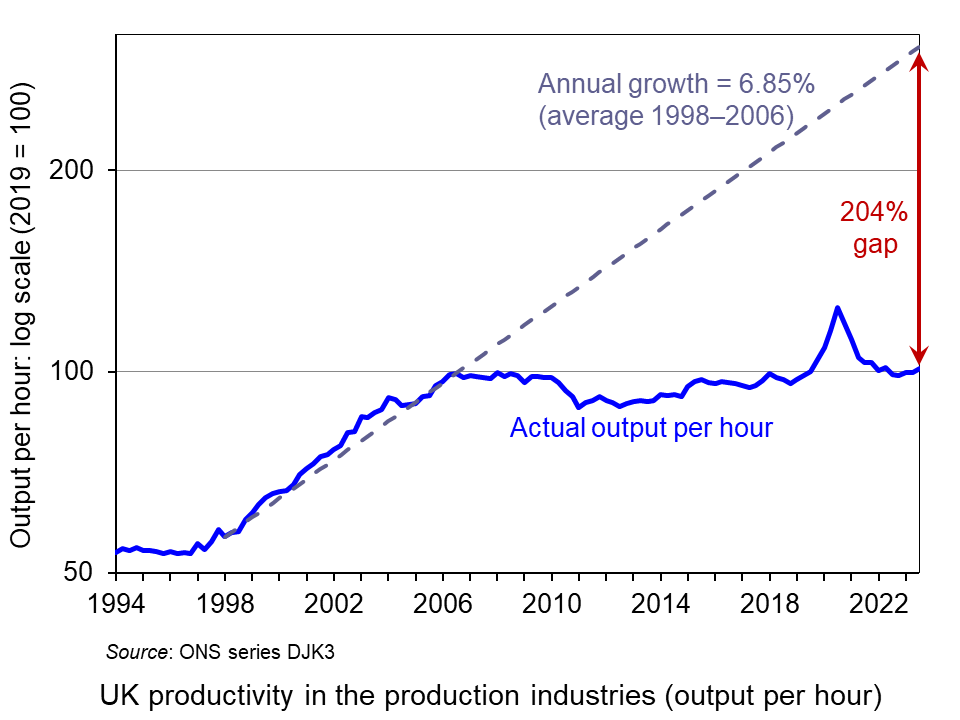 In the UK, labour productivity growth in the production industries was 6.85% per annum from 1998 to 2006. If this growth rate had been maintained, productivity would have been 204% higher by the end of 2023 than it actually was. This is shown in the chart (click here for a PowerPoint).
The key driver of long-term economic growth is labour productivity, which can best be measured by real GDP per hour worked. This depends on three things: the amount of capital per worker, the productivity of this capital and the efficiency of workers themselves – the latter two giving total factor productivity (TFP). Productivity growth has slowed, and with it the long-term rate of economic growth.
If we are measuring growth in output per head of the population, as opposed to simple growth in output, then another important factor is the proportion of the population that works. With ageing populations, many countries are facing an increase in the proportion of people not working. In most countries, these demographic pressures are likely to increase.
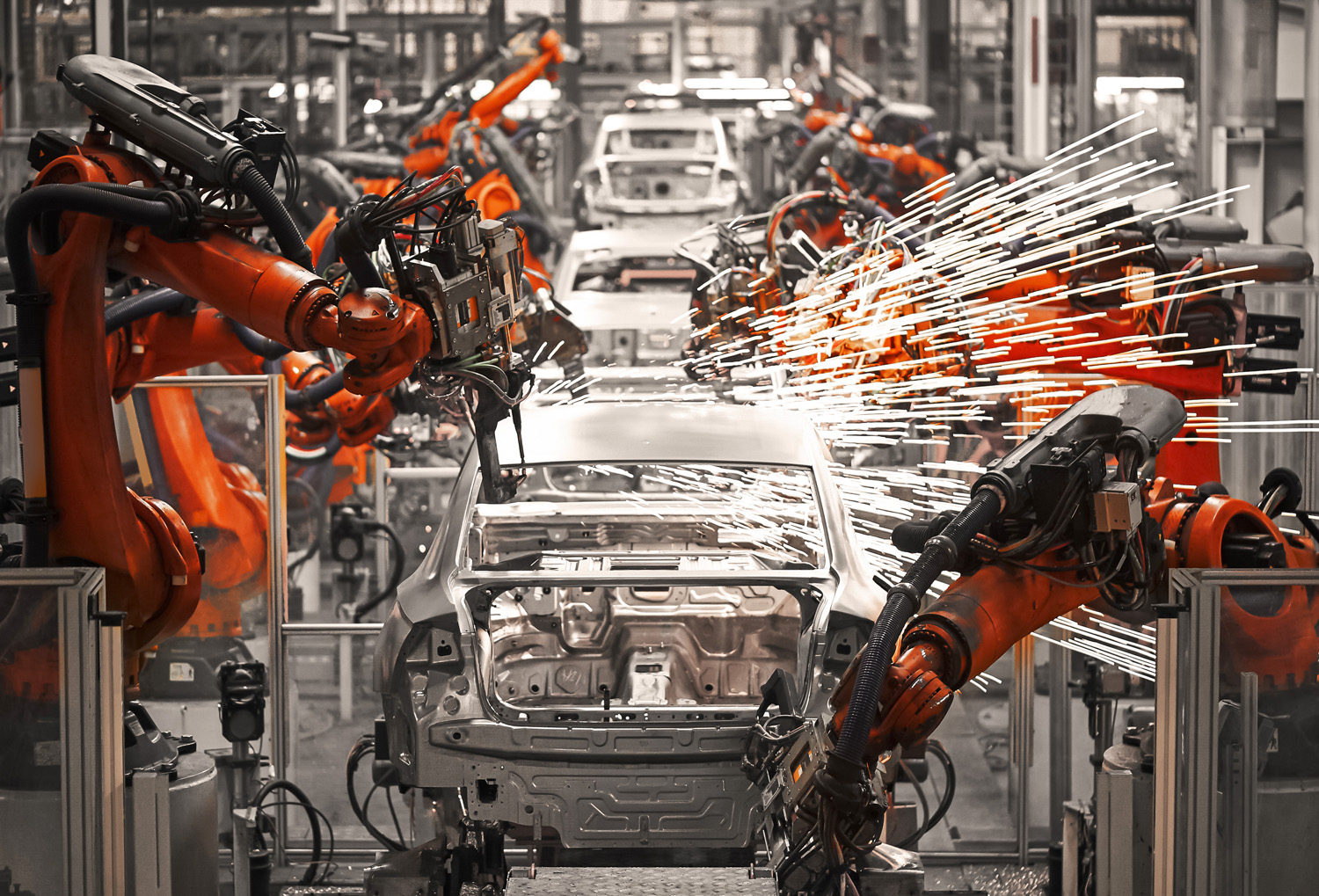 A major determinant of long-term economic growth and productivity is investment. Investment has been badly affected by crises, such as the financial crisis and COVID, and by geopolitical tensions, such as the war in Ukraine and tensions between the USA and China and potential trade wars. It has also been adversely affected by government attempts to deal with rising debt caused by interventions following the financial crisis and COVID. The fiscal squeeze and, more recently higher interest rates, have dampened short-term growth and discouraged investment, thereby dampening long-term growth.
Another factor adversely affecting productivity has been a lower growth of allocative efficiency. Competition in many industries has declined as the rate of new firms entering and exiting markets has slowed. The result has been an increase in concentration and a growth in supernormal profits.
In the UK’s case, growth prospects have also been damaged by Brexit. According to Bank of England and OBR estimates, Brexit has reduced productivity by around 4% (see the blog: The costs of Brexit: a clearer picture). For many companies in the UK, Brexit has hugely increased the administrative burdens of trading with the EU. It has also reduced investment and led to a slower growth in the capital stock.
The UK’s poor productivity growth over many yeas is examined in the blog The UK’s poor productivity record.
Boosting productivity
So, how could productivity be increased and what policies could help the process?
 Artificial intelligence. One important driver of productivity growth is technological advance. The rapid advance in AI and its adoption across much of industry is likely to have a dramatic effect on working practices and output. Estimates by the IMF suggest that some 40% of jobs globally and 60% in advanced countries could be affected – some replaced and others complemented and enhanced by AI. The opportunities for raising incomes are huge, but so too are the dangers of displacing workers and deepening inequality, as some higher-paid jobs are enhanced by AI, while many lower paid jobs are little affected and other jobs disappear.
AI is also likely to increase returns to capital. This may help to drive investment and further boost economic growth. However, the increased returns to capital are also likely to exacerbate inequality.
To guard against the growth of market power and its abuse, competition policies may need strengthening to ensure that the benefits of AI are widely spread and that new entrants are encouraged. Also training and retraining opportunities to allow workers to embrace AI and increase their mobility will need to be provided.
 Training. And it is not just training in the use of AI that is important. Training generally is a key ingredient in encouraging productivity growth. In the UK, there has been a decline in investment in adult education and training, with a 70% reduction since the early 2000s in the number of adults undertaking publicly-funded training, and with average spending on training by employers decreasing by 27% per trainee since 2011. The Institute for Fiscal Studies identifies five main policy levers to address this: “public funding of qualifications and skills programmes, loans to learners, training subsidies, taxation of training and the regulation of training” (see link in articles below).
Competition. Another factor likely to enhance productivity is competition, both internationally and within countries. Removing trade restrictions could boost productivity growth; erecting barriers to protect inefficient domestic industry would reduce it.
Investment. Policies to encourage investment are also key to productivity growth. Private-sector investment can be encouraged by tax incentives. For example, in the UK the Annual Investment Allowance allows businesses to claim 100% of the cost of plant and machinery up to £1m in the year it is incurred. However, for tax relief to produce significant effects on investment, companies need to believe that the policy will stay and not be changed as economic circumstances or governments change.
 Public-sector investment is also key. Good road and rail infrastructure and public transport are vital in encouraging private investment and labour mobility. And investment in health, education and training are a key part in encouraging the development of human capital. Many countries, the UK included, cut back on public-sector capital investment after the financial crisis and this has had a dampening effect on economic growth.
Regional policy. External economies of scale could be encouraged by setting up development areas in various regions. Particular industries could be attracted to specific areas, where local skilled workers, managerial expertise and shared infrastructure can benefit all the firms in the industry. These ‘agglomeration economies’ have been very limited in the UK compared with many other countries with much stronger regional economies.
Changing the aims and governance of firms. A change in corporate structure and governance could also help to drive investment and productivity. According to research by the think tank, Demos (see the B Lab UK article and the second report below), if legislation required companies to consider the social, economic and environmental impact of their business alongside profitability, this could have a dramatic effect on productivity. If businesses were required to be ‘purpose-led’, considering the interests of all their stakeholders, this supply-side reform could dramatically increase growth and well-being.
Such stakeholder-governed businesses currently outperform their peers with higher levels of investment, innovation, product development and output. They also have higher levels of staff engagement and satisfaction.
Articles
- World Must Prioritize Productivity Reforms to Revive Medium-Term Growth
IMF Blog, Nan Li and Diaa Noureldin (10/4/24)
- Why has productivity slowed down?
Oxford Martin School News, Ian Goldin, Pantelis Koutroumpis, François Lafond and Julian Winkler (18/3/24)
- How can the UK revive its ailing productivity?
Economics Observatory, Michelle Kilfoyle (14/3/24)
- With the UK creeping out of recession, here’s an economist’s brief guide to improving productivity
The Conversation, Nigel Driffield (13/3/24)
- UK economy nearly a third smaller thanks to ‘catastrophically bad’ productivity slowdown
City A.M., Chris Dorrell (12/3/24)
- Can AI help solve the UK’s public sector productivity puzzle?
City A.M., Chris Dorrell (11/3/24)
- AI Will Transform the Global Economy. Let’s Make Sure it Benefits Humanity
IMF Blog, Kristalina Georgieva (14/1/24)
- Productivity and Investment: Time to Manage the Project of Renewal
NIESR, Paul Fisher (12/3/24)
- Productivity trends using key national accounts indicators
Eurostat (15/3/24)
- New report says change to company law could add £149bn to the UK economy
B Lab UK (28/11/23)
- Investment in training and skills: Green Budget Chapter 9
Institute for Fiscal Studies, Imran Tahir (12/10/23)
Reports
Data
Questions
- Why has global productivity growth been lower since 2008 than before 2008?
- Why has the UK’s productivity growth been lower than many other advanced economies?
- How does the short-run macroeconomic environment affect long-term growth?
- Find out why Japan’s productivity growth has been so poor compared with other countries.
- What are likely to be the most effective means of increasing productivity growth?
- How may demand management policies affect the supply side of the economy?
- How may the adoption of an ESG framework by companies for setting objectives affect productivity growth?
Artificial intelligence is having a profound effect on economies and society. From production, to services, to healthcare, to pharmaceuticals; to education, to research, to data analysis; to software, to search engines; to planning, to communication, to legal services, to social media – to our everyday lives, AI is transforming the way humans interact. And that transformation is likely to accelerate. But what will be the effects on GDP, on consumption, on jobs, on the distribution of income, and human welfare in general? These are profound questions and ones that economists and other social scientists are pondering. Here we look at some of the issues and possible scenarios.
According to the Merrill/Bank of America article linked below, when asked about the potential for AI, ChatGPT replied:
AI holds immense potential to drive innovation, improve decision-making processes and tackle complex problems across various fields, positively impacting society.
But the magnitude and distribution of the effects on society and economic activity are hard to predict. Perhaps the easiest is the effect on GDP. AI can analyse and interpret data to meet economic goals. It can do this much more extensively and much quicker than using pre-AI software. This will enable higher productivity across a range of manufacturing and service industries. According to the Merrill/Bank of America article, ‘global revenue associated with AI software, hardware, service and sales will likely grow at 19% per year’. With productivity languishing in many countries as they struggle to recover from the pandemic, high inflation and high debt, this massive boost to productivity will be welcome.
But whilst AI may lead to productivity growth, its magnitude is very hard to predict. Both the ‘low-productivity future’ and the ‘high-productivity future’ described in the IMF article linked below are plausible. Productivity growth from AI may be confined to a few sectors, with many workers displaced into jobs where they are less productive. Or, the growth in productivity may affect many sectors, with ‘AI applied to a substantial share of the tasks done by most workers’.
Growing inequality?
 Even if AI does massively boost the growth in world GDP, the distribution is likely to be highly uneven, both between countries and within countries. This could widen the gap between rich and poor and create a range of social tensions.
In terms of countries, the main beneficiaries will be developed countries in North America, Europe and Asia and rapidly developing countries, largely in Asia, such as China and India. Poorer developing countries’ access to the fruits of AI will be more limited and they could lose competitive advantage in a number of labour-intensive industries.
Then there is growing inequality between the companies controlling AI systems and other economic actors. Just as companies such as Microsoft, Apple, Google and Meta grew rich as computing, the Internet and social media grew and developed, so these and other companies at the forefront of AI development and supply will grow rich, along with their senior executives. The question then is how much will other companies and individuals benefit. Partly, it will depend on how much production can be adapted and developed in light of the possibilities that AI presents. Partly, it will depend on competition within the AI software market. There is, and will continue to be, a rush to develop and patent software so as to deliver and maintain monopoly profits. It is likely that only a few companies will emerge dominant – a natural oligopoly.
Then there is the likely growth of inequality between individuals. The reason is that AI will have different effects in different parts of the labour market.
The labour market
 In some industries, AI will enhance labour productivity. It will be a tool that will be used by workers to improve the service they offer or the items they produce. In other cases, it will replace labour. It will not simply be a tool used by labour, but will do the job itself. Workers will be displaced and structural unemployment is likely to rise. The quicker the displacement process, the more will such unemployment rise. People may be forced to take more menial jobs in the service sector. This, in turn, will drive down the wages in such jobs and employers may find it more convenient to use gig workers than employ workers on full- or part-time contracts with holidays and other rights and benefits.
But the development of AI may also lead to the creation of other high-productivity jobs. As the Goldman Sachs article linked below states:
Jobs displaced by automation have historically been offset by the creation of new jobs, and the emergence of new occupations following technological innovations accounts for the vast majority of long-run employment growth… For example, information-technology innovations introduced new occupations such as webpage designers, software developers and digital marketing professionals. There were also follow-on effects of that job creation, as the boost to aggregate income indirectly drove demand for service sector workers in industries like healthcare, education and food services.
Nevertheless, people could still lose their jobs before being re-employed elsewhere.
The possible rise in structural unemployment raises the question of retraining provision and its funding and whether workers would be required to undertake such retraining. It also raises the question of whether there should be a universal basic income so that the additional income from AI can be spread more widely. This income would be paid in addition to any wages that people earn. But a universal basic income would require finance. How could AI be taxed? What would be the effects on incentives and investment in the AI industry? The Guardian article, linked below, explores some of these issues.
The increased GDP from AI will lead to higher levels of consumption. The resulting increase in demand for labour will go some way to offsetting the effects of workers being displaced by AI. There may be new employment opportunities in the service sector in areas such as sport and recreation, where there is an emphasis on human interaction and where, therefore, humans have an advantage over AI.
Another issue raised is whether people need to work so many hours. Is there an argument for a four-day or even three-day week? We explored these issues in a recent blog in the context of low productivity growth. The arguments become more compelling when productivity growth is high.
Other issues
AI users are not all benign. As we are beginning to see, AI opens the possibility for sophisticated crime, including cyberattacks, fraud and extortion as the technology makes the acquisition and misuse of data, and the development of malware and phishing much easier.
 Another set of issues arises in education. What knowledge should students be expected to acquire? Should the focus of education continue to shift towards analytical skills and understanding away from the simple acquisition of knowledge and techniques. This has been a development in recent years and could accelerate. Then there is the question of assessment. Generative AI creates a range of possibilities for plagiarism and other forms of cheating. How should modes of assessment change to reflect this problem? Should there be a greater shift towards exams or towards project work that encourages the use of AI?
Finally, there is the issue of the sort of society we want to achieve. Work is not just about producing goods and services for us as consumers – work is an important part of life. To the extent that AI can enhance working life and take away a lot of routine and boring tasks, then society gains. To the extent, however, that it replaces work that involved judgement and human interaction, then society might lose. More might be produced, but we might be less fulfilled.
Articles
- The Macroeconomics of Artificial Intelligence
IMF publications, Erik Brynjolfsson and Gabriel Unger (December 2023)
- Economic impacts of artificial intelligence (AI)
European Parliamentary Research Service, Marcin Szczepański (July 2019)
- Artificial intelligence: A real game changer
Chief Investment Office, Merrill/Bank of America (July 2023)
 Generative AI could raise global GDP by 7%
Goldman Sachs, Joseph Briggs (5/4/23)
- The macroeconomic impact of artificial intelligence
PwC, Jonathan Gillham, Lucy Rimmington, Hugh Dance, Gerard Verweij, Anand Rao, Kate Barnard Roberts and Mark Paich (February 2018)
- How genAI is revolutionizing the field of economics
CNN, Bryan Mena and Samantha Delouya (12/10/23)
- AI-powered digital colleagues are here. Some ‘safe’ jobs could be vulnerable.
BBC Worklife, Sam Becker (30/11/23)
- Generative AI and Its Economic Impact: What You Need to Know
Investopedia, Jim Probasco (1/12/23)
- AI is coming for our jobs! Could universal basic income be the solution?
The Guardian Philippa Kelly (16/11/23)
- CFPB chief’s warning: AI is a ‘natural oligopoly’ in the making
Politico, Sam Sutton (21/11/23)
Questions
- Which industries are most likely to benefit from the development of AI?
- Distinguish between labour-replacing and labour-augmenting technological progress in the context of AI.
- How could AI reduce the amount of labour per unit of output and yet result in an increase in employment?
- What people are most likely to (a) gain, (b) lose from the increasing use of AI?
- Is the distribution of income likely to become more equal or less equal with the development and adoption of AI? Explain.
- What policies could governments adopt to spread the gains from AI more equally?
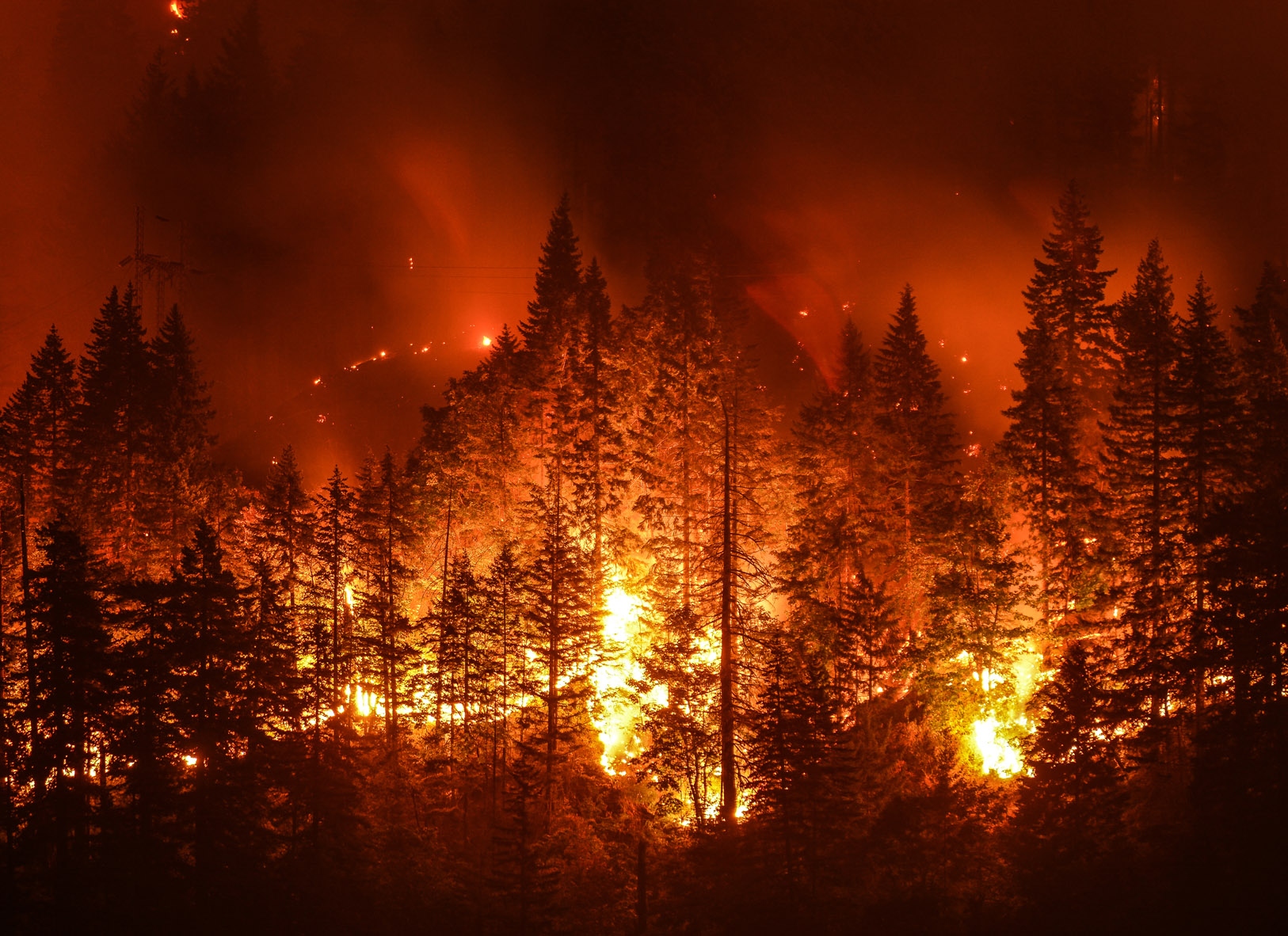 The global average temperature for July 2023 was the highest ever recorded and July 3rd was the world’s hottest day on record. We’ve seen scenes of wildfires raging across much of southern Europe, people suffering searing temperatures in south-west USA, southern India and western China, flash floods in South Korea, Japan and eastern USA. These are all directly related to global warming, which is causing weather systems to become more extreme. And as the planet continues to warm, so these problems will intensify.
The Secretary General of the United Nations, Antonio Guterres, in a press conference on 27 July warned that:
Climate change is here. It is terrifying. And it is just the beginning. The era of global warming has ended; the era of global boiling has arrived. The air is unbreathable. The heat is unbearable. And the level of fossil-fuel profits and climate inaction is unacceptable. Leaders must lead. No more hesitancy. No more excuses. No more waiting for others to move first. There is simply no more time for that.
The environmental, human, social and economic impact of global warming is huge, but concentrated on just part of the world’s population. For many, a more variable climate is at worst an inconvenience – at least in the short term. But it is the short term that politicians are most concerned about when seeking to win the next election.
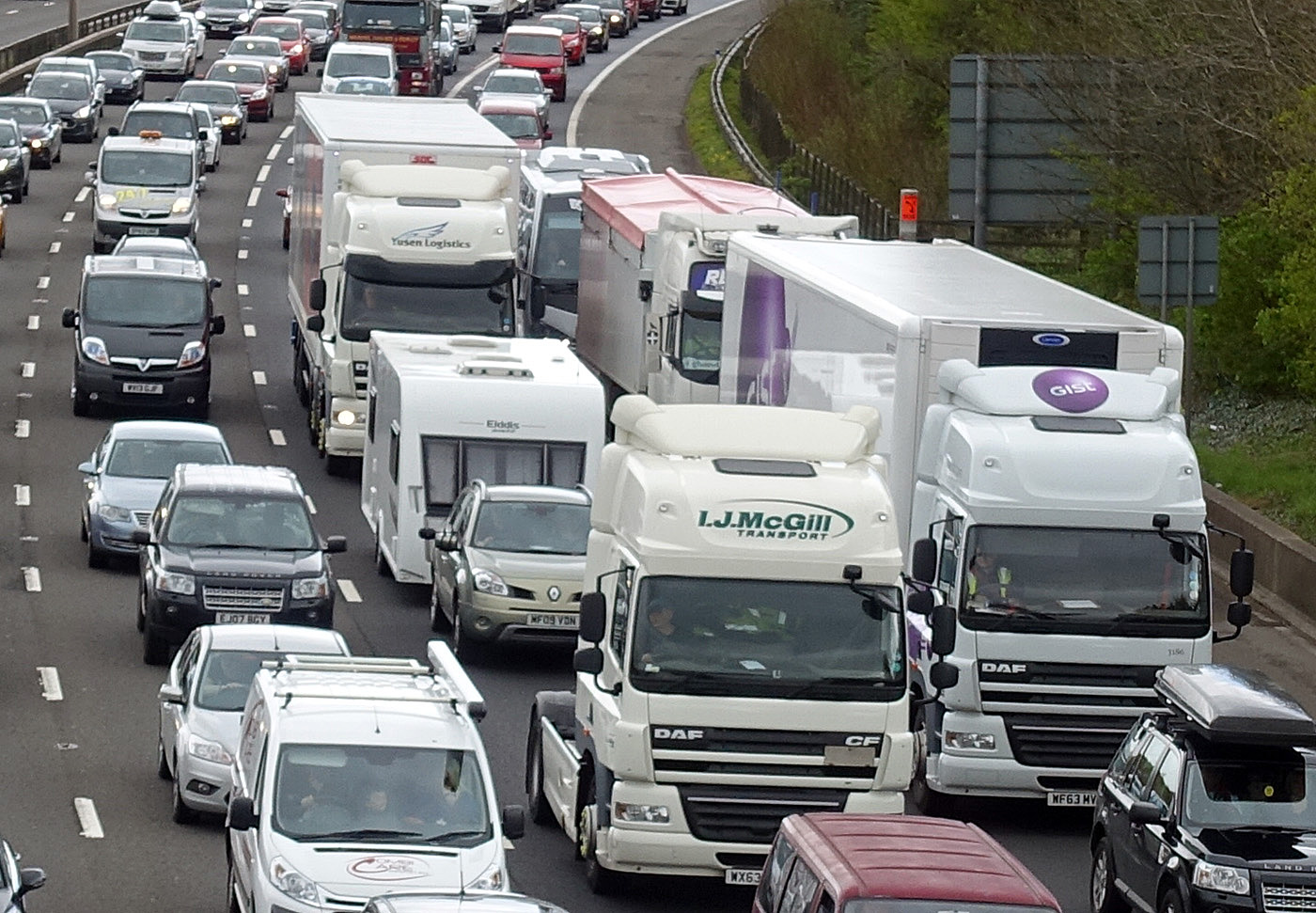 Tackling climate change requires action to reduce carbon emissions now, even though the effects take many years. But one person’s emissions make only a minuscule contribution to global warming. So why not be selfish and carry on driving, flying off on holiday, using a gas boiler and eating large amounts of red meat? This is what many people want to do and governments know it. Many people do not like green policies as they involve sacrifice. Examples include higher fuel prices and restrictions on what you can do. So, despite the visions of fires, floods and destruction, governments are wary about raising fuel taxes, airport duties and charges to use old high-emission cars in cities; wary about raising taxes generally to provide subsidies for sustainable power generation; wary about banning new oil and gas fields that would reduce reliance on imported fuel.
Because the external costs of carbon emissions are so high and global, government action is required to change behaviour. Education can help and scenes of devastation from around the world may change the hearts and minds or some people. Also, the prospect of profits from cleaner and more fuel-efficient technology can help to spur innovation and investment. But to meet net zero targets still requires policies that are unpopular with many people who might be inconvenienced or have to pay higher petrol, energy and food prices, especially at a time when budgets are being squeezed by inflation.
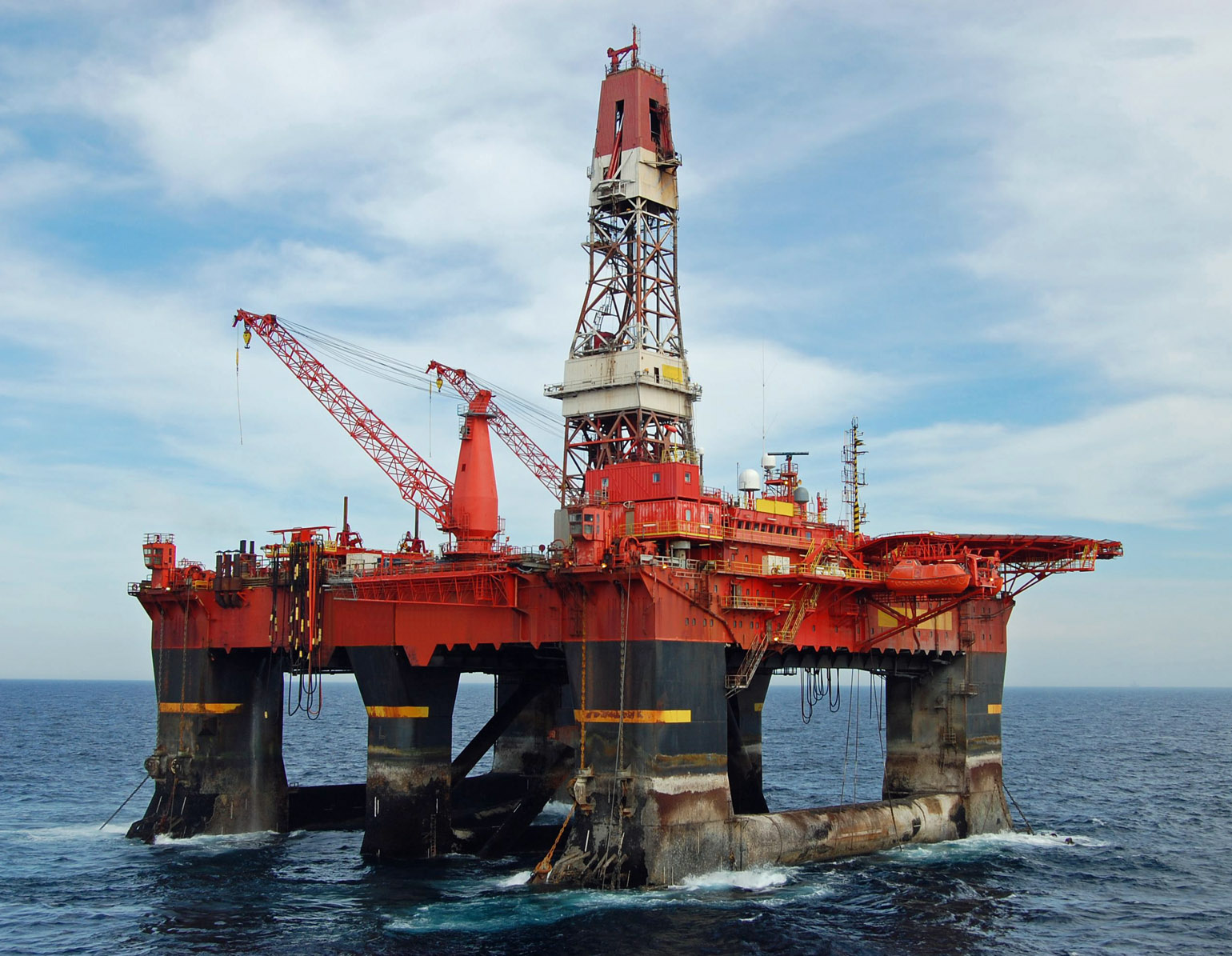 Part of the problem is a distributional one. The people most affected by the cost-of-living crisis and higher interest rates are those on lower incomes and with higher debts. Politicians know that it will be hard to win the votes of such people if they are faced with higher green taxes. As elections approach, politicians are likely to backtrack on many environmental commitments to appeal to such people.
This is beginning to happen in the UK, with the government declaring that it is on the side of the motorist. Indeed, Rishi Sunak has just announced that the government will authorise more than 100 new licenses for new oil and gas wells in the North Sea. This is despite the United Nations, various other international bodies, climate scientists and charities calling for a halt to all licensing and funding of new oil and gas development from new and existing fields. The government argues that increased North Sea production would reduce the reliance on imported oil.
Video
Articles
- July 2023 the Hottest Ever Month on Record, Likely Warmest in ‘Tens of Thousands of Years’
The Wire, Aathira Perinchery (28/7/23)
- Climate threat ‘existential’ says Biden, as world faces hottest July
BBC News, Heather Sharp and Emma Owen (27/7/23)
- UN chief says Earth in ‘era of global boiling’, calls for radical action
Aljazeera (27/7/23)
- Why it’s time to prepare for the worst on climate change
Financial Times, Robert Pindyck (6/7/23)
- The planet heats, the world economy cools – the real global recession is ecological
The Guardian, Larry Elliott (9/7/23)
- Climate change will reshape global supply chains — it can reduce welfare on Earth by 20%: Ivan Rudick
The Economic Times (India), Srijana Mitra Das (30/6/23)
- Rishi Sunak defends granting new North Sea oil and gas licences
BBC News (31/7/23)
- The oil industry has succumbed to a dangerous new climate denialism
The Conversation, Adi Imsirovic (31/7/23)
- Dismay as Rishi Sunak vows to ‘max out’ UK fossil fuel reserves
The Guardian, Severin Carrell, Peter Walker and Helena Horton (31/7/23)
- What are the Conservatives’ green policies – and what could be scrapped
Sky News, Jennifer Scott (31/7/23)
- Rishi Sunak signals he is ready to soften UK green policies
Financial Times, George Parker and Lucy Fisher (24/7/23)
- Green campaigners fear UK policy backlash after ULEZ keeps Uxbridge Tory
Politico, Charlie Cooper and Bethany Dawson (23/7/23)
- Climate policy and economic inequality
VoxEU, Diego Känzig (25/6/23)
- The untapped potential of education in the battle against climate change
VoxEU, Noam Angrist, Kevin Winseck, Harry Anthony Patrinos and Joshua Graff Zivin (14/7/23)
Questions
- In what sense is the environment a ‘public good’? How is the concept of externalities relevant in analysing the private decisions made about the use of a public good?
- How may game theory be used to help understand the difficulties in reaching international agreement about climate change policies?
- What is meant by ‘net zero’? Is carbon capture and storage an acceptable alternative to cutting carbon emissions?
- In what ways could policies to tackle climate change be designed to reduce income inequality rather than increase it?
- What are the arguments for and against banning (a) petrol and diesel cars; (b) gas boilers; (c) fossil-fuel power stations? How much notice should be given if such bans are to be introduced?
- What is meant by ‘nudge theory’? In what ways could people be nudged into making greener decisions?
- What are the arguments for and against granting new licences for North Sea oil and gas drilling? Explain where you feel the balance of the arguments lies.
 Back in November, when Joe Biden had just been elected, we considered some of his proposed policies to tackle climate change (see A new era for climate change policy?). On 20th January, the day of his inauguration, he signed 17 executive orders overturning a range of policies of the Trump presidency. Further executive orders followed. Some of these related directly to climate change.
The first was to cancel the Keystone XL oil pipeline project. If it had gone ahead, it would have transported 830 000 barrels of oil per day from the Alberta tar sands in Canada to refineries on the Gulf Coast of Texas. It would have involved building a new pipeline from Alberta to Nebraska, where it would have linked to an existing pipeline to Texas. Extracting oil from tar sands is a particularly dirty process, involves cutting down large areas of forest (a carbon sink) and total emissions are around 20% greater per barrel than from conventional crude.
 The pipeline would have cut across First Nations land and any spills would have been highly toxic to the local environment. In terms of profitability, returns on tar sands oil extraction and transportation are very low. This is likely to remain the case as oil prices are likely to remain low, with greater global energy efficiency and the switch to renewables.
Critics of Biden’s decision argue that the pipeline project would have created some 5000 to 6000 temporary jobs in the USA during the two-year construction phase. Also they claim that it would have contributed to greater energy security for the USA.
 The second executive order was to rejoin the Paris Climate Agreement, a process that will take 30 days. Rejoining will involve commitments to cut greenhouse gas emissions and the adoption of various measures to bring this about. During the election campaign, Biden pledged to achieve economy-wide net-zero emissions no later than 2050. As we saw in the previous blog, under Biden the USA will play a leading role in the November 2021 UN COP26 climate change conference in Glasgow.
At present, the Paris agreement is for countries to aim to reach a peak of greenhouse gas emissions as soon as possible to achieve a climate neutral world by mid-century. Many countries have have made commitments about when they aim to achieve carbon neutrality, although concrete action is much more limited. It is hoped that the COP26 conference will lead to stronger commitments and actions and that the USA under Biden will play a leading part in driving this forward.
 In addition, to cancelling the Keystone XL pipeline and rejoining the Paris Agreement, the executive orders reversed more than 100 other decisions with negative environmental effects taken by the Trump administration – many overturning environmental measures introduced by previous administrations, especially the Obama administration.
These orders included reversing the easing of vehicle emissions standards; stopping reductions in the area of two major national monuments (parks) in Utah; enforcing a temporary moratorium on oil and natural gas leases in Alaska’s Arctic National Wildlife Refuge; and re-establishing a working group on the social costs of greenhouse gasses.
Then there will be new measures, such as adopting strict fuel economy standards and investment in clean public transport. But it remains to be seen how far and fast the Biden administration can move to green the US economy. With the desire for bipartisanship and seeking an end to the divisive policies of Trump, there may be limits to what the new President can achieve in terms of new legislation, especially with a Senate divided 50:50 and only the casting vote of the chair (Kamala Harris as Vice-President) being in Democrat hands.
The articles below consider the various green policies and how likely they are to succeed in their objectives.
Articles
- Climate change: Biden’s first act sets tone for ambitious approach
BBC News, Matt McGrath (20/1/21)
- Biden nixes Keystone XL permit, halts Arctic refuge leasing
The Hill, Rachel Frazin (20/1/21)
- Biden’s return to Paris pact just a first step for U.S. climate action
Reuters, Megan Rowling (20/1/21)
- Court Decision Lets Biden Set New Emissions Rules To Meet Paris Agreement Climate Goals
Forbes, Allan Marks (20/1/21)
- Biden to ‘hit ground running’ as he rejoins Paris climate accords
The Guardian, Oliver Milman (19/1/21)
- What could a Biden-Harris administration mean for the planet?
Euronews, Marthe de Ferrer (20/1/21)
- Ask a Scientist: What Should the Biden Administration and Congress Do to Address the Climate Crisis?
ecoWatch, Elliott Negin (18/1/21)
- Biden marks Day One with burst of orders reversing Trump policies on climate and health
Science Business, Éanna Kelly (21/1/21)
- What Is the Paris Climate Agreement That Joe Biden Will Rejoin, Why Did Donald Trump Leave?
Newsweek, Kashmira Gander (18/1/21)
Questions
- Find out what other environmental policies are being pursued by President Biden and assess their likely effectiveness in achieving their environmental objectives.
- Would policies to reduce carbon emissions necessarily be desirable? How would you assess their desirability?
- When is it best to use the ‘precautionary principle’ when devising environmental policies?
- To what extent is game theory relevant in understanding the difficulties and opportunities of developing internationally agreed policies on carbon reduction?
- If the objective is to tackle global warming, is it better to seek international agreement on limiting the extent of global warming or international agreement on carbon reduction? Explain.
 A ‘Super’ El Nino Is Coming For Southeast Asia. What Happens Next?