
Artificial intelligence (AI) has become a key technology in the 21st Century. Businesses use AI systems to analyse data, automate routine tasks, improve customer service, write software, create content and even assist with decision-making. As AI improves and becomes even more capable, governments, economists, businesses and society are debating its effects on productivity, employment and economic growth – and also its potentially extreme dangers.
Some commentators compare AI to earlier technological revolutions such as the steam engine, electricity and the Internet. They argue that AI will continue to increase productivity, create new industries and improve living standards. Others worry that AI may eliminate a large numbers of jobs, increase inequality, concentrate economic power in a few firms and, in the most extreme scenarios, pose a threat to humanity itself.
These debates raise important questions including how society should evaluate the potential risks of a technology whose benefits may be enormous but whose long-term consequences remain uncertain.
AI and the labour market
 Historically, technological change has had both positive and negative effects on employment. Automation reduced the demand for many agricultural workers, while creating jobs in manufacturing. Computers automated clerical tasks but generated entirely new industries in software, telecommunications and digital services.
AI appears likely to follow a similar pattern. According to the World Economic Forum, advances in AI, robotics and information-processing technologies are expected to transform labour markets significantly during the second half of the 2020s, creating demand for new skills while reducing demand for others. The fastest-growing skills are expected to include AI and big data, technological literacy and cybersecurity.
The potential benefits
AI may benefit labour markets in several ways:
- Higher productivity: Workers can complete tasks more quickly with AI assistance.
- New occupations: Demand has emerged for AI engineers, prompt specialists, data scientists and AI governance professionals.
- Better decision-making: Firms can use AI to improve forecasting, inventory management and customer service.
- Complementing human skills: AI may perform repetitive tasks, allowing employees to focus on creativity, problem-solving and interpersonal activities.
- Economic growth: Higher productivity can increase profits, wages and living standards over time.
Many economists argue that AI will not simply replace workers but will change the tasks they perform. Research from the OECD suggests that even highly AI-exposed occupations continue to require management, communication, collaboration and social skills that technologies struggle to replicate.
The potential costs
 At the same time, AI may create significant labour-market challenges. Many white-collar occupations previously considered relatively safe from automation are becoming vulnerable. Generative AI systems can draft reports, analyse legal documents, write computer code and create marketing content. This means that some professional and administrative roles may face considerable disruption.
The World Economic Forum reports that business leaders have differing expectations about the effects of AI. In a 2026 survey (see link below), around 54 per cent expected AI to displace existing jobs, while only 24 per cent expected it to create new jobs within their organisations. Economists have identified several potential problems:
- Structural unemployment: workers in industries that are in decline may struggle to find employment requiring their existing skills.
- Increased income inequality: there may be a growing income disparity between highly skilled and less-skilled workers.
- Growing market power: the largest technology firms that own the most advanced AI systems may see their market power grow further creating dominance in certain areas.
- Regional inequalities: AI-related investment may become concentrated in particular cities and countries, exacerbating regional inequalities within and between countries.
- Pressure on governments: to address issues of structural unemployment and increasing inequality, governments may be forced to expand retraining and social-support programmes.
AI and catastrophic risk
 Most economic discussion around AI focuses on employment and productivity. However, some researchers argue that the most significant risks from AI may be much broader.
Economists distinguish between ordinary risks and catastrophic risks. Catastrophic risks involve events with a very low probability of occurring but potentially enormous consequences. Examples include nuclear accidents, pandemics and certain climate-related disasters.
AI raises similar concerns. Advanced AI systems could potentially be used to conduct cyberattacks, spread misinformation, disrupt critical infrastructure or support the development of dangerous technologies. Some researchers have even suggested that highly advanced AI systems could pose an existential risk to humanity if they become sufficiently powerful and are not properly controlled.
This became a widely discussed topic in the media in September 2026 following the resignation of an employee, Jacob Coxon, from AI firm, Anthropic. He said that people working on AI were ‘genuinely frightened’ about how quickly AI was advancing and what it might mean for the future of humanity. He said:
I believe that if we don’t slow down at the current rate of progress, there is a strong chance that we could all die in the immediate future.
Other researchers have raised similar concerns and there have since been calls from some of the biggest AI companies for regulation of AI to prevent this.
The policy debate and CBA
 All of this creates a challenge for cost-benefit analysis. Suppose AI generates trillions of pounds of economic benefits. But, if there is also a very small probability of catastrophic harm, how should policymakers weigh up the two?
Traditional cost-benefit analysis values risk by multiplying the size of a potential outcome by its probability. However, this approach becomes problematic when both the probability and the consequences are highly uncertain. The risks may be extremely difficult to estimate, while the potential costs could be vast and affect future generations. For this reason, governments and firms increasingly use scenario analysis, stress testing and AI safety assessments to evaluate potential risks. These approaches attempt to prepare for extreme outcomes rather than relying solely on probability calculations.
Supporters of AI argue that technological progress has historically improved living standards and that restricting AI too heavily could reduce innovation and economic growth. Critics argue that uncertainty about potentially catastrophic outcomes justifies a more cautious approach.
The debate therefore extends beyond labour economics to the wider issue of managing catastrophic risk. As with nuclear power or climate change, policymakers must decide how much risk society is willing to accept in exchange for potentially large economic benefits.
Articles
- Why are there concerns AI could threaten humanity, and how real are they?
BBC News, Liv McMahon (17/9/26)
- Two dire warnings, one from Terence Tao, the other from someone who just quit Anthropic
Marcus on AI, Gary Marcus (9/9/26)
- AI insiders fear extinction. Security experts see a familiar fight
Scientific American, Peter Hall (11/9/26)
- US rejects pleas from OpenAI, Anthropic for global AI standards
BBC News, Kali Hays (24/9/26)
- How would AI actually kill all humans? Here are the top 5 scenarios
The Conversation, Toby Walsh (22/9/26)
- Who’s Who In The Fight Over Whether AI Will Kill Us
Forbes, Andréa Morris (24/9/26)
- Why this AI doomsday warning from former Anthropic researcher broke through
The Guardian, Blake Montgomery (15/9/26)
 As AI behavior raises concerns, ex-researcher Jacob Coxon warns what may lie ahead
PBS News
- ‘A setup’: Elon Musk fuels wild theory about Anthropic whistleblower Jacob Coxon
ABC News, Harrison Christian (11/9/26)
- Sam Altman, Dario Amodei urge UN Security Council to adopt international AI standards
CNN, Hadas Gold (24/9/26)
- Not everyone thinks AI will kill us all
CNN, Hadas Gold and Clare Duffy (24/9/26)
- The turbulent AI era is here. The choices we make now are critical.
Gates Notes, Bill Gates (26/8/26)
Reports
Questions
- How might AI increase productivity while also causing unemployment in some sectors? Which sectors are likely to be affected the most?
- Why is it difficult to estimate the costs and benefits of advanced AI?
- Assume that a disaster is estimated to cost society £1000 billion (£1 000 000 000 000). The chances of the disaster occurring are said to be minute, however. Estimates vary from a probability of one in a million to one in a billion. What estimate of this cost would you include in a cost–benefit analysis?
- Why are many low-income countries apparently prepared to accept riskier projects than are high-income ones?
- Discuss whether the greatest economic challenge posed by AI is (a) job displacement; (b) increased inequality; (c) market concentration and the power of large technology firms; or (d) catastrophic long-term risks.
- Read the article by Bill Gates, The turbulent AI era is here. The choices we make now are critical. According to him, what steps should the world take to ensure that ‘AI will be a force for good and leave everyone better off’?
 With businesses increasing their use of AI, this is likely to have significant effects on employment. But how will this affect the distribution of income, both within countries and between countries?
In some ways, AI is likely to increase inequality within countries as it displaces low-skilled workers and enhances the productivity of higher-skilled workers. In other ways, it could reduce inequality by allowing lower-skilled workers to increase their productivity, while displacing some higher-skilled workers and managers through the increased adoption of automated processes.
The effect of AI on the distribution of income between countries will depend crucially on its accessibility. If it is widely available to low-income countries, it could significantly enhance the productivity of small businesses and workers in such countries and help to reduce the income gap with the richer world. If the gains in such countries, however, are largely experienced by multinational companies, whether in mines and plantations, or in labour-intensive industries, such as garment production, few of the gains may accrue to workers and global inequality may increase.
Redistribution within a country
 The deployment of AI may result in labour displacement. AI is likely to replace both manual and white-collar jobs that involve straightforward and repetitive tasks. These include: routine clerical work, such as data entry, filing and scheduling; paralegal work, contract drafting and legal research; consulting, business research and market analysis; accounting and bookkeeping; financial trading; proofreading, copy mark-up and translation; graphic design; machine operation; warehouse work, where AI-enabled warehouse robots do many receiving, sorting, stacking, retrieval, carrying and loading tasks (e.g. Amazon’s Sequoia robotic system); basic coding or document sifting; market research and advertising design; call-centre work, such as enquiry handling, sales, telemarketing and customer service; hospitality reception; sales cashiers in supermarkets and stores; analysis of health data and diagnosis. Such jobs can all be performed by AI assistants, AI assisted robots or chat bots.
Women are likely to be disproportionately affected because they perform a higher share of the administrative and service roles most exposed to AI.
Workers displaced by AI may find that they can find employment only in lower-paid jobs. Examples include direct customer-facing roles, such as bar staff, shop assistants, hairdressers and nail and beauty consultants.
Such job displacement by AI is likely to redistribute income from relatively low-skilled labour to capital: a redistribution from wages to profits. This will tend to lead to greater inequality.
AI is also likely to lead to a redistribution of income towards certain types of high-skilled labour that are difficult to replace with AI but which could be enhanced by it. Take the case of skilled traders, such as plumbers, electricians and carpenters. They might be able to use AI in their work to enhance their productivity, through diagnosis, planning, problem-solving, measurement, etc. but the AI would not displace them. Instead, it could increase their incomes by allowing them to do their work more efficiently or effectively and thus increase their output per hour and enhance their hourly reward. Another example is architecture, where AI can automate repetitive tasks and open up new design possibilities, allowing architects to focus on creativity, flexibility, aesthetics, empathy with clients and ethical decision-making.
An important distinction is between disembodied and embodied AI investment. Disembodied AI investment could include AI ‘assistants’, such as ChatGPT and other software that can be used in existing jobs to enhance productivity. Such investment can usually be rolled out relatively quickly. Although the extra productivity may allow some reduction in the number of workers, disembodied AI investment is likely to be less disruptive than embodied AI investment. The latter includes robotics and automation, where workers are replaced by machines. This would require more investment and may be slower to be adopted.
Then there are jobs that will be created by AI. These include prompt engineers, who develop questions and prompt techniques to optimise AI output; health tech experts, who help organisations implement new medical AI products; AI educators, who train people in the uses of AI in the workplace; ethics advisors, who help companies ensure that their uses of AI are aligned with their values, responsibilities and goals; and cybersecurity experts who put systems in place to prevent AI stealing sensitive information. Such jobs may be relatively highly paid.
 In other cases, the gains from AI in employment are likely to accrue mainly to the consumer, with probably little change in the incomes of the workers themselves. This is particularly the case in parts of the public sector where wages/salaries are only very loosely related to productivity and where a large part of the work involves providing a personal service. For example, health professionals’ productivity could be enhanced by AI, which could allow faster and more accurate diagnosis, more efficient monitoring and greater accuracy in surgery. The main gainers would be the patients, with probably little change in the incomes of the health professionals themselves. Teachers’ productivity could be improved by allowing more rapid and efficient marking, preparation of materials and record keeping, allowing more time to be spent with students. Again, the main gainers would be the students, with little change in teachers’ incomes. Other jobs in this category include social workers, therapists, solicitors and barristers, HR specialists, senior managers and musicians.
Thus there is likely to be a distribution away from lower-skilled workers to both capital and higher-skilled workers who can use AI, to people who work in new jobs created by AI and to the consumers of certain services.
AI will accelerate productivity growth and, with it, GDP growth, but will probably displace workers faster than new roles emerge. This is likely to increase inequality and be a major challenge for society. Can the labour market adapt? Could the effects be modified if people moved to a four- or three-day week? Will governments introduce statutory limits to weekly working hours? Will training and education adapt to the new demands of employers?
Redistribution between countries
 AI threatens to widen the global rich–poor divide. It will give wealthier nations a productivity and innovation edge, which could displace low-skilled jobs in low-income nations. Labour-intensive production could be replaced by automated production, with the capital owned by the multinational companies of just a few countries, such as the USA and China, which between them account for 40% of global corporate AI R&D spending. For some companies, it would make sense to relocate production to rich countries, or certain wealthier developing countries, with better digital infrastructure, advanced data systems and more reliable power supply.
For other companies, however, production might still be based in low-income countries to take advantage of low-cost local materials. But there would still be a redistribution from wages in such countries to the profits of multinationals.
But it is not just in manufacturing where low-income countries are vulnerable to the integration of AI. Several countries, such as India, the Philippines, Mexico and Egypt have seen considerable investment in call centres and IT services for business process outsourcing and customer services. AI now poses a threat to employment in this industry as it has the potential to replace large numbers of workers.
AI-related job losses could exacerbate unemployment and deepen poverty in poorer countries, which, with limited resources, limited training and underdeveloped social protection systems, are less equipped to absorb economic and social shocks. This will further widen the global divide. In the case of embodied AI investment, it may only be possible in low-income countries through multinational investment and could displace many traditional jobs, with much of the benefit going in additional multinational profit.
But it is not all bad news for low-income countries. AI-driven innovations in healthcare, education, and agriculture, if adopted in poor countries, can make a significant contribution to raising living standards and can slow, or even reverse, the widening gap between rich and poor nations. Some of the greatest potential is in small-scale agriculture. Smallholders can boost crop yields though precision farming powered by AI; AI tools can help farmers buy seeds, fertilisers and animals and sell their produce at optimum times and prices; AI-enabled education tools can help farmers learn new techniques.
Articles
- New Skills and AI Are Reshaping the Future of Work
IMF Blog, Kristalina Georgieva (14/1/26)
- Generative AI: degenerative for jobs?
Bank Underground, Bank of England blog, Edward Egan (22/1/26)
- Artificial intelligence (AI) and employment
UK Parliament Research Briefing Lydia Harriss and Sam Money-Kyrle (23/12/25)
- Is Your Job AI-Proof? What to Know About AI Taking Over Jobs
Built In, Matthew Urwin (27/8/25)
- AI likely to displace jobs, says Bank of England governor
BBC News, Michael Race (19/12/25)
- These Jobs Will Fall First as AI Takes Over the Workplace
Forbes, Jack Kelly (30/4/25)
- Disrupted or displaced? How AI is shaking up jobs
exec-appointments.com, Anjli Raval (9/7/25)
- Navigate the economic risks and challenges of generative AI
EY-Parthenon, Lydia Boussour (25/6/24)
- AI Isn’t Increasing Inequality; It’s Revealing the Gaps We Haven’t Wanted to See
HR News, Mark Abbott (18/12/25)
- AI promises efficiency, but it’s also amplifying labour inequality
The Conversation, Mehnaz Rafi (3/12/25)
- 10 Jobs AI Will Replace in 2025
Live Career, Marta Bongilaj (29/12/25)
- From steam to Silicon: Why inequality persists
Aik News HD (Pakistan), Ahmed Fawad Farooq (27/12/25)
- Rethinking AI’s role in income inequality
PwC: The Leadership Agenda (4/9/25)
- How Europe Can Capture the AI Growth Dividend
IMF Blog, Florian Misch, Ben Park, Carlo Pizzinelli and Galen Sher (20/11/25)
- The Next Great Divergence
UNDP: Asia and the Pacific (2/12/25)
- AI risks sparking a new era of divergence as development gaps between countries widen, UNDP report finds
UNDP Press Release (2/12/25)
- AI threatens to widen inequality among states: UN
Aljazeera (2/12/25)
- AI risks deepening inequality, says head of world’s largest SWF
Financial Times, James Fontanella-Khan and Sun Yu (23/11/25)
- Three Reasons Why AI May Widen Global Inequality
Center for Global Development, Philip Schellekens and David Skilling (17/10/24)
- AI Will Transform the Global Economy. Let’s Make Sure It Benefits Humanity
IMF Blog, Kristalina Georgieva (14/1/24)
- AI’s $4.8 trillion future: UN Trade and Development alerts on divides, urges action
UNCTAD Press Release (7/4/25)
- AI could affect 40% of jobs and widen inequality between nations, UN warns
CNBC, Dylan Butts (4/4/25)
Questions
- What types of job are most vulnerable to AI?
- How will AI change the comparative advantage of low-income countries and what effect will it be likely to have on the pattern of global trade?
- Assess alternative policies that governments in high-income countries can adopt to offset the growth in inequality caused by the increasing use of AI.
- What policies can governments in low-income countries or aid agencies adopt to offset the growth in inequality within low-income countries and between high- and low-income countries?
- How might the growth of AI affect your own approach to career development?
- Is AI likely to increase or decrease economic power? Explain.
 Artificial Intelligence (AI) is transforming the way we live and work, with many of us knowingly or unknowingly using some form of AI daily. Businesses are also adopting AI in increasingly innovative ways. One example of this is the use of pricing algorithms, which use large datasets on market conditions to set prices.
While these tools can drive innovation and efficiency, they can also raise significant competition concerns. Subsequently, competition authorities around the world are dedicating efforts to understanding how businesses are using AI and, importantly, the potential risks its use may pose to competition.
How AI pricing tools can enhance competition
The use of AI pricing tools offers some clear potential efficiencies for firms, with the potential to reduce costs that can potentially translate into lower prices for consumers.
Take, for instance, industries with highly fluctuating demand, such as airlines or hotels. Algorithms can enable businesses to monitor demand and supply in real time and respond more quickly, which could help firms to respond more effectively to changing consumer preferences. Similarly, in industries which have extensive product ranges, like supermarkets, algorithms can significantly reduce costs and save resources that are usually required to manage pricing strategies across a large range of products.
Furthermore, as pricing algorithms can monitor competitors’ prices, firms can more quickly respond to their rivals. This could promote competition by helping prices to reach the competitive level more quickly, to the benefit of consumers.
How AI pricing tools can undermine competition
 However, some of the very features that make algorithms effective can also facilitate anti-competitive behaviour that can harm consumers. In economic terms, collusion occurs when firms co-ordinate their actions to reduce competition, often leading to higher prices. This can happen both explicitly or implicitly. Explicit collusion, commonly referred to as illegal cartels, involves firms agreeing to co-ordinate their prices instead of competing. On the other hand, tacit collusion occurs when firms’ pricing strategies are aligned without a formal agreement.
The ability for these algorithms to monitor competitors’ prices and react to changes quickly could work to facilitate collusion, by learning to avoid price wars to maximise long-term profits. This could result in harm to consumers through sustained higher prices.
 Furthermore, there may be additional risks if competitors use the same algorithmic software to set prices. This can facilitate the sharing of confidential information (such as pricing strategies) and, as the algorithms may be able to predict the response of their competitors, can facilitate co-ordination to achieve higher prices to the detriment of consumers.
This situation may resemble what is known as a ‘hub and spoke’ cartel, in which competing firms (the ‘spokes’) use the assistance of another firm at a different level of the supply chain (e.g. a buyer or supplier that acts as a ‘hub’) to help them co-ordinate their actions. In this case, a shared artificial pricing tool can act as the ‘hub’ to enable co-ordination amongst the firms, even without any direct communication between the firms.
In 2015 the CMA investigated a cartel involving two companies, Trod Limited and GB Eye Limited, which were selling posters and frames through Amazon (see linked CMA Press release below). These firms used pricing algorithms, similar to those described above, to monitor and adjust their prices, ensuring that neither undercut the other. In this case, there was also an explicit agreement between the two firms to carry out this strategy.
What does this mean for competition policy?
Detecting collusion has always been a significant challenge for the competition authorities, especially when no formal agreement exists between firms. The adoption of algorithmic pricing adds another layer of complexity to detection of cartels and could raise questions about accountability when algorithms inadvertently facilitate collusion.
 In the posters and frames case, the CMA was able to act because one of the firms involved reported the cartel itself. Authorities like the CMA depend heavily on the firms involved to ‘whistle blow’ and report cartel involvement. They incentivise firms to do this through leniency policies that can offer firms reduced penalties or even complete immunity if they provide evidence and co-operate with the investigation. For example, GB eye reported the cartel to the CMA and therefore, under the CMA’s leniency policy, was not fined.
But it’s not all doom and gloom for competition authorities. Developments in Artificial Intelligence could also open doors to improved detection tools, which may have come a long way since the discussion in a blog on this topic several years ago. Competition Authorities around the world are working diligently to expand their understanding of AI and develop effective regulations for these rapidly evolving markets.
Articles
Questions
- In what types of markets might it be more likely that artificial intelligence can facilitate collusion?
- How could AI pricing tools impact the factors that make collusion more or less sustainable in a market?
- What can competition authorities do to prevent AI-assisted collusion taking place?
 Global long-term economic growth has slowed dramatically since the financial crisis of 2007–8. This can be illustrated by comparing the two 20-year periods 1988 to 2007 and 2009 to 2028 (where IMF forecasts are used for 2024 to 2028: see WEO Database under the Data link below). Over the two periods, average annual world growth fell from 3.8% to 3.1%. In advanced countries it fell from 2.9% to 1.6% and in developing countries from 4.8% to 4.3%. In the UK it fell from 2.4% to 1.2%, in the USA from 3.1% to 1.8% and in Japan from 1.9% to 0.5%.
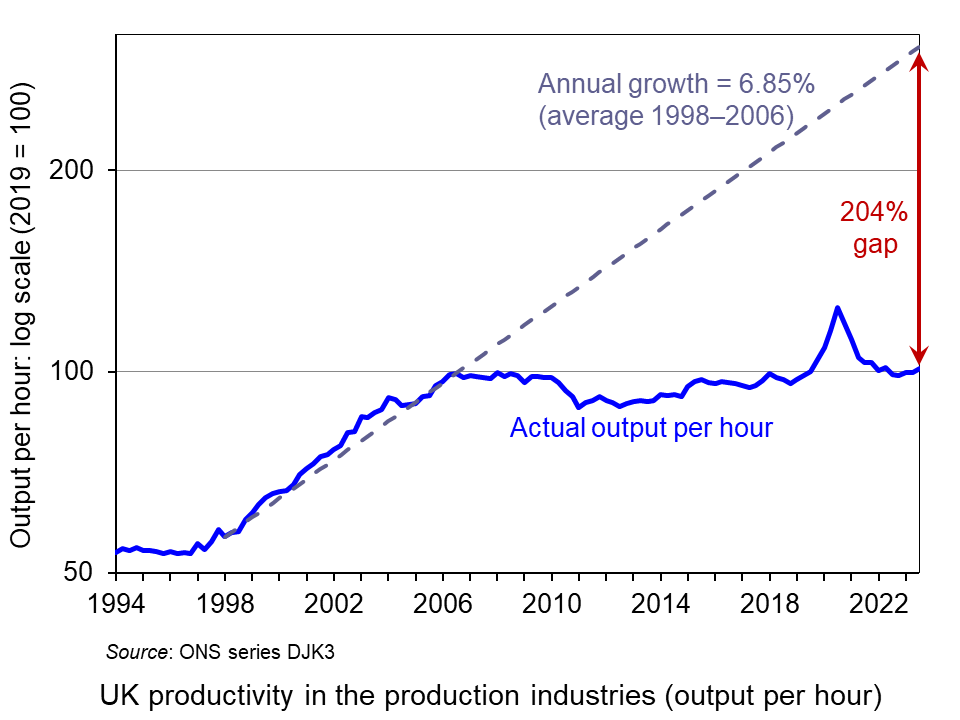 In the UK, labour productivity growth in the production industries was 6.85% per annum from 1998 to 2006. If this growth rate had been maintained, productivity would have been 204% higher by the end of 2023 than it actually was. This is shown in the chart (click here for a PowerPoint).
The key driver of long-term economic growth is labour productivity, which can best be measured by real GDP per hour worked. This depends on three things: the amount of capital per worker, the productivity of this capital and the efficiency of workers themselves – the latter two giving total factor productivity (TFP). Productivity growth has slowed, and with it the long-term rate of economic growth.
If we are measuring growth in output per head of the population, as opposed to simple growth in output, then another important factor is the proportion of the population that works. With ageing populations, many countries are facing an increase in the proportion of people not working. In most countries, these demographic pressures are likely to increase.
 A major determinant of long-term economic growth and productivity is investment. Investment has been badly affected by crises, such as the financial crisis and COVID, and by geopolitical tensions, such as the war in Ukraine and tensions between the USA and China and potential trade wars. It has also been adversely affected by government attempts to deal with rising debt caused by interventions following the financial crisis and COVID. The fiscal squeeze and, more recently higher interest rates, have dampened short-term growth and discouraged investment, thereby dampening long-term growth.
Another factor adversely affecting productivity has been a lower growth of allocative efficiency. Competition in many industries has declined as the rate of new firms entering and exiting markets has slowed. The result has been an increase in concentration and a growth in supernormal profits.
In the UK’s case, growth prospects have also been damaged by Brexit. According to Bank of England and OBR estimates, Brexit has reduced productivity by around 4% (see the blog: The costs of Brexit: a clearer picture). For many companies in the UK, Brexit has hugely increased the administrative burdens of trading with the EU. It has also reduced investment and led to a slower growth in the capital stock.
The UK’s poor productivity growth over many yeas is examined in the blog The UK’s poor productivity record.
Boosting productivity
So, how could productivity be increased and what policies could help the process?
Artificial intelligence. One important driver of productivity growth is technological advance. The rapid advance in AI and its adoption across much of industry is likely to have a dramatic effect on working practices and output. Estimates by the IMF suggest that some 40% of jobs globally and 60% in advanced countries could be affected – some replaced and others complemented and enhanced by AI. The opportunities for raising incomes are huge, but so too are the dangers of displacing workers and deepening inequality, as some higher-paid jobs are enhanced by AI, while many lower paid jobs are little affected and other jobs disappear.
AI is also likely to increase returns to capital. This may help to drive investment and further boost economic growth. However, the increased returns to capital are also likely to exacerbate inequality.
To guard against the growth of market power and its abuse, competition policies may need strengthening to ensure that the benefits of AI are widely spread and that new entrants are encouraged. Also training and retraining opportunities to allow workers to embrace AI and increase their mobility will need to be provided.
 Training. And it is not just training in the use of AI that is important. Training generally is a key ingredient in encouraging productivity growth. In the UK, there has been a decline in investment in adult education and training, with a 70% reduction since the early 2000s in the number of adults undertaking publicly-funded training, and with average spending on training by employers decreasing by 27% per trainee since 2011. The Institute for Fiscal Studies identifies five main policy levers to address this: “public funding of qualifications and skills programmes, loans to learners, training subsidies, taxation of training and the regulation of training” (see link in articles below).
Competition. Another factor likely to enhance productivity is competition, both internationally and within countries. Removing trade restrictions could boost productivity growth; erecting barriers to protect inefficient domestic industry would reduce it.
Investment. Policies to encourage investment are also key to productivity growth. Private-sector investment can be encouraged by tax incentives. For example, in the UK the Annual Investment Allowance allows businesses to claim 100% of the cost of plant and machinery up to £1m in the year it is incurred. However, for tax relief to produce significant effects on investment, companies need to believe that the policy will stay and not be changed as economic circumstances or governments change.
 Public-sector investment is also key. Good road and rail infrastructure and public transport are vital in encouraging private investment and labour mobility. And investment in health, education and training are a key part in encouraging the development of human capital. Many countries, the UK included, cut back on public-sector capital investment after the financial crisis and this has had a dampening effect on economic growth.
Regional policy. External economies of scale could be encouraged by setting up development areas in various regions. Particular industries could be attracted to specific areas, where local skilled workers, managerial expertise and shared infrastructure can benefit all the firms in the industry. These ‘agglomeration economies’ have been very limited in the UK compared with many other countries with much stronger regional economies.
Changing the aims and governance of firms. A change in corporate structure and governance could also help to drive investment and productivity. According to research by the think tank, Demos (see the B Lab UK article and the second report below), if legislation required companies to consider the social, economic and environmental impact of their business alongside profitability, this could have a dramatic effect on productivity. If businesses were required to be ‘purpose-led’, considering the interests of all their stakeholders, this supply-side reform could dramatically increase growth and well-being.
Such stakeholder-governed businesses currently outperform their peers with higher levels of investment, innovation, product development and output. They also have higher levels of staff engagement and satisfaction.
Articles
- World Must Prioritize Productivity Reforms to Revive Medium-Term Growth
IMF Blog, Nan Li and Diaa Noureldin (10/4/24)
- Why has productivity slowed down?
Oxford Martin School News, Ian Goldin, Pantelis Koutroumpis, François Lafond and Julian Winkler (18/3/24)
- How can the UK revive its ailing productivity?
Economics Observatory, Michelle Kilfoyle (14/3/24)
- With the UK creeping out of recession, here’s an economist’s brief guide to improving productivity
The Conversation, Nigel Driffield (13/3/24)
- UK economy nearly a third smaller thanks to ‘catastrophically bad’ productivity slowdown
City A.M., Chris Dorrell (12/3/24)
- Can AI help solve the UK’s public sector productivity puzzle?
City A.M., Chris Dorrell (11/3/24)
- AI Will Transform the Global Economy. Let’s Make Sure it Benefits Humanity
IMF Blog, Kristalina Georgieva (14/1/24)
- Productivity and Investment: Time to Manage the Project of Renewal
NIESR, Paul Fisher (12/3/24)
- Productivity trends using key national accounts indicators
Eurostat (15/3/24)
- New report says change to company law could add £149bn to the UK economy
B Lab UK (28/11/23)
- Investment in training and skills: Green Budget Chapter 9
Institute for Fiscal Studies, Imran Tahir (12/10/23)
Reports
Data
Questions
- Why has global productivity growth been lower since 2008 than before 2008?
- Why has the UK’s productivity growth been lower than many other advanced economies?
- How does the short-run macroeconomic environment affect long-term growth?
- Find out why Japan’s productivity growth has been so poor compared with other countries.
- What are likely to be the most effective means of increasing productivity growth?
- How may demand management policies affect the supply side of the economy?
- How may the adoption of an ESG framework by companies for setting objectives affect productivity growth?
Artificial intelligence is having a profound effect on economies and society. From production, to services, to healthcare, to pharmaceuticals; to education, to research, to data analysis; to software, to search engines; to planning, to communication, to legal services, to social media – to our everyday lives, AI is transforming the way humans interact. And that transformation is likely to accelerate. But what will be the effects on GDP, on consumption, on jobs, on the distribution of income, and human welfare in general? These are profound questions and ones that economists and other social scientists are pondering. Here we look at some of the issues and possible scenarios.
According to the Merrill/Bank of America article linked below, when asked about the potential for AI, ChatGPT replied:
AI holds immense potential to drive innovation, improve decision-making processes and tackle complex problems across various fields, positively impacting society.
But the magnitude and distribution of the effects on society and economic activity are hard to predict. Perhaps the easiest is the effect on GDP. AI can analyse and interpret data to meet economic goals. It can do this much more extensively and much quicker than using pre-AI software. This will enable higher productivity across a range of manufacturing and service industries. According to the Merrill/Bank of America article, ‘global revenue associated with AI software, hardware, service and sales will likely grow at 19% per year’. With productivity languishing in many countries as they struggle to recover from the pandemic, high inflation and high debt, this massive boost to productivity will be welcome.
But whilst AI may lead to productivity growth, its magnitude is very hard to predict. Both the ‘low-productivity future’ and the ‘high-productivity future’ described in the IMF article linked below are plausible. Productivity growth from AI may be confined to a few sectors, with many workers displaced into jobs where they are less productive. Or, the growth in productivity may affect many sectors, with ‘AI applied to a substantial share of the tasks done by most workers’.
Growing inequality?
 Even if AI does massively boost the growth in world GDP, the distribution is likely to be highly uneven, both between countries and within countries. This could widen the gap between rich and poor and create a range of social tensions.
In terms of countries, the main beneficiaries will be developed countries in North America, Europe and Asia and rapidly developing countries, largely in Asia, such as China and India. Poorer developing countries’ access to the fruits of AI will be more limited and they could lose competitive advantage in a number of labour-intensive industries.
Then there is growing inequality between the companies controlling AI systems and other economic actors. Just as companies such as Microsoft, Apple, Google and Meta grew rich as computing, the Internet and social media grew and developed, so these and other companies at the forefront of AI development and supply will grow rich, along with their senior executives. The question then is how much will other companies and individuals benefit. Partly, it will depend on how much production can be adapted and developed in light of the possibilities that AI presents. Partly, it will depend on competition within the AI software market. There is, and will continue to be, a rush to develop and patent software so as to deliver and maintain monopoly profits. It is likely that only a few companies will emerge dominant – a natural oligopoly.
Then there is the likely growth of inequality between individuals. The reason is that AI will have different effects in different parts of the labour market.
The labour market
 In some industries, AI will enhance labour productivity. It will be a tool that will be used by workers to improve the service they offer or the items they produce. In other cases, it will replace labour. It will not simply be a tool used by labour, but will do the job itself. Workers will be displaced and structural unemployment is likely to rise. The quicker the displacement process, the more will such unemployment rise. People may be forced to take more menial jobs in the service sector. This, in turn, will drive down the wages in such jobs and employers may find it more convenient to use gig workers than employ workers on full- or part-time contracts with holidays and other rights and benefits.
But the development of AI may also lead to the creation of other high-productivity jobs. As the Goldman Sachs article linked below states:
Jobs displaced by automation have historically been offset by the creation of new jobs, and the emergence of new occupations following technological innovations accounts for the vast majority of long-run employment growth… For example, information-technology innovations introduced new occupations such as webpage designers, software developers and digital marketing professionals. There were also follow-on effects of that job creation, as the boost to aggregate income indirectly drove demand for service sector workers in industries like healthcare, education and food services.
Nevertheless, people could still lose their jobs before being re-employed elsewhere.
The possible rise in structural unemployment raises the question of retraining provision and its funding and whether workers would be required to undertake such retraining. It also raises the question of whether there should be a universal basic income so that the additional income from AI can be spread more widely. This income would be paid in addition to any wages that people earn. But a universal basic income would require finance. How could AI be taxed? What would be the effects on incentives and investment in the AI industry? The Guardian article, linked below, explores some of these issues.
The increased GDP from AI will lead to higher levels of consumption. The resulting increase in demand for labour will go some way to offsetting the effects of workers being displaced by AI. There may be new employment opportunities in the service sector in areas such as sport and recreation, where there is an emphasis on human interaction and where, therefore, humans have an advantage over AI.
Another issue raised is whether people need to work so many hours. Is there an argument for a four-day or even three-day week? We explored these issues in a recent blog in the context of low productivity growth. The arguments become more compelling when productivity growth is high.
Other issues
AI users are not all benign. As we are beginning to see, AI opens the possibility for sophisticated crime, including cyberattacks, fraud and extortion as the technology makes the acquisition and misuse of data, and the development of malware and phishing much easier.
 Another set of issues arises in education. What knowledge should students be expected to acquire? Should the focus of education continue to shift towards analytical skills and understanding away from the simple acquisition of knowledge and techniques. This has been a development in recent years and could accelerate. Then there is the question of assessment. Generative AI creates a range of possibilities for plagiarism and other forms of cheating. How should modes of assessment change to reflect this problem? Should there be a greater shift towards exams or towards project work that encourages the use of AI?
Finally, there is the issue of the sort of society we want to achieve. Work is not just about producing goods and services for us as consumers – work is an important part of life. To the extent that AI can enhance working life and take away a lot of routine and boring tasks, then society gains. To the extent, however, that it replaces work that involved judgement and human interaction, then society might lose. More might be produced, but we might be less fulfilled.
Articles
- The Macroeconomics of Artificial Intelligence
IMF publications, Erik Brynjolfsson and Gabriel Unger (December 2023)
- Economic impacts of artificial intelligence (AI)
European Parliamentary Research Service, Marcin Szczepański (July 2019)
- Artificial intelligence: A real game changer
Chief Investment Office, Merrill/Bank of America (July 2023)
 Generative AI could raise global GDP by 7%
Goldman Sachs, Joseph Briggs (5/4/23)
- The macroeconomic impact of artificial intelligence
PwC, Jonathan Gillham, Lucy Rimmington, Hugh Dance, Gerard Verweij, Anand Rao, Kate Barnard Roberts and Mark Paich (February 2018)
- How genAI is revolutionizing the field of economics
CNN, Bryan Mena and Samantha Delouya (12/10/23)
- AI-powered digital colleagues are here. Some ‘safe’ jobs could be vulnerable.
BBC Worklife, Sam Becker (30/11/23)
- Generative AI and Its Economic Impact: What You Need to Know
Investopedia, Jim Probasco (1/12/23)
- AI is coming for our jobs! Could universal basic income be the solution?
The Guardian Philippa Kelly (16/11/23)
- CFPB chief’s warning: AI is a ‘natural oligopoly’ in the making
Politico, Sam Sutton (21/11/23)
Questions
- Which industries are most likely to benefit from the development of AI?
- Distinguish between labour-replacing and labour-augmenting technological progress in the context of AI.
- How could AI reduce the amount of labour per unit of output and yet result in an increase in employment?
- What people are most likely to (a) gain, (b) lose from the increasing use of AI?
- Is the distribution of income likely to become more equal or less equal with the development and adoption of AI? Explain.
- What policies could governments adopt to spread the gains from AI more equally?