
The grocery retail market in New Zealand is worth billions of dollars each year and is one of the most concentrated supermarket sectors in the world. The industry is dominated by two large groups: Foodstuffs and Woolworths New Zealand. Together, these firms account for around 80–90 per cent of grocery sales, with Foodstuffs operating brands such as Pak’nSave, New World and Four Square, while Woolworths operates the Woolworths supermarket chain.
The market displays many of the characteristics of an oligopoly. The two dominant firms compete through store location, loyalty schemes, advertising and product range, and to some extent through pricing. At the same time, they benefit from substantial economies of scale, extensive distribution networks and strong relationships with suppliers. These factors mean that there are significant barriers to entry in the market and this can prevent new firms from entering the market and surviving.
Competition concerns
Concern about competition in the sector has led to investigations by New Zealand’s Commerce Commission. The Commission concluded that although there was competition in the market, it was less than optimal and both firms were earning higher profits than they would have been able to earn had they been in operating in a more competitive market.
 It identified various barriers to entry that limited competition, including access to suitable retail sites, ownership of distribution networks and the difficulty of establishing large-scale supply chains in a country with a relatively small population.
Despite the market being dominated by these two big firms, there are also many smaller retailers operating within the market, including independent grocery stores, convenience stores and specialist food retailers. However, they lack the scale that is needed to challenge the dominance of Foodstuffs and Woolworths at a national level.
Potential international entrants, such as Aldi and Lidl, have often been suggested as possible competitors, but the costs of establishing a nationwide network of stores and distribution facilities in New Zealand are significant. There have been examples of large and dominant supermarkets in one country attempting to enter the market in other countries but failing to survive or deciding to exit the market early. For example, Tesco entered the Chinese market in 2004 but, despite its efforts, exited the market in 2020.
Response by the New Zealand government
 In response to concerns about competition, the New Zealand government has introduced a series of measures designed to make market entry easier. These include restrictions on anti-competitive land covenants, the introduction of a Grocery Commissioner and changes intended to improve access to wholesale grocery supply.
But, despite these measures, recent reports suggest that the overall market structure has changed little, with the two major firms continuing to dominate grocery retailing.
The public interest
Supporters of the current market structure argue that large supermarket chains deliver lower costs through economies of scale and provide consumers with extensive product choice.
Critics counter that limited competition leads to higher prices, reduced innovation and weaker bargaining power for suppliers.
The debate illustrates the difficulties faced by policymakers when attempting to balance efficiency against the promotion of competition.
Whether greater competition will emerge in the future remains uncertain. Much will depend on whether existing reforms can encourage new entrants or whether the structural advantages enjoyed by Foodstuffs and Woolworths continue to deter potential rivals.
Articles
- ‘Substantive, potentially systemic’ supermarket concerns raised by Commerce Commission
RNZ News, Susan Edmunds (7/7/26)
- Supermarkets aren’t the problem. This issue is a far bigger deal
Money Stuff, Rupert Carlyon (23/9/26)
- This may be as good as it gets: NZ and Australia face a complicated puzzle when it comes to supermarket prices
The Conversation, Richard Meade (23/4/25)
- Every party has pitched its own supermarket fix. What if we combined the best ideas?
The Conversation, Jonathan Baker (21/9/26)
- NZ regulator eyes ‘problematic’ supermarket supplier fees
Inside FMCG, Sean Cao (7/7/26)
- Australia vs NZ: Supermarket competition compared
Consumer NZ, Vanessa Pratley (27/3/25)
- Grocery Commissioner puts supermarkets on notice
RNZ News, Susan Edmunds (18/3/26)
- High margins, double the normal returns – does NZ’s supermarket duopoly drive prices up?
The Press, Susan Edmunds (22/9/26)
- Everyone wants to break up the supermarkets. How would it actually work?
The Spinoff, Joel MacManus (22/9/26)
Questions
- What are the characteristics of the New Zealand supermarket industry that create barriers to entry for new firms?
- To what extent is the New Zealand grocery market consistent with the characteristics of an oligopoly?
- Evaluate the likely effectiveness of government measures designed to increase competition in the supermarket sector.
- Australia too has two main supermarket chains: Coles and Woolworths. However, Aldi has entered the Australian market and in some parts of the country had provided significant competition to the two major chians. Why may Aldi have more difficulty in entering the New Zealnd market
- Investigate the grocery retail market in another country (not the UK). Who are the major competitors and what is their market share? What barriers to entry exist? Has the competition authority expressed concerns about the market and if so, what are they?
 Artificial Intelligence (AI) is transforming the way we live and work, with many of us knowingly or unknowingly using some form of AI daily. Businesses are also adopting AI in increasingly innovative ways. One example of this is the use of pricing algorithms, which use large datasets on market conditions to set prices.
While these tools can drive innovation and efficiency, they can also raise significant competition concerns. Subsequently, competition authorities around the world are dedicating efforts to understanding how businesses are using AI and, importantly, the potential risks its use may pose to competition.
How AI pricing tools can enhance competition
The use of AI pricing tools offers some clear potential efficiencies for firms, with the potential to reduce costs that can potentially translate into lower prices for consumers.
Take, for instance, industries with highly fluctuating demand, such as airlines or hotels. Algorithms can enable businesses to monitor demand and supply in real time and respond more quickly, which could help firms to respond more effectively to changing consumer preferences. Similarly, in industries which have extensive product ranges, like supermarkets, algorithms can significantly reduce costs and save resources that are usually required to manage pricing strategies across a large range of products.
Furthermore, as pricing algorithms can monitor competitors’ prices, firms can more quickly respond to their rivals. This could promote competition by helping prices to reach the competitive level more quickly, to the benefit of consumers.
How AI pricing tools can undermine competition
 However, some of the very features that make algorithms effective can also facilitate anti-competitive behaviour that can harm consumers. In economic terms, collusion occurs when firms co-ordinate their actions to reduce competition, often leading to higher prices. This can happen both explicitly or implicitly. Explicit collusion, commonly referred to as illegal cartels, involves firms agreeing to co-ordinate their prices instead of competing. On the other hand, tacit collusion occurs when firms’ pricing strategies are aligned without a formal agreement.
The ability for these algorithms to monitor competitors’ prices and react to changes quickly could work to facilitate collusion, by learning to avoid price wars to maximise long-term profits. This could result in harm to consumers through sustained higher prices.
 Furthermore, there may be additional risks if competitors use the same algorithmic software to set prices. This can facilitate the sharing of confidential information (such as pricing strategies) and, as the algorithms may be able to predict the response of their competitors, can facilitate co-ordination to achieve higher prices to the detriment of consumers.
This situation may resemble what is known as a ‘hub and spoke’ cartel, in which competing firms (the ‘spokes’) use the assistance of another firm at a different level of the supply chain (e.g. a buyer or supplier that acts as a ‘hub’) to help them co-ordinate their actions. In this case, a shared artificial pricing tool can act as the ‘hub’ to enable co-ordination amongst the firms, even without any direct communication between the firms.
In 2015 the CMA investigated a cartel involving two companies, Trod Limited and GB Eye Limited, which were selling posters and frames through Amazon (see linked CMA Press release below). These firms used pricing algorithms, similar to those described above, to monitor and adjust their prices, ensuring that neither undercut the other. In this case, there was also an explicit agreement between the two firms to carry out this strategy.
What does this mean for competition policy?
Detecting collusion has always been a significant challenge for the competition authorities, especially when no formal agreement exists between firms. The adoption of algorithmic pricing adds another layer of complexity to detection of cartels and could raise questions about accountability when algorithms inadvertently facilitate collusion.
 In the posters and frames case, the CMA was able to act because one of the firms involved reported the cartel itself. Authorities like the CMA depend heavily on the firms involved to ‘whistle blow’ and report cartel involvement. They incentivise firms to do this through leniency policies that can offer firms reduced penalties or even complete immunity if they provide evidence and co-operate with the investigation. For example, GB eye reported the cartel to the CMA and therefore, under the CMA’s leniency policy, was not fined.
But it’s not all doom and gloom for competition authorities. Developments in Artificial Intelligence could also open doors to improved detection tools, which may have come a long way since the discussion in a blog on this topic several years ago. Competition Authorities around the world are working diligently to expand their understanding of AI and develop effective regulations for these rapidly evolving markets.
Articles
Questions
- In what types of markets might it be more likely that artificial intelligence can facilitate collusion?
- How could AI pricing tools impact the factors that make collusion more or less sustainable in a market?
- What can competition authorities do to prevent AI-assisted collusion taking place?
 The UK Competition and Markets Authority (CMA) has been investigating road fuel pricing in the UK. In July 2022, it launched a study into the development of the road-fuel market over recent years. The final report of this study was published in July 2023 and covered the refining, wholesale and retail elements of the market.
In the retail part of the market, the CMA noted some potential causes for concern: retailer fuel margins had increased; there were geographical variations in pricing; filling stations with fewer competitors tended to charge higher prices; retail prices tended to rise rapidly when oil prices increased but fell slowly when oil prices fell (known as ‘rocket and feather’ pricing patterns); motorway service stations charged considerably higher prices than supermarkets or other filling stations.
In response to these findings, the CMA has been publishing an interim report every four months. These reports give average pump prices and margins. They also give relative average pump prices between different types of retailer, and between each of the supermarkets.
The latest interim report was published on 26 July 2024. It reiterated the finding of the 2023 report that the fuel market has become less competitive since 2019. What is more, it continues to be so. In particular, the range of retail prices and the level of retail margins remain high compared to historic levels. The interim report estimates that ‘the increase in retailers’ fuel margins compared to 2019 resulted in increased fuel costs for drivers in 2023 of over £1.6bn’.
Price leadership
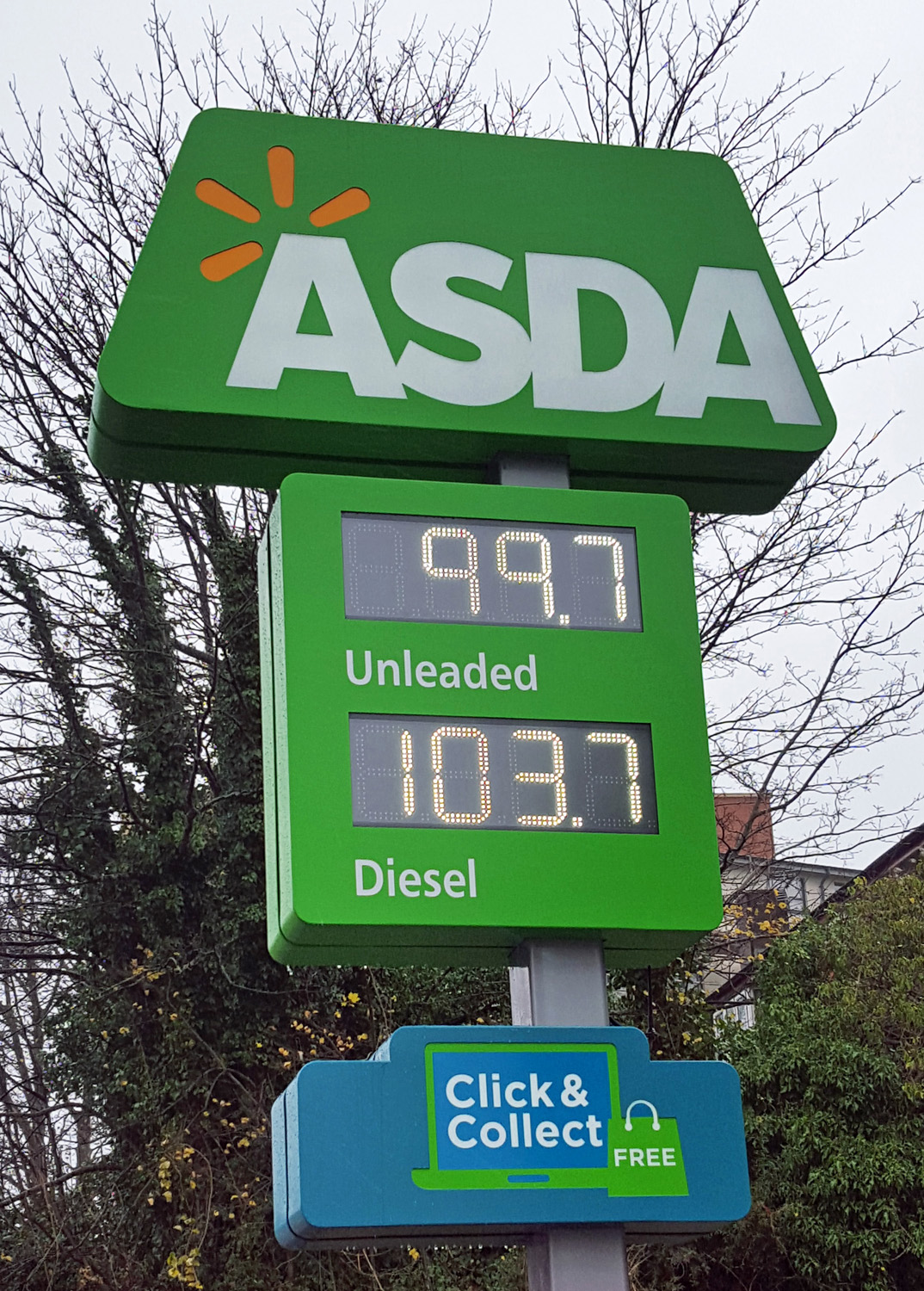 Road fuel retailing is an oligopoly, with the major companies being the big supermarkets, the retail arms of oil companies (such as Shell, BP, Esso and Texaco, operating their own filling stations) and a few large specialist companies, such as the Motor Fuel Group (MFG), the EG Group and Rontec, whose filling stations sell one or other of the main brands. But although it is an oligopoly producing a homogeneous product, it is not a cartel (unlike OPEC). Nevertheless, there has been a high degree of tacit collusion in the market with price competition limited to certain rules of behaviour in particular locations. A familiar one is setting prices ending in .9 of a penny (e.g. 142.9p), with the acceptance by competitors that Applegreen will set it ending at .8 of a penny and Asda at .7 of a penny.
One of the main forms of tacit collusion in areas where there are several filling stations is that of price leadership. Asda, and in some areas Morrisons, have been price leaders, setting the lowest price for that area, with other filling stations setting the price at or slightly above that level (e.g. 0.2p, 1.2p or 2.2p higher). Indeed, other major retailers, such as Tesco, Sainsbury’s, Esso and Shell took a relatively passive approach to pricing, unwilling to undercut Asda and accept lower profit margins.
 Things changed after 2019. Asda chose to increase its profit margins. In 2022 it did this by reducing prices more slowly than would previously have been the case as wholesale prices fell. In other words, it used price feathering. Other big retailers might have been expected to use the opportunity to undercut Asda. Instead, they decided to increase their own margins by following a similar pricing path. The result was a 6 pence per litre increase in the average supermarket fuel margin from 2019 to 2022.
More recently, Asda has increased its margins more than other major retailers, making it no longer the price leader. The effect has been to put less pressure on other retailers to trim their now higher profit margins.
Remedies
The 2023 CMA report made two specific recommendations to deal with this rise in profit margins.
The first was that the CMA should be given a statutory monitoring function over the fuel market to ‘hold the industry to account’. In May this year, legislation was passed to this effect. This requires the CMA to monitor the industry and report anti-competitive practice to the government.
The second was to introduce a new statutory ‘open data real-time fuel finder scheme’. This would give motorists access to live, station-by-station fuel prices.
Several major retailers already contribute to a voluntary price data sharing scheme. However, this covers only around 40% of UK forecourts. According to the CMA, it ‘falls well short of the comprehensive, real-time, station-by station data needed to empower motorists and drive competition’. The CMA has thus called on the new Labour government to introduce legislation to make its recommended system compulsory. This, it is hoped, would make the retail fuel market much more competitive by improving consumer information about prices at alternative filling stations in their area.
Articles
CMA reports
Questions
- What forms can tacit collusion take?
- Why are fuel prices at motorway service stations so much higher than in towns? What is the relevance of the price elasticity of demand to the answer?
- What are the main findings of the CMA’s July 2024 Interim Report
- What is meant by rocket and feather pricing?
- What recommendations does the CMA make for increasing competition in the retail road fuel market?
- Find out how competitive retail fuel pricing is in two other developed countries. Why are they more or less competitive than the UK?
 The Competition and Markets Authority (CMA) is proposing to launch a formal Market Investigation into anti-competitive practices in the UK’s £2bn veterinary industry (for pets rather than farm animals or horses). This follows a preliminary investigation which received 56 000 responses from pet owners and vet professionals. These responses reported huge rises in bills for treatment and medicines and corresponding rises in the cost of pet insurance.
At the same time there has been a large increase in concentration in the industry. In 2013, independent vet practices accounted for 89% of the market; today, they account for only around 40%. Over the past 10 years, some 1500 of the UK’s 5000 vet practices had been acquired by six of the largest corporate groups. In many parts of the country, competition is weak; in others, it is non-existent, with just one of these large companies having a monopoly of veterinary services.
This market power has given rise to a number of issues. The CMA identifies the following:
- Of those practices checked, over 80% had no pricing information online, even for the most basic services. This makes is hard for pet owners to make decisions on treatment.
- Pet owners potentially overpay for medicines, many of which can be bought online or over the counter in pharmacies at much lower prices, with the pet owners merely needing to know the correct dosage. When medicines require a prescription, often it is not made clear to the owners that they can take a prescription elsewhere, and owners end up paying high prices to buy medicines directly from the vet practice.
- Even when there are several vet practices in a local area, they are often owned by the same company and hence there is no price competition. The corporate group often retains the original independent name when it acquires the practice and thus is is not clear to pet owners that ownership has changed. They may think there is local competition when there is not.
 Often the corporate group provides the out-of-hours service, which tends to charge very high prices for emergency services. If there is initially an independent out-of-hours service provider, it may be driven out of business by the corporate owner of day-time services only referring pet owners to its own out-of-hours service.
- The corporate owners may similarly provide other services, such as specialist referral centres, diagnostic labs, animal hospitals and crematoria. By referring pets only to those services owned by itself, this crowds out independents and provides a barrier to the entry of new independents into these parts of the industry.
- Large corporate groups have the incentive to act in ways which may further reduce competition and choice and drive up their profits. They may, for example, invest in advanced equipment, allowing them to provide more sophisticated but high-cost treatment. Simpler, lower-cost treatments may not be offered to pet owners.
- The higher prices in the industry have led to large rises in the cost of pet insurance. These higher insurance costs are made worse by vets steering owners with pet insurance to choosing more expensive treatments for their pets than those without insurance. The Association of British Insurers notes that there has been a large rise in claims attributable to an increasing provision of higher-cost treatments.
- The industry suffers from acute staff shortages, which cuts down on the availability of services and allows practices to push up prices.
- Regulation by the Royal College of Veterinary Surgeons (RCVS) is weak in the area of competition and pricing.
The CMA’s formal investigation will examine the structure of the veterinary industry and the behaviour of the firms in the industry. As the CMA states:
In a well-functioning market, we would expect a range of suppliers to be able to inform consumers of their services and, in turn, consumers would act on the information they receive.
Market failures in the veterinary industry
The CMA’s concerns suggest that the market is not sufficiently competitive, with vet companies holding significant market power. This leads to higher prices for a range of vet services. However, the CMA’s analysis suggests that market failures in the industry extend beyond the simple question of market power and lack of competition.
A crucial market failure is asymmetry of information. The veterinary companies have much better information than pet owners. This is a classic principal–agent problem. The agent, in this case the vet (or vet company), has much better information than the principal, in this case the pet owner. This information can be used to the interests of the vet company, with pet owners being persuaded to purchase more extensive and expensive treatments than they might otherwise choose if they were better informed.
The principal–agent problem also arises in the context of the dependant nature of pets. They are the ones receiving the treatment and, in this context, are the principals. Their owners are the ones acquiring the treatment for them and hence are the pets’ agents. The question is whether the owners will always do the best thing for their pets. This raises philosophical questions of animal rights and whether owners should be required to protect the interests of their pets.
 Another information issue is the short-term perspective of many pet owners. They may purchase a young and healthy pet and assume that it will remain so. However, as the pet gets older, it is likely to face increasing health issues, with correspondingly increasing vet bills. But many owners do not consider such future bills when they purchase the pet. They suffer from what behavioural economists call ‘irrational exuberance’. Such exuberance may also occur when the owner of a sick pet is offered expensive treatment. They may over-optimistically assume that the treatment will be totally successful and that their pet will not need further treatment.
Vets cite another information asymmetry. This concerns the costs they face in providing treatment. Many owners are unaware of these costs – costs that include rent, business rates, heating and lighting, staff costs, equipment costs, consumables (such as syringes, dressings, surgical gowns, antiseptic and gloves), VAT, and so on. Many of these costs have risen substantially in recent months and are reflected in the prices pet owners are charged. With people experiencing free health care for themselves from the NHS (or other national provider), this may make them feel that the price of pet health care is excessive.
Then there is the issue of inequality. Pets provide great benefits to many owners and contribute to owners’ well-being. If people on low incomes cannot afford high vet bills, they may either have to forgo having a pet, with the benefits it brings, or incur high vet bills that they ill afford or simply go without treatment for their pets.
 Finally, there are the external costs that arise when people abandon their pets with various health conditions. This has been a growing problem, with many people buying pets during lockdown when they worked from home, only to abandon them later when they have had to go back to the office or other workplace. The costs of treating or putting down such pets are born by charities or local authorities.
The CMA is consulting on its proposal to begin a formal Market Investigation. This closes on 11 April. If, in the light of its consultation, the Market Investigation goes ahead, the CMA will later report on its findings and may require the veterinary industry to adopt various measures. These could require vet groups to provide better information to owners, including what lower-cost treatments are available. But given the oligopolistic nature of the industry, it is unlikely to lead to significant reductions in vets bills.
Articles
- UK competition watchdog plans probe into veterinary market
Financial Times, Suzi Ring and Oliver Ralph (12/3/24)
 Vet prices: Investigation over concerns pet owners are being overcharged
Sky News (12/3/24)
- UK watchdog plans formal investigation into vet pricing
The Guardian, Kalyeena Makortoff (12/3/24)
- ‘Eye-watering’ vet bills at chain-owned surgeries prompt UK watchdog review
The Guardian, Kalyeena Makortoff (7/9/23)
- Warning pet owners could be overpaying for medicine
BBC News, Lora Jones & Jim Connolly (12/3/24)
- I own a vet practice, owners complain about the spiralling costs of treatments, but I only make 5 -10% profit – here’s our expenditure breakdown
Mail Online, Alanah Khosla (14/3/24)
- Vets bills around the world: As big-name veterinary practices come under pressure for charging pet owners ‘eyewatering’ care costs, how do fees in Britain compare to other countries?
Mail Online, Rory Tingle, Dan Grennan and Katherine Lawton (13/3/24)
CMA documents
Questions
- How would you establish whether there is an abuse of market power in the veterinary industry?
- Explain what is meant by the principal–agent problem. Give some other examples both in economic and non-economic relationships.
- What market advantages do large vet companies have over independent vet practices?
- How might pet insurance lead to (a) adverse selection; (b) moral hazard? Explain. How might (i) insurance companies and (ii) vets help to tackle adverse selection and moral hazard?
- Find out what powers the CMA has to enforce its rulings.
- Search for vet prices and compare the prices charged by at least three vet practices. How would you account for the differences or similarities in prices?
 Artificial intelligence is having a profound effect on economies and society. From production, to services, to healthcare, to pharmaceuticals; to education, to research, to data analysis; to software, to search engines; to planning, to communication, to legal services, to social media – to our everyday lives, AI is transforming the way humans interact. And that transformation is likely to accelerate. But what will be the effects on GDP, on consumption, on jobs, on the distribution of income, and human welfare in general? These are profound questions and ones that economists and other social scientists are pondering. Here we look at some of the issues and possible scenarios.
According to the Merrill/Bank of America article linked below, when asked about the potential for AI, ChatGPT replied:
AI holds immense potential to drive innovation, improve decision-making processes and tackle complex problems across various fields, positively impacting society.
But the magnitude and distribution of the effects on society and economic activity are hard to predict. Perhaps the easiest is the effect on GDP. AI can analyse and interpret data to meet economic goals. It can do this much more extensively and much quicker than using pre-AI software. This will enable higher productivity across a range of manufacturing and service industries. According to the Merrill/Bank of America article, ‘global revenue associated with AI software, hardware, service and sales will likely grow at 19% per year’. With productivity languishing in many countries as they struggle to recover from the pandemic, high inflation and high debt, this massive boost to productivity will be welcome.
But whilst AI may lead to productivity growth, its magnitude is very hard to predict. Both the ‘low-productivity future’ and the ‘high-productivity future’ described in the IMF article linked below are plausible. Productivity growth from AI may be confined to a few sectors, with many workers displaced into jobs where they are less productive. Or, the growth in productivity may affect many sectors, with ‘AI applied to a substantial share of the tasks done by most workers’.
Growing inequality?
 Even if AI does massively boost the growth in world GDP, the distribution is likely to be highly uneven, both between countries and within countries. This could widen the gap between rich and poor and create a range of social tensions.
In terms of countries, the main beneficiaries will be developed countries in North America, Europe and Asia and rapidly developing countries, largely in Asia, such as China and India. Poorer developing countries’ access to the fruits of AI will be more limited and they could lose competitive advantage in a number of labour-intensive industries.
Then there is growing inequality between the companies controlling AI systems and other economic actors. Just as companies such as Microsoft, Apple, Google and Meta grew rich as computing, the Internet and social media grew and developed, so these and other companies at the forefront of AI development and supply will grow rich, along with their senior executives. The question then is how much will other companies and individuals benefit. Partly, it will depend on how much production can be adapted and developed in light of the possibilities that AI presents. Partly, it will depend on competition within the AI software market. There is, and will continue to be, a rush to develop and patent software so as to deliver and maintain monopoly profits. It is likely that only a few companies will emerge dominant – a natural oligopoly.
Then there is the likely growth of inequality between individuals. The reason is that AI will have different effects in different parts of the labour market.
The labour market
 In some industries, AI will enhance labour productivity. It will be a tool that will be used by workers to improve the service they offer or the items they produce. In other cases, it will replace labour. It will not simply be a tool used by labour, but will do the job itself. Workers will be displaced and structural unemployment is likely to rise. The quicker the displacement process, the more will such unemployment rise. People may be forced to take more menial jobs in the service sector. This, in turn, will drive down the wages in such jobs and employers may find it more convenient to use gig workers than employ workers on full- or part-time contracts with holidays and other rights and benefits.
But the development of AI may also lead to the creation of other high-productivity jobs. As the Goldman Sachs article linked below states:
Jobs displaced by automation have historically been offset by the creation of new jobs, and the emergence of new occupations following technological innovations accounts for the vast majority of long-run employment growth… For example, information-technology innovations introduced new occupations such as webpage designers, software developers and digital marketing professionals. There were also follow-on effects of that job creation, as the boost to aggregate income indirectly drove demand for service sector workers in industries like healthcare, education and food services.
Nevertheless, people could still lose their jobs before being re-employed elsewhere.
The possible rise in structural unemployment raises the question of retraining provision and its funding and whether workers would be required to undertake such retraining. It also raises the question of whether there should be a universal basic income so that the additional income from AI can be spread more widely. This income would be paid in addition to any wages that people earn. But a universal basic income would require finance. How could AI be taxed? What would be the effects on incentives and investment in the AI industry? The Guardian article, linked below, explores some of these issues.
The increased GDP from AI will lead to higher levels of consumption. The resulting increase in demand for labour will go some way to offsetting the effects of workers being displaced by AI. There may be new employment opportunities in the service sector in areas such as sport and recreation, where there is an emphasis on human interaction and where, therefore, humans have an advantage over AI.
Another issue raised is whether people need to work so many hours. Is there an argument for a four-day or even three-day week? We explored these issues in a recent blog in the context of low productivity growth. The arguments become more compelling when productivity growth is high.
Other issues
AI users are not all benign. As we are beginning to see, AI opens the possibility for sophisticated crime, including cyberattacks, fraud and extortion as the technology makes the acquisition and misuse of data, and the development of malware and phishing much easier.
 Another set of issues arises in education. What knowledge should students be expected to acquire? Should the focus of education continue to shift towards analytical skills and understanding away from the simple acquisition of knowledge and techniques. This has been a development in recent years and could accelerate. Then there is the question of assessment. Generative AI creates a range of possibilities for plagiarism and other forms of cheating. How should modes of assessment change to reflect this problem? Should there be a greater shift towards exams or towards project work that encourages the use of AI?
Finally, there is the issue of the sort of society we want to achieve. Work is not just about producing goods and services for us as consumers – work is an important part of life. To the extent that AI can enhance working life and take away a lot of routine and boring tasks, then society gains. To the extent, however, that it replaces work that involved judgement and human interaction, then society might lose. More might be produced, but we might be less fulfilled.
Articles
- The Macroeconomics of Artificial Intelligence
IMF publications, Erik Brynjolfsson and Gabriel Unger (December 2023)
- Economic impacts of artificial intelligence (AI)
European Parliamentary Research Service, Marcin Szczepański (July 2019)
- Artificial intelligence: A real game changer
Chief Investment Office, Merrill/Bank of America (July 2023)
- Generative AI could raise global GDP by 7%
Goldman Sachs, Joseph Briggs (5/4/23)
- The macroeconomic impact of artificial intelligence
PwC, Jonathan Gillham, Lucy Rimmington, Hugh Dance, Gerard Verweij, Anand Rao, Kate Barnard Roberts and Mark Paich (February 2018)
- How genAI is revolutionizing the field of economics
CNN, Bryan Mena and Samantha Delouya (12/10/23)
- AI-powered digital colleagues are here. Some ‘safe’ jobs could be vulnerable.
BBC Worklife, Sam Becker (30/11/23)
- Generative AI and Its Economic Impact: What You Need to Know
Investopedia, Jim Probasco (1/12/23)
- AI is coming for our jobs! Could universal basic income be the solution?
The Guardian Philippa Kelly (16/11/23)
- CFPB chief’s warning: AI is a ‘natural oligopoly’ in the making
Politico, Sam Sutton (21/11/23)
Questions
- Which industries are most likely to benefit from the development of AI?
- Distinguish between labour-replacing and labour-augmenting technological progress in the context of AI.
- How could AI reduce the amount of labour per unit of output and yet result in an increase in employment?
- What people are most likely to (a) gain, (b) lose from the increasing use of AI?
- Is the distribution of income likely to become more equal or less equal with the development and adoption of AI? Explain.
- What policies could governments adopt to spread the gains from AI more equally?