The grocery retail market in New Zealand is worth billions of dollars each year and is one of the most concentrated supermarket sectors in the world. The industry is dominated by two large groups: Foodstuffs and Woolworths New Zealand. Together, these firms account for around 80–90 per cent of grocery sales, with Foodstuffs operating brands such as Pak’nSave, New World and Four Square, while Woolworths operates the Woolworths supermarket chain.
The market displays many of the characteristics of an oligopoly. The two dominant firms compete through store location, loyalty schemes, advertising and product range, and to some extent through pricing. At the same time, they benefit from substantial economies of scale, extensive distribution networks and strong relationships with suppliers. These factors mean that there are significant barriers to entry in the market and this can prevent new firms from entering the market and surviving.
Competition concerns
Concern about competition in the sector has led to investigations by New Zealand’s Commerce Commission. The Commission concluded that although there was competition in the market, it was less than optimal and both firms were earning higher profits than they would have been able to earn had they been in operating in a more competitive market.
 It identified various barriers to entry that limited competition, including access to suitable retail sites, ownership of distribution networks and the difficulty of establishing large-scale supply chains in a country with a relatively small population.
Despite the market being dominated by these two big firms, there are also many smaller retailers operating within the market, including independent grocery stores, convenience stores and specialist food retailers. However, they lack the scale that is needed to challenge the dominance of Foodstuffs and Woolworths at a national level.
Potential international entrants, such as Aldi and Lidl, have often been suggested as possible competitors, but the costs of establishing a nationwide network of stores and distribution facilities in New Zealand are significant. There have been examples of large and dominant supermarkets in one country attempting to enter the market in other countries but failing to survive or deciding to exit the market early. For example, Tesco entered the Chinese market in 2004 but, despite its efforts, exited the market in 2020.
Response by the New Zealand government
 In response to concerns about competition, the New Zealand government has introduced a series of measures designed to make market entry easier. These include restrictions on anti-competitive land covenants, the introduction of a Grocery Commissioner and changes intended to improve access to wholesale grocery supply.
But, despite these measures, recent reports suggest that the overall market structure has changed little, with the two major firms continuing to dominate grocery retailing.
The public interest
Supporters of the current market structure argue that large supermarket chains deliver lower costs through economies of scale and provide consumers with extensive product choice.
Critics counter that limited competition leads to higher prices, reduced innovation and weaker bargaining power for suppliers.
The debate illustrates the difficulties faced by policymakers when attempting to balance efficiency against the promotion of competition.
Whether greater competition will emerge in the future remains uncertain. Much will depend on whether existing reforms can encourage new entrants or whether the structural advantages enjoyed by Foodstuffs and Woolworths continue to deter potential rivals.
Articles
- ‘Substantive, potentially systemic’ supermarket concerns raised by Commerce Commission
RNZ News, Susan Edmunds (7/7/26)
- Supermarkets aren’t the problem. This issue is a far bigger deal
Money Stuff, Rupert Carlyon (23/9/26)
- This may be as good as it gets: NZ and Australia face a complicated puzzle when it comes to supermarket prices
The Conversation, Richard Meade (23/4/25)
- Every party has pitched its own supermarket fix. What if we combined the best ideas?
The Conversation, Jonathan Baker (21/9/26)
- NZ regulator eyes ‘problematic’ supermarket supplier fees
Inside FMCG, Sean Cao (7/7/26)
- Australia vs NZ: Supermarket competition compared
Consumer NZ, Vanessa Pratley (27/3/25)
- Grocery Commissioner puts supermarkets on notice
RNZ News, Susan Edmunds (18/3/26)
- High margins, double the normal returns – does NZ’s supermarket duopoly drive prices up?
The Press, Susan Edmunds (22/9/26)
- Everyone wants to break up the supermarkets. How would it actually work?
The Spinoff, Joel MacManus (22/9/26)
Questions
- What are the characteristics of the New Zealand supermarket industry that create barriers to entry for new firms?
- To what extent is the New Zealand grocery market consistent with the characteristics of an oligopoly?
- Evaluate the likely effectiveness of government measures designed to increase competition in the supermarket sector.
- Australia too has two main supermarket chains: Coles and Woolworths. However, Aldi has entered the Australian market and in some parts of the country had provided significant competition to the two major chians. Why may Aldi have more difficulty in entering the New Zealnd market
- Investigate the grocery retail market in another country (not the UK). Who are the major competitors and what is their market share? What barriers to entry exist? Has the competition authority expressed concerns about the market and if so, what are they?
 Each week, BBC Radio 4 broadcasts readings from a book serialised in five 15-minute episodes. In the week beginning 18 January 2021, the readings were from English Pastoral: An Inheritance by James Rebanks, a farmer from the Cumbrian fells. His farm is relatively small, covering 185 acres.
He has attempted to make it much more sustainable and less intensive, reintroducing traditional Herdwick sheep, having a mixture of cows and sheep rather than just sheep, a greater sub-division of fields, and more natural scrubland, peatbogs and trees. As a result, soil quality has improved and there has been an explosion of biodiversity, with an abundance of wild flowers and insects.
Apart from being an autobiography of his time as a farmer and his attempt to move towards more traditional methods, the book examines broader issues of agricultural sustainability. It looks at the pressures of consumers wanting cheap food, the market power of supermarkets and wholesalers, the cost pressures on farmers pushing them towards monoculture to achieve economies of scale, and the role of the agrichemicals industry promoting fertilisers, feeds and pesticides which bring short-term financial gains to farmers, but which cause longer-term damage to the land and to biodiversity.
Rebanks has gained quite a lot of media attention after the publication of his first book, The Shepherd’s Life, including being one of the guests on Desert Island Discs and the subject of an episode of The Food Programme.
Listen to the Food Programme podcast and try answering the questions, which are all based on the podcast in the order of the points made in the interview.
Podcast
Reviews
Questions
- What are the incentives of an unregulated market for food that result in monoculture and a loss of biodiversity?
- To what extent are consumers responsible for changes in farming methods?
- Have the changes helped the urban poor?
- How is the monopsony power of supermarkets and food wholesalers impacting on food production and the pattern of agriculture?
- There are various (private) economies of scale in food production, but these often involve substantial external costs and long-term private costs too. How does this impact on land use?
- What are some of the limits of technology in increasing crop, meat and dairy yields?
- Will more recent changes in the pattern of food consumption help to increase mixed farming and biodiversity?
- Is it ‘rational’ for many farmers to continue with intensive farming with high levels of artificial fertilisers and pesticides?
- Is diversity in farming across farms within a local area a public good? If so, how could such diversity be achieved?
- How can farmers be encouraged to think and act holistically?
- Is there a trade-off between food output and biodiversity?
- What are the dangers in the UK reaching an agricultural trade deal with the USA?
- What are the benefits and costs of encouraging local food markets?
 We all know that our spending changes during the Christmas period: namely we spend a lot more than during the rest of the year. This applies across the board – we buy more clothes, food and drink, even though each day, we can generally only wear, eat and drink the same amount as usual! This has some interesting points from a behavioural economics stance, but here I’m going to think about the impact of this on some key retailers.
Marks & Spencer have previously made headlines for the wrong reasons: poor sales on clothes and the need for serious restructuring of its stores, target audience and marketing in order for this long-standing retailer to remain current and competitive. Although sales were expected to rise in the Christmas period, they did significantly better than expected, with sales growth of 2.3%, above the expected 0.5%. More encouragingly, this growth was not just in food, but in clothing and homeware as well.
One of the key reasons given for this above-expected improvement in sales was the conveniently timed Christmas, falling on a Sunday and hence giving extra shopping days. M&S have said that this certainly helped with their Christmas trading. Although this was good for Q4 trading, the timing will not play ball for Easter and they are expecting a negative effective during that trading period. Some analysts have said that despite the growth being boosted by the timing of Christmas, there were still signs of a change in fortunes. Bryan Roberts from TCC Global said:

“It might be the sign of some green shoots in that part of the business.”
This is consistent with the Chief Executive, Steve Rowe’s comments that despite the timing of Christmas adding around 1.5% to clothing and home sales growth, the recovery was also due to “better ranges, better availability and better prices”.
It appears as though many other retailers have experienced positive growth in Christmas sales, with the John Lewis Partnership seeing like-for-like sales growth of 2.7%, with Waitrose at a 2.8% rise.
The other interesting area is supermarkets. Waitrose and M&S are certainly competitors in the food industry, but at the higher end. If we consider the mid-range supermarkets (Asda, Morrisons, Sainsbury’s and Tesco), they have also performed, as a whole, fairly well. The low-cost Aldi and Lidl have been causing havoc for these supermarket chains, but the Christmas period seemed to prove fruitful for them.
Tesco saw UK like-for-like sales up by 1.8%, which showed significant progress in light of previously difficult trading periods with the emergence of the low-cost chains. Q$ was its better quarter of sales growth for over five years. One of the key drivers of this growth is fresh food sales and its Chief Executive, Dave Lewis said “we are very encouraged by the sustained strong progress that we are making across the group.” However, despite these positive numbers, Tesco only really met market expectation, rather than surpassing them as Morrison, Sainsbury’s and Marks & Spencer did.
 Perhaps the stand-out performance came from Morrisons, with its best Christmas performance for seven years. Another casualty of the low-cost competitors, it has been making a recovery and Q4 of 2016 demonstrated this beyond doubt. Like-for-like sales for the nine weeks to the start of 2017 were up by 2.9%, with growth in both food and drink and clothing.
Morrisons has been on a long and painful journey, with significant reorganisation of its stores and management. While this has created problems, it does appear to be working.
We also saw a general move up to the more premium own-brands and this again benefited all supermarkets. Morrisons Chief Executive, David Potts said:
“We are delighted to have found our mojo … Every year does bring its challenges, but so far we haven’t seen any change in consumer sentiment. Customers splashed out over Christmas and wanted to trade up … We are becoming more relevant to more people as we turn the company around.”
So it seems to be success all round for traders over the Christmas period and that, in many cases, this has been a reversal of fortunes. The question now is whether or not this will continue with the uncertainty over Brexit and the economy.
Articles
M&S beats Christmas sales forecast in clothing and homeware BBC News (12/1/17)
Marks & Spencer reports long-awaited rise in clothing sales The Telegraph, Ashley Armstrong (12/1/17)
Marks and Spencer reveals signs of growth in clothing business Financial Times, Mark Vandevelde (12/1/17)
Tesco’s festive sales lifted by fresh food The Telegraph, Ashley Armstrong (12/01/17)
Tesco caps year of recovery with solid Christmas Reuters, James Davey and Kate Holton (12/1/17)
Tesco, Marks & Spencer, Debenhams, John Lewis and co cheer strong Christmas trading Independent, Josie Cox and Zlata Rodionova (12/1/17)
Morrisons sees best Christmas performance for seven years BBC News (10/12/17)
Morrisons enjoys some ‘remarkable’ Christmas cheer’ The Guardian, Sarah butler and Angela Monaghan (10/1/17)
Record Christmas as Sainsbury’s ‘shows logic of Argos takeover’ The Guardian, Sarah Butler and Angela Monaghan (11/1/17)
Questions
- Why have the big four in the supermarket industry been under pressure over the past 2 years in terms of their sales, profits and market share?
- How have the changes that have been made by M&S’ Chief Executive helped to boost sales once more?
- Share prices for supermarkets have risen. Illustrate why this is on a demand and supply diagram. Why has Tesco, despite its performance, seen a fall in its share price?
- What are the key factors behind Morrison’s success?
- What type of market structure is the supermarket industry? Does this help to explain why the big four have faced so many challenges in recent times?
- If there has been a general increase in sales across all stores over the Christmas trading period, that goes beyond expectations, can we infer anything about customer tastes and their expectations about the future?
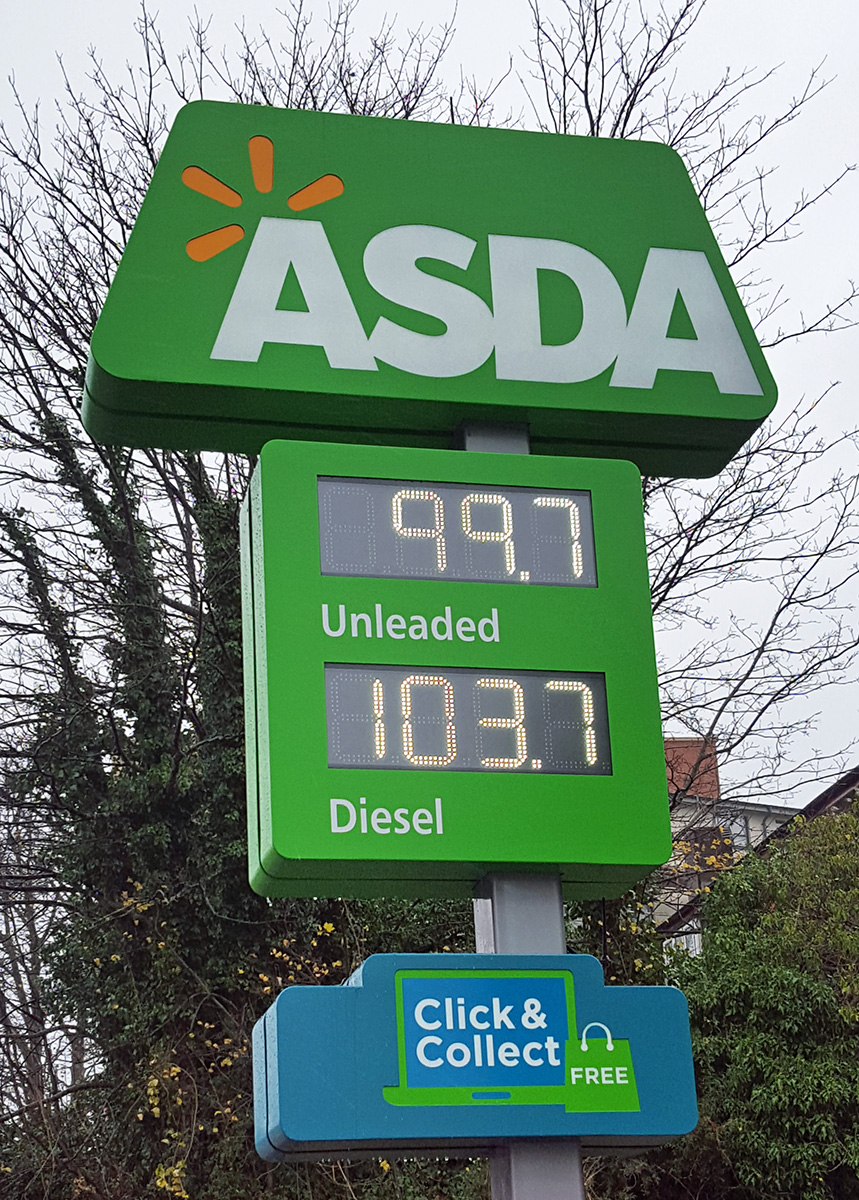
 The price of petrol is of interest to most families, occupying a key component of weekly expenditure. Over the past decade, it has fluctuated significantly, from around 85p per litre to over £1.40. More recently, prices have been around £1.03 to £1.10, depending on the brand and the location. But, will we see prices falling below that magical £1 per litre mark?
We have recently seen a 2p drop in wholesale fuel prices and it is this which has led to speculation about a further fall in prices at petrol stations to below £1. This, according to the RAC, has a ‘very good chance’ of happening.
A key determinant of petrol prices is the market price for crude oil and it is this which has been contributing towards the low petrol prices. As these prices filter through to the pumps, the RAC suggests that prices may once again come down. Furthermore, with some of the key petrol stations being operated by the big supermarkets, competition for sales and hence on prices may be fierce.
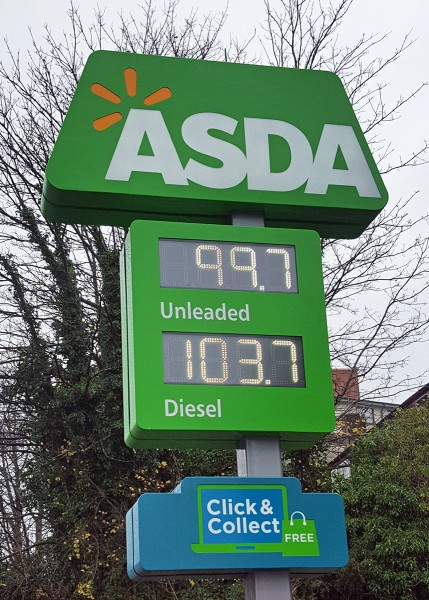 But, now let’s consider another well-informed organisation. According to the AA, the chances of petrol prices falling below £1 are ‘remote’. So, who should we believe? In fact, we can probably believe both. The market price may not fall below £1, but in the run-up to Christmas and in the start of the New Year, we may well see petrol on sale for under £1 as a means to entice shoppers or, as the AA has said, as a ‘marketing gimmick’. As you can see from the picture, Asda has dropped the price below £1 per litre in some of its petrol stations.
You might think this is a little strange, given the inelastic nature of the demand for petrol: after all, as prices of petrol rise and fall, I for one, don’t change my demand. This is also confirmed by HMRC, which reports that total petrol consumption is falling despite the low prices. But, it’s probably less about changing your total demand for petrol and more about from where you buy that total demand. For any one petrol station, the demand may be relatively elastic. It is this which may fuel a price war on petrol. The following articles consider this.
£1 per litre petrol? It’s unlikely The Telegraph, Rozina Sabur (20/11/15)
‘Good chance’ of £1 per litre petrol, says RAC BBC News (20/11/15)
Petrol prices ‘could fall below £1 per litre’ ITV News (20/11/15)
Fuel Prices: ‘Good chance’ of £1 a litre Sky News (20/11/15)
Questions
- What are they demand-side and supply-side factors which have helped to cut the price of petrol? Use a diagram to illustrate your answer.
- How much of a role has OPEC played in keeping petrol prices down in the UK?
- Why is the demand for petrol price inelastic?
- HMRC suggests that despite low prices, the demand for petrol has been falling. Does this suggest that the demand curve for petrol is upward sloping? Explain your answer.
- If the demand for petrol is falling, can this tell car companies anything about the future demand for vehicles? Which concepts are important here?
- If petrol prices do not fall to reflect falling oil prices, what does this suggest about the profit margins on petrol? Should government intervene?
 This rather strange question has been central to a storm that has been brewing between various celebrity chefs, including Jamie Oliver and Hugh Fearnley-Whittingstall, and the supermarkets. Supermarkets say that consumers don’t want irregular shaped vegetables, such as carrots, parsnips and potatoes. ‘Nonsense’, say their critics.
At the centre of the storm are the farmers, who find a large proportion of their vegetables are rejected by the supermarkets. And these are vegetables which are not damaged or bad – simply not of the required shape. Although these rejected vegetables have been described as ‘wonky’, in fact many are not wonky at all, but simply a little too large or too small, or too short or too long. Most of these vegetables are simply wasted – ploughed back into the ground, or at best used for animal feed.
And it’s not just shape; it’s colour too. Many producers of apples find a large proportion being rejected because they are too red or not red enough.
 But do consumers really want standardised fruit vegetables? Are the supermarkets correct? Are they responding to demand? Or are they attempting to manipulate demand?
Supermarkets claim that they are just responding to what consumers want. Their critics say that they are setting ludicrously rigid cosmetic standards which are of little concern to consumers. As Hugh Fearnley-Whittingstall states:
‘It’s only when you see the process of selection on the farm, how it has been honed and intensified, it just looks mad. There are many factory line systems where you have people looking for faults on the production line; in this system you’re looking for the good ones.
What we’re asking supermarkets to do is to relax their cosmetic standards for the vegetables that all get bagged up and sold together. It’s about slipping a few more of the not-so-perfect ones into the bag.’
In return, consumers must be prepared to let the supermarkets know that they are against these cosmetic standards and are perfectly happy to buy slightly more irregular fruit and vegetables. Indeed, this is beginning to happen through social media. 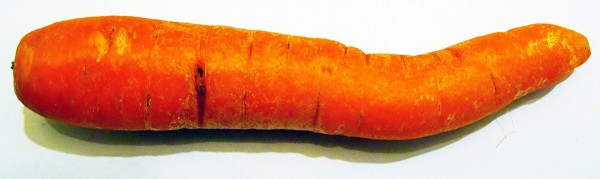 The pressure group 38 degrees has already taken up the cause.
But perhaps consumers ‘voting with their feet’ is what will change supermarkets’ behaviour. With the rise of small independent greengrocers, many from Eastern Europe, there is now intense competition in the fruit and vegetables market in many towns and cities. Perhaps supermarkets will be forced to sell slightly less cosmetically ‘perfect’ produce at a lower price to meet this competition.
Videos
 Hugh’s War on Waste Episode 1 BBC on YouTube, Hugh Fearnley-Whittingstall (2/11/15)
Hugh’s War on Waste Episode 2 BBC on YouTube, Hugh Fearnley-Whittingstall (9/11/15)
Articles
Hugh Fearnley-Whittingstall rejects Morrisons’ ‘pathetic’ wonky veg trial The Guardian, Adam Vaughan (9/11/15)
Jamie Oliver leads drive to buy misshapen fruit and vegetables The Guardian, Rebecca Smithers (1/1/15)
Hugh Fearnley-Whittingstall’s war over wonky parsnips The Telegraph, Patrick Foster (30/10/15)
Asda extends ‘wonky’ fruit and veg range Resource, Edward Perchard (4/11/15)
Wearne’s last farmer shares memories and laments loss of farming community in Langport area Western Gazette, WGD Mumby (8/11/15)
Viewpoint: The rejected vegetables that aren’t even wonky BBC News Magazine (28/10/15)
Viewpoint: The supermarkets’ guilty secret about unsold food BBC News Magazine (6/11/15)
Questions
- What market failures are there is the market for fresh fruit and vegetables?
- Supermarkets are oligopsonists in the wholesale market for fruit and vegetables. What is the implication of this for (a) farmers; (b) consumers?
- Is there anything that (a) consumers and (b) the government can do to stop the waste of fruit and vegetables grown for supermarkets?
- How might supermarkets estimate the demand for fresh fruit and vegetables and its price elasticity?
- What can supermarkets do with unsold food? What incentives are there for supermarkets not to throw it away but to make good use of it?
- Could appropriate marketing persuade people to be less concerned about the appearance of fruit and vegetables? What form might this marketing take?