
The grocery retail market in New Zealand is worth billions of dollars each year and is one of the most concentrated supermarket sectors in the world. The industry is dominated by two large groups: Foodstuffs and Woolworths New Zealand. Together, these firms account for around 80–90 per cent of grocery sales, with Foodstuffs operating brands such as Pak’nSave, New World and Four Square, while Woolworths operates the Woolworths supermarket chain.
The market displays many of the characteristics of an oligopoly. The two dominant firms compete through store location, loyalty schemes, advertising and product range, and to some extent through pricing. At the same time, they benefit from substantial economies of scale, extensive distribution networks and strong relationships with suppliers. These factors mean that there are significant barriers to entry in the market and this can prevent new firms from entering the market and surviving.
Competition concerns
Concern about competition in the sector has led to investigations by New Zealand’s Commerce Commission. The Commission concluded that although there was competition in the market, it was less than optimal and both firms were earning higher profits than they would have been able to earn had they been in operating in a more competitive market.
 It identified various barriers to entry that limited competition, including access to suitable retail sites, ownership of distribution networks and the difficulty of establishing large-scale supply chains in a country with a relatively small population.
Despite the market being dominated by these two big firms, there are also many smaller retailers operating within the market, including independent grocery stores, convenience stores and specialist food retailers. However, they lack the scale that is needed to challenge the dominance of Foodstuffs and Woolworths at a national level.
Potential international entrants, such as Aldi and Lidl, have often been suggested as possible competitors, but the costs of establishing a nationwide network of stores and distribution facilities in New Zealand are significant. There have been examples of large and dominant supermarkets in one country attempting to enter the market in other countries but failing to survive or deciding to exit the market early. For example, Tesco entered the Chinese market in 2004 but, despite its efforts, exited the market in 2020.
Response by the New Zealand government
 In response to concerns about competition, the New Zealand government has introduced a series of measures designed to make market entry easier. These include restrictions on anti-competitive land covenants, the introduction of a Grocery Commissioner and changes intended to improve access to wholesale grocery supply.
But, despite these measures, recent reports suggest that the overall market structure has changed little, with the two major firms continuing to dominate grocery retailing.
The public interest
Supporters of the current market structure argue that large supermarket chains deliver lower costs through economies of scale and provide consumers with extensive product choice.
Critics counter that limited competition leads to higher prices, reduced innovation and weaker bargaining power for suppliers.
The debate illustrates the difficulties faced by policymakers when attempting to balance efficiency against the promotion of competition.
Whether greater competition will emerge in the future remains uncertain. Much will depend on whether existing reforms can encourage new entrants or whether the structural advantages enjoyed by Foodstuffs and Woolworths continue to deter potential rivals.
Articles
- ‘Substantive, potentially systemic’ supermarket concerns raised by Commerce Commission
RNZ News, Susan Edmunds (7/7/26)
- Supermarkets aren’t the problem. This issue is a far bigger deal
Money Stuff, Rupert Carlyon (23/9/26)
- This may be as good as it gets: NZ and Australia face a complicated puzzle when it comes to supermarket prices
The Conversation, Richard Meade (23/4/25)
- Every party has pitched its own supermarket fix. What if we combined the best ideas?
The Conversation, Jonathan Baker (21/9/26)
- NZ regulator eyes ‘problematic’ supermarket supplier fees
Inside FMCG, Sean Cao (7/7/26)
- Australia vs NZ: Supermarket competition compared
Consumer NZ, Vanessa Pratley (27/3/25)
- Grocery Commissioner puts supermarkets on notice
RNZ News, Susan Edmunds (18/3/26)
- High margins, double the normal returns – does NZ’s supermarket duopoly drive prices up?
The Press, Susan Edmunds (22/9/26)
- Everyone wants to break up the supermarkets. How would it actually work?
The Spinoff, Joel MacManus (22/9/26)
Questions
- What are the characteristics of the New Zealand supermarket industry that create barriers to entry for new firms?
- To what extent is the New Zealand grocery market consistent with the characteristics of an oligopoly?
- Evaluate the likely effectiveness of government measures designed to increase competition in the supermarket sector.
- Australia too has two main supermarket chains: Coles and Woolworths. However, Aldi has entered the Australian market and in some parts of the country had provided significant competition to the two major chians. Why may Aldi have more difficulty in entering the New Zealnd market
- Investigate the grocery retail market in another country (not the UK). Who are the major competitors and what is their market share? What barriers to entry exist? Has the competition authority expressed concerns about the market and if so, what are they?
 In my previous blog post on this site, I examined how AI-powered pricing tools can act as a ‘double-edged sword’: offering efficiency gains, while also creating opportunities for collusion. I referred to one of the early examples of this, which was the case involving Trod Ltd and GB Eye, where two online poster and frame sellers on Amazon used pricing algorithms to monitor and adjust their prices. However, in this instance there was also an explicit agreement between the firms. As some commentators put it, it was ‘old wine in new bottles‘, meaning a fairly conventional cartel that was simply facilitated through digital tools.
Since then, algorithms have increasingly become part of everyday life and are now embedded in routine business practice.
Some of the effects may have a positive effect on competition. For example, algorithms can help to lower barriers to entry. In some markets, incumbents benefit from long-standing experience, while new firms face significant learning costs and are at a disadvantage. By reducing these learning costs and supporting entry, algorithms could contribute to making collusion harder to sustain.
On the other hand, algorithms could increase the likelihood of collusion. For example, individual algorithms used by competing firms may respond to market conditions in predictable ways, making it easier for firms to collude tacitly over time.
Algorithms can also improve the ability of firms to monitor each other’s prices. This is particularly relevant for multi-product firms. Traditionally, we might expect these markets to be less prone to collusion because co-ordinating across many products is complex. AI can overcome this complexity. In the Sainsbury’s/Asda merger case, for example, the Competition and Markets Authority suggested that the main barrier to reaching and monitoring a pricing agreement was the complexity of pricing across such a wide range of products. However, the CMA also suggested that technological advances could increase its ability to do so in the future.
The ‘hub-and-spoke’ model
 One of the other growing concerns is the ability of AI pricing algorithms to facilitate collusion by acting as a ‘hub’ in a ‘hub-and-spoke’ arrangement. In this type of collusion, competing firms (the ‘spokes’) need not communicate directly with one another. Instead, the ‘hub’ helps them to co-ordinate their actions.
While there have been only limited examples of an AI pricing algorithm acting as a hub in practice, what once seemed to be a largely theoretical concern has now become a live enforcement issue.
A very recent example is the RealPage case in the United States. The Department of Justice (DOJ) filed an antitrust lawsuit against RealPage Inc. in August 2024, alleging that RealPage, acting as the ‘hub’, facilitated collusion between landlords (the ‘spokes’).
RealPage provided pricing software to numerous landlords, including the largest landlord in the USA, which manages around 950 000 rental units across the country. These landlords would normally compete independently in setting rental prices, discounts and lease terms to win consumers. However, by feeding competitively sensitive information that would not usually be shared between rivals into RealPage’s system, the software generated pricing recommendations that, according to the DOJ, led to co-ordinated rent increases across competing apartment complexes.
I n the RealPage case, the authorities reported that they had access to internal documents and statements from the parties involved, which helped support their allegations. These included references within RealPage to helping landlords ‘avoid the race to the bottom’ and comments from a landlord describing the software as ‘classic price fixing’.
Evidence in these cases really matters because the standard of proof required to establish a hub-and-spoke arrangement is much higher than for traditional cases of explicit collusion. This is because it can be difficult to distinguish between legitimate and anti-competitive communication between retailers and suppliers. Also, proving ‘anti-competitive intent’ is inherently challenging.
Other competition authorities around the world are also turning their attention to these issues. For example, the European Commission recently announced that a number of investigations into algorithmic pricing are underway, signalling a clear shift toward more active scrutiny. As technology continues to advance, it is clear that algorithmic pricing will remain an area where both firms and authorities must move and adapt quickly.
Articles
Questions
- In what ways does the RealPage case differ from the earlier Trod Ltd and GB Eye Ltd case? Consider the roles played by the firms, the nature of the alleged co-ordination, and the extent to which pricing algorithms were used to facilitate the conduct.
- How might the use of pricing algorithms affect the likelihood of firms colluding, either explicitly or tacitly? Consider ways that algorithms may make collusion easier to sustain but also ways in which they may reduce its likelihood.
- Should firms be held liable for anti-competitive outcomes produced by algorithms that ‘self-learn’, even if they did not intend those outcomes? Explain why or why not.
 Artificial Intelligence (AI) is transforming the way we live and work, with many of us knowingly or unknowingly using some form of AI daily. Businesses are also adopting AI in increasingly innovative ways. One example of this is the use of pricing algorithms, which use large datasets on market conditions to set prices.
While these tools can drive innovation and efficiency, they can also raise significant competition concerns. Subsequently, competition authorities around the world are dedicating efforts to understanding how businesses are using AI and, importantly, the potential risks its use may pose to competition.
How AI pricing tools can enhance competition
The use of AI pricing tools offers some clear potential efficiencies for firms, with the potential to reduce costs that can potentially translate into lower prices for consumers.
Take, for instance, industries with highly fluctuating demand, such as airlines or hotels. Algorithms can enable businesses to monitor demand and supply in real time and respond more quickly, which could help firms to respond more effectively to changing consumer preferences. Similarly, in industries which have extensive product ranges, like supermarkets, algorithms can significantly reduce costs and save resources that are usually required to manage pricing strategies across a large range of products.
Furthermore, as pricing algorithms can monitor competitors’ prices, firms can more quickly respond to their rivals. This could promote competition by helping prices to reach the competitive level more quickly, to the benefit of consumers.
How AI pricing tools can undermine competition
However, some of the very features that make algorithms effective can also facilitate anti-competitive behaviour that can harm consumers. In economic terms, collusion occurs when firms co-ordinate their actions to reduce competition, often leading to higher prices. This can happen both explicitly or implicitly. Explicit collusion, commonly referred to as illegal cartels, involves firms agreeing to co-ordinate their prices instead of competing. On the other hand, tacit collusion occurs when firms’ pricing strategies are aligned without a formal agreement.
The ability for these algorithms to monitor competitors’ prices and react to changes quickly could work to facilitate collusion, by learning to avoid price wars to maximise long-term profits. This could result in harm to consumers through sustained higher prices.
Furthermore, there may be additional risks if competitors use the same algorithmic software to set prices. This can facilitate the sharing of confidential information (such as pricing strategies) and, as the algorithms may be able to predict the response of their competitors, can facilitate co-ordination to achieve higher prices to the detriment of consumers.
This situation may resemble what is known as a ‘hub and spoke’ cartel, in which competing firms (the ‘spokes’) use the assistance of another firm at a different level of the supply chain (e.g. a buyer or supplier that acts as a ‘hub’) to help them co-ordinate their actions. In this case, a shared artificial pricing tool can act as the ‘hub’ to enable co-ordination amongst the firms, even without any direct communication between the firms.
In 2015 the CMA investigated a cartel involving two companies, Trod Limited and GB Eye Limited, which were selling posters and frames through Amazon (see linked CMA Press release below). These firms used pricing algorithms, similar to those described above, to monitor and adjust their prices, ensuring that neither undercut the other. In this case, there was also an explicit agreement between the two firms to carry out this strategy.
What does this mean for competition policy?
Detecting collusion has always been a significant challenge for the competition authorities, especially when no formal agreement exists between firms. The adoption of algorithmic pricing adds another layer of complexity to detection of cartels and could raise questions about accountability when algorithms inadvertently facilitate collusion.
 In the posters and frames case, the CMA was able to act because one of the firms involved reported the cartel itself. Authorities like the CMA depend heavily on the firms involved to ‘whistle blow’ and report cartel involvement. They incentivise firms to do this through leniency policies that can offer firms reduced penalties or even complete immunity if they provide evidence and co-operate with the investigation. For example, GB eye reported the cartel to the CMA and therefore, under the CMA’s leniency policy, was not fined.
But it’s not all doom and gloom for competition authorities. Developments in Artificial Intelligence could also open doors to improved detection tools, which may have come a long way since the discussion in a blog on this topic several years ago. Competition Authorities around the world are working diligently to expand their understanding of AI and develop effective regulations for these rapidly evolving markets.
Articles
Questions
- In what types of markets might it be more likely that artificial intelligence can facilitate collusion?
- How could AI pricing tools impact the factors that make collusion more or less sustainable in a market?
- What can competition authorities do to prevent AI-assisted collusion taking place?
 The UK Competition and Markets Authority (CMA) has been investigating road fuel pricing in the UK. In July 2022, it launched a study into the development of the road-fuel market over recent years. The final report of this study was published in July 2023 and covered the refining, wholesale and retail elements of the market.
In the retail part of the market, the CMA noted some potential causes for concern: retailer fuel margins had increased; there were geographical variations in pricing; filling stations with fewer competitors tended to charge higher prices; retail prices tended to rise rapidly when oil prices increased but fell slowly when oil prices fell (known as ‘rocket and feather’ pricing patterns); motorway service stations charged considerably higher prices than supermarkets or other filling stations.
In response to these findings, the CMA has been publishing an interim report every four months. These reports give average pump prices and margins. They also give relative average pump prices between different types of retailer, and between each of the supermarkets.
The latest interim report was published on 26 July 2024. It reiterated the finding of the 2023 report that the fuel market has become less competitive since 2019. What is more, it continues to be so. In particular, the range of retail prices and the level of retail margins remain high compared to historic levels. The interim report estimates that ‘the increase in retailers’ fuel margins compared to 2019 resulted in increased fuel costs for drivers in 2023 of over £1.6bn’.
Price leadership
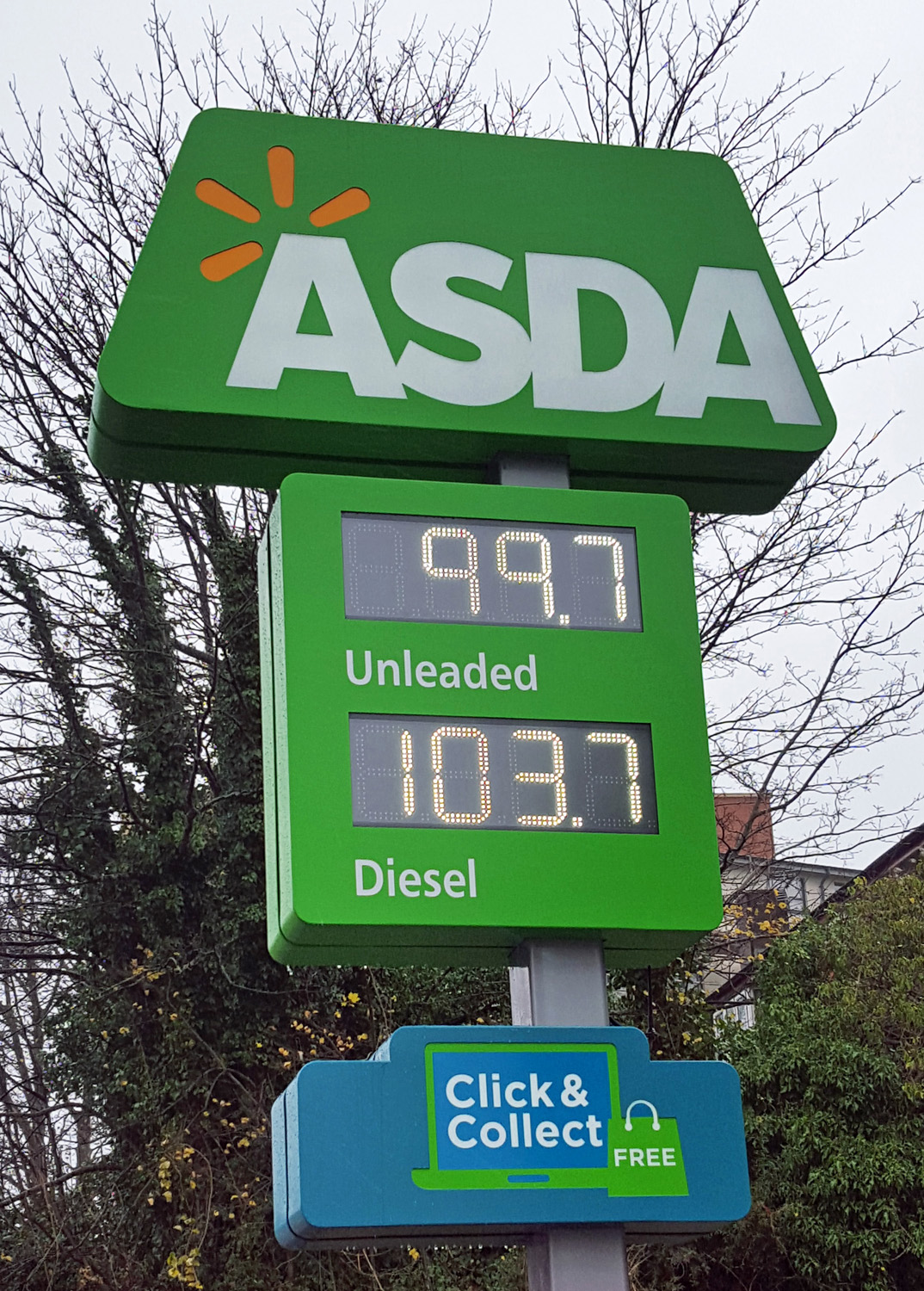 Road fuel retailing is an oligopoly, with the major companies being the big supermarkets, the retail arms of oil companies (such as Shell, BP, Esso and Texaco, operating their own filling stations) and a few large specialist companies, such as the Motor Fuel Group (MFG), the EG Group and Rontec, whose filling stations sell one or other of the main brands. But although it is an oligopoly producing a homogeneous product, it is not a cartel (unlike OPEC). Nevertheless, there has been a high degree of tacit collusion in the market with price competition limited to certain rules of behaviour in particular locations. A familiar one is setting prices ending in .9 of a penny (e.g. 142.9p), with the acceptance by competitors that Applegreen will set it ending at .8 of a penny and Asda at .7 of a penny.
One of the main forms of tacit collusion in areas where there are several filling stations is that of price leadership. Asda, and in some areas Morrisons, have been price leaders, setting the lowest price for that area, with other filling stations setting the price at or slightly above that level (e.g. 0.2p, 1.2p or 2.2p higher). Indeed, other major retailers, such as Tesco, Sainsbury’s, Esso and Shell took a relatively passive approach to pricing, unwilling to undercut Asda and accept lower profit margins.
 Things changed after 2019. Asda chose to increase its profit margins. In 2022 it did this by reducing prices more slowly than would previously have been the case as wholesale prices fell. In other words, it used price feathering. Other big retailers might have been expected to use the opportunity to undercut Asda. Instead, they decided to increase their own margins by following a similar pricing path. The result was a 6 pence per litre increase in the average supermarket fuel margin from 2019 to 2022.
More recently, Asda has increased its margins more than other major retailers, making it no longer the price leader. The effect has been to put less pressure on other retailers to trim their now higher profit margins.
Remedies
The 2023 CMA report made two specific recommendations to deal with this rise in profit margins.
The first was that the CMA should be given a statutory monitoring function over the fuel market to ‘hold the industry to account’. In May this year, legislation was passed to this effect. This requires the CMA to monitor the industry and report anti-competitive practice to the government.
The second was to introduce a new statutory ‘open data real-time fuel finder scheme’. This would give motorists access to live, station-by-station fuel prices.
Several major retailers already contribute to a voluntary price data sharing scheme. However, this covers only around 40% of UK forecourts. According to the CMA, it ‘falls well short of the comprehensive, real-time, station-by station data needed to empower motorists and drive competition’. The CMA has thus called on the new Labour government to introduce legislation to make its recommended system compulsory. This, it is hoped, would make the retail fuel market much more competitive by improving consumer information about prices at alternative filling stations in their area.
Articles
CMA reports
Questions
- What forms can tacit collusion take?
- Why are fuel prices at motorway service stations so much higher than in towns? What is the relevance of the price elasticity of demand to the answer?
- What are the main findings of the CMA’s July 2024 Interim Report
- What is meant by rocket and feather pricing?
- What recommendations does the CMA make for increasing competition in the retail road fuel market?
- Find out how competitive retail fuel pricing is in two other developed countries. Why are they more or less competitive than the UK?
 In recent years, US tech companies have faced increased scrutiny in Washington over their size and power. Despite the big tech firms in America being economically robust, seemingly more so than any other sector, they are also more politically vulnerable. This potential vulnerability is present regardless of the recent election result.
Both the Democrat and Republican parties are thinking critically about monopoly power and antitrust issues, where ‘antitrust’ refers to the outlawing or control of oligopolistic collusion. Despite the varied reasons across different parts of the political spectrum, the increased scrutiny over big tech companies is bipartisan.
Rising monopoly power
Monopoly power occurs when a firm has a dominant position in the market. A pure monopoly is when one firm has a 100% share of the market. A firm might be considered to have monopoly power with more than a 25% market share.
If there is a rise in market concentration, it tends to hurt blue-collar workers, such as those employed in factories, more than everyone else. Research, from the University of Chicago, studied what happens to particular classes of workers when companies increasingly dominate a market and have more power to raise prices. The study found that those workers that make things tend to be left worse off, while the workers who sell, market or design things gain. When companies have more pricing power, they make fewer products and sell each one for a higher profit margin. In that case, it’s far more valuable to a company to be an employee working in so-called expansionary positions, such as marketing, than in production jobs, such as working on a factory line — because there’s less production to be done and more salesmanship.
Monopoly power under Trump Vs Biden
 In February, President Trump and his economic team saw no need to rewrite the federal government’s antitrust rules, drawing a battle line with the Democrats on an issue that has increasingly drawn the attention of economists, legal scholars and other academics. In their annual Economic Report of the President, Mr. Trump and his advisers effectively dismissed research that found large American companies increasingly dominate industries like telecommunications and tech, stifling competition and hurting consumers. At the time the Trump administration contended that studies demonstrating a rise in market concentration were flawed and that the rise of large companies may not be a bad thing for consumers.
On page 201, the report reads:
Concentration may be driven by economies of scale and scope that can lower costs for consumers. Also, successful firms tend to grow, and it is important that antitrust enforcement and competition policy not be used to punish firms for their competitive success.
The Trump administration approved some high-profile corporate mergers, such as the merger of Sprint and T-Mobile, while also trying to block others, such as AT&T’s purchase of Time Warner. Mr. Trump’s advisers stated that agencies already had the tools they needed to evaluate mergers and antitrust cases. It lamented that some Americans have come to hold the mistaken, simplistic view that ‘Big Is Bad.’
However, it is likely that such big firms, including the tech giants, would take a hit under the new presidency. President-Elect Joe Biden has pledged to undo the tax cuts introduced by Trump and has vowed to increase corporation tax from 21% to 28%. As part of these tax changes, he has suggested the introduction of a minimum 15% tax for all companies with a revenue of over $100 million. This has now been given the nickname of the ‘Amazon Tax’ and it is clear how it would impact on the big the firms such as Amazon.
This is the opposite of what was probable if Trump were to have been re-elected. It was expected that the US would continue along the path of deregulation and lower taxes for corporates and high-income households, which would have been welcomed by the stock market. However, analysts suggest that the tax changes under Biden would negatively affect the US tech sector, with some analysts maintaining that the banking sector would also be hit.
 Antitrust enforcement is often associated with the political left, but the current situation is not so clear-cut. In the past, Silicon Valley has largely avoided any clashes with Washington, even when European regulators have levied fines against the tech giants. European regulators have fined Google a total of $9bn for anticompetitive practices. In 2018 Donald Trump attacked the EU decisions. “I told you so! The European Union just slapped a Five Billion Dollar fine on one of our great companies, Google,” Trump tweeted. “They truly have taken advantage of the US, but not for long!”
However, since then the mood has changed, with Trump and other conservatives joining liberals, including senators Elizabeth Warren and Bernie Sanders, in attacking the dominance of tech firms, including Amazon, Google, Facebook and others. While Democrats have largely stuck to criticising the scale of big tech’s dominance, Republicans, including Trump, have accused the major tech companies of censoring conservative speech.
An antitrust subcommittee of the Democrat-controlled House Judiciary Committee released a 449-page report excoriating the Big Four tech companies, Amazon, Facebook, Apple and Google-owner, Alphabet, for what it calls systematic and continuing abuses of their monopoly power. Recommendations from the report include ways to limit their power, force them out of certain areas of business and even a break-up of some of them.
Democratic lawmakers working on the probe claim that these firms have too much power, and that power must be reined in. But not all Republicans involved agreed with the recommendations. One Republican congressman, Jim Jordan, dismissed the report as “partisan” and said it advanced “radical proposals that would refashion antitrust law in the vision of the far left.” However, others have said they support many of the report’s conclusions about the firms’ anti-competitive tactics, but that remedies proposed by Democrats go too far.
The US tech giants
Amazon is a leading example of the economic strength held by the tech giants. Amazon has produced 12-month revenues of $321bn to October 2020, which in an increase from 2019 and 2018 revenues of $280bn and $233bn respectively. However, Amazon, along with the other big players Apple, Facebook, Google parent Alphabet, and Microsoft, are facing increased government scrutiny.
The US Department of Justice has filed a lawsuit against Google for entrenching itself as the dominant search engine through anti-competitive practices. Google’s complex algorithms, software, and custom-built servers helped make it into one of the world’s richest and most-powerful corporations. It currently dominates the online search market in the USA, accounting for around 80% of search queries. The lawsuit accuses the tech company of abusing its position to maintain an illegal monopoly over search and search advertising. Facebook also faces an antitrust lawsuit from the Federal Trade Commission. It is arguable that the US tech giants are so powerful that they may accomplish the seemingly impossible and unite the two parties, at least on one policy – breaking them up.
If it is correct that the tech giants’ behaviour ultimately damages innovation and exacerbates inequality, it is arguable that such problems have only grown worse with the coronavirus pandemic. Many smaller businesses have succumbed to the economic damage: many have been closed during lockdowns or suffered a decline in sales; many have gone out of business.
The changing patterns in teleworking and retail have accelerated in ways that have made Americans more reliant on technologies produced by a few firms. Shares in the Big Four, along with Microsoft, Netflix, and Tesla, added $291 billion in market value in just one day last week. It could therefore be claimed that the dangers of Big Tech domination are more profound now than they were even a few months ago.
Google’s lawsuit
On 20 October, the Department of Justice — along with eleven state Attorneys General — filed a civil antitrust lawsuit in the U.S. District Court for the District of Columbia to stop Google from unlawfully maintaining monopolies through anticompetitive and exclusionary practices in the search and search advertising markets and to remedy the competitive harms.
 This is the most significant legal challenge to a major tech company in decades and comes as US authorities are increasingly critical of the business practices of the major tech companies. The suit alleges that Google is no longer a start-up company with an innovative way to search the emerging internet. Instead Google is being described as a “monopoly gatekeeper for the internet” that has used “pernicious” anticompetitive tactics to maintain and extend its monopolies.
The allegation that Google is unfairly acting as a gatekeeper to the internet is based on the argument that through a series of business agreements, Google has effectively locked out any competition. One of the specific arrangements being challenged is the issue of Google being preloaded on mobile devices. On mobile phones running its Android operating system, Google is preinstalled and cannot be deleted. The company pays billions each year to “secure default status for its general search engine and, in many cases, to specifically prohibit Google’s counterparties from dealing with Google’s competitors,” the suit states. It is argued that this alone forecloses competition for internet search as it denies its rivals to compete effectively and prevent potential innovation.
However, Google has defended its position, calling the lawsuit “deeply flawed”. It has argued that consumers themselves choose to use Google; they do not use it because they are forced to or because they can’t find an alternative search platform. Google also argues that this lawsuit will not be beneficial for consumers. It claims that this will artificially prop up lower-quality search alternatives, increase phone prices, and make it harder for people to get the search services they want to use.
Conclusion
Despite wanting to stop Google from “unlawfully maintaining monopolies in the markets for” search services, advertising, and general search text, the lack of consensus and divergence among the Democrats and Republicans on the antitrust issues remains a major issue to move things forward.
The Democrats want to see the power held by these companies reined in, while the Republicans would rather see targeted antitrust enforcement over onerous and burdensome regulation that kills industry innovation. It is clear that the US government will have to balance its reforms and ideas while making sure not to put the largest companies in the USA at a competitive disadvantage versus their competitors globally.
Articles
- US tech giants accused of ‘monopoly power’
BBC News (6/10/20)
- Tech, healthcare & the ‘fear index’: An investor’s guide to US election night 2020
Investment Trust Insider, Alex Steger, Alex Rosenberg, John Coumarianos, Nicole Piper, Jake Martin and Ian Wenik (2/11/20)
- Justice Department Sues Monopolist Google For Violating Antitrust Laws
The United States Department of Justice (20/10/20)
- Trump Administration Sees No Threat to Economy From Monopolies
The New York Times, Jim Tankersley (20/2/20)
- Trump vs Biden: Winners and losers under America’s next leader
Shares, Yoosof Farah (29/10/20)
- America’s Monopoly Problem Goes Way Beyond the Tech Giants
The Atlantic, David Dayen (28/7/20)
- US justice department sues Google over accusation of illegal monopoly
The Guardian, Dominic Rushe and Kari Paul (20/10/20)
Questions
- With the aid of a diagram, explain how pricing decisions are made in a monopoly.
- What factors influence the degree of monopoly power a company has within an industry?
- What are the advantages of a monopoly?
- Why would a government want to prevent a monopoly? Discuss the policies a government could implement to do this.