
The grocery retail market in New Zealand is worth billions of dollars each year and is one of the most concentrated supermarket sectors in the world. The industry is dominated by two large groups: Foodstuffs and Woolworths New Zealand. Together, these firms account for around 80–90 per cent of grocery sales, with Foodstuffs operating brands such as Pak’nSave, New World and Four Square, while Woolworths operates the Woolworths supermarket chain.
The market displays many of the characteristics of an oligopoly. The two dominant firms compete through store location, loyalty schemes, advertising and product range, and to some extent through pricing. At the same time, they benefit from substantial economies of scale, extensive distribution networks and strong relationships with suppliers. These factors mean that there are significant barriers to entry in the market and this can prevent new firms from entering the market and surviving.
Competition concerns
Concern about competition in the sector has led to investigations by New Zealand’s Commerce Commission. The Commission concluded that although there was competition in the market, it was less than optimal and both firms were earning higher profits than they would have been able to earn had they been in operating in a more competitive market.
 It identified various barriers to entry that limited competition, including access to suitable retail sites, ownership of distribution networks and the difficulty of establishing large-scale supply chains in a country with a relatively small population.
Despite the market being dominated by these two big firms, there are also many smaller retailers operating within the market, including independent grocery stores, convenience stores and specialist food retailers. However, they lack the scale that is needed to challenge the dominance of Foodstuffs and Woolworths at a national level.
Potential international entrants, such as Aldi and Lidl, have often been suggested as possible competitors, but the costs of establishing a nationwide network of stores and distribution facilities in New Zealand are significant. There have been examples of large and dominant supermarkets in one country attempting to enter the market in other countries but failing to survive or deciding to exit the market early. For example, Tesco entered the Chinese market in 2004 but, despite its efforts, exited the market in 2020.
Response by the New Zealand government
 In response to concerns about competition, the New Zealand government has introduced a series of measures designed to make market entry easier. These include restrictions on anti-competitive land covenants, the introduction of a Grocery Commissioner and changes intended to improve access to wholesale grocery supply.
But, despite these measures, recent reports suggest that the overall market structure has changed little, with the two major firms continuing to dominate grocery retailing.
The public interest
Supporters of the current market structure argue that large supermarket chains deliver lower costs through economies of scale and provide consumers with extensive product choice.
Critics counter that limited competition leads to higher prices, reduced innovation and weaker bargaining power for suppliers.
The debate illustrates the difficulties faced by policymakers when attempting to balance efficiency against the promotion of competition.
Whether greater competition will emerge in the future remains uncertain. Much will depend on whether existing reforms can encourage new entrants or whether the structural advantages enjoyed by Foodstuffs and Woolworths continue to deter potential rivals.
Articles
- ‘Substantive, potentially systemic’ supermarket concerns raised by Commerce Commission
RNZ News, Susan Edmunds (7/7/26)
- Supermarkets aren’t the problem. This issue is a far bigger deal
Money Stuff, Rupert Carlyon (23/9/26)
- This may be as good as it gets: NZ and Australia face a complicated puzzle when it comes to supermarket prices
The Conversation, Richard Meade (23/4/25)
- Every party has pitched its own supermarket fix. What if we combined the best ideas?
The Conversation, Jonathan Baker (21/9/26)
- NZ regulator eyes ‘problematic’ supermarket supplier fees
Inside FMCG, Sean Cao (7/7/26)
- Australia vs NZ: Supermarket competition compared
Consumer NZ, Vanessa Pratley (27/3/25)
- Grocery Commissioner puts supermarkets on notice
RNZ News, Susan Edmunds (18/3/26)
- High margins, double the normal returns – does NZ’s supermarket duopoly drive prices up?
The Press, Susan Edmunds (22/9/26)
- Everyone wants to break up the supermarkets. How would it actually work?
The Spinoff, Joel MacManus (22/9/26)
Questions
- What are the characteristics of the New Zealand supermarket industry that create barriers to entry for new firms?
- To what extent is the New Zealand grocery market consistent with the characteristics of an oligopoly?
- Evaluate the likely effectiveness of government measures designed to increase competition in the supermarket sector.
- Australia too has two main supermarket chains: Coles and Woolworths. However, Aldi has entered the Australian market and in some parts of the country had provided significant competition to the two major chians. Why may Aldi have more difficulty in entering the New Zealnd market
- Investigate the grocery retail market in another country (not the UK). Who are the major competitors and what is their market share? What barriers to entry exist? Has the competition authority expressed concerns about the market and if so, what are they?
 The enforcement of Article 102 of the Treaty on the Functioning of the European Union (TFEU) by the European Commission (EC) tends to focus on exclusionary abuses by firms with significant market power. Exclusionary abuses are actions that limit or prevent competition, as opposed to exploitative abuses that directly harm the consumer, such as charging high prices.
The treatment of exclusionary abuses has evolved over time. Initially, the approach towards enforcement was form-based (i.e. the nature of the abuses), but this changed when the EC produced new guidelines in 2009 which signalled a move to a more effects-based approach.
The EC plans to produce a new set of guidelines in 2025 and published a draft version in August 2024 as part of the consultation process with businesses and other stakeholders. These draft guidelines indicate a partial shift back to a form-based approach. Any moves in this direction made by the EC are likely to influence both national-level competition authorities and the courts.
The form-based approach to policy enforcement
A form-based approach to the enforcement of Article 102 assumes that certain types of business conduct are inherently anti-competitive except in very exceptional circumstances. In other words, there is a presumption that the characteristics or form of the behaviour mean that it must have a negative impact on competition and consumer welfare in virtually all real-world cases.
With a form-based approach to enforcement there is no requirement for the authorities to carry out detailed case-specific analyses of business conduct as part of an investigation. This had been the approach adopted by the EC before 2009. It is possible, however, that the same form of business conduct could have anti-competitive effects in some market situations but pro-competitive effects in others. The EC was criticised for not making enough allowance for the chances of this happening.
The effects-based approach to policy enforcement
 In response to this criticism the European Union published a new set of guidelines in 2009 which signalled that the enforcement of Article 102 was moving to a more effects-based approach. The effects-based approach uses economic analysis to assess the impact of a dominant firm’s conduct on a case-by-case basis. Context-specific evidence is examined by the competition authorities to see if the behaviour effectively excludes rival businesses from the market that are just as efficient as the dominant firm.
The use of economics in this effects-based approach gradually increased over time. Initially, the analysis was predominately based on theoretical arguments, but increasingly cases included sophisticated analysis of market-specific evidence using econometric models and market simulations. This, however, led to the following issues.
- The increasing use of complex economic analysis makes it more difficult to meet the evidentiary standards of the courts and prove a case. As the effects-based approach places a greater burden on the competition authorities to meet these evidentiary standards (i.e. provide evidence of case-specific anti-competitive effects of the conduct) it disproportionality affects their ability to prove cases.
- Businesses with significant market power are more likely to make large profits and so have access to greater resources than government-funded competition authorities. Therefore, they will be able to employ more economic consultants with the relevant technical expertise to (a) carry out the analysis and (b) communicate the findings effectively in a court case
This led to concerns that the competition authorities were losing cases where there was strong evidence of exclusionary conduct by the dominant firm.
In response to these concerns, the EC announced in 2023 that it would be revising its 2009 guidelines to improve enforcement of Article 102.
The draft guidelines
The draft guidelines published in August 2024 split different types of potentially anti-competitive conduct by dominant firms into three categories.
The first category includes types of conduct where there is a strong presumption of anti-competitive effects: i.e. the sole purpose of the business behaviour is to restrict competition. These types of conduct are referred to as a ‘naked restriction’ and the documentation provides the following three examples:
- making payments to customers (typically other businesses) on the condition that they cancel or postpone the launch of a product that uses inputs produced by the dominant firm’s rivals;
- threatening to withdraw discounts offered to suppliers unless they agree to supply the dominant firm’s product in place of a similar product produced by a rival firm;
- actively dismantling infrastructure used by a rival firm.
The guidelines indicate a form-based approach will be taken when investigating these types of conduct as the EC will not have to provide any case-specific evidence of anti-competitive effects. A business under investigation can challenge the presumption of anti-competitive effects with appropriate evidence, but the guidelines make it clear that this would only succeed in exceptional circumstances. In other words, it is highly unlikely that the conduct could ever be justified on pro-competitive grounds.
 The second category of anti-competitive conduct includes actions that are also presumed to have a negative impact on competition. The presumption, however, is not as strong as with naked restrictions, so firms have a better chance of proving pro-competitive effects.
There is a form-based element towards this second category of conduct as the EC will not have to provide any initial case specific evidence of anti-competitive effects. But, if a business under investigation does submit evidence to challenge the presumption of anti-competitive effects, the EC must demonstrate that (a) it has fully assessed this evidence and (b) the evidence is insufficient to prove that the conduct does have pro-competitive effects. As part of this process, the EC can provide its own case-specific evidence. Therefore, for this second category of conduct, the initial burden of proof effectively shifts from the competition authority to the firm under investigation, making it more of a form-based approach. However, if the firm uses relevant evidence to appeal its case, the burden shifts back to the competition authority and becomes a more effects-based approach.
The third category includes types of conduct where the EC must initially provide case-specific evidence that it reduces competition. For this category of conduct, the approach towards enforcement remains the same as in the 2009 guidelines and an effects-based approach is adopted.
It will be interesting to see the extent to which the final guidelines (a) follow the approach outlined in the draft guidance and (b) influence the enforcement of Article 102 by the EC and other national-level competition authorities.
Articles
Questions
- What exactly does it mean if a firm has ‘significant’ market power?
- What methods do competitions authorities use to assess whether a firm has a dominant market position?
- Explain the difference between conduct by dominant firm that is (a) an exploitative abuse of its market power and (b) an exclusionary abuse of its market power.
- Explain why a form-based approach towards the enforcement of competition policy is more likely to lead to Type 1 errors (false positives), whereas an effects-based approach is more likely to lead to Type 2 errors (false negatives).
- Provide some examples of exclusionary abuses that are not considered to be naked restrictions.
- Competition policy guidance documents commonly refer to ‘competition on the merits’. What is the precise meaning of this term?
 Global long-term economic growth has slowed dramatically since the financial crisis of 2007–8. This can be illustrated by comparing the two 20-year periods 1988 to 2007 and 2009 to 2028 (where IMF forecasts are used for 2024 to 2028: see WEO Database under the Data link below). Over the two periods, average annual world growth fell from 3.8% to 3.1%. In advanced countries it fell from 2.9% to 1.6% and in developing countries from 4.8% to 4.3%. In the UK it fell from 2.4% to 1.2%, in the USA from 3.1% to 1.8% and in Japan from 1.9% to 0.5%.
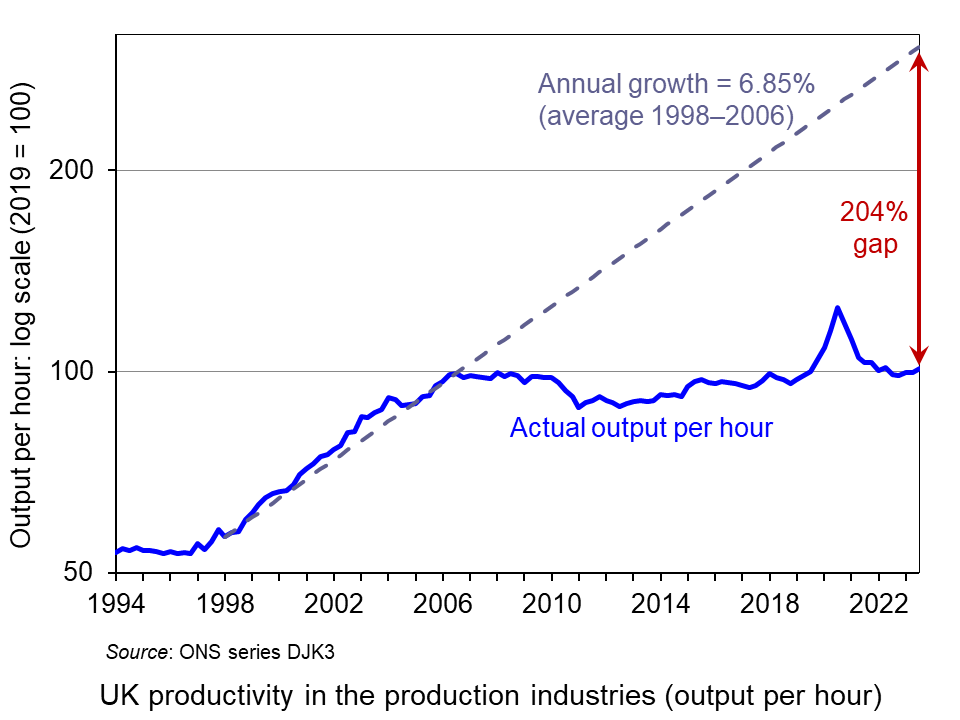 In the UK, labour productivity growth in the production industries was 6.85% per annum from 1998 to 2006. If this growth rate had been maintained, productivity would have been 204% higher by the end of 2023 than it actually was. This is shown in the chart (click here for a PowerPoint).
The key driver of long-term economic growth is labour productivity, which can best be measured by real GDP per hour worked. This depends on three things: the amount of capital per worker, the productivity of this capital and the efficiency of workers themselves – the latter two giving total factor productivity (TFP). Productivity growth has slowed, and with it the long-term rate of economic growth.
If we are measuring growth in output per head of the population, as opposed to simple growth in output, then another important factor is the proportion of the population that works. With ageing populations, many countries are facing an increase in the proportion of people not working. In most countries, these demographic pressures are likely to increase.
 A major determinant of long-term economic growth and productivity is investment. Investment has been badly affected by crises, such as the financial crisis and COVID, and by geopolitical tensions, such as the war in Ukraine and tensions between the USA and China and potential trade wars. It has also been adversely affected by government attempts to deal with rising debt caused by interventions following the financial crisis and COVID. The fiscal squeeze and, more recently higher interest rates, have dampened short-term growth and discouraged investment, thereby dampening long-term growth.
Another factor adversely affecting productivity has been a lower growth of allocative efficiency. Competition in many industries has declined as the rate of new firms entering and exiting markets has slowed. The result has been an increase in concentration and a growth in supernormal profits.
In the UK’s case, growth prospects have also been damaged by Brexit. According to Bank of England and OBR estimates, Brexit has reduced productivity by around 4% (see the blog: The costs of Brexit: a clearer picture). For many companies in the UK, Brexit has hugely increased the administrative burdens of trading with the EU. It has also reduced investment and led to a slower growth in the capital stock.
The UK’s poor productivity growth over many yeas is examined in the blog The UK’s poor productivity record.
Boosting productivity
So, how could productivity be increased and what policies could help the process?
 Artificial intelligence. One important driver of productivity growth is technological advance. The rapid advance in AI and its adoption across much of industry is likely to have a dramatic effect on working practices and output. Estimates by the IMF suggest that some 40% of jobs globally and 60% in advanced countries could be affected – some replaced and others complemented and enhanced by AI. The opportunities for raising incomes are huge, but so too are the dangers of displacing workers and deepening inequality, as some higher-paid jobs are enhanced by AI, while many lower paid jobs are little affected and other jobs disappear.
AI is also likely to increase returns to capital. This may help to drive investment and further boost economic growth. However, the increased returns to capital are also likely to exacerbate inequality.
To guard against the growth of market power and its abuse, competition policies may need strengthening to ensure that the benefits of AI are widely spread and that new entrants are encouraged. Also training and retraining opportunities to allow workers to embrace AI and increase their mobility will need to be provided.
 Training. And it is not just training in the use of AI that is important. Training generally is a key ingredient in encouraging productivity growth. In the UK, there has been a decline in investment in adult education and training, with a 70% reduction since the early 2000s in the number of adults undertaking publicly-funded training, and with average spending on training by employers decreasing by 27% per trainee since 2011. The Institute for Fiscal Studies identifies five main policy levers to address this: “public funding of qualifications and skills programmes, loans to learners, training subsidies, taxation of training and the regulation of training” (see link in articles below).
Competition. Another factor likely to enhance productivity is competition, both internationally and within countries. Removing trade restrictions could boost productivity growth; erecting barriers to protect inefficient domestic industry would reduce it.
Investment. Policies to encourage investment are also key to productivity growth. Private-sector investment can be encouraged by tax incentives. For example, in the UK the Annual Investment Allowance allows businesses to claim 100% of the cost of plant and machinery up to £1m in the year it is incurred. However, for tax relief to produce significant effects on investment, companies need to believe that the policy will stay and not be changed as economic circumstances or governments change.
 Public-sector investment is also key. Good road and rail infrastructure and public transport are vital in encouraging private investment and labour mobility. And investment in health, education and training are a key part in encouraging the development of human capital. Many countries, the UK included, cut back on public-sector capital investment after the financial crisis and this has had a dampening effect on economic growth.
Regional policy. External economies of scale could be encouraged by setting up development areas in various regions. Particular industries could be attracted to specific areas, where local skilled workers, managerial expertise and shared infrastructure can benefit all the firms in the industry. These ‘agglomeration economies’ have been very limited in the UK compared with many other countries with much stronger regional economies.
Changing the aims and governance of firms. A change in corporate structure and governance could also help to drive investment and productivity. According to research by the think tank, Demos (see the B Lab UK article and the second report below), if legislation required companies to consider the social, economic and environmental impact of their business alongside profitability, this could have a dramatic effect on productivity. If businesses were required to be ‘purpose-led’, considering the interests of all their stakeholders, this supply-side reform could dramatically increase growth and well-being.
Such stakeholder-governed businesses currently outperform their peers with higher levels of investment, innovation, product development and output. They also have higher levels of staff engagement and satisfaction.
Articles
- World Must Prioritize Productivity Reforms to Revive Medium-Term Growth
IMF Blog, Nan Li and Diaa Noureldin (10/4/24)
- Why has productivity slowed down?
Oxford Martin School News, Ian Goldin, Pantelis Koutroumpis, François Lafond and Julian Winkler (18/3/24)
- How can the UK revive its ailing productivity?
Economics Observatory, Michelle Kilfoyle (14/3/24)
- With the UK creeping out of recession, here’s an economist’s brief guide to improving productivity
The Conversation, Nigel Driffield (13/3/24)
- UK economy nearly a third smaller thanks to ‘catastrophically bad’ productivity slowdown
City A.M., Chris Dorrell (12/3/24)
- Can AI help solve the UK’s public sector productivity puzzle?
City A.M., Chris Dorrell (11/3/24)
- AI Will Transform the Global Economy. Let’s Make Sure it Benefits Humanity
IMF Blog, Kristalina Georgieva (14/1/24)
- Productivity and Investment: Time to Manage the Project of Renewal
NIESR, Paul Fisher (12/3/24)
- Productivity trends using key national accounts indicators
Eurostat (15/3/24)
- New report says change to company law could add £149bn to the UK economy
B Lab UK (28/11/23)
- Investment in training and skills: Green Budget Chapter 9
Institute for Fiscal Studies, Imran Tahir (12/10/23)
Reports
Data
Questions
- Why has global productivity growth been lower since 2008 than before 2008?
- Why has the UK’s productivity growth been lower than many other advanced economies?
- How does the short-run macroeconomic environment affect long-term growth?
- Find out why Japan’s productivity growth has been so poor compared with other countries.
- What are likely to be the most effective means of increasing productivity growth?
- How may demand management policies affect the supply side of the economy?
- How may the adoption of an ESG framework by companies for setting objectives affect productivity growth?
 The Competition and Markets Authority (CMA) is proposing to launch a formal Market Investigation into anti-competitive practices in the UK’s £2bn veterinary industry (for pets rather than farm animals or horses). This follows a preliminary investigation which received 56 000 responses from pet owners and vet professionals. These responses reported huge rises in bills for treatment and medicines and corresponding rises in the cost of pet insurance.
At the same time there has been a large increase in concentration in the industry. In 2013, independent vet practices accounted for 89% of the market; today, they account for only around 40%. Over the past 10 years, some 1500 of the UK’s 5000 vet practices had been acquired by six of the largest corporate groups. In many parts of the country, competition is weak; in others, it is non-existent, with just one of these large companies having a monopoly of veterinary services.
This market power has given rise to a number of issues. The CMA identifies the following:
- Of those practices checked, over 80% had no pricing information online, even for the most basic services. This makes is hard for pet owners to make decisions on treatment.
- Pet owners potentially overpay for medicines, many of which can be bought online or over the counter in pharmacies at much lower prices, with the pet owners merely needing to know the correct dosage. When medicines require a prescription, often it is not made clear to the owners that they can take a prescription elsewhere, and owners end up paying high prices to buy medicines directly from the vet practice.
- Even when there are several vet practices in a local area, they are often owned by the same company and hence there is no price competition. The corporate group often retains the original independent name when it acquires the practice and thus is is not clear to pet owners that ownership has changed. They may think there is local competition when there is not.
 Often the corporate group provides the out-of-hours service, which tends to charge very high prices for emergency services. If there is initially an independent out-of-hours service provider, it may be driven out of business by the corporate owner of day-time services only referring pet owners to its own out-of-hours service.
- The corporate owners may similarly provide other services, such as specialist referral centres, diagnostic labs, animal hospitals and crematoria. By referring pets only to those services owned by itself, this crowds out independents and provides a barrier to the entry of new independents into these parts of the industry.
- Large corporate groups have the incentive to act in ways which may further reduce competition and choice and drive up their profits. They may, for example, invest in advanced equipment, allowing them to provide more sophisticated but high-cost treatment. Simpler, lower-cost treatments may not be offered to pet owners.
- The higher prices in the industry have led to large rises in the cost of pet insurance. These higher insurance costs are made worse by vets steering owners with pet insurance to choosing more expensive treatments for their pets than those without insurance. The Association of British Insurers notes that there has been a large rise in claims attributable to an increasing provision of higher-cost treatments.
- The industry suffers from acute staff shortages, which cuts down on the availability of services and allows practices to push up prices.
- Regulation by the Royal College of Veterinary Surgeons (RCVS) is weak in the area of competition and pricing.
The CMA’s formal investigation will examine the structure of the veterinary industry and the behaviour of the firms in the industry. As the CMA states:
In a well-functioning market, we would expect a range of suppliers to be able to inform consumers of their services and, in turn, consumers would act on the information they receive.
Market failures in the veterinary industry
The CMA’s concerns suggest that the market is not sufficiently competitive, with vet companies holding significant market power. This leads to higher prices for a range of vet services. However, the CMA’s analysis suggests that market failures in the industry extend beyond the simple question of market power and lack of competition.
A crucial market failure is asymmetry of information. The veterinary companies have much better information than pet owners. This is a classic principal–agent problem. The agent, in this case the vet (or vet company), has much better information than the principal, in this case the pet owner. This information can be used to the interests of the vet company, with pet owners being persuaded to purchase more extensive and expensive treatments than they might otherwise choose if they were better informed.
The principal–agent problem also arises in the context of the dependant nature of pets. They are the ones receiving the treatment and, in this context, are the principals. Their owners are the ones acquiring the treatment for them and hence are the pets’ agents. The question is whether the owners will always do the best thing for their pets. This raises philosophical questions of animal rights and whether owners should be required to protect the interests of their pets.
 Another information issue is the short-term perspective of many pet owners. They may purchase a young and healthy pet and assume that it will remain so. However, as the pet gets older, it is likely to face increasing health issues, with correspondingly increasing vet bills. But many owners do not consider such future bills when they purchase the pet. They suffer from what behavioural economists call ‘irrational exuberance’. Such exuberance may also occur when the owner of a sick pet is offered expensive treatment. They may over-optimistically assume that the treatment will be totally successful and that their pet will not need further treatment.
Vets cite another information asymmetry. This concerns the costs they face in providing treatment. Many owners are unaware of these costs – costs that include rent, business rates, heating and lighting, staff costs, equipment costs, consumables (such as syringes, dressings, surgical gowns, antiseptic and gloves), VAT, and so on. Many of these costs have risen substantially in recent months and are reflected in the prices pet owners are charged. With people experiencing free health care for themselves from the NHS (or other national provider), this may make them feel that the price of pet health care is excessive.
Then there is the issue of inequality. Pets provide great benefits to many owners and contribute to owners’ well-being. If people on low incomes cannot afford high vet bills, they may either have to forgo having a pet, with the benefits it brings, or incur high vet bills that they ill afford or simply go without treatment for their pets.
 Finally, there are the external costs that arise when people abandon their pets with various health conditions. This has been a growing problem, with many people buying pets during lockdown when they worked from home, only to abandon them later when they have had to go back to the office or other workplace. The costs of treating or putting down such pets are born by charities or local authorities.
The CMA is consulting on its proposal to begin a formal Market Investigation. This closes on 11 April. If, in the light of its consultation, the Market Investigation goes ahead, the CMA will later report on its findings and may require the veterinary industry to adopt various measures. These could require vet groups to provide better information to owners, including what lower-cost treatments are available. But given the oligopolistic nature of the industry, it is unlikely to lead to significant reductions in vets bills.
Articles
- UK competition watchdog plans probe into veterinary market
Financial Times, Suzi Ring and Oliver Ralph (12/3/24)
 Vet prices: Investigation over concerns pet owners are being overcharged
Sky News (12/3/24)
- UK watchdog plans formal investigation into vet pricing
The Guardian, Kalyeena Makortoff (12/3/24)
- ‘Eye-watering’ vet bills at chain-owned surgeries prompt UK watchdog review
The Guardian, Kalyeena Makortoff (7/9/23)
- Warning pet owners could be overpaying for medicine
BBC News, Lora Jones & Jim Connolly (12/3/24)
- I own a vet practice, owners complain about the spiralling costs of treatments, but I only make 5 -10% profit – here’s our expenditure breakdown
Mail Online, Alanah Khosla (14/3/24)
- Vets bills around the world: As big-name veterinary practices come under pressure for charging pet owners ‘eyewatering’ care costs, how do fees in Britain compare to other countries?
Mail Online, Rory Tingle, Dan Grennan and Katherine Lawton (13/3/24)
CMA documents
Questions
- How would you establish whether there is an abuse of market power in the veterinary industry?
- Explain what is meant by the principal–agent problem. Give some other examples both in economic and non-economic relationships.
- What market advantages do large vet companies have over independent vet practices?
- How might pet insurance lead to (a) adverse selection; (b) moral hazard? Explain. How might (i) insurance companies and (ii) vets help to tackle adverse selection and moral hazard?
- Find out what powers the CMA has to enforce its rulings.
- Search for vet prices and compare the prices charged by at least three vet practices. How would you account for the differences or similarities in prices?
 In September 2023, the Stonegate Group, the largest pub company in the UK with around 4,500 premises, announced that it was going to start increasing the pint of beer by 20p during busy periods. There was an immediate backlash on social media with many customers calling on people to boycott Stonegate’s pubs such as the Slug & Lettuce and Yates.
This announcement is an example of dynamic pricing, where firms with market power adjust prices relatively quickly in response to changing market conditions: i.e. to changes in demand and supply.
Traditionally, prices set by firms in most retail markets have been less flexible. They may eventually adjust to changing market conditions, but this could take weeks or even months. If a product proves to be popular on a particular day or time, firms have typically left the price unchanged with the item selling out and customers facing empty shelves. If the product is unpopular, then the firm is left with unsold stock.
One business that makes extensive use of dynamic pricing is Amazon. Prices for popular items on Amazon Marketplace change every 10 minutes and can fluctuate by more than 20 per cent in just one hour.
Conditions for dynamic pricing to operate
The Amazon example helps to illustrate the conditions that must be in place for a firm to implement dynamic pricing successfully. These include:
- The capacity to collect and process large amounts of accurate real-time data on the demand for and supply of particular items i.e. the number of sales or the interest in the product.
- The ability to adjust prices in a timely manner in response to changing market conditions indicated by the data.
- Effectively communicating the potential advantages of the pricing strategy to consumers.
Consumer attitudes
 The last point is an interesting one. As the Stonegate example illustrates, consumers tend to dislike dynamic pricing, especially when price rises reflect increases in demand. A previous article on this website discussed the unpopularity of dynamic pricing amongst fans in the ticket market for live musical events.
The precise reason for the increase in demand, can also have an impact on consumer attitudes. For example, following a mass shooting at a subway station in New York in April 2022, the authorities shut down the underground system. This led to a surge in demand for taxis and this was picked up by the algorithm/software used by Uber’s dynamic pricing system. Fares for Uber cars began to rise rapidly, and people started to post complaints on social media. Uber responded by disabling the dynamic pricing system and capping prices across the city. It also announced that it would refund customers who were charged higher prices after the subway system shut down.
There is a danger for businesses that if they fail to communicate the policy effectively, annoyed customers may respond by shopping elsewhere. However, if it is implemented successfully then it can help businesses to increase their revenue and may also have some advantages for consumers.
The growing popularity of dynamic pricing
 It has been widely used in airline and hotel industries for many years. Robert Cross, who chairs a revenue management company predicts that ‘It will eventually be everywhere’.
More businesses in the UK appear to be using dynamic pricing. In a consumer confidence survey undertaken for Barclays in September 2023, 47 per cent of the respondents had noticed more examples of companies raising prices for goods/services in response to higher demand at peak times.
It has traditionally been more difficult for bricks-and-mortar retailers to implement dynamic pricing because of the costs of continually changing prices (so-called ‘menu costs’). However, this might change with the increasing use of electronic shelf labels.
It will be interesting to see if dynamic pricing becomes more widespread in the future or whether opposition from consumers limits its use.
Articles
Questions
- Explain the difference between surge and dynamic pricing.
- Using a diagram, explain how dynamic pricing can increase a firm’s revenue.
- Discuss both the advantages and disadvantages for consumers of firms using dynamic pricing.
- How might dynamic pricing influence consumer behaviour if it alters their expectations about future price changes.
- There is some evidence that the use of dynamic pricing is less unpopular amongst 18–24-year-olds than other age groups. Suggest some possible reasons why this might be the case.
- Using the concept of loss aversion, consider some different ways that a business could present a new dynamic pricing policy to its customers.