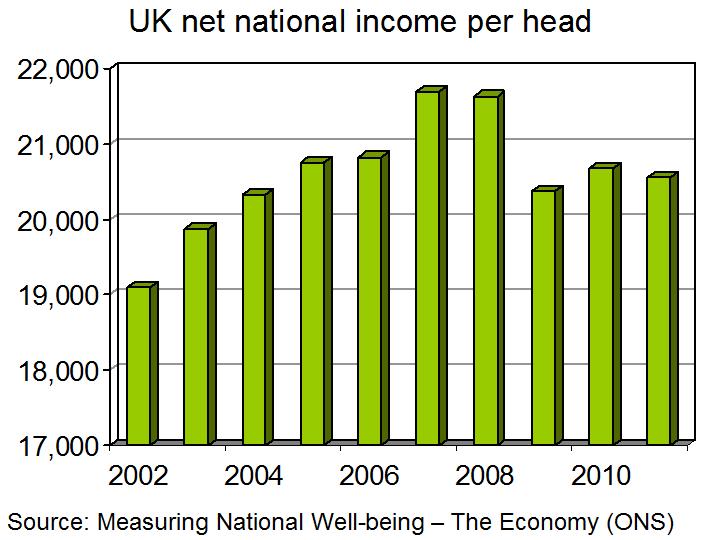
 Although every recession is different (for example in terms of length and magnitude), they do tend to have a few things in common. The focus of this blog is on consumer income and how it is affected in the aftermath of (or even during) a recession. According to data from the ONS, real national income per head has fallen by more than 13% since the start of 2008.
This latest data from the Office of National Statistics shows that in the aftermath of the 2008 recession, UK incomes have fallen by much more than they did in the 2 previous recessions experienced in the UK (click here for a PowerPoint of the chart). We would normally expect consumer incomes to fall during and possibly directly after a recession, as national output falls and confidence tends to be and remain low. However, the crucial thing to consider with falling consumer incomes is how it affects purchasing power. If my income is cut by 50%, but prices fall by 80%, then I’m actually better off in terms of my purchasing power.

The data from the ONS is all about purchasing power and shows how UK consumer incomes have fallen at the same time as inflation having been relatively high. It is the combination of these two variables that has been ‘eating into the value of the cash that people were earning’. Comparing the incomes in the four years after the 2008 recession with similar periods following the early 1980s and 1990s recession, the ONS has shown that this most recent recession had a much larger effect on consumer well-being. Part of this may be due to the rapid growth in incomes prior to the start of the credit crunch.
It’s not just the working population that has seen their incomes fall since 2008 – the retired population has also seen a decline in income and according to a report from the Institute for Fiscal Studies, it is the wealthiest portion of older households that have taken the largest hit since 2007. According to the IFS, the average person over 50 has experienced a fall in their gross wealth of about 10%, or close to £60,000. Of course for these older households, the concern is whether they will be able to make up this lost wealth before they retire. The concern for everyone is how long until incomes and purchasing power increase back to pre-crisis levels. The following articles consider this latest data on economic well-being and the impact the recession has had.
UK wellbeing still below financial crisis levels Guardian, Larry Elliott and Randeep Ramesh (23/10/12)
National income per head ‘down 13% in four years’ BBC Newsd (23/10/12)
Financial crisis hits UK retirement income Financial Times, Norma Cohen (23/10/12)
Over 50s ‘left £160,000 out of pocket by the financial crisis’ The Telegraph, James Kirkup (23/10/12)
Those near retirement in UK hit hard by crisis Wall Street Journal, Paul Hannon (23/10/12)
Living standards down 13pc since start of recession The Telegraph (23/10/12)
Questions
- Why is net national income per head said to be the best measure of economic well-being?
- Why is it so important to take into account inflation when measuring wellbeing?
- What explanation can be given for the larger fall in consumer incomes following the 2008 recession relative to the previous 2 recessions?
- According to data from the IFS, the richest portion of older households have suffered the most in terms of lost wealth. Why is this the case?
- What is meant by purchasing power?
- GDP has fallen by about 7%, whereas national income per head, taking inflation into account is down by over 13%. What is the explanation for these 2 different figures?
- How can recessions differ from each other? Think about the length, the magnitude of each.
- Is GDP a good measure of economic well-being? Are there any other ways we can measure it?
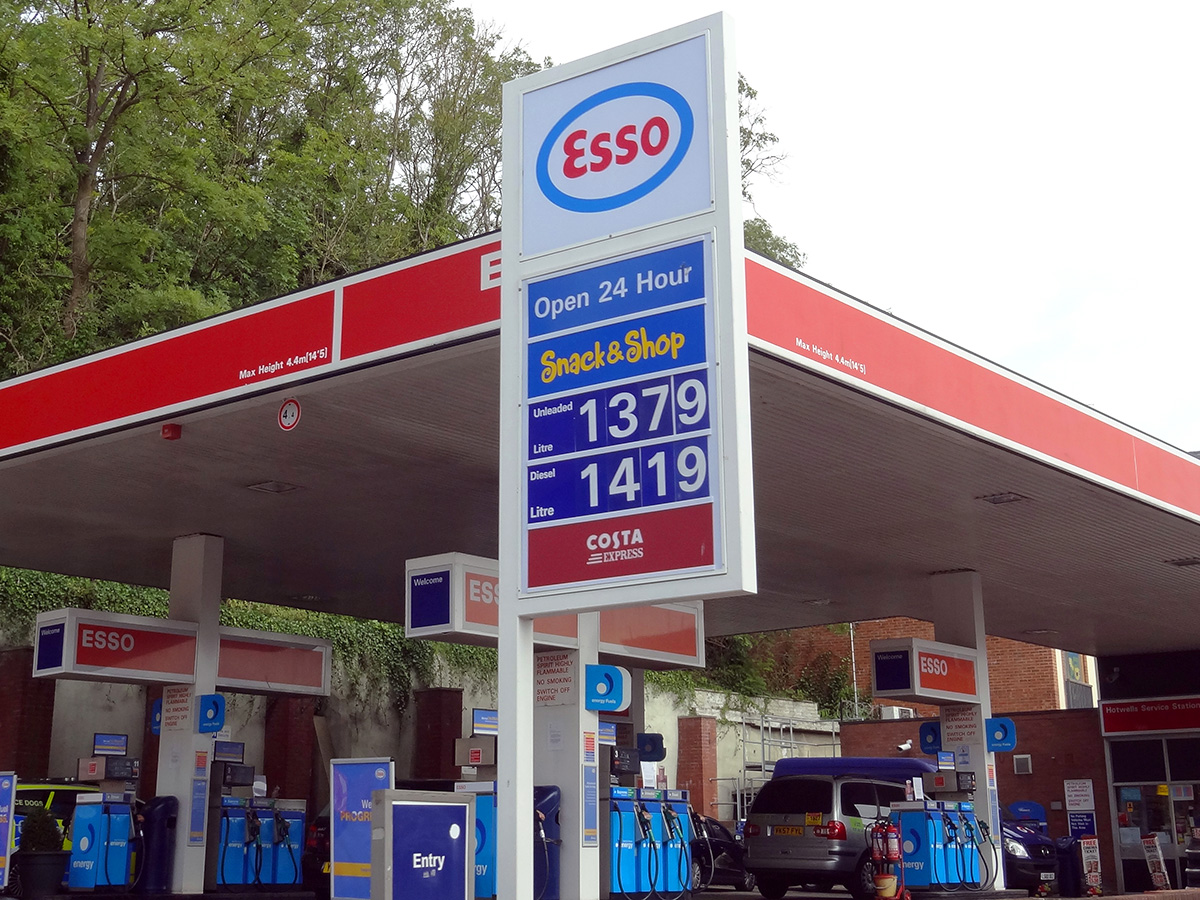
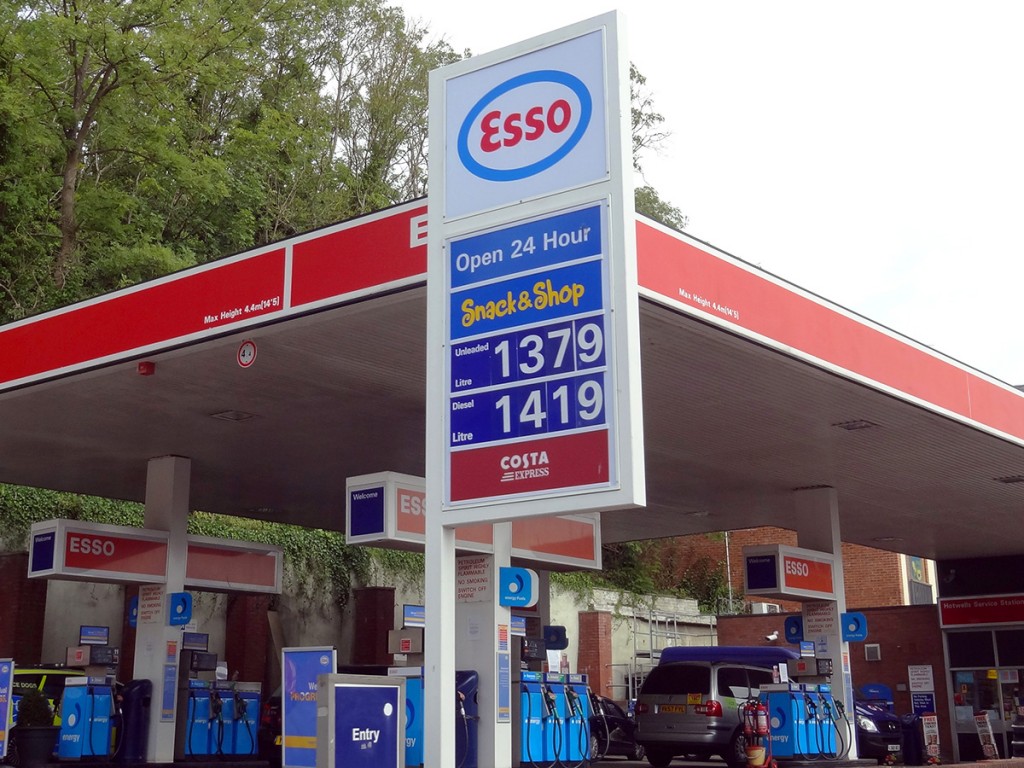 As resources become scarce, the price mechanism works to push up the price (see, for example, Box 9.11 in Economics 8th ed). If you look at the price of petrol over the past few decades, there has been a general upward trend – part of this is due to growth in demand, but part is due to oil being a scarce resource. Many millions have been spent on trying to find alternative fuels and perhaps things are now looking up!
Air Fuel Synthesis, a small British company, has allegedly managed to make ‘petrol from air’. Following this, the company has unsurprisingly received finance and investment offers from across the world. However, the entrepreneur Professor Marmont has said that he does not want any company from the oil industry to get a stake in this firm. This doesn’t mean that investment is not needed or on the cards, as in order to increase production of petrol from thin air financing is needed. Professors Marmont said:
We’ve had calls offering us money from all over the world. We’ve never had that before. We’ve made the first petrol with our demonstration plant but the next stage is to build a bigger plant capable of producing 1 tonne of petrol a day, which means we need between £5m and £6m
Whilst the process appears to be a reality, Air Fuel Synthesis is a long way from being able to produce en masse. However, it does offer an exciting prospect for the future of petrol and renewable energy resources in the UK. At the moment oil companies appear to be uninterested, but if this breakthrough receives the financing it needs and progress continues to be made, it will be interesting to see how the big oil companies respond. The following articles consider this break-through.
Company that made ‘petrol from air’ breakthrough would refuse investment from big oil Independent, Steve Connor (19/10/12)
British engineers create petrol from air and water Reuters, Alice Baghdijan (19/10/12)
Petrol from air: will it make a difference? BBC News, Jason Palmer (19/10/12)
British engineers produce amazing ‘petrol from air’ technology The Telegraph , Andrew Hough (18/10/12)
Questions
- Explain the way in which the price mechanism works as resources become scarce. Use a diagram to help your explanation.
- As raw materials become scarce, prices of the goods that use them to work or require them to be produced will be affected. Explain this interdependence between markets.
- Why is investment from an oil company such a concern for Professor Marmont?
- Why is there unlikely to be any impact in the short run from this new breakthrough?
- If such a technology could be put into practice, what effect might this have on the price of petrol?
- How might oil companies react to the growth in this technology?
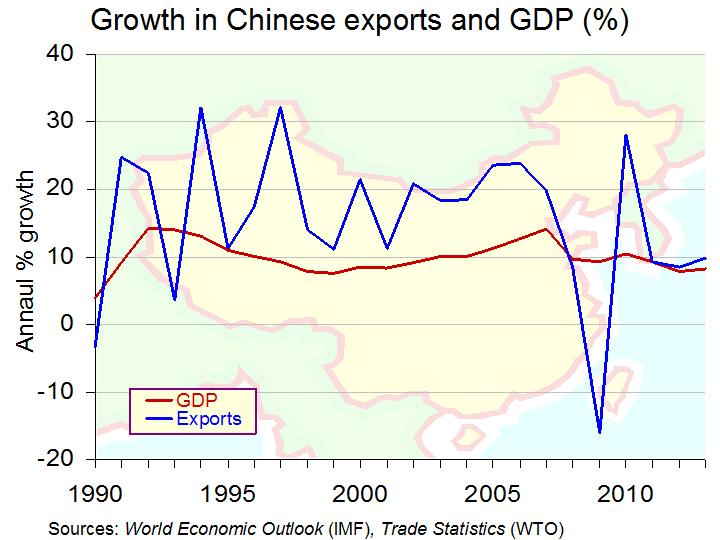 China has been one of the success stories of the past 20 years, with rapid growth in domestic and export demand. This has created the second largest economy in the world. From 1992 to 2007 annual GDP growth averaged 10.7% and annual export growth averaged 18.9% (see chart).
However, with the credit crunch and ensuing recession, growth rates in China have fallen somewhat. Annual GDP growth has averaged 9.6% and annual export growth has averaged 7.4%. Such growth rates may not seem bad, given that many Western economies have been struggling to achieve any growth, but they have been causing concern for this booming economy.
 In its May Outlook, the World Bank forecast China’s growth for the year at 8.2%, but it has since been reduced to 7.8%. A key part of China’s success story has been its export market, but it has been this market that has caused concerns for the mainland economy. In August of this year, its year-on-year export growth was at only 2.7%, but exports last month grew by more than expected, at approximately 7.4%. China has had a consistent trade surplus and according to government figures, this has widened to $27.67 billion in September from $26.66 billion in the previous month.
Recovery in this market will be crucial for the continued success of the economy, as a means of alleviating the fears of a slowdown. This higher growth of exports may be a misleading indicator, perhaps influenced by seasonal factors and thus may not be a sign of what’s to come. Indeed, many analysts have said that they are not convinced that these healthier trade figures will remain. Alistair Thornton, from IHS Global Economics said:
“It’s safe to say we are overshooting the trend here and we expect (the data) to come back in line in the months ahead.”
Citigroup economist, Ding Shaung also confirmed these sentiments:
”The trade data is a positive sign for the Chinese economy … But it remains to be seen whether import and export growth can remain at these levels.”
Part of this pessimism is due to the uncertainty surrounding the growth prospects of its biggest two trading partners – the US and the European Union. Exports to the former have remained relatively high, but exports to the European Union have suffered, falling by over 5.6%. It is likely that weaknesses in the global economy have held back China’s growth prospects in both exports and national output. The Chinese government was aiming for growth of 7.6% in 2012. Not a bad rate you may say, but when compared with growth rates for 2011 (9.3%) and 2010 (10.4%), it does represent a significant fall. The future of the Chinese economy is crucial for the recovery of the world economy, in part as it represents a big demand for imports from other countries, such as the US and Europe. The following articles consider the trade and growth prospects of the world’s second largest economy.
Chinese exports grow faster than expected in September BBC News (14/10/12)
Chinese exports grow faster than expected Financial Times, Patti Waldmeir (14/10/12)
China exports jump, but weaknesses seen ahead The Korea Herald (14/10/12)
China exports rise, hinting at a glimmer of revival New York Times, Keith Bradsher (13/10/12)
China’s trade surplus widens Wall Street Journal, William Kazer (13/10/12)
Chinese surplus widens as exports surge CNN, Paavan Mathemas (13/10/12)
 China’s economic slow-down BBC Today Programme, Linda Yueh (18/10/12)
Questions
- What is a trade surplus?
- Which factors have influenced Chinese exports and imports?
- Why is China’s growth rate such an important variable for the UK and other Western economies?
- Why has export growth in China fallen recently? Can you use the same explanation for its lower growth in national output?
- Explain why analysts remain pessimistic about the sustainability of these improved trade figures.
- Using a diagram, illustrate the effect that higher Chinese growth rates will have on GDP in a country such as the UK. Could there be a multiplier effect?
 The energy sector has a history of criticism with regards to prices and practices. In the past, Ofgem have tried to make the sector more competitive, by ensuring that price comparisons are easier. At the beginning of this year, many of the big six providers announced price cuts, but within the next few weeks, we will see the reverse occurring, as energy prices begin to rise.
British Gas has announced price rises of 6% from 16th November that will affect over 8 million customers by adding approximately £80 per year to the annual dual fuel bill. Npower will also put its prices up 10 days later (8.8% for gas and 9.1% for electricity), creating higher bills for 3 million people.
In January of this year, when we saw energy prices fall, it was not solely due to Ofgem’s findings. We had a relatively mild winter, which reduced the demand for energy and this fed into lower prices. As the winter now approaches once more, demand for energy will begin to increase, feeding into prices that are now higher.
Furthermore, the energy companies have said that a range of external factors are also adding to their costs and putting increasing pressure on them to increase their charges. Npower’s Chief Commercial Officer said:
“There is never a good time to increase energy bills, particularly when so many people are working hard to make ends meet…But the costs of new statutory schemes, increases in distribution charges and the price of gas for the coming winter are all being driven up by external factors, for example government policy”
 Significant investment is needed in the energy sector. Energy companies are required to set aside money for maintaining and improving the national grid and investing in renewable energy, such as wind and solar power. In order for the energy companies to fund these investments, more money must be raised and the logical method is to put up prices. However, critics are simply blaming ‘these very big lazy companies’ who are passing ‘above-inflation price rises’ onto already squeezed households.
Part of this is undoubtedly to do with the market structure of this sector. A typical oligopoly creates a market which, under certain circumstances, can be highly competitive, but because of barriers to entry that prevent new firms from entering the market may charge higher prices and be inefficient. Indeed, Ofgem has plans to reduce the power of the main energy providers by forcing them to auction off some of the electricity they generate. The aim of this is to free up the market and make it more competitive.
While only three providers have announced price rises, it is inevitable that the other three will follow. The relative increases will create incentives for consumers to switch providers, but crucial to this is an ability to understand the different tariffs on offer and lack of clarity on this has been a big criticism previously levelled at the energy sector. Indeed, half of UK customers have never switched energy providers. Perhaps this is the time to think about it, firstly as a means of saving money and secondly as a means of putting the energy companies in competition with each other. The following articles consider this market.
Energy price rises: how to switch, save and safeguard your supply The Guardian, Mark King (12/10/12)
Npower and British Gas raise energy prices (including video) BBC News (12/10/12)
Energy price rises? We’re like turkeys voting for Christmas The Telegraph, Rosie Murray-West (12/10/12)
British Gas and Npower to raise prices fuelling fears of a ‘long, cold winter’ for more households Independent
, Graeme Evans (12/10/12)Wholesale prices rise as energy costs jump Wall Street Journal, Sarah Portlock and Jeffrey Sparshott (12/10/12)
British Gas raises gas and electricity prices by 6pc The Telegraph (12/10/12)
Osborne warns energy firms over price hikes Reuters (12/10/12)
Energy price hikes to take effect from next week Independent, Simon Read(13/10/12)
Questions
- What are the main reasons influencing the recent price rises? In each case, explain whether it is a demand- or supply-side factor.
- Using your answer from question 1, illustrate the effect of it on a demand and supply diagram.
- Which features of an oligopolistic market are relevant to the energy sector. How can we use them to explain these higher prices.
- How has government policy affected the energy sector and energy prices?
- Why are customers reluctant to change energy providers? Does this further the energy company’s ability to raise prices?
- Are there any government policies that could be implemented to reduce the power of the energy companies?
 With the winter fast approaching, consumers have already begun to stock up on warmer clothes. This has contributed towards consumer spending increasing faster in September than it has in the past 3 years. According to Visa Europe’s UK expenditure index, sales in August increased by 1.2pc, but in September they rose month-on-month by 3pc.
But whilst sales on the high-street increased, sales on-line and over the telephone declined. It seems that the recent decrease in temperature is just what the retail sector ordered, as people took to the high streets.
Furthermore, recent improvements in consumer income, together with lower inflation and rising employment have all contributed towards a growth in spending. However, as consumer confidence remains at a relatively low level, it is unlikely that the winter will bring much of a change to growth in the economy. The Chief Economist at Markit said:
However, consumer confidence remains historically low as uncertainty about the economy and job security persists, suggesting that the bounce in spending seen in the third quarter could be as good as it gets for the foreseeable future.
 Although the lower temperature has caused a boost in consumption, once people have made their ‘investment’ in warmer clothes, retail spending may once again decline. Hence the above comment by Markit, which suggests that further sustained increases in consumer spending may still be some way off.
The following few articles look at the latest data on retail spending.
UK consumer spending ‘rose in September’ BBC News (5/10/12)
Consumer spending increases by 3pc The Telegraph (5/10/12)
Consumer spending increases by 3% The Press Association (5/10/12)
UK retail sales: what the analysts say Guardian (20/9/12)
Online sales and wet weather boost John Lewis Scotsman, Peter Ranscombe (5/10/12)
Questions
- Which factors typically affect consumer spending?
- Using a diagram, illustrate the impact of this increase in consumption on national output and the price level.
- Is it possible that a multiplier effect may occur with the August and September rise in retail sales?
- Why is consumer confidence remaining low? Which components of aggregate demand does it affect?
- Explain why (a) lower inflation, (b) the colder weather and (c) rising employment have caused consumer spending to rise.