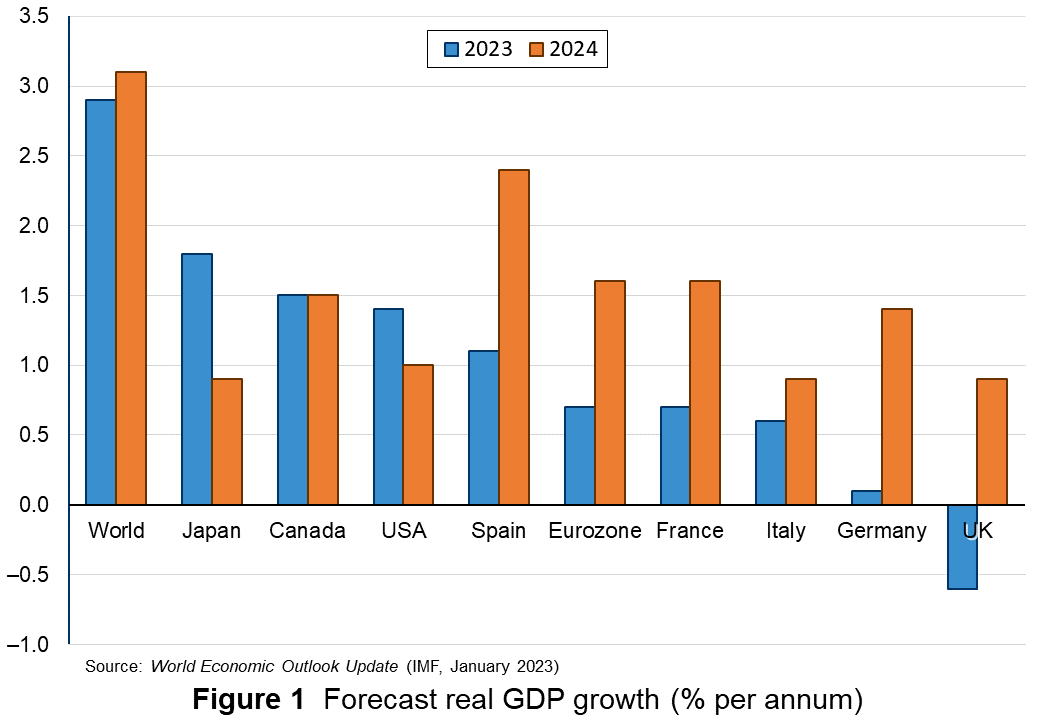
 In its latest World Economic Outlook update, the IMF forecasts that the UK in 2023 will be the worst performing economy in the G7. Unlike all the other countries and regions in the report, only the UK economy is set to shrink. UK real GDP is forecast to fall by 0.6% in 2023 (see Figure 1: click here for a PowerPoint). In the USA it is forecast to rise by 1.4%, in Germany by 0.1%, in France by 0.7% and in Japan by 1.8%. GDP in advanced countries as a whole is forecast to grow by 1.2%, while world output is forecast to grow by 2.9%. Developing countries are forecast to grow by 4.0%, with China and India forecast to grow by 5.2% and 6.1%, respectively. And things are not forecast to be a lot better for the UK in 2024, with growth of 0.9% – bottom equal with Japan and Italy.
Low projected growth in the UK in part reflects the tighter fiscal and monetary policies being implemented to curb inflation, which is slow to fall thanks to tight labour markets and persistently higher energy prices. The UK is particularly exposed to high wholesale gas prices, with a larger share of its energy coming from natural gas than most countries.
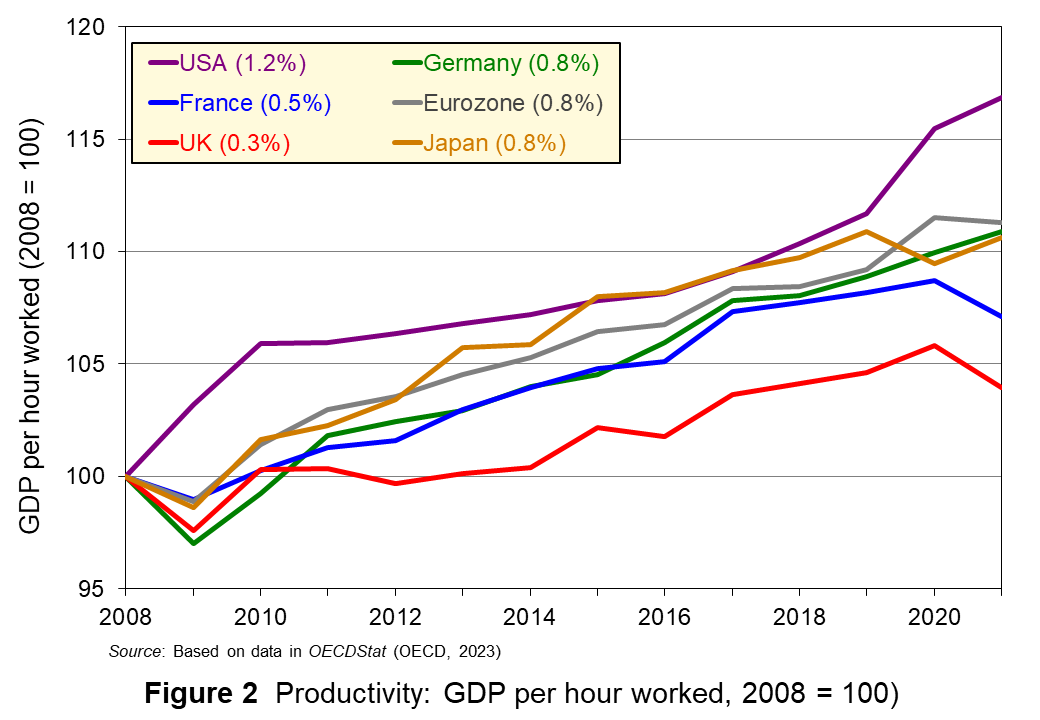 But the UK’s lower forecast growth relative to other countries reflects a longer-term problem in the UK and that is the slow rate of productivity growth. This is illustrated in Figure 2, which shows output (GDP) per hour worked in major economies, indexed at 100 in 2008 (click here for a PowerPoint). As you can see, the growth in productivity in the UK has lagged behind that of the other economies. The average annual percentage growth in productivity is shown next to each country. The UK’s growth in productivity since 2008 has been a mere 0.3% per annum.
Causes of low productivity/low productivity growth
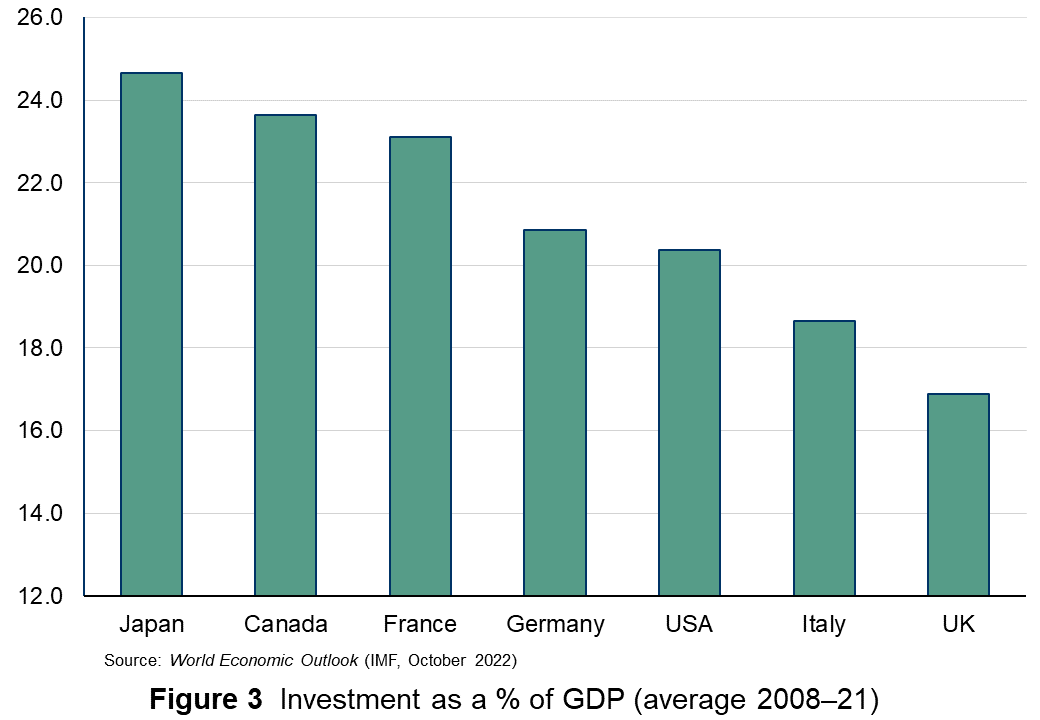 A major cause of low productivity growth is low levels of investment in physical capital. Figure 3 shows investment (gross capital formation) as a percentage of GDP for the G7 countries from the 2007–8 financial crisis to the year before the pandemic (click here for a PowerPoint). As you can see, the UK performs the worst of the seven countries.
Part of the reason for the low level of private investment is uncertainty. Firms have been discouraged from investing because of a lack of economic growth and fears that this was likely to remain subdued. The problem was compounded by Brexit, with many firms uncertain about their future markets, especially in the EU. COVID affected investment, as it did in all countries, but supply chain problems in the aftermath of COVID have been worse for the UK than many countries. Also, the UK has been particularly exposed to the effects of higher gas prices following the Russian invasion of Ukraine, as a large proportion of electricity is generated from natural gas and natural gas is the major fuel for home heating.
Part of the reason is an environment that is unconducive for investment. Access to finance for investment is more difficult in the UK and more costly than in many countries. The financial system tends to have a short-term focus, with an emphasises on dividends and short-term returns rather than on the long-term gains from investment. This is compounded by physical infrastructure problems with a lack of investment in energy, road and rail and a slow roll out of advances in telecoms.
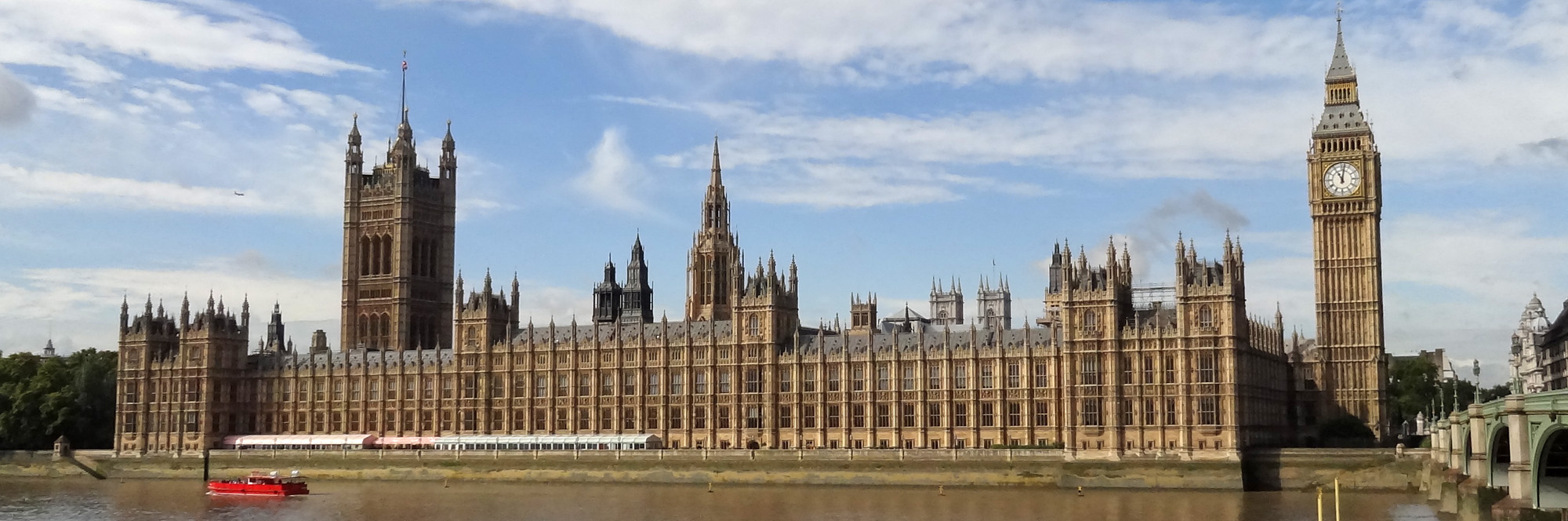
To help fund investment and drive economic growth, in 2021 the UK government established a government-owned UK Infrastructure Bank. This has access to £22 billion of funds. However, as The Conversation article below points out:
According to a January 2023 report from Westminster’s Public Accounts Committee, 18 months after its launch the bank had only deployed ‘£1 billion of its £22 billion capital to 10 deals’, and had employed just 16 permanent staff ‘against a target of 320’. The committee also said it was ‘not convinced the bank has a strategic view of where it best needs to target its investments’.
Short-termism is dominant in politics, with ministers keen on short-term results in time for the next election, rather than focusing on the long term when they may no longer be in office. When the government is keen to cut taxes and find ways of cutting government expenditure, it is often easier politically to cut capital expenditure rather than current expenditure. The Treasury oversees fiscal policy and its focus tends to be short term. What is needed is a government department where the focus is on the long term.
One problem that has impacted on productivity is the relatively large number of people working for minimum wages or a little above. Low wages discourage firms from making labour-saving investment and thereby increasing labour productivity. It will be interesting to see whether the labour shortages in the UK, resulting from people retiring early post-COVID and EU workers leaving, will encourage firms to make labour-saving investment.
Another issue is company taxation. Until recently, countries have tended to compete corporate taxes down in order to attract inward investment. This was stemmed somewhat by the international agreement at the OECD that Multinational Enterprises (MNEs) will be subject to a minimum 15% corporate tax rate from 2023. The UK is increasing corporation tax from 19% to 25% from April 2023. It remains to be seen what disincentive effect this will have on inward investment. Although the new rate is similar to, or slightly lower, than other major economies, there are some exceptions. Ireland will have a rate of just 15% and is seen as a major alternative to the UK for inward investment, especially with its focus on cheaper green energy. AstraZeneca has just announced that instead of building its new ‘state-of-the-art’ manufacturing plant in England close to its two existing plats in NW England, it will build it in Ireland instead, quoting the UK’s ‘discouraging’ tax rates and price capping for drugs by the NHS.
 And it is not just physical investment that affects productivity, it is the quality of labour. Although a higher proportion of young people go to university (close to 50%) than in many other countries, the nature of the skills sets acquired may not be particularly relevant to employers.
What is more, relatively few participate in vocational education and training. Only 32% of 18-year olds have had any vocational training. This compares with other countries, such as Austria, Denmark and Switzerland where the figure is over 65%. Also a greater percentage of firms in other countries, such as Germany, employ people on vocational training schemes.
Another aspect of labour quality is the quality of management. Poor management practices in the UK and inadequate management training and incentives have resulted in a productivity gap with other countries. According to research by Bloom, Sadun & Van Reenen (see linked article below, in particular Figure A5) the UK has an especially large productivity gap with the USA compared with other countries and the highest percentage of this gap of any country accounted for by poor management.
Solutions
Increasing productivity requires a long-term approach by both business and government. Policy should be consistent, with no ‘chopping and changing’. The more that policy is changed, the less certain will business be and the more cautious about investing.
As far a government investment is concerned, capital investment needs to be maintained at a high level if significant improvements are to be made in the infrastructure necessary to support increased growth rates. As far as private investment is concerned, there needs to be a focus on incentives and finance. If education and training are to drive productivity improvements, then there needs to be a focus on the acquisition of transferable skills.
Such policies are not difficult to identify. Carrying them out in a political environment focused on the short term is much more difficult.
Podcasts
Articles
- UK to perform worst of major economies in 2023, says IMF – here’s how to achieve long-term growth
The Conversation, Michael Kitson (2/2/23)
- The UK economy has recovered from doom and recession before – and it can do so again: the Economy 2030 Inquiry
Resolution Foundation, Centre for Economic Performance and Nuffield Foundation, Krishan Shah (7/2/23)
- Minding the (productivity and income) gaps: the Economy 2030 Inquiry
Resolution Foundation, Centre for Economic Performance and Nuffield Foundation, Krishan Shah and Gregory Thwaites (3/2/23)
- How to fix the British economy
Financial Times, Tim Harford (3/2/23)
- Is the IMF right about the UK economy?
Financial Times, Chris Giles (31/1/23)
- Why is UK Productivity Low and How Can It Improve?
The National Institute of Economic and Social Research (NIESR), Issam Samiri and Stephen Millard (26/9/22)
- Britain’s productivity puzzle
LSE British Politics and Policy, Ben Clift and Sean McDaniel (7/9/22)
- Why is the UK So Unproductive Compared to Germany?
Agency Central (26/8/20)
- Smarter taxes could ease UK productivity crisis
Reuters, Francesco Guerrera (9/1/23)
- Diagnosing the UK productivity slowdown: which sectors matter and why?
The Bennett Institute for Public Policy, University of Cambridge, Lucy Hampton (20/1/23)
- Management as a Technology?
National Bureau of Economic Research, Nicholas Bloom, Raffaella Sadun & John Van Reenen (October 2017)
- Take AstraZeneca’s warning seriously. The UK is missing out in life sciences
The Guardian, Nils Pratley (9/2/23)
Data
Questions
- What features of the UK economic and political environment help to explain its poor productivity growth record?
- What are the arguments for and against making higher education more vocational?
- Find out what policies have been adopted in a country of your choice to improve productivity. Are there any lessons that the UK could learn from this experience?
- How could the UK attract more inward foreign direct investment? Would the outcome be wholly desirable?
- What is the relationship between inequality and labour productivity?
- What are the arguments for and against encouraging more immigration in the current economic environment?
- Could smarter taxes ease the UK’s productivity crisis?
 World politicians, business leaders, charities and pressure groups are meeting in Davos at the 2022 World Economic Forum. Normally this event takes place in January each year, but it was postponed to this May because of Covid-19 and is the first face-to-face meeting since January 2020.
The meeting takes place amid a series of crises facing the world economy. The IMF’s Managing Director, Kristalina Georgieva, described the current situation as a ‘confluence of calamities’. Problems include:
- Continuing hangovers from Covid have caused economic difficulties in many countries.
- The bounceback from Covid has led to demand outpacing supply. The world is suffering from a range of supply-chain problems and shortages of key materials and components, such as computer chips.
- The war in Ukraine has not only caused suffering in Ukraine itself, but has led to huge energy and food price increases as a result of sanctions and the difficulties in exporting wheat, sunflower oil and other foodstuffs.
- Supply shocks have led to rising global inflation. This will feed into higher inflationary expectations, which will compound the problem if they result in higher prices and wages in response to higher costs.
- Central banks have responded by raising interest rates. These dampen an already weakened global economy and could push the world into recession.
- Global inequality is rising rapidly, both within countries and between countries, as Covid disruptions and higher food and energy prices hit the poor disproportionately. Poor people and countries also have a higher proportion of debt and are thus hit especially hard by higher interest rates.
- Global warming is having increasing effects, with a growing incidence of floods, droughts and hurricanes. These lead to crop failures and the displacement of people.
- Countries are increasingly resorting to trade restrictions as they seek to protect their own economies. These slow economic growth.
World leaders at Davos will be debating what can be done. One approach is to use fiscal policy. Indeed, Kristalina Georgieva said that her ‘main message is to recognise that the world must spend the billions necessary to contain Covid in order to gain trillions in output as a result’. But unless the increased expenditure is aimed specifically at tackling supply shortages and bottlenecks, it could simply add to rising inflation. Increasing aggregate demand in the context of supply shortages is not the solution.
 In the long run, supply bottlenecks can be overcome with appropriate investment. This may require both greater globalisation and greater localisation, with investment in supply chains that use both local and international sources.
International sources can be widened with greater investment in manufacturing in some of the poorer developing countries. This would also help to tackle global inequality. Greater localisation for some inputs, especially heavier or more bulky ones, would help to reduce transport costs and the consumption of fuel.
With severe supply shocks, there are no simple solutions. With less supply, the world produces less and becomes poorer – at least temporarily until supply can increase again.
Articles
Discussion (video)
Report
Questions
- Draw an aggregate demand and supply diagram (AD/AS or DAD/DAS) to illustrate the effect of a supply shock on output and prices.
- Give some examples of supply-side policies that could help in the current situation.
- What are the arguments for and against countries using protectionist policies at the current time?
- What policies could countries adopt to alleviate rapid rises in the cost of living for people on low incomes? What problems do these policies pose?
- What are the arguments for and against imposing a windfall tax on energy companies and using the money to support poor people?
- If the world slips into recession, should central banks and governments use expansionary monetary and fiscal policies?
 The suffering inflicted on the Ukrainian people by the Russian invasion is immense. But, at a much lower level, the war will also inflict costs on people in countries around the world. There will be significant costs to households in the form of even higher energy and food price inflation and a possible economic slowdown. The reactions of governments and central banks could put a further squeeze on living standards. Stock markets could fall further and investment could decline as firms lose confidence.
Russia is the world’s second largest oil supplier and any disruption to supplies will drive up the price of oil significantly. Ahead of the invasion, oil prices were rising. At the beginning of February, Brent crude was around $90 per barrel. With the invasion, it rose above $100 per barrel.
 Russia is also a major producer of natural gas. The EU is particularly dependent on Russia, which supplies 40% of its natural gas. With Germany halting approval of the major new gas pipeline under the Baltic from Russia to Germany, Nord Stream 2, the price of gas has rocketed. On the day of the invasion, European gas prices rose by over 50%.
Nevertheless, with the USA deciding not to extend sanctions to Russia’s energy sector, the price of gas fell back by 32% the next day. It remains to be seen just how much the supplies of oil and gas from Russia will be disrupted over the coming weeks.
Both Russia and Ukraine are major suppliers of wheat and maize, between them responsible for 14% of global wheat production and 30% of global wheat exports. A significant rise in the price of wheat and other grains will exacerbate the current rise in food price inflation.
Russia is also a significant supplier of metals, such as copper, platinum, aluminium and nickel, which are used in a wide variety of products. A rise in their price has begun and will further add to inflationary pressures and supply-chain problems which have followed the pandemic.
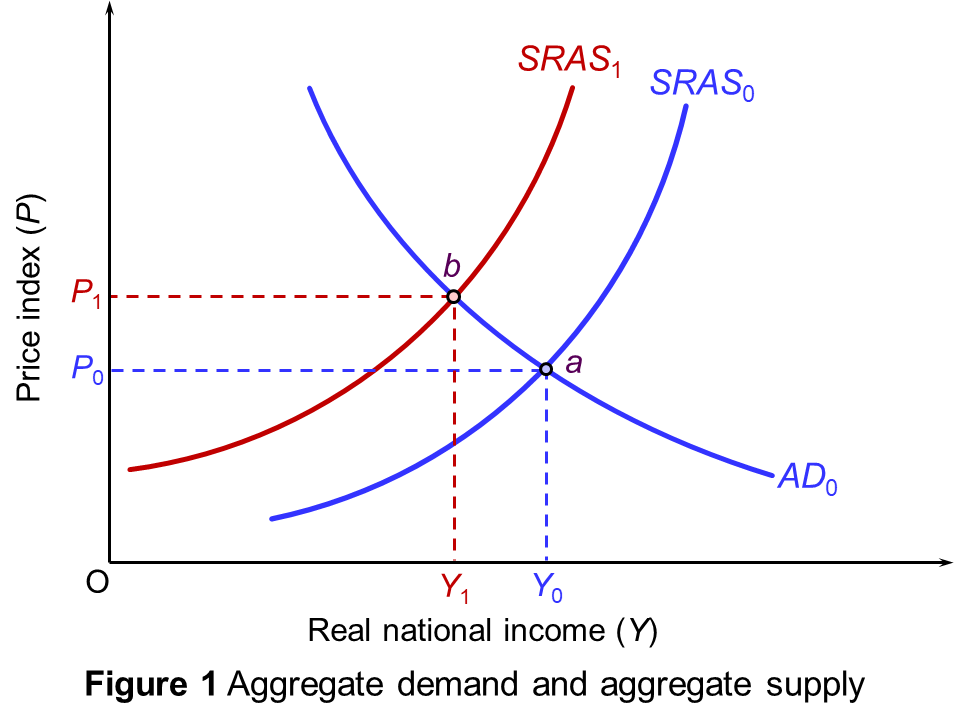 The effect of these supply shocks can be illustrated in a simple aggregate demand and supply diagram (see Figure 1), which shows a representative economy that imports energy, grain and other resources. Aggregate demand and short-run aggregate supply are initially given by AD0 and SRAS0. Equilibrium is at point a, with real national income (real GDP) of Y0 and a price index of P0.
The supply shock shifts short-run aggregate supply to SRAS1. Equilibrium moves to point b. The price index rises to P1 and real national income falls to Y1. If it is a ‘one-off’ cost increase, then the price index will settle at the new higher level and GDP at the new lower level provided that real aggregate demand remains the same. Inflation will be temporary. If, however, the SRAS curve continues to shift upwards to the left, then cost-push inflation will continue.
These supply-side shocks make the resulting inflation hard for policymakers to deal with. When the problem lies on the demand side, where the inflation is accompanied by an unsustainable boom, a contractionary fiscal and monetary policy can stabilise the economy and reduce inflation. But the inflationary problem today is not demand-pull inflation; it’s cost-push inflation. Disruptions to supply are both driving up prices and causing an economic slowdown – a situation of ‘stagflation’, or even an inflationary recession.
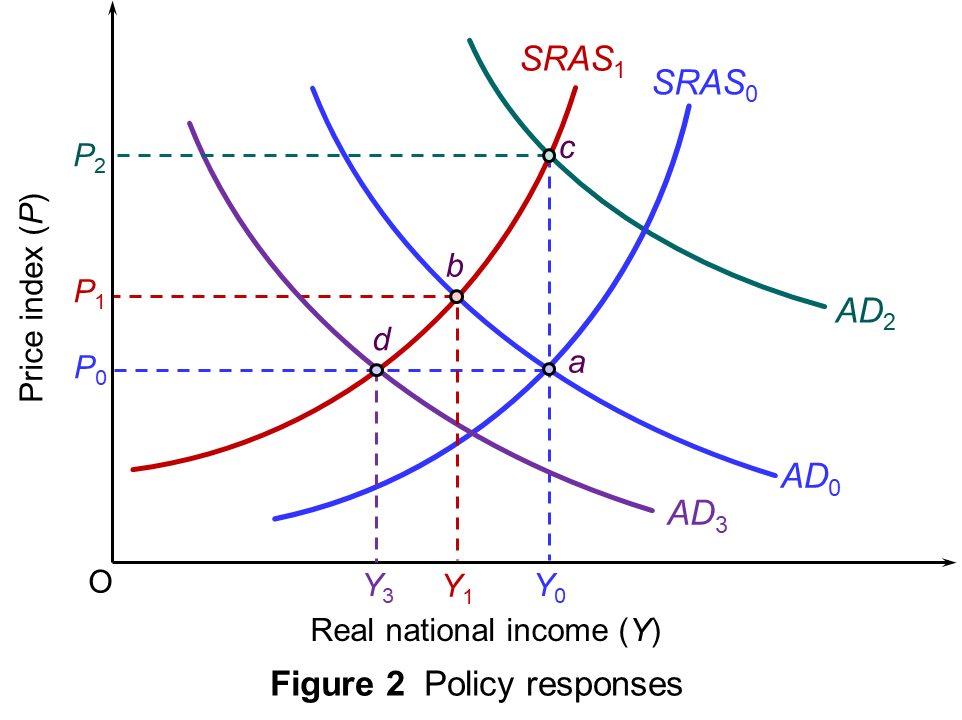 An expansionary policy, such as increasing bond purchases (quantitative easing) or increasing government spending, may help to avoid recession (at least temporarily), but will only exacerbate inflation. In Figure 2, aggregate demand shifts to AD2. Equilibrium moves to point c. Real GDP returns to Y0 (at least temporarily) but the price level rises further, to P2. (Click here for a PowerPoint of the diagram.)
A contractionary policy, such as raising interest rates or taxes, may help to reduce inflation but will make the slowdown worse and could lead to recession. In the diagram, aggregate demand shifts to AD3. Equilibrium moves to point d. The price level returns to P0 (at least temporarily) but real income falls further, to Y3.
In other words, you cannot tackle both the slowdown/recession and the inflation simultaneously by the use of demand-side policy. One requires an expansionary fiscal and/or monetary policy; the other requires fiscal and/or monetary tightening.
Then there are other likely economic stresses. If NATO countries respond by increasing defence expenditure, this will put further strain on public finances.
Sentiment is a key driver of the economy and prices. Expectations tend to be self-fulfilling. So if the war in Ukraine undermines confidence in stock markets and the real economy and further raises inflationary expectations, this pessimistic mood will tend in itself to drive down share prices, drive up inflation and drive down investment and economic growth.
Articles
- How will Russia’s invasion of Ukraine hit the global economy?
Financial Times, Chris Giles, Jonathan Wheatley and Valentina Romei (25/2/22)
- Ukraine conflict raises the possibility of stagflation
Financial Times, The Editorial Board (25/2/22)
- Five ways the Ukraine war could push up prices
BBC News, Laura Jones (5/3/22)
- Jason Furman cautions against reading too much into the initial market reactions to Russia’s invasion
interest.co.nz, Jason Furman (26/2/22)
- Putin’s war promises to crush the global economy with inflation and much slower growth
Market Watch, Nouriel Roubini (25/2/22)
- Roubini: 6 Financial, Economic Risks of Russia-Ukraine War
ThinkAdvisor, Janet Levaux (25/2/22)
- Fed tightening plans now contending with war, possible oil shock
Reuters, Howard Schneider and Jonnelle Marte (24/2/22)
- The invasion of Ukraine changed everything for Wall Street
CNN, Julia Horowitz (27/2/22)
- Why the Russian invasion will have huge economic consequences for American families
CNN, Matt Egan (24/2/22)
- European gas prices soar and oil tops $105 after Russia attacks Ukraine
Financial Times, Neil Hume, Emiko Terazono and Tom Wilson (24/2/22)
- Five essential commodities that will be hit by war in Ukraine
The Conversation, Sarah Schiffling and Nikolaos Valantasis Kanellos (24/2/22)
- Ukraine: ‘I’m surprised the oil price hasn’t hit US$130 a barrel yet’ – energy trading expert Q&A
The Conversation, Adi Imsirovic (25/2/22)
- Ukraine crisis: Warning UK energy bills could top £3,000 a year
BBC News, Michael Race (25/2/22)
- Putin’s energy shock: The economic realities of invasion
BBC News, Faisal Islam (25/2/22)
- Fears of UK food and fuel prices rising due to war
BBC News, Oliver Smith & Michael Race (26/2/22)
- Ukraine conflict: What is Swift and why is banning Russia so significant?
BBC News, Russell Hotten (27/2/22)
- Ukraine conflict: How reliant is Europe on Russia for oil and gas?
BBC News, Jake Horton & Daniele Palumbo (25/2/22)
- Ukraine crisis complicates ECB’s path to higher rates
Reuters, Francesco Canepa and Balazs Koranyi (24/2/22)
- Russia and the West are moving towards all out economic war
Al Jazeera, Maximilian Hess (24/2/22)
Questions
- If there is a negative supply shock, what will determine the size of the resulting increase in the price level and the rate of inflation over the next one or two years?
- How may expectations affect (a) the size of the increase in the price level; (b) future prices of gas and oil?
- Why did stock markets rise on the day after the invasion of Ukraine?
- Argue the case for and against relaxing monetary policy and delaying tax rises in the light of the economic consequences of the war in Ukraine.
 Inflation has been rising around the world as a combination of a recovery in demand and supply-chain issues have resulted in aggregate demand exceeding aggregate supply. Annual consumer price inflation at the beginning of 2022 is around 2.5% in China, 3.5% in Sweden, 5% in the eurozone, Canada and India, 6% in the UK and South Africa, 7% in the USA and 7.5% in Mexico. In each case it is forecast to go a little higher before falling back again.
Inflation in Turkey
In Turkey inflation is much higher. The official annual rate of consumer price inflation in December 2021 was 36.1%, sharply up from 21.3% in November. But according to Turkey’s influential ENAGrup the December rate was much higher still at 82.8%. Official producer price inflation was 79.9% and this will feed through into official consumer price inflation in the coming weeks.
The rise in inflation has hit the poor particularly badly. According to the official statistics, in the year to December 2021, domestic energy prices increased by 34.2%, food by 44.7% and transport by 53.7%. In response, the government has raised the minimum wage by nearly 50% for 2022.
Causes of high and rising inflation
 Why is Turkey’s inflation so much higher than in most developed and emerging economies and why has it risen so rapidly? The answer is that aggregate demand has been excessively boosted – well ahead of the ability of supply to respond. This has driven inflation expectations.
Turkey’s leader, President Erdoğan, in recent years has been seeking to stimulate economic growth through a mixture of supply-side, fiscal and monetary policies. He has hoped that the prospect of high growth would encourage both domestic and inward investment and that this would indeed drive the high growth he seeks. To encourage investment he has sought to reduce the reliance on imports through various measures, such as public procurement favouring domestic firms, tax reliefs for business and keeping interest rates down. He has claimed that the policy is focused on investment, production, employment and exports, instead of the ‘vicious circle of high interest rates and low exchange rates’.
With the pandemic, fiscal policy was largely focused on health, social security and employment measures. Such support was aided by a relatively healthy public finances. General government debt was 32% of GDP in 2020. This compares with 74% for the EU and 102% for the G7. Nevertheless, the worsening budget deficit has made future large-scale expenditure on public infrastructure, tax cuts for private business and other supply-side measures more difficult. Support for growth has thus fallen increasingly to monetary policy.
The Turkish central bank is not independent, with the President firing senior officials with whom he disagrees over monetary policy. The same applies to the Finance Ministry, with independently-minded ministers losing their jobs. Monetary and exchange rate policy have thus become the policy of the President. And it is here that a major part of the current problem of rising inflation lies.
Monetary and exchange rate policy
Despite rising inflation, the central bank has reduced interest rates. At its monthly meeting in September 2021, the Turkish central bank reduced its key rate from 19% to 18% and then to 16% in October, to 15% in November and 14% in December. These unprecedented rate cuts saw a large increase in the money supply. M1 rose by 11.7% in November alone; the annual growth rate was 59.5%. Broad money (M2 and M3) similarly rose. M3 grew by an annual rate of 51% in November 2021. The cut in interest rates and rise in money supply led to a rise in nominal expenditure which, in turn, led to higher prices.
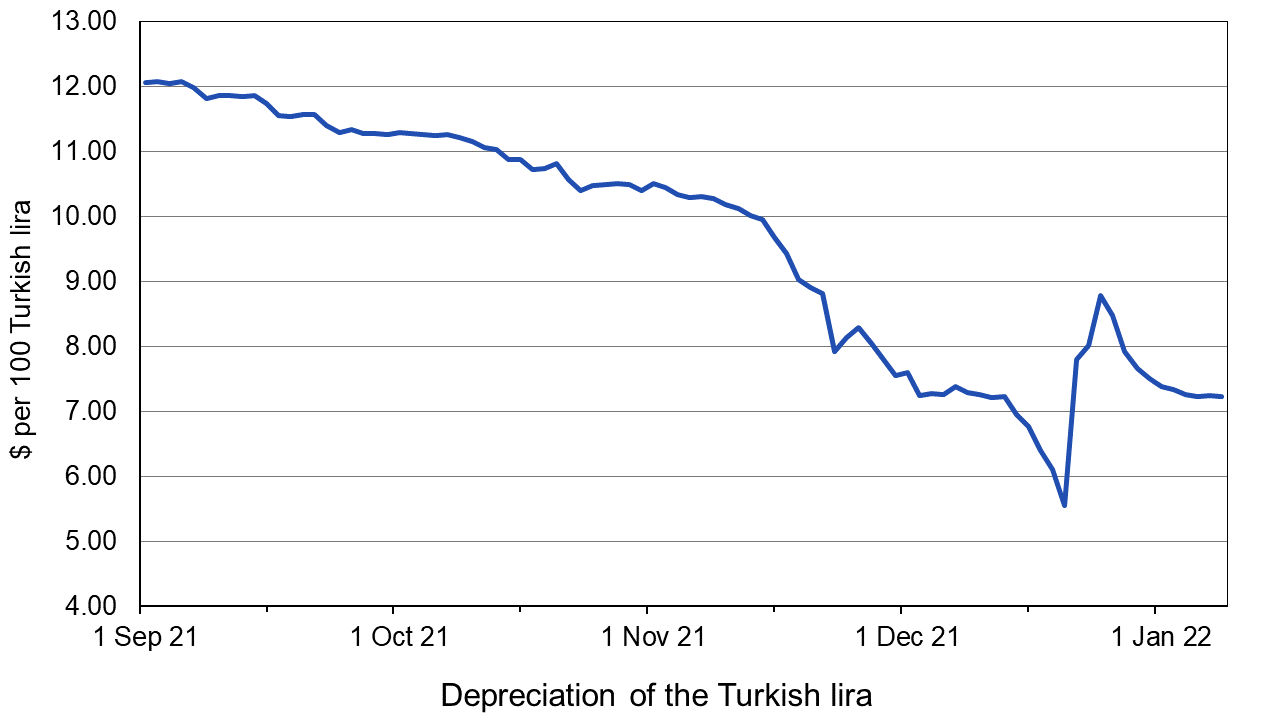
The cut in interest rates and rise in nominal aggregate demand led to a large depreciation in the exchange rate. On 1 September 2021, 100 Turkish lira exchanged for $12.05. By 11 January 2022 the rate had fallen to $7.22 – a 40.1% depreciation. This depreciation, in turn, further stoked inflation as the lower exchange rate pushed up the price of imported goods. (Click here for a PowerPoint of the chart.)
Attempts were made to stem this fall in the lira on 20 December, by which point 100 lira were trading for just $5.50 (see chart) and speculation against the lira was gathering momentum. President Erdoğan announced a scheme to protect lira deposits against currency volatility, guaranteeing lira deposits in hard currency terms. The mechanism adopted was a rise in the interest rate on lira deposits with a maturity of 3 to 12 months, thereby encouraging people to lock in deposits for the medium term and not, therefore, to use them to speculate against the lira by buying other currencies. Other interest rates would be unaffected. At the same time the central bank used foreign currency reserves to engage in large-scale purchases of the lira on the foreign exchange market.
The lira rallied. By 23 December, 100 lira were trading for $8.79. But then selling of the lira began again and, as stated above, by early January 100 lira had fallen to $7.22. The underlying problem of excess demand and high inflationary expectations had not been solved.
It remains to be seen whether the President will change his mind and decide that the central bank needs to raise interest rates to reduce inflation and restore confidence.
Videos
Articles
- Turkish Inflation Hits Highest Since 2002 Amid Lira Woes
Bloomberg, Baris Balci and Cagan Koc (3/1/22)
- Turkey’s annual inflation rate is over 82 percent, finds research group
Bianet (3/1/22)
- How Turkey can overcome its economic challenges
Arab News, Zaid M Belbagi (2/1/22)
- Turkey cuts interest rates despite spiralling inflation
BBC News, Victoria Craig (16/12/21)
- Turkey inflation surges 36% amid lira crisis, highest since 2002
CNBC (3/1/22)
- Turkey mulls new financial instruments to shield against inflation
Daily Sabah (3/1/22)
- Turkey raises minimum wage as lira crash, inflation sow hardship
Aljazeera, Umar Farooq (16/12/21)
- What to make of Turkey’s latest unorthodox currency move
Financial Times, Mohamed El-Erian (21/12/21)
- Erdoğan gambles on economy amid protests and rocketing inflation
The Guardian, Phillip Inman (24/11/21)
- Explained: How did Turkey’s economy go so wrong?
The Indian Express, Patricia Cohen (15/12/21)
Data
Questions
- Until the pandemic, the Turkish economy could be seen as a success story. Why?
- What supply-side policies did Turkey pursue?
- Use either an aggregate demand and supply diagram or a dynamic aggregate demand and supply (DAD/DAS) diagram to explain what has happened to inflation in Turkey in the past few months.
- Explain the thinking behind the successive cuts in interest rates since September 2021.
- Why did the measures introduced on 20 December 2021 only temporarily halt the depreciation of the lira?
- Choose a country with a higher rate of inflation than Turkey (see second data link above). Find out the causes of its high rate. Are they similar to those in Turkey?
 During the pandemic, millions of people’s wages in the UK were paid by the government to prevent the closure of businesses and a surge in unemployment. The furlough scheme officially came to an end in September 2021. However, with the spread of the Omicron variant and the fear of further restrictions being put in place, there has been a call by many to re-introduce the furlough scheme.
The furlough scheme
The furlough scheme began when the government brought in, what was officially called the Coronavirus Job Retention Scheme (CJRS) in early 2020. This was when the pandemic first forced businesses across the country to close. The scheme worked by paying part of employees’ wages, preventing the need for businesses to make their staff redundant, therefore avoiding a rapid rise in unemployment along with the associated costs. It also avoided the financial and emotional costs of firing and then rehiring workers post pandemic. Under the scheme, furloughed workers received 80% of their wages, up to £2500 a month, if they couldn’t work because of the impact of coronavirus. Employees were able to maintain the security of employment and the payments helped furloughed workers pay their bills.
 The scheme saw billions of pounds spent paying the wages of employees whose firms were forced to close temporarily. It could be argued that the expense of the scheme was a huge disadvantage. However, the alternative would have been for the government to pay unemployment-related benefits. Despite the furlough scheme being deemed necessary, it was not without its drawbacks for the structure of businesses. Rather than businesses adapting to changes in the economy and consumer demands, they could decide to claim the money and avoid the need to restructure. There was also concern about the length of the furlough scheme and the ability of businesses to bounce back post-pandemic.
Since the start of the scheme, the specifics of what was paid and who received it changed over time, especially once the economy started opening again. Initial steps were made to allow part-time return to work and the scheme started to wind down over the summer of 2021, with the government covering less of the wages and businesses covering more. From July, employers had to provide 10% of the wages of their furloughed staff, with the government paying the rest. This then increased to 20% in August with the CJRS coming to a complete end on 30 September 2021. At this point, there were around 1.6 million employees still receiving payment from the scheme.
Impact on Employment
With the end to the furlough scheme in September 2021, there were concerns that this would lead to a large number of redundancies. However, data indicate that has not happened and there is a record number of job vacancies. Official figures show that UK employment rose in October, confirming the strength of the labour market. The Office for National Statistics stated that the employment rate rose to 75.5% in the three months to October, up 0.2 percentage points on the previous quarter. This is believed to be driven by a rise in part-time work, which had dropped sharply during the pandemic. However, it is important to note that the strength in these numbers was prior to the emergence of the Omicron variant.
Omicron
 In November, the government had ruled out once again bankrolling people’s wages at enormous expense. However, the Chancellor is now under pressure to respond to the latest announcements around the ever-changing landscape of the pandemic. The fast-spreading mutation of the Covid-19 virus, Omicron, is posing a fresh threat to the economy.
On the 8 December, the Prime Minister announced new ‘Plan B’ Covid rules for England. As part of these new rules to limit the spread of Omicron, people are being asked to work from home again if possible and face masks are compulsory in most public places. Covid passes or a negative Covid test result are also needed to get into nightclubs and large venues.
Scotland and Wales have brought in further restrictions. Scotland’s First Minister, Nicola Sturgeon, has asked people to limit socialising to three households at a time in the run-up to Christmas. Shops and hospitality venues in Scotland must bring back physical distancing and screens. In Wales, nightclubs will close after 26 December and social distancing will be reintroduced in shops.
 Although the hospitality industry and retail sector remain open, they are facing a slump in trade thanks to the new restrictions and worries among the general public. With the work-from-home guidance and advice from health officials that people should limit their social interactions, pubs and restaurants have seen widespread cancellations in the run-up to Christmas. Trade is suffering and these mass cancellations come at a time when these sectors were hoping for bumper trade after a dismal last couple of years.
In light of these concerns, ministers are now being urged to guarantee support in case businesses have to shut. Despite the indication that it would be highly unlikely that the UK would experience a full return to the restrictions seen at previous stages of the crisis, the International Monetary Fund has stated that the UK government should be drawing up contingency plans. The IMF has called for a mini-furlough scheme in the event that the Omicron variant forces the government to close parts of the economy. The idea is that the mini-furlough scheme would see a limited version of the multi-billion-pound job subsidy scheme being rolled out if firms are forced to close.
There are strong calls for there to be targeted support, which this mini-furlough scheme could offer. The Resolution Foundation argued in mid-December that a furlough scheme tied solely to the hospitality industry would help prevent job loses in an industry that is currently suffering once again. It calculated that the cost of a hospitality-only furlough scheme would be £1.4 billion a month if it were pitched at the original level of 80% of wage support. If a January to March sector-specific scheme were to be introduced it is estimated to cost around £5 billion, a small cost in comparison to £46 billion spent on furlough so far.
Inflation
Any reintroduction of a furlough scheme would be a jolt for the government. This would mean a return to the 2020-style arguments around protecting livelihoods and businesses, a contrast to the recent messaging from the Treasury of restoring public finances. There is also concern about how this will all impact on current growth predictions and inflation concerns. The IMF expects the growth of the UK economy to be 6.8% in 2021 and 5% in 2022. However, the drawback from this is that the recovery would also be accompanied by rising inflation. It has been suggested, therefore, that interest rate increases from the Bank of England would be needed to keep inflation under control, while at the same time being not so great as to kill off growth.
It was widely expected that the Bank of England would again put off a rate hike in order to wait to see the economic impact of Plan B restrictions. However, on Thursday 16 December, interest rates were raised for the first time in more than three years. Despite the fears that Omicron could slow the economy by causing people to spend less, Bank Rate was raised from 0.1% to 0.25% . This came in the wake of data showing prices climbing at the fastest pace for 10 years.
Next Steps?
Government finances would take another huge hit if the furlough scheme were revived. But a version of such a scheme is likely to be necessary to avert an unemployment crisis and the attendant costs.
However, in resisting further measures, the government has argued that it has already acted early to help control the virus’s spread by rapidly rolling out booster jabs, while avoiding unduly damaging economic and social restrictions.
The government also argues that some of the measures from the total £400 billion Covid support package since the start of the pandemic will continue to help businesses into Spring 2022. Such measures include government-backed loans for small- and medium-sized businesses until June 2022, a reduction in VAT from 20% to 12.5% until March 2022 and business rates relief for eligible retail, hospitality, and leisure businesses until March 2022. Talks are ongoing with hospitality and and other business organisations directly affected by Covid restrictions.
The British Chambers of Commerce has argued that current measures are not enough and has called for VAT on hospitality and tourism to be cut back to its emergency rate of 5% and for the 100% business rates relief for retailers to return. The CBI has also called for any unspent local authority grants to be spent now to help affected firms and that further help, including business rates relief, should be on the table if restrictions continue after the government’s 5 January review date. The IMF said that with strong policy support, the economy had proved resilient, but it stressed that a return of some of the measures that prevented mass unemployment and large-scale business failures might soon be needed.
Conclusion
Infections caused by the new Omicron variant are rising rapidly, doubling every two to three days. It is expected to become the dominant variant in the UK soon with health officials warning it may be the most significant threat since the start of the pandemic. However, it is not yet known what the full extent of the impact of this new variant on the NHS will be, leaving the severity of future restrictions uncertain.
But what is evident is that the course of the pandemic has changed and there is a growing case for the government to start planning for new support packages. Although a reintroduction of the furlough scheme was hoped not to be needed on the path out of the pandemic, a short detour may be required in the form of a mini-furlough scheme. The size and reach of any support put in place will depend upon any further restrictions on economic activity.
Articles
Questions
- Should the level of support for business return to the levels in place earlier in 2021?
- What measures could a government put in place to curtail the spread of the Omicron variant that have only a minimal impact on business and employment?
- Compare the UK measures to curtail the spread of the virus with those used in some other European countries.
- What are the arguments for and against (a) re-introducing the furlough scheme as it was earlier in 2021; (b) introducing a version restricted to the hospitality sector?
 Global and European Productivity Outlook 2023-2030