 The International Monetary Fund has just published its six-monthly World Economic Outlook (WEO). The publication assesses the state of the global economy and forecasts economic growth and other indicators over the next few years. So what is this latest edition predicting?
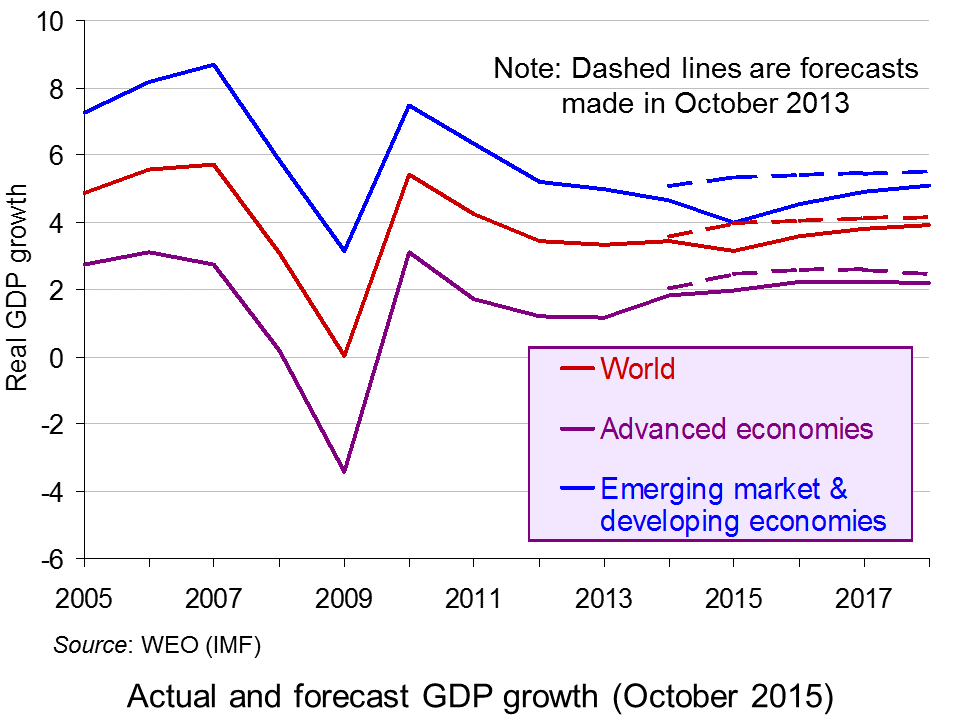
Well, once again the IMF had to adjust its global economic growth forecasts down from those made six months ago, which in turn were lower than those made a year ago. As Larry Elliott comments in the Guardian article linked below:
Every year, economists at the fund predict that recovery is about to move up a gear, and every year they are disappointed. The IMF has over-estimated global growth by one percentage point a year on average for the past four years.
In this latest edition, the IMF is predicting that growth in 2015 will be slightly higher in developed countries than in 2014 (2.0% compared with 1.8%), but will continue to slow for the fifth year in emerging market and developing countries (4.0% in 2015 compared with 4.6% in 2014 and 7.5% in 2010).
In an environment of declining commodity prices, reduced capital flows to emerging markets and pressure on their currencies, and increasing financial market volatility, downside risks to the outlook have risen, particularly for emerging market and developing economies.
So what is the cause of this sluggish growth in developed countries and lower growth in developing countries? Is lower long-term growth the new norm? Or is this a cyclical effect – albeit protracted – with the world economy set to resume its pre-financial-crisis growth rates eventually?
 To achieve faster economic growth in the longer term, potential national output must grow more rapidly. This can be achieved by a combination of more rapid technological progress and higher investment in both physical and human capital. But in the short term, aggregate demand must expand sufficiently rapidly. Higher short-term growth will encourage higher investment, which in turn will encourage faster growth in potential national output.
But aggregate demand remains subdued. Many countries are battling to cut budget deficits, and lending to the private sector is being constrained by banks still seeking to repair their balance sheets. Slowing growth in China and other emerging economies is dampening demand for raw materials and this is impacting on primary exporting countries, which are faced with lower exports and lower commodity prices.
Quantitative easing and rock bottom interest rates have helped somewhat to offset these adverse effects on aggregate demand, but as the USA and UK come closer to raising interest rates, so this could dampen global demand further and cause capital to flow from developing countries to the USA in search of higher interest rates. This will put downward pressure on developing countries’ exchange rates, which, while making their exports more competitive, will make it harder for them to finance dollar-denominated debt.
As we have seen, long-term growth depends on growth in potential output, but productivity growth has been slower since the financial crisis. As the Foreword to the report states:
The ongoing experience of slow productivity growth suggests that long-run potential output growth may have fallen broadly across economies.  Persistently low investment helps explain limited labour productivity and wage gains, although the joint productivity of all factors of production, not just labour, has also been slow. Low aggregate demand is one factor that discourages investment, as the last World Economic Outlook report showed. Slow expected potential growth itself dampens aggregate demand, further limiting investment, in a vicious circle.
But is this lower growth in potential output entirely the result of lower demand? And will the effect be permanent? Is it a form of hysteresis, with the effect persisting even when the initial causes have disappeared? Or will advances in technology, especially in the fields of robotics, nanotechnology and bioengineering, allow potential growth to resume once confidence returns?
Which brings us back to the short and medium terms. What can be done by governments to stimulate sustained recovery? The IMF proposes a focus on productive infrastructure investment, which will increase both aggregate demand and aggregate supply, and also structural reforms. At the same time, loose monetary policy should continue for some time – certainly as long as the current era of falling commodity prices, low inflation and sluggish growth in demand persists.
Articles
Uncertainty, Complex Forces Weigh on Global Growth IMF Survey Magazine (6/10/15)
A worried IMF is starting to scratch its head The Guardian, Larry Elliott (6/10/15)
Storm clouds gather over global economy as world struggles to shake off crisis The Telegraph, Szu Ping Chan (6/10/15)
Five charts that explain what’s going on in a miserable global economy right now The Telegraph, Mehreen Khan (6/10/15)
IMF warns on worst global growth since financial crisis Financial Times, Chris Giles (6/10/15)
Global economic slowdown in six steps Financial Times, Chris Giles (6/10/15)
IMF Downgrades Global Economic Outlook Again Wall Street Journal, Ian Talley (6/10/15)
WEO publications
World Economic Outlook, October 2015: Adjusting to Lower Commodity Prices IMF (6/10/15)
 Global Growth Slows Further, IMF’s latest World Economic Outlook IMF Podcast, Maurice Obstfeld (6/10/15)
Transcript of the World Economic Outlook Press Conference IMF (6/10/15)
World Economic Outlook Database IMF (October 2015 edition)
Questions
- Look at the forecasts made in the WEO October editions of 2007, 2010 and 2012 for economic growth two years ahead and compare them with the actual growth experienced. How do you explain the differences?
- Why is forecasting even two years ahead fraught with difficulties?
- What factors would cause a rise in (a) potential output; (b) potential growth?
- What is the relationship between actual and potential economic growth?
- Explain what is meant by hysteresis. Why may recessions have a permanent negative effect, not only on trend productivity levels, but on trend productivity growth?
- What are the current downside risks to the global economy?
- Why have commodity prices fallen? Who gains and who loses from lower commodity prices? Does it matter if falling commodity prices in commodity importing countries result in negative inflation?
- To what extent can exchange rate depreciation help commodity exporting countries?
- What is meant by the output gap? How have IMF estimates of the size of the output gap changed and what is the implication of this for actual and potential economic growth?
 With worries about Greek exit from the eurozone, with the unlikelihood of further quantitative easing in the USA and the UK, with interest rates likely to rise in the medium term, and with Chinese growth predicted to be more moderate, many market analysts are forecasting that stock markets are likely to fall in the near future. Indeed, markets are already down over the past few weeks. Since late April/early May, the FTSE is down 4.5%; the German DAX index is down 7.0%; the French CAC40 index is down 6.9%; and the US Dow Jones index is down 2.3%. But does this give us an indication of what is likely to happen over the coming months?
If stock markets were perfectly efficient, then all possible information about the future will already have been taken into account and will all be reflected in current share prices. It would be impossible to ‘get ahead of the game’.
It is only if market participants have imperfect information and if you have better information than other people that you can are likely to predict correctly what will happen. Even then, the markets might be buffeted by random and hence unpredictable shocks.
 Some people correctly predicted things in the past: such as crashes or booms. But in many cases, this was luck and their subsequent predictions have proved to be wrong. When financial advisers or newspaper columnists give advice, they are often wrong. If they were reliably right, then people would follow their advice and markets would rapidly adjust to their predictions.
If Greece were definitely to exit the euro, if interest rates were definitely to rise in the near future, if it became generally believed that stock markets were overvalued, then stock markets would probably fall. But these things may not happen. After all, people have been predicting a rise in interest rates from their ultra-low levels for many months – and it hasn’t happened yet, and may not happen for some time to come – but it may!
If you want to buy shares, you might just as well buy them at random – or randomly sell any you already have. As Tetlock says, quoted in the Nasdaq article:
“Even the most astute observers will fail to outperform random prediction generators – the functional equivalent of dart-throwing chimps.”
And yet, people do believe that they can predict what is going to happen to stock markets – if not precisely, then at least roughly. Are they deluded, or can looking calmly at likely political and economic events put them one step ahead of other people who perhaps behave more reactively and emotionally?
Bond rout spells disaster for stock markets as global credit kraken awakens The Telegraph, John Ficenec (14/6/15)
Comment: Many imponderables for markets The Scotsman, Bill Jamieson (14/6/15)
How Ignoring Stock Market Forecasts Will make you a better investor Forbes, Ky Trang Ho (6/6/15)
The Predictions Racket Nasdaq, AdviceIQ, Jason Lina (21/5/15)
Questions
- Why may a return of rising interest rates lead to a ‘meltdown in equity prices’? Why might it not?
- Why have bond yields fallen dramatically since 2008?
- Why are bond yields rising again now and what significance might this have (or have had) for equity markets?
- Why may following the crowd often lead to buying high and selling low?
- Is there an asymmetry between buying and selling behaviour in stock markets?
- Will ignoring stock market forecasts make people better investors?
- “The stock market prices suggest that investors believe both the Federal Reserve and the Bank of England are bluffing about raising interest rates. That may be so, but it is an extremely risky game of chicken for investors to play.” Explain and discuss.
The UK general election is on May 7. In the campaign during the run-up to the election the economy will be a major issue. All parties will use economic data to claim that the economy has performed well or badly and that the prospects are good or bad. As economics students you will, no doubt, be asked to comment on these claims by your friends. So where can you get analysis of the data that is not biased towards one party or another?
One source is the Institute for Fiscal Studies. It is respected by politicians of all parties as an impartial presenter and analyser of economic data. In fact, it is fiercely independent. But at election time, when often quite dramatic claims are made by politicians, the IFS often comments on whether the data support such claims.
An example occurred when David Cameron claimed that if Labour were elected, working families would face a £3028 tax rise to fund the party’s spending commitments. The IFS said that the claim was misleading as, even on the Conservatives’ assumptions, it was was based on the cumulative increase over five years, not the annual increase, and was not per household but only per working household. The IFS also said that the Conservatives’ assumptions were wrong and not in accordance with the Charter for Budget Responsibility, with which the Labour party agreed.
Expect the IFS to criticise more claims as the election campaign progresses: not just by the Conservative party but by the other parties too. After all, the IFS is not partisan and is prepared to challenge false economic claims from whatever party. Expect also that the political parties will cherry pick whatever statements by the IFS seen to favour them or criticise their opponents.
You can also expect political bias in the newspapers that report the campaigns. Even when they present facts, how they present them and which facts they choose to include and which to ignore will be a reflection of their political bias. So even newspaper reporting of what the IFS says is likely to be selective and nuanced!
Why IFS boss Paul Johnson counts in this tightest of general elections The Guardian, Larry Elliott (30/3/15)
David Cameron’s claim that Labour would raise taxes by £3,000 is ‘not sensible’, says the IFS Independent, Jon Stone (30/3/15)
‘tax rise’ is shot down by IFS The Guardian, Patrick Wintour (30/3/15)
We will borrow more if we win the election, Labour admits The Telegraph, Christopher Hope (29/3/15)
Chancellor accused of U-turn on austerity: Top economist says £20bn fiscal boost lurking in Budget is ‘remarkable reversal’ This is Money, Hugo Duncan (19/3/15)
Questions
- Distinguish between positive and normative statements. How might politicians blur the distinction in their claims and counter-claims?
- Identify three series of macroeconomic data from at least two independent organisations. For what reasons might the data be (a) unreliable; (b) used by political parties to mislead the electorate?
- In what ways can political parties use economic data to their own advantage without falsifying the data?
- How may public-sector deficit and debt statistics be interpreted in ways to suit (a) the current government’s case that the public finances have been well managed; (b) the opposition case that the public finances have been badly managed?
- Use data to analyse an economic claim by each of at least three political parties and the extent to which the claims are accurate.
- The above links are to articles from four UK national newspapers: The Guardian, the Independent, The Telegraph and the Daily Mail (This is Money). Identify political bias in the reporting in each of the articles.
 Many UK coal mines closed in the 1970s and 80s. Coal extraction was too expensive in the UK to compete with cheap imported coal and many consumers were switching away from coal to cleaner fuels. Today many shale oil producers in the USA are finding that extraction has become unprofitable with oil prices having fallen by some 50% since mid-2014 (see A crude indicator of the economy (Part 2) and The price of oil in 2015 and beyond). So is it a bad idea to invest in fossil fuel production? Could such assets become unusable – what is known as ‘stranded assets‘?
In a speech on 3 March 2015, Confronting the challenges of tomorrow’s world, delivered at an insurance conference, Paul Fisher, Deputy Governor of the Bank of England, warned that a switch to both renewable sources of energy and actions to save energy could hit investors in fossil fuel companies.
‘One live risk right now is of insurers investing in assets that could be left ‘stranded’ by policy changes which limit the use of fossil fuels. As the world increasingly limits carbon emissions, and moves to alternative energy sources, investments in fossil fuels and related technologies – a growing financial market in recent decades – may take a huge hit. There are already a few specific examples of this having happened.
… As the world increasingly limits carbon emissions, and moves to alternative energy sources, investments in fossil fuels and related technologies – a growing financial market in recent decades – may take a huge hit. There are already a few specific examples of this having happened.’
Much of the known reserves of fossil fuels could not be used if climate change targets are to be met. And investment in the search for new reserves would be of little value unless they were very cheap to extract. But will climate change targets be met?  That is hard to predict and depends on international political agreements and implementation, combined with technological developments in fields such as clean-burn technologies, carbon capture and renewable energy. The scale of these developments is uncertain. As Paul Fisher said in his speech:
‘Tomorrow’s world inevitably brings change. Some changes can be forecast, or guessed by extrapolating from what we know today. But there are, inevitably, the unknown unknowns which will help shape the future. … As an ex-forecaster I can tell you confidently that the only thing we can be certain of is that there will be changes that no one will predict.’
The following articles look at the speech and at the financial risks of fossil fuel investment. The Guardian article also provides links to some useful resources.
Articles
Bank of England warns of huge financial risk from fossil fuel investments The Guardian, Damian Carrington (3/3/15)
PRA warns insurers on fossil fuel assets Insurance Asset Risk (3/3/15)
Energy trends changing investment dynamics UPI, Daniel J. Graeber (3/3/15)
Speech
Confronting the challenges of tomorrow’s world Bank of England, Paul Fisher (3/3/15)
Questions
- What factors are taken into account by investors in fossil fuel assets?
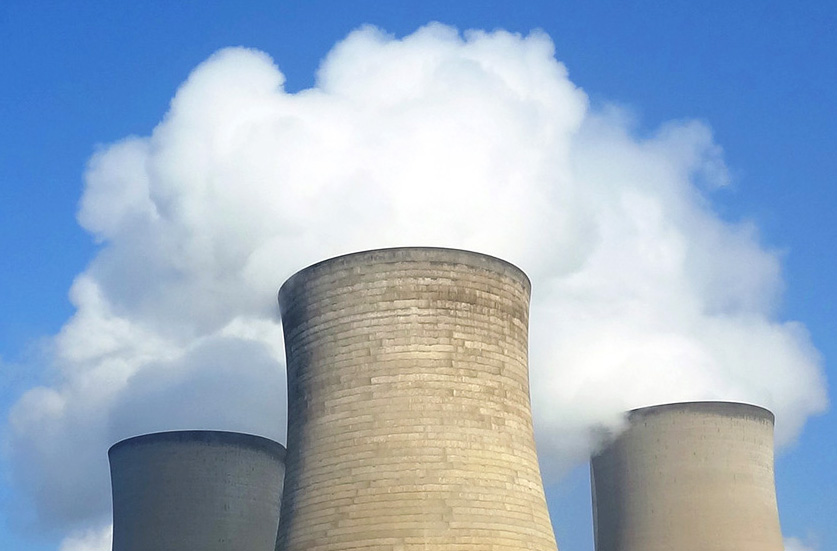
- Why might a power station become a ‘stranded asset’?
- How is game theory relevant in understanding the process of climate change negotiations and the outcomes of such negotiations?
- What social functions are filled by insurance?
- Why does climate change impact on insurers on both sides of their balance sheets?
- What is the Prudential Regulation Authority (PRA)? What is its purpose?
- Explain what is meant by ‘unknown unknowns’. How do they differ from ‘known unknowns’?
- How do the arguments in the article and the speech relate to the controversy about investing in fracking in the UK?
- Explain and comment on the statement by World Bank President, Jim Yong Kim, that sooner rather than later, financial regulators must address the systemic risk associated with carbon-intensive activities in their economies.
 The first link below is to an excellent article by Noriel Roubini, Professor of Economics at New York University’s Stern School of Business. Roubini was one of the few economists to predict the 2008 financial crisis and subsequent recession. In this article he looks at the current problem of substantial deficiency of demand: in other words, where actual output is well below potential output (a negative output gap). It is no wonder, he argues, that in these circumstances central banks around the world are using unconventional monetary policies, such as virtually zero interest rates and quantitative easing (QE).
He analyses the causes of deficiency of demand, citing banks having to repair their balance sheets, governments seeking to reduce their deficits, attempts by firms to cut costs, effects of previous investment in commodity production and rising inequality.
 The second link is to an article about the prediction by the eminent fund manager, Crispin Odey, that central banks are running out of options and that the problem of over-supply will lead to a global slump and a stock market crash that will be ‘remembered in a hundred years’. Odey, like Roubini, successfully predicted the 2008 financial crisis. Today he argues that the looming ‘down cycle will cause a great deal of damage, precisely because it will happen despite the efforts of central banks to thwart it.’
I’m sorry to post this pessimistic blog and you can find other forecasters who argue that QE by the ECB will be just what is needed to stimulate economic growth in the eurozone and allow it to follow the USA and the UK into recovery. That’s the trouble with economic forecasting. Forecasts can vary enormously depending on assumptions about variables, such as future policy measures, consumer and business confidence, and political events that themselves are extremely hard to predict.
Will central banks continue to deploy QE if the global economy does falter? Will governments heed the advice of the IMF and others to ease up on deficit reduction and engage in a substantial programme of infrastructure investment? Who knows?
An Unconventional Truth Project Syndicate, Nouriel Roubini (1/2/15)
UK fund manager predicts stock market plunge during next recession The Guardian, Julia Kollewe (30/1/15)
Questions
- Explain each of the types of unconventional monetary policy identified by Roubini.
- How has a policy of deleveraging by banks affected the impact of quantitative easing on aggregate demand?
- Assume you predict that global economic growth will increase over the next two years. What reasons might you give for your prediction?
- Why have most commodity prices fallen in recent months? (In the second half of 2014, the IMF all-commodity price index fell by 28%.)
- What is likely to be the impact of falling commodity prices on global demand?
- Some neo-liberal economists had predicted that central bank policies ‘would lead to hyperinflation, the US dollar’s collapse, sky-high gold prices, and the eventual demise of fiat currencies at the hands of digital krypto-currency counterparts’. Why, according to Roubini, did the ‘root of their error lie in their confusion of cause and effect’?
 The International Monetary Fund has just published its six-monthly World Economic Outlook (WEO). The publication assesses the state of the global economy and forecasts economic growth and other indicators over the next few years. So what is this latest edition predicting?