 The New Year is a time for reflection and prediction. What will the New Year bring? What does the longer-term future hold? Here are two articles from The Guardian that look into the future.
The first, by Larry Elliott, considers a number of scenarios and policy options. Although not totally doom laden, the article is not exactly cheery in its predictions. Perhaps ‘life will go on’ and the global economy will muddle through. But perhaps a new recession is around the corner or, even worse, the world is at a tipping point when things are fundamentally changing. Unless policy-makers are careful, clever and co-ordinated, perhaps a new dark age may be looming. But who knows?
Which brings us to the second article, by Gaby Hinsliff. This argues that people are pretty hopeless at predicting. “History is littered with supposed dead certs that didn’t happen – Greece leaving the euro, the premature collapse of the coalition – and wholly unimagined events that came to pass.” And economists and financial experts are little better.
Two years ago, The Observer challenged a panel of City investors to pick a portfolio of stocks and rated their performance against that of Orlando, a ginger cat who selected his portfolio by tossing a toy mouse at a sheet of paper. Inevitably, the cat triumphed.
But is this fair? If capital markets are relatively efficient, stock prices today already reflect knowable information about the future, but clearly not unknowable information.
It’s the same with economies. When information is already to hand, such as a pre-announced tax change, then its effects, ceteris paribus, can be estimated – at least roughly.
 But it’s the ‘ceteris paribus‘ assumption that’s the problem. Other things are not equal. The world is constantly changing and there are all sorts of unpredictable events that will influence the outcomes of economic policy and of economic decisions more generally. And central to the problem are people’s attitudes and confidence. Mood can swing quite dramatically, from irrational exuberance to deep pessimism. And such mood changes – often triggered by some exogenous factor, such as an international dispute, an election or unexpected economic news – can rapidly gather momentum and have significant effects.
Predicting the long-term future is both easier and more difficult: easier, in that short-term cyclical effects are less relevant; more difficult in that changes that have not yet happened, such as technological changes or changes in working practices, may themselves be key determinants of the future global economy.
One of the most salutary lessons is to look at predictions made in the past about the world today and at just how wrong they have proved to be. Perhaps we need to call on Orlando more frequently.
Why ‘life will go on’ thesis about global economy might not pass muster in 2015 The Guardian, Larry Elliott (28/12/14)
Who knows what the new year holds? Certainly none of us The Guardian, Gaby Hinsliff (26/12/14)
Questions
- Give some examples of factors that could have a major influence on the global economy, but which are unpredictable.
- Is economic forecasting still worthwhile? Explain.
- Look at some macroeconomic forecasts made in the past about the world today. You might want to look at forecasts of agencies such as the IMF, the OECD, the World Bank and the European Commission. You can find links in the Economics Network’s Economic Data freely available online. Explain why such forecasts have differed from the actual outcome.
- Why, if capital markets were perfect, might Orlando be just as good as a top investment manager at predicting the future course of share prices?
- In what ways is economic forecasting similar to and different from weather forecasting in its methods, its use of data and its reliability?
 Now here’s a gloomy article from Robert Peston. He’s been looking at investors’ views about the coming years and sees a general pessimism about the prospects for long-term economic growth. And that pessimism is becoming deeper.
It is true that both the UK and the USA have recorded reasonable growth rates in recent months and do seem, at least on the surface, to be recovering from recession. But, according to investor behaviour, they:
seem to be saying, in how they place their money, that the UK’s and USA’s current reasonably rapid growth will turn out to be a short-lived period of catch-up, following the deep recession of 2008-9.
So what is it about investor behaviour that implies a deep pessimism and are investors right to be pessimistic? The article explores these issues. It does also look at an alternative explanation that investors may merely be being cautious until a clearer picture emerges about long-term growth prospects – which may turn out to be better that many currently now predict.
The article finishes by looking at a possible solution to the problem (if you regard low or zero growth as a problem). That would be for the government to ‘throw money at investment in infrastructure – to generate both short-term growth and enhance long-term productive potential.’
Note that Elizabeth also looks at this article in her blog The end of growth in the west?.
The end of growth in the West? BBC News, Robert Peston (26/9/14)
Questions
- What is meant by the ’25-year yield curve for government bonds’? Why does this yield curve imply a deep level of business pessimism about the long-term prospects for UK economic growth?
- What are the determinants of long-term economic growth?
- Looking at these determinants, which ones suggest that long-term economic growth may be low?
- Are there any determinants which might suggest that economic growth will be maintained over the long term at historical levels of around 2.6%?
- Do demand-side policies affect potential GDP and, if so, how?
- What policies could government pursue to increase the rate of growth in potential GDP?
- What current ‘dramas’ affecting the world economy could have long-term implications for economic growth? How does uncertainty about the long-term implications for the global economy of such dramas itself affect economic growth?
- Is long-term growth in real GDP an appropriate indicator of (a) economic development and (b) long-term growth in general well-being?
 Economic journalists, commentators and politicians have been examining the possible economic effects of a Yes vote in the Scottish independence referendum on 18 September. For an economist, there are two main categories of difficulty in examining the consequences. The first is the positive question of what precisely will be the consequences. The second is
  the normative question of whether the likely effects will be desirable or undesirable and how much so.
The first question is largely one of ‘known unknowns’. This rather strange term was used in 2002 by Donald Rumsfeld, US Secretary of Defense, in the context of intelligence about Iraq. The problem is a general one about forecasting the future. We may know the types of thing that are likely happen, but the magnitude of the outcome cannot be precisely known because there are so many unknowable things that can influence it.
Here are some known issues of Scottish independence, but with unknown consequences (at least in precisely quantifiable terms). The list is certainly not exhaustive and you could probably add more questions yourself to the list.
|
|
| • |
Will independence result in lower or higher economic growth in the short and long term? |
| • |
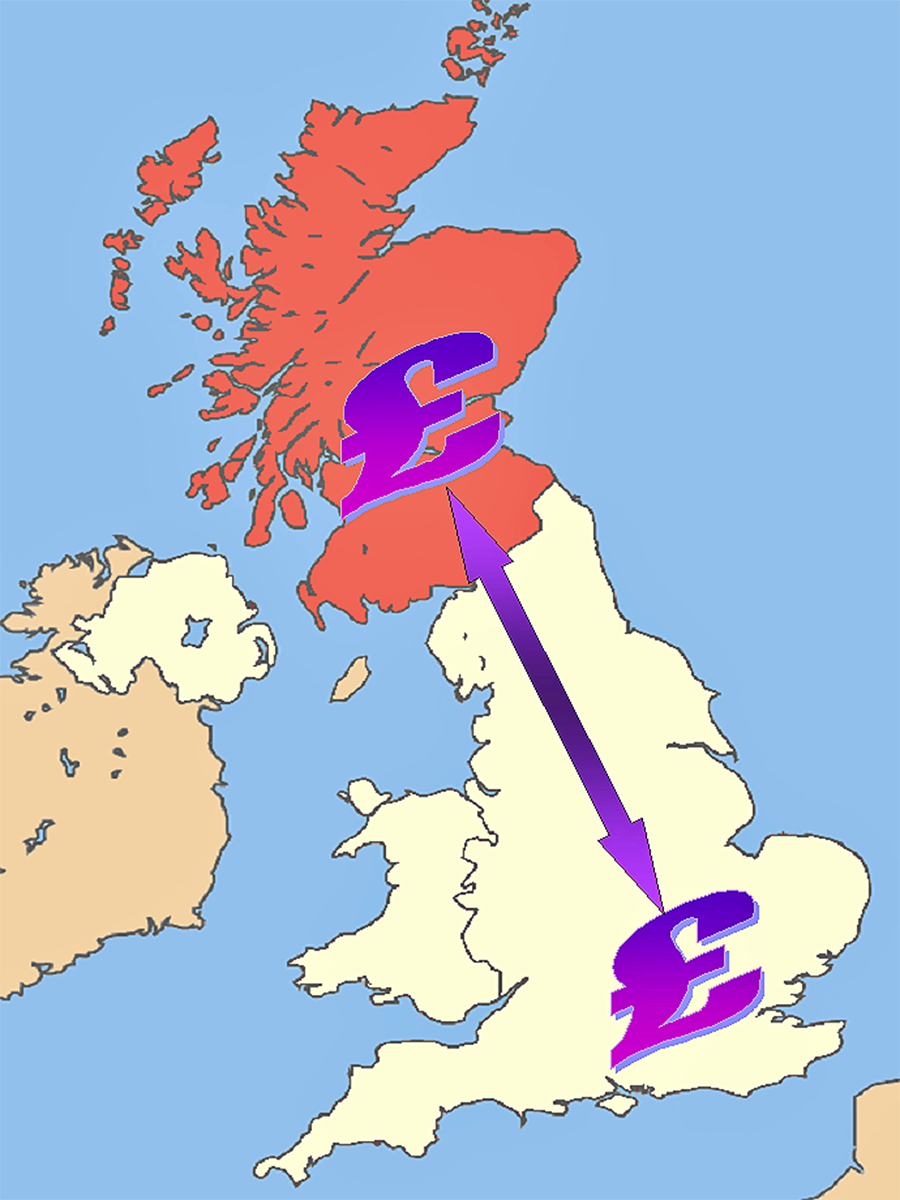
Will there be a currency union, with Scotland and the rest of the UK sharing the pound and a central bank? Or will Scotland merely use the pound outside a currency union? Would it prefer to have its own currency or join the euro over the longer term? |
| • |
What will happen to the sterling exchange rate with the dollar, the euro and various other countries? |
| • |
How will businesses react? Will independence encourage greater inward investment in Scotland or will there be a net capital outflow? And either way, what will be the magnitude of the effect? |
| • |
How will assets, such as oil, be shared between Scotland and the rest of the UK? And how will national debt be apportioned? |
| • |
How big will the transition costs be of moving to an independent Scotland? |
| • |
How will independence impact on Scottish trade (a) with countries outside the UK and (b) with the rest of the UK? |
| • |
What will happen about Scotland’s membership of the EU? Will other EU countries, such as Spain (because of its concerns about independence movements in Catalonia and the Basque country), attempt to block Scotland remaining in or rejoining the EU? |
| • |
What will happen to tax rates in Scotland, with the new Scottish government free to set its own tax rates? |
| • |
What will be the consequences for Scottish pensions and the Scottish pensions industry? |
| • |
What will happen to the distribution of income in Scotland? How might Scottish governments behave in terms of income redistribution and what will be its consequences on output and growth? |
Of course, just because the effects cannot be known with certainty, attempts are constantly being made to quantify the outcomes in the light of the best information available at the time. These are refined as circumstances change and newer data become available.
 But forecasts also depend on the assumptions made about the post-referendum decisions of politicians in Scotland, the rest of the UK and in major trading partner countries. It also depends on assumptions about the reactions of businesses. Not surprisingly, both sides of the debate make assumptions favourable to their own case.
Then there is the second category of question. Even if you could quantify the effects, just how desirable would they be? The issue here is one of the weightings given to the various costs and benefits. How would you weight distributional consequences, given that some people will gain or lose more than others? What social discount rate would you apply to future costs and benefits?
Then there are the normative and largely unquantifiable costs and benefits. How would you assess the desirability of political consequences, such as greater independence in decision-making or the break-up of a union dating back over 300 years? But these questions about nationhood are crucial issues for many of the voters.
Articles
Scottish Independence would have Broad Impact on UK Economy NBC News, Catherine Boyle (9/9/14)
Scottish independence: the economic implications The Guardian, Angela Monaghan (7/9/14)
Scottish vote: Experts warn of potential economic impact BBC News, Matthew Wall (9/9/14)
The economics of Scottish independence: A messy divorce The Economist (21/2/14)
Dispute over economic impact of Scottish independence Financial Times, Mure Dickie, Jonathan Guthrie and John Aglionby (28/5/14)
10 economic benefits for a wealthier independent Scotland Michael Gray (6/3/14)
Scottish independence, UK dependency New Economics Foundation (NEF), James Meadway (4/9/14)
Scottish Jobs and the World Economy Scottish Economy Watch, Brian Ashcroft (25/8/14)
Scottish yes vote: what happens to the pound in your pocket? Channel 4 News (9/9/14)
What price Scottish independence? BBC News, Robert Peston (12/9/14)
What price Scottish independence? BBC News, Robert Peston (7/9/14)
Economists can’t tell Scots how to vote BBC News, Robert Peston (16/9/14)
Books and Reports
The Economic Consequences of Scottish Independence Scottish Economic Society and Helmut Schmidt Universität, David Bell, David Eiser and Klaus B Beckmann (eds) (August 2014)
The potential implications of independence for businesses in Scotland Oxford Economics, Weir (April 2014)
Questions
- What is a currency union? What implications would there be for Scotland being in a currency union with the rest of the UK?
- If you could measure the effects of independence over the next ten years, would you treat £1m of benefits or costs occurring in ten years’ time the same as £1m of benefits and costs occurring next year? Explain.
- Is it inevitable that events occurring in the future will at best be known unknowns?
- If you make a statement that something will occur in the future and you turn out to be wrong, was your statement a positive one or a normative one?
- What would be the likely effects of Scottish independence on the current account of the balance of payments (a) for Scotland; (b) for the rest if the UK?
- How does inequality in Scotland compare with that in the rest of the UK and in other countries? Why might Scottish independence lead to a reduction in inequality? (See the chapter on inequality in the book above edited by David Bell, David Eiser and Klaus B Beckmann.)
- One of the problems in assessing the arguments for a Yes vote is uncertainty over what would happen if there was a majority voting No. What might happen in terms of further devolution in the case of a No vote?
- Why is there uncertainty over the amount of national debt that would exist in Scotland if it became independent?
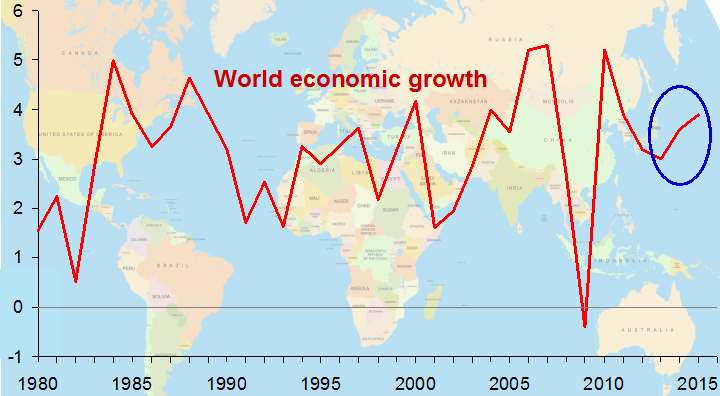 The IMF has just published its 6-monthly World Economic Outlook report. The report is moderately optimistic, arguing that ‘global activity has broadly strengthened and is expected to improve further in 2014–15’. World growth is expected to rise from 3.0% in 2013 to 3.6% in 2014 and 3.9% in 2015,
Much of the impetus for an acceleration in growth is expected to come from advanced countries. Growth in these countries is expected to average 2¼% in 2014–15, a rise of 1 percentage point compared with 2013. Part of the reason is that these countries still have large output gaps and thus have considerable scope to respond to rises in aggregate demand.
Monetary policy in advanced countries remains accommodative, although the USA has begun to taper off its quantitative easing programme. It is possible, however, that the ECB may make its monetary policy more accommodative, with signs that it might embark on quantitative easing if eurozone growth remains weak and if the risks of deflation rise. If the average price level in the eurozone does fall, this could dampen demand as consumers defer consumption until prices have fallen.
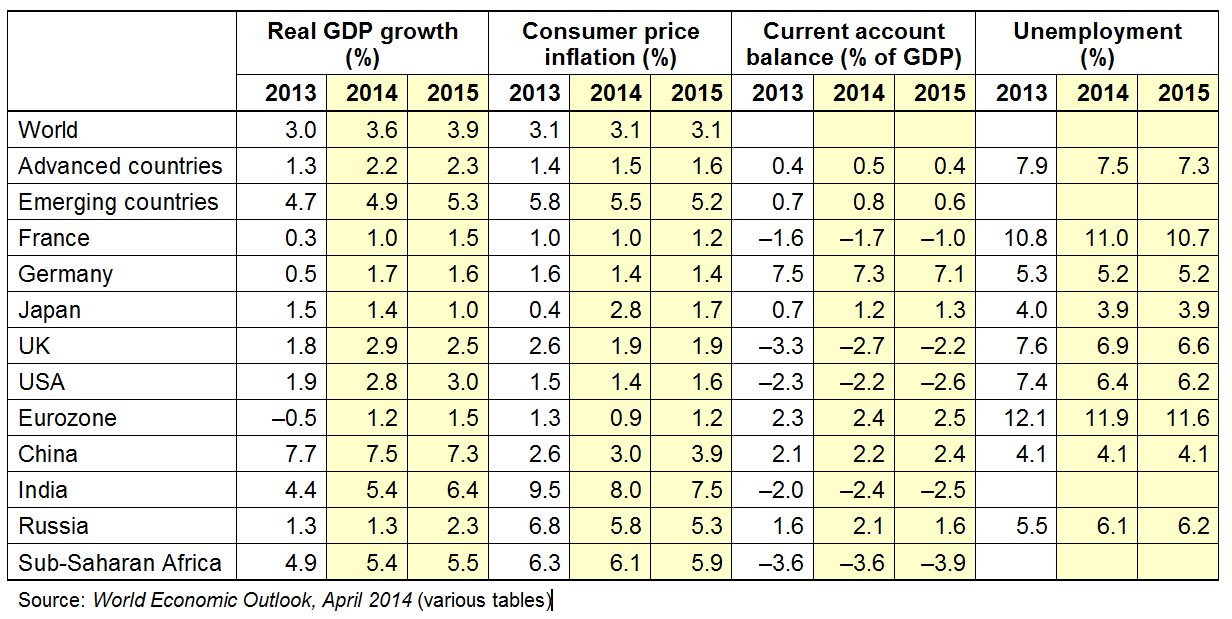
As far as emerging economies are concerned, growth is projected to ‘pick up gradually from 4.7 percent in 2013 to about 5 percent in 2014 and 5¼% in 2015’. Although predicted growth is higher in emerging countries than in advanced countries, its acceleration is less, and much of the predicted growth is dependent on rising export sales to the advanced countries.
Global growth, however, is still fragile. Emerging market economies are vulnerable to a slowing or even reversal of monetary flows from the USA as its quantitative easing programme winds down. Advanced countries are vulnerable to deflationary risks. ‘The result [of deflation] would be higher real interest rates, an increase in private and public debt burdens, and weaker demand and output.’
The UK is predicted to have the strongest growth (2.9%) of the G7 countries in 2014 (see above chart). But the IMF cautions about being too optimistic:
Growth has rebounded more strongly than anticipated in the United Kingdom on easier credit conditions and increased confidence. However, the recovery has been unbalanced, with business investment and exports still disappointing.
Articles
IMF: World economy stronger; recovery uneven USA Today, Paul Davidson (8/4/14)
Emerging markets feel the pressure The Telegraph, Szu Ping Chan (8/4/14)
IMF cuts downturn danger to near zero Financial Times, Chris Giles (8/4/14)
IMF warns eurozone and ECB on deflation threat RTE News (8/4/14)
Recovery strong but risk shifts to emerging markets: IMF CNBC, Kiran Moodley (8/4/14)
IMF: World economy is stronger but faces threats Bloomberg Businessweek, Christopher S. Rugaber (8/4/14)
IMF: UK economic growth to reach 2.9% in 2014 BBC News (8/4/14)
 IMF: UK economic growth to reach 2.9% in 2014 BBC News, Hugh Pym (8/4/14)
Five signs that the global economic recovery may be an illusion The Guardian, Larry Elliott (6/4/14)
Report and data
World Economic Outlook (WEO) International Monetary Fund (8/4/14)
World Economic Outlook Database IMF (8/4/14)
Questions
- Why does the IMF expect the world economy to grow more strongly in 2014 and 2015 than in 2013?
- What are the greatest risks to economic growth for (a) advanced countries; (b) developing countries?
- What geo-political events could negatively affect economic growth in (a) the eurozone; (b) the global economy?
- In what ways is the UK’s economic growth unbalanced?
- How much credence should be given to economic forecasts?
- Should countries’ economic performance be judged primarily by their growth in GDP?
As the old year gives way to the new, papers have been full of economic forecasts for the coming year. This year is no exception. The authors of the articles below give their predictions of what is to come for the global economy and, for the most part, their forecasts are relatively optimistic – but not entirely so. Despite a sunny outlook, there are various dark clouds on the horizon.
Most forecasters predict a higher rate of global economic growth in 2014 than in 2013 – and higher still in 2015. The IMF, in its October forecasts, predicted global growth of 3.6% in 2014 (up from 2.9% in 2013) and 4.0% in 2015.
Some countries will do much better than others, however. The USA, the UK, Germany and certain developing countries are forecast to grow more strongly. The eurozone as a whole, however, is likely to see little in the way of growth, as countries such as Greece, Spain, Portugal and Italy continue with austerity policies in an attempt to reduce their debt. 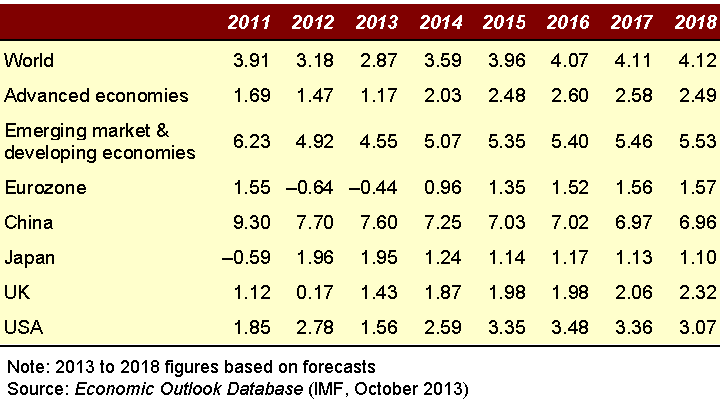 Chinese growth has slowed, as the government seeks to rebalance the economy away from exports and investment in manufacturing towards consumption, and services in particular. It is still forecast to be 7.3% in 2014, however – well above the global average. Japanese growth has picked up in response to the three arrows of fiscal, monetary and supply-side policy. But this could well fade somewhat as the stimulus slows. The table shows IMF growth forecasts for selected countries and groups of countries to 2018.
Much will depend on what happens to monetary policy around the world. How quickly will monetary stimulus taper in the USA and in Japan? Will the ECB introduce more aggressively expansionary monetary policy? When will the Bank of England start raising interest rates?
Growth within countries is generally favouring those on higher incomes, with the gap between rich and poor set to continue widening over the coming years. The pay of top earners has continued to rise considerably faster than prices, while increasingly flexible labour markets and squeezed welfare budgets have seen a fall in living standards of many on low incomes. According to a Which? survey (reported in the Independent article below), in the UK:
Only three in ten expect their family’s situation to improve in the new year, while 60% said they are already dreading the arrival of their winter energy bill. The Which? survey also found that 13 million people could afford to pay for Christmas only by borrowing, with more than four in ten using credit cards, loans or overdrafts to fund their festive spending. A third of people (34%) also dipped into their savings, taking an average of £450 from their accounts.
If recovery is based on borrowing, with real incomes falling, or rising only very slowly, household debt levels are likely to increase. This has been stoked in the UK by the ‘Help to Buy‘ scheme, which has encouraged people to take on more debt and has fuelled the current house price boom. This could prove damaging in the long term, as any decline in confidence could lead to a fall in consumer expenditure once more as people seek to reduce their debts.
 And what of the global banking system? Is it now sufficiently robust to weather a new crisis. Is borrowing growing too rapidly? Is bank lending becoming more reckless again? Are banks still too big to fail? Is China’s banking system sufficiently robust? These are questions considered in the articles below and, in particular, in the New York Times article by Gordon Brown, the former Prime Minister and Chancellor of the Exchequer.
Articles
Global economy: hopes and fears for 2014The Observer, Heather Stewart and Larry Elliott (29/12/13)
Looking ahead to 2014 BBC News, Linda Yueh (20/12/13)
Low hopes for a happy new financial year in 2014 Independent, Paul Gallagher (29/12/13)
Brisk UK economic growth seen in 2014 fuelled by spending – Reuters poll Reuters, Andy Bruce (12/12/13)
GLobal Economy: 2014 promises faster growth, but no leap forward Reuters, Andy Bruce (29/12/13)
My 2014 Economic Briefing Huffington Post, Tony Dolphin (27/12/13)
Three UK Economy Stories that will Dominate in 2014 International Business Times, Shane Croucher (27/12/13)
Who You Calling a BRIC? Bloomberg, Jim O’Neill (12/11/13)
Hope and Hurdles in 2014 Project Syndicate, Pingfan Hong (27/12/13)
On top of the world again The Economist (18/11/13)
Digging deeper The Economist (31/10/13)
BCC Economic Forecast: growth is gathering momentum, but recovery is not secure British Chambers of Commerce (12/13)
Eight predictions for 2014 Market Watch, David Marsh (30/12/13)
Stumbling Toward the Next Crash New York Times, Gordon Brown (18/12/13)
Central banks must show leadership to rejuvenate global economy The Guardian, Larry Elliott (1/1/14)
Global economy set to grow faster in 2014, with less risk of sudden shocks The Guardian, Nouriel Roubini (31/12/13)
A dismal new year for the global economy The Guardian, Joseph Stiglitz (8/1/14)
Forecasts and reports
World Economic Outlook (WEO) IMF (October 2013)
Economic Outlook OECD (November 2013)
Output, prices and jobs The Economist
Bank of England Inflation Report: Overview Bank of England (November 2013)
Questions
- What reasons are there to be cheerful about the global economic prospects for 2014 and 2015?
- Who will gain the most from economic growth in the UK and why?
- Why is the eurozone likely to grow so slowly, if at all?
- Are we stumbling towards another banking crisis, and if so, which can be done about it?
- Why has unemployment fallen in the UK despite falling living standards for most people?
- What is meant by ‘hysteresis’ in the context of unemployment? Is there a problem of hysteresis at the current time and, if so, what can be done about it?
- Explain whether the MINT economies are likely to be a major source of global economic growth in the coming year?
- Why is it so difficult to forecast the rate of economic growth over the next 12 months, let alone over a longer time period?
 But it’s the ‘ceteris paribus‘ assumption that’s the problem. Other things are not equal. The world is constantly changing and there are all sorts of unpredictable events that will influence the outcomes of economic policy and of economic decisions more generally. And central to the problem are people’s attitudes and confidence. Mood can swing quite dramatically, from irrational exuberance to deep pessimism. And such mood changes – often triggered by some exogenous factor, such as an international dispute, an election or unexpected economic news – can rapidly gather momentum and have significant effects.