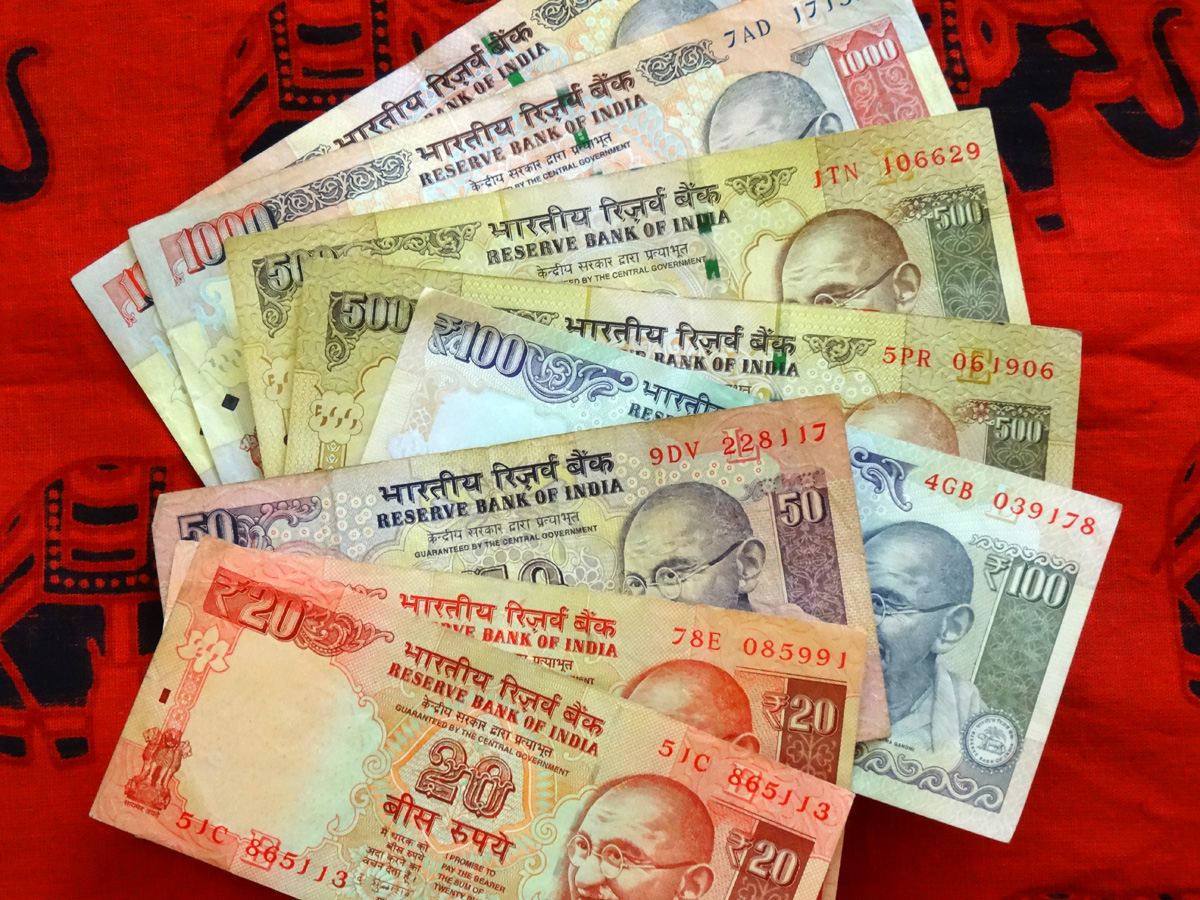
 The expansion of the BRIC economies has both advantages and disadvantages for Western countries. Their consistently high growth rates have created a much wider market place for Western firms and a much needed additional source of consumer demand, especially in times of recession. Countries such as China have had double digit growth rates, with others like India experiencing growth rates of just under 10%. But are these impressive growth rates now beginning to fall?
For the last 2 years, the growth rate in the Indian economy has been sub-5%, with growth in the 2013-14 financial year at 4.7%. Though some sectors, including agriculture have experienced buoyant growth, it is other sectors that have been holding this economy back. Manufacturing contracted at an annualised rate of 1.4% over the quarter, while mining contracted by 0.4%. With a growth rate of just under 5%, one might think that this was good – after all many Western economies have only recently entered positive growth. However, the Indian economy has a rapidly growing population and it is estimated that 10 million additional jobs each year must be created. It is this figure that requires such a high growth rate – estimated at around 8%. Thus, the sub-5% growth recorded for 2 years is insufficient to sustain the required job creation.
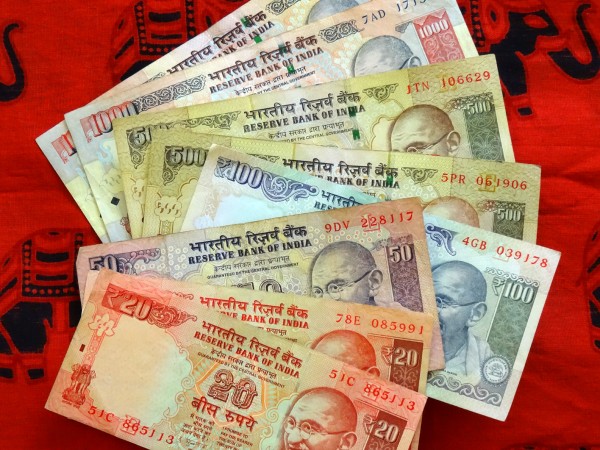
There are many factors that appear to be holding growth back. High inflation has been a problem for some years and the Indian currency has been relatively weak and volatile. Together, these issues have created an environment of uncertainty and if there’s one thing that investors don’t like, it’s uncertainty. This has therefore led to a lack of investment in the economy, which is a key component of aggregate demand and hence a key source of economic growth. Furthermore, interest rates rose last year, thereby pushing up the cost of borrowing and the rate of credit growth has also slowed. These factors collectively have led to lower foreign investment, domestic investment and spending, which have all contributed towards more subdued growth than in the past. Glenn Levine, a senior economist at Moody’s said:
India’s economy continues to grow well below potential as a combination of supply‐side constraints and the adverse effects of an underperforming government weigh on capital expenditure and hiring … It will be a while before the Indian economy is expanding above 6% again.
However, many economists remain optimistic about the prospects of Asia’s third-largest economy. Inflation appears to be under control and the currency has gained strength. Many believe that more investment supporting government policies will be the kick start the economy needs and this will in turn encourage firms to begin investment. It may be the new leader of this country, Narendra Modo, that will jump start the economy. The Prime Minister is expected to back policies to stimulate growth, who will direct more spending at infrastructure, simplify taxes and introduce policies to attract foreign investment. Adi Godrej, Chairman of the Godrej group said:
As soon as investors see the first signals of growth-supportive policies, you will see a definite turnaround on the ground.
The coming months will be crucial in determining how quickly the Indian economy is likely to see a return to near double digit growth. The new government has indeed promised policies to boost the economy, but the annual budget will confirm whether this promise is likely to be kept. Given the dependence of Indian jobs on a fast growth rate and the dependence of the Western world on the continued growth of the BRICs in creating a wider market for our exports, the fortunes of India are extremely important. The following articles consider this economy.
Indian economy grew at 4.7% in 2013-14 The Times of India (30/5/14)
India’s economic growth disappoints BBC News (30/5/14)
India’s GDP grows 4.7% in fiscal year, missing government forecast Wall Street Journal, Anant Vijay Kala (30/5/14)
India’s economy expands 4.7pct in fiscal year 2013/14 Reuters (30/5/14)
India’s economy still underwhelms CNN Money, Charles Riley, Alanna Petroff (30/5/14)
FY14 GDP growth at 4.7%; India sees worst slowdown in 25 years The Economic Times (30/5/14)
India growth below 5% adds pressure on Modi to spur investment Bloomberg, Unni Krishnan (30/5/14)
Jim Armitage: ‘Modinomics’ in India has helped growth, but not for all Independent, Jim Armitage (17/5/14)
Questions
- Using a diagram, explain how economic growth can be created through (a) demand-side measures and (b) supply-side measures.
- Why would higher interest rates reduce growth?
- Why does high inflation create uncertainty and what impact does this have on business investment?
- India has experienced a weak and volatile currency and this has contributed towards a lack of foreign investment and low growth. Using a diagram, explain why this could be the case.
- What sort of government policies would you recommend for the Indian economy if you had become the new Prime Minister and your primary objective was to boost economic growth?
- Why is the expansion of the BRIC economies, of which India is one, so important for Western economies?
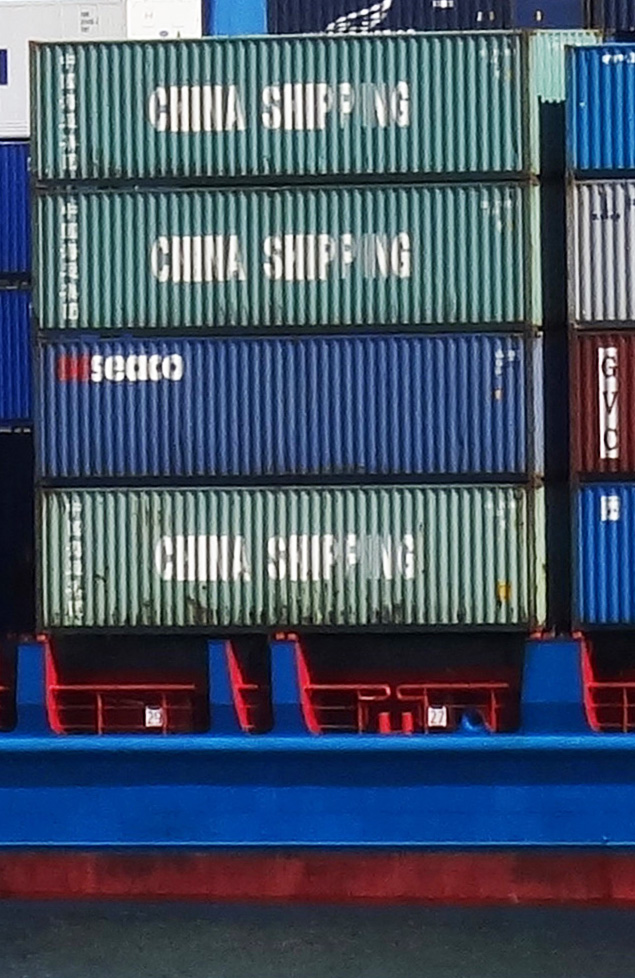 Globalisation has led to an increasingly interdependent world, with companies based in one country often dependent on a market abroad. In recent years, it is the rapid growth of countries like China that has led to growth in the size of the markets for many products. With incomes rising in emerging countries, demand for many products has been growing, but in the past year, the trend for Prada has ended and seems to be reversing.
As the market in China matures and growth of demand in Europe slows, Prada has seen its shares fall by the largest margin since June last year.
Prada is a well-known luxury brand. The products it sells are relatively expensive and hence its products are likely to have an income elasticity of demand well above +1. With changes in China and Europe, Prada expects its growth in sales to January 2015 will be ‘low single-digit’ – less than the 7% figure recorded for the last financial year.
 This lower growth in same-store sales is likely to continue the following year as well. Add on to this the lower-than-expected profits, which missed analysts’ forecasts, and you have a prime example of a brand that is suffering because of its customer base and the economic times.
Prada isn’t alone in suffering from economic conditions and, relative to its European counterparts, is expected to have higher growth in sales and profits in the next 12 months – at 11.5% and 14.8% respectively. This is according to a survey by Thomson Reuters.
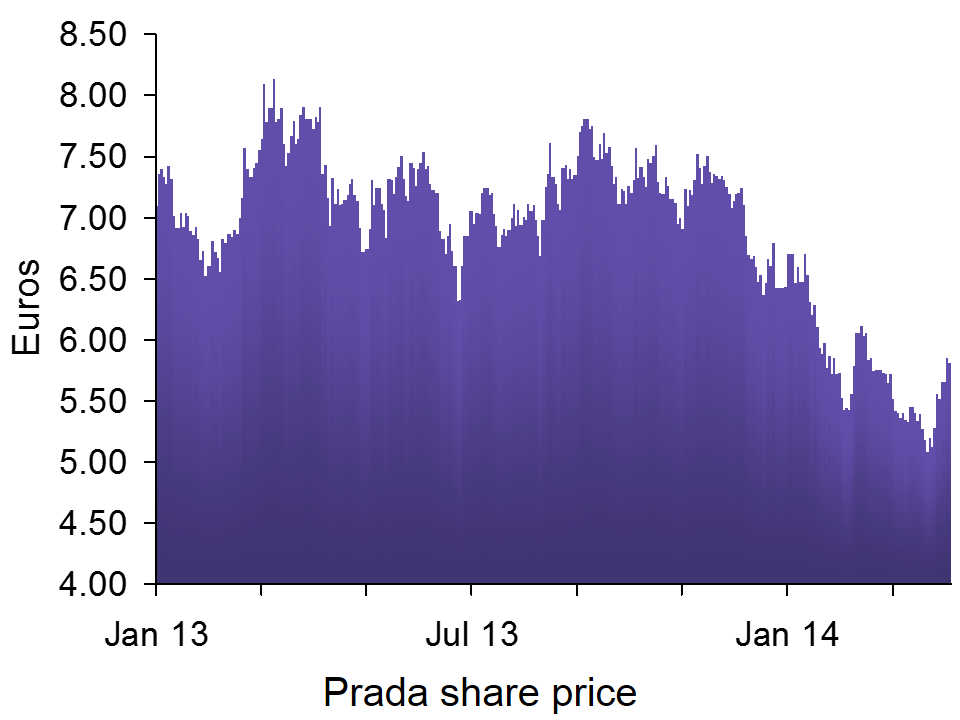 Prada has exploited high demand by Chinese consumers, but has recently been affected by the strength of the euro. A strong euro means that the Italian-based Prada is struggling with exports, which only adds to its problems. As economic growth picks up in China and as other emerging economies begin to experience more rapid economic growth, the fortunes of this luxury-retailer may change once more. However, with volatile economic times still around in many countries, the future of many retailers selling high-end products to higher income customers will remain uncertain. The following articles consider the fortunes of Prada.
Prada shares fall sharply after China luxury warning BBC News (3/4/14)
Prada falls after forecasting slowing luxury sales growth Bloomberg, Andrew Roberts and Vinicy Chan (3/4/14)
Prada profits squeezed by weakness in Europe and crackdown in China The Guardian (2/4/14)
Prada bets on men to accelerate sales growth Reuters, Isla Binnie (2/4/14)
Prada misses full year profit forecast Independent, Laura Chesters (2/4/14)
Questions
- How can we define a luxury product?
- Explain the main factors which have led to a decline in the demand for Prada products over the past 12 months.
- Using a diagram, illustrate what is meant by a strong euro and how this affects export demand.
- What business strategies are Prada expected to adopt to reverse their fortunes?
- Using a diagram, explain the factors that have caused Prada share prices to decline.
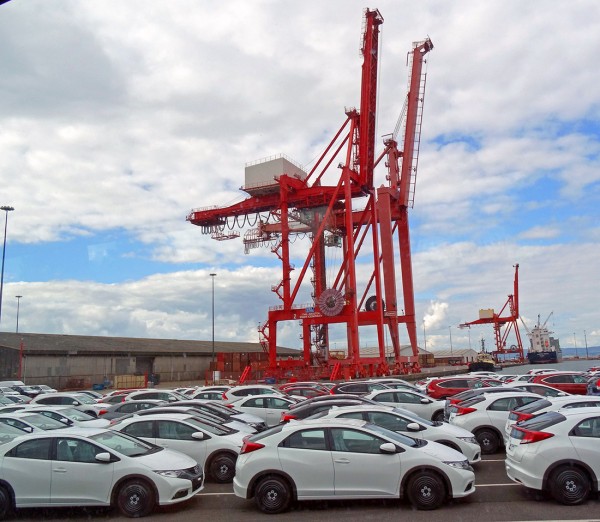 The latest balance of payments data for the UK show that in the final two quarters of 2013 the current account deficit as a percentage of GDP was the highest ever recorded. In quarter 3 it was 5.6% of GDP and in quarter 4 it was 5.4% of GDP. The previous highest quarterly figures were 5.3% in 1988 Q4 and 5.2% in 1989 Q3. The average current account deficit from 1960 to 2013 has been 1.1% of GDP and from 1980 to 2013 has been 1.6% of GDP.
The current account has four major components: the balance on goods, the balance on services, the balance on current transfers and the balance on income flows (e.g. investment income). The chart below shows the annual balances of each of these components, plus the overall current account balance, from 1960 to 2013.
There are large differences in the balances of these four and the differences seem to be widening. (Click here for a PowerPoint of the chart.)
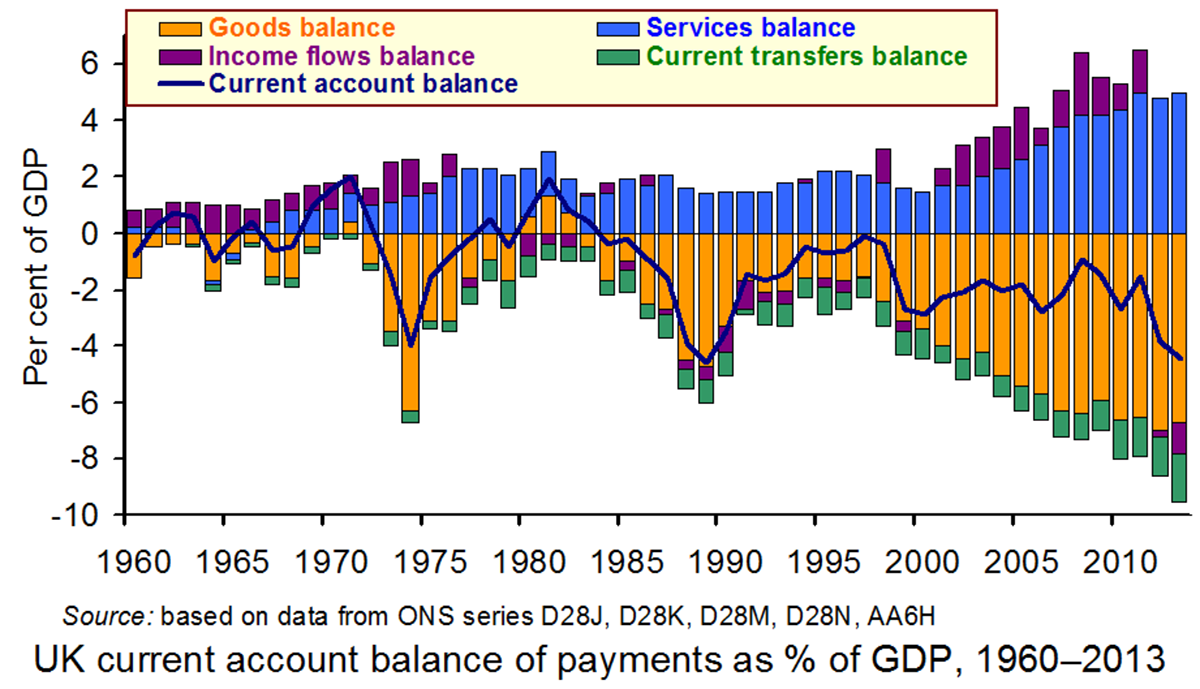
Traditionally the balance on goods has been negative. In 2013 Q3 the deficit on goods reached a record 7.3% of GDP. It fell back somewhat in Q4 to 6.5%, still significantly above the average since 2000 of 5.5%. With the economy still recovering slowly, it would normally be expected that the trade deficit would be low. However, the high exchange rate has made it difficult for UK exporters to compete. Also with consumer confidence returning, imports are rising, again boosted by the high exchange rate, which makes imports cheaper.
The services balance, by contrast, is typically in surplus. In the final two quarters of 2013, the surpluses were 4.9% and 5.1% of GDP respectively. These compare with an average of 3.3% since 2000. It seems that the service sector, which includes banking, insurance, consultancy, advertising, accountancy, law, etc., is much more able to compete in a global environment.
The balance of current transfers to and from such bodies as the EU and UN have traditionally been negative, although as a proportion of GDP this has gradually widened in recent years. In 2013 the deficit was 1.7% compared with an average of 1.0% since 2000.
 The most dramatic change has been in income flows and particularly those from investment. Before the crash in late 2008, the returns to many of the risky investments abroad made by UK financial institutions were very high. Income flows in the 12 months 2007 Q4 to 2008 Q3 averaged a surplus of 2.8% of GDP. They stayed positive, albeit at lower levels, until 2012 Q1, but then became negative as UK institutions reduced their exposure to overseas investments and as earnings in the UK by overseas investors increased. In the last two quarters of 2013, the deficits on income flows were 1.4% and 2.5% of GDP respectively.
How do these figures accord with the Chancellor’s desire to rebalance the economy towards exports? In terms of services, the export performance is good. In terms of goods, however, exports actually fell in the last two quarters from £78.4bn to £74.8bn. Although imports fell too in the final quarter, there is a danger that, with recovery and a high pound, these could begin to rise rapidly
 So should the Bank of England attempt to bring the sterling exchange rate down? After all, the exchange rate index has risen from 79.1 in March 2013 to 85.9 in February 2014 (an appreciation of 8.6%). But if it did want to do so, what could it do? The traditional methods of reducing Bank rate and increasing the money supply are not open to it at the present time: Bank rate, at 0.5%, is already about as low as it could go and the Bank has ruled out any further quantitative easing.
The articles consider the latest balance of payments figures and their implications for the economy and for economic policy
Articles
UK current account deficit far bigger than forecast The Guardian, Katie Allen (28/3/14)
UK current account deficit near record high at £22.4bn BBC News (28/3/14)
UK current account gap second widest on record The Telegraph, Szu Ping Chan (28/3/14)
When will the UK pay its way? BBC News, Robert Peston (28/3/14)
Current account deficit crisis creeping up on UK can no longer be ignored The Guardian, Larry Elliott (30/3/14)
Data
Balance of Payments, Q4 and annual 2013 ONS (28/3/14)
Statistical Interactive Database – interest & exchange rates data Bank of England
Questions
- If the current account is in deficit, how is the overall balance of payments in balance (i.e. is in neither deficit nor surplus)?
- If the current account is in record deficit, why has sterling appreciated over recent months? What effect is this appreciation likely to have on the balance on trade in goods and services?
- Why has the balance on investment income deteriorated? In what ways could this be seen as a ‘good thing’?
- To what extent do the balance of payments figures show a rebalancing of the economy in the way the Chancellor would like?
- What could the Bank of England do to bring about a depreciation of sterling?
- What would be the benefits and costs of a depreciation of sterling?
- Why do investors overseas seem so willing to lend to the UK, thereby producing a large surplus on the financial account?
 According to latest evidence from the Bank for International Settlements, in April 2013 some £3.2 trillion ($5.3 trillion) of foreign exchange was traded daily on global foreign exchange (forex) markets. About 40% of forex dealing goes through trading rooms in London. This market is highly profitable for the UK economy. But all is not well with the way people trade. There is a scandal about rate fixing.
Exchange rates on the forex market are freely determined by demand and supply and fluctuate second by second, 24 hours a day, except for weekends. Nevertheless, once a day rates are fixed for certain trades. At 4pm GMT a set of reference rates is set for corporate customers by banks and other traders. The rates are set at the free market average over the one minute from 16:00 to 16:01. The allegation is that banks have been colluding, through text messaging and chat rooms, to manipulate the market over that one minute.
Since the early summer of 2013, the Financial Conduct Authority (FCA) in the UK, along with counterparts in the USA, Switzerland, Hong Kong and elsewhere, has been looking into these allegations. Last week (4/3/14), the Bank of England suspended a member of its staff as part of its own investigation into potential rigging of the foreign exchange market. The allegation is not that the staff member(s) were involved in the rigging but that they might have known about it.The Bank said that, “An oversight committee will lead further investigations into whether bank officials were involved in forex market manipulation or were aware of manipulation, or at least the potential for such manipulation.”
Meanwhile, the House of Commons Treasury Select Committee has been questioning Bank of England staff, including the governor, Mark Carney, about the scandal. Speaking to the Committee, Martin Wheatley, head of the FCA said that the investigation over rigging had been extended to 10 banks and that the allegations are every bit as bad as they have been with Libor.
Forex rigging ‘as serious as’ Libor scandal: Carney Yahoo News, Roland Jackson (11/2/14)
Forex manipulation: How it worked HITC (Here Is The City), Catherine Boyle (11/3/14)
Bank of England Chief Grilled Over Forex Scandal ABC News, Danica Kirka (11/3/14)
Carney Faces Grilling as Currency Scandal Snares BOE Bloomberg, Scott Hamilton and Suzi Ring (10/3/14)
UK financial body urges quick action over foreign exchange ‘fixing’ Reuters, Huw Jones (11/3/14)
Timeline -The FX “fixing” scandal Reuters, Jamie McGeever (11/3/14)
Forex in the spotlight Financial Times (16/2/14)
Forex scandal: What is that all about? BBC News (11/3/14)
 Bank of England in shake-up after rate manipulation criticism BBC News (11/3/14)
Mark Carney faces Forex questions from MPs BBC News, Hugh Pym (11/3/14)
Bank of England’s Paul Fisher: ‘It’s not our job to go hunting for market wrongdoing’ Independent, Russell Lynch , Ben Chu (11/3/14)
Questions
- For what reasons would sterling appreciate against the dollar?
- Most of forex trading is for speculative purposes, rather than for financing trade or investment. Why is this and does it benefit international trade?
- If foreign exchange rates fluctuate, is it not a good thing that banks collude to agree the 4pm fixed rate? Explain.
- What was the Libor scandal? Why are some people arguing that the current forex scandal is worse?
- What can the FCA do to prevent collusion over exchange rates?
 World markets were taken by surprise by a large rise in Turkish interest rates on 28/1/14. In an attempt to combat a falling lira and rising inflation, the Turkish central bank raised its overnight lending rate from 7.75% to 12%. Following the decision, the lira appreciated by over 3%.
Since the start of this year, the Turkish lira had depreciated by 7.1% and since the start of 2013 by 22.8%. Along with the currencies of several other emerging economies, such as India and Brazil, speculators had been selling the Turkish currency. This has been triggered by worries that the Fed’s tapering off its quantitative easing programme would lead to a fall, and perhaps reversal, of the inflow of finance into these countries; in the worst-case scenario it could lead to substantial capital flight.
Consumer price inflation in Turkey is currently 7.4%, up from 6.2% a year ago. The central bank, in a statement issued alongside the interest rate rise, said that it would continue with a tight monetary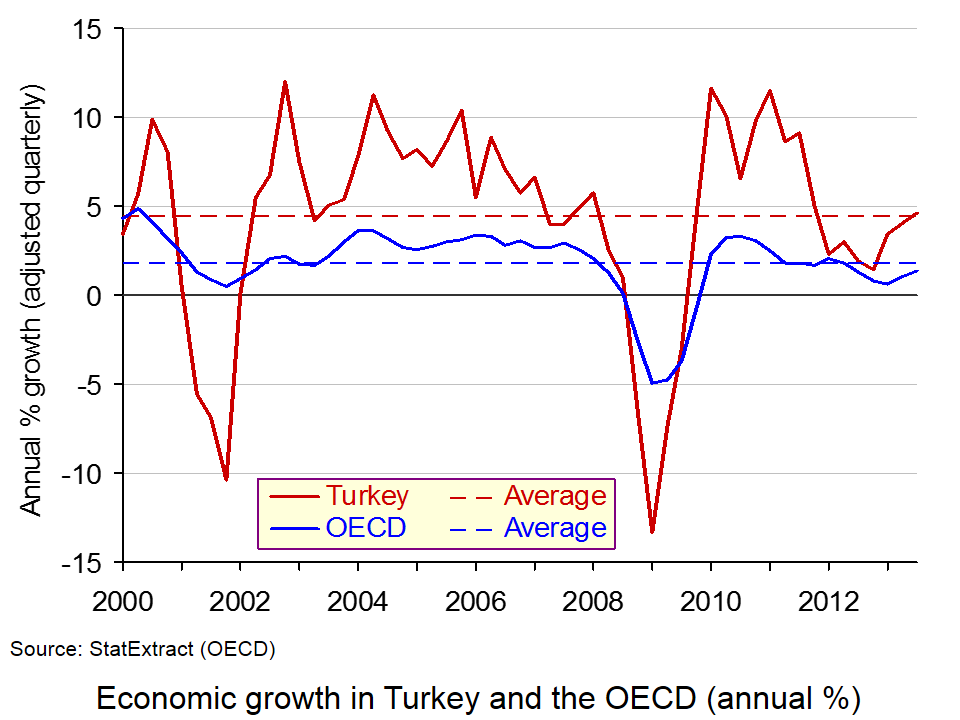 policy until the inflation outlook showed a clear improvement.
The Turkish Prime Minister, Tayyip Erdogan, has been opposed to rises in interest rates, fearing that the dampening effect on aggregate demand would reduce economic growth, which, as the chart shows, has been recovering recently (click here for a PowerPoint of the chart). A slowing of growth could damage his prospects in forthcoming elections.
World stock markets, however, rallied on the news, seeing the rise in interest rates as a symbolic step in emerging countries stemming outflows of capital.
Articles
Turkey raises interest from 7.75pc to 12pc The Telegraph (28/1/14)
Emerging markets forced to tighten by US and Chinese monetary superpowers The Telegraph, Ambrose Evans-Pritchard (28/1/14)
Turkey Gets Aggressive on Rates The Wall Street Journal, Joe Parkinson (28/1/14)
Turkish central bank raises lending rate to 12% BBC News (28/1/14)
Asian stock markets stage relief rally after Turkey rate rise BBC news (29/1/14)
Turkey raises rates to halt lira’s slide Financial Times, Daniel Dombey (29/1/14)
Turkey Rate Increase Stems Lira Drop as Basci Defies Erdogan Bloomberg Businessweek, Onur Ant and Taylan Bilgic (29/1/14)
Fragile economies under pressure as recovery prompts capital flight The Observer, Angela Monaghan (2/2/14)
Data
Main Economic Indicators (including Turkish data) OECD
Data on Turkey, World Economic Outlook database IMF
Turkey price indices Central Bank of the Republic of Turkey
Questions
- Why did the Turkish central bank decide to raise interest rates by such a large amount?
- Why has the Turkish lira been depreciating so much over the past few months? How has this been linked to changes in Turkey’s balance of payments and what parts of the balance of payments account have been affected?
- Why did global stock markets rally on the news from Turkey?
- What will be the impact of the central bank’s actions on (a) inflation; (b) economic growth?
- How has the USA’s quantitative easing programme affected developing countries?
 The expansion of the BRIC economies has both advantages and disadvantages for Western countries. Their consistently high growth rates have created a much wider market place for Western firms and a much needed additional source of consumer demand, especially in times of recession. Countries such as China have had double digit growth rates, with others like India experiencing growth rates of just under 10%. But are these impressive growth rates now beginning to fall?