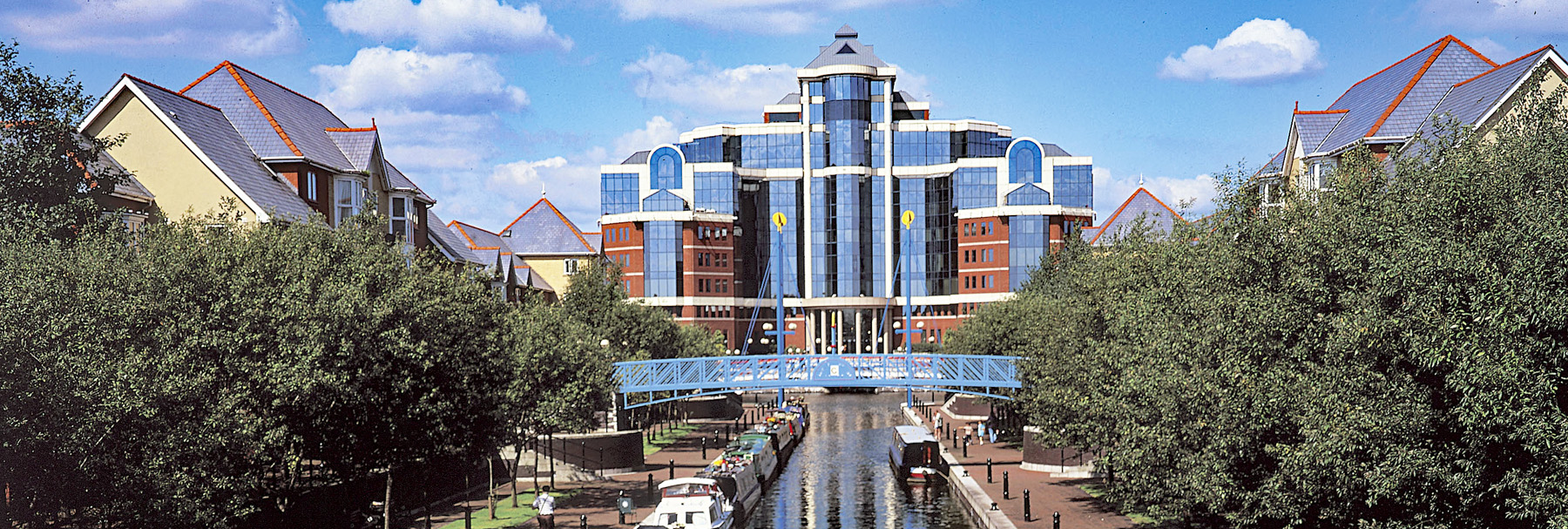
Andy Burnham is set to become UK Prime Minister on 20 July if no-one else stands to replace Keir Starmer. In a speech on 29 June, he outlined his economic vision. Central to this is devolution, where a greater number of economic decisions would be taken locally rather than by central government. This approach has been dubbed ‘Manchesterism’, in reference to his time as Mayor of Greater Manchester from 2017 to earlier this year. Under his mayoralty, Greater Manchester (GM) achieved faster economic growth than other regions or cities in the UK. From 2017 to 2023, GM’s gross value added grew by an average of 6.6% per annum and the city of Manchester’s by 8.4% – the highest of any city in the UK. The UK average was 4.9% and London’s was 4.6%.
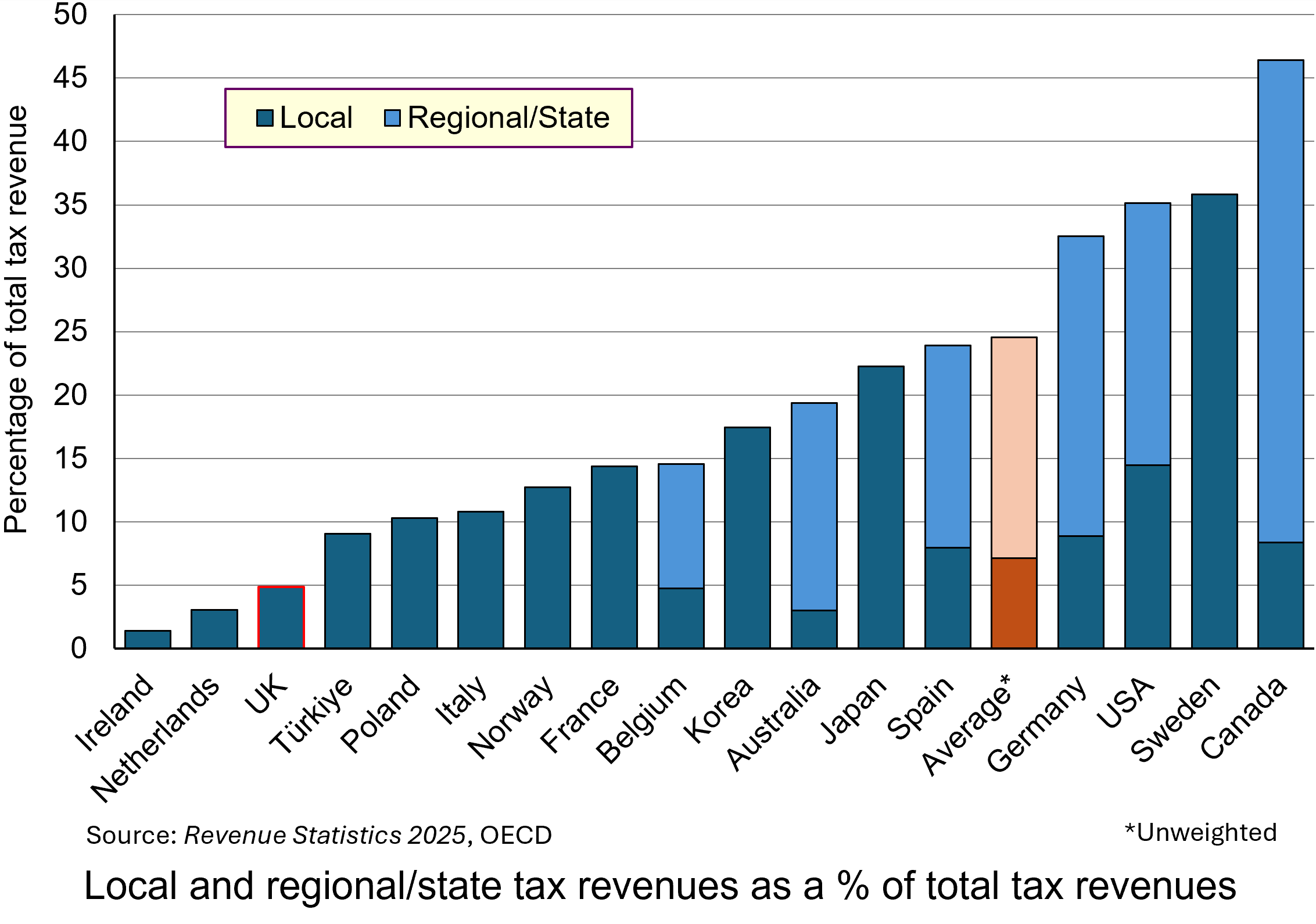 The UK, especially England, is one of the least devolved of the OECD countries. One aspect of this is taxation. The chart shows local taxes and, in the case of federal countries, state/regional/provincial taxes too. (Click here for a PowerPoint.)
Only 4.9% of UK tax revenue is in the form of local taxes (council tax and 50% of business rates) and the amount that can be raised in council tax is capped by the central government. The remainder of UK tax revenue goes to central government in the form of income taxes, social security taxes (national insurance), VAT, excise duties, etc. This compares with an average of 7.1% local taxes and 24.5% local plus regional taxes across the 17 OECD countries shown in the chart.
Andy Burnham plans to shift some of the spending and tax-raising powers from Whitehall to metro mayors and local councils. The aim is to stimulate productivity and economic growth at a regional and local level by tailoring support and incentives to local needs and strengths. Local leaders will be best positioned to understand these needs and strengths and will be able to customise spending and support appropriately.
 Examples of the types of greater autonomy over decision making would include:
- Control over adult education budgets to allow them to be tailored to provide training and apprenticeships to meet the skills requirements of existing and emerging industries in the area;
- Forming partnerships with local universities to support research and development that complements regional economic growth;
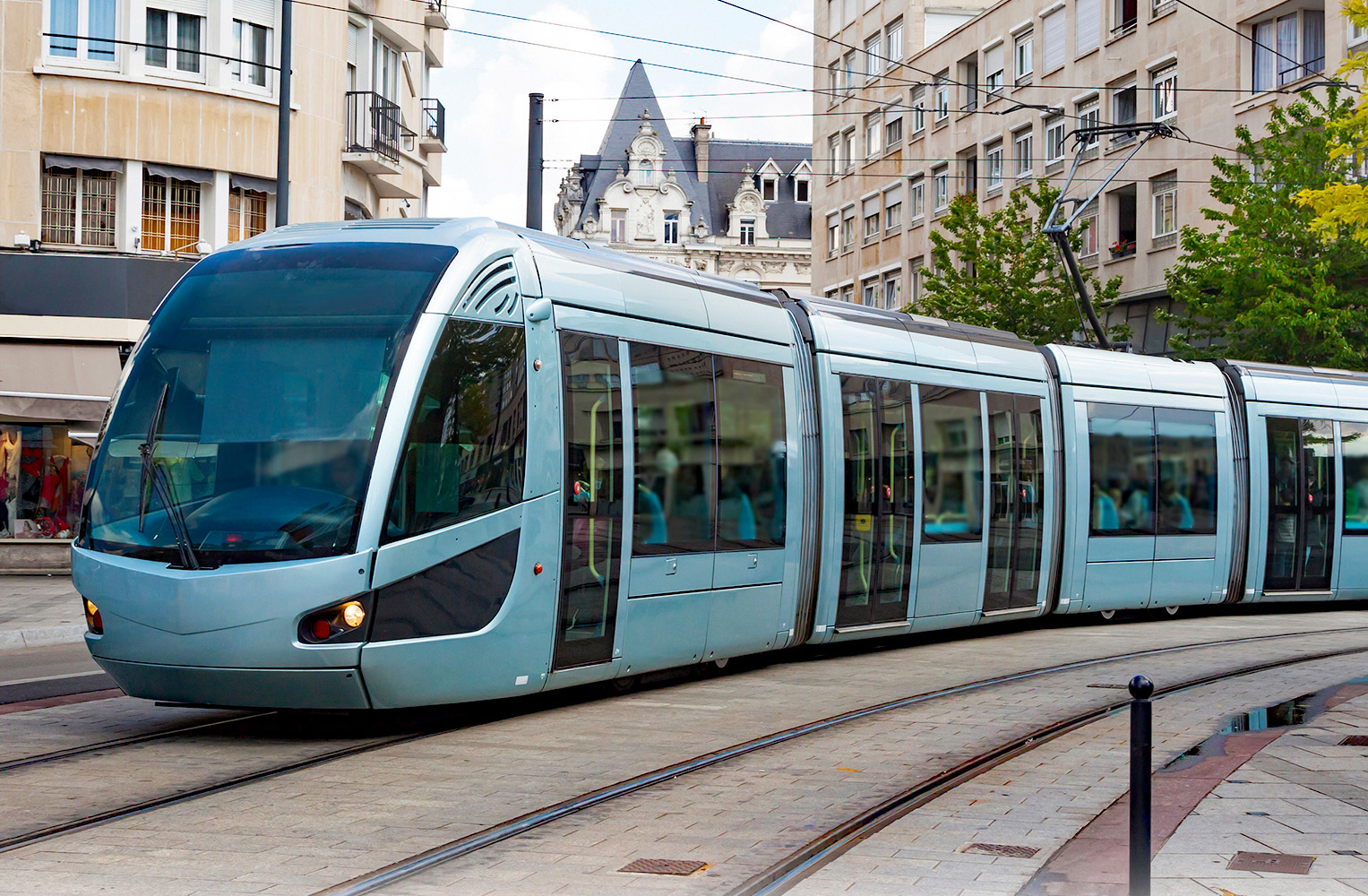
- Providing greater funding for and control over local transport infrastructure, including roads, buses, trams, trains, etc., with local consultation to make them fit for the local population and businesses;
- Tailoring business incentives to local needs and to the needs of the businesses themselves so as to attract an increase in investment;
- Greatly expanding council house building, which has virtually dried up in recent years, with mayors and/or local authorities empowered to develop local housing strategies, including affordable housing programmes, and to direct housing investment funding to particular housing developments in areas of greatest need.
Andy Burnham has pledged to stick to the government’s two existing fiscal rules:
a) The Stability Rule (Fiscal Mandate): the current (day-to-day) budget must be in balance or surplus. In other words the provision of salaries, public services, state pensions, welfare, etc. must be covered by government revenues (largely taxation). The government should borrow only to fund long-term investment.
b) The Debt Rule (Stock Mandate): each year, public-sector net financial liabilities (PSNFL) must be forecast by the OBR to be falling as a share of GDP compared to the previous year in three years’ time. This acts as a break on the amount of borrowing for long-term investment.
It is likely, therefore, that there will be little extra government money for investment. Rather, the policy involves a redistribution of public-sector investment from central government to mayoral/local authorities.
 In theory, such a policy of devolution need not see a redistribution from richer to poorer regions, but that might be part of the policy when the details are published. The UK has a bigger gap in productivity (GDP per worker) between its capital city and other large cities than in do other countries. Birmingham, Sheffield, Leeds, Newcastle, etc., as well as Cardiff, Glasgow, Edinburgh and Belfast, lag further behind London in output per head and economic growth than do other European countries lag behind their capital city. Thus the gap between Paris and Lyon, Toulouse and Marseille is narrower; as is that between Belin and Munich, Hamburg and Frankfurt. It is a similar picture in Spain and Italy. In the USA, some cities, such as San Francisco, outperform Washington DC and New York. A redistribution of government funding from London to the regions could see their incomes rise faster without having too much impact on London, which would still continue to attract large amounts of private investment.
Overall, there would be little increase in government funding. ‘Manchesterism’ is not, therefore, a demand-side policy. It is a supply-side policy – directing funds to areas where, combined with local incentives and local knowledge, the funding could yield greater returns and thereby increase potential GDP.
But this is not to say that there is no effect on aggregate demand. The hope is that devolution along the lines outlined by Andy Burnham will attract increased private investment, thereby increasing actual GDP as well as further increasing potential GDP.
We wait to see the details over the coming weeks.
Articles
- Will Andy Burnham’s devolution plan raise economic growth?
BBC Verify, Ben Chu (29/6/26)
- Burnham’s ‘Manchesterism’ could change the UK, but is not yet a full economic plan
BBC News, Faisal Islam (29/6/26)
- Burnham’s ‘Manchesterism’ got him to No 10 – but will it work for the UK?
BBC News, Faisal Islam (17/7/26)
- Burnham says there is some room for movement on tax
BBC News, Kate Wannel and Joshua Nevett (3/7/26)
- England’s mayors should be given sweeping new powers, says devolution expert
The Guardian, Kiran Stacey (2/7/26)
- What is Andy Burnham’s economic and political blueprint for Britain?
The Guardian, Richard Partington and Jessica Elgot (29/6/26)
- Why Andy Burnham’s radical plan relies on the Treasury being a friend of devolution
The Conversation, Dave Richards and Sam Warner (26/6/26)
- How Andy Burnham may try to give the UK economy a boost in his ‘10‑year plan’
The Conversation, Steve Schifferes (29/6/26)
- Could Andy Burnham let mayors raise more taxes?
House of Commons Research Briefing, Mark Sandford (2/7/26)
- Andy Burnham sets out policy plans in first major speech in PM leadership bid: Legal comments
Browne Jacobson, Dan Robinson (29/6/26)
- What does Andy Burnham think ‘Good Growth’ is?
Centre for Cities, Jess Tulasiewicz (30/6/26)
- Manchester’s digital transformation could be a blueprint for other parts of the UK
The Conversation, Richard Whittle (21/7/26)
Videos
Data
Questions
- Use an aggregate demand and supply diagram (simple or dynamic) to illustrate the effects on real GDP of a successful devolution strategy.
- Find out the details of the last Conservative government’s ‘levelling up’ policy. Was it similar in aims to that of ‘Manchesterism’?
- How could a policy of devolution as outlined by Andy Burnham affect income distribution within regions?
- Find out about the approach to regional policy in the EU. Is it similar to that being advocated by Andy Burnham?
- What is meant by ‘regional multipliers’? Why might they differ from the national multiplier?
 HS2 has been cancelled north of Birmingham. The prime minister, Rishi Sunak, announced this at the Conservative Party conference on 4 October, some 13 years after the plan was adopted by the Labour government to build a new high-speed railway from London to Birmingham, which then would branch into two legs – one to Manchester and one to Leeds. The initial budget for this was £15.8bn to £17.4bn. When it came to power, the Conservative-Liberal coalition government ordered a review of the plan. In light of this, the government gave the green light in January 2012 for the full Y-shaped project to go ahead. The London–Birmingham leg was planned to open in 2026 and the two northern legs from 2033.
 The project was divided into two phases: Phase 1 to Birmingham and Phase 2 to Manchester and Leeds. The Phase 1 parliamentary bill became law in February 2017 and soon after that, various construction contracts were signed. After some delays, preparation for construction work began in June 2019. There was growing doubt, however, about the viability of the northern legs.
On becoming prime minister in 2019, Boris Johnson ordered an independent review of the project after estimates that the costs of the full project would be some £88bn. The review, chaired by Douglas Oakervee, was published in December 2019 (for a link, see list of reports below). It found that costs (in 2015 prices) were likely to be between £62bn and £69bn. Nevertheless, it concluded that the project should proceed: that the original rationale for HS2 still held; that there were:
no shovel-ready alternative investments in the existing network that were available: if HS2 were to be cancelled, many years of planning work would be required to identify, design and develop new proposals; that the upgrading of existing lines would also come at a high passenger cost with significant disruption; that there would be serious consequences for the supply chain, the fragile UK construction industry and confidence in UK infrastructure planning if HS2 were to be cancelled at this late stage.
In February 2020, the prime minister announced that HS2 would go ahead, including the legs to Manchester and Leeds. The Department for Transport published a document (see source line to the following table) giving the full business case for Phase 1 and the outline case for Phase 2. The document itemised the costs and benefits as estimated at the time.
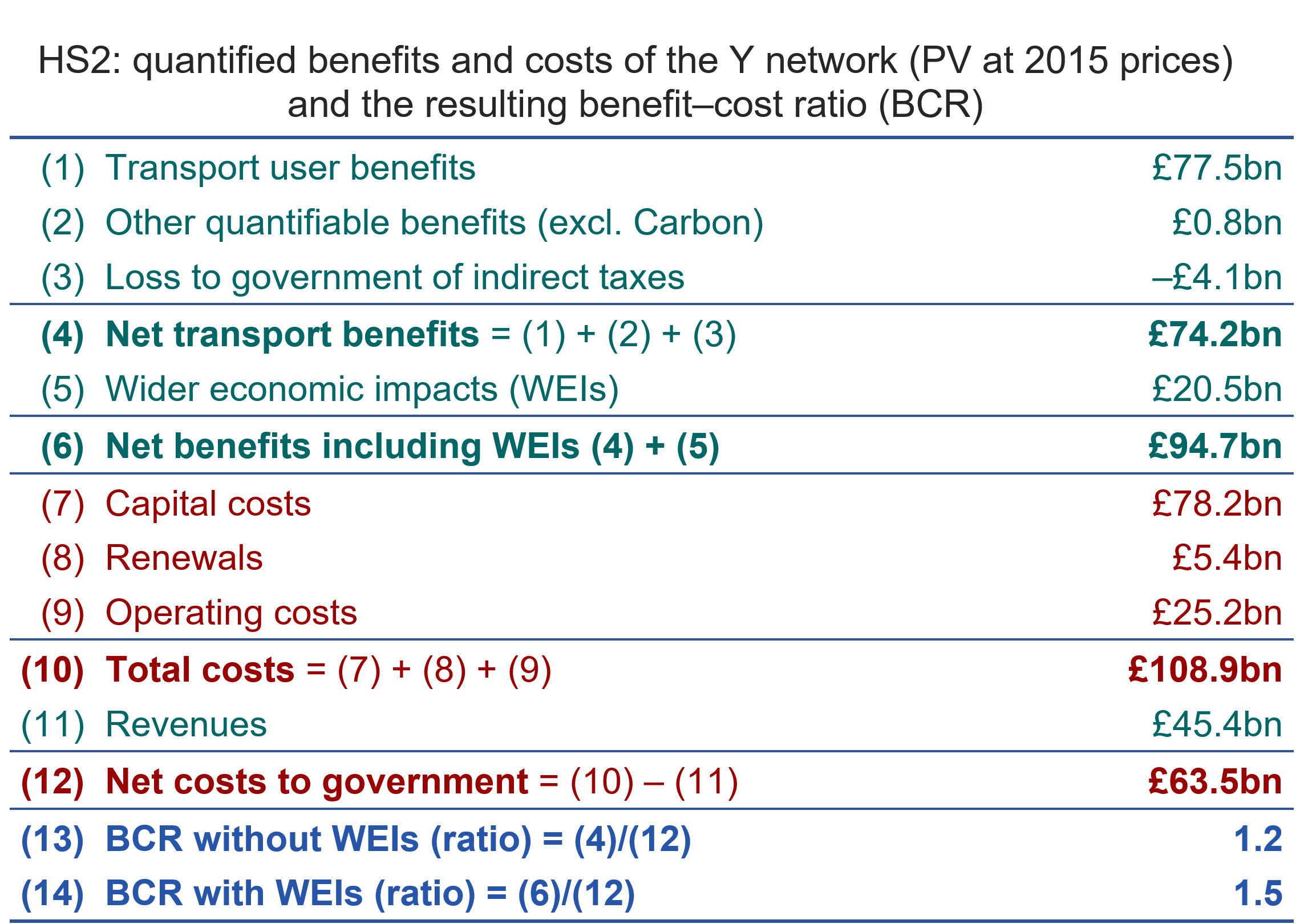
Source: Full Business Case: High Speed Two, Table 2.9, Department for Transport (April 2020)
Box 12.6 in Economics (eleventh edition) and Case study 8.16 on the Essentials of Economics (ninth edition) student website looks at these costs and benefits. The above table is taken from the box/case study. Net transport benefits (present value at 2015 prices) were estimated to be £74.2bn. These include benefits to passengers from shorter journey times, greater reliability, greater connectivity and less crowding, and reduced congestion on roads. They also include other benefits, such as a reduction in carbon emissions and a reduction in road accidents. Net benefits also include the wider benefits from greater connectivity between firms (resulting in increased specialism, trade and investment), greater competition and greater labour mobility. These wider benefits were estimated to be £20.5bn, giving total net benefits of £94.7bn.
Total costs to the government were estimated to be £108.9bn and revenues from fares to be £45.4bn, giving total net costs of £63.5bn. This gave a benefit/cost ratio of 1.5 (£94.7bn/£63.5bn). In the light of these findings, the government announced in September 2020 that the main work on the London to Birmingham leg would begin, despite the Public Accounts Committee’s finding that the project was badly off course and lacking in transparency.
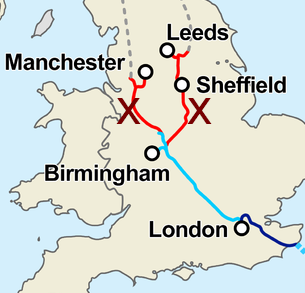
Concern was expressed over whether the Leeds leg would go ahead, but in May 2021, the transport secretary, Grant Shapps, confirmed that it would be completed. However, with the publication of the Integrated Rail Plan in November 2021 (for a link, see list of reports below), the government decided that the eastern leg of HS2 would no longer reach Leeds but instead end in the East Midlands. Then in June 2022, the link between the HS2 line near Manchester and the West Coast Main Line was scrapped. This would have allowed HS2 trains to reach Scotland.
In early 2023, it was announced that the building of the terminus at Euston was being put on hold. Many interpreted this as meaning that it was being scrapped, with trains terminating at Old Oak Common, some six miles from Central London.
Finally, as we have seen, HS2 north of Birmingham has now been scrapped and the government is seeking private-sector funding to build the terminus at Euston and complete the line from Old Oak Common.
Arguments for scrapping the northern legs
The main argument given by the government was that projected costs have risen substantially above original estimates and that by cancelling the Manchester and east Midlands legs, the money saved could be better used elsewhere. The argument is one of opportunity cost. The cost of going ahead would mean not going ahead with better-value alternatives.
The government claims that £36bn will be saved and that this will be diverted to rail, road and other transport projects, primarily (although not exclusively) in the north of England. The money would be spent between 2029 and 2040. Projects include spending additional money on the planned upgrading of the rail link between Manchester and Liverpool, Sheffield, Leeds and Hull; building a new station at Bradford; developing a mass transit system for Leeds and its surroundings; a £2.5bn fund for improved transport for smaller cities, towns and the countryside in the north of England; extra funding for transport in the east and west Midlands, including funding a Midlands Rail Hub. Out of the £36bn, £6.5bn would be for projects elsewhere, including road improvement.
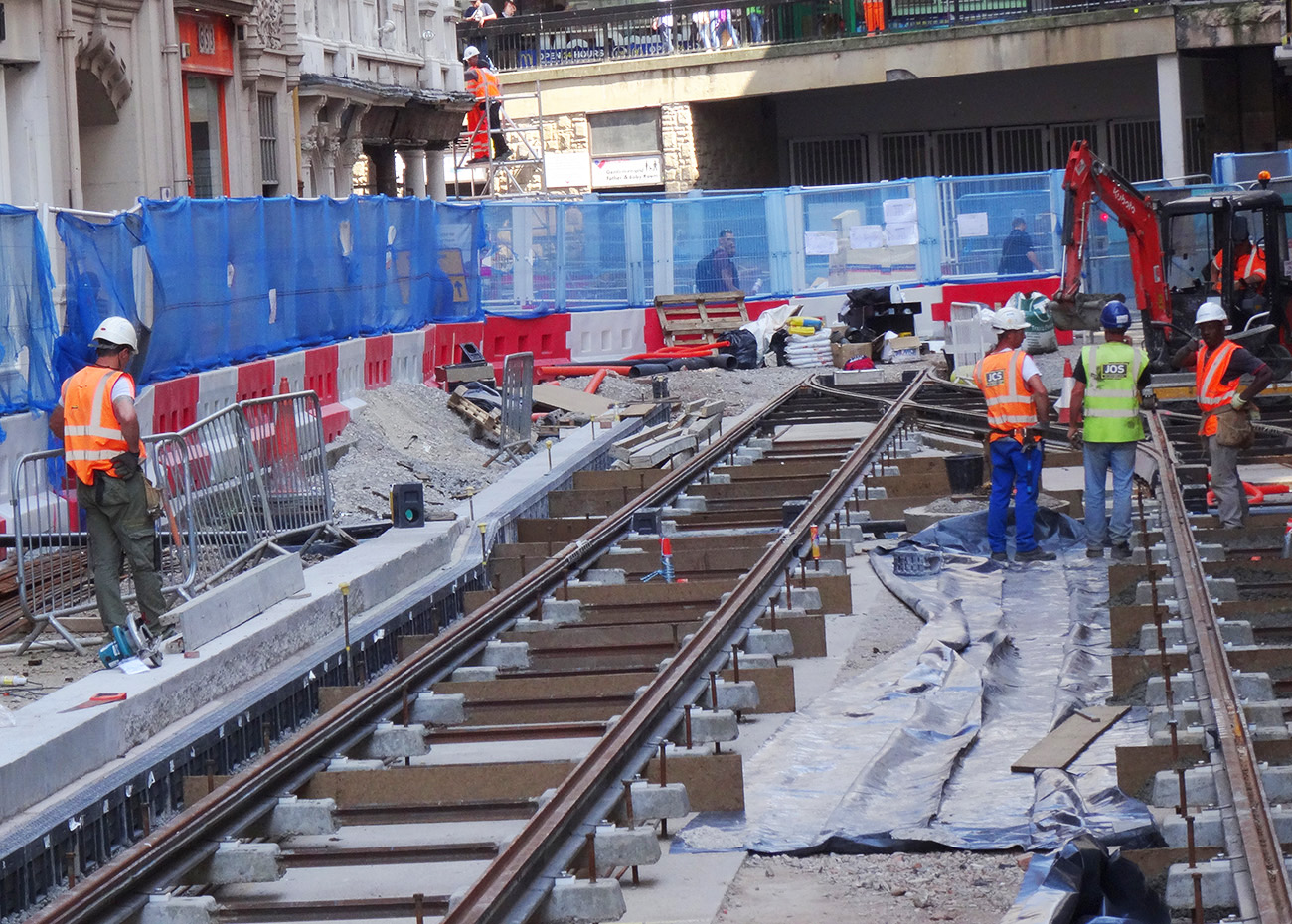 In order to judge whether the diversion of funds represents a better use of money, a full analysis of costs and benefits of the various projects would need to be conducted and compared with an updated cost–benefit analysis of continuing with the legs to Manchester and the east Midlands and possibly reinstating the Leeds leg too.
One possible benefit for the government is a political one. It hopes that promising more local projects rather than HS2 will appeal to the electorate in large parts of the north of England who are suffering from poor and unreliable transport links. However, most of these projects will be started well beyond the next election and this political gain may turn out to be small. Indeed, cancelling HS2 may breed cynicism, with people wondering whether any promised new projects will actually be delivered.
Arguments against scrapping the northern leg(s)
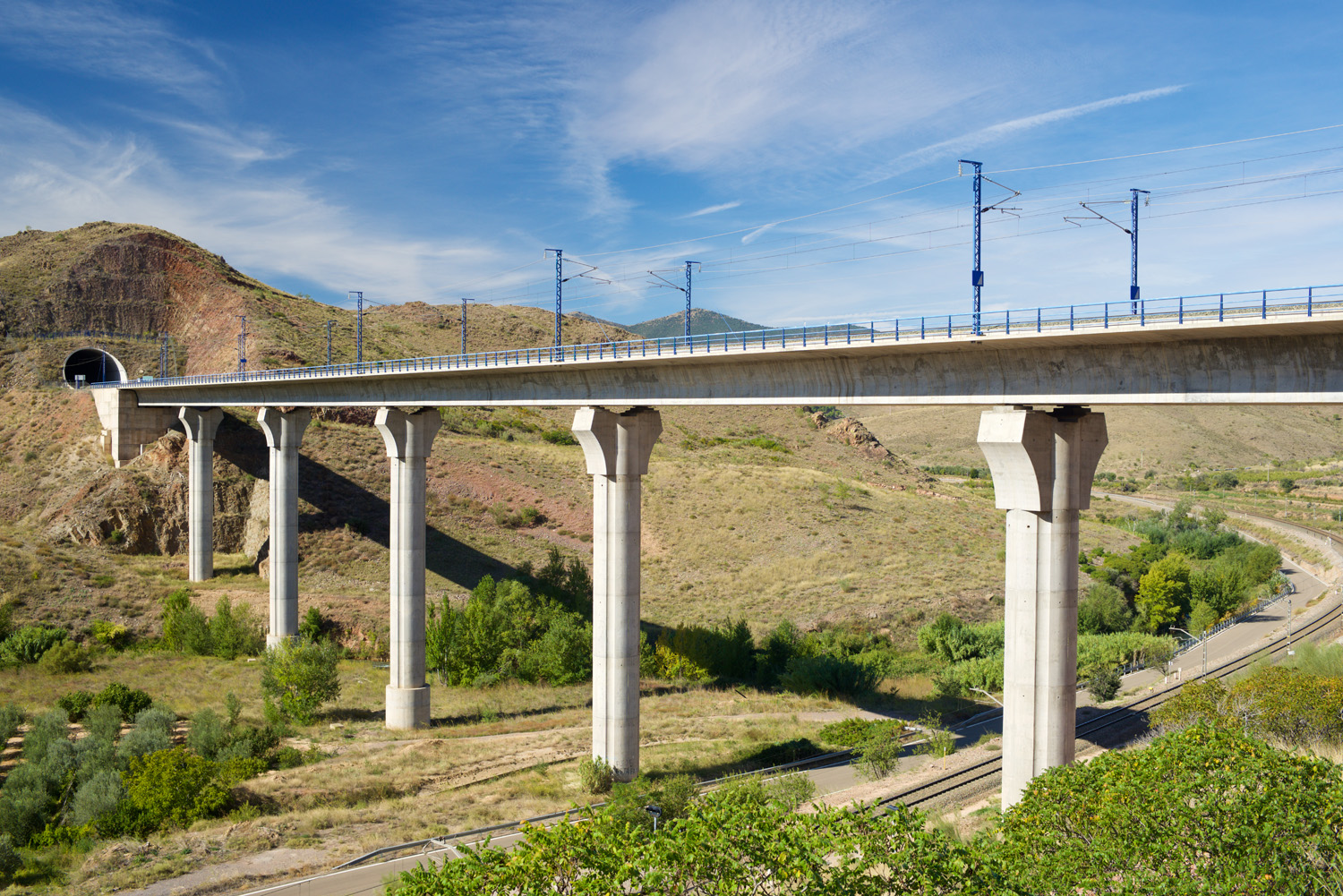 The benefits originally identified from HS2 will now be lost. It is not just that the northern legs of HS2 would have provided faster travel to Manchester and Leeds, but the new lines would have reduced congestion for slower trains and freight on existing lines. This has been the experience in countries such as Japan and Spain, which have invested heavily in new, separate high-speed lines.
When the line is completed to Birmingham, the HS2 trains will be able to continue north of Birmingham on existing lines. But these lines are heavily congested, which will limit the number of HS2 trains that can use them. Also they will be restricted to 110 mph on these lines as they have no tilting mechanism. Also they will have a maximum capacity of only 550 seats (a single train set) as the platforms at Manchester Piccadilly cannot accommodate double-set trains. The existing Pendalino trains on the West Coast mainline can travel at 125 mph as they do have the tilting mechanism and they have a higher capacity of 607 seats.
Then there are the signals that cancellation sends to industry about whether governments can be trusted to follow through on public-sector projects. Many business had expanded or relocated to places near the HS2 routes. Many others will wonder whether the promised new projects will go ahead. Indeed, shortly after giving a list of the projects (some of which had already been built or were being built), the list was removed from the government website. There is already a mood of scepticism amongst the electorate. Polling following the initial announcement showed that a majority believed that it was unlikely that the Conservatives would deliver the other projects if they won the next election.
The opportunity cost argument that the money would be better spent on alternative transport projects is predicated on various assumptions. One is that the money will actually be spent, which, as we have seen, people consider doubtful. Another is that the only choice is either spending a fixed pot of money on the northern leg(s) of HS2 or spending it on the alternative projects announced by the prime minister. It could be argued that the government should proceed with both the full HS2 and these other projects, and fund it by extra taxation. Investment as a percentage of GDP is low in the UK compared with other countries. Over the past 10 years, it has averaged 17.8% in the UK. This compares with 21.0% in the USA, 21.5% in Germany, 23.7% in France and 25.4% in Japan. Also, public-sector investment is low in the UK compared with that in other countries.
Assessing the arguments
Many of the costs and benefits of long-term projects, such as HS2, occur many years hence. There is, therefore, a great deal of uncertainty over their magnitude. This makes it extremely difficult to reach a clear conclusion over the desirability of cancelling HS2 north of Birmingham or continuing with it. Under such circumstances, politics tends to dominate decision making.
Articles
- Rishi Sunak promises more rail, road and bus links
BBC News (4/10/23)
- The HS2 rail line: what has been cut and what will replace it?
Financial Times Gill Plimmer, Phillip Georgiadis, Jennifer Williams and Jim Pickard (4/10/24)
 HS2 explained: What is the route now, what are the costs and why is the Manchester leg being axed?
Sky News, Sarah Taaffe-Maguire (5/10/23)
- Rishi Sunak finally axes HS2 in the north – weeks after The Independent revealed plan
Independent, Jon Stone and Adam Forrest (4/10/23)
- HS2 | Timeline of a mistreated megaproject
New Civil Engineer, Rob Hakimian (4/10/23)
- HS2 scale-back creates ‘chilling effect’
Construction News, Catherine Moore (5/10/23)
- How HS2 caused the UK to lose focus on ‘levelling up’ during years of high-speed rail delays
The Conversation, Steven McCabe (28/9/23)
- What Rishi Sunak scrapping HS2 – and promising a new ‘Network North’– means for the north of England
The Conversation Tom Arnold (4/10/23)
- HS2: Why Rishi Sunak’s big gamble may not pay off
BBC News, Faisal Islam (5/10/23)
- ‘Managed decline’: the uncertain future for British rail after cuts to HS2
Financial Times, Philip Georgiadis, Gill Plimmer and Jim Pickard (6/10/23)
- Investment outside London could bring £100bn boost to economy, says Bank of England’s former chief economist
Channel 4 News, Helia Ebrahimi interviews Andy Haldane (27/9/23)
- HS2 surgery is the wrong choice say leading academics
RailTech, Simon Walton (3/10/23)
- Why has HS2 ended up being so expensive?
The Guardian, Gwyn Topham (25/9/23)
- Ten problems with Rishi Sunak’s Network North announcement
The Guardian, Helen Pidd (5/10/23)
- International investors are laughing at the HS2 shambles
The Guardian, Nils Pratley (4/10/23)
- Spain’s high-speed trains aren’t just efficient, they have transformed people’s lives
The Guardian, María Ramírez (11/10/23)
Government Press Release
Reports
Questions
- Why have the costs of HS2 (in real terms) risen substantially since the first estimates in 2012?
- Identify the types of environmental costs and benefits of the full Y-shaped HS2 project. Why might such costs and benefits be difficult to measure?
- Is the opportunity of cost of proceeding with the full Y-shaped HS2 a range of other transport projects? Explain.
- Find out the level of public-sector investment expenditure as a percentage of (a) total government expenditure and (b) GDP in some other developed countries and compare them with the UK. Comment on your findings.
- Should the decision whether or not to go ahead with the Manchester and east Midlands legs have been delayed until a new updated cost–benefit analysis had been conducted?
- If most of the benefits from the originally planned HS2 will be now be lost with the line ending at Birmingham, should this leg to Birmingham also be cancelled, even though many of the costs have already been incurred? Explain your reasoning.
 On June 20, the Review of the Government’s case for a High Speed Rail programme was published. This was commissioned by the Transport Select Committee from the independent consultancy, Oxera.
The programme is initially for a high-speed rail link form London to Birmingham and then subsequently for two additonal routes from Birmingham to Manchester and from Birmingham to Leeds. The whole thing is known as the ‘HS2 Y programme’
Oxera’s brief was to ‘provide an independent review of the economic case for the programme and to provide a set of questions that the Committee could use to probe the evidence base put forward by witnesses during its inquiry.’ In considering the economic case, Oxera focused on the economic, social and environment impacts, both monetary and non-monetary.
The summary to the report states that:
Overall, the case for the High Speed Rail programme seems to depend on whether and when the capacity is needed, the selection of the best VfM [value-for-money] approach to delivering that capacity, the degree of uncertainty around the monetised benefits and costs of the preferred options, and judgements on the balance of evidence relating to non-monetised items, such as environment and regeneration impacts (which are likely to be substantive in their own right but not fully set out in the Government’s assessment).
On July 19, the Institute for Economic Affairs, the pro-free-market think-tank, published a highly critical disussion paper, challenging the case for HS2. The paper, High Speed 2: the next government project disaster? arges that:
There is a significant risk that High Speed 2 (HS2) will become the latest in a long series of government big-project disasters with higher-than-forecast costs and lower-than-forecast benefits. HS2 is not commercially viable and will require substantial and increasing levels of subsidy. Taxpayers will therefore bear a very high proportion of the financial risks, which are wholly under-represented in the Economic Case presented by the Department for Transport.
The publication of the report and the IEA discussion paper has fueled the debate between supporters and opponents of HS2, as the articles below demonstrate.
Update
In November 2011, the House of Commons Transport Select Committee came out in favour of the government’s HS2 plans. According to the committee’s chair, Louise Ellman:
A high speed rail network, beginning with a line between London and the West Midlands, would provide a step change in the capacity, quality, reliability and frequency of rail services between our major cities.
A high speed line offers potential economic and strategic benefits which a conventional line does not, including a dramatic improvement in connectivity between our major cities, Heathrow and other airports, and the rest of Europe.
However, she did raise some issues that would need addressing concerning the overall level of investment in the rail network and the encironmental impact of HS2.
Investment in HS2 must not lead to reduced investment in the ‘classic’ rail network. We are concerned that the Government is developing separate strategies for rail and aviation, with HS2 separate from both. We call again for the publication of a comprehensive transport strategy.
Investment in high speed rail has potential to boost growth but may have a substantial negative impact on the countryside, communities and people along the route. This must be better reflected in the business case for HS2 and future phases of the project. We would encourage the Government to follow existing transport corridors wherever possible.
Further update
In January 2012, the government approved HS2. The Transport Secretary, Justine Greening, said:
I have decided Britain should embark upon the most significant transport infrastructure project since the building of the motorways by supporting the development and delivery of a new national high speed rail network.
The ‘articles for further update’ below give reactions to the announcement.
Articles
Is the UK’s high speed rail project a waste of money? BBC News, Rory Cellan-Jones (21/7/11)
On a collision path The Economist blogs, Blighty (21/7/11)
High speed rail dismissed as ‘vanity project’ by right-wing think tank The Telegraph, David Millward (19/7/11)
HS2 high-speed rail plans ‘a recipe for disaster’ Guardian, Dan Milmo (19/7/11)
High speed rail report shows ‘uncertainty’ over benefits Rail.co, A. Samuel (21/7/11)
Our high speed rail future BBC News, Rory Cellan-Jones (21/7/11)
Anger as high-speed rail link to London branded ‘vanity project’ Yorkshire Post (20/7/11)
Articles for update
MPs support plans for a high speed rail network BBC News, Richard Lister (8/11/11)
High-speed rail project will boost economy, say MPs Guardian, Dan Milmo (8/11/11)
High speed rail report ‘raises questions’ say opponents BBC News (8/11/11)
MPs back controversial high-speed rail link Yahoo News, Sebastien Bozon (8/11/11)
HS2 project: ‘Wrong to castigate locals’ BBC Today Programme (8/11/11)
Articles for further update
HS2 go-ahead sees mixed reaction BBC News (10/1/12)
HS2 – What’s in it for you? Channel 4 News (10/1/12)
Ready to depart: But will the HS2 express be derailed before it arrives? Independent, Nigel Morris (11/1/12)
HS2 go-ahead sees mixed reaction BBC News (10/1/12)
HS2 go-ahead sees mixed reaction BBC News (10/1/12)
Reports and discussion paper
Review of the Government’s case for a High Speed Rail programme Oxera Publishing (20/6/11)
High Speed 2: the next government project disaster? IEA Discussion Paper No. 36 (19/7/11)
Good case for high speed rail to run to Birmingham and beyond, say MPs House of Commons Transport Select Committee News (8/11/11)
Transport Committee – Tenth Report: High Speed Rail House of Commons Transport Select Committee (8/11/11)
Questions
- Itemise (a) the monetary costs and benefits and (b) the non-monetary costs and benefits of HS2 that were identified by Oxera. Try to identify other costs and benefits that were not included by Oxera.
- Why are the costs and benefits subject to great uncertainty?
- How should this uncertainty be taken into account by decision-makers?
- Explain the process of discounting in cost–benefit analysis. How should the rate of discount be chosen?
- What are the main criticisms of the report made by the IEA discussion paper?
- Assess these criticisms.