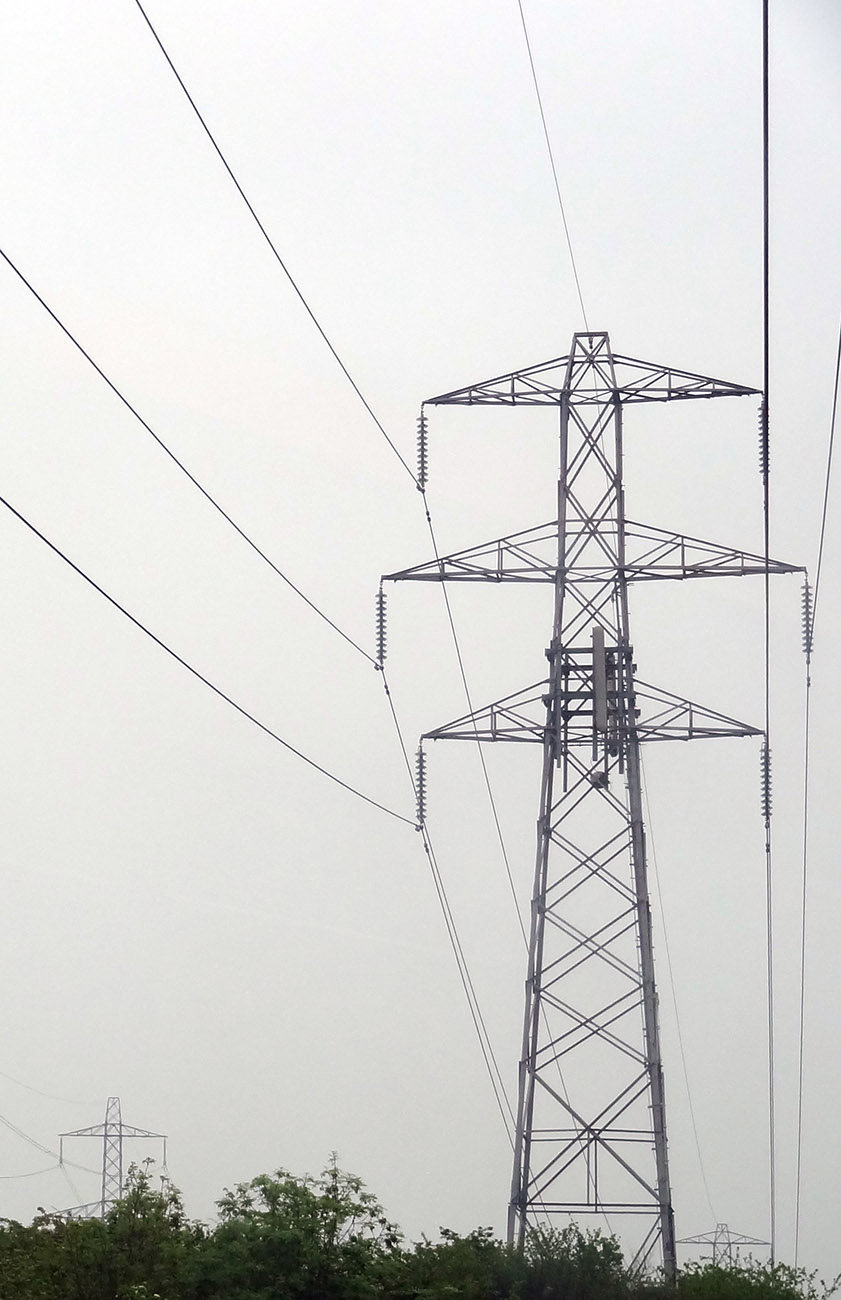
 The environment has been a growing part of government policy for many years. With the Kyoto Protocol and Europe’s carbon trading system, effort has been made to reduce carbon emissions. Part of UK policy to meet its emission’s target requires substantial investment in infrastructure to provide efficient energy.
Details of the government’s Energy Bill sets out plans that will potentially increase average household energy bills by about £100 per annum, although estimates of this vary from about £90 to £170. This money will be used to finance much needed investment in infrastructure that will allow the UK to meet its carbon emissions target. With this extra cost on bills, energy companies will increase bring in something like £7.6bn. The benefit of this higher cost is that investment today will lead to lower energy bills tomorrow. Essentially, we’re looking at a short-term cost for a long-term gain.
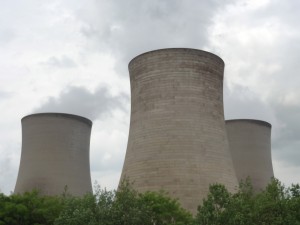 The Energy Bill also delayed setting a carbon emission target until 2016. Crucially, this will come after the next election. Environmentalists have naturally criticised this omission. John Sauven of Greenpeace said:
’By failing to agree to any carbon target for the power sector until after the next election, David Cameron has allowed a militant tendency within his own ranks to derail the Energy Bill … It’s a blatant assault on the greening of the UK economy that leaves consumers vulnerable to rising gas prices, and sends billions of pounds of clean-tech investment to our economic rivals.’
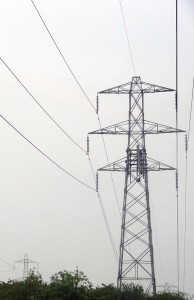
One further problem that this lack of a target creates is uncertainty. The energy sector requires significant investment and in order to be encouraged to invest, firms need assurances. Without knowing the target and hence facing a degree of uncertainty, firms may be less likely to invest in building new power plants. And this investment is crucial. The Government has committed to replacing most coal-fired power stations across Britain with low carbon technology at a cost of hundreds of billions of pounds. However, the Chancellor has said “he would not allow saving the planet to come at the cost of ‘putting our country out of business.’”
When this Energy Bill is published, it is claimed that £110bn of spending on different aspects of the National Grid will occur. The suggestion is that this will generate a further 250,000 jobs by 2030 and will be a big step in the right direction towards creating an economy that is more reliant on clean energy.
The following articles consider the wide range of issues surrounding the Energy Bill.
’It’s reasonable to hike energy bills to build wind farms’ says Tim Yeo The Telegraph, Rowena Mason (23/11/12)
Energy Bill to increase prices to fund cleaner fuel BBC News (23/11/12)
Energy deal means bills will rise to pay for green power The Guardian, Juliette Jowit and Fiona Harvey (23/11/12)
Energy Bill Q&A BBC News (23/11/12)
Energy bills to rise by £170 a year to fund wind farms Independent, Andrew Woodcock and Emily Beament (23/11/12)
Energy deal – but no target to cut Britain’s carbon emissions Independent, Nigel Morris (22/11/12)
Davey defends contentious energy agreement Financial Times, Jim Pickard, Pilita Clark and Hannah Kuchler (23/11/12)
Energy bill lacks emissions target Channel 4 News (23/11/12)
Questions
- Why does the environment require so much government intervention? Think about the different ways in which the environment as a market fails.
- If household bills rise, is there likely to be an income and substitution effect between consumption of ‘energy’ and other goods? Which direction will each effect move in and which do you think would be the largest?
- Why is uncertainty such a deterrent for investment? Why does a lack of a carbon emissions target represent uncertainty?
- The higher cost of bills today may enable future bills to fall. Why is this? For a household, explain why discount factors could be important here.
- Why do some argue that the extra cost to households set out by the government are likely to under-estimate the actual increase households will face?
- Is the Chancellor right to say that he will not put our country out of business to save the planet?
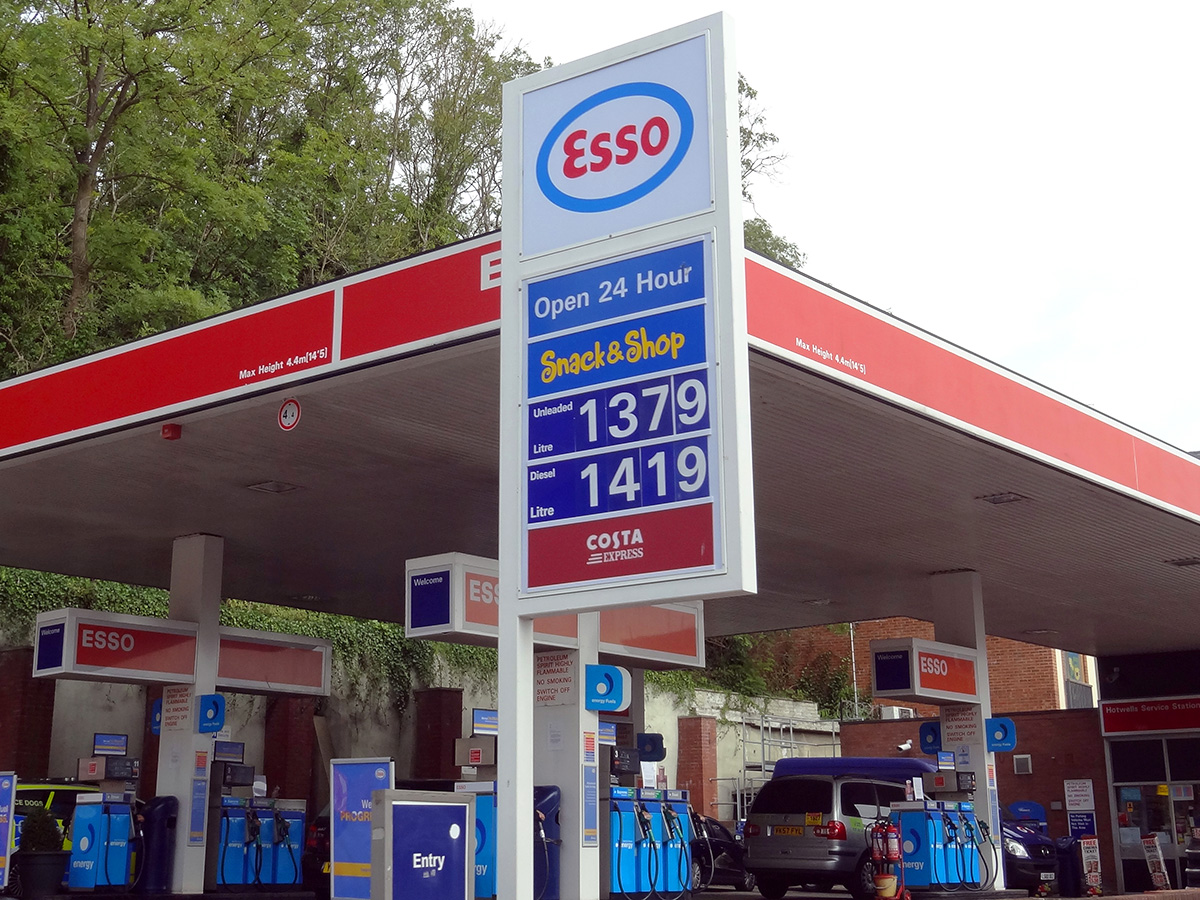
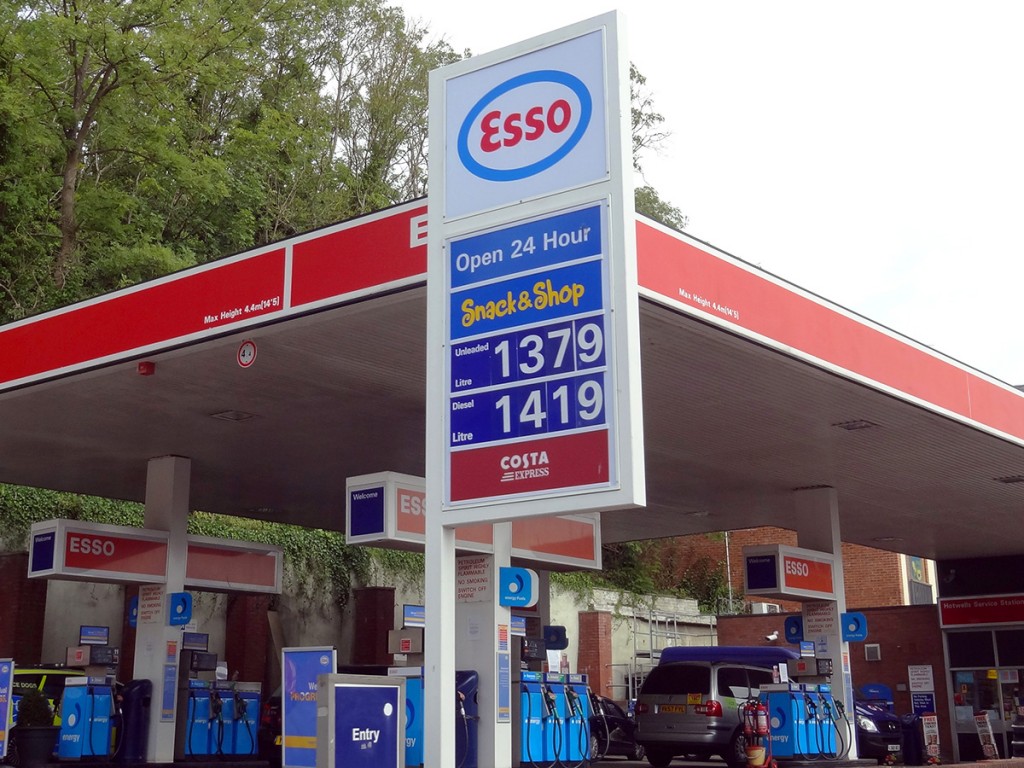 As resources become scarce, the price mechanism works to push up the price (see, for example, Box 9.11 in Economics 8th ed). If you look at the price of petrol over the past few decades, there has been a general upward trend – part of this is due to growth in demand, but part is due to oil being a scarce resource. Many millions have been spent on trying to find alternative fuels and perhaps things are now looking up!
Air Fuel Synthesis, a small British company, has allegedly managed to make ‘petrol from air’. Following this, the company has unsurprisingly received finance and investment offers from across the world. However, the entrepreneur Professor Marmont has said that he does not want any company from the oil industry to get a stake in this firm. This doesn’t mean that investment is not needed or on the cards, as in order to increase production of petrol from thin air financing is needed. Professors Marmont said:
We’ve had calls offering us money from all over the world. We’ve never had that before. We’ve made the first petrol with our demonstration plant but the next stage is to build a bigger plant capable of producing 1 tonne of petrol a day, which means we need between £5m and £6m
Whilst the process appears to be a reality, Air Fuel Synthesis is a long way from being able to produce en masse. However, it does offer an exciting prospect for the future of petrol and renewable energy resources in the UK. At the moment oil companies appear to be uninterested, but if this breakthrough receives the financing it needs and progress continues to be made, it will be interesting to see how the big oil companies respond. The following articles consider this break-through.
Company that made ‘petrol from air’ breakthrough would refuse investment from big oil Independent, Steve Connor (19/10/12)
British engineers create petrol from air and water Reuters, Alice Baghdijan (19/10/12)
Petrol from air: will it make a difference? BBC News, Jason Palmer (19/10/12)
British engineers produce amazing ‘petrol from air’ technology The Telegraph , Andrew Hough (18/10/12)
Questions
- Explain the way in which the price mechanism works as resources become scarce. Use a diagram to help your explanation.
- As raw materials become scarce, prices of the goods that use them to work or require them to be produced will be affected. Explain this interdependence between markets.
- Why is investment from an oil company such a concern for Professor Marmont?
- Why is there unlikely to be any impact in the short run from this new breakthrough?
- If such a technology could be put into practice, what effect might this have on the price of petrol?
- How might oil companies react to the growth in this technology?
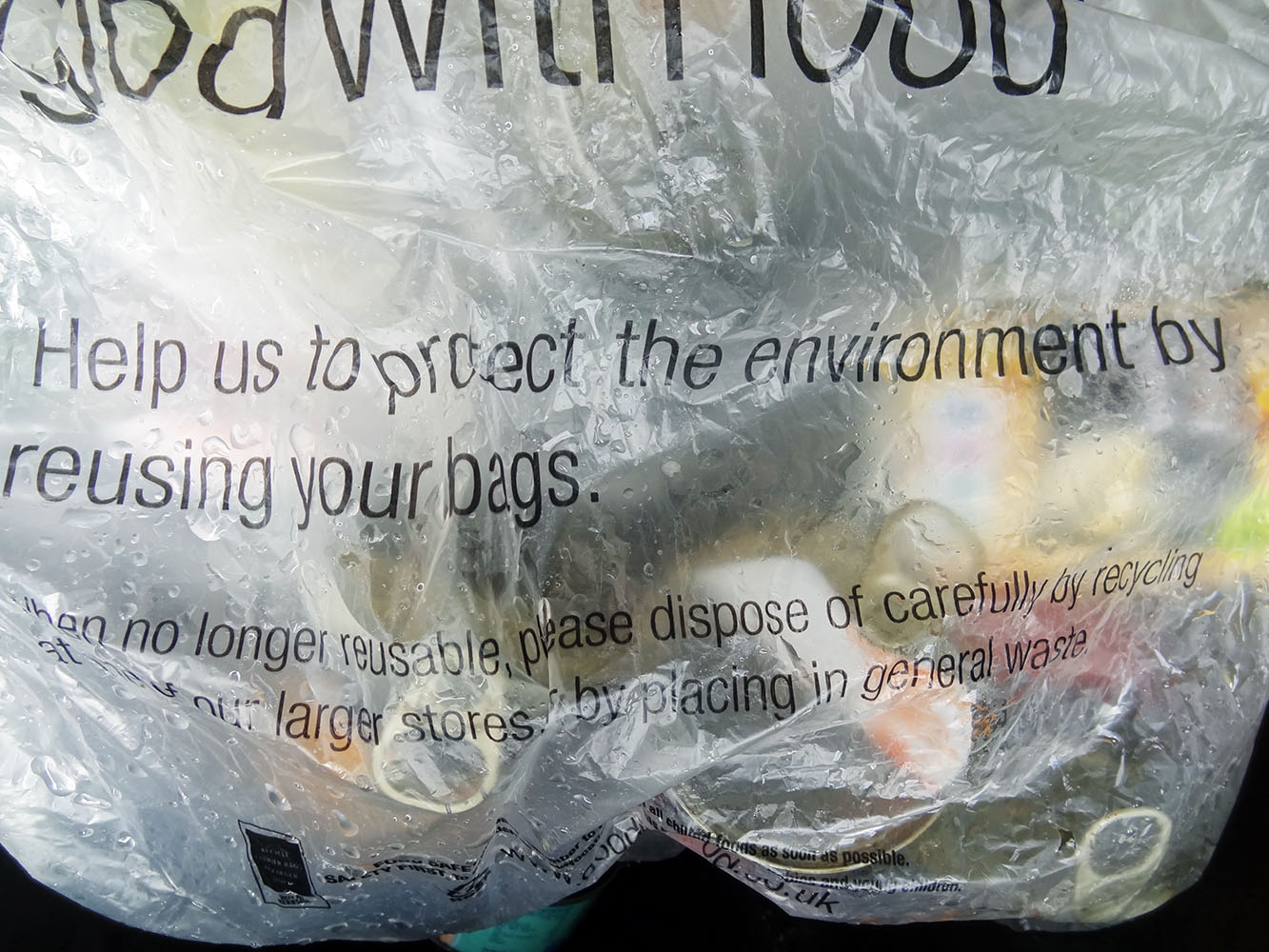
 A campaign to introduce a tax on disposable plastic bags in England has been launched by various pressure groups, including The Campaign to Protect Rural England (CPRE), Keep Britain Tidy, the Marine Conservation Society and Surfers Against Sewage. Plastic bags, they maintain, litter streets and the countryside and pollute the seas, where they cause considerable damage to marine life.
They propose a tax of 5p per bag, which would be passed on to consumers. Such a levy has already been introduced in Wales in October 2011. As a result, plastic bag use in Wales has dropped dramatically (see also the full report from the Welsh Government). The Scottish Government and the Northern Ireland Assembly are also planning introducing similar charges.
Many other governments have introduced taxes, charges or bans on plastic bags and many more are considering introducing such measures. Ireland introduced a 15 euro cent charge on single-use plastic bags as far back as 2002 and saw a 94% reduction in plastic bag use (328 per person per year to 21). The charge was raised to 22 euro cents in 2007 after bag use rose to 30 per person.
Other countries have banned plastic bags altogether: some, such as Rwanda and Somalia have banned all plastic bags; others, such as China and South Africa have banned very thin bags; others, such as Italy, have banned non-biodegradable ones.
In the USA, various states or districts have introduced levies and in the EU, where more than four billion bags are thrown away each year, the European Commission will soon publish proposals for limiting the use of plastic bags.
So what are the arguments for limiting the use of plastic bags? Why is it not enough to leave things simply to the market? And if the use of plastic bags is to be reduced, what’s the most efficient way of doing so? Are there any problems with alternatives to plastic bags? The following articles and reports consider these questions?
Articles
England urged to pick up Wales’ plastic bag levy businessGreen, Jessica Shankleman (1/8/12)
Wales’ plastic bag charge yields massive green savings businessGreen, Jessica Shankleman (5/7/12)
 Supermarkets ‘should charge £1 a bag’ BBC Today Programme, Samantha Harding and Judith Holder (2/8/12)
Environmentalists team up to push for bag tax in England Plastics News, Anthony Clark (1/8/12)
Break the Bag Habit Keep Britain Tidy (1/8/12)
Plastic bag use ‘up for second year running’ Guardian, Rebecca Smithers (5/7/12)
Plastic bag use in Wales plummets due to 5p charge, figures show Guardian, Adam Vaughan (4/7/12)
Carrier bag charge ‘effective and popular’ figures reveal ITV News (4/7/12)
What should be done about plastic bags? BBC News Magazine, Chris Summers (19/3/12)
Irish bag tax hailed success BBC News, Chris Summers (20/8/02)
The Big Fix The Math Behind Sacking Disposable Bags Atlantic Cities, Nate Berg (26/9/11)
Fremantle moves to ban plastic bags ABC News, Lucy Martin (23/7/12)
Bans Plastic Bag Ban Report, Ted Duboise (updated)
Vote With Your Dollars, and Also Vote New York Times, Gernot Wagner (30/7/12)
Reports
Evaluation Of The Introduction Of The Single-Use Carrier Bag Charge In Wales: Attitude Change And Behavioural Spillover, Wouter Poortinga, Lorraine Whitmarsh and Christine Suffolk Report to Welsh Government by Cardiff University (June 2012)
Life cycle assessment of supermarket carrierbags: a review of the bags available in 2006 Environment Agency, Joanna Marchant (25/7/11)
Stakeholder consultation on options to reduce the use of plastic carrier bags … EC Environment (19/3/12)
Questions
- Draw a diagram demonstrating the externalities involved in the use of plastic bags. Show the marginal private and social costs and benefits and the socially efficient level of consumption.
- How would you set about establishing the amount of consumer surplus from the use of plastic bags at a zero price?
- Compare the relative social efficiency of a tax on plastic bags with a ban on plastic bags.
- Would education be an effective alternative to taxing plastic bags?
- Why might it be difficult to get supermarkets and other retailers to agree to a voluntary ban on giving out free plastic bags?
- Why might it be extremely difficult in practice to establish the socially efficient price for plastic bags?
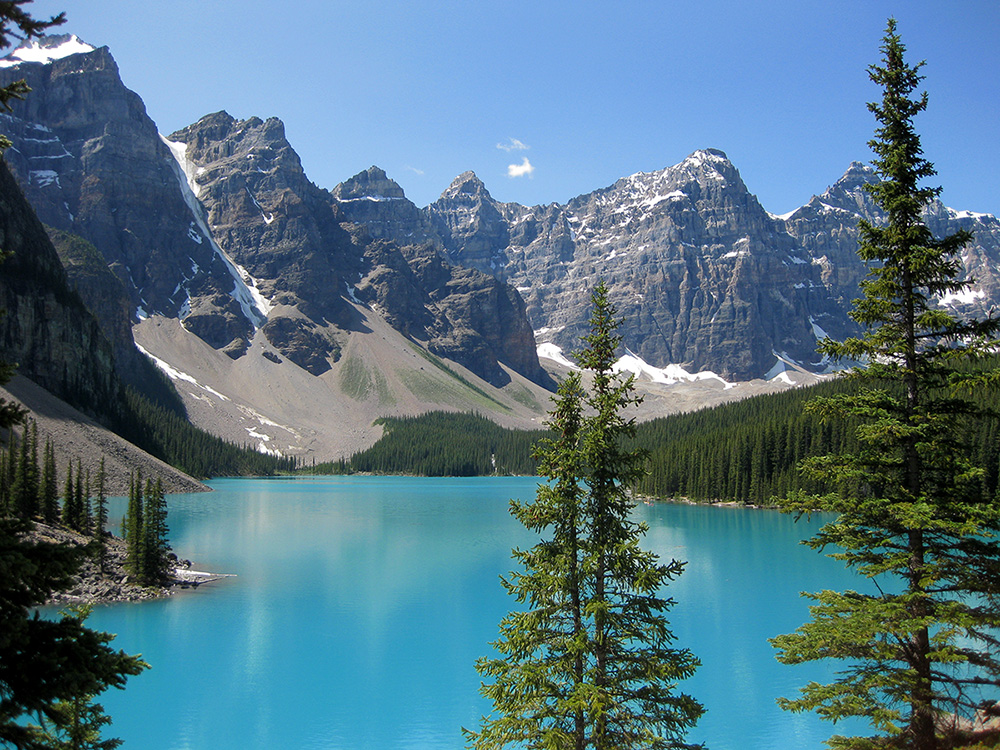 World leaders have been meeting in Rio de Janeiro at a United Nations Conference on Sustainable Development. The conference, dubbed ‘Rio+20’, refers back to the first UN Conference on Environment and Development (UNCED) held in Rio 20 years ago in June 1992.
The 1992 conference adopted an Agenda 21. It was “comprehensive plan of action to be taken globally, nationally and locally by organizations of the United Nations System, Governments, and Major Groups in every area in which human impacts on the environment.”
The 2012 conference has looked at progress, or lack of it, on sustainability and what needs to be done. It has focused on two major themes: “how to build a green economy to achieve sustainable development and lift people out of poverty, including support for developing countries that will allow them to find a green path for development; and how to improve international coordination for sustainable development.” Issues examined have included decent jobs, energy, sustainable cities, food security and sustainable agriculture, water, oceans and disaster readiness.
But just what is meant by sustainable development? The conference defines sustainable development as that which meets the needs of the present without compromising the ability of future generations to meet their own needs. “Seen as the guiding principle for long-term global development, sustainable development consists of three pillars: economic development, social development and environmental protection.”
The articles below look at prospects for national and global sustainability. They also look at a new measure of national wealth, the Inclusive Wealth Index (IWI). This index has been developed under the auspices of the International Human Dimensions Programme on Global Environmental Change (IHDP) and published in its Inclusive Wealth Report 2012 (see report links below).
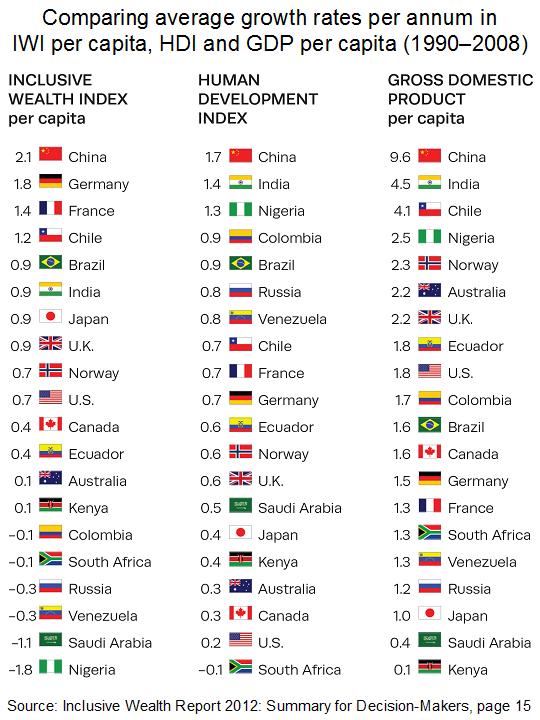 The IWR 2012 was developed on the notion that current economic production indicators such as gross domestic product (GDP) and the Human Development Index (HDI) are insufficient, as they fail to reflect the state of natural resources or ecological conditions, and focus exclusively on the short term, without indicating whether national policies are sustainable.
The IWR 2012 features an index that measures the wealth of nations by looking into a country’s capital assets, including manufactured, human and natural capital, and its corresponding values: the Inclusive Wealth Index (IWI). Results show changes in inclusive wealth from 1990 to 2008, and include a long-term comparison to GDP for an initial group of 20 countries worldwide, which represent 72% of the world GDP and 56% of the global population. (Click on chart for a larger version.)
So will growth in IWI per capita be a better measure of sustainable development than growth in GDP per capita? The articles also consider this issue.
Articles: summit
Rio+20 deal weakens on energy and water pledges BBC News, Richard Black (17/6/12)
Rio+20: Progress on Earth issues ‘too slow’ – UN chief BBC News, Richard Black (20/6/12)
Rio+20 Earth Summit Q&A The Telegraph, Louise Gray (16/5/12)
Rio+20 Earth Summit: campaigners decry final document Guardian, Jonathan Watts and Liz Ford (23/6/12)
A catastrophe if global warming falls off the international agenda Observer, Will Hutton (24/6/12)
Analysis: Rio +20 – Epic Fail The Bureau of Investigative Journalism Brendan Montague (22/6/12)
Articles: IWI
Accounting for natural wealth gains world traction Atlanta Business NewsKaty Daigle (17/6/12) (see alternatively)
New index shows lower growth for major economies Reuters, Nina Chestney (17/6/12)
A New Balance Sheet for Nations: UNU-IHDP and UNEP Launch Sustainability Index that Looks Beyond GDP EcoSeed (20/6/12)
World’s leading economies lag behind in natural capital Firstpost (18/6/12)
Beyond GDP: Experts preview ‘Inclusive Wealth’ index at Planet under Pressure conference EurekAlert, Terry Collins (28/3/12)
New sustainability index created that looks at more than gross domestic product bits of science (17/6/12)
For Sustainability, Go Beyond Gross Domestic Product Scientific AmericanDavid Biello (17/6/12)
Report
Inclusive Wealth Report 2012: Overview IHDP
Inclusive Wealth Report 2012: Summary for Decision-makers IHDP
Inclusive Wealth Report 2012: full report IHDP
Questions
- What progress has been made towards sustainable development over the past 20 years?
- What are the limitations of conferences such as Rio+20 in trying to achieve global action?
- With the current challenges faced by the eurozone and the global economy more generally, is this a good time to be discussing long-term issues of sustainable development?
- Explain how IWI is derived and measured?
- Looking at the chart above, explain the very different positions of countries in the three columns.
- What are the strengths and weaknesses of using growth in IWI compared with using growth in GDP as measures of (a) economic development; (b) economic wellbeing?
Economics studies the choices people make. ‘Rational choice’ involves the weighing up of costs and benefits and trying to maximise the surplus of benefits over costs. This surplus will be maximised when people do more of things where the marginal benefit exceeds the marginal cost and less of things where the marginal cost exceeds the marginal benefit. But, of course, measuring benefits and costs is not always easy. Nevertheless, for much of the time we do make conscious choices where we consider that choosing to do something is ‘worth it’: i.e. that the benefit to us exceeds the cost.
When we make a choice, often this involves expenditure. For example, when we choose to buy an item in a shop, we spend money on the item, and also, perhaps, spend money on transport to get us to the shop. But the full opportunity cost includes not only the money we spend, but also the best alternative activity sacrificed while we are out shopping.
Then there are the benefits. Not all pleasurable activity costs us money. The sight of beautiful contryside or the pleasure of the company of friends may cost us very little, if anything, in money terms. But they may still be very valuable to us.
If we are to make optimal decisions we need to have some estimate of all costs and benefits, not just ones involving the payment or receipt of money. This applies both to individual behaviour and to collective decisions made by governments or other agencies.
Cost–benefit analysis seeks to do this to help decisions about new projects, such as a new road, a new hospital, environmental projects, and so on. But just how do we set about putting a value on the environment – on the pleasure of a walk in bluebell woods, on protecting bird life in wetlands or sustaining ecosystems?
For the first time there has been a major study that attempts to value the environment. According to the introduction to the report:
The UK National Ecosystem Assessment (UK NEA) is the first analysis of the UK’s natural environment in terms of the benefits it provides to society and the nation’s continuing prosperity. Carried out between mid-2009 and mid-2011, the UK NEA has been a wide-ranging, multi-stakeholder, cross-disciplinary process, designed to provide a comprehensive picture of past, present and possible future trends in ecosystem services and their values; it is underpinned by the best available evidence and the most up-to-date conceptual thinking and analytical tools. The UK NEA is innovative in scale, scope and methodology, and has involved more than 500 natural scientists, economists, social scientists and other stakeholders from government, academic and private sector institutions, and non-governmental organisations (NGOs).
The following podcast and webcast look at the report and at some of the issues it raises in terms of quantifying and incorporating environmental costs and benefits into decision taking.
Podcast and Webcast
‘The hidden value’ of our green spaces BBC Today Programme, Tom Feilden (2/6/11)
Report puts monetary value on Britain’s natural assets BBC News, Jeremy Cooke (2/6/11)
Articles
NEA report highlights need for biodiversity Farmers Guardian, Ben Briggs (2/6/11)
Nature is worth £19bn a year to the UK economy – report Energy & Environmental Management Magazine (2/6/11)
In praise of… the unquantifiable Guardian (3/6/11)
Priceless benefits of bluebell woods Guardian letters, Dr Bhaskar Vira and Professor Roy Haines-Young (4/6/11)
Nature ‘is worth billions’ to UK BBC News, Richard Black (2/6/11)
Putting a price on nature BBC News, Tom Feilden (2/6/11)
Value of Britain’s trees and waterways calculated in ‘ground-breaking’ study The Telegraph, Andy Bloxham (2/6/11)
Nature worth billions, says environment audit Financial Times, Clive Cookson (2/6/11)
Nature gives UK free services worth billions Planet Earth, Tom Marshall (3/6/11)
UK scientists put price on nature with National Ecosystem Assessment GreenWise, Ann Elise Taylor (2/6/11)
Report
UK National Ecosystem Assessment: link to report DEFRA
UK National Ecosystem Assessment (June 2011)
The UK National Ecosystem Assessment: Synthesis of the Key Findings
Questions
- How would you set about valuing the benefits of woodlands?
- According to the report, the health benefits of living close to a green space are worth up to £300 per person per year. How much credance sould we attach to such a figure?
- What do you understand by the ‘ecosystem approach’ and the term ‘ecosystem services’?
- Explain Figure 2 on page 3 of Chapter 2 of the report.
- Should decision makers quantify only those benefits of ecosystems experienced by humans? Would all environmentalists agree with this approach?
- What are the advantages and disadvantages of quantifying all costs and benefits in money terms?
- Compare the consequences over the next 50 years of a ‘world markets’ scenarios with that of a ‘nature at work’ scenario.
- What policy implications follow from the report?
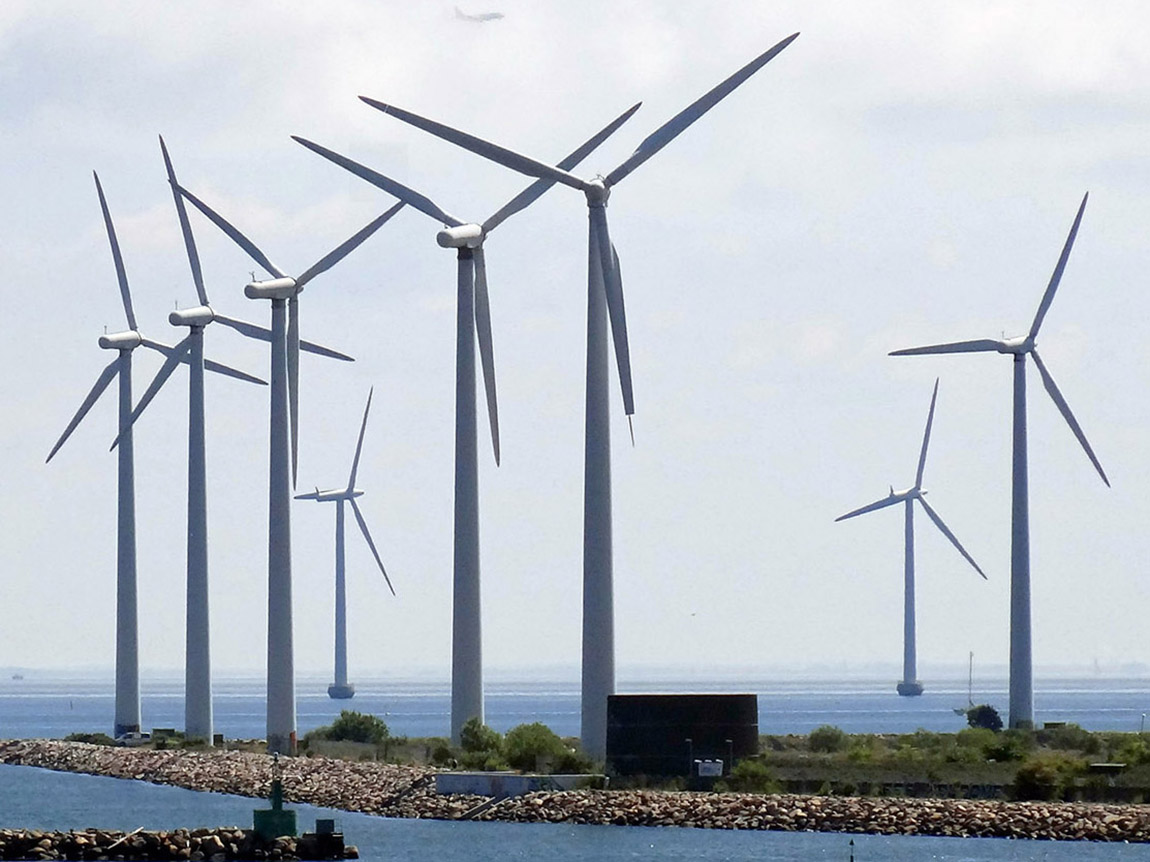 The environment has been a growing part of government policy for many years. With the Kyoto Protocol and Europe’s carbon trading system, effort has been made to reduce carbon emissions. Part of UK policy to meet its emission’s target requires substantial investment in infrastructure to provide efficient energy.
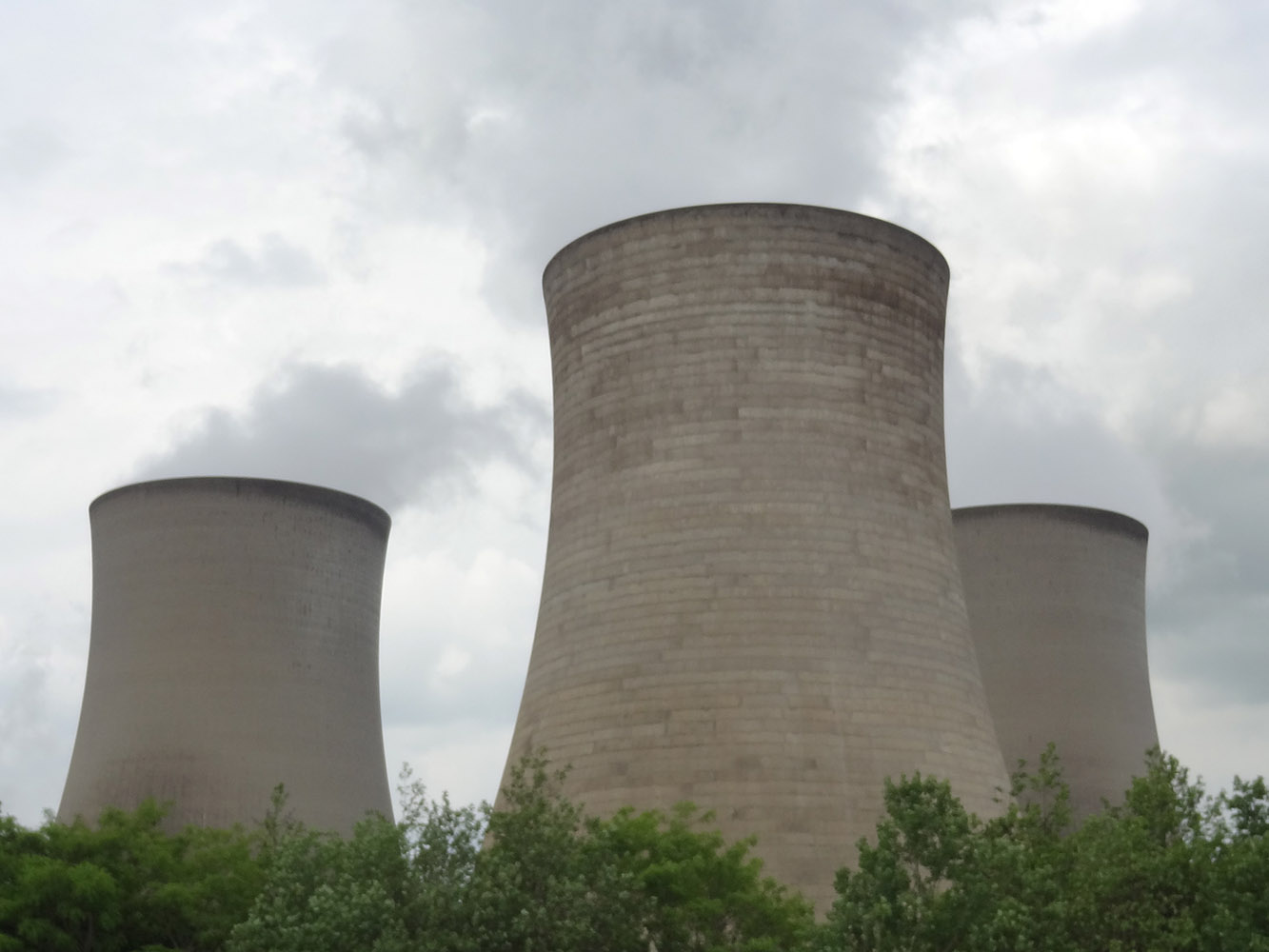 The Energy Bill also delayed setting a carbon emission target until 2016. Crucially, this will come after the next election. Environmentalists have naturally criticised this omission. John Sauven of Greenpeace said: