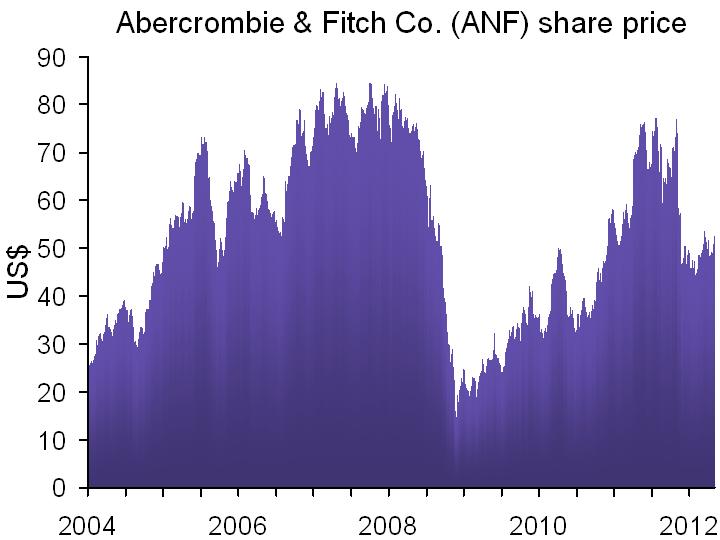
 The trendy US fashion retailer Abercrombie & Fitch entered the UK in 2007 with the opening of a flagship store close to Savile Row in London. Located in the upmarket Mayfair area of London, Savile Row is famous for its traditional men’s tailors.
Recently Abercrombie & Fitch decided to go one step further by opening a childrenswear store directly on Savile Row. This move upset the local retailers and was met with protests.
This was just the latest in a history of controversy surrounding Abercrombie & Fitch which has included a product boycott and a lawsuit concerning employment issues. Should all this bad publicity be a concern for the company?
We expect tastes to be one of the key determinants of demand. If taste for a company’s product declines, its demand curve shifts to the left. This means it can sell less at any given price and consequently will have a knock-on effect on profits. Somewhat surprisingly, therefore, the PR expert, Mark Borkowski, quoted in the Guardian article above, suggests that all this adverse publicity may have in fact helped the company because:
“…the focus is on the brand. They’ve got a very keen identity of who they are, what they want, who they want to consume their products, and they’ve stuck to it.”
It is also clear that the company is very aware of the importance of protecting its brand – even going as far as paying television actors NOT to wear their clothes! Abercrombie & Fitch has also been reluctant to cut its prices during the current recession, perhaps because of a fear of harming its brand.
Abercrombie & Fitch with its ‘crappy clothes’ threatens staid Savile Row Observer, Euan Ferguson (11/03/12)
Savile Row cannot live in the past Guardian, Charlie Porter (24/04/12)
Sorry chaps, Abercrombie & Fitch simply doesn’t fit Savile Row Guardian, Gustav Temple (24/04/12)
Savile unrest … the tailors who want to stop Abercrombie & Fitch London Evening Standard, Josh Sims (27/04/12)
Questions
- What are the distinctive features of the Abercrombie & Fitch brand?
- What are the key features of competition in this industry?
- Why might Abercrombie & Fitch be keen to open up a store on Savile Row?
- Why might the local tailors object to Abercrombie & Fitch opening a store nearby?
- Why do you think negative publicity appears to have little effect on Abercrombie & Fitch?
- Why do you think television coverage could harm the Abercrombie & Fitch brand?
 Vodafone has offered to purchase Cable & Wireless Worldwide (C&WW), with Vodafone paying 38p per share, making this deal worth £1.044bn.
This deal, however, was rejected by C&WW’s largest shareholder, Orbis, within hours, as the price was not high enough, despite the 38p per share offer representing a 92% premium to the level of C&WW’s share price before the bid interest emerged in February. A spokesperson for Orbis said:
‘Although we believe the C&WW management team has handled the bid process responsibly, we have declined to give an irrevocable undertaking or letter of intent to the support the transaction.’
However, with the only other interested party, Tata Communications withdrawing, Vodafone was the only remaining bidder. As such, many suggest that this deal is a good one for the struggling business, despite Orbis’ claim that it under-values the business.
Adding a UK fixed-line cable to Vodafone’s business will increase its capacity, which is much needed at this moment in time with the added demand for mobile data from increased Smartphone usage. Cost savings are also expected from this merger, as the company will no longer have to pay to other companies to lease its fixed-line capacity.
The bid from Vodafone did help C&WW’s trading performance, which had been worsening for some time and so some shareholders will be glad of the bid. Its shares were up following this deal and it went to the top of the FTSE250. Vodafone will also benefit, as this merger would make it the second largest combined fixed and mobile line operator in the UK.
The trends of these two companies in recent years have been very much in contrast. C&WW had been the larger of the two firms up until 1999, yet the price Vodafone would now pay for the company represents a mere 1% of its current market value. The following articles consider this merger.
Vodafone bids for Cable and Wireless: The end of the line The Economist (24/4/12)
Questor shares tip: Vodafone deal looks goodThe Telegraph, Garry White(23/4/12)
Vodafone puts paid to once-revered C&WW Financial Times, Daniel Thomas (23/4/12)
Top CWW shareholder rejects sale to Vodafone Independent, Gideon Spanier (24/4/12)
CWW accepting Vodafone’s £1bn bid is a good call The Telegraph, Alistair Osborne (23/4/12)
Vodafone agrees £1bn deal for Cable & Wireless Worldwide Guardian, Julia Kollewe and Juliette Garside (23/4/12)
Vodafone agrees £1bn takeover of C&W Worldwide BBC News (23/4/12)
Questions
- Into which market structure would you place the above industry? Explain your answer.
- Which factors have caused C&WW’s worsening position? In each case, explain whether they are internal or external influences.
- What type of merger is that between C&WW and Vodafone?
- Explain some of the motives behind this merger.
- Which factors have caused these two companies to have such different trading performances in the last 15 years?
- Why was the announcement of the bid followed by better share prices for C&WW?
- Is there any reason why the competition authorities should be concerned about this merger?
 With the financial crisis came accusations towards the banking sector that they had taken on too many bad risks. Banks were lending money on more and more risky ventures and this in part led to the credit crunch. Since then, bank lending has fallen and banks have been less and less willing to take on risky investments.
Small businesses tend to fall (rightly or wrongly) into the category of high risk and it is this sector in particular that is finding itself struggling to make much needed investments. All businesses require loans for investments and improvements and if the banking sector is unable or unwilling to lend then these improvements cannot take place.
Quantitative easing has been a key response across the world to the credit crisis to encourage banks to begin lending to each other and to customers. A new government backed scheme worth £20bn aims to increase bank lending to small and medium sized enterprises (SMEs). By guaranteeing £20bn of the participating banks’ own borrowing, lenders will be able to borrow more cheaply than normal. As the banks (so far including Barclays, Santander, RBS and Lloyds Banking Group) can borrow at a cheaper rate, they will therefore be able to pass this on to the businesses they lend to. Under this National Loan Guarantee Scheme (NLGS), businesses will be able to borrow at interests rates that are 1 percentage point lower than those outside the scheme. £5bn will initially be made available with subsequent installments each of £5bn to come later.
With the Budget looming, the Chancellor is keen to show that the government is delivering on its promise to give smaller businesses access to finance at lower interest rates. If this initiative does indeed stimulate higher lending, it may be a much needed boost for the economy’s faltering economic growth. Criticisms have been leveled at the scheme, saying that although it is a step in the right direction, it can by no means be assumed that it will be sufficient to solve all the problems. In particular, the NLGS is unlikely to provide much help for those small businesses that can’t get finance in the first place, irrespective of the cost of the borrowing. Furthermore some banks, notably HSBC, have chosen not to participate in the scheme, due to it not being commercially viable. The overall effect of this scheme will take some time be seen, but if it is effective, it could give the economy and the small business sector a much needed boost.
Banks to join credit-easing scheme Associated Press (20/3/12)
Credit easing: small businesses to get £20bn of guaranteed cheap loans Telegraph, Harry Wilson (20/3/12)
Bank lending scheme targets small businesses BBC News (20/3/12)
Move over Merlin, credit easing has arrived Independent, Ben Chu (20/3/12)
Credit easing injects £20bn into small firms Sky News (20/3/12)
UK launches small firm loan scheme, critics want more Reuters, Fiona Shaikh (20/3/12)
Osborne’s big plan: £20bn for small businesses Independent, Andrew Grice and Ben Chu (20/3/12)
George Osborne launches new scheme to boost lending to businesses Guardian, Larry Elliott (20/3/12)
Questions
- What is credit easing? Has the government’s previous credit easing had the intended effect?
- Why are small and medium sized enterprises normally seen as risky investments?
- Briefly explain the thinking behind this National Loan Guarantee Scheme.
- What are the criticisms currently levelled at this scheme? To what extent are they justified?
- Why has HSBC said that the scheme is not commercially viable for the bank?
- Explain why this scheme could provide a stimulus to the UK economy.
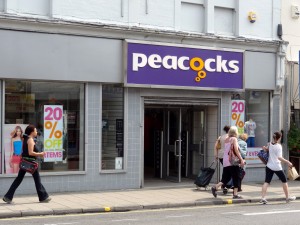 It’s not the first retailer to go into administration and it won’t be the last, but the well-known high street retailer Peacocks will continue to trade for the foreseeable future thanks to Edinburgh Woolen Mill.
The administrators were called in at the beginning of 2012, as Peacocks total debt reach £750 million and it was unable to restructure £240 million of this debt. Edinburgh Woollen Mill has bought the company out of administration, protecting 6000 jobs in the UK. However, at the same time more than 3000 workers will be made redundant, as 224 stores cease trading.
Throughout the recession, retailers across the UK have been struggling, as household incomes have remained low, causing consumer spending to fall. One of the administrators from KMPG, commented that:
‘This (the low consumer demand), combined with a surplus of stores and unsustainable capital structure, led to the business becoming financially unviable.’
 The coming months will be crucial in determining whether more jobs are lost and if there are any further store closures. Much hinges on the ability of Edinburgh Woollen Mill to stabilize the financial performance of Peacocks and stimulate renewed customer demand. The following articles consider this take-over.
Peacocks closes 19 Ulster stores with 263 job losses Belfast Telegraph (23/2/12)
Peacocks Takeover: Edinburgh Woollen Mill buy retailer but 3,100 jobs lost BBC News (including video) (22/2/12)
Peacocks piqued by PIKs Guardian, Nils Pratley (22/2/12)
Edinburgh Woollen Mill buys Peacocks Independent, James Thompson (23/2/12)
Peacocks sold to Edinburgh Woollen Mill – KPMG The Wall Street Journal, Jessica Hodgson (23/2/12)
Questions
- Why has consumer demand in the retails sector fallen during the recession?
- What type of take-over would you classify this as?
- Who are Peacocks’ main competitors? In which market structure would you place the retail sector? Explain your answer.
- The Guardian article refers to the Management-buy-out of Peacocks in 2005. What is a management-buy-out? What were the problems associated with it?
- What are the problems that have been identified as causing Peacocks to go into administration?
- To what extent do you think the Management-buy-out of 2005 is the main reason why Peacocks has fallen into administration?
 With the fall of communism in eastern Europe between 1989 and 1991, many hailed this as the victory of capitalism.
Even China, which is still governed by the Chinese Communist Party, has embraced the market and accepted growing levels of private ownership of capital. It is only one or two countries, such as North Korea and Cuba, that could be described as communist in the way the term was used to describe the centrally planned economies of eastern Europe before 1990.
But whilst market capitalism seemed to have emerged as the superior system in the 1990s, may are now questioning whether the market capitalism we have today is fit for the 21st century. Today much of the world’s capital in the hands of big business, with financial institutions holding a large proportion of shares in such companies. And the gap between rich and poor is ever widening
The market system of today, is very different from that of 100 years ago. In fact, as John Kay agues in his article “Let’s talk about the market economy” below, it would be wrong to describe it as ‘capitalism’ in the sense the term was used in the debates of the 19th and early 20th centuries. Nonetheless, the term is still used and generally refers to the market system we now have. And it is a market system that many see as failing and unfit for purpose. It is a system that coincided with the bubble of the 1990s and early 2000s, the credit crunch of 2007–9 and the recession of 2008/9, now seeming to return as a double-dip recession
 With the political and business leaders of the world meeting at the World Economic Forum at Davos in Switzerland on 25–29 January 2012, a central theme of the forum has been the future of capitalism and whether it’s fit for the 21st century.
Is there a fairer and more compassionate capitalism that can be fostered? This has been a stated objective of all three political parties in the UK recently. Can we avoid another crisis of capitalism as seen in the late 2000s and which still continues today? What is the role of government in regulating the market system? Does the whole capitalist system need restructuring?
It’s becoming increasingly clear that we need to talk about capitalism. The following webcasts and articles do just that.
Webcasts and podcasts
 Davos 2012 – TIME Davos Debate on Capitalism< World Economic Forum (25/01/12)
Can capitalism be ‘responsible’? BBC Newsnight, Paul Mason (19/01/12)
Capitalism ‘nothing to do with responsibility’ BBC Newsnight, Eric Hobsbawm (19/01/12)
Are there alternatives to capitalism? BBC Newsnight, Danny Finkelstein, Tristram Hunt and Julie Meyer (19/01/12)
America Beyond Capitalism The Real News on YouTube, Gar Alperovitz (27/12/11)
The future of capitalism CNBC, Warren Buffett and Bill Gates (12/11/09)
Capitalism Hits the Fan (excerpt) YouTube, Richard Wolff (2/1/12)
Panel Discussion “20 years after – Future of capitalism in CEE” Erste Group on YouTube, Andreas Treichl, Janusz Kulik, Jacques Chauvet, and media Adrian Sarbu (24/2/11)
The Future of Capitalism: Constructive Competition or Chaos? YouTube, Nathan Goetting, Tony Nelson, Craig Meurlin and Judd Bruce Bettinghaus (24/1/11)
Capitalism in Crisis Financial Times, Various videos (24/1/11)
Bill Gates: Capitalism a ‘phenomenal system’ BBC Today Programme, Bill Gates talks to Evan Davis (25/1/12)
Capitalism (See also) BBC The Bottom Line, Evan Davis and guests (28/1/12)
Articles
Meddle with the market at your peril Financial Times, Alan Greenspan (25/1/12)
The world’s hunger for public goods Financial Times, Martin Wolf (24/1/12)
When capitalism and corporate self-interest collide JohnKay.com, John Kay (25/1/12)
Let’s talk about the market economy JohnKay.com, John Kay (11/1/12)
A real market economy ensures that greed is good JohnKay.com, John Kay (18/1/12)
Seven ways to fix the system’s flaws Financial Times, Martin Wolf (22/1/12)
To the barricades, British defenders of open markets! The Economist, Bagehot’s Notebook (26/1/12)
Community reaction to doubts about capitalism in Davos CBC News (26/1/12)
Capitalism saw off USSR, now it needs to change or die The National (UAE), Frank Kane (26/1/12)
Words won’t change capitalism. So be daring and do something Observer, Will Hutton (22/1/12)
A political economy fit for purpose: what the UK could learn from Germany Our Kingdom, Alex Keynes (20/1/12)
Debate on State Capitalism The Economist (24/1/12)
Questions
- How has the nature of capitalism changed over recent decades?
- Can capitalism be made more ‘caring’ and, if so, how?
- What do you understand by the term a ‘fair allocation of resources’? Is capitalism fair? Can it be made fairer and, if so, what are the costs of making it so?
- Can greed ever be good?
- How does the ‘Anglo-Saxon’ model of capitalism differ from the European model?
- What do you understand by the term ‘crony capitalism’? Is crony capitalism on the increase?
- John Kay states that “Modern titans derive their authority and influence from their position in a hierarchy, not their ownership of capital.” Explain what this means and what its implications are for making capitalism meet social goals.
- In what ways can governments control markets? Have these instruments and their effectiveness changed in effectiveness over time?
- What are the costs and benefits to society of the increasing globalisation of capital?
- To what extent was the financial crisis and credit crunch the result of a flawed capitalist system and to what extent was it a failure of government intervention?
- Why is it important for the success of capitalism that companies should be allowed to fail? Consider whether this should also apply to banks. How is the concept of moral hazard relevant to your answer?