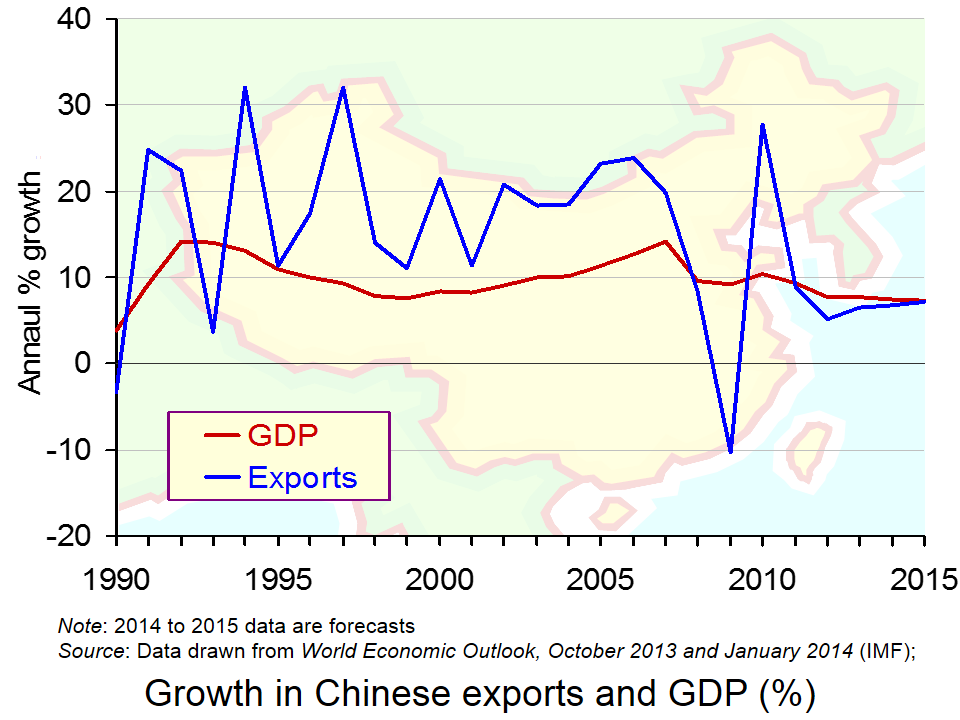
 The growth of China over the past decade has been quite phenomenal, with figures recorded in double-digits. However, in the aftermath of the recession, growth has declined to around 7% – much higher than Western economies are used to, but significantly below the ‘norm’ for China. (Click here for a PowerPoint of the chart.)
The growth target for this year is 7.5%, but there appear to be some concerns about China’s ability to reach this figure and this has been emphasised by a recent Chinese policy.
A mini-stimulus package has been put in place, with the objective of meeting the 7.5% growth target. Government expenditure is a key component of aggregate demand and when other components of AD are lower than expected, boosting ‘G’ can be a solution. However, it’s not something that the Chinese government has had to do in recent years and the fact that this stimulus package has been put in place has brought doubts over China’s economic performance to the forefront , but has confirmed its commitment to growth. Mizuho economist, Shen Jianguang, said:
It’s very obvious that the leaders feel the need to stabilise growth…Overall, the 7.5 per cent growth target means that the government still cares a lot about economic growth.
Data suggest that growth in China is relatively weak and there are concerns that the growth target will be missed, hence the stimulus package. In the aftermath of the 2008 financial crisis, there was a large stimulus package in place in China. This latest investment by the government is in no way comparable to the size of the 2008 package, but instead will be on a smaller and more specific scale. Mark Williams of Capital Economics said:
It’s a bit of a rerun of what we saw last year – something less than a stimulus package and more of piecemeal measures to ensure they reach their growth target.
It is the construction of public housing and railways that will be the main areas of investment this time round. A sum of $120–180bn per year will be available for railway construction and $161bn for social housing, and tax breaks are being extended for small businesses.
The 2008 stimulus package saw debt increase to some 200% of GDP, which did cause growing concerns about the reliance on debt. However, this latest package will be financed through the issue of bonds, which is much more similar to how market economies finance spending.
The fact that the government has had to intervene with such a stimulus package is, however, causing growing concerns about the level of debt and the future of this fast growing economy, though the new method of financing is certainly seen as progress.

It should be noted that a decline in growth for China is not only concerning for China itself, but is also likely to have adverse consequences other countries. In the increasingly interdependent world that we live in, Western countries rely on foreign consumers purchasing their exports, and in recent years it has been Chinese consumers that have been a key component of demand. However, a decline in growth may also create some benefits – resources may not be used up as quickly and prices of raw materials and oil in particular may remain lower.
It is certainly too early for alarm bells, but the future of China’s growth is less certain than it was a decade ago. The following articles consider this issue.
China’s new mini-stimulus offers signs of worry and progress BBC News, Linda Yueh (3/4/14)
China puts railways and houses at hear of new stimulus measures The Guardian (3/4/14)
China unveils mini stimulus to to boost slowing economy The Telegraph (3/4/14)
China stimulus puts new focus on growth target Wall Street Journal, Bob Davis and Michael Arnold (3/4/14)
China embarks on ‘mini’ stimulus programme to kick-start economy Independent, Russell Lynch (3/4/14)
China takes first step to steady economic growth Reuters (2/4/14)
China unveils fresh stimulus The Autstralian (3/4/14)
China’s reformers can triumph again, if they follow the right route The Guardian, Joseph Stiglitz (2/4/14)
Questions
- How has Chinese growth reached double-digits? Which factors are responsible for such high growth?
- The BBC News article suggests that the stimulus package is cause for concerns but also shows progress. How can it do both?
- Using a diagram, illustrate how a stimulus package can boost economic growth.
- What are the advantages and disadvantages of high rates of growth for (a) China and (b) Western economies?
- Why does the method of financing growth matter?
- Railway and housing construction have been targeted to receive additional finance. Why do you think these sectors have been targeted?
 Globalisation has led to an increasingly interdependent world, with companies based in one country often dependent on a market abroad. In recent years, it is the rapid growth of countries like China that has led to growth in the size of the markets for many products. With incomes rising in emerging countries, demand for many products has been growing, but in the past year, the trend for Prada has ended and seems to be reversing.
As the market in China matures and growth of demand in Europe slows, Prada has seen its shares fall by the largest margin since June last year.
Prada is a well-known luxury brand. The products it sells are relatively expensive and hence its products are likely to have an income elasticity of demand well above +1. With changes in China and Europe, Prada expects its growth in sales to January 2015 will be ‘low single-digit’ – less than the 7% figure recorded for the last financial year.
 This lower growth in same-store sales is likely to continue the following year as well. Add on to this the lower-than-expected profits, which missed analysts’ forecasts, and you have a prime example of a brand that is suffering because of its customer base and the economic times.
Prada isn’t alone in suffering from economic conditions and, relative to its European counterparts, is expected to have higher growth in sales and profits in the next 12 months – at 11.5% and 14.8% respectively. This is according to a survey by Thomson Reuters.
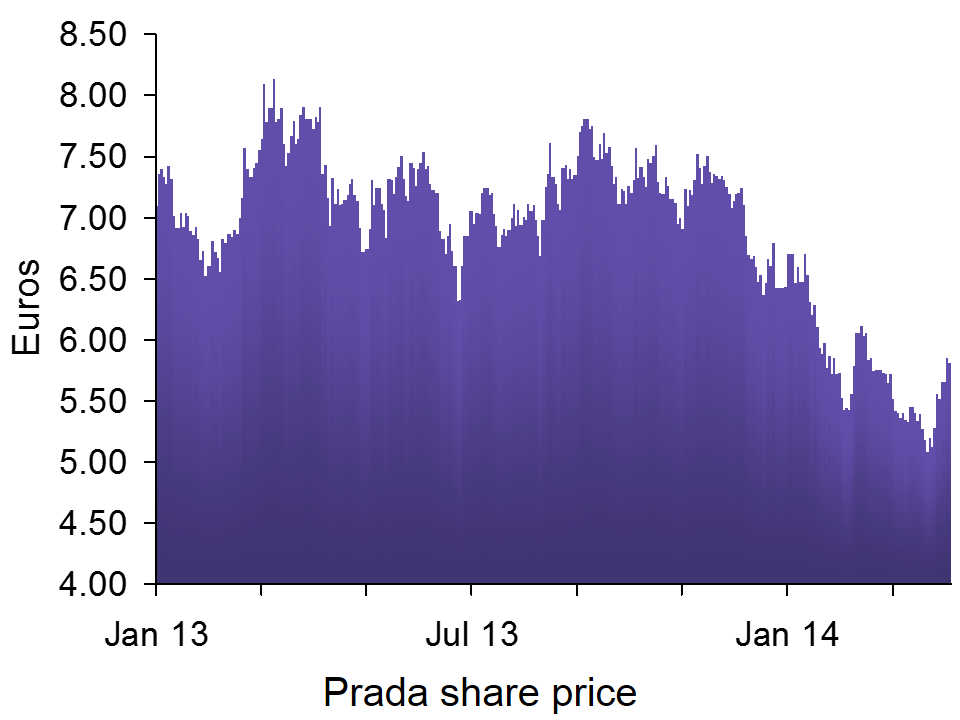 Prada has exploited high demand by Chinese consumers, but has recently been affected by the strength of the euro. A strong euro means that the Italian-based Prada is struggling with exports, which only adds to its problems. As economic growth picks up in China and as other emerging economies begin to experience more rapid economic growth, the fortunes of this luxury-retailer may change once more. However, with volatile economic times still around in many countries, the future of many retailers selling high-end products to higher income customers will remain uncertain. The following articles consider the fortunes of Prada.
Prada shares fall sharply after China luxury warning BBC News (3/4/14)
Prada falls after forecasting slowing luxury sales growth Bloomberg, Andrew Roberts and Vinicy Chan (3/4/14)
Prada profits squeezed by weakness in Europe and crackdown in China The Guardian (2/4/14)
Prada bets on men to accelerate sales growth Reuters, Isla Binnie (2/4/14)
Prada misses full year profit forecast Independent, Laura Chesters (2/4/14)
Questions
- How can we define a luxury product?
- Explain the main factors which have led to a decline in the demand for Prada products over the past 12 months.
- Using a diagram, illustrate what is meant by a strong euro and how this affects export demand.
- What business strategies are Prada expected to adopt to reverse their fortunes?
- Using a diagram, explain the factors that have caused Prada share prices to decline.
 The supermarket industry is a classic example of an oligopoly. A market dominated by a few large companies, which is highly competitive and requires the companies to think about the reactions of the other competitors whenever a decision is made. Throughout the credit crunch, price cutting was the order of the day, as the big four tried to maintain market share and not lose customers to the low cost Aldi and Lidl. Morrisons, however, has found itself in exactly that position and is now looking to restructure to return to profitability.
Morrisons is well known for its fresh food, but it seems that with incomes still being squeezed, even this is insufficient to keep its customers from looking for cheaper alternatives. Morrisons’ market share has been in decline and its profits or the last financial year have been non-existent. It’s been losing ground to its big competitor, Tesco and part of this is due to the fact that Morrisons was late to enter the ‘Tesco metro’ market. It remained dependent on its large supermarkets, whereas Tesco saw the opportunity to expand onto the highstreets, with smaller stores. It was also late arriving to the online shopping business and while it has now developed more sophisticated IT systems, it did lose significant ground to Tesco and its other key competitors.

Another problem is that Morrisons has found itself unable to compete with the low cost supermarkets. The prices on offer at Morrisons are certainly not low enough to compete with prices at Aldi and Lidl and Morrisons has seen many of its customers switch to these cheaper alternatives. But Morrisons is fighting back and has announced plans to cut prices on a huge range of products across its stores. The fresh food aspect of the business will still remain and the hope is that the fresh food combined with cheaper price tags will allow Morrisons to re-gain lost ground to Tesco and take back some of its lost customers from the low-cost alternatives. However, it’s not just Morrisons that has been losing customers to the budget retailers. Tesco, Sainsbury’s and Asda have all lost market share to Aldi and Lidl, but it is Morrisons that has fared the worst.
The latest news on Morrisons’ profits and overall performance, together with its promise of restructuring and price cuts worth £1 billion has caused uncertainty for shareholders and this has reduced the value of shares. However, Morrisons’ Directors have tried to restore confidence by purchasing shares themselves. With expectations of price wars breaking out, the other supermarkets have also seen significant declines in their share values, with a total of £2 billion being wiped off the value of their shares collectively. The consequences of Morrisons’ performance will certainly continue: customers are likely to benefit from lower prices in all of the big four supermarkets, but investors may lose out – at least in the short run. The impact on jobs is uncertain and will certainly depend on how investors and customers react in the coming weeks. The following articles consider this sector.
UK grocer Morrison warns on profit, threatens price war Reuters, James Davey (13/3/14)
Morrisons and the threat to mainstream supermarkets BBC News, Robert Peston (13/3/14)
Morrisons expected to sell property in response to profit drop The Guardian (9/3/14)
Morrisons restructuring sparks fears of new price war BBC News (13/3/14)
Morrisons’ dividend up while profit falls? It’s hard to believe The Guardian, Nils Pratley (13/3/14)
Morrisons boss talks tough as group slides into red The Scotsman, Scott Reid (13/3/14)
Morrisons plots price cuts after annual loss Sky News (13/3/14)
Morrisons’ declaration of £1bn price war with budget stores hammers Sainsbury and Tesco shares This is Money, Rupert Steiner (14/3/14)
Ocado on track for first profit in wake of Morrisons deal Independent, Simon Neville (14/4/14)
Questions
- What are the key characteristics of an oligopoly?
- To what extent do you think the supermarket sector is a good example of an oligopoly?
- Why is the characteristic of interdependence a key cause of the potential price war between the supermarkets?
- Why has Morrisons been affected so badly with the emergence of the budget retailers?
- By using the income an substitution effect, explain how the big four supermarkets have been affected by retailers, such as Aldi and Lidl.
- Using a demand and supply diagram, explain how the share prices of companies like Morrisons are determined. Which factors affect (a) the demand for and (b) the supply of shares?
- What do you think will happen to the number of jobs in Morrisons given the performance of the company and its future plans?
 Footballers in the English Premier League are some of the most highly paid workers in the world. With unique talents and skills and hence a limited supply of labour, together with an insatiable appetite from the British public for football, we would expect to see high wages and a market ripe for investment, with high returns on offer. But, is this case?
The article below is by Linda Yueh, the Chief Business Correspondent for BBC News, and she has looked into the football, asking why on earth buy a football club? Despite the success of the English Premier League in drawing fans, TV and commercial revenues, many teams find it difficult to break even and investing in a team is unlikely to yield much of a return (if any!). Yet, we still see successful businesspeople, especially from abroad, purchasing English football teams.
Many club owners have hugely profitable ventures in other markets and historically only invest their money when they see an opportunity for a high return. But, not in the case of football. A return is unlikely and yet they still invest. So, with positive returns unlikely, what is it about this market that attracts investors? The article by Linda Yueh considers this question.
Article
Why on earth buy a football club? BBC News, Linda Yueh (27/2/14)
Report
Annual Review of Football Finance – Highlights Deloitte, Sports Business Group June 2013
Questions
- How can the returns to investment be measured?
- How can a company’s operating profit be calculated?
- Using a labour market diagram, explain why footballers are paid such a high wage.
- Is it monetary or non-monetary factors that seem to explain why businessmen invest in football clubs?
- Why are English football clubs typically unprofitable? Should they be?
- Which factors can explain the growing financial inequality between clubs in the Premier League and in the divisions below? Is there an argument for government involvement to regulate football?
 In the blog Effects of raising the minimum
wage, the policy of an above-inflation rise in the minimum wage was discussed, as this had been advocated by political leaders. Over the past 5 years, the minimum wage has fallen in real terms, but from October 2014, the national minimum wage will increase 19p per hour and this rise will be the first time since 2008 when the increase will be higher than inflation.
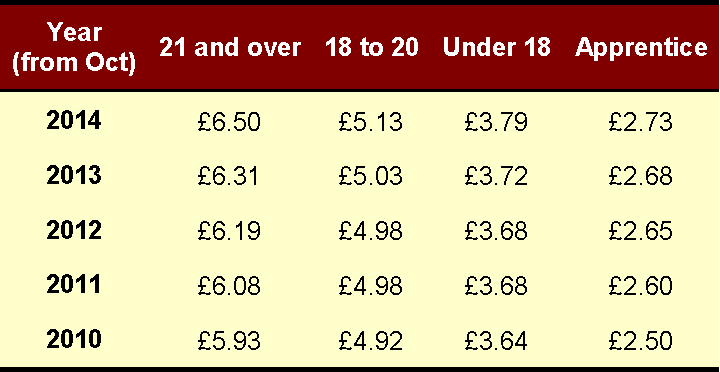
The National Minimum Wage is a rate applied to most workers in the UK and is their minimum hourly entitlement. For adults over the age of 21, it will be increased by just over 3% to £6.50. Rises will also occur for 18-20 year olds, though their increase will be lower at 10p and will take the hourly wage to £5.13 an hour, representing a 2% rise. 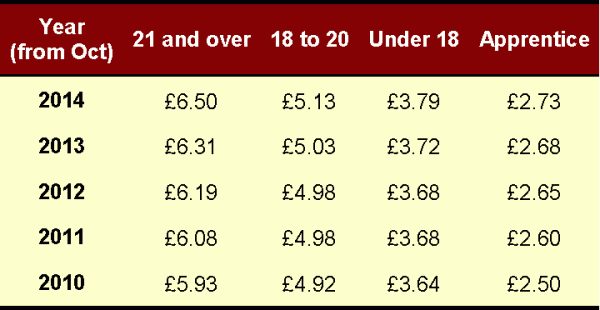 Those aged 16 and 17 will also see a 2% rise, taking their wage up by 7p to £3.79. With inflation currently at 1.9% (as measured by the CPI), these rises outstrip inflation, representing a real increase in the minimum wage. Undoubtedly this is good news for workers receiving the minimum wage, and it is thought that millions of workers will benefit.
Vince Cable said:
The recommendations I have accepted today mean that low-paid workers will enjoy the biggest cash increase in their take home pay since 2008…This will benefit over one million workers on national minimum wage and marks the start of a welcome new phase in minimum wage policy.
While this rise has been praised, there are still suggestions that this minimum wage is too low and does not represent a ‘living wage’. The General Secretary of Unison said:
Across the country people are struggling to make ends meet. The sooner we move to a Living Wage the better. The real winners today will again be payday loan sharks who prey on working people, unable to bridge the financial gap between what they earn and what their families need to survive.
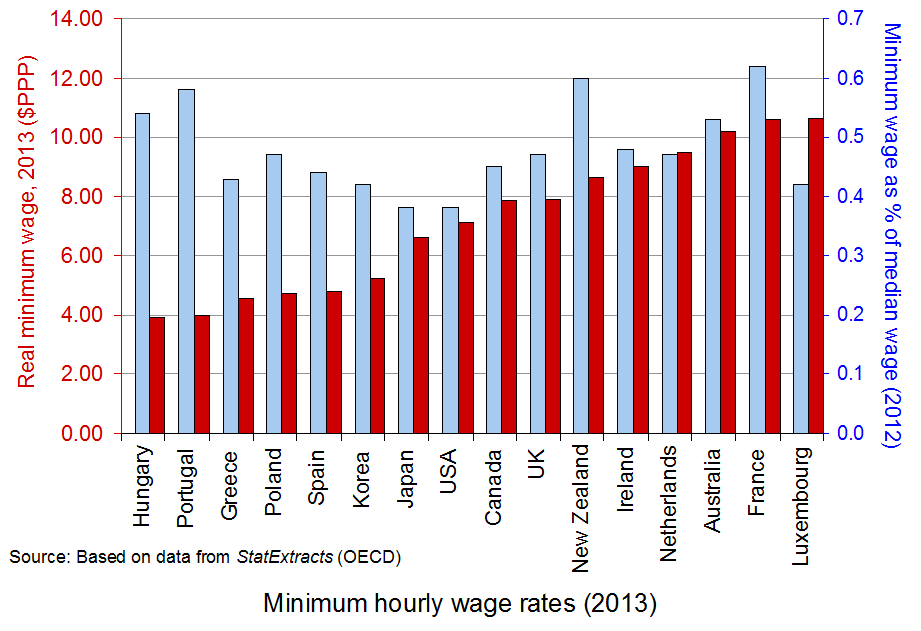
(Click here for a PowerPoint of the above chart.)
The Chancellor eventually wants to increase the minimum wage to £7 per hour, but there will undoubtedly be an impact on businesses of such a rise. Is it also possible that with the national minimum wage being pushed up, unemployment may become a problem once more?
Market wages are determined by the interaction of the demand and supply of labour and when they are in equilibrium, the only unemployment in the economy will be equilibrium unemployment, namely frictional or structural. However, when the wage rate is forced above the equilibrium wage rate, disequilibrium unemployment may develop. At a wage above the equilibrium the supply of labour will exceed the demand for labour and the excess is unemployment.
By increasing the national minimum wage, firms will face higher labour costs and this may discourage them from taking on new workers, but may also force them into laying off existing workers. The impact of the minimum wage on unemployment doesn’t seem to be as pronounced as labour market models suggest, so perhaps the increase in the minimum wage will help the lowest paid families and we won’t observe any adverse effect on businesses and employment. The following articles consider this story.
National minimum wage to rise to £6.50 The Guardian, Rowena Mason (12/3/14)
Minimum wage up to £6.50 an hour BBC News (12/3/14)
Minium wage to increase by 3% to £6.50 an hour Independent, Maria Tadeo (12/3/14)
Minimum wage rise confirmed Fresh Business Thinking, Daniel Hunter (12/3/14)
Ministers approve minimum wage rise London Evening Standard (12/3/14)
Government to accept proposed 3% minimum wage rise The Guardian, Rowena Mason (4/3/14)
Londoners do not believe minimum wage is enough to live on in the capital The Guardian, Press Association (9/3/14)
Minimum wage: The Low Pay Commission backs a 3% increase BBC News (26/2/14)
Questions
- Using a diagram, illustrate the impact of raising the national minimum wage in an otherwise perfectly competitive labour market.
- How does your answer to question 1 change, if the market is now a monopsony?
- To what extent is elasticity relevant when analysing the effects of the national minimum wage on unemployment?
- How might an increase in the national minimum wage affect public finances?
- Why is an above-inflation increase in the national minimum wage so important?
- What is meant by a Living Wage?
- What do you think the impact on business and the macroeconomy would be if the minimum wage were raised to a ‘Living Wage’?