 When you think about John Lewis, you think of a large department store. It is a department store celebrating its 150th anniversary. Many large retailers, such as John Lewis, have expanded their product range throughout their history and have grown organically, moving into larger and more prominent locations. What’s the latest location? St Pancras station.
The idea of a click-and-collect store has grown in popularity over the past decade. With more and more people working and leading very busy lives, together with the growth of online shopping, it is the convenience of this type of purchase which has led to many retailers developing click-and-collect. Indeed, for John Lewis, 33% of its internet sales do come through click-and-collect. However, John Lewis is going a step further and its new strategy is reminiscent of companies like Tesco. If you just need to pop into Tesco to get some milk, you’re likely to go to the local Tesco express. The first mover advantage of Tesco in this market was vital.

John Lewis is unusual in that it is owned by its employees and this ownership structure has proved successful. Despite a long history, John Lewis has moved with the times and this latest strategy is further evidence of that. In today’s world, convenience is everything and that is one of the key reasons behind its new St Pancras convenience store. It will allow customers to purchase items and then collect them on their way to and from work – click-and-commute, but it will also provide customers with an easily accessible place to buy electronic equipment and a range of household goods. The retail director, Andrew Murphy said:
In the battleground of convenience, we are announcing a new way for commuters to shop with us … Customers spend a huge amount of time commuting, and our research shows that making life easier and shopping more convenient is their top priority.
This appears to be the first of many smaller convenience stores, enabling John Lewis to gain a presence in seemingly impossible places, given the normal size of such Department stores. For many people, commuting to and from work often involves waiting at transport hubs – one of the big downsides to not driving. So it seems sensible for such an established retailer to take advantage of commuters waiting for their train or plane to arrive, who have time to kill. The following articles consider this new direction for an old retailer.
John Lewis to open St Pancras convenience store BBC News (2/5/14)
John Lewis thinks small with convenience store The Guardian, Zoe Wood (2/5/14)
John Lewis to trial convenience store click-and-collect format at St Pancras Retail Week, Ben Cooper (2/5/14)
 Why is click and collect proving so popular? BBC News, Phil Dorrell (2/5/14)
The rise of click and collect for online shoppers BBC News, Phil Dorrell (2/5/14)
Questions
- What are the advantages and disadvantages of the organisational and ownership structure of John Lewis?
- How would you classify this new strategy?
- How do you think this new strategy will benefit John Lewis in terms of its market share, revenue and profit?
- Is it likely that John Lewis will be able to target new customers with this new convenience store strategy?
- How important is a first-mover advantage when it comes to retail? Using game theory, can you create a game whereby there is clear first mover advantage to John Lewis?
 When Kraft took over Cadbury, it was seen as a large take-over, but its size pales in comparison to the potential takeover of AstraZeneca by Pfizer. However, having made two offers for the UK drugs firm, the US company has been rejected twice, saying the terms of the offer were ‘inadequate, substantially undervalue AstraZeneca and are not a basis on which to engage with Pfizer.’
Pfizer initially made an offer of £46.61 per share, valuing the company at £58.5bn, but this latest offer increased the share price to around £50 and raised the company value to £63bn. The rejection was relatively swift and the price still too low, though analysts are suggesting that a price closer to £53 may tempt shareholders. At the moment the negotiations between these two giants remain ‘friendly’, but with this second offer being rejected by the Board, there are now concerns that the takeover could become ‘hostile’ with Pfizer going directly to shareholders. Indeed one investor has said:
We were very keen that the two boards actually get around the table and disucss the bid … I’m never very keen when companies just dismiss things and don’t allow shareholders to take a decision on it … The key thing is that these businesses get talking to each other so they can hammer out a deal.
Following the second offer, shares in AstraZeneca rose by 10p, as the debate continued as to whether such a take-over would be good or bad for British jobs.
Cadbury was seen as a jewel in the crown of British industry and the same can be said of AstraZeneca, especially with the growing importance placed on the Science sector in the UK. While Pfizer has now given the British government further assurances about protection for Britain’s science base, there are still concerns about what this take-over would mean for British jobs. Pfizer has said that 20% of the company’s workforce in research and development would work in the UK and the planned R&D base in Cambridge would still go ahead. However, asset-stripping is a phrase that has been thrown around, based on Pfizer’s previous take-overs and, based on this history, many are suggesting that any assurances made by Pfizer will be pointless. In particular, Allan Black from the GMB union said:
Similar undertakings were given by US multinationals before which have proved to be worthless.
This was echoed by Lord Sainsbury who commented that any assurances made by Pfizer would be ‘frankly meaningless’. However, Vince Cable seems more confident about the consequences for British industry and said:
We’ve now received some assurances from the company that they will strengthen the British science base, they will protect British manufacturing … We need to look at that in detail, we need to look at the small print, we need to establish that it is binding, but as far as it goes, on the basis of what we’ve seen so far, it is welcome and encouraging.
We therefore seem to have a tale of two stories. On the one hand, the assurances of a US company that British jobs and its science base will be protected, but on the other hand, suggestions that we should take Pfizer’s assurances with a pinch of salt and that any take-over could be ‘devastating’. The truth of the matter will only be known if and when the take-over goes ahead and perhaps more importantly, whether it remains friendly and co-operative or does indeed go ‘hostile’. The following articles consider this medical take-over between giants.
AstraZeneca rejects Pfizer bid as US Pharma giant courts UK government The Guardian, Julia Kollewe and Sean Farrell (2/5/14)
AstraZeneca rejects new Pfizer offer BBC News (2/5/14)
AstraZeneca Pfizer: major shareholder urges talks The Telegraph, Denise Roland (2/5/14)
AstraZeneca rejects Pfizer’s raised bid of 63 billion pounds Reuters (2/5/14)
Pfizer-AstraZeneca offer: IoD warns intervention ‘disastrous’ for Britain. The Telegraph, Louise Armitstead (2/5/14)
Pfizer enters takeover discussions with AstraZeneca, sources say Wall Street Journal (2/5/14)
Exclusive: Pfizer insider warns that takeover of AstraZeneca could be ‘devastating’ Independent, Jim Armitage and Chris Green (2/5/14)
The Cadbury deal: how it changed takeovers BBC News, Ben Morris (2/5/14)
Pfizer set to make higher bid for AstraZeneca The Guardian, Julia Kollewe (1/5/14)
The UK’s response to Pfizer’s takeover bid is incoherent and misguided The Guardian, Larry Elliott (4/5/14)
Questions
- What type of take-over would this be classified as? Explain your answer.
- What would occur if the take-over became ‘hostile’?
- Using a demand and supply diagram, explain why share prices in AstraZeneca went up by 10p on the day the second offer was made.
- How would such a take-over affect British jobs?
- Explain how this proposed take-over could (a) boost British R&D in science and (b) harm British R&D in science.
- To what extent might there be concerns from the competition authorities were this take-over to go ahead? How might such a takeover affect Pfizer’s market share and hence its ability to charge a high price?
 Rising inflation: not normally a cause for celebration, but that’s not the case for Japan. Having been subject to the spectre of deflation for many years, the 22-year high for the CPI at 2.7% is a welcome figure, even it is slightly lower than expected. This surge in prices is partly the result of a growth in domestic demand and a sign, therefore, that output will expand in response to the rise in demand.
The Japanese economy has experienced largely stagnant growth for two decades and a key cause has been falling prices. Although consumers like bargains, this has been problematic for this large economy. Deflation creates continuously falling prices and this means consumers hold back from purchasing durable goods, preferring to wait until prices have fallen further.

In the blog, Japan’s recovery, we looked at inflation data showing Japanese consumer prices growing at a faster rate than expected. This ‘positive’ trend has continued.
When it comes to inflation, expectations are crucial. If people think prices will rise in the future, they are more likely to buy now to get the lower price. This can therefore help to stimulate aggregate demand and it is this that has been the target for Japan. Part of the growth in the CPI is down to the sales tax rise from 5% to 8%. This was the first time in 17 years that the sales tax had increased. Further increases in it are expected in 2015. There were concerns about the impact of this rise, based on the depression that followed the last rise back in 1997, but so far the signs seem good.
Monetary easing was a key component in ending the downward trajectory of the Japanese economy and, following the sales tax rise, many believe that another round of monetary easing may be needed to counter the effects and create further growth in the economy and in the CPI. As the Bank of Japan Governor said:
There are various ways to adjust policy. We will decide what among these measures is appropriate depending on economic and price developments at the time … For now, we can say Japan is making steady progress toward achieving 2 per cent inflation.
One of the ‘three arrows‘ of the government’s policy has been to boost government spending, which should directly increase aggregate demand. Furthermore, with signs of the CPI rising, consumers may be encouraged to spend more, giving a much needed boost to consumption. The economy is certainly not out of the woods, but appears to be on the right path. The following articles consider the Japanese economy.
Japan CPI rises less than expected Wall Street Journal, Takashi Nakamichi (25/4/14)
Japan inflation may beat BOJ forecast Reuters, Leika Kihara (22/4/14)
Tokyo consumer price growth at 22-year high BBC News (25/4/14)
Japan inflation quickens to over 5-year high, output rebounds Reuters, Leika Kihara and Stanley White (31/1/14)
Japan’s consumer inflation set to reach five-year high Guardian (18/4/14)
Tokyo inflation hits 22-year high, inching toward BOJ goal Reuters, Tetsushi Kajimoto and Leika Kihara (25/4/14)
Tokyo’s core CPI got 2.7% lift in April from tax hike The Japan Times (25/4/14)
Is Japan winning the war against deflation? CNBC, Ansuya Harjani (25/4/14)
Questions
- Why is deflation a problem?
- Using an AD/AS diagram, illustrate the problem of expectations and how this contributes to stagnant growth.
- Use the same diagram to explain how expectations of rising prices can help to boost AD.
- Why is the sales tax expected to reduce growth?
- Why is another round of monetary easing expected?
- What government policies would you recommend to a government faced with stagnant growth and falling prices?
 Calls for an independent Scotland have focused on a variety of economic issues. These have included taxation, government spending, currency, fiscal policy and monetary policy. However, the BBC News article below looks at another factor which may be affected by a ‘yes’ vote – the price of stamps.
Having just returned from 10 days in the Highlands, I certainly agree with the BBC article that it would be an expensive business to deliver to the remotest parts of Scotland and would definitely require ‘trains, planes, ferries, Land Rovers and vans’ and, in an extreme case, a fishing boat.
So is the price we pay for postage to less rural areas of the UK used to subsidise the higher costs of delivery to the remotest parts of Scotland and, in particular, to the small islands off the Scottish coastline? What would a ‘yes’ vote mean for the cost of stamps in Scotland and in the remainder of the UK? The following articles consider this rather odd question.
Why postage should be cheaper in UK if Scots vote ‘Yes’ BBC News, Brian Milligan (19/4/14)
Tories warn over post service costs The Courier (6/4/14)
Questions
- What happened when the Royal Mail was privatised?
- What are the benefits and costs of privatisation?
- Using a cost and revenue diagram, explain how the different costs of delivery between urban parts of the UK and the remotest parts of Scotland should be reflected in different prices of postage.
- If the price of postage is the same for delivery everywhere in the UK, use your diagram to explain how this happens.
- What does your diagram suggest will happen to the price of postage stamps if a ‘subsidy’ is no longer available?
 Unemployment and employment are concepts that are often talked about in the media. Indeed, the 7% unemployment target referred to by the Governor of the Bank of England has been a constant feature of recent headlines. However, rather than targeting an unemployment rate of 7%, George Osborne has now called for ‘full employment’ and believes that tax and welfare changes are key to meeting this objective.
Reducing the unemployment rate is a key macroeconomic objective and the costs of unemployment are well-documented. There are obviously big costs to the individual and his/her family, including lower income, dependency, stress and potential health effects. There are also costs to the government: lower income tax revenues, potentially lower revenues from VAT through reduced consumer expenditure and the possibility of higher benefit payments. There are other more ‘economic’ costs, namely an inefficient use of resources. Unemployment represents a cost to the economy, as we are operating below full capacity and we therefore see a waste of resources. It is for this reason that ‘full employment’ is being targeted.
Traditional economic theory suggests that there is a trade-off between unemployment and inflation, illustrated by the well-known Phillips curve. In the past, governments have been willing to sacrifice unemployment for the purpose of reducing inflation. There have also been attempts to boost the economy and create jobs through increased borrowing. However, George Osborne has said:
Unemployment is never a price worth paying, but artificial jobs paid for with borrowed money doesn’t work either.
A figure representing full employment hasn’t been mentioned, so it remains unclear what level of unemployment would be acceptable, as despite the name ‘full employment’, this doesn’t mean that everyone has a job. There are several definitions of full employment, in both an economic and political context. In the period of reconstruction after the Second World War, William Beveridge, architect of the welfare state, defined full employment as where 3% of people would be unemployed.
In more recent times, other definitions have been given. In the era of monetarism in the 1970s, the term ‘natural rate of unemployment’ was used to define the unemployment rate to which economies tend in the long run – after inflationary expectations have adjusted. Keynesians use the term the ‘non-accelerating-inflation rate of unemployment (NAIRU)’, where unemployment is confined to equilibrium unemployment and where there is no excess or deficiency of aggregate demand. Both the natural rate and the NAIRU relate to the rate of unemployment at which the long-run Phillips curve is vertical.
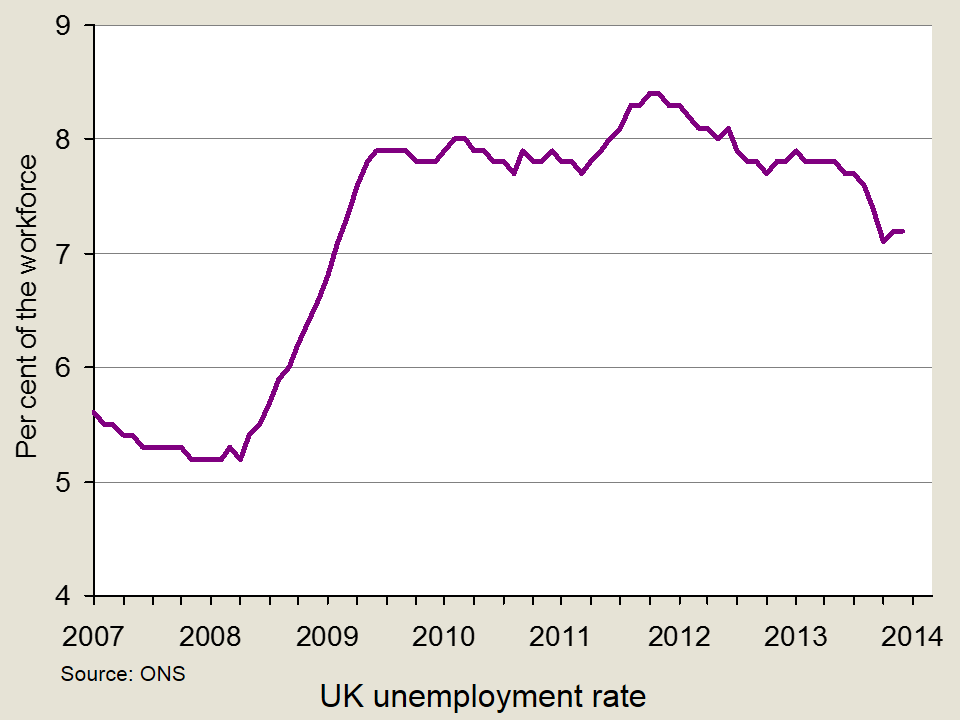
In its Economic and Fiscal Outlook of March 2013, the Office for Budget Responsibility estimated the UK’s NAIRU to be 5.4%. George Osborne has not specified a particular rate. Rather, his speech refers to creating the ‘highest employment rate of any of the world’s leading economies’. He said the ambition was to make the UK:
…the best place in the world to create a job; to get a job; to keep a job; to be helped to look for another job if you lose one…A modern approach to full employment means backing business. It means cutting the tax on jobs and reforming welfare.
Therefore, while it appears that there is no target figure for unemployment, it seems that a new Conservative objective will be to focus on sustainable job creation and eliminate disequilibrium unemployment. This represents a move very much into Labour territory. Meeting the objective will be no easy task, given the past few years and such high levels of youth unemployment, as Labour were quick to point out, but the unemployment figures are certainly moving in the right direction. The following articles consider the objective of full employment.
Articles
Britain’s Osborne changes tone on economy with “full employment” target Reuters, William James (31/3/14)
George Osborne commits to ‘fight for full employment’ BBC News (including video) (1/4/14)
What does full employment mean? The Guardian (1/4/14)
What is full employment? The Telegraph, Peter Dominiczak (31/3/14)
’Jobs matter’, says George Osborne as he aims for full employment Independent, Andrew Grice (31/3/14)
Liam Bynre: Labour would aim for ‘full employment’ BBC News (17/5/13)
Osborne pledges full employment for UK Sky News (31/3/14)
Osborne commits to full employment as election looms Bloomberg, Svenja O’Donnell (31/3/14)
Whatever happened to full employment? BBC News, Tom de Castella and Caroline McClatchey (13/10/11)
Questions
- What is meant by full employment?
- Is it a good idea to target zero unemployment?
- Using a diagram, illustrate the difference between disequilibrium and equilibrium unemployment?
- How can full employment be achieved?
- What are the costs of unemployment?
- Use a diagram to illustrate the natural rate of unemployment and explain what it means in terms of the relationship between unemployment and inflation.