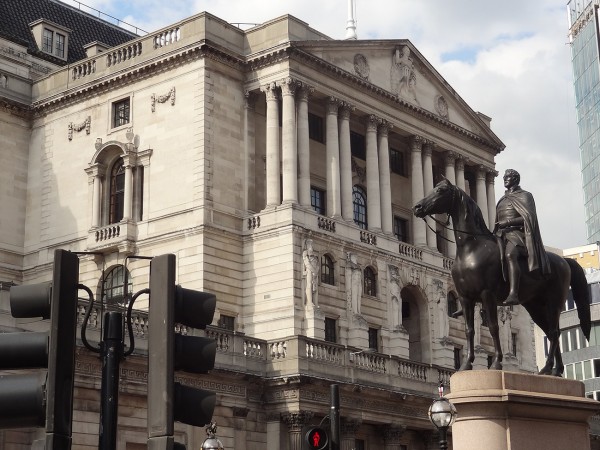
 In 2009, interest rates in the UK were cut to a record low of 0.5%. Since that point, there has been almost unanimous agreement amongst the members of the Monetary Policy Committee to keep rates at this low. It is only in the last couple of months when some have even voted to raise rates. However, this month, interest rates were once again held at 0.5%.
The low interest rates have played a key part in creating an economic stimulus for the UK economy. With low interest rates, some of the key components of aggregate demand are stimulated and this in turn is crucial in creating a growth environment. However, with the recovery of the UK economy, there are now expectations that interest rates may soon begin to rise. Perhaps adding to this expectation is the fact that the bank’s stimulus programme has remained unchanged at £375bn. As more data is released that continues to show the positive progress of the UK economy, it becomes increasingly likely that interest rates will soon rise.
Despite the fact that interest rates will inevitably increase, Mark Carney has said that any increase will be slow and gradual to minimise the effect on consumers, especially home-owners. Mortgage payments are typically the biggest expenditure for a household and so any increase in interest rates will certainly put added pressure on home-owners and with wage growth still remaining slow, there are concerns of the impact this may have. Perhaps this may continue to deter some of the Committee for voting in favour of interest rate rises. There does appear to be some conflict between economists as to what the next step is likely to be. Yael Selfin is the economics director at KPMG and said:
With inflationary pressures still subdued, it is no surprise that rates have been held … Despite recent revisions to GDP and productivity, there is still room for further improvements in productivity, to mop up some of the rise in demand over the coming months. Steady falls in unemployment and strong economic growth are likely to see rates rising in February next year.
However, Andrew Goodwin, who is the senior economic adviser to the EY ITEM Club commented that:
On one hand, the stronger performance might convince some members that the economy is sufficiently robust to withstand the steady tightening of policy, although it should be noted that the Bank routinely builds into its forecasts the expectation of some upward revisions to the recent historical data … On the flip side, the revisions also provide some ammunition for those of a dovish persuasion, with evidence that a stronger productivity performance has had little feed through into inflationary pressures.
The key question therefore appears to be not whether interest rates will increase, but when. The MPC certainly considers inflation when making its decisions, but over the past few years, it is economic growth which has probably been the biggest influence. The data for the UK economy over the coming months, as well as the fast-approaching General Election, will prove crucial in determining exactly when interest rates increase. The following articles consider this monetary policy change.
UK interest rates held at record low of 0.5% BBC News (4/9/14)
Bank of England holds interest rates at 0.5pc for 66th month The Telegraph, Szu Ping Chan (4/9/14)
Timing of UK interest rate hike mired in UK services sector conundrum International Business Times, Lianna Brinded (3/9/14)
Interest rates expected to hold Mail Online, Press Association (31/8/14)
Bank of England holds rates despite robust recovery Reuters, Andy Bruce (4/9/14)
Bank of England keeps record-low rate on weak inflation Bloomberg, Scott Hamilton (4/9/14)
Questions
- By outlining the key components of aggregate demand, explain the mechanisms by which interest rates will affect each component.
- How can inflation rates be affected by interest rates?
- Why is there a debate between economists and the MPC as to when interest rates should be increased?
- If interest rates do increase, how is this likely to affect home-owners?
- What are the advantages and disadvantages of a slow and gradual rise as opposed to one big rise?
 Every year thousands of entrepreneurs will have another great idea that is sure to take off and bring in millions of customers. However, most of these great ideas will turn into another business failure. But, in the case of Dropbox, it is multiple business failures that eventually created a huge success, giving hope to millions of budding entrepreneurs.
With 300 million users, the file sharing ‘Dropbox’ is certainly a success, estimated at a value of $10bn. But it didn’t happen immediately and was preceded by a few failures. So, what is the secret to success in this case? The co-founder of Dropbox, Drew Houston, said that it is all about providing something that customers want. In the case of Dropbox, customers are crucial: the more people use it, the easier it becomes for others to use it too, as it allows file sharing on a much larger scale. Perhaps here we have a case of network externalities.
With Dropbox people would tell their friends about it and collaborate. So when you go into work and work on a project with colleagues you recruit them in essence to become Dropbox users because you’re all working on a project together.
No doubt there are many other examples of businesses that have proved a success after several failed attempts. Providing customers with what they want, at the time when they need it is clearly a key ingredient, but so, it appears, is business failure. The following article from BBC News considers the rise of Dropbox.
 Dropbox and the failures behind it BBC News, Richard Taylor (1/7/14)
Questions
- Customers are clearly crucial for any business to succeed. How can a new entrepreneur find out if there is a demand?
- Why was timing so important in the case of Dropbox?
- Given that customers can actually use Dropbox for free, how does this company make so much money?
- What are network externalities? Explain them in the context of Dropbox.
- Drew Houston says that ‘distribution’ is another key ingredient to success. What do you think is meant by this and how will it help create success?
 One example of an oligopoly was recently discussed on this blog –supermarkets. Here, is another classic example: the energy sector. It is dominated by six big firms, which hold the majority of the market in an industry with high barriers to entry; there is inter-dependence between the firms; and there are accusations of price fixing and collusion – all typical features of an oligopoly that may operate against consumers’ interests.
There have been numerous investigations into the actions of these energy providers, owing to their high prices, a lack of competition and significant profits. Developments in the industry have focused on reducing the barriers to entry created by the vertical integration of the incumbent firms in order to make it easier for new firms to enter, thus boosting competition.
However, the latest step is the biggest one, with the energy regulator, Ofgem, referring this industry to the Competition and Markets Authority (CMA). The investigation is likely to last 18 months and will ‘leave no stone unturned in establishing the truth behind energy prices’.
One of the key things that will be investigated is the accusation of profiteering and thus whether the big six should be broken up. This would inevitably lead to reductions in entry barriers and more opportunities for new firms to enter the market, thereby creating a much needed increase in competition. The Chief Executive of Ofgem, Dermot Nolan said:
Now is the right time to refer the energy market to the CMA for the benefit of consumers…There is near-unanimous support for a referral and the CMA investigation offers an important opportunity to clear the air. This will help rebuild consumer trust and confidence in the energy market as well as provide the certainty investors have called for.
Further comments were made about the energy sector and the future direction in terms of market reforms. This was another reason given for the referral to the CMA. Dermot Nolan added:
A CMA investigation should ensure there are no barriers to stop effective competition bearing down on prices and delivering the benefits of these changes to consumers.
The impact of this latest news will undoubtedly be felt by the big six, with share prices already taking a small hit, as investors start to look ahead to the potential outcome, despite any decision not being expected for a good 18 months. The following articles consider this latest energy market development.
Ofgem puts big six energy suppliers under CMA spotlight The Guardian, Terry Macalister (26/6/14)
Ofgem refers ‘big six’ energy groups for competition probe Financial Times, Claer Barrett (26/6/14)
U.K. energy regulator Ofgem asks for utilities probe Wall Street Journal, Selina Williams (26/6/14)
Energy probe could lead to ‘major structural change’ BBC News (26/6/14)
Probe into energy firms’ £100 per home profits The Telegraph, Emily Gosden (26/6/14)
UK competition watchdog kicks off energy suppliers probe Reuters (26/6/14)
Energy sharks may £101 profit per family: Major inquiry launched into power Mail Online, Sean Poulter (26/6/14)
Big six energy firms face full competition probe Independent, Simon Read (26/6/14)
Questions
- How well does the energy sector fit the structure of an oligopoly?
- What are the barriers to entry in the energy market? How can this referral to the CMA help to reduce them?
- Which factors determine the price of energy?
- The big six have been accused of profiteering. What is meant by this and why is it against the public interest?
- Why has it taken so long for such a referral to take place?
- In the BBC News article, the suggestion is that this investigation could lead to a ‘major structural change’. What is meant by this and why is it a possibility?
 Oligopoly is the most complex market structure, characterised by a few large firms which dominate the industry. Typically there are high barriers to entry and prices can be very sticky. However, perhaps the most important characteristic is interdependence. With this feature of the market, oligopolies, despite being dominated by a few big firms, can be the most competitive market structure.
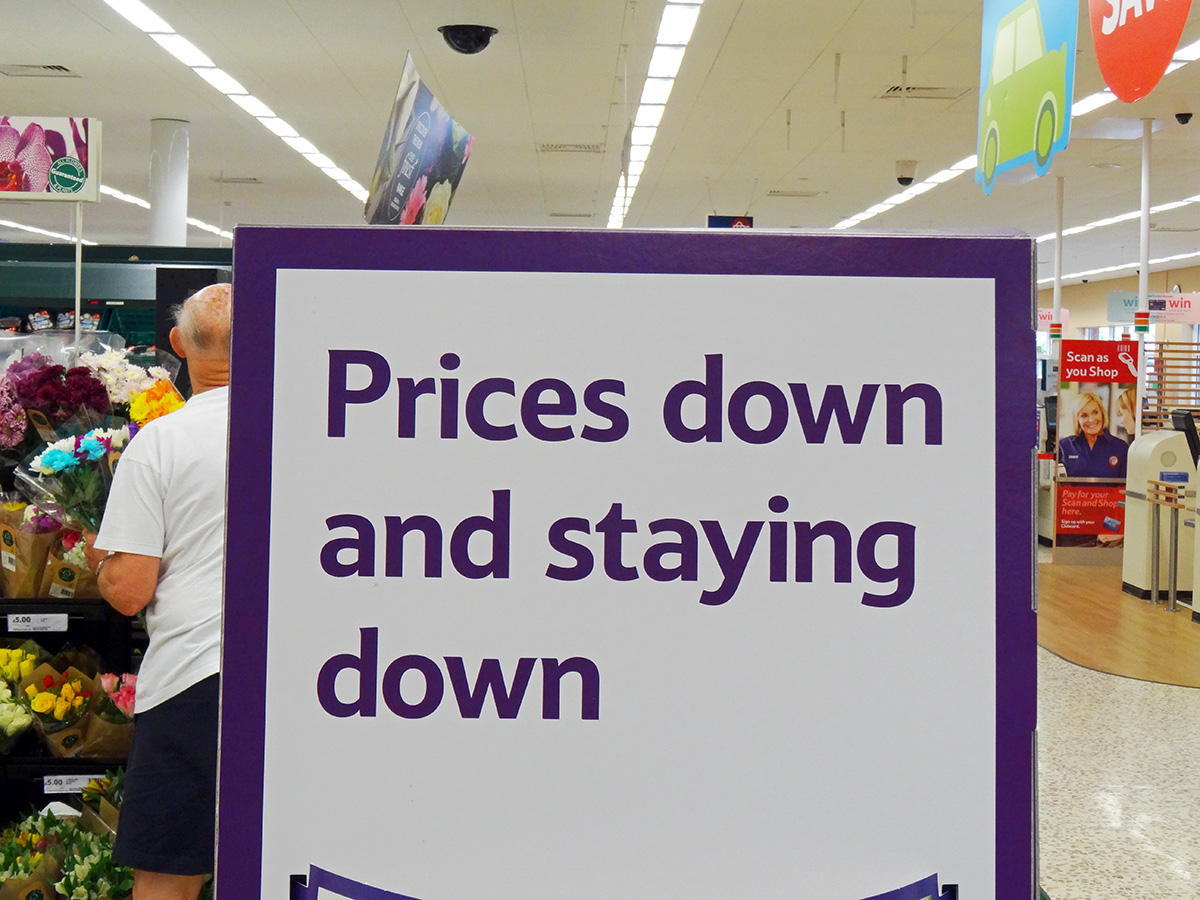
There are many examples of oligopolies and one of the best is the supermarket industry. Dominated by the likes of Tesco, Morrisons and Asda, competition in terms of branding, product development and quality is constant, but so is price competition.  During the recession, you could hardly watch a TV programme that included advert breaks without seeing one of the big four advertising their low prices.
However, in the past few years, the supermarket industry has seen competition grow even further and the big four are now facing competition from low-cost retailers, including Aldi and Lidl. This has led to falling sales and profits for the likes of Tesco and Morrisons.
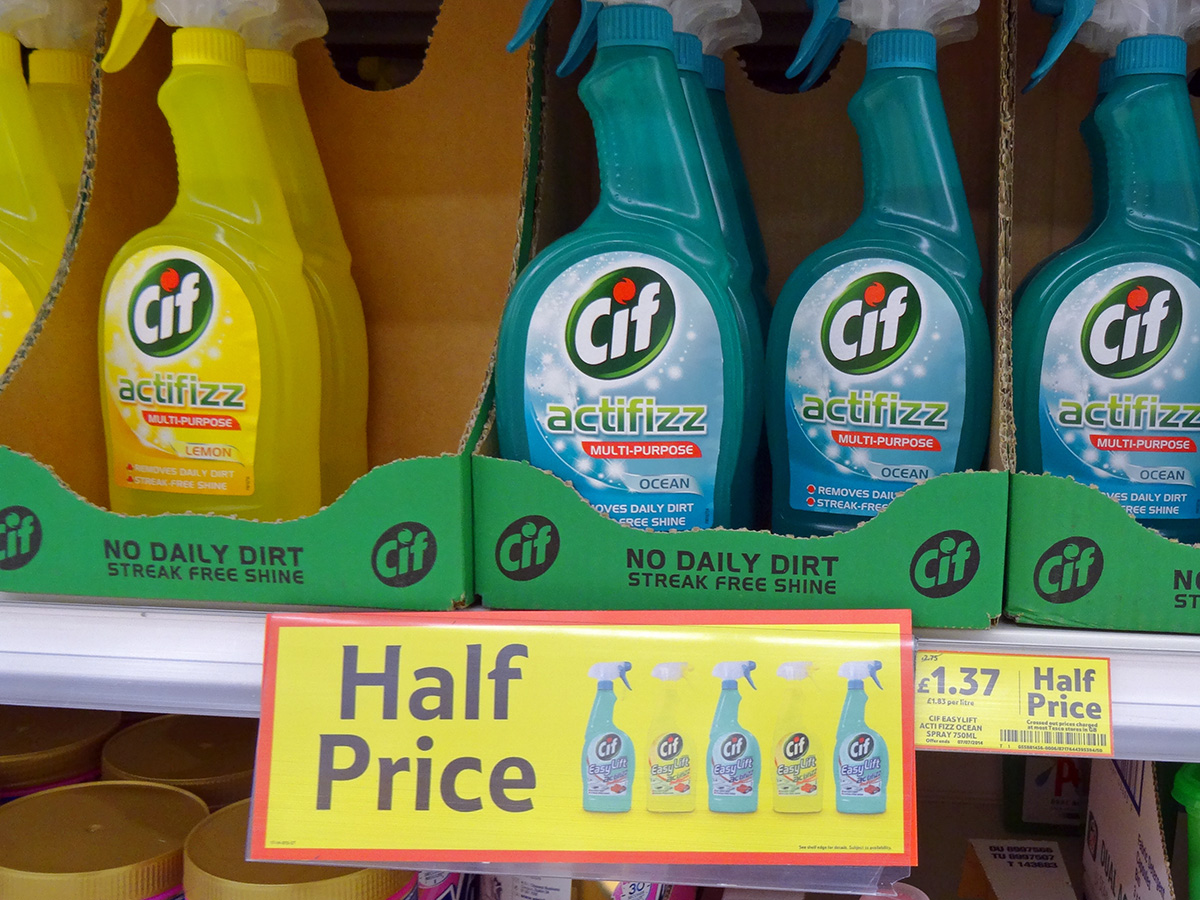
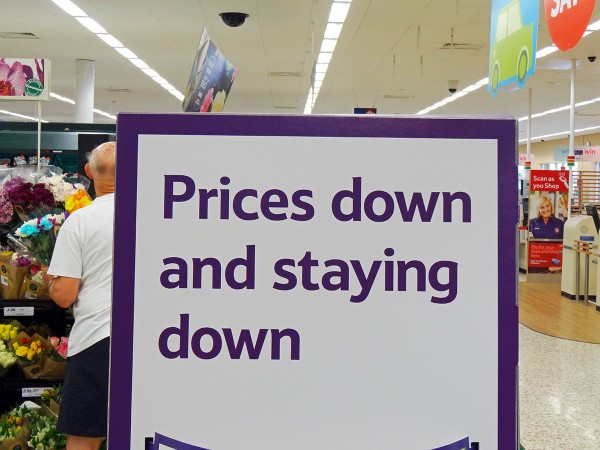 Tesco, Morrisons, Sainsbury’s and Asda have all felt the emergence of discount retailers and have seen their customer numbers fall. All have reacted with rounds of price cuts and new deals, and this price war looks set to continue. Morrisons have just announced a 14% average price cut on 135 products to match earlier changes in pricing strategies by the other main competitors. As I’m writing this during the Algeria v. South Korea match, I have just seen an advert from Sainsbury’s, promoting their milk chocolate digestive biscuits, priced at £1. The advert explicitly states that they are ‘less than Morrisons’, where the price is £1.50. This was soon followed by another from Sainsbury’s saying that
 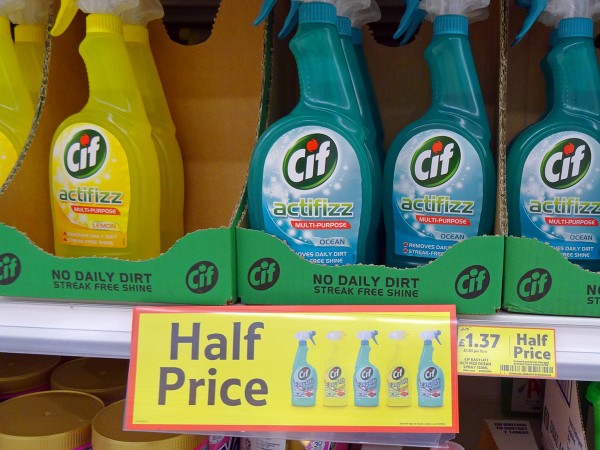 the Cif bathroom spray is £1.50, which is ‘less than Tesco’, priced at £2.75. I need say no more.
So, what is it about this industry which means it is so susceptible to price wars? Are all oligopolies like this? The following articles consider the supermarket industry and the price wars that have emerged. Think about this sector in terms of oligopoly power and consider the questions that follow.
Morrisons announces another round of price cuts/a> BBC News (22/6/14)
Tesco suffers worst sales for decades The Guardian, Sarah Butler and Sean Farrell (4/6/14)
Britain’s Morrisons to cut prices on 135 products Reuters (22/6/14)
Morrisons slashes more prices by up to 41pct The Telegraph, Scott Campbell (22/6/14)
Sainsbury’s and Netto in discount store tie-up BBC News (20/6/14)
Slow to respond, Tesco now pays the price Wall Street Journal, Peter Evans and Ese Erheriene (19/6/14)
One million fewer customer visits a week at Tesco The Guardian, Sean Farrell (3/6/14)
Asda only one of big four to grow share as Lidl achieves highest ever growth Retail Week, Nicola Harrison (3/6/14)
Will Asda shoot itself in the foot with in-store cost cutting? The Grocer, Alec Mattinson (28/5/14)
Tesco sales slide at record speed as discounters pile on the pressure Independent, Simon Neville (3/6/14)
Quester: Back J Sainsbury to prove doubters wrong The Telegraph, Graham Ruddick (11/6/14)
Questions
- What are the key characteristics of an oligopoly?
- How do the above characteristics explain the conduct of firms in an oligopoly? How relevant is this to the supermarket industry?
- In many oligopolies, prices are sticky. Why is it that in the supermarket industry price wars break out?
- Is the kinked demand curve a relevant model to use when talking about the supermarket industry?
- What other industries fit into the category of an oligopoly? Is the kinked demand curve model relevant in these industries?
- Would there be an incentive for the big 4 supermarkets to collude and fix price? Explain your answer.
- Interdependence is the key characteristic in an oligopoly. Can this explain the behaviour of the supermarkets?
- Given that oligopolies are characterised by high barriers to entry, how is that Aldi and Lidl have been able to compete with them?
 What does it take to create a successful business? From the looks of it: mud, electric barbed wire, icy water, enormous walls to climb, big jumps to make, team work and complete exhaustion – the recipe for every successful business.
Tough Mudder was founded in 2010 and runs gruelling extreme obstacle courses for anyone mad enough to think it might be fun. In the BBC News article below, you’ll see that there is a discussion as to intellectual property rights, but whatever the outcome, this company has become the main provider of such extreme sports in a remarkably short period of time. Within 2 years of being established, it had gained 500,000 participants and now records annual revenues of more than £60m. Add to this, that there has no external funding and this organic growth is beyond impressive.
A key question, then, is what creates such a successful business? Without a doubt, this depends on the product you are selling and the market a firm is in, but there are some aspects that apply across the board. Understanding what your customers want is crucial, as they represent your demand. Differentiating your product to create inelastic demand may be a good strategy to enable price rises, without losing a large number of sales, but the differentiated product is essential in establishing demand, loyalty and reputation. Marketing something in the right way and to the right audience is crucial – word-of-mouth is often the most effective form of advertising.
If you have all of these aspects, then you have the makings of a successful business. The next step is putting it into practice and climbing those high walls, taking the big jumps and hopefully avoiding the mud and ice. The following article considers Will Dean and his fast growing business.
Will Dean: ‘The Mark Zuckerberg of extreme sports’ BBC News, Will Smale (9/6/14)
Questions
- If you were starting up a business, how might you go about finding out if there is a demand for your product?
- Why is product differentiation a key aspect of a successful business? Using a diagram, explain how this might help a firm increase revenue and profits.
- What forms of marketing might be used in persuading customers to buy your product?
- In the case of Tough Mudder, which aspects have proved the most important in creating such a successful business?
- Are there any barriers to the entry of new firms in this sector? If so, what are they are how important are they in allowing Tough Mudder to retain a monopoly position?
- Which factors should be considered by a company when it is thinking of global expansion?
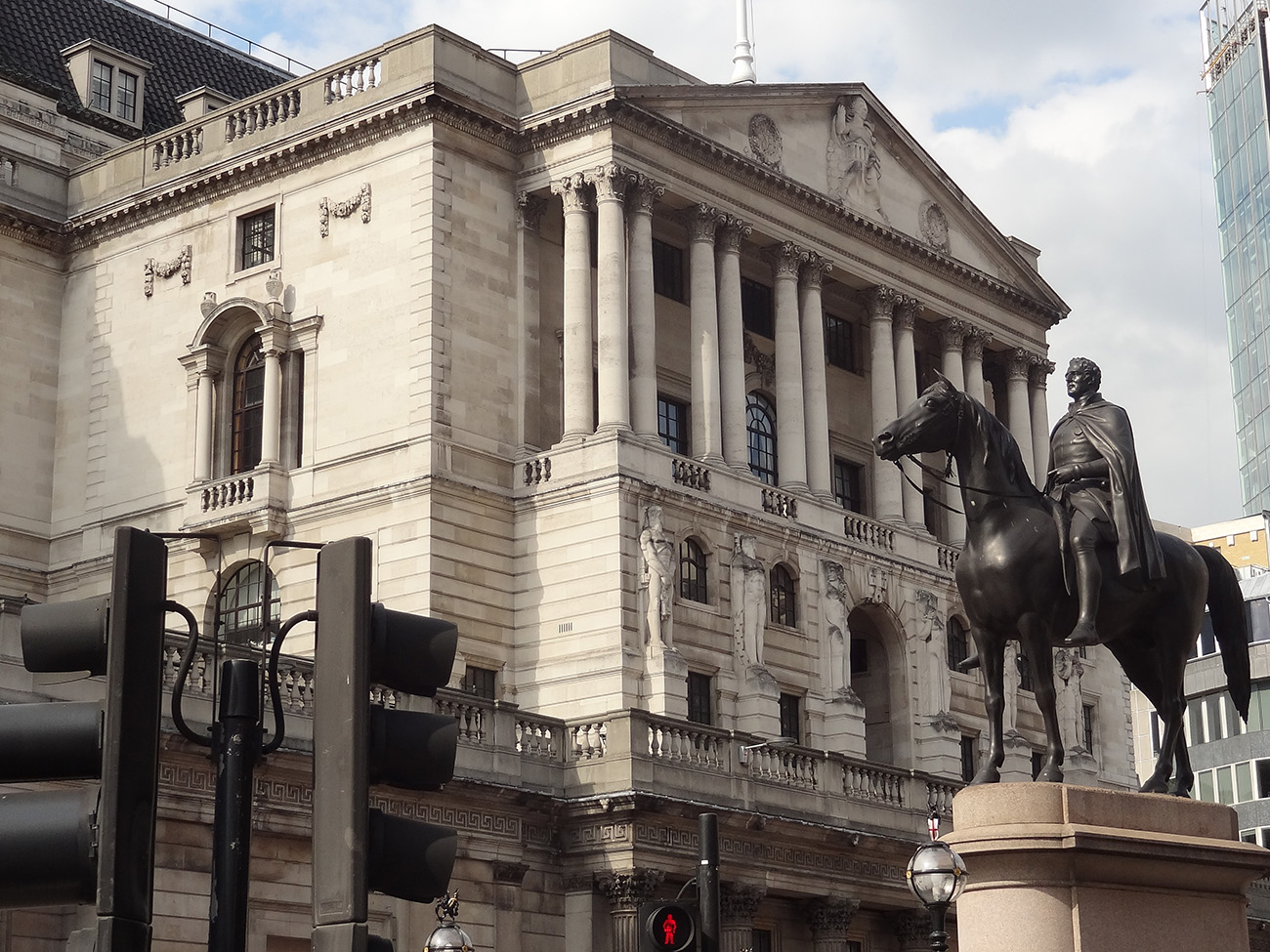 In 2009, interest rates in the UK were cut to a record low of 0.5%. Since that point, there has been almost unanimous agreement amongst the members of the Monetary Policy Committee to keep rates at this low. It is only in the last couple of months when some have even voted to raise rates. However, this month, interest rates were once again held at 0.5%.