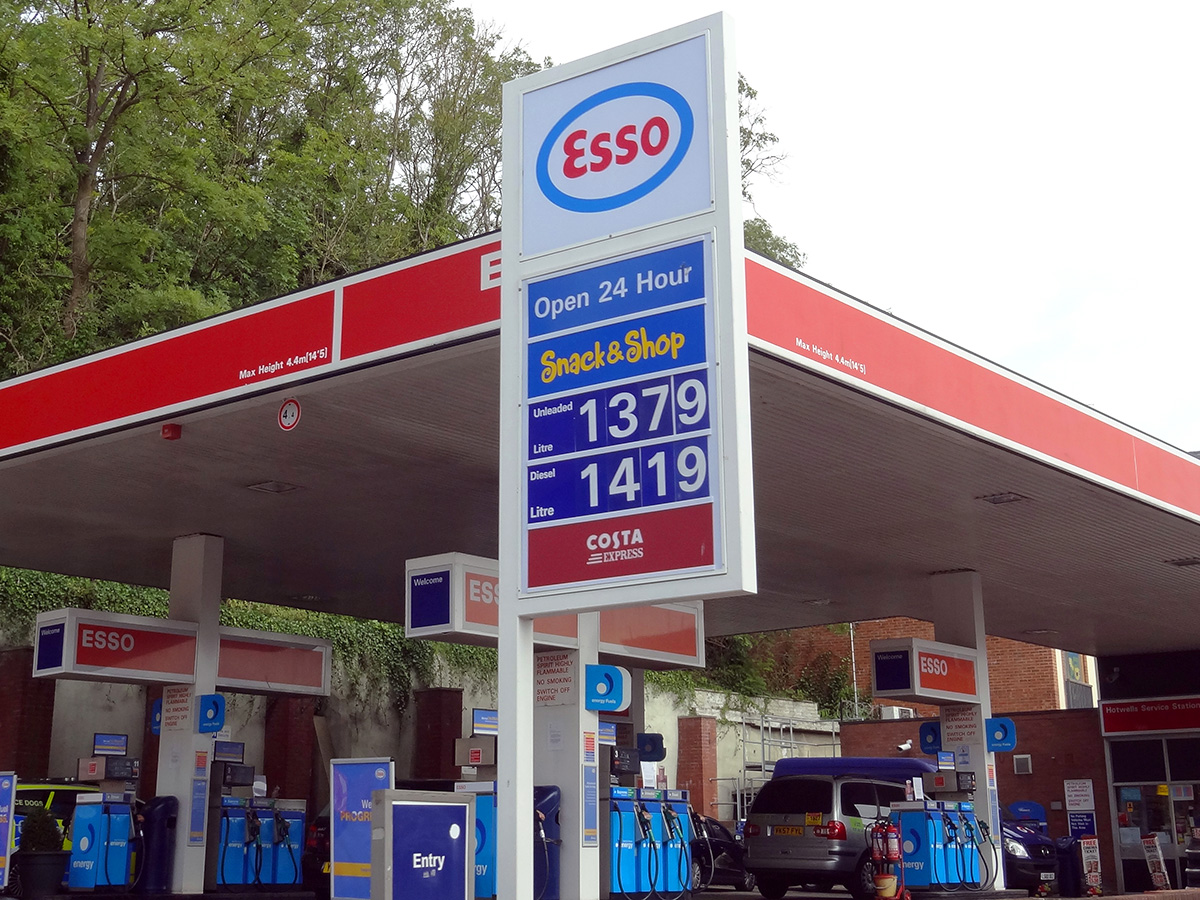
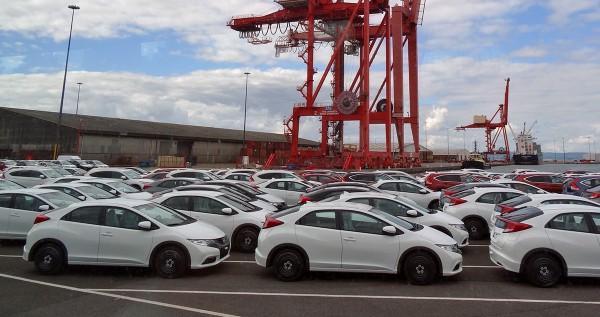
 There’s been much talk about the UK’s economic recovery and whether or not it has begun and whether consumer spending is actually the cause. The latest sector to post positive figures is the car industry, which has seen 2013 bring in the highest level of car sales since the onset of the credit crunch.
According to the Society of Motor Manufacturers and Traders (SMMT), vehicle registrations in 2013 were 2.26 million, which represented a 10.8% increase from 2012. That’s not to say that we have returned to the heights seen pre-crisis levels, as sales still remain some way below their 2007 figure, but the data is certainly moving in the right direction. The key questions are: What’s the cause of this growth and what does it mean for the UK economy?
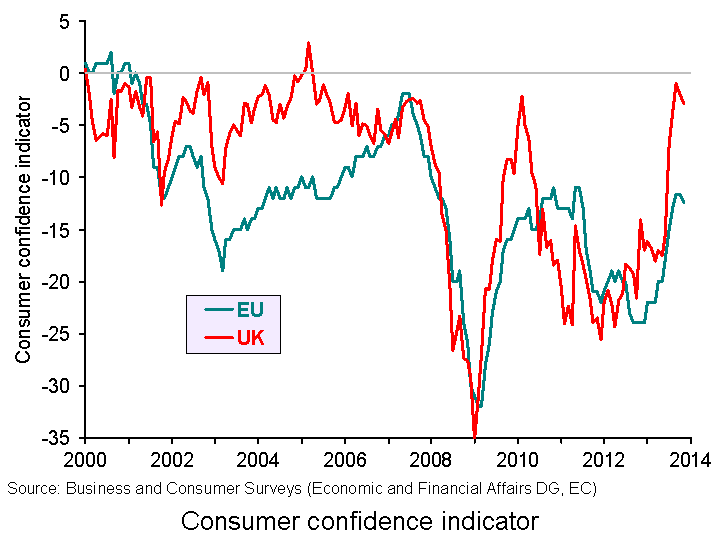 The economy has certainly turned a corner and perhaps consumer confidence is improving to reflect this. With consumes more optimistic about future economic prospects, more luxury items may well be purchased. During the height of the recession, many families may well have said ‘it will last’ or ‘we’ll make do’, referring to their old cars. However, this improved confidence, together with attractive finance deals may have been instrumental in convincing consumers to splash out. This is reflected in the data, which indicates that some 75% of car sales involve a finance package. One further explanation that has been offered by industry analysts is that the refunds individuals are receiving through mis-sold payment protection insurance are providing a nice contribution towards the deposit.
PPI payments will certainly dry up, but as long as attractive finance packages remain, car sales should continue. A key factor affecting affordability may be interest rates. When they increase, any variable rate loans will become more expensive to service and this may act to deter consumers. However, if the car industry helps to stimulate other sectors and wages begin to increase, the overall effect may be to sustain and even further the growth of this key economic sector. The following articles consider the car industry.
UK car sales hit five-year high The Guardian, Angela Monaghan (7/1/14)
UK new car sales highest since 2007, SMTT says BBC News (7/1/14)
Car sales increased by almost 11% in 2013 Sky News (7/1/14)
UK new car sales rise to highest level since 2007 Reuters, David Milliken (7/1/14)
UK car sales up 11% in 2013, topping pre-crisis levels Wall Street Journal, Matthew Curtin and Ian Walker (7/1/14)
New car sales in UK at highest since before recession Independent, Sean O’Grady (7/1/14)
UK car sales top pre-recession levels Financial Times, Henry Foy (6/1/14)
Questions
- How important is the car industry in the context of the UK economy?
- How is the UK car industry performing relative to its Western rivals?
- Would a 30% single rate of income tax be equitable?
- Explain the way in which car sales have been affected by consumer confidence.
- How have finance packages helped to stimulate car sales?
- What are the key macroeconomic variables that are likely to affect the future performance of this key sector?
 Valued by private investors at more than $10 billion, the future listing on the stock market of Twitter, is an eagerly anticipated event. The necessary forms have been submitted to the US Securities and Exchange Commission (SEC) ahead of the initial public offering (IPO). Twitter will be looking to avoid the mistakes made by Facebook when they were first listed in May last year. Twitter has also announced its intentions to purchase MoPub, which is a firm specialising in mobile advert exchanges.
So, what will this listing mean for Twitter? The public will now be able to purchase shares in Twitter, in much the same way as you can buy shares in RBS or Facebook. The financial performance of Twitter will come under much greater scrutiny from its shareholders, who will be interested in short term returns and long term stability. Becoming a public limited company will attract investors and is likely to provide a much larger scope for expansion for Twitter. However, as yet no details have been released on a likely date for the flotation or on the prices we can expect.
One thing Twitter will be trying to avoid is a repeat of the problems that beset Facebook and indeed of the problems that other public listings have created for giants such as Google, Zynga and Groupon. When Facebook moved to public ownership, its share prices initially fell below its IPO and subsequently Facebook lost more than half its value. More recent success in mobile advertising has restored the fortunes of this company, but Goldman Sachs, which is handling Twitter’s transition will be looking to avoid a similar occurrence. As Sam Hamadeh from PrivCo (a firm that gathers data on private companies) said:
Twitter will learn from Facebook’s flawed playbook and do the opposite … Unlike Facebook, which waited too long to IPO (until its growth rate decelerated), Twitter will IPO at just the right inflection point: while revenue grows in triple digits.
Twitter is a rapidly growing business, but still has significant scope for expansion and this move to public ownership may be just the thing. Setting the right IPO and the right date will be crucial, as a multitude of factors can and do affect the price of shares listed on the stock market. Twitter will also need to ‘focus on doing the right stuff’ to make a success of the listing and its purchase of Mopub looks to be a step in the right direction. For now, all we can do is speculate, but if the launch is successful, then the founders of Twitter are likely to bring in hundreds of millions of dollars each.
Twitte files for IPO The Telegraph, Sophie Curtis (13/9/13)
 Twitter plans stock market listing (see also) BBC News (13/9/13)
Twitter files for IPO, hopes to avoid Facebook’s mistakes Independent, Nikhil Humar and James Vincent (12/9/13)
Facebook shares close 11% below flotation price BBC News (21/5/12)
Twitter fails to answer key IPO questions Financial Times, Richard Waters and April Dembosky (13/9/13)
Twitter IPO: how much is it worth? The Guardian, Juliette Garside (13/9/13)
Twitter IPO: Tech float successes and disasters The Telegraph, Gabrielle Putter and Szu Ping Chan (13/9/13
Twitter to see ‘strong demand’ for share sale BBC News (13/9/13)
Twitter IPO: Firm in stock market launch bid Sky News (13/9/13)
Questions
- What are the characteristics of a public limited company? Are there advantages and disadvantages?
- Which factors affect (a) the supply of shares and (b) the demand for shares?
- What mistakes were made by Facebook when it made the transition to public ownership?
- How does advertising generate revenue for Twitter?
- How might you go about valuing Twitter or Facebook?
- Companies such as Twitter and Facebook have hundreds of millions of subscribers. Are there network externalities of this?
- Twitter is purchasing MoPub. What type of takeover would you classify this as?
 The growth of emerging economies, such as China, India and Brazil brings with it both good and bad news for the once dominant countries of the West. With growth rates in China reaching double digits and a much greater resilience to the credit crunch and its aftermath in these emerging nations, they became the hope of the recovery for the West. But, is it only benefits that emerge from the growth in countries like China?
Chinese business has grown and expanded into all areas, especially technology, but countries such as the USA have been reluctant to allow mergers and takeovers of some of their businesses. Notably, the takeovers that have been resisted have been in key sectors, particularly oil, energy and technology. However, it seems as though pork is an industry that is less important or, at least, a lower risk to national security.
 Smithfield Foods is a US giant, specialising in the production and selling of pork. A takeover by China’s Shuanghui International Holdings has been approved (albeit reluctantly) by the US Committee on Foreign Investment. While the takeover could still run into obstacles, this Committee’s approval is crucial, as it alleviates concerns over the impact on national security. The value of the deal is some $7.1bn, including the debt that Shuangui will have to take on. While some see this takeover as good news, others are more concerned, identifying the potential negative impact it may have on prices and standards in the USA. Zhijun Yang, Shuanghui’s Chief Executive said:
This transaction will create a leading global animal protein enterprise. Shuanghui International and Smithfield have a long and consistent track record of providing customers around the world with high-quality food, and we look forward to moving ahead together as one company.
The date of September 24th looks to be the decider, when a shareholder meeting is scheduled to take place. There is still resistance to the deal, but if it goes ahead it will certainly help other Chinese companies looking for the ‘OK’ from US regulators for their own business deals. The following articles consider the controversy and impact of this takeover.
US clears Smithfield’s acquisition by China’s Shuanghui Penn Energy, Reuters, Lisa Baertlein and Aditi Shrivastava (10/9/13)
Chinese takeover of US Smithfield Foods gets US security approval Telegraph (7/9/13)
US clears Smithfield acquisition by China’s Shuanghui Reuters (7/9/13)
Go-ahead for Shuanghui’s $4.7bn Smithfield deal Financial Times, Gina Chon (6/9/13)
US security panel approves Smithfield takeover Wall Street Journal, William Mauldin (6/9/13)
Questions
- What type of takeover would you classify this as? Explain your answer.
- Why have other takeovers in oil, energy and technology not met with approval?
- Some people have raised concerns about the impact of the takeover on US pork prices. Using a demand and supply diagram, illustrate the possible effects of this takeover.
- What do you think will happen to the price of pork in the US based on you answer to question 3?
- Why do Smithfield’s shareholders have to meet before the deal can go ahead?
- Is there likely to be an impact on share prices if the deal does go ahead?
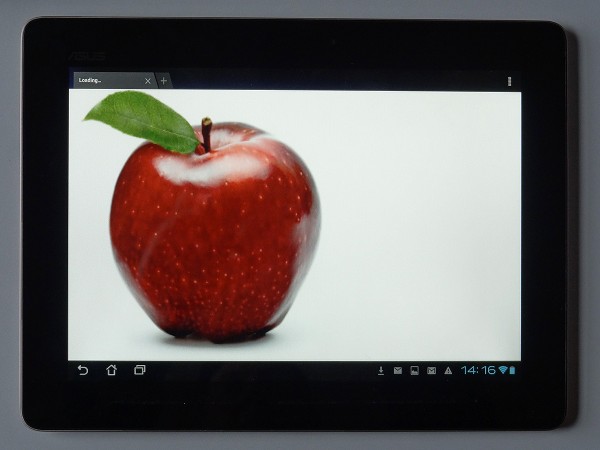 The technology sector is highly complex and is led by Apple. However, as the tablet market is continuing to grow, it is becoming increasingly competitive with other firms such as Samsung gaining market share. Although both firms sell many products, it is the growing tablet market which is one of the keys to their continued growth.
Tablet PCs have seen a growth in the final quarter of 2012 to a high of 52.5 million units, according to IDC. Although Apple, leading the market, has seen a growth in its sales, its market share has declined to 43.6%. Over the same period, Samsung has increased its market share from 7.3% to 15.1%. While it is still a huge margin behind Apple in the tablet PC market, Samsung’s increase in sales from 2.2 million to 7.9 million is impressive and if such a trend were to continue, it would certainly cause Apple to take note.
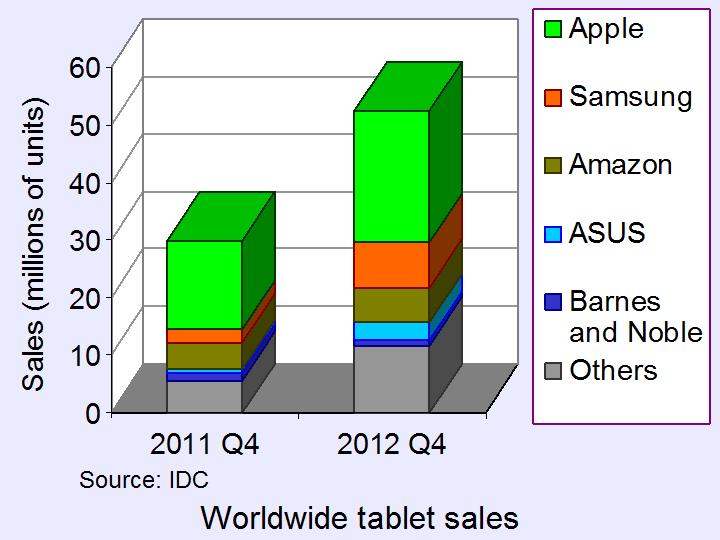 It’s not just these two firms trying to take advantage of this growing industry. Microsoft has recently launched a new tablet PC and although its reception was less than spectacular, it is expected that Microsoft will become a key competitor in the long run. There are many factors driving the growth in this market and the war over market share is surely only just beginning. The chart shows the 75.3% growth in sales in just one year. (Click here for a PowerPoint of the chart.)
A Research Director at IDC said:
We expected a very strong fourth quarter, and the market didn’t disappoint…New product launches from the category’s top vendors, as well as new entrant Microsoft, led to a surge in consumer interest and very robust shipments totals during the holiday season’
Apple has been so dominant in this sector that other companies until recently have had little success in gaining market share. However, with companies such as Samsung and ASUS now making in-roads, competition is likely to become fierce. There are already concerns that Apple’s best days are behind it and its share price reflects this. People are now less willing to pay a premium price for an Apple product, as the innovations of its competitors have now caught up with those of the leading brand name. The following articles consider this growing market.
Samsung gain tablet market share as Apple lead narrows BBC News (1/2/13)
Apple snatches US lead from Samsung Financial Times, Tim Bradshaw (1/2/13)
Apple revenues miss expectations despite high sales figures BBC News (24/1/13)
Samsung eats into Apple sales in the tablet market Mirror, Ruki Sayid (1/2/13)
MacWorld’s Apple celebration opens amid fears of tech giant’s decline Guardian, Rory Carroll (31/1/13)
Samsung’s tablet sales soar as Apple’s grip on market loosens Daily News and Analysis, Richard Blagden (2/2/13)
Samsung takes a nibble out of Apple’s tablet lead InfoWorld, Ted Samson(31/1/13)
Tablet Sales up 75% as Samsung and Asus Gain on Apple Interational Business Times, Edward Smith (31/1/13)
Questions
- Which factors are behind this exceptional growth in the tablet PC market?
- Using the Boston matrix, where do you think tablet PCs fit in terms of market size and market growth?
- Where would you place this market in terms of the product life cycle?
- What does the product life cycle say about the degree of competition, the impact on pricing on profits etc. in the phase that you placed the tablet PC market in your answer to question 3?
- Why have Apple’s shares fallen recently? Do you think this will be the new trend?
- Microsoft’s new tablet didn’t attract huge sales. What explanation was given for this? Use a diagram to help answer this question.
- Tablet PCs are relatively expensive, yet sales of them have increased significantly over the past few years. What explanation is there for this, given that we have been (and still are) in tough financial times?
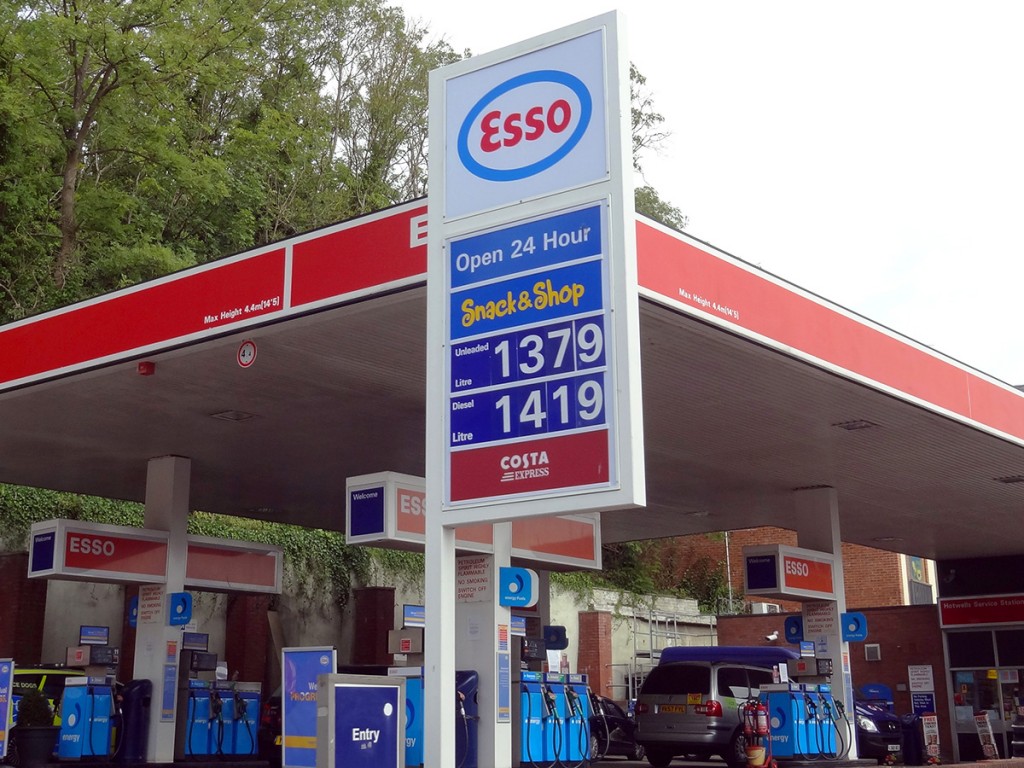 As resources become scarce, the price mechanism works to push up the price (see, for example, Box 9.11 in Economics 8th ed). If you look at the price of petrol over the past few decades, there has been a general upward trend – part of this is due to growth in demand, but part is due to oil being a scarce resource. Many millions have been spent on trying to find alternative fuels and perhaps things are now looking up!
Air Fuel Synthesis, a small British company, has allegedly managed to make ‘petrol from air’. Following this, the company has unsurprisingly received finance and investment offers from across the world. However, the entrepreneur Professor Marmont has said that he does not want any company from the oil industry to get a stake in this firm. This doesn’t mean that investment is not needed or on the cards, as in order to increase production of petrol from thin air financing is needed. Professors Marmont said:
We’ve had calls offering us money from all over the world. We’ve never had that before. We’ve made the first petrol with our demonstration plant but the next stage is to build a bigger plant capable of producing 1 tonne of petrol a day, which means we need between £5m and £6m
Whilst the process appears to be a reality, Air Fuel Synthesis is a long way from being able to produce en masse. However, it does offer an exciting prospect for the future of petrol and renewable energy resources in the UK. At the moment oil companies appear to be uninterested, but if this breakthrough receives the financing it needs and progress continues to be made, it will be interesting to see how the big oil companies respond. The following articles consider this break-through.
Company that made ‘petrol from air’ breakthrough would refuse investment from big oil Independent, Steve Connor (19/10/12)
British engineers create petrol from air and water Reuters, Alice Baghdijan (19/10/12)
Petrol from air: will it make a difference? BBC News, Jason Palmer (19/10/12)
British engineers produce amazing ‘petrol from air’ technology The Telegraph , Andrew Hough (18/10/12)
Questions
- Explain the way in which the price mechanism works as resources become scarce. Use a diagram to help your explanation.
- As raw materials become scarce, prices of the goods that use them to work or require them to be produced will be affected. Explain this interdependence between markets.
- Why is investment from an oil company such a concern for Professor Marmont?
- Why is there unlikely to be any impact in the short run from this new breakthrough?
- If such a technology could be put into practice, what effect might this have on the price of petrol?
- How might oil companies react to the growth in this technology?
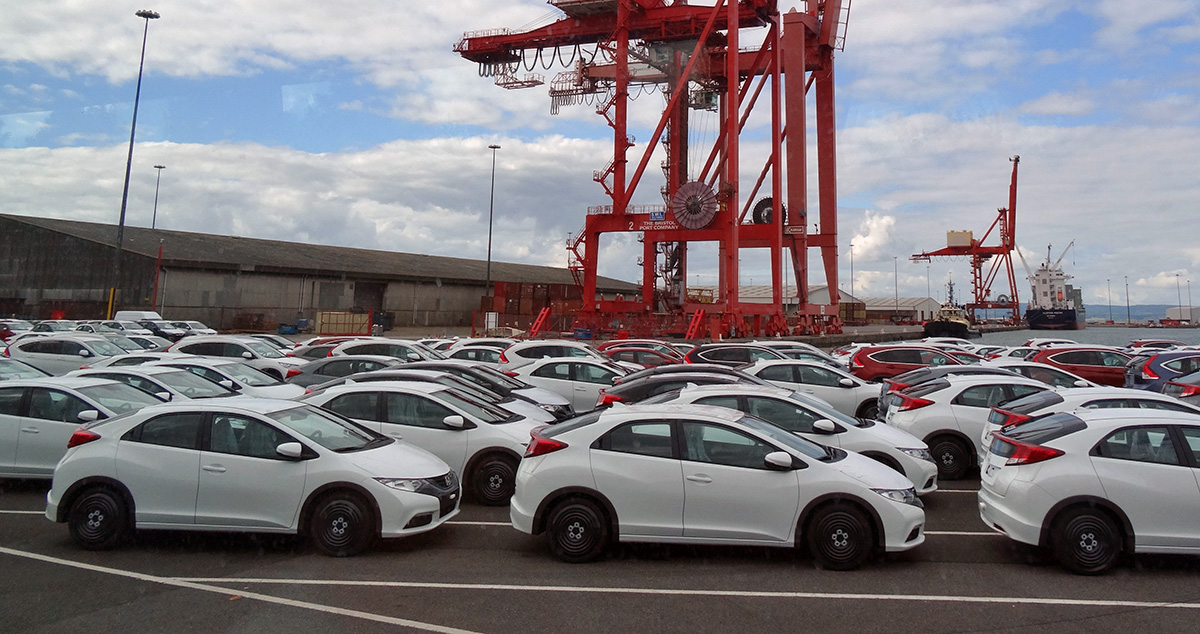 There’s been much talk about the UK’s economic recovery and whether or not it has begun and whether consumer spending is actually the cause. The latest sector to post positive figures is the car industry, which has seen 2013 bring in the highest level of car sales since the onset of the credit crunch.