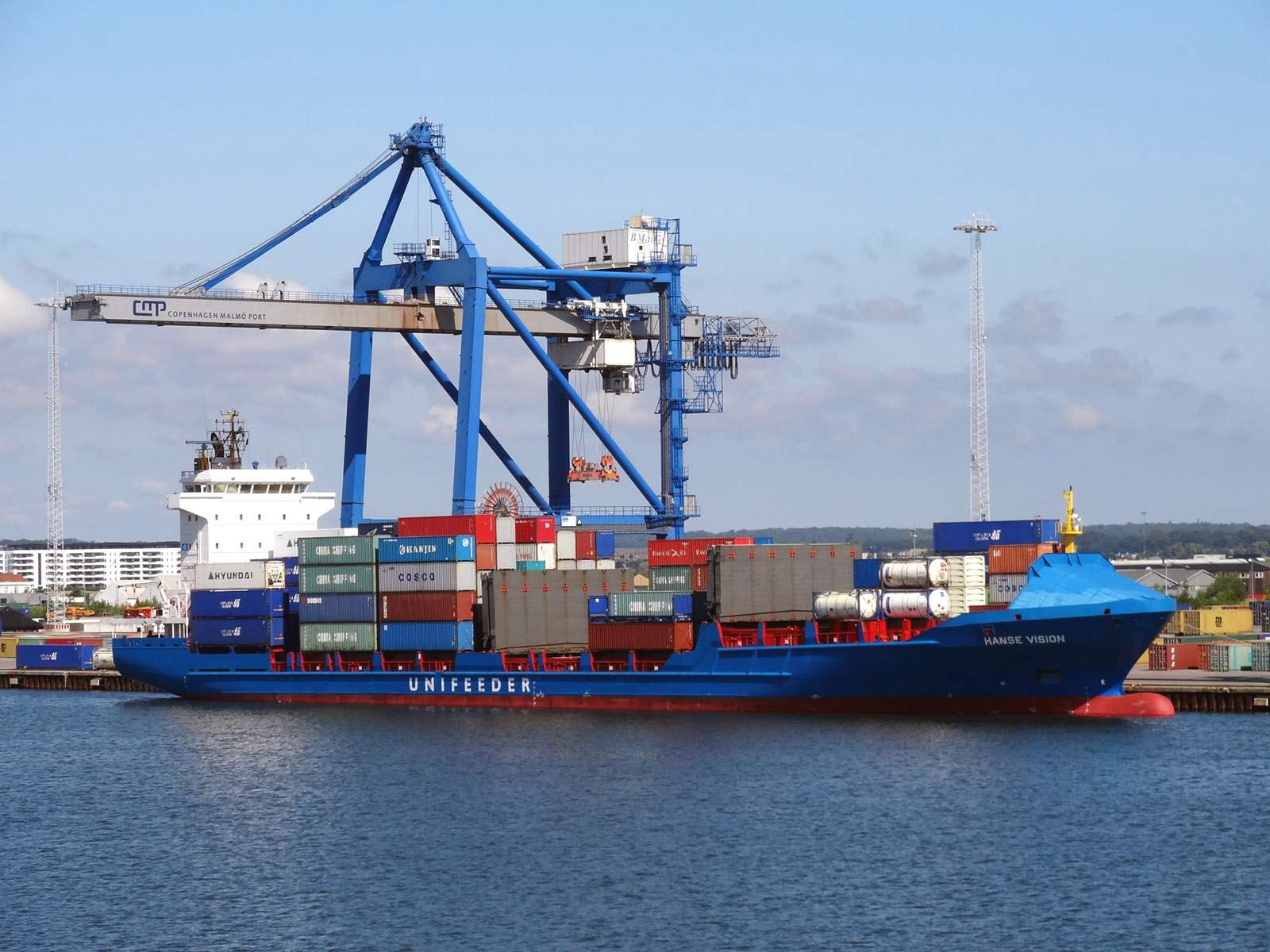
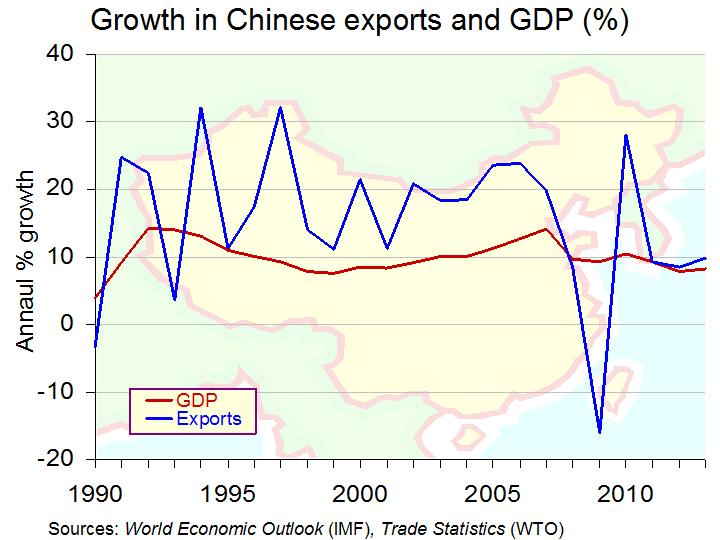
 China has been one of the success stories of the past 20 years, with rapid growth in domestic and export demand. This has created the second largest economy in the world. From 1992 to 2007 annual GDP growth averaged 10.7% and annual export growth averaged 18.9% (see chart).
However, with the credit crunch and ensuing recession, growth rates in China have fallen somewhat. Annual GDP growth has averaged 9.6% and annual export growth has averaged 7.4%. Such growth rates may not seem bad, given that many Western economies have been struggling to achieve any growth, but they have been causing concern for this booming economy.
 In its May Outlook, the World Bank forecast China’s growth for the year at 8.2%, but it has since been reduced to 7.8%. A key part of China’s success story has been its export market, but it has been this market that has caused concerns for the mainland economy. In August of this year, its year-on-year export growth was at only 2.7%, but exports last month grew by more than expected, at approximately 7.4%. China has had a consistent trade surplus and according to government figures, this has widened to $27.67 billion in September from $26.66 billion in the previous month.
Recovery in this market will be crucial for the continued success of the economy, as a means of alleviating the fears of a slowdown. This higher growth of exports may be a misleading indicator, perhaps influenced by seasonal factors and thus may not be a sign of what’s to come. Indeed, many analysts have said that they are not convinced that these healthier trade figures will remain. Alistair Thornton, from IHS Global Economics said:
“It’s safe to say we are overshooting the trend here and we expect (the data) to come back in line in the months ahead.”
Citigroup economist, Ding Shaung also confirmed these sentiments:
”The trade data is a positive sign for the Chinese economy … But it remains to be seen whether import and export growth can remain at these levels.”
Part of this pessimism is due to the uncertainty surrounding the growth prospects of its biggest two trading partners – the US and the European Union. Exports to the former have remained relatively high, but exports to the European Union have suffered, falling by over 5.6%. It is likely that weaknesses in the global economy have held back China’s growth prospects in both exports and national output. The Chinese government was aiming for growth of 7.6% in 2012. Not a bad rate you may say, but when compared with growth rates for 2011 (9.3%) and 2010 (10.4%), it does represent a significant fall. The future of the Chinese economy is crucial for the recovery of the world economy, in part as it represents a big demand for imports from other countries, such as the US and Europe. The following articles consider the trade and growth prospects of the world’s second largest economy.
Chinese exports grow faster than expected in September BBC News (14/10/12)
Chinese exports grow faster than expected Financial Times, Patti Waldmeir (14/10/12)
China exports jump, but weaknesses seen ahead The Korea Herald (14/10/12)
China exports rise, hinting at a glimmer of revival New York Times, Keith Bradsher (13/10/12)
China’s trade surplus widens Wall Street Journal, William Kazer (13/10/12)
Chinese surplus widens as exports surge CNN, Paavan Mathemas (13/10/12)
 China’s economic slow-down BBC Today Programme, Linda Yueh (18/10/12)
Questions
- What is a trade surplus?
- Which factors have influenced Chinese exports and imports?
- Why is China’s growth rate such an important variable for the UK and other Western economies?
- Why has export growth in China fallen recently? Can you use the same explanation for its lower growth in national output?
- Explain why analysts remain pessimistic about the sustainability of these improved trade figures.
- Using a diagram, illustrate the effect that higher Chinese growth rates will have on GDP in a country such as the UK. Could there be a multiplier effect?
 For some people, a pint of beer is a regular thing each week. Add all your pints of beer together, then add your friend’s pints, their friends’ pints and … you get the idea. Once you’ve done that for the entire population, you have an estimate of total beer consumption in the UK. This can then be compared with total consumption of beer in other countries and between continents.
Prior to 2007, Europe and the Americas were the biggest beer drinking continents, but since then, Asia has emerged as the leader of pints of beer consumed, drinking 67bn litres of beer compared with the Americas’ 57bn and Europe’s 51bn in 2011. In per capita terms, Asia is still some way off, with Japan leading the way as the highest Asian country in 41st place, consuming 64 litres of beer per year per capita of the population. So how is this relevant to economics and business?
 Consumption of anything provides jobs – bar workers, manufacturers and in the case of beer, probably law enforcement! It probably also increases utility – after all, why consume it if it’s not going to give you some degree of satisfaction!
We can analyse the demand for beer and see how it varies with changes in price and income. Minimum prices for alcohol have been proposed as a means of reducing consumption, and tax and excise duties are always linked to alcoholic beverages and clearly have an effect on demand. In this case, however, we can also consider the emergence of Asia and how tastes have changed. It is the fastest growing beer market in the world; so what can we deduce from that? As the BBC News article states, it is ‘a sign of a young, upwardly mobile, and increasingly hedonistic population.’
Experts also say that the increased consumption of beer in Asian countries is closely correlated with growing incomes and prosperity. A consumer research analyst from Standard Chartered, Nirgunan Tiruchelvam, said:
“Beer has a clearer correlation with strong economic growth … People tend to drink beer in times of growth. They drink spirits when times are good and when times are bad.”
Data suggest that when a certain level of prosperity is reached in a nation, beer sales begin to rise. As many Asian economies begin to develop rapidly, beer sales have taken off. This could be regarded as a good thing for Europe. With stagnant Western economies, beer producers within Europe may be grateful for a growing demand in Asia. Indeed, many of the world’s biggest breweries are expanding rapidly, providing jobs and income. Consumers in Europe will also be happy to see that beer production remains profitable in other parts of the world. With unemployment still high and recession ongoing, a pint of beer will be a much needed pick-me-up for many people. At least, that’s what the evidence from the Great Depression of the 1930s suggested!!
It’s not good news for everyone, however. Beer production has also increased in Asian countries, most notably in China, which now leads the world as the largest beer producer. This clearly reduces the export potential for European beer producers.
Also, many argue that the growing consumption of beer in Asia is simply an illustration of growing Western influence and it is likely to create severe medical problems in the future. Binge drinking and under-age consumption is already a big problem in Western countries and this could soon begin to extend across the world. The following articles consider the growth in consumption of beer.
Brewers thirsty for expansion as taste for beer grows in emerging markets Guardian, Simon Neville (3/9/12)
Beer in Asia: the drink of economic growth BBC News, Saira Syed (6/9/12)
Study says world beer production hits new high Long Island Business News, Associated Press (8/8/12)
Global beer sales go up for 27th year running News Track India (9/8/12)
Questions
- Use a supply and demand diagram to analyse recent trends in beer consumption across the world.
- Which factors have caused demand in emerging markets to increase? Based on your answer to the previous question, how might that have affected equilibrium prices?
- How has growth in beer consumption throughout Asia benefited Western producers?
- What would you expect the price and income elasticities of demand to be for a product such as beer? Explain your answer.
- To what extent do you think this trend in beer production is a sign of globalisation?
- Evaluate the extent to which the growth in consumption and production of beer in Asia is a good thing. You should consider everyone who and everything might be affected!
 After weak Christmas trading, Tesco issued a profit warning – its first in 20 years. Following this, their shares fell in value by some £5bn, but this was met with an announcement of the creation of 20,000 jobs in the coming years, as part of a project to train staff, improve existing stores and open new ones. Yet, Tesco has reported another quarter of falling sales.
Trading times have been challenging and the fact that the UK’s biggest supermarket is struggling is only further evidence to support this. In the 13 weeks to the 26th May 2012, Tesco reported a decline in like-for-like sales of 1.5%. Although much of the £1bn investment in Tesco is yet to be spent, the fact that sales have fallen for a full year must be of concern, not only to its Chief Executive, but also to analysts considering the economic future for the UK.
Consumer confidence remains low and together with tight budgets, shoppers are continuing to be very cautious of any unnecessary spending. Part of Tesco’s recent drive to drum up sales has been better customer service and a continuing promotion war with the other supermarkets. This particular sector is highly competitive and money-off coupons and other such promotions plays a huge part in the competitive process. Whilst low prices are obviously crucial, this is one sector where non-price competition can be just as important.
Although Tesco sales in the UK have been nothing to shout about – the Chief Executive said their sales performance was ‘steady’ – its total global sales did increase by 2.2%. The Chief Executive, Mr Clarke said:
‘Internationally, like-for-like sales growth proved resilient, despite slowing economic growth in China…Against the backdrop of continued uncertainty in the eurozone, it is pleasing to see that our businesses have largely sustained their performance.’
A boost for UK sales did come with the Jubilee weekend and with the Olympics just round the corner, Tesco will be hoping for a stronger end to the year than their beginning. The following articles consider Tesco’s sales and the relative performance of the rest of the sector.
Tesco’s quarterly sales hit by ‘challenging’ trading BBC News (11/6/12)
Tesco UK arm notches up one year of falling sales Guardian, Zoe Wood (11/6/12)
Tesco upbeat despite new sales dip Independent, Peter Cripps (11/6/12)
Tesco sales seen lower in first quarter Reuters, James Davey(11/6/12)
The Week Ahead: Tesco set to admit it is losing ground to rivals Independent, Toby Green (11/6/12)
Tesco’s performance in the UK forecast to slip again Telegraph, Harry Wallop (10/6/12)
Tesco: What the analysts say Retail Week, Alex Lawson (11/6/12)
Supermarkets issue trading updates The Press Association (9/6/12)
The Week Ahead: Supermarkets prepare to give City food for thought Scotsman, Martin Flanagan (11/6/12)
Asda’s sales growth accelerates Reuters, James Davey (17/5/12)
Asda sales increase helped by Tesco Telegraph, Harry Wallop (18/5/12)
Tesco v. Sainsbury’s in trading update battle Manchester Evening News (11/6/12)
Sainsbury’s out-trades Tesco on UK food sales Independent, James Thompson (10/6/12)
Questions
- Using some examples, explain what is meant by non-price competition.
- Why has Tesco been losing ground to its competitors?
- Given the products that Tesco sells (largely necessities), why have sales been falling, despite household’s tight budgets?
- Into which market structure would you place the supermarket sector? Explain your answer by considering each of the assumptions behind the market structure you choose.
- Why have Tesco’s rivals been gaining ground on Tesco?
- How might this latest sales data affect Tesco’s share prices?
- Based on what the analysts are saying about the food sector, can we deduce anything about the future of the UK economy in the coming months?
 Vodafone has offered to purchase Cable & Wireless Worldwide (C&WW), with Vodafone paying 38p per share, making this deal worth £1.044bn.
This deal, however, was rejected by C&WW’s largest shareholder, Orbis, within hours, as the price was not high enough, despite the 38p per share offer representing a 92% premium to the level of C&WW’s share price before the bid interest emerged in February. A spokesperson for Orbis said:
‘Although we believe the C&WW management team has handled the bid process responsibly, we have declined to give an irrevocable undertaking or letter of intent to the support the transaction.’
However, with the only other interested party, Tata Communications withdrawing, Vodafone was the only remaining bidder. As such, many suggest that this deal is a good one for the struggling business, despite Orbis’ claim that it under-values the business.
Adding a UK fixed-line cable to Vodafone’s business will increase its capacity, which is much needed at this moment in time with the added demand for mobile data from increased Smartphone usage. Cost savings are also expected from this merger, as the company will no longer have to pay to other companies to lease its fixed-line capacity.
The bid from Vodafone did help C&WW’s trading performance, which had been worsening for some time and so some shareholders will be glad of the bid. Its shares were up following this deal and it went to the top of the FTSE250. Vodafone will also benefit, as this merger would make it the second largest combined fixed and mobile line operator in the UK.
The trends of these two companies in recent years have been very much in contrast. C&WW had been the larger of the two firms up until 1999, yet the price Vodafone would now pay for the company represents a mere 1% of its current market value. The following articles consider this merger.
Vodafone bids for Cable and Wireless: The end of the line The Economist (24/4/12)
Questor shares tip: Vodafone deal looks goodThe Telegraph, Garry White(23/4/12)
Vodafone puts paid to once-revered C&WW Financial Times, Daniel Thomas (23/4/12)
Top CWW shareholder rejects sale to Vodafone Independent, Gideon Spanier (24/4/12)
CWW accepting Vodafone’s £1bn bid is a good call The Telegraph, Alistair Osborne (23/4/12)
Vodafone agrees £1bn deal for Cable & Wireless Worldwide Guardian, Julia Kollewe and Juliette Garside (23/4/12)
Vodafone agrees £1bn takeover of C&W Worldwide BBC News (23/4/12)
Questions
- Into which market structure would you place the above industry? Explain your answer.
- Which factors have caused C&WW’s worsening position? In each case, explain whether they are internal or external influences.
- What type of merger is that between C&WW and Vodafone?
- Explain some of the motives behind this merger.
- Which factors have caused these two companies to have such different trading performances in the last 15 years?
- Why was the announcement of the bid followed by better share prices for C&WW?
- Is there any reason why the competition authorities should be concerned about this merger?
 International trade brings various benefits to an economy. One is that it can stimulate economic growth – something the UK government would very much like to achieve in current circumstances.
As one of the components of aggregate demand, net exports is a key variable that can create jobs and growth in an economy, and it is this variable that is being directly targeted in a trade agreement between the UK and South Korea. Growth in developing countries is far outstripping that in the West and through this trade deal, the UK is hoping to benefit from some of this growth – to the tune of about £500m per year.
South Korea already trades a huge amount with the UK – we are its second largest European trade partner after Germany. The Free Trade Area that has been agreed will put British firms in a stronger position when negotiating contracts, especially in relation to sporting events, such as the Asian Games in 2014, the World Student Games in 2015 and the Pyeongchang Winter Olympics in 2018. Nick Clegg, who announced the agreement said:
‘The best of British design, innovation and services will have even greater opportunity to show their strength in South Korea. UK and Korean companies will be able to form alliances on multi-billion pound projects across the world.’
Some of the benefits of this agreement may be seen relatively soon, as the South Korea National Pension Service has announced plans to set up a base in London, which would create a much need injection of investment into the stagnant economy. This latest trade deal is very much a part of the Coalition’s strategy of creating stronger ties and trade links to the fast growing emerging markets. The size of these potential benefits and the speed with which they emerge can only be estimated, but if they do materialise they will undoubtedly have positive effects on economic growth. The following articles consider these ‘economic opportunities in the UK’.
Nick Clegg hails Korean trade deal as £2bn opportunity for Britain Telegraph, Anna White (25/3/12)
South Korea trade deal ‘may bring £500m to UK economy’ BBC News (26/3/12)
South Korea’s $320bn pension fund to set up London base Guardian (26/3/12)
S Korea pension fund to set up London office Financial Times, Elizabeth Rigby (25/3/12)
Nick Clegg boosts British business in South Korea The Economic Voice, Jeff Taylor (26/3/12)
Questions
- What are the benefits and costs of trade? To whom do they accrue?
- The articles talk about a free trade area. What are the characteristics of such an agreement?
- What other types of trade agreement are there? In each case, find examples of that type of agreement.
- Why is trade seen as an engine of growth? Think about aggregate demand and how this can explain a boost to national income.
- If the South Korea National Pension Service does create a base in London, explain how the multiplier effect might create additional benefits to the UK.