 When you look at the linked articles below, I’m sure many of you will be thinking that this is an odd choice for an economics blog! However, part of the economic relevance of ‘cyber-crime fighters’ relates to the relative skills of workers and the gap that exists between the most and least skilled workers in the UK.
Crime has always existed, but as technology has developed the types of crime committed have grown along with the complexity of them. For certain crimes, a very skilled individual is needed. With this emergence of technologically advanced crimes, those fighting crimes have also had to improve their skills and techniques. Thus crime-fighters have become more technologically advanced as well.
The problem is that the number of skilled workers able to deal with things like cyber crime has not kept pace with the demand for them and thus we have a skills gap. Usage of the Internet has continued to grow, creating more and more opportunities for cyber crime. However, the UK supply of IT and cyber-security professionals has not been able to keep pace. Therefore, we have a shortage of skilled labour in this area.
 More investment into research and education is occurring, with the aim of addressing this shortage, but it is expected to take many years before supply catches up to demand. In particular, more investment is needed in the sciences and technology subjects at school to create the supply at university level. The NAO said that:
‘The current pipeline of graduates and practitioners are unable to meet demand.’
A second area of relevance to economics is the cost of cyber crime. The NAO estimated that the cost is somewhere between £18bn and £27bn per annum. However, on the other side, is there a case that crime actually benefits the macroeconomy by requiring government investment. As cyber crime has grown, so has the demand for cyber-crime fighters and this has created more jobs. With more jobs comes increased spending and the benefits of the multiplier. The following articles consider cyber crime and the impact it is having.
National Audit Office warns UK needs more skilled cyber crime fighters BBC News (12/2/13)
IT staff shortages raise cyber crime risk Sky News (12/2/13)
UK planning ‘Cyber Reserve’ defence force BBC News (3/12/12)
Britain vulnerable from cyber attacks for at least 20 years The Telegraph, Tom Whitehead (12/2/13)
Britain targeted by 120,000 every DAY with cost to country thought to total £27billion Mail Online, Jack Doyle (12/2/13)
Questions
- Illustrate the demand for and supply of labour curves in the market for cyber crime fighters. How is the equilibrium wage determined?
- If there is increased investment in education, how would this affect the shape and position of the MRP curve and what impact would this have on your diagram?
- If there is a shortage of cyber crime fighters, what does that suggest about the position of the two curves? Illustrate this situation and explain why it is a problem.
- Which factors would be considered by NAO in estimating the costs of cyber crime?
- Explain why crime can pay.
- How does the macroeconomy benefit from increased crime? Illustrate this on a diagram.
- Does your answer to question 5 above suggest anything about the effectiveness of using GDP as a measure of welfare?
- How is the multiplier effect relevant?
 The technology sector is highly complex and is led by Apple. However, as the tablet market is continuing to grow, it is becoming increasingly competitive with other firms such as Samsung gaining market share. Although both firms sell many products, it is the growing tablet market which is one of the keys to their continued growth.
Tablet PCs have seen a growth in the final quarter of 2012 to a high of 52.5 million units, according to IDC. Although Apple, leading the market, has seen a growth in its sales, its market share has declined to 43.6%. Over the same period, Samsung has increased its market share from 7.3% to 15.1%. While it is still a huge margin behind Apple in the tablet PC market, Samsung’s increase in sales from 2.2 million to 7.9 million is impressive and if such a trend were to continue, it would certainly cause Apple to take note.
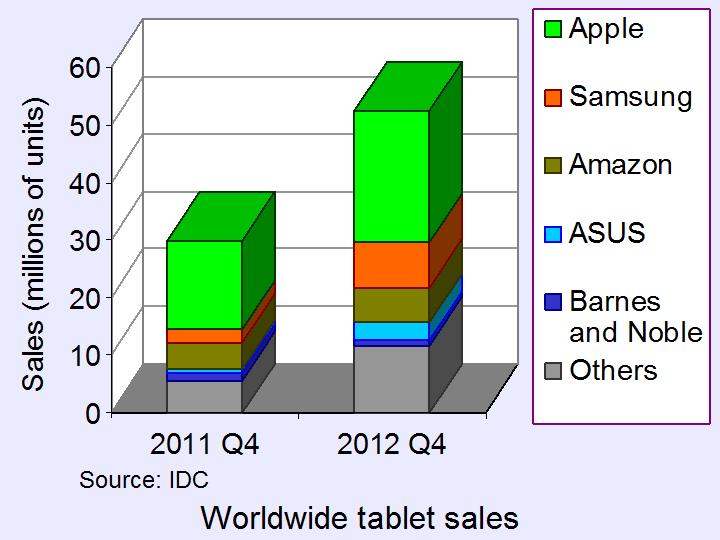 It’s not just these two firms trying to take advantage of this growing industry. Microsoft has recently launched a new tablet PC and although its reception was less than spectacular, it is expected that Microsoft will become a key competitor in the long run. There are many factors driving the growth in this market and the war over market share is surely only just beginning. The chart shows the 75.3% growth in sales in just one year. (Click here for a PowerPoint of the chart.)
A Research Director at IDC said:
We expected a very strong fourth quarter, and the market didn’t disappoint…New product launches from the category’s top vendors, as well as new entrant Microsoft, led to a surge in consumer interest and very robust shipments totals during the holiday season’
Apple has been so dominant in this sector that other companies until recently have had little success in gaining market share. However, with companies such as Samsung and ASUS now making in-roads, competition is likely to become fierce. There are already concerns that Apple’s best days are behind it and its share price reflects this. People are now less willing to pay a premium price for an Apple product, as the innovations of its competitors have now caught up with those of the leading brand name. The following articles consider this growing market.
Samsung gain tablet market share as Apple lead narrows BBC News (1/2/13)
Apple snatches US lead from Samsung Financial Times, Tim Bradshaw (1/2/13)
Apple revenues miss expectations despite high sales figures BBC News (24/1/13)
Samsung eats into Apple sales in the tablet market Mirror, Ruki Sayid (1/2/13)
MacWorld’s Apple celebration opens amid fears of tech giant’s decline Guardian, Rory Carroll (31/1/13)
Samsung’s tablet sales soar as Apple’s grip on market loosens Daily News and Analysis, Richard Blagden (2/2/13)
Samsung takes a nibble out of Apple’s tablet lead InfoWorld, Ted Samson(31/1/13)
Tablet Sales up 75% as Samsung and Asus Gain on Apple Interational Business Times, Edward Smith (31/1/13)
Questions
- Which factors are behind this exceptional growth in the tablet PC market?
- Using the Boston matrix, where do you think tablet PCs fit in terms of market size and market growth?
- Where would you place this market in terms of the product life cycle?
- What does the product life cycle say about the degree of competition, the impact on pricing on profits etc. in the phase that you placed the tablet PC market in your answer to question 3?
- Why have Apple’s shares fallen recently? Do you think this will be the new trend?
- Microsoft’s new tablet didn’t attract huge sales. What explanation was given for this? Use a diagram to help answer this question.
- Tablet PCs are relatively expensive, yet sales of them have increased significantly over the past few years. What explanation is there for this, given that we have been (and still are) in tough financial times?
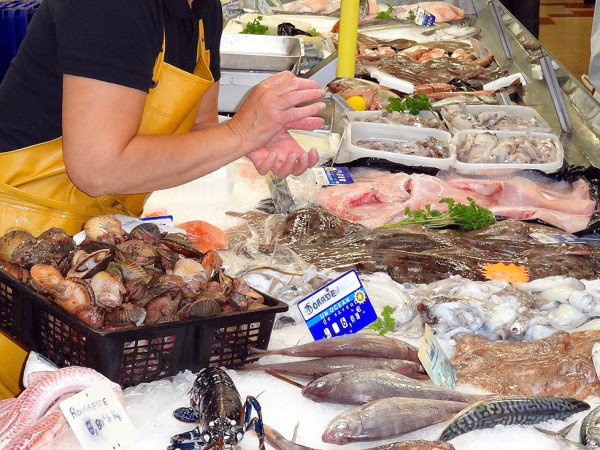 It’s a relatively common dish to see on a menu at a restaurant: mackerel. This particular fish has been promoted as a healthy and sustainable dish, but now its sustainability is coming into question and the Marine Conservation Society has taken it off its ‘fish to eat’ list. My brother Hugh is a marine biologist and often comments on which fish we should be avoiding due to sustainability issues (especially given how much I like fish!) So, how is this an economics issue?
There a couple of key things to pick out here. Firstly, with the conservationists’ warning of this issue of unsustainability, they have been asking consumers to reduce the amount of mackerel they buy. This will naturally have an impact on fisherman. If consumers do listen to the conservationists and hence reduce their demand for mackerel, we could see a fall in the price of this fish and a reduction in the fishermen’s turnover. It could be that we see a switch in consumption to other more sustainable fish, especially if we see some form of intervention.
 Another area concerning economics is the idea of over-fishing. For years, there have been disputes over who has the rights to these fish stocks. In the past, the Faroe Isles and Iceland have increased their quotas significantly, as mackerel appear to have migrated to their shores, contributing to this question of sustainability. Iceland and the Faroe Isles have ‘unilaterally agreed their quotas … as they are not governed by the common fisheries policy’.
The question is: when fisherman catch one additional mackerel, what are they considering? Do they think about the private benefit to them (or their company) or do they consider the external cost imposed on others? Whenever one fish is taken from the sea, there is one less fish available for other fishermen.
 This leads to over-consumption of fish and contributes towards the well-documented depletion of fish stocks and ‘The Tragedy of the Commons’, if account is not taken of the external cost imposed on other fishermen.
The total catch is now far in excess of what has been scientifically recommended and previously agreed upon by all participating countries. Negotiations to introduce new catch allowances have so far failed to reach agreement.
There are hopes that an international policy on quotas can be agreed to ensure mackerel levels return to or remain at a sustainable level. However, at present no progress has been made. Until some form of an agreement is reached, fishermen around Iceland and the Faroe Isles will continue to battle against the conservationists. The following articles consider this fishy topic.
Mackerel taken off conservationists’ ‘fish-to-eat’ list The Guardian, Rebecca Smithers (22/1/13)
Warning over mackerel stocks Scottish Herald (22/1/13)
Fishing quota talks begin amid ongoing disputes and finger-pointing The Scotsman, Fran Urquhart (14/1/13)
Mackerel no longer an ethical choice because of over-fishing The Telegraph, Louise Gray (22/1/13)
Ths fishy tale of macro-mismanagement The Guardian, Annalisa Barbieri (22/1/13)
You can still eat mackerel – just make sure it’s British The Telegraph, Louise Gray (22/1/13)
Dispute means mackerel is no longer fish of the day BBC News, Matt McGrath (22/1/13)
Mackerel struck off sustainable fish list Associated Press (22/1/13)
Questions
- Why are quotas set by the EU for fishing? Who do they apply to?
- Why is there an externality from fishing?
- What is the Tragedy of the Commons? Using a diagram with average and marginal revenue product and average and marginal cost illustrate the market equilibrium and the social optimum. Why are they different?
- Following on from question 3, what does this suggest about the role of governments?
- If the conservationists’ request regarding buying less mackerel is successful, what impact might this have on fishermen and fisheries?
- If consumers do switch to buying other fish, what would happen to the equilibrium in the mackerel market and in the market for other fish? Think about this question in terms of general equilibrium analysis.
 Market trading has existed for centuries and in many respects it hasn’t changed very much. One thing that has developed is the means of exchange. Goods used to be traded for other goods – for example 1 pig for 4 chickens! But then money was developed as a means of exchange and then came cheques and plastic.
However, for many market traders, accepting credit and debit cards is relatively costly. It involves paying a monthly contract, which for many traders is simply not worthwhile, based on the quantity and value of the transactions. But, for many customers using debit or credit cards is the preferred method of payment and the fact that some traders only accept cash can be a deterrent to them making purchases and this therefore reduces the sales of the market traders.
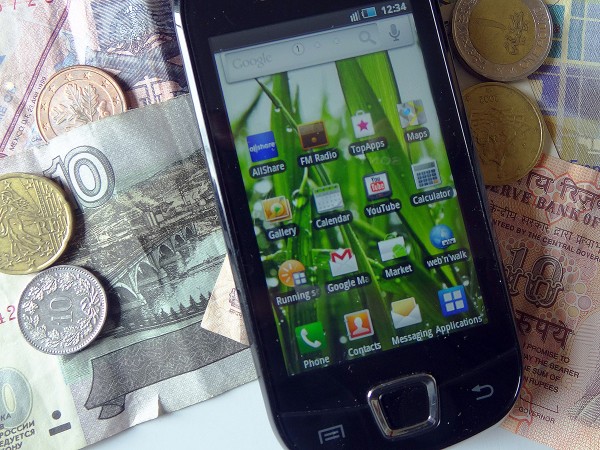 But, with advances in technology a new way of paying has emerged. Small card readers can now be plugged into iphones, ipads, other tablets and smartphones. By putting a customer’s card into this device customers can then pay by card and either sign for their purchase or use the phone to enter their security details. There are plan for these companies to offer chip and pin technology to further ease payment by card on market stalls. The traders pay a small commission per transaction, but aside from that, the initial start-up cost is minimal and it is likely to encourage more customers to use markets. Jim Stewart, the Director of a firm that has begun using this technology said:
I think it’s definitely going to take off, the world is going that way … The money has always appeared in my bank account, no transactions have been declined, my accountant is happy, it’s all been good.
Some customers have raised concerns about the security of these transactions, as they have to put their cards into someone else’s ipad. However, traders have said that there are no risks and that customers can be sent a receipt for their purchase. The following few articles look at this latest (and other) technological developments.
Smartphone card payment system seeks small firms BBC News, Rob Howard (19/1/13)
POS Trends: What’s new for 2013 Resource News (17/1/13)
Payments by text message service to launch in UK in Spring 2014 BBC News (15/1/13)
Questions
- What are fixed cost and why does having a traditional card payment machine represent a fixed cost for a firm?
- How might this new technology affect a firm’s sales and profits?
- Will there be an increase in the firm’s variable costs from adopting this technology?
- Using a cost and revenue diagram, put your answers to questions 1 – 3 into practice and show how it will shift them and thus how the equilibrium may change for a market trader.
- What are the properties of money that allow it to be a good medium of exchange?
- How will this increased use of debit and credit cards affect the demand for money? Use a diagram to illustrate your answer.
 The exchange rate for sterling is determined in much the same way as the price of goods – by the interaction of demand and supply.
When factors change that cause residents abroad to want to hold more or fewer pounds, the demand curve for sterling will shift. If, instead, factors change that cause UK residents to want to buy more or less foreign currency, then the supply curve of sterling will shift. It is these two curves that determine the equilibrium exchange rate of sterling.
There are concerns at the moment that sterling is about to reach a peak, with expectations that the pound will weaken throughout 2013. But is a weakening exchange rate good or bad for the UK?
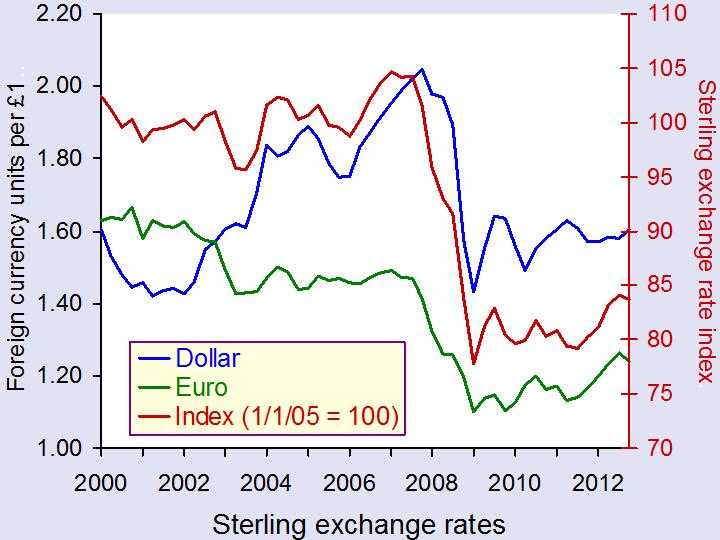
 With lower exchange rates, exports become relatively more competitive. This should lead to an increase in the demand for UK products from abroad. As exports are a component of aggregate demand, any increase in exports will lead to the AD curve shifting to the right and thus help to stimulate a growth in national output. Indeed, throughout the financial crisis, the value of the pound did fall (see chart above: click here for a PowerPoint) and this led to the total value of UK exports increasing significantly. However, the volume of UK exports actually fell. This suggests that whilst UK exporters gained in terms of profitability, they have not seen much of an increase in their overall sales and hence their market share.
Therefore, while UK exporters may gain from a low exchange rate, what does it mean for UK consumers? If a low exchange rate cuts the prices of UK goods abroad, it will do the opposite for the prices of imported goods in the UK. Many goods that UK consumers buy are from abroad and, with a weak pound, foreign prices become relatively higher. This means that the living standards of UK consumers will be adversely affected by a weak pound, as any imported goods buy will now cost more.
It’s not just the UK that is facing questions over its exchange rate. Jean-Claude Junker described the euro as being ‘dangerously high’ and suggested that the strength or over-valuation of the exchange rate was holding the eurozone back from economic recovery. So far the ECB hasn’t done anything to steer its currency, despite many other countries, including Japan and Norway having already taken action to bring their currencies down. Mario Draghi, the ECB’s president, however, said that ‘both the real and the effective exchange rate of the euro are at their long-term average’ and thus the current value of the euro is not a major cause for concern.
So, whatever your view about intervening in the market to steer your currency, there will be winners and losers. Now that countries are so interdependent, any changes in the exchange rate will have huge implications for countries across the world. Perhaps this is why forecasting currency fluctuations can be so challenging. The following articles consider changes in the exchange rate and the impact this might have.
A pounding for sterling in 2013? BBC News, Stephanomics, Stephanie Flanders (17/1/13)
UK drawn into global currency wars as slump deepens Telegraph, Ambrose Evans-Pritchard (16/1/13)
Foreign currency exchange rate predictions for GBP EUR, Forecasts for USD and NZD Currency News, Tim Boyer (15/1/13)
Euro still looking for inspiration, Yen firm Reuters (16/1/13)
Daily summary on USD, EUR, JPY, GBP, AUD, CAD and NZD International Business Times, Roger Baettig (16/1/13)
UK inflation bonds surge on Index as pound falls versus euro Bloomberg, Business News, Lucy Meakin (10/1/13)
Questions
- Which factors will cause an increase in the demand for sterling? Which factors will cause a fall in the supply of sterling?
- In the article by Stephanie Flanders from the BBC, loose monetary policy is mentioned as something which is likely to continue. What does this mean and how will this affect the exchange rate?
- Explain the interest- and exchange-rate transmission mechanisms, using diagrams to help your answer.
- If sterling continues to weaken, how might this affect economic growth in the UK? Will there be any multiplier effect?
- What is the difference between the volume and value of exports? How does this relate to profit margins?
- Why are there suggestions that the euro is over-valued? Should European Finance Ministers be concerned?
- Should governments or central banks intervene in foreign exchange markets?
- If all countries seek to weaken their currencies in order to make their exports more competitive, why is this a zero-sum game?