 What does it take to create a successful business? From the looks of it: mud, electric barbed wire, icy water, enormous walls to climb, big jumps to make, team work and complete exhaustion – the recipe for every successful business.
Tough Mudder was founded in 2010 and runs gruelling extreme obstacle courses for anyone mad enough to think it might be fun. In the BBC News article below, you’ll see that there is a discussion as to intellectual property rights, but whatever the outcome, this company has become the main provider of such extreme sports in a remarkably short period of time. Within 2 years of being established, it had gained 500,000 participants and now records annual revenues of more than £60m. Add to this, that there has no external funding and this organic growth is beyond impressive.
A key question, then, is what creates such a successful business? Without a doubt, this depends on the product you are selling and the market a firm is in, but there are some aspects that apply across the board. Understanding what your customers want is crucial, as they represent your demand. Differentiating your product to create inelastic demand may be a good strategy to enable price rises, without losing a large number of sales, but the differentiated product is essential in establishing demand, loyalty and reputation. Marketing something in the right way and to the right audience is crucial – word-of-mouth is often the most effective form of advertising.
If you have all of these aspects, then you have the makings of a successful business. The next step is putting it into practice and climbing those high walls, taking the big jumps and hopefully avoiding the mud and ice. The following article considers Will Dean and his fast growing business.
Will Dean: ‘The Mark Zuckerberg of extreme sports’ BBC News, Will Smale (9/6/14)
Questions
- If you were starting up a business, how might you go about finding out if there is a demand for your product?
- Why is product differentiation a key aspect of a successful business? Using a diagram, explain how this might help a firm increase revenue and profits.
- What forms of marketing might be used in persuading customers to buy your product?
- In the case of Tough Mudder, which aspects have proved the most important in creating such a successful business?
- Are there any barriers to the entry of new firms in this sector? If so, what are they are how important are they in allowing Tough Mudder to retain a monopoly position?
- Which factors should be considered by a company when it is thinking of global expansion?
 Calls for an independent Scotland have focused on a variety of economic issues. These have included taxation, government spending, currency, fiscal policy and monetary policy. However, the BBC News article below looks at another factor which may be affected by a ‘yes’ vote – the price of stamps.
Having just returned from 10 days in the Highlands, I certainly agree with the BBC article that it would be an expensive business to deliver to the remotest parts of Scotland and would definitely require ‘trains, planes, ferries, Land Rovers and vans’ and, in an extreme case, a fishing boat.
So is the price we pay for postage to less rural areas of the UK used to subsidise the higher costs of delivery to the remotest parts of Scotland and, in particular, to the small islands off the Scottish coastline? What would a ‘yes’ vote mean for the cost of stamps in Scotland and in the remainder of the UK? The following articles consider this rather odd question.
Why postage should be cheaper in UK if Scots vote ‘Yes’ BBC News, Brian Milligan (19/4/14)
Tories warn over post service costs The Courier (6/4/14)
Questions
- What happened when the Royal Mail was privatised?
- What are the benefits and costs of privatisation?
- Using a cost and revenue diagram, explain how the different costs of delivery between urban parts of the UK and the remotest parts of Scotland should be reflected in different prices of postage.
- If the price of postage is the same for delivery everywhere in the UK, use your diagram to explain how this happens.
- What does your diagram suggest will happen to the price of postage stamps if a ‘subsidy’ is no longer available?
 UK Supermarkets: a prime example of an oligopoly. This industry is highly competitive and over the past decade, but particularly since the onset of the credit crunch, price wars have been a constant feature of this market. You could barely watch a full programme on commercial TV without seeing one of the big supermarkets advertising that their prices were lower than everyone else’s! So, despite oligopoly being towards the ‘least competitive’ end of the market structure spectrum, this is an example of just how competitive the market can actually be.
With household incomes being squeezed, in particular by another oligopolistic industry (energy) and with the ‘middle market’ being pinched by higher-end retailers and budget retailers, the supermarket sector is facing uncertain times. Asda’s sales growth has continued to slow and in response, the giant supermarket chain will be launching a £1 billion price-cutting campaign. Tesco is the market leader, but Sainsbury’s and Asda have been battling over the second spot. One of Asda’s selling points is its low prices. Perhaps not as low as Aldi and Lidl, but this new pricing strategy will aim to bring its prices further below Tesco, Sainsbury’s and Morrisons and close the gap with the two big discount supermarkets. As Andy Clarke, Asda’s Chief Executive, said:
We regard ourselves as the UK’s leading value retailer and it is against this backdrop that I have today set out our strategic priorities which will improve, extend and expand the business over the next five years.
So, what will be the impact of lower prices? It appears as though Asda is marketing itself towards the budget end of the pricing spectrum, perhaps aiming to become fiercer competitors with Aldi and Lidl and let Tesco and Sainsbury’s do battle with the higher-end retailers, such as Waitrose and Marks and Spencer. Lower prices should cause a substitution effects towards Asda’s products, as many of them will have relatively price elastic demand. If the other supermarkets don’t respond, this should lead to sales growth. However, the key to an oligopoly is interdependence: the actions of one firm will affect all other firms in the market. The implications then, are that Tesco may react to this pricing strategy by engaging in its own price cuts, especially as the Christmas period approaches. The characteristic of interdependence was evident in the aftermath of Asda’s announcement when shares in Tesco and Morrisons both fell, showing how the markets were responding.
 Of course, there are many other factors that affect a consumer’s decision as to whether to shop at Asda, Tesco or any other big supermarket. In the area where I live, we have a Tesco and a Morrisons (a few years ago, we had neither!). I don’t shop at Asda, as the nearest branch is over 30 miles away – even if prices were significantly lower, it would be more expensive to get there and back and a lot less convenient. For others, it may be loyalty and not just of the ‘I’ve shopped there all my life’ kind! For some, clubcard vouchers from Tesco may be preferred to Asda’s offerings and thus tiny price differences between the supermarkets may have little effect on a consumer’s decision as to where to shop. Many products at supermarkets are relatively cheap and thus as the proportion of our income that we spend on these goods is pretty low, any change in price doesn’t cause much of an effect on our demand.
It’s not just a pricing strategy where money is being invested by Asda. More investment will be going into their online services and more stores will be created, kin particular in London and the South East where their presence is low, but demand appears to be high. Improving ‘product quality, style and design’ will also be on the agenda, all with the aim of boosting sales growth and securing its position as the second largest retailer in the sector, perhaps with a long term aim of one day overtaking Tesco. The following articles consider the supermarket battleground.
Supermarket battle heats up as Asda announces £1bn price-cutting plan The Telegraph, Graham Ruddick (14/11/13)
 Sainsbury’s profits make it second biggest supermarket BBC News (13/11/13)
Asda to launch £1bn price-cut plan AOL, Press Association (15/11/13)
Asda takes fight to rivals with £1bn investment plan The Guardian, Angela Monaghan (14/11/13)
UK’s Asda promises £1 billion investment in price cuts Reuters (14/11/13)
Asda makes bid to woo shoppers with vow of five-year £1billion price war after it was overtaken in market share by Sainsbury’s Mail Online, Sean Poulter (15/11/13)
Sainsbury’s overtakes Asda on demand for its premium lines Independent, Simon Neville (14/11/13)
Asda to put £1bn into lowering prices over five years The Grocer, Thomas Hobbs (14/11/13)
Wal-Mart posts $3.7bn quarterly income BBC News (14/11/13)
Questions
- What are the key characteristics of an oligopoly?
- What is meant by a price war? Who benefits?
- How important is the concept of price elasticity of demand when deciding whether or not to cut the price of a range of products?
- Why is the proportion of income spent on a good a key determinant of the elasticity of demand of a product?
- How can market share be calculated?
- Many suggest that the ‘middle market’ of the supermarket sector is slowly disappearing. Why is this?
- How effective will Asda’s price cutting strategy be? Which factors will determine its effectiveness?
 Valued by private investors at more than $10 billion, the future listing on the stock market of Twitter, is an eagerly anticipated event. The necessary forms have been submitted to the US Securities and Exchange Commission (SEC) ahead of the initial public offering (IPO). Twitter will be looking to avoid the mistakes made by Facebook when they were first listed in May last year. Twitter has also announced its intentions to purchase MoPub, which is a firm specialising in mobile advert exchanges.
So, what will this listing mean for Twitter? The public will now be able to purchase shares in Twitter, in much the same way as you can buy shares in RBS or Facebook. The financial performance of Twitter will come under much greater scrutiny from its shareholders, who will be interested in short term returns and long term stability. Becoming a public limited company will attract investors and is likely to provide a much larger scope for expansion for Twitter. However, as yet no details have been released on a likely date for the flotation or on the prices we can expect.
One thing Twitter will be trying to avoid is a repeat of the problems that beset Facebook and indeed of the problems that other public listings have created for giants such as Google, Zynga and Groupon. When Facebook moved to public ownership, its share prices initially fell below its IPO and subsequently Facebook lost more than half its value. More recent success in mobile advertising has restored the fortunes of this company, but Goldman Sachs, which is handling Twitter’s transition will be looking to avoid a similar occurrence. As Sam Hamadeh from PrivCo (a firm that gathers data on private companies) said:
Twitter will learn from Facebook’s flawed playbook and do the opposite … Unlike Facebook, which waited too long to IPO (until its growth rate decelerated), Twitter will IPO at just the right inflection point: while revenue grows in triple digits.
Twitter is a rapidly growing business, but still has significant scope for expansion and this move to public ownership may be just the thing. Setting the right IPO and the right date will be crucial, as a multitude of factors can and do affect the price of shares listed on the stock market. Twitter will also need to ‘focus on doing the right stuff’ to make a success of the listing and its purchase of Mopub looks to be a step in the right direction. For now, all we can do is speculate, but if the launch is successful, then the founders of Twitter are likely to bring in hundreds of millions of dollars each.
Twitte files for IPO The Telegraph, Sophie Curtis (13/9/13)
Twitter plans stock market listing (see also) BBC News (13/9/13)
Twitter files for IPO, hopes to avoid Facebook’s mistakes Independent, Nikhil Humar and James Vincent (12/9/13)
Facebook shares close 11% below flotation price BBC News (21/5/12)
Twitter fails to answer key IPO questions Financial Times, Richard Waters and April Dembosky (13/9/13)
Twitter IPO: how much is it worth? The Guardian, Juliette Garside (13/9/13)
Twitter IPO: Tech float successes and disasters The Telegraph, Gabrielle Putter and Szu Ping Chan (13/9/13
Twitter to see ‘strong demand’ for share sale BBC News (13/9/13)
Twitter IPO: Firm in stock market launch bid Sky News (13/9/13)
Questions
- What are the characteristics of a public limited company? Are there advantages and disadvantages?
- Which factors affect (a) the supply of shares and (b) the demand for shares?
- What mistakes were made by Facebook when it made the transition to public ownership?
- How does advertising generate revenue for Twitter?
- How might you go about valuing Twitter or Facebook?
- Companies such as Twitter and Facebook have hundreds of millions of subscribers. Are there network externalities of this?
- Twitter is purchasing MoPub. What type of takeover would you classify this as?
 The strength of the housing market is often a key indicator of the strength of the economy. But, the opposite is also true: a weak economy often filters through to create a weak housing market. With the current weak economy, a boost in confidence is needed and signs suggest that the housing market is beginning to recover.
While the picture of the housing market today is nothing like the pre-crisis view, things are beginning to look up. For a couple of years now, house price inflation in the UK has been very close, if not equal to zero. However, data from Nationwide Building Society suggests that in May, house prices rose by 0.4% and the once stagnant year-on-year change in house prices rose to 1.1% (see chart below: click here for a PowerPoint of the chart). This is the fastest it has grown since the end of 2011.
Commentators have suggested that this latest data is an indication that ‘the market is gaining momentum’. A further confirmation of this rejuvenated market came with the data that property sales were 5% up each month this year, than the average monthly level for 2012. Despite this improvement, they still remain well below the pre-crisis levels.
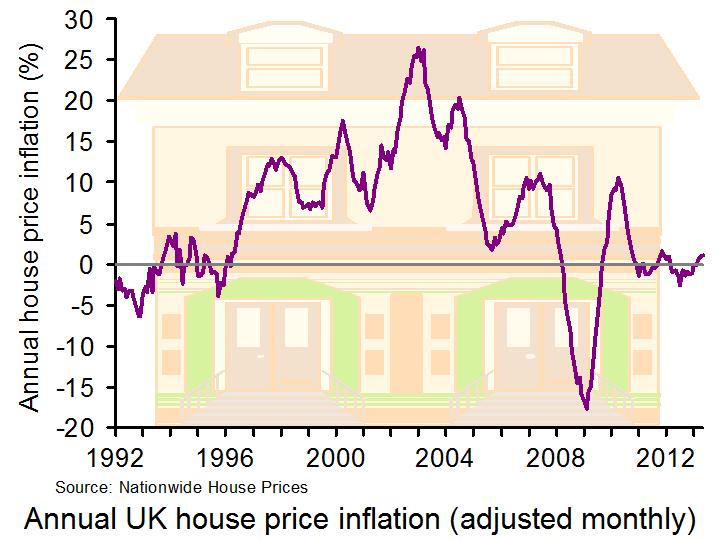 Which factors have contributed to this tentative recovery? Most households require a mortgage to purchase a house and, given the central role that the housing market played in the financial crisis with companies engaging in excessive lending as a means of expanding their mortgage books, the availability of mortgages fell. The number of mortgage approvals is likely to feed through to affect the number of house sales and these have improved in the first few months of 2013. Interest rates offered by lenders have also fallen, making mortgages more affordable, thus boosting demand. Furthermore, government assistance is available to help individuals put a deposit down on a house, by offering them an equity loan. Further measures are due to come into effect in January 2014, with the aim of providing a further boost to the housing market. The chief economist at Nationwide, Robert Gardner said:
Widespread expectations that the economy will continue to recover gradually in the quarters ahead, that interest rates will remain low, and the ongoing impact of policy measures aimed at supporting the availability and lowering the cost of credit all provide reasons for optimism that activity will continue to gain momentum in the quarters ahead.
Despite the optimism, the situation is different across the UK, with some areas benefiting more than others. London and the South-East are driving this 0.4% rise, whereas other areas may be in need of further assistance to keep pace (see The UK housing market: good in parts).
Although these latest data may be a sign of things to come, it is also possible that things could go the opposite way. Incomes remain low; employment data are hardly encouraging; and the spectre of inflation is always there. Perhaps most importantly, consumer confidence remains fragile and until that gains momentum, uncertainty will continue to plague the UK marketplace. The following articles consider this issue.
Articles
UK house prices again up in May, says Nationwide The Guardian, Hilary Osborne (30/5/13)
Housing market could boost retail industry, Kingfisher says The Telegraph, Graham Ruddick (30/5/13)
UK house prices see modest rise, says Nationwide BBC News (30/5/13)
Hugh’s Review: House prices in spotlight BBC News, Hugh Pym with Yolande Barnes of Savills and Matthew Pointon of Capital Economics (31/5/13)
House prices are racing ahead as stimulus for the market kicks in Independent, Russell Lynch (31/5/13)
’Pick up’ in house prices recorded in sign of market confidence, says Nationwide Independent, Vicky Shaw (30/5/13)
House prices at highest level for nearly two years as confidence in UK economy grows and mortgages get cheaper This is Money, Matt West (30/5/13)
Stamp duty is ‘choking’ housing market as it rises seven times faster than inflation over last 15 years Mail Online, Tara Brady (28/5/13)
Nationwide launches Help to Buy mortgages The Telegraph, William Clarke (29/5/13)
UK home prices rise most in 18 months, Nationwide says Bloomberg, Jennifer Ryan (30/5/13)
House price data
Links to house price data The Economics Network
Statistical data set – Property transactions Department of Communities and Local Government
Nationwide house price index Nationwide Building Society
Halifax House Price Index Lloyds Banking Group
Lending to individuals – November 2012 Bank of England
Questions
- How is the equilibrium determined in the housing market? Using a demand and supply diagram, illustrate the equilibrium. Make sure you think about the shapes of the curves you’re drawing.
- Which factors affect the demand for and supply of housing?
- Why are there regional variations in house prices?
- Why is the housing market a good indicator of the strength of the economy?
- Why have house prices risen throughout 2013? Is the trend likely to continue?
- If the housing market does indeed gain momentum, how might this affect the rest of the economy? Which sectors in particular are likely to benefit?
- Explain why the government’s intervention in the housing market could be seen to have a multiplier effect?
- Concerns have been raised that the government’s schemes to help the housing market may create a house price bubble. Why might this be the case?
 What does it take to create a successful business? From the looks of it: mud, electric barbed wire, icy water, enormous walls to climb, big jumps to make, team work and complete exhaustion – the recipe for every successful business.