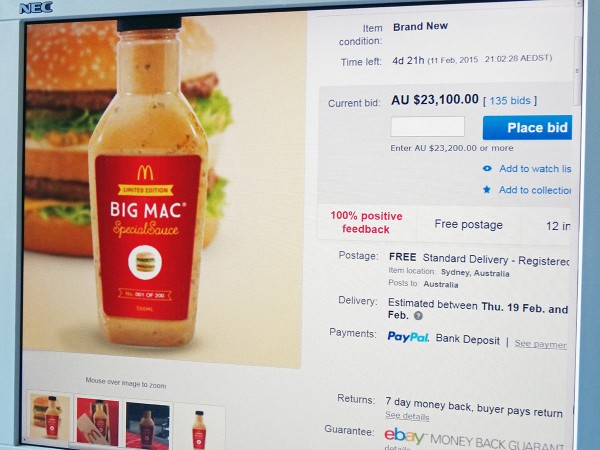
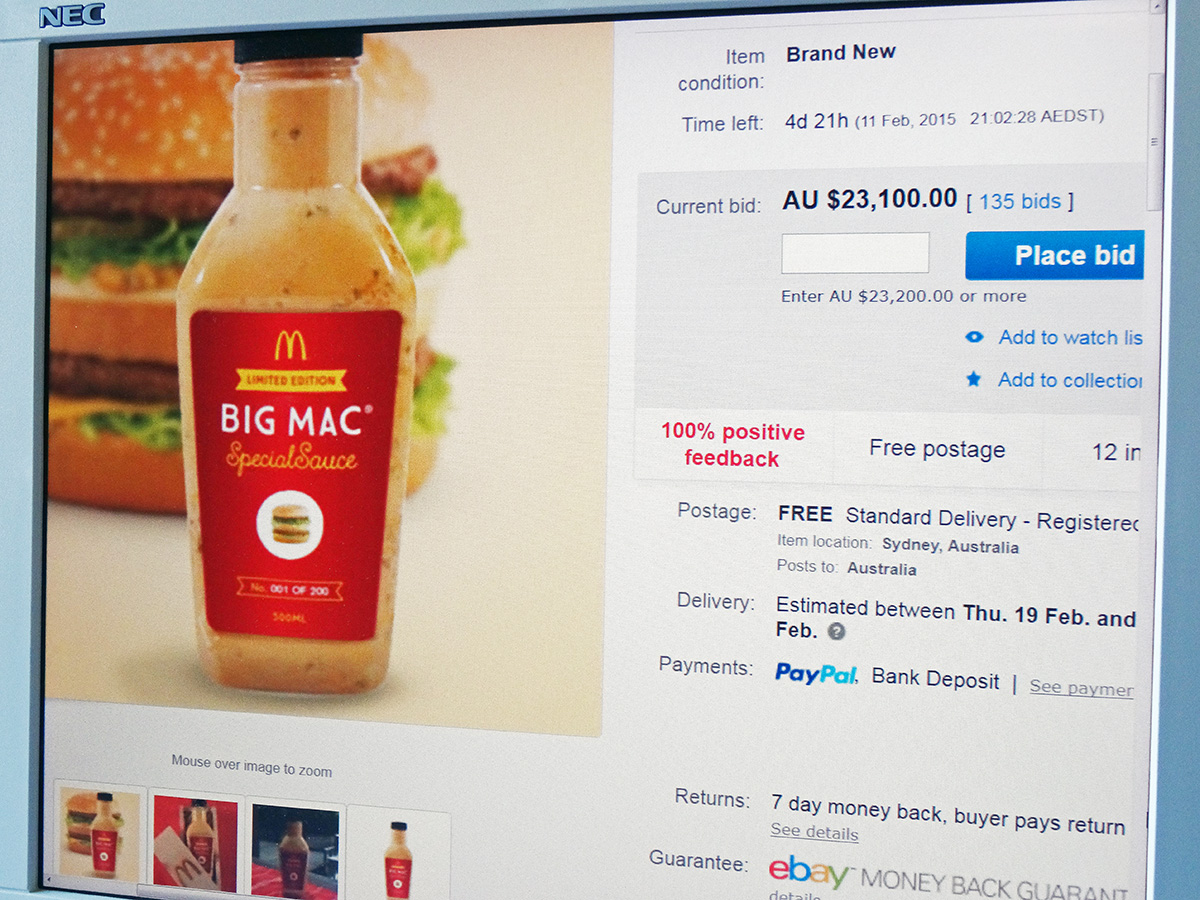
 McDonalds is one of the most recognised names in the world and its iconic product, the Big Mac, is an obsession for many people – though I have to confess that I have never had one. McDonalds is taking advantage of this fact by auctioning off a bottle of its secret Big Mac sauce. The proceeds will go to charity.
McDonalds has around 36 000 stores around the world, located in over 100 countries. The Big Mac is sold in all of these stores and the famous sauce is available there for a pretty small price. However, on eBay, this bottle of sauce has already reached a bid of AU$23 100 (£11 800)! The 500m bottle is only being auctioned in Australia and with a few days before the auction finishes, the price may get still higher.
So, why are people prepared to pay such a high price for a bottle of sauce that is readily available on a Big Mac and which, in Australia, will be sold in small tubs throughout this month?
The advert on eBay suggests that the bottle is being set free and is ‘rarer than a spot on Bondi beach on New Years Day’. As we know, when products become scarce their price tends to rise. This auction will be the first time that this sauce is available, as normally the sauce is dispensed straight onto the burger. The ingredients of this famous sauce are known, but the recipe for making it is not. Perhaps it represents an opportunity for someone to try to re-create it!
An auction is an interesting mechanism to receive the highest price for any product. Most people have a maximum willingness to pay for something and if they pay less than that, they will receive some consumer surplus. However, with an auction, it can be a good way for the seller to force consumers to bid their maximum price and hence this can reduce the consumer surplus.
Of course, in this auction only the highest bidder will actually pay and so it will only be their consumer surplus that is affected. However, other auction designs, such as an ‘All-pay’ auction can extract the full consumer surplus from bidders. Mr Lollback, the Chief Marketing Officer said:
‘We’re excited to be auctioning off the first-ever bottle of Big Mac sauce for a cause we are passionate about… It’s going to be interesting to see just how much people are prepared to pay for such a sought after commodity.’
The final price will certainly be interesting and, with other bottles of this sauce available, we will have to wait and see whether or not further auctions take place or if other mechanisms of delivering the sauce to the public appear. The following articles consider the Big Mac sauce auction.
McDonald’s Big Mac sauce auction attracts $18,000 bid BBC News (3/2/15)
Liquid Gold! Macca’s auction off the only bottle of its trademark Big Mac special sauce in Australia … and bids have already reached $23,000 Mail Online, Leesa Smith (3/2/15)
 Bottle of McDonald’s secret Big Mac sauce up for auction USA Today, Jessica Durando (3/2/15)
McDonald’s Big Mac special sauce yours to own from today The Telegraph, Richard Noone (29/1/15)
Questions
- Why does the price of a product rise when it is scarce? Use a diagram to explain this.
- What is consumer surplus and how can a firm aim to extract as much of this as possible? Why would a firm want to do this? Use a diagram to illustrate the concept of consumer surplus and how it can change.
- Why can an auction push up the market price of a product?/li>
- Given that the Big Mac sauce is available on all Big Macs, which can be purchased for a very low price, what explanation can be given for people being prepared to pay over £10,000?
- When are auctions a good mechanism to sell a product?
- What are the different types of auctions that can occur? How do they vary in terms of the price that can be achieved?
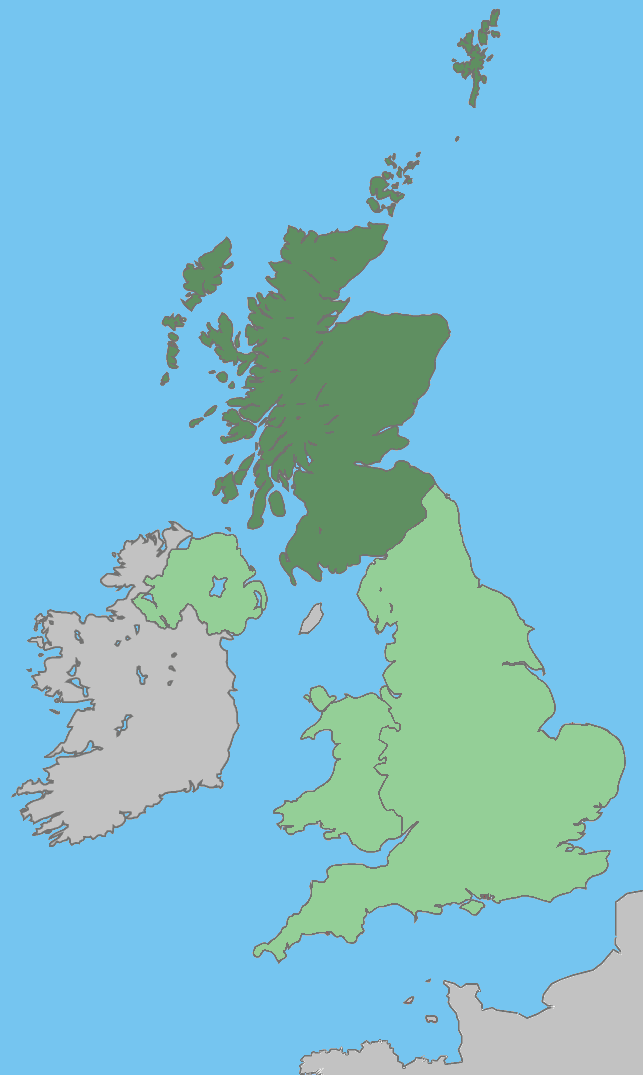 The Scottish debate revolved around a variety of issues and one of the key factors that added weight to the ‘No’ campaign was the idea of being British. But the concept of ‘Britishness’ is not just important to those who live here. It still appears to be a key signal of quality in foreign markets and it is something which foreign consumers are willing to pay a price for.
Barclays Corporate Banking has undertaken research into eight key export markets to determine the value of ‘Britain’. One of the key factors that boost demand for a product is quality and another is the idea of a brand. As quality improves and brands become more recognized, a product’s demand curve will begin to shift to the right, thus pushing up the market price. In other words, with higher quality and brand recognition, an individual’s willingness to pay rises. One brand that foreign consumers seem willing to pay a premium to purchase are those labelled ‘Made in Britain’.
The research indicates that 31% of customers in emerging markets have been prepared to and have purchased products that are from Britain, despite the higher price. Seeing the label ‘Made in Britain’ seems to send the signal of quality and this in turn creates a higher willingness to pay. Furthermore, this willingness to pay, while still good for Scottish, English and Welsh products, is higher for ‘British’ products, perhaps another indication of the truth behind the ‘Better together’ campaign.
The increase in willingness to pay between products with seemingly no country of origin and a British country of origin is 7% and this knowledge should give a confidence boost to the British export market. It should also indicate to exporters in Wales, Scotland and England that they are better to advertise as ‘Made in Britain’ than ‘Made in Wales, Scotland or England’. The expected boost from the 8 key emerging markets is around £2bn. The following articles consider the concept of ‘Brand Britain’.
Good news for exports as Brand Britain is revealed to be valuable concept Small Business, John Bromley (3/11/14)
Britain ‘best brand’ for Welsh exports, survey suggests BBC News (26/11/11)
Overseas consumers 64% more willing to pay premium for ‘Brand Britain’ Marketing Week, Sebastian Joseph (3/11/14)
Report flags up ‘British’ benefit The Courier, James Williamson (3/10/14)
Questions
- Using a diagram, illustrate the effect of a product’s being a well-known brand on its equilibrium price and quantity.
- Why is it that the relative willingness to pay a premium for British products is higher in developing countries than in developed countries?
- Using the concept of marginal utility theory, explain the impact of the ‘Made in Britain’ label.
- The BBC News article suggests, however, that some Welsh companies have not found the brand effect to be the case. What factors might explain this?
- To what extent are the concepts of consumer and producer surplus relevant here?
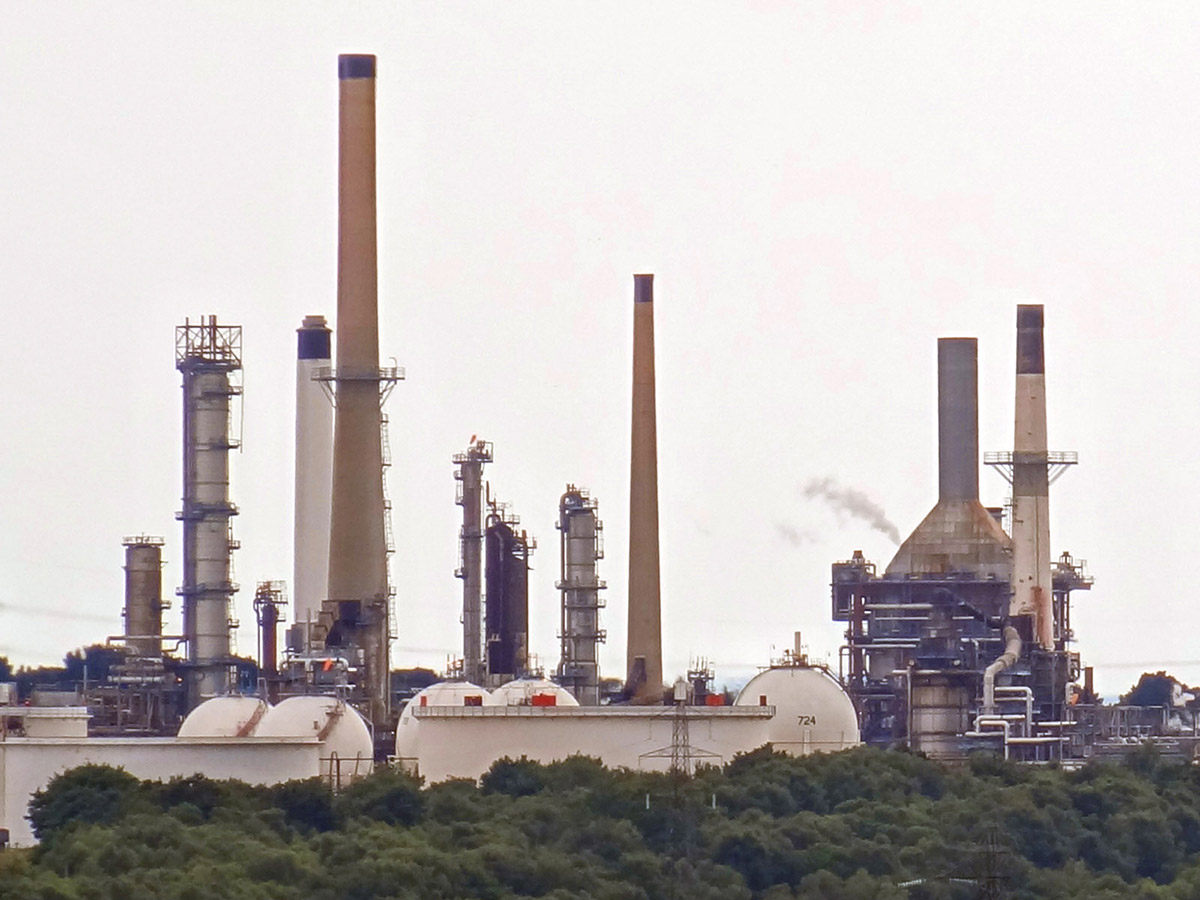 One of the key prices in any economy is that of oil. Whenever oil prices change, it can have a knock-on effect on a range of other markets, as oil, or some variation, is used as an input into the production of countless products. The main products that consumers will see affected are energy prices and petrol prices..
Although on the supply-side, we see a large cartel in the form of OPEC, it is still the case that the forces of demand and supply directly affect the market price. Key things such as the demand for heating, economic growth, fears of war and disruption will change the demand and supply of oil. The possibility of militant strikes in oil producers, such as Syria, would normally reduce supply and push up the market price. However, we have actually seen oil prices drop much faster than we have in two years, dropping below $100 per barrel since September 5th. The slowdown of economic growth in Asia, together with the return of Libyan production at a level greater than expected have helped to push prices down and have offset the fears of global production.
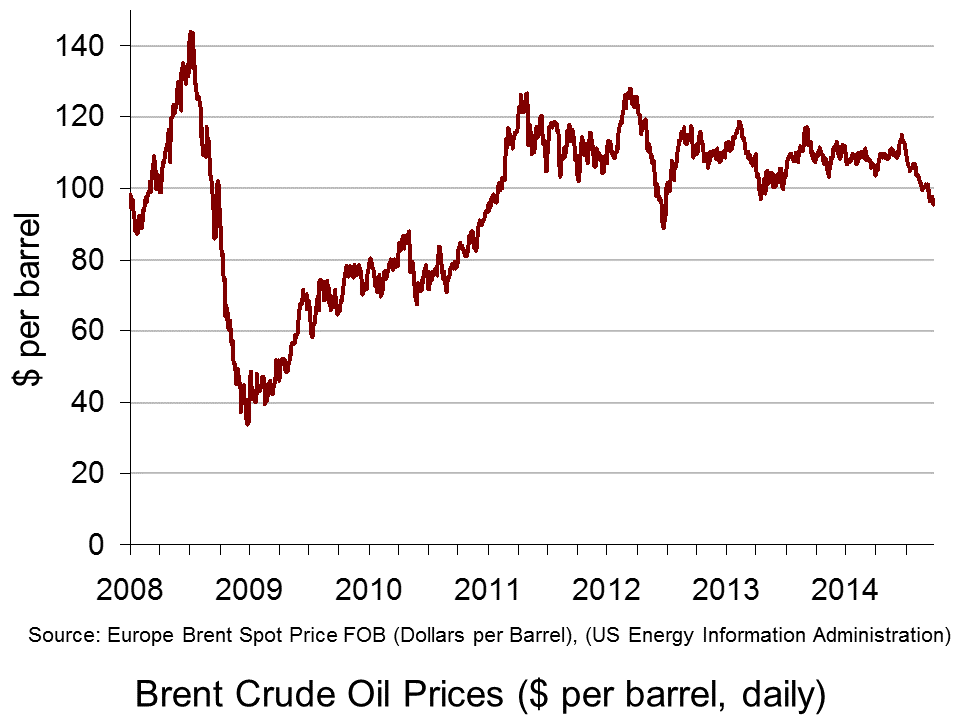 The market forces pushing prices down, while good for consumers and firms that use crude oil or one of its by-products, are clearly bad for oil producers. (Click here for a PowerPoint of the chart.) Countries are urging OPEC to halt its production and thereby shift supply upwards to the left putting a stop to the downward oil price trend. Several countries are concerned about the impact of lower prices, and one country that may be significantly affected is Russia. Some are suggesting that the impact could be as big as 4% of Russia’s GDP, taking into account the ongoing political crisis with Ukraine.
The market for oil is highly susceptible to changes in both demand and supply-side factors. Microeconomic changes will have an impact, but at the same time any global macroeconomic factors can have significant effects on the global price. Expectations are crucial and as countries release information about the size of the oil stocks and inventories, it is adding to the downward pressure on prices. Some oil experts have predicted that prices could get as low as $80 per barrel before OPEC takes significant action, influenced heavily by countries like Saudi Arabia. The following articles consider this global market.
Articles
Iran urges OPEC to halt oil price slide Financial Times, Anjli Raval (26/9/14)
Oil overflow: as prices slump, producers grapple with a new reality The Globe and Mail, Shawn McCarthy and Jeff Lewis (27/9/14)
Weak demand, plentiful supply drive decline in oil prices International Distribution (26/9/14)
Oil prices plunging despite ISIS CNN Money, Paul R La Monica (25/9/14)
Oil prices fall on EIA report of big U.S. crude stocks build Reuters, Robert Gibbons (17/9/14)
Sanctions and weaker oil prices could cost Russia 4% of GDP – official RT (25/9/14)
Data
Spot oil prices Energy Information Administration
Weekly European Brent Spot Price Energy Information Administration (Note: you can also select daily, monthly or annual.)
Annual Statistical Bulletin OPEC
Questions
- What are the key factors on the microeconomic side that affect (a) demand and (b) supply of oil?
- Explain the key macroeconomic factors that are likely to have an impact on global demand and supply of oil.
- Militant action in some key oil producing countries has caused fears of oil disruption. Why is that oil prices don’t reflect these very big concerns?
- Use a demand and supply diagram to explain the answer you gave to question 3.
- What type of intervention could OPEC take to stabilise oil prices?
- Why is the Russian economy likely to be adversely affected by the trend in oil prices?
- Changes in the global macroeconomy will directly affect oil prices. Is there a way that changes in oil prices can also affect the state of the global economy?
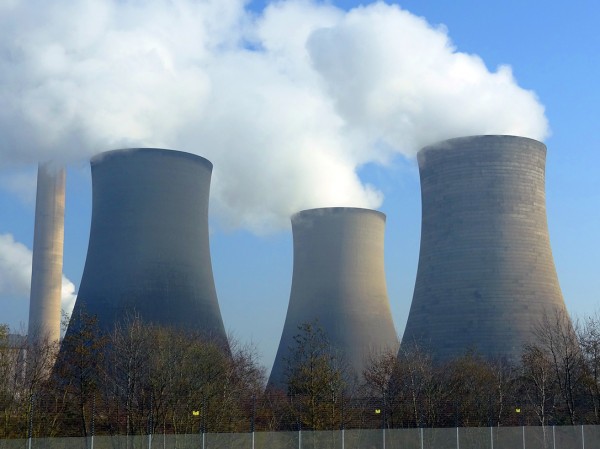 One example of an oligopoly was recently discussed on this blog –supermarkets. Here, is another classic example: the energy sector. It is dominated by six big firms, which hold the majority of the market in an industry with high barriers to entry; there is inter-dependence between the firms; and there are accusations of price fixing and collusion – all typical features of an oligopoly that may operate against consumers’ interests.
There have been numerous investigations into the actions of these energy providers, owing to their high prices, a lack of competition and significant profits. Developments in the industry have focused on reducing the barriers to entry created by the vertical integration of the incumbent firms in order to make it easier for new firms to enter, thus boosting competition.
However, the latest step is the biggest one, with the energy regulator, Ofgem, referring this industry to the Competition and Markets Authority (CMA). The investigation is likely to last 18 months and will ‘leave no stone unturned in establishing the truth behind energy prices’.
One of the key things that will be investigated is the accusation of profiteering and thus whether the big six should be broken up. This would inevitably lead to reductions in entry barriers and more opportunities for new firms to enter the market, thereby creating a much needed increase in competition. The Chief Executive of Ofgem, Dermot Nolan said:
Now is the right time to refer the energy market to the CMA for the benefit of consumers…There is near-unanimous support for a referral and the CMA investigation offers an important opportunity to clear the air. This will help rebuild consumer trust and confidence in the energy market as well as provide the certainty investors have called for.
Further comments were made about the energy sector and the future direction in terms of market reforms. This was another reason given for the referral to the CMA. Dermot Nolan added:
A CMA investigation should ensure there are no barriers to stop effective competition bearing down on prices and delivering the benefits of these changes to consumers.
The impact of this latest news will undoubtedly be felt by the big six, with share prices already taking a small hit, as investors start to look ahead to the potential outcome, despite any decision not being expected for a good 18 months. The following articles consider this latest energy market development.
Ofgem puts big six energy suppliers under CMA spotlight The Guardian, Terry Macalister (26/6/14)
Ofgem refers ‘big six’ energy groups for competition probe Financial Times, Claer Barrett (26/6/14)
U.K. energy regulator Ofgem asks for utilities probe Wall Street Journal, Selina Williams (26/6/14)
Energy probe could lead to ‘major structural change’ BBC News (26/6/14)
Probe into energy firms’ £100 per home profits The Telegraph, Emily Gosden (26/6/14)
UK competition watchdog kicks off energy suppliers probe Reuters (26/6/14)
Energy sharks may £101 profit per family: Major inquiry launched into power Mail Online, Sean Poulter (26/6/14)
Big six energy firms face full competition probe Independent, Simon Read (26/6/14)
Questions
- How well does the energy sector fit the structure of an oligopoly?
- What are the barriers to entry in the energy market? How can this referral to the CMA help to reduce them?
- Which factors determine the price of energy?
- The big six have been accused of profiteering. What is meant by this and why is it against the public interest?
- Why has it taken so long for such a referral to take place?
- In the BBC News article, the suggestion is that this investigation could lead to a ‘major structural change’. What is meant by this and why is it a possibility?
 Oligopoly is the most complex market structure, characterised by a few large firms which dominate the industry. Typically there are high barriers to entry and prices can be very sticky. However, perhaps the most important characteristic is interdependence. With this feature of the market, oligopolies, despite being dominated by a few big firms, can be the most competitive market structure.
There are many examples of oligopolies and one of the best is the supermarket industry. Dominated by the likes of Tesco, Morrisons and Asda, competition in terms of branding, product development and quality is constant, but so is price competition.  During the recession, you could hardly watch a TV programme that included advert breaks without seeing one of the big four advertising their low prices.
However, in the past few years, the supermarket industry has seen competition grow even further and the big four are now facing competition from low-cost retailers, including Aldi and Lidl. This has led to falling sales and profits for the likes of Tesco and Morrisons.
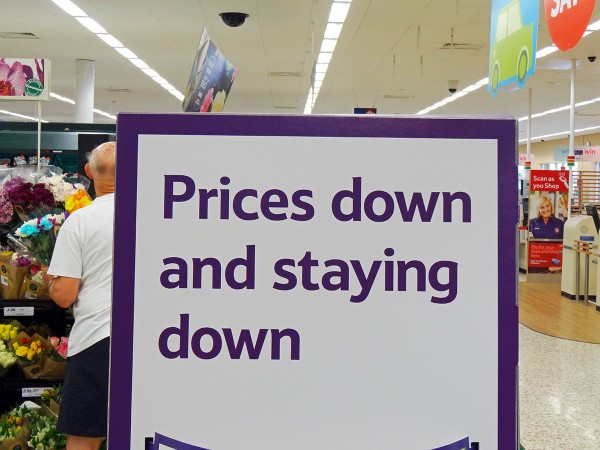 Tesco, Morrisons, Sainsbury’s and Asda have all felt the emergence of discount retailers and have seen their customer numbers fall. All have reacted with rounds of price cuts and new deals, and this price war looks set to continue. Morrisons have just announced a 14% average price cut on 135 products to match earlier changes in pricing strategies by the other main competitors. As I’m writing this during the Algeria v. South Korea match, I have just seen an advert from Sainsbury’s, promoting their milk chocolate digestive biscuits, priced at £1. The advert explicitly states that they are ‘less than Morrisons’, where the price is £1.50. This was soon followed by another from Sainsbury’s saying that
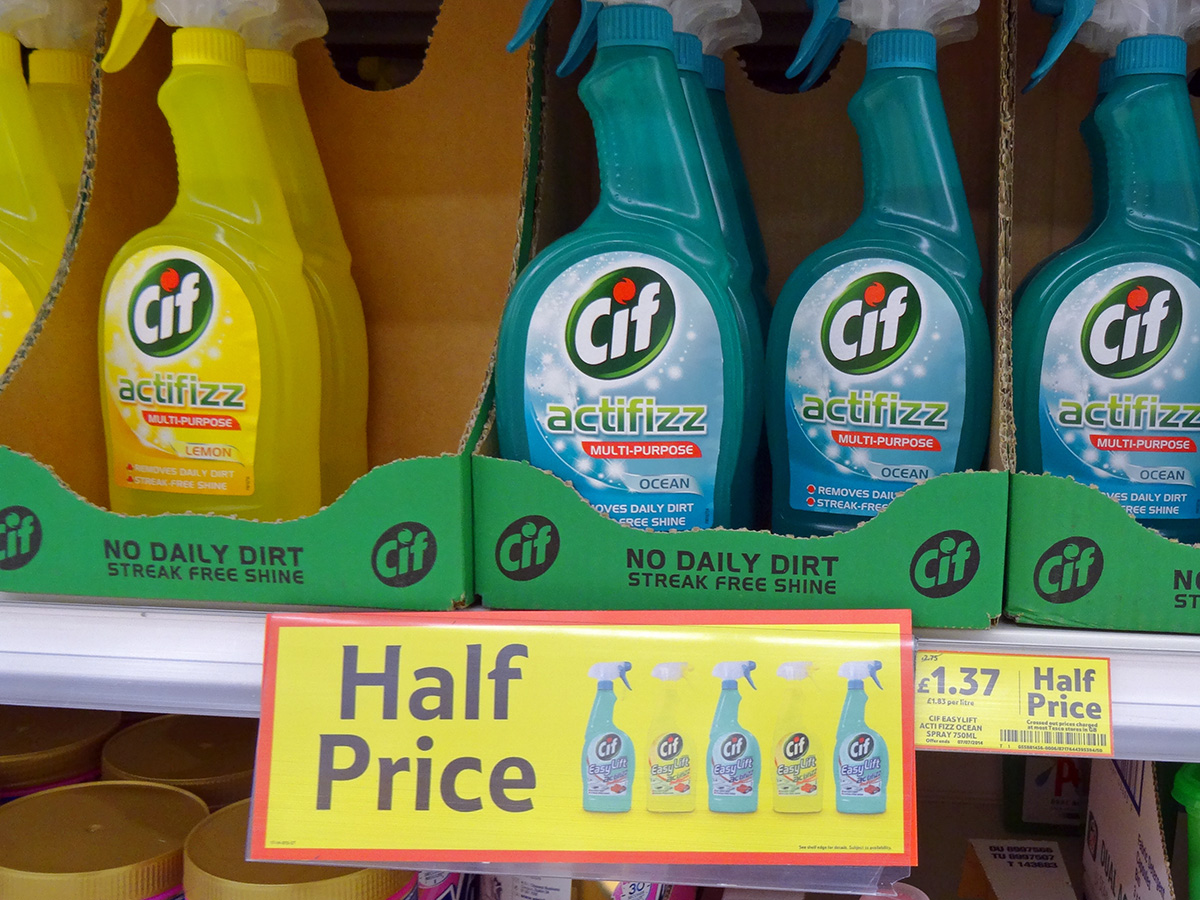
 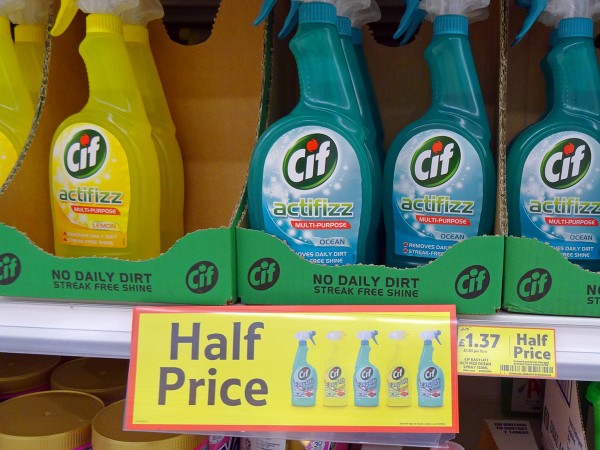 the Cif bathroom spray is £1.50, which is ‘less than Tesco’, priced at £2.75. I need say no more.
So, what is it about this industry which means it is so susceptible to price wars? Are all oligopolies like this? The following articles consider the supermarket industry and the price wars that have emerged. Think about this sector in terms of oligopoly power and consider the questions that follow.
Morrisons announces another round of price cuts/a> BBC News (22/6/14)
Tesco suffers worst sales for decades The Guardian, Sarah Butler and Sean Farrell (4/6/14)
Britain’s Morrisons to cut prices on 135 products Reuters (22/6/14)
Morrisons slashes more prices by up to 41pct The Telegraph, Scott Campbell (22/6/14)
Sainsbury’s and Netto in discount store tie-up BBC News (20/6/14)
Slow to respond, Tesco now pays the price Wall Street Journal, Peter Evans and Ese Erheriene (19/6/14)
One million fewer customer visits a week at Tesco The Guardian, Sean Farrell (3/6/14)
Asda only one of big four to grow share as Lidl achieves highest ever growth Retail Week, Nicola Harrison (3/6/14)
Will Asda shoot itself in the foot with in-store cost cutting? The Grocer, Alec Mattinson (28/5/14)
Tesco sales slide at record speed as discounters pile on the pressure Independent, Simon Neville (3/6/14)
Quester: Back J Sainsbury to prove doubters wrong The Telegraph, Graham Ruddick (11/6/14)
Questions
- What are the key characteristics of an oligopoly?
- How do the above characteristics explain the conduct of firms in an oligopoly? How relevant is this to the supermarket industry?
- In many oligopolies, prices are sticky. Why is it that in the supermarket industry price wars break out?
- Is the kinked demand curve a relevant model to use when talking about the supermarket industry?
- What other industries fit into the category of an oligopoly? Is the kinked demand curve model relevant in these industries?
- Would there be an incentive for the big 4 supermarkets to collude and fix price? Explain your answer.
- Interdependence is the key characteristic in an oligopoly. Can this explain the behaviour of the supermarkets?
- Given that oligopolies are characterised by high barriers to entry, how is that Aldi and Lidl have been able to compete with them?
 McDonalds is one of the most recognised names in the world and its iconic product, the Big Mac, is an obsession for many people – though I have to confess that I have never had one. McDonalds is taking advantage of this fact by auctioning off a bottle of its secret Big Mac sauce. The proceeds will go to charity.