
Inflation has been rising around the world. The main reason has been the supply shock of rising oil, fertiliser and commodity prices caused by the Iran war and the disruption to global supply chains from conflicts in the Middle East and Russia (see the blog, Why have diesel prices risen more than petrol prices?). Central banks, including the US Federal Reserve Bank, the European Central Bank and the Bank of Japan, have responded to this cost-push inflationary shock by raising interest rates. The Bank of England is likely to raise Bank rate at its next meeting on 5 November 2026.
Similar supply shocks have been experienced in recent years (see the May 2026 blog, Supply shocks – long-term gain from the short-term pain?).
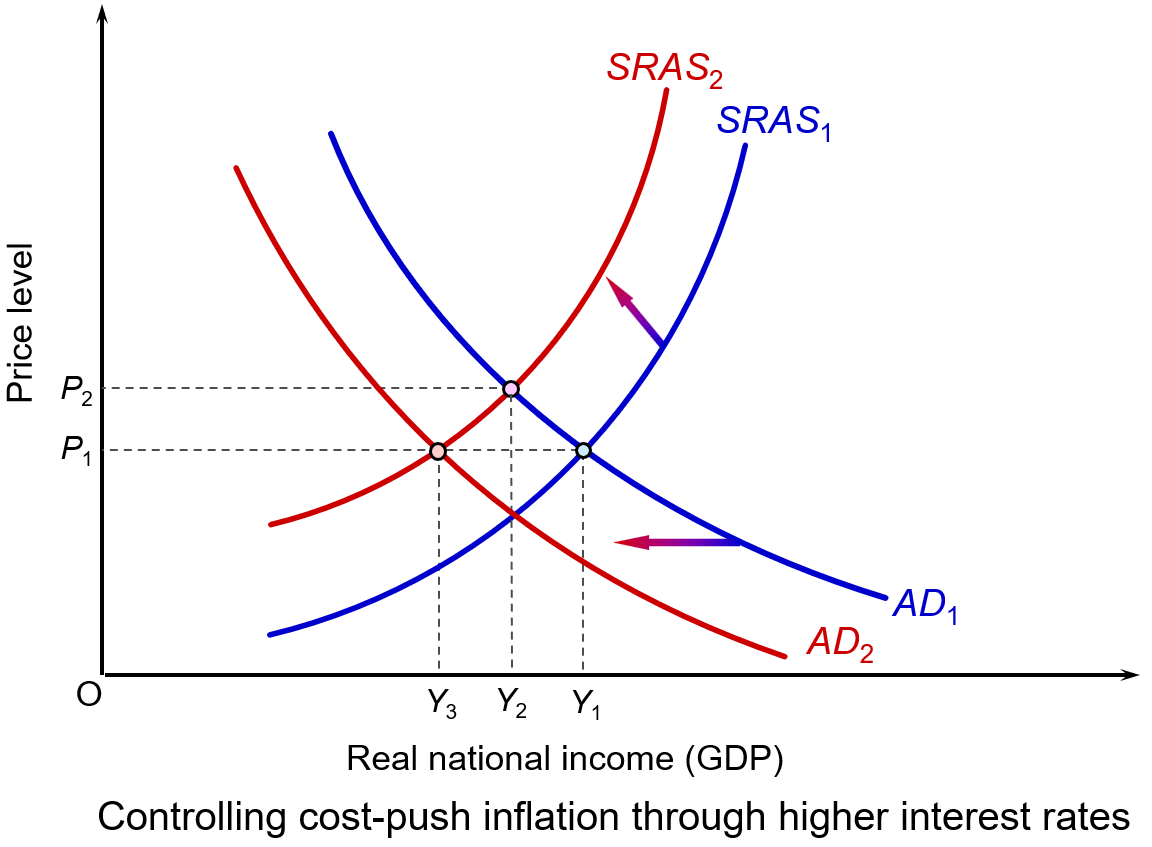 Raising interest rates reduces aggregate demand, or at least its rate of growth. This puts downward pressure on prices, or at least on the rate of inflation. This can be illustrated in the diagram. (Click here for a PowerPoint.)
It shows a country’s initial short-run aggregate supply curve (SRAS1) and initial aggregate demand curve (AD1). The price index is P1 and real GDP is Y1.
The higher costs shift the SRAS curve upwards to the left, say to SRAS2. The price index rises to P2 and real GDP falls to Y2. If, in response to the higher prices, the central bank raises the interest rate, this shifts the aggregate demand curve to the left, say to AD2. As a result, the price index falls back to P1, but the fall in demand causes real GDP to fall further, to Y3.
Policy alternatives
 So, is a rise in interest rates the appropriate response to higher costs that push inflation above, or further above, its target, which for most countries is 2%?
If the cause of inflation was excessive increases in aggregate demand from, say, large government budget deficits or a large increase in consumer demand, then a rise in interest rates would have helped reduce this unsustainable rise in demand. But if the cause of the inflation is a supply shock, is curbing aggregate demand the correct solution?
Ideally, the solution would be to tackle the cost increases directly. A rise in productivity, for example, would help to increase aggregate supply and counter the effect of rising commodity prices. But productivity increases take place over the longer term and are not a solution to a short-term supply shock. Better still, if the increase in commodity prices could be reversed, by finding a political solution that reopened the Strait of Hormuz and other choke points, then higher interest rates would not be needed.
Alternatively, some countries might be able to resort to price controls. These could be targeted at specific sectors such as energy, rent or construction. For example, the UK government has used energy price caps to limit household energy bills.
But even though this may control inflation in the short term, price controls create shortages because demand exceeds the reduced supply. This could lead to higher prices in unofficial markets as people sought to avoid the price controls. It could also create considerable problems for firms planning their logistics when supplies may simply not be available.
Alternatively, subsidies could be used to support output or prices in similar areas. Or they could be targeted at low-income households. These, however, could be costly for governments and may distort markets.
If price controls and subsidies are rejected, and in the absence of short-term increases in aggregate supply, the only solution to inflation is curbing aggregate demand to match the reduced aggregate supply. This could be achieved through fiscal policy by raising taxes or reducing government expenditure, but would prove unpopular and would probably be rejected by governments. Generally, they would prefer to pass the burden to central banks through the use of monetary policy.
The blunt instrument of monetary policy
But, raising interest rates is, indeed, a blunt instrument. Tighter monetary policy cannot increase the global supply of fuel, fix broken supply chains or lower insurance and construction costs. In other words, it cannot directly fix supply shocks, only limit their effect on prices.
 Also, by making borrowing more expensive, higher interest rates may suppress business investment and house building. This adverse supply-side effect may worsen inflation over the longer term.
The hope is that such effects will be avoided by suppressing inflation and helping thereby to maintain business confidence. It is a delicate balancing act for central bankers, who want to constrain inflation but do not want to plunge their economies into recession and damage longer-term increases in potential real GDP.
Most of all, the hope is that by suppressing nominal demand, second-round effects will be avoided. These are where higher prices encourage workers to demand higher wages to compensate for higher prices and businesses to raise prices to cover those wage increases, knowing that they can pass these price increases on to consumers as their competitors are doing the same. This risks creating a damaging wage-price spiral and embedding inflation. By raising interest rates and signalling that they will bring inflation back down to the target rate, central banks hope to anchor long-term inflation expectations. They hope that this will ensure that temporary price shocks do not become permanently embedded in the economy.
Distributional consequences
 However, the burden of higher interest rates will not be shouldered equally. They predominantly penalise a minority of the population, especially younger households with consumer debt and/or large variable-rate mortgages relative to their income or fixed rate mortgages coming the end of their term and requiring renewing. They also penalise businesses which rely on short-term debt.
Meanwhile, people who own their homes outright or wealthy savers may be largely unaffected or even benefit from higher yields on their savings deposits. Similarly, firms with low debt may hardly be affected.
Consequences for servicing public debt
Higher interest rates increase governments’ debt-servicing costs. More has to be paid on new borrowing, either to finance budget deficits or to replace government bonds and bills that are maturing. This consumes a larger share of public spending and limits the fiscal room to support vulnerable households suffering from the price and interest increases.
We examined such costs in the US context in the blog US national debt reaches $40 trillion: but does it matter?.
Fingers crossed!
By being cautious about raising interest rates, central banks hope that geopolitical developments will be favourable and that the supply constraints will diminish. For example, the hope is that there will be a settlement between the USA and Iran that allows oil to flow once more through the Strait of Hormuz. That is why, despite inflation being well above target, central banks have been raising interest rates by just a quarter of a percentage point.
Articles
- US interest rates raised for first time in three years
BBC News, Michael Race (17/9/26)
- What the Fed interest rate hike likely means for borrowers and savers
NBC4 New York, Paul Wiseman (16/9/26)
- How increasing interest rates could reduce inflation, but potentially cause a recession
CNBC, Trina Paul (21/9/26)
- Interest rates held but Bank signals rise if energy prices stay high
BBC News, Dearbail Jordan and Kevin Peachey (17/9/26)
- Bank of England defies Fed’s rate-hike lead, leaving rates unchanged
CNBC, Chloe Taylor (17/9/26)
- ECB hikes rates to 2.5% as energy shock pushes eurozone inflation higher
Euronews, Quirino Mealha (10/9/26)
- Japan raises interest rates to 31-year high to curb impact of rising prices
The Guardian, Mark Sweney (18/9/26)
- What exactly is inflation, and are interest rates the only option for dealing with it?
The Conversation, Luke Hartigan (10/2/26)
- US consumers and businesses are now facing a future of more expensive borrowing
The Conversation, John W Diamond (16/9/26)
- Inflation: raising interest rates was never the right medicine – here’s why central bankers did it anyway
The Conversation, Robert Gausden (20/10/23)
- There are three main reasons inflation is rising. Higher rates won’t fix them
ABC (Australia), Michael Janda (15/9/26)
- Higher interest rates are meant to lower inflation. US economist John Cochrane says there’s only ‘shaky’ evidence it works
ABC (Australia), Michael Janda and Alicia Barry(15/3/24)
- How Governments Fight Inflation with Monetary Policies
Investopedia, Leslie Kramer (11/3/26)
- Interest rates are not the tool to solve the inflation caused by the US’s war with Iran
The Guardian, Josh Ryan-Collins (18/3/26)
- Are higher interest rates the only tool for managing inflation?
Rethinking Economics, Tim Thornton (3/8/23)
Videos
Information
Questions
- What policies have central banks pursued during the Iran war?
- Paint an optimistic scenario for the global economy five years hence.
- Paint a pessimistic scenario for the global economy five years hence.
- Compare the reasons given by the Federal Reserve and ECB for raising interest rates with those given by the Bank of England for not raising them.
- Donald Trump argues for cutting interest rates as a stimulus to the US economy. Provide a critique of this policy.
Large European banks call for further integration, but is it in consumers’ interests?
 Those of a certain age may remember the fanfare which heralded the introduction of the Single European market (SEM) on 1 January 1993. It promised the removal of internal barriers to the movement of goods, services, capital and people. One sector that was noticeably absent from the single market, however, was banking.
Moves towards banking union only started after the global financial crisis in 2008. However, as a report published on the 2 September 2025 by the Association of Financial Markets in Europe (AFME) highlights, the institutional frameworks of banking in the EU are still deeply fragmented – the promised integration through the European Banking Union (EBU) is still incomplete. This has put European banks at a competitive disadvantage in global markets compared with rivals from the USA and Asia, thereby reducing their profitability and growth prospects. The report called on the European Central Bank (ECB) and national regulatory authorities to remove hurdles to cross-border banking services in the EU. This would enhance the strategic position of European banks.
In this blog we will trace the development of the EBU and analyse the current state of integration. We discuss the AFME proposals for achieving greater integration and highlight their benefits for large banks. We also analyse the barriers which limit full integration and examine the risks that retail customers might see few benefits from the proposed changes.
What is meant by European Banking Union (EBU)?
The 1993 Single European Market (SEM) in goods and services removed internal barriers to the movement of goods, services, capital and people within the EU. As part of this, there were harmonised standards and regulations for goods and services, no capital controls, mutual recognition of professional qualifications and common regulations on consumer protection, product safety, environmental protection and labour rights.
This integration of previously restricted domestic markets was designed to boost economic growth, employment and competitiveness by increasing trade and investment flows. Offering consumers greater choice would expose firms to greater competition. This would drive down prices and encourage greater efficiency and innovation. It has generally achieved these goals across many industries.
However, banking was excluded from integration. The 1985 White Paper, Completing the Internal Market, proposed the liberalisation of financial services, but banking remained regulated at the national level. This was influenced by interrelated economic, political and institutional forces, national sovereignty and political sensitivities, fragmented regulation and concerns about risk.
 Even as the EU moved towards economic and monetary union (EMU) during the 1990s, there was no discussion of integration for the banking industry. However, that changed following the 2008 financial crisis and 2011 eurozone crisis. Both episodes exposed vulnerabilities in the EU banking system which required taxpayer support. It was proposed that deeper integration of the banking sector would ensure its stability and resilience. This stimulated moves towards European Banking Union (EBU), starting with the European Council agreeing its creation in 2012. There are three institutional pillars to the Union:
- The Single Supervisory Mechanism (2014) for systemically important financial institutions (SIFIs) ensures consistent oversight. SIFIs are banks with over €30 billion of liabilities or 20% of national GDP.
- The Single Resolution Mechanism (2016) manages the orderly resolution of failing banks with minimal costs to taxpayers. There is a central board for resolution decisions and a fund financed by the banking industry to support resolution actions.
- A European Deposit Insurance Scheme (still under negotiation) is proposed to protect depositors uniformly across the banking union against bank default.
The Union is intended to operate under a harmonised set of EU laws, known as the ‘Single Rulebook’, which includes implementing the BASEL III capital requirements, regulating national deposit insurance and setting rules for managing failing banks.
What is the state of integration at present?
Moves towards European Banking Union (EBU) have contributed to enhancing the resilience of the European banking system. This was one of its major objectives. European banks are much more secure having increased capital and liquidity levels, reduced credit risks and become less reliant on state-aid. They are also less profitable.
The AFME report points to remaining gaps in Banking Union which raise the cost for banks offering cross-border retail banking within the EU and limit the incentive to do so. The report identifies four such gaps.
 1. Ring fencing. Although there is a single supervisory mechanism for large systemically important institutions, since the financial crisis national regulators have implemented ‘ring-fencing’. This aims to protect retail banking activities from riskier investment banking. Ring-fencing retains liquidity, dividends and other bank assets within national borders to protect their retail banking sectors from contagion. The ECB estimates €225 billion of capital and €250 billion of liquidity is trapped by such national restrictions. Further, unharmonized and unpredictable use of capital buffers adds complexity for capital management at a multinational level. This particularly impacts large institutions. Banks’ cross-border activities are impeded since they are restricted in the way they can use capital and liquidity across the bloc.
The report argues that the stringent requirements of the ECB and the multiple layers of macroprudential requirements imposed at national level have led to an unnecessarily high level of capital. This disadvantages large European banks compared to their international competitors.
2. Impediments to cross-border M&As in banking within the EU. This is due to cumbersome authorisation processes, involving multiple authorities at both national and supra-national level. Further, national authorities may interfere in the process of M&As in a bid to prevent domestic banks being acquired by ones from other parts of the EU. A recent example is UniCredit’s bid for Germany’s Commerzbank, which the German government opposes. These characteristics restrict opportunities for consolidation and efficiency gains for European banks.
The AFME report estimates that once eurozone banks grow beyond €450 billion in total assets, they suffer from negative synergies putting them at a competitive disadvantage to global competitors. Indeed, US banks are able to leverage scale economies from their domestic market to enter large EU markets. An example is JP Morgan’s entry into multiple EU markets through its Chase brand.
3. Contributions to the Single Resolution Fund (SRF) are complex and lack transparency. This makes it difficult for banks to predict future commitments. The fund itself and its target level were determined at a time when banks had low buffers. Since then, European banks have raised their loss absorbing capacity and the AFME report proposes that further increases in contributions to the fund need to be carefully considered and reviewed.
4. The Deposit Guarantee Scheme remains unimplemented and there are still differences in national schemes. This situation creates uncertainty for banks, which would like the European scheme for large systemically important institutions to be implemented fully.
These AFME proposals focus on the aspects of banking union which benefit large European institutions in their strategic competition with global rivals. These aspects would create ‘European’ banks as opposed to ‘national’ ones. This would give them the scale to be ‘champions’ in global competition. In particular, the large banks want lower capital requirements and the relaxation of national ring-fencing for retail banking to allow them greater freedom to achieve scale and scope economies across the bloc.
To what extent this will benefit retail customers, however, is debateable.
Will retail banking customers benefit?
Retail banking across Europe remains deeply fragmented, with significant price differentials from country to country. The following table illustrates pricing differentials for two retail products – loans and mortgages – across a sample of EU countries for July 2025.
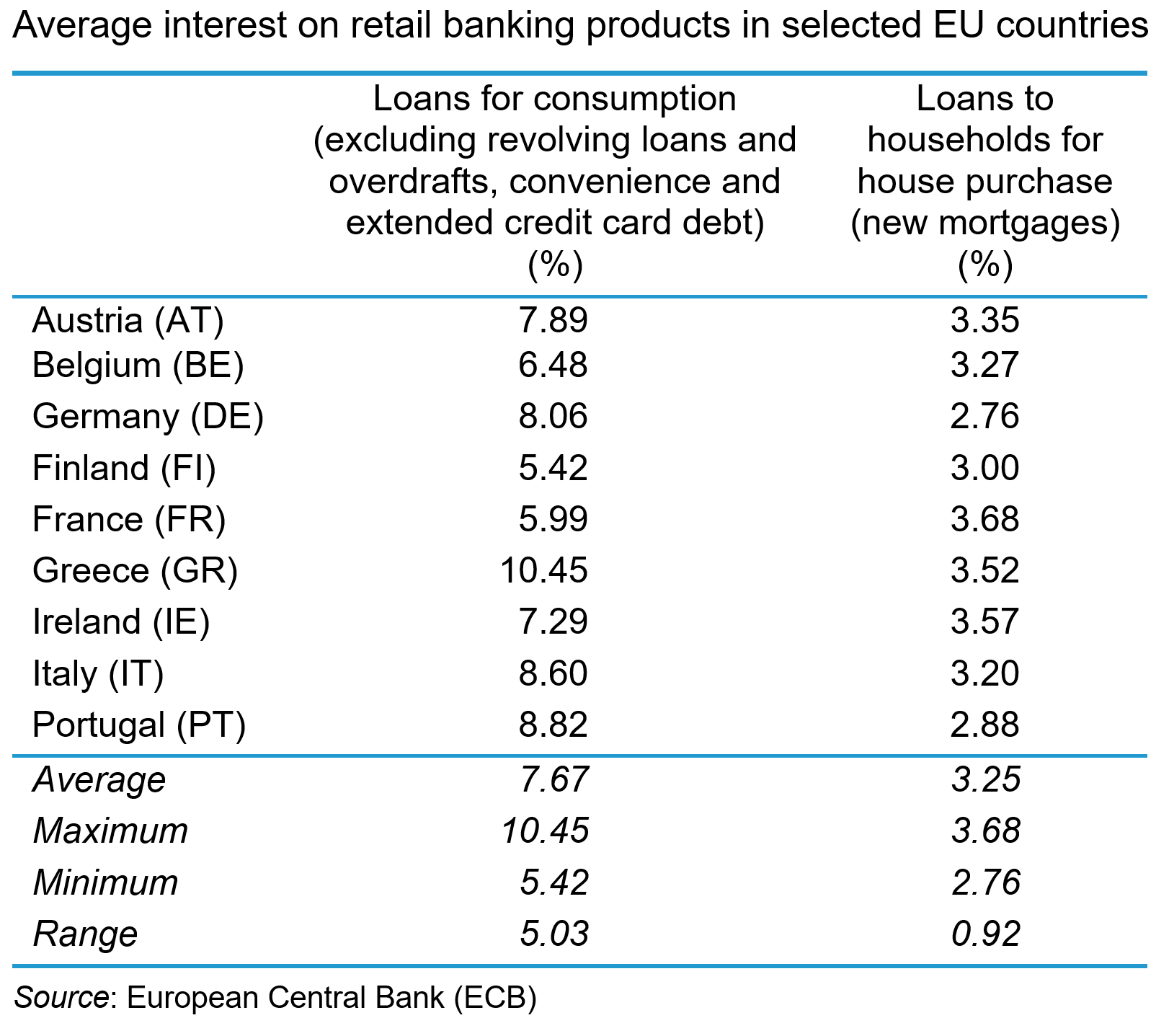
The data show a range of average interest rates offered across the countries with a range of 5.03% for loans to households and 0.92% for new mortgages. These price differentials reflect a broad array of factors, not least the different institutional legal and risk characteristics of the national markets. They also reflect varying degrees of competition and the lack of cross-border trade in retail banking products. Retail banking remains a largely domestic industry within the EU. Cross-border banking services remain a marginal activity with non-domestic retail deposits rising by just 0.5% and non-domestic retail loans rising by just 0.3% between 2016 and 2024.
There are both natural and policy-induced barriers, which means that retail banking will remain largely segmented by nation.
 On the demand-side, retail banking is largely a relational rather than a transactional service, with consumption taking place over a long time-period with significant financial risks attached. Even with deposit insurance and a lender of last resort (the central bank), consumers exhibit significant loss aversion in their use of retail banking services. Consequently, trust and confidence are important characteristics for consumers and that means they are likely to prefer to use familiar domestic institutions.
Further, perceptions about switching costs mean that consumers are reluctant to change suppliers. Such costs are exacerbated by language, cultural and legal differences between European countries, which can make the perceived costs of banking beyond national boundaries prohibitively expensive and create a preference for local institutions.
Consumer preferences can also create idiosyncratic market structures for retail banking services in particular countries. For instance, in several countries across the EU, notably Germany, mutualised credit unions account for significant shares of retail banking. This may limit the potential for foreign banks to penetrate Europe’s largest market.
There are also policy-induced obstacles to cross-border retail banking which operate on the demand-side. These include discriminatory tax treatment of foreign financial services which deters their purchase by consumers. Further, there are still eight different currencies used in the EU across the 27 member states (Denmark, Poland and Sweden are three significant examples). This creates costs and risks associated with currency exchange for consumers that may deter their use of cross-border deposits and loans. The full adoption of a single currency across the EU seems a long way off, which will limit the potential for a single banking market, particularly in the retail segment.
Retail banking as a public utility
 Some argue that retail banking is a public utility and should be regulated as such. It has a simple business model, taking deposits, making payments and making loans. Like other utilities, such as water and energy, retail banking is an essential service for the smooth functioning of the economy and society. Like other utilities, bank failures create severe problems for the economy and society.
Since the financial crisis, stability in retail banking has been much more highly valued. In the period preceding the crisis, banks had used retail deposits to cross-subsidise their risky investment banking. The bank failures that resulted from this had severe economic consequences. The danger today is that by relaxing capital and liquidity restrictions too much, large banks may once again engage in risky behaviour, subsidised by retail banking – for example, by engaging in cross-border M&As. These may benefit their shareholders but provide little benefit to retail customers.
Further, allowing these large banks freedom to move funds around the bloc may lead to capital being concentrated in the most profitable markets, leaving less profitable markets / countries underserved. Retail banking, as a public utility, should be required to provide services there.
Who ultimately benefits?
The integration of banking services in the EU has progressed since the financial crisis, producing a more resilient system. However, there are features of retail banking which mean that integration which benefits consumers may be difficult to achieve.
Addressing the policy gaps identified by the AFME report may benefit large European banks by facilitating the scale economies to make them competitive internationally. However, until consumers are prepared, or able, to source banking services beyond national borders, they will see little benefit from European Banking Union (EBU) through lower prices and/or better service. The nature of retail banking in the EU suggests that this is unlikely any time soon.
Furthermore, since retail banking exhibits features of a public utility, regulators need to be wary of permitting the type of behaviour by large institutions which creates dangerous systemic risk. The worry is that, in the drive to create ‘European Champions’ in banking, regulators ignore the potential impact on retail customers.
Articles
Book
Report
Data and Information
Questions
- Using an average cost (AC) schedule, illustrate the efficiency benefits for large European banks from banking union.
- Analyse the sources of efficiency gains that European banks can gain from cross-border M&As.
- Explain how European retail banking customers could gain from such efficiency.
- Analyse why they may not.
- Analyse whether retail banking in Europe needs to be regulated as a public utility.
 Central bankers, policymakers, academics and economists met at the Economic Symposium at Jackson Hole, Wyoming from August 24–26. This annual conference, hosted by Kansas City Fed, gives them a chance to discuss current economic issues and the best policy responses. The theme this year was ‘Structural Shifts in the Global Economy’ and one of the issues discussed was whether, in the light of such shifts, central banks’ 2 per cent inflation targets are still appropriate.
Inflation has been slowing in most countries, but is still above the 2 peer cent target. In the USA, CPI inflation came down from a peak of 9.1% in June 2022 to 3.2% in July 2023. Core inflation, however, which excludes food and energy was 4.7%. At the symposium, in his keynote address the Fed Chair, Jay Powell, warned that despite 11 rises in interest rates since April 2022 (from 0%–0.25% to 5%–5.25%) having helped to bring inflation down, inflation was still too high and that further rises in interest rates could not be ruled out.
We are prepared to raise rates further if appropriate, and intend to hold policy at a restrictive level until we are confident that inflation is moving sustainably down toward our objective.
However, he did recognise the need to move cautiously in terms of any further rises in interest rates as “Doing too much could also do unnecessary harm to the economy.” But, despite the rises in interest rates, growth has remained strong in the USA. The annual growth rate in real GDP was 2.4% in the second quarter of 2023. Unemployment, at 3.5%, is low by historical standards and similar to the rate before the Fed began raising interest rates.
Raising the target rate of inflation?
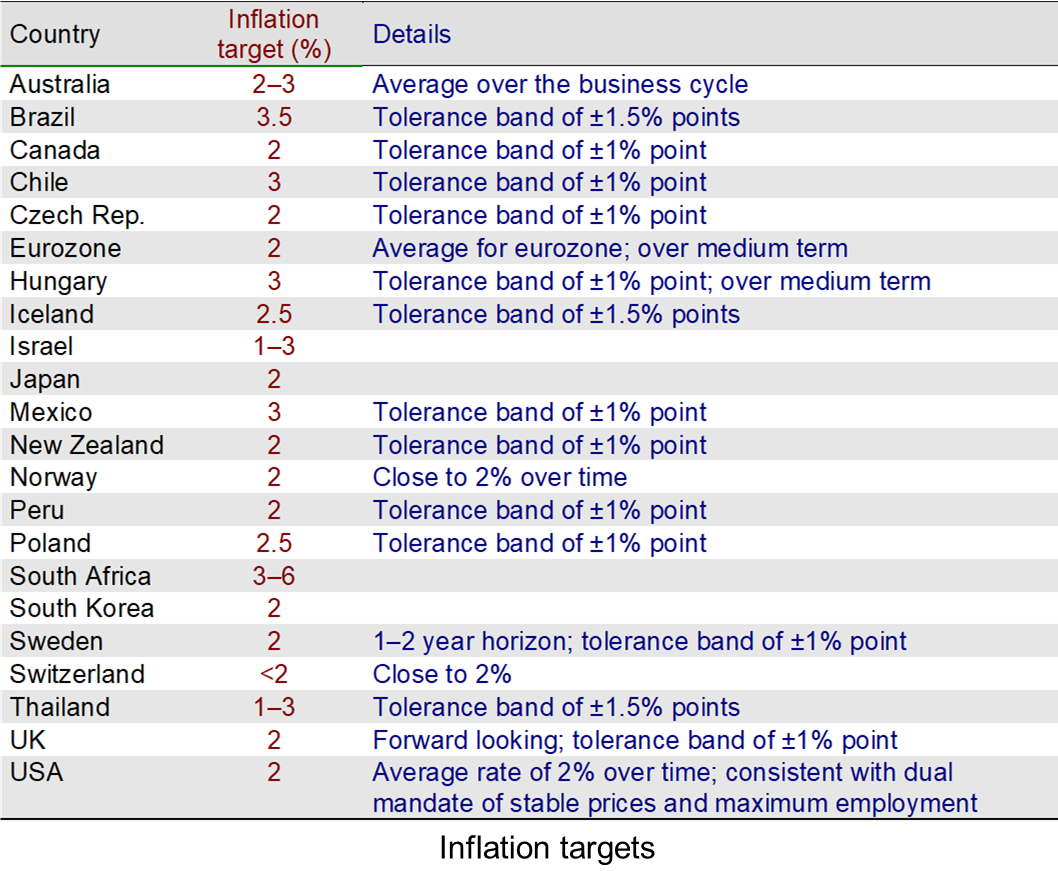 Some economists and politicians have advocated raising the target rate of inflation from 2 per cent to, perhaps, 3 per cent. Jason Furman, an economic policy professor at Harvard and formerly chief economic advisor to President Barack Obama, argues that a higher target has the benefit of helping cushion the economy against severe recessions, especially important when such there have been adverse supply shocks, such as the supply-chain issues following the COVID lockdowns and then the war in Ukraine. A higher inflation rate may encourage more borrowing for investment as the real capital sum will be eroded more quickly. Some countries do indeed have higher inflation targets, as the table shows.
Powell emphatically ruled out any adjustment to the target rate. His views were expanded upon by Christine Lagarde, the head of the European Central Bank. She argued that in a world of greater supply shocks (such as from climate change), greater frictions in markets and greater inelasticity in supply, and hence greater price fluctuations, it is important for wage increases not to chase price increases. Increasing the target rate of inflation would anchor inflationary expectations at a higher level and hence would be self-defeating. Inflation in the eurozone, as in the USA, is falling – it halved from a peak of 10.6% in 2022 to 5.3% in July this year. Given this and worries about recession, the ECB may not raise interest rates at its September meeting. However, Lagarde argued that interest rates needed to remain high enough to bring inflation back to target.
The UK position
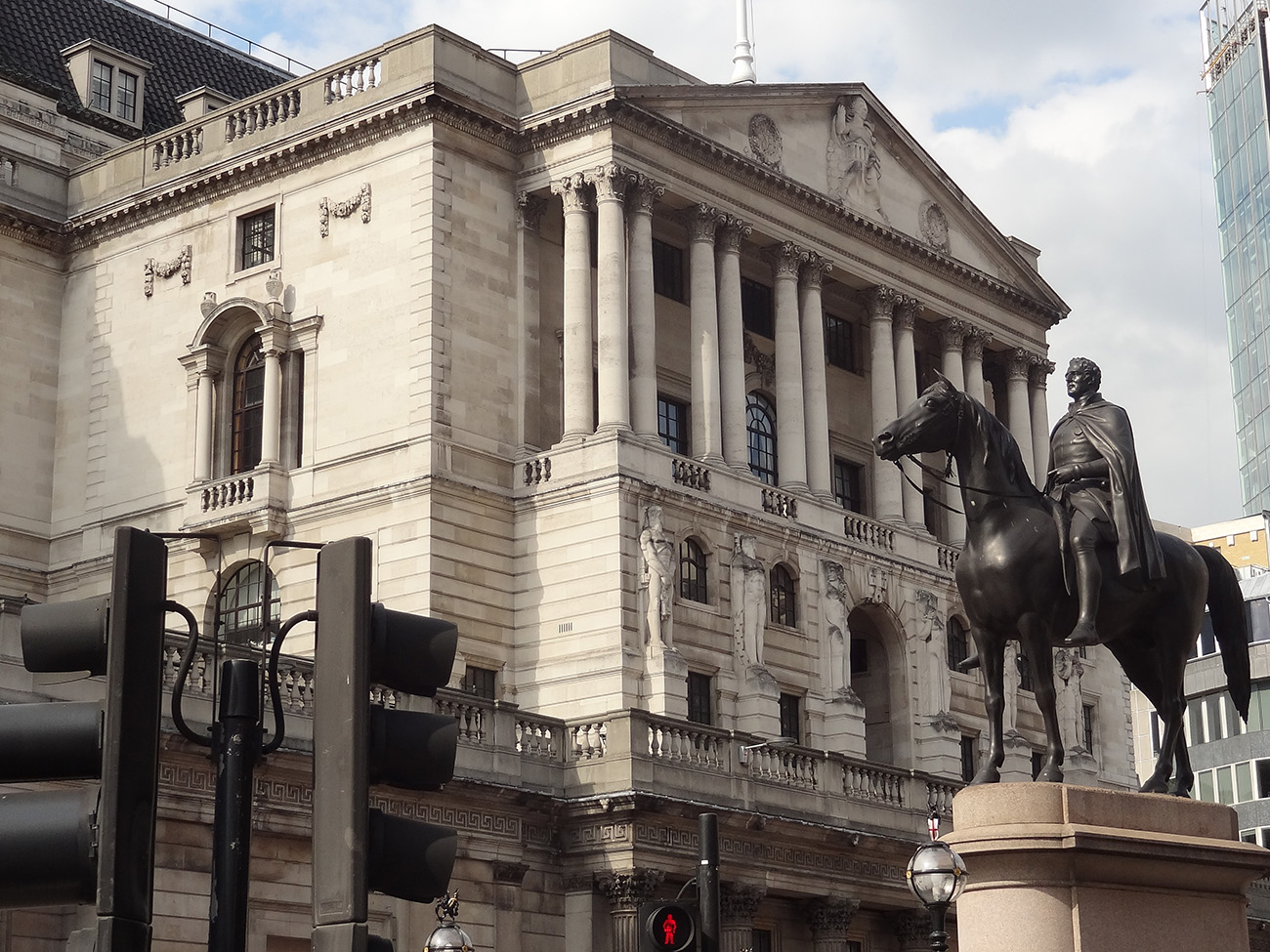 The Bank of England, too, is committed to a 2 per cent inflation target, even though the inflationary problems for the UK economy are greater that for many other countries. Greater shortfalls in wage growth have been more concentrated amongst lower-paid workers and especially in the public health, safety and transport sectors. Making up these shortfalls will slow the rate of inflationary decline; resisting doing so could lead to protracted industrial action with adverse effects on aggregate supply.
Then there is Brexit, which has added costs and bureaucratic procedures to many businesses. As Adam Posen (former member of the MPC) points out in the article linked below:
Even if this government continues to move towards more pragmatic relations with the EU, divergences in standards and regulation will increase costs and decrease availability of various imports, as will the end of various temporary exemptions. The base run rate of inflation will remain higher for some time as a result.
Then there is a persistent problem of low investment and productivity growth in the UK. This restriction on the supply side will make it difficult to bring inflation down, especially if workers attempt to achieve pay increases that match cost-of-living increases.
Sticking to the status quo
There seems little appetite among central bankers to adjust inflation targets. Squeezing inflation out of their respective economies is painful when inflation originates largely on the supply side and hence the problem is how to reduce demand and real incomes below what they would otherwise have been.
Raising inflation targets, they argue, would not address this fundamental problem and would probably simply anchor inflationary expectations at the higher level, leaving real incomes unchanged. Only if such policies led to a rise in investment would a higher target be justified and central bankers do not believe that it would.
Articles
- What happens in Jackson Hole doesn’t stay in Jackson Hole
CNN, Elisabeth Buchwald (26/8/23)
- Fed Chair Powell calls inflation ‘too high’ and warns that ‘we are prepared to raise rates further’
CNBC, Jeff Cox (25/8/23)
- Inflation? This man holds the key
Politico, Geoffrey Smith and Carlo Boffa (24/8/23)
- Global inflation pressures could become harder to manage in coming years, research suggests
Independent, Christopher Rugaber (27/8/23)
- Christine Lagarde warns of long-term inflation risks after global economic upheaval
Financial Times, Martin Arnold and Colby Smith (25/8/23)
- No appetite at Fed, ECB for changing inflation goal
Reuters, Ann Saphir, Howard Schneider and Balazs Koryani (25/8/23)
- Is it time for Fed to raise interest rate target to 3%? Experts weigh in
mint, Nishant Kumar (22/8/23)
- What is the UK inflation rate and why is it so high?
BBC News (16/8/23)
- If you think the UK’s high-inflation cycle has run its course, think again
The Observer, Adam Posen (26/8/23)
Data
Questions
- Use an aggregate demand and supply diagram (AD/AS or DAD/DAS) to illustrate inflation since the opening up of economies after the COVID lockdowns. Use another one to illustrate the the effects of central banks raising interest rates?
- Why is the world likely to continue experiencing bigger supply shocks and greater price volatility than before the pandemic?
- With hindsight, was increasing narrow money after the financial crisis and then during the pandemic excessive? Would it have been better to have used the extra money to fund government spending on infrastructure rather than purchasing assets such as bonds in the secondary market?
- What are the arguments for and against increasing the target rate of inflation?
- How do inflationary expectations influence the actual rate of inflation?
- Consider the arguments for and against the government matching pay increases for public-sector workers to the cost of living.
In the current environment of low inflation and rising unemployment, the Federal Reserve Bank, the USA’s central bank, has amended its monetary targets. The new measures were announced by the Fed chair, Jay Powell, in a speech for the annual Jackson Hole central bankers’ symposium (this year conducted online on August 27 and 28). The symposium was an opportunity for central bankers to reflect on their responses to the coronavirus pandemic and to consider what changes might need to be made to their monetary policy targets and instruments.
The Fed’s previous targets
Previously, like most other central banks, the Fed had a long-run inflation target of 2%. It did, however, also seek to ‘maximise employment’. In practice, this meant seeking to achieve a ‘normal’ rate of unemployment, which the Fed regards as ranging from 3.5 to 4.7% with a median value of 4.1%. The description of its objectives stated that:
In setting monetary policy, the Committee seeks to mitigate deviations of inflation from its longer-run goal and deviations of employment from the Committee’s assessments of its maximum level. These objectives are generally complementary. However, under circumstances in which the Committee judges that the objectives are not complementary, it follows a balanced approach in promoting them, taking into account the magnitude of the deviations and the potentially different time horizons over which employment and inflation are projected to return to levels judged consistent with its mandate.
The new targets
 Under the new system, the Fed has softened its inflation target. It will still be 2% over the longer term, but it will be regarded as an average, rather than a firm target. The Fed will be willing to see inflation above 2% for longer than previously before raising interest rates if this is felt necessary for the economy to recover and to achieve its long-run potential economic growth rate. Fed chair, Jay Powell, in a speech on 27 August said:
Following periods when inflation has been running below 2%, appropriate monetary policy will likely aim to achieve inflation moderately above 2 per cent for some time.
Additionally, the Fed has increased its emphasis on employment. Instead of focusing on deviations from normal employment, the Fed will now focus on the shortfall of employment from its normal level and not be concerned if employment temporarily exceeds its normal level. As Powell said:
Going forward, employment can run at or above real-time estimates of its maximum level without causing concern, unless accompanied by signs of unwanted increases in inflation or the emergence of other risks that could impede the attainment of our goals
 The Fed will also take account of the distribution of employment and pay more attention to achieving a strong labour market in low-income and disadvantaged communities. However, apart from the benefits to such communities from a generally strong labour market, it is not clear how the Fed could focus on disadvantaged communities through the instruments it has at its disposal – interest rate changes and quantitative easing.
Assessment
Modern monetary theorists (see blog MMT – a Magic Money Tree or Modern Monetary Theory?) will welcome the changes, arguing that they will allow more aggressive expansion and higher government borrowing at ultra-low interest rates.
The problem for the Fed is that it is attempting to achieve more aggressive goals without having any more than the two monetary instruments it currently has – lowering interest rates and increasing money supply through asset purchases (quantitative easing). Interest rates are already near rock bottom and further quantitative easing may continue to inflate asset prices (such as share and property prices) without sufficiently stimulating aggregate demand. Changing targets without changing the means of achieving them is likely to be unsuccessful.
It remains to be seen whether the Fed will move to funding government borrowing directly, which could allow for a huge stimulus through infrastructure spending, or whether it will merely stick to using asset purchases as a way for introducing new money into the system.
Articles
- In landmark shift, Fed rewrites approach to inflation, labor market
Reuters, Jonnelle Marte, Ann Saphir and Howard Schneider (27/8/20)
- 5 Key Takeaways From Powell’s Jackson Hole Fed Speech
Bloomberg, Mohamed A. El-Erian (28/8/20)
- Fed adopts new strategy to allow higher inflation and welcome strong labor markets
Market Watch, Greg Robb (27/8/20)
- Fed to tolerate higher inflation in policy shift
Financial Times, James Politi and Colby Smith (27/8/20)
- Fed inflation shift raises questions about past rate rises
Financial Times, James Politi and Colby Smith (28/8/20)
- Dollar slides as bond market signals rising inflation angst
Financial Times, Adam Samson and Colby Smith (28/8/20)
- Wall Street shares rise after Fed announces soft approach to inflation
The Guardian, Larry Elliott (27/8/20)
- How the Fed Is Bringing an Inflation Debate to a Boil
Bloomberg, Ben Holland, Enda Curran, Vivien Lou Chen and Kyoungwha Kim (27/8/20)
- The live now, pay later economy comes at a heavy cost for us all
The Guardian, Phillip Inman (29/8/20)
- The world’s central banks are starting to experiment. But what comes next?
The Guardian, Adam Tooze (9/9/20)
Speeches
Questions
- Find out how much asset purchases by the Fed, the Bank of England and the ECB have increased in the current rounds of quantitative easing.
- How do asset purchases affect narrow money, broad money and aggregate demand? Is there a fixed money multiplier effect between the narrow money increases and aggregate demand? Explain.
- Why did the dollar exchange rate fall following the announcement of the new measures by Jay Powell?
- The Governor of the Bank of England, Andrew Bailey, also gave a speech at the Jackson Hole symposium. How does the approach to money policy outlined by Bailey differ from that outlined by Jay Powell?
- What practical steps, if any, could a central bank take to improve the relative employment prospects of disadvantaged groups?
- Outline the arguments for and against central banks directly funding government expenditure through money creation.
- What longer-term problems are likely to arise from central banks pursuing ultra-low interest rates for an extended period of time?
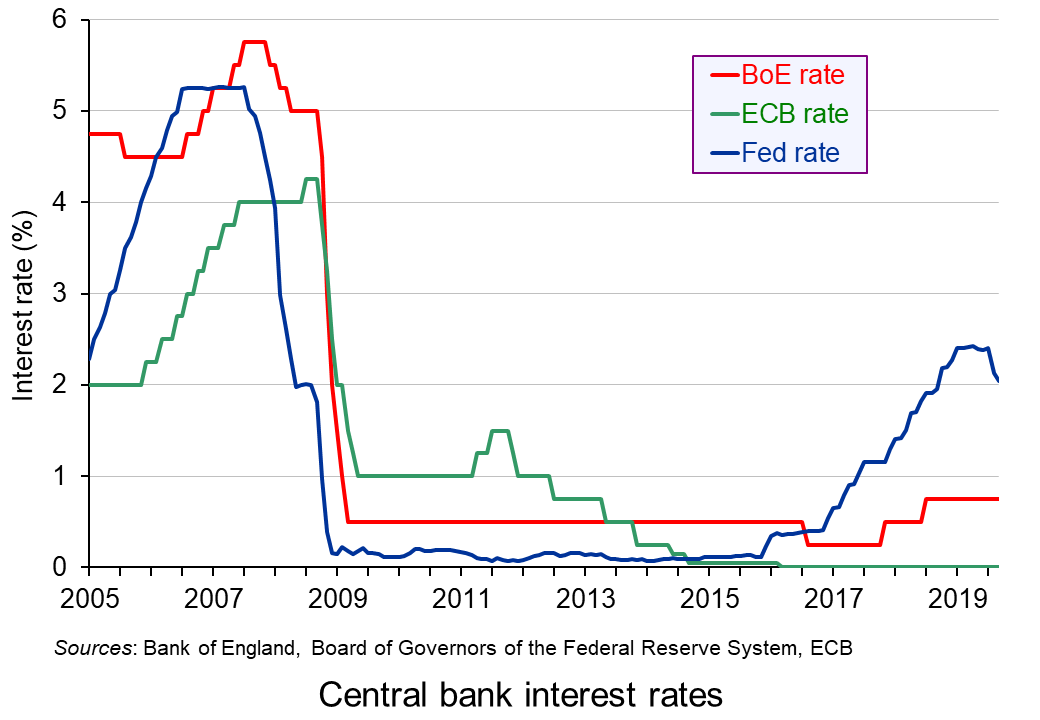
 With the prospects of weaker global economic growth and continuing worries about trade wars, central banks have been loosening monetary policy. The US central bank, the Federal Reserve, lowered its target Federal Funds rate in both July and September. Each time it reduced the rate by a quarter of a percentage point, so that it now stands at between 1.75% and 2%.
The ECB has also cut rates. In September it reduced the overnight deposit rate for banks from –0.4% to –0.5%, leaving the main rate at 0%. It also introduced a further round of quantitative easing, with asset purchases of €20 billion per month from 1 November and lasting until the ECB starts raising interest rates.
The Australian Reserve Bank has cut its ‘cash rate‘ three times this year and it now stands at an historically low level of 0.75%. Analysts are predicting that it may be forced to introduce quantitative easing if lower interest rates fail to stimulate growth.
Japan continues with its programme of quantitative easing (QE) and other central banks are considering lowering interest rates and/or (further) QE.
 But there are two key issues with looser monetary policy.
The first is whether it will be sufficient to provide the desired stimulus. With interest rates already at or near historic lows (although slightly above in the case of the USA), there is little scope for further reductions. QE may help, but without a rise in confidence, the main effect of the extra money may simply be a rise in the price of assets, such as property and shares. It may result in very little extra spending on consumption and investment – in other words, very little extra aggregate demand.
The second is the effect on inequality. By inflating asset prices, QE rewards asset owners. The wealthier people are, the more they will gain.
Many economists and commentators are thus calling for the looser monetary policy to be backed up by expansionary fiscal policy. The boost to aggregate demand, they argue, should come from higher public spending, with governments able to borrow at very low interest rates because of the loose monetary policy. Targeted spending on infrastructure would have a supply-side benefit as well as a demand-side one.
Articles
- European Central Bank cuts its deposit rate, launches new bond-buying program
CNBC, Elliot Smith (12/9/19)
- Can monetary policies help prevent a global recession?
Investment Week, Martin Gilbert (7/10/19)
- Draghi’s Utmost Is Still Not Enough
Bloomberg, John Authers (13/9/19)
- Draghi puts heat on politicians to boost fiscal stimulus with his ECB swan song
MarketWatch, William Watts (12/9/19)
- To infinity and beyond: ECB’s quantitative easing
EJ Insight, Raphael Olszyna-Marzys (2/10/19)
- The dangers of negative interest rates
Money Week, Merryn Somerset Webb (7/10/19)
- Schwarzman: Europe could enter Japan-style stagnation if governments don’t start spending
CNBC, Elliot Smith (7/10/19)
- US Fed cuts interest rates for second time since 2008
BBC News, Andrew Walker (18/9/19)
- Current Federal Reserve Interest Rates and Why They Change
The Balance, Kimberly Amadeo (19/9/19)
- Federal Reserve Interest Rate Cuts Alone Can’t Prevent a Recession
Barron’s, Al Root (4/10/19)
- Why is the Fed pumping money into the banking system?
BBC News, Natalie Sherman (19/9/19)
- Top of Lagarde’s ECB to-do list: stop QE and democratise monetary policy
Social Europe, Jens van’t Klooster (25/9/19)
- Economists warn Reserve Bank could be forced to print money if rate cuts fail to deliver
The Guardian, Martin Farrer (2/10/19)
- A very large gamble: evidence on Quantitative Easing in the US and UK
Institute for Policy Research. Policy Brief, Chris Martin and Costas Milas
- The verdict on 10 years of quantitative easing
The Guardian, Richard Partington (8/3/19)
ECB Press Conference
Questions
- Explain what is meant by quantitative easing.
- What determines the effectiveness of quantitative easing?
- Why is President Trump keen for the Federal Reserve to pursue more aggressive interest rate cuts?
- What is the Bank of England’s current attitude towards changing interest rates and/or further quantitative easing?
- What are the current advantages and disadvantages of governments pursuing a more expansionary fiscal policy?
- Compare the relative merits of quantitative easing through asset purchases and the use of ‘helicopter money’.
 US hikes interest rates as fears grow of global oil shock over Iran War