Controlling inflation with higher interest rates – a blunt instrument?

Inflation has been rising around the world. The main reason has been the supply shock of rising oil, fertiliser and commodity prices caused by the Iran war and the disruption to global supply chains from conflicts in the Middle East and Russia (see the blog, Why have diesel prices risen more than petrol prices?). Central banks, including the US Federal Reserve Bank, the European Central Bank and the Bank of Japan, have responded to this cost-push inflationary shock by raising interest rates. The Bank of England is likely to raise Bank rate at its next meeting on 5 November 2026.
Similar supply shocks have been experienced in recent years (see the May 2026 blog, Supply shocks – long-term gain from the short-term pain?).
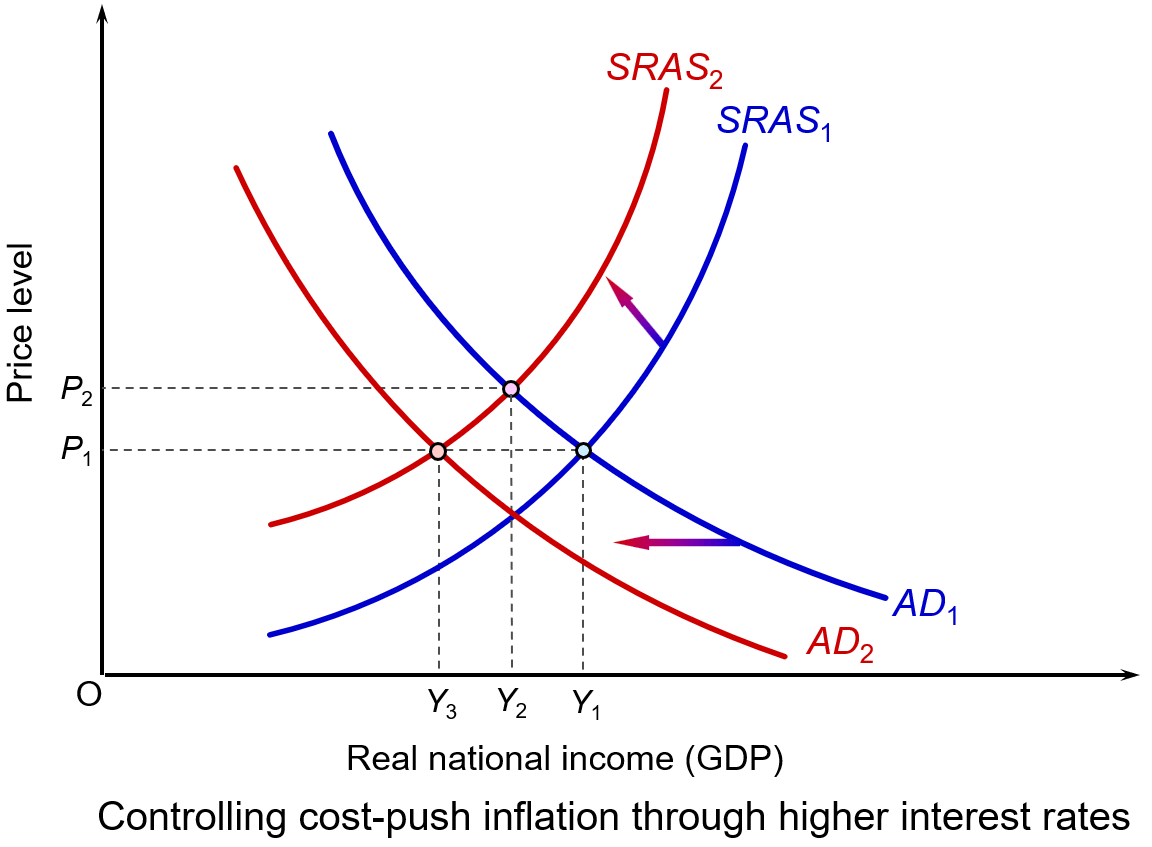 Raising interest rates reduces aggregate demand, or at least its rate of growth. This puts downward pressure on prices, or at least on the rate of inflation. This can be illustrated in the diagram. (Click here for a PowerPoint.)
It shows a country’s initial short-run aggregate supply curve (SRAS1) and initial aggregate demand curve (AD1). The price index is P1 and real GDP is Y1.
The higher costs shift the SRAS curve upwards to the left, say to SRAS2. The price index rises to P2 and real GDP falls to Y2. If, in response to the higher prices, the central bank raises the interest rate, this shifts the aggregate demand curve to the left, say to AD2. As a result, the price index falls back to P1, but the fall in demand causes real GDP to fall further, to Y3.
Policy alternatives
 So, is a rise in interest rates the appropriate response to higher costs that push inflation above, or further above, its target, which for most countries is 2%?
If the cause of inflation was excessive increases in aggregate demand from, say, large government budget deficits or a large increase in consumer demand, then a rise in interest rates would have helped reduce this unsustainable rise in demand. But if the cause of the inflation is a supply shock, is curbing aggregate demand the correct solution?
Ideally, the solution would be to tackle the cost increases directly. A rise in productivity, for example, would help to increase aggregate supply and counter the effect of rising commodity prices. But productivity increases take place over the longer term and are not a solution to a short-term supply shock. Better still, if the increase in commodity prices could be reversed, by finding a political solution that reopened the Strait of Hormuz and other choke points, then higher interest rates would not be needed.
Alternatively, some countries might be able to resort to price controls. These could be targeted at specific sectors such as energy, rent or construction. For example, the UK government has used energy price caps to limit household energy bills.
But even though this may control inflation in the short term, price controls create shortages because demand exceeds the reduced supply. This could lead to higher prices in unofficial markets as people sought to avoid the price controls. It could also create considerable problems for firms planning their logistics when supplies may simply not be available.
Alternatively, subsidies could be used to support output or prices in similar areas. Or they could be targeted at low-income households. These, however, could be costly for governments and may distort markets.
If price controls and subsidies are rejected, and in the absence of short-term increases in aggregate supply, the only solution to inflation is curbing aggregate demand to match the reduced aggregate supply. This could be achieved through fiscal policy by raising taxes or reducing government expenditure, but would prove unpopular and would probably be rejected by governments. Generally, they would prefer to pass the burden to central banks through the use of monetary policy.
The blunt instrument of monetary policy
But, raising interest rates is, indeed, a blunt instrument. Tighter monetary policy cannot increase the global supply of fuel, fix broken supply chains or lower insurance and construction costs. In other words, it cannot directly fix supply shocks, only limit their effect on prices.
 Also, by making borrowing more expensive, higher interest rates may suppress business investment and house building. This adverse supply-side effect may worsen inflation over the longer term.
The hope is that such effects will be avoided by suppressing inflation and helping thereby to maintain business confidence. It is a delicate balancing act for central bankers, who want to constrain inflation but do not want to plunge their economies into recession and damage longer-term increases in potential real GDP.
Most of all, the hope is that by suppressing nominal demand, second-round effects will be avoided. These are where higher prices encourage workers to demand higher wages to compensate for higher prices and businesses to raise prices to cover those wage increases, knowing that they can pass these price increases on to consumers as their competitors are doing the same. This risks creating a damaging wage-price spiral and embedding inflation. By raising interest rates and signalling that they will bring inflation back down to the target rate, central banks hope to anchor long-term inflation expectations. They hope that this will ensure that temporary price shocks do not become permanently embedded in the economy.
Distributional consequences
 However, the burden of higher interest rates will not be shouldered equally. They predominantly penalise a minority of the population, especially younger households with consumer debt and/or large variable-rate mortgages relative to their income or fixed rate mortgages coming the end of their term and requiring renewing. They also penalise businesses which rely on short-term debt.
Meanwhile, people who own their homes outright or wealthy savers may be largely unaffected or even benefit from higher yields on their savings deposits. Similarly, firms with low debt may hardly be affected.
Consequences for servicing public debt
Higher interest rates increase governments’ debt-servicing costs. More has to be paid on new borrowing, either to finance budget deficits or to replace government bonds and bills that are maturing. This consumes a larger share of public spending and limits the fiscal room to support vulnerable households suffering from the price and interest increases.
We examined such costs in the US context in the blog US national debt reaches $40 trillion: but does it matter?.
Fingers crossed!
By being cautious about raising interest rates, central banks hope that geopolitical developments will be favourable and that the supply constraints will diminish. For example, the hope is that there will be a settlement between the USA and Iran that allows oil to flow once more through the Strait of Hormuz. That is why, despite inflation being well above target, central banks have been raising interest rates by just a quarter of a percentage point.
Articles
- US interest rates raised for first time in three years
- What the Fed interest rate hike likely means for borrowers and savers
- How increasing interest rates could reduce inflation, but potentially cause a recession
- Interest rates held but Bank signals rise if energy prices stay high
- Bank of England defies Fed’s rate-hike lead, leaving rates unchanged
- ECB hikes rates to 2.5% as energy shock pushes eurozone inflation higher
- Japan raises interest rates to 31-year high to curb impact of rising prices
- What exactly is inflation, and are interest rates the only option for dealing with it?
- US consumers and businesses are now facing a future of more expensive borrowing
- Inflation: raising interest rates was never the right medicine – here’s why central bankers did it anyway
- There are three main reasons inflation is rising. Higher rates won’t fix them
- Higher interest rates are meant to lower inflation. US economist John Cochrane says there’s only ‘shaky’ evidence it works
- How Governments Fight Inflation with Monetary Policies
- Interest rates are not the tool to solve the inflation caused by the US’s war with Iran
- Are higher interest rates the only tool for managing inflation?
BBC News, Michael Race (17/9/26)
NBC4 New York, Paul Wiseman (16/9/26)
CNBC, Trina Paul (21/9/26)
BBC News, Dearbail Jordan and Kevin Peachey (17/9/26)
CNBC, Chloe Taylor (17/9/26)
Euronews, Quirino Mealha (10/9/26)
The Guardian, Mark Sweney (18/9/26)
The Conversation, Luke Hartigan (10/2/26)
The Conversation, John W Diamond (16/9/26)
The Conversation, Robert Gausden (20/10/23)
ABC (Australia), Michael Janda (15/9/26)
ABC (Australia), Michael Janda and Alicia Barry(15/3/24)
Investopedia, Leslie Kramer (11/3/26)
The Guardian, Josh Ryan-Collins (18/3/26)
Rethinking Economics, Tim Thornton (3/8/23)
Videos
 US hikes interest rates as fears grow of global oil shock over Iran War
- Bank of England issues energy bill warning
- Why borrowing costs are rising worldwide
- US Fed defies Trump, raising benchmark interest rate for 1st time in 3 years
- US Federal Reserve defies Trump with interest rate hike
- US Federal Reserve announces first interest rate hike since 2023
BBC News on YouTube, Dharshini David, Sarah Smith and Chris Mason (17/9/26)
Sky News on YouTube, Ed Conway (18/9/26)
Sky News on YouTube, Ed Conway (2/9/26)
Global News on YouTube (17/9/26)
France24 on YouTube, Kate Moody (17/9/26) (first 2’15”)
DW News on YouTube, Akin Oyedele (17/9/26)
Information
- How can interest rates control inflation?
- How do higher interest rates help to lower inflation?
- What is happening with interest rates in the UK?
LSE blogs, Ethan Ilzetzki (11/7/22)
Bank of England (11/5/23)
Bank of England (17/9/26)
Questions
- What policies have central banks pursued during the Iran war?
- Paint an optimistic scenario for the global economy five years hence.
- Paint a pessimistic scenario for the global economy five years hence.
- Compare the reasons given by the Federal Reserve and ECB for raising interest rates with those given by the Bank of England for not raising them.
- Donald Trump argues for cutting interest rates as a stimulus to the US economy. Provide a critique of this policy.