 An earlier post on this site described a recent row between Tesco and Unilever that erupted when Unilever attempted to raise the prices it charges Tesco for its products. Unilever justified this because its costs have increased as a result of the UK currency depreciation following the Brexit decision.
It also appears that more general concerns that the fall in the value of sterling would lead to higher retail prices were prevalent around the time that the Tesco Unilever dispute came to light. Former Sainsbury’s boss, Justin King, made clear that British shoppers should be prepared for higher prices. He also said that:
Retailers’ margins are already squeezed. So there is no room to absorb input price pressures and costs will need to be passed on. But no one wants to be the first to break cover. No business wants to be the first to blame Brexit for a rise in prices. But once someone does, there will be a flood of companies because they will all be suffering.
It is interesting to consider further why the Tesco and Unilever case was the first to make the headlines and why their dispute was resolved so quickly. In addition, what are the more general implications for the retail prices consumers will have to pay?
Arguably, Unilever saw itself as having a strong hand in negotiations with Tesco because its product portfolio includes a wide variety of must-stock brands, including Pot Noodles, Marmite and Persil, that are found in 98% of UK households..
Unilever has been criticised for using the currency devaluation as an excuse to justify charging Tesco more, since most of its products are made in the UK. However, Unilever was quick to point outthat commodities it uses in the manufacture of products are priced in US dollars, so the currency devaluation can still affect the cost of products that it manufactures in the UK. In addition, Unilever’s chief financial officer, Graeme Pitkethly, insisted that price increases due to rising costs were a normal part of doing business:
We are taking price increases in the UK. That is a normal devaluation-led cycle.
On the other hand, even if the cost increases faced by Unilever are genuine, it is interesting to speculate whether it would have been so quick to adjust its prices downwards in response to a currency appreciation. After all, a commonly observed phenomenon across a range of markets is ‘rockets and feathers’ pricing behaviour i.e. prices going up from a cost increase more quickly than they go down following an equivalent cost decrease.
Compared to Unilever, some other suppliers are likely to have less bargaining power – in particular, those competing in highly fragmented markets and those producing less branded products. In such markets the suppliers may be forced to accept cost increases. For example, almost 50% of butter and cheese consumed in the UK comes from milk sourced from EU markets. Protecting such suppliers is one of the key roles of the Grocery code of conduct that the UK competition agency has put in place.
From Tesco’s point of view it will have benefited from good publicity by doing its best to protect consumers from price hikes. Helen Dickinson, chief executive of the British Retail Consortium, said:
Retailers are firmly on the side of consumers in negotiating with suppliers and improving efficiencies in the supply chain to control the inflationary pressure that is building through the devaluation of the pound.
However, it is also clear that Tesco had its own motives for resisting increased costs for Unilever’s products. In such situations both supplier and retailer should be keen to avoid a situation where they both impose their own substantial mark-ups at each stage of the supply chain. It is well established that this creates a double mark-up and not only harms consumers, but also the supplier and retailer themselves. Instead, the firms have an incentive to use more complex contractual arrangements to solve the problem. For example, suppliers may pay slotting allowances to get a place on the retailers’ shelves in exchange for lower retail mark-ups.
 It has also been claimed that cutthroat competition in the supermarket industry, especially from discounter retailers Aldi and Lidl, made Tesco particularly keen to prevent price rises. Some arguments suggest that these discounters will be best placed to benefit from the currency devaluation as they sell more own brands, have a limited range, the leanest supply chains and benefit from substantial economies of scale. On the other hand, they source more of their products from abroad and it has been suggested that:
A fall in sterling will push prices up for everyone who sources products from Europe, but Aldi and Lidl will be affected more than most.
One prediction suggests that the overall impact of the currency depreciation on food prices will be an increase of around 3%. This may be particularly worrisome given concerns that the impact will fall most heavily on benefit claimants and other low-income households.
Outside of the food industry, Mike Rake, the chairman of BT, has highlighted the fact that:
Imported mobile phones and broadband home hubs were already 10% more expensive and the cost would have to be passed on to consumers in the near future.
It is therefore clear that the currency devaluation has the potential to create substantial tensions in the supply-chain agreements across a range of markets. The impact on the firms involved and on consumers will depend upon a wide range of factors, including the competitiveness of the markets, the nature of the firms involved and their bargaining power. Furthermore, evidence from an earlier currency depreciation in Latin America makes clear that the price elasticity of demand will be another factor that determines the impact price rises have.
Finally, it is also worth noting that a potential flip side of the currency depreciation is a boost for UK exports. However, it has been suggested that the manufacturing potential to take advantage of this in the UK is limited. In addition, even the manufacturing that does take place, for example in the car industry, often relies on components imported from abroad.
Articles
The Brexiteers’ Marmite conspiracy theories exposed their utter ignorance of how markets really work Independent, Ben Chu (16/10/16)
Tesco price dispute sends Unilever brand perceptions tumbling Marketing Week, Leonie Roderick (17/10/16)
Unilever and Tesco both benefit from their price row, but Brexit will bring more pain Marketing Week, Mark Ritson (19/10/16)
Why the Tesco v Unilever feud was good for British business campaign, Helen Edwards (20/10/16)
Questions
- What are some of the factors that affect a supplier’s bargaining power?
- How might the discount retailers respond to the currency devaluation?
- Use the figures from Latin America in the article cited above to calculate the price elasticity of demand.
- Explain why the price elasticity of demand is an important determinant of the effect of a price rise.
- Can you think of other examples of markets that may be particularly prone to price rises following a currency depreciation?
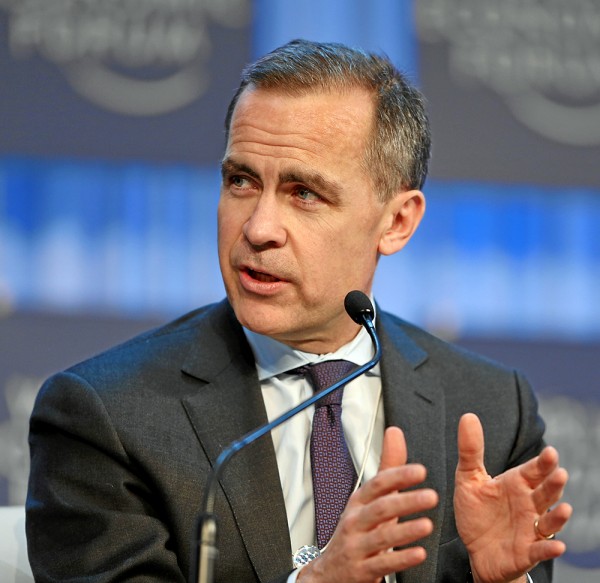
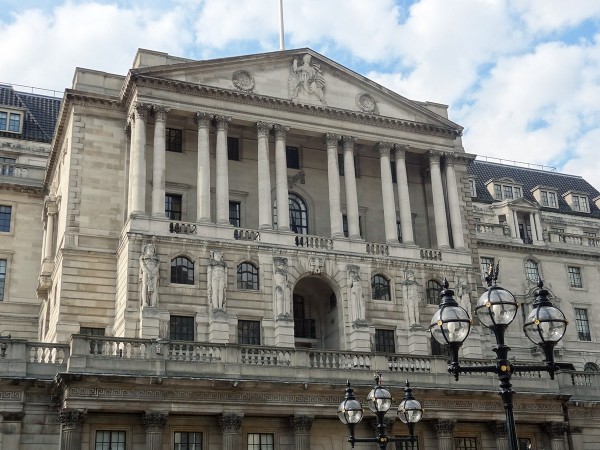 The Bank of England’s monetary policy is aimed at achieving an inflation rate of 2% CPI inflation ‘within a reasonable time period’, typically within 24 months. But speaking in Nottingham in one of the ‘Future Forum‘ events on 14 October, the Bank’s Governor, Mark Carney, said that the Bank would be willing to accept inflation above the target in order to protect growth in the economy.
“We’re willing to tolerate a bit of an overshoot in inflation over the course of the next few years in order to avoid rising unemployment, to cushion the blow and make sure the economy can adjust as well as possible.”
But why should the Bank be willing to relax its target – a target set by the government? In practice, a temporary rise above 2% can still be consistent with the target if inflation is predicted to return to 2% within ‘a reasonable time period’.
 But if even if the forecast rate of inflation were above 2% in two years’ time, there would still be some logic in the Bank not tightening monetary policy – by raising Bank Rate or ending, or even reversing, quantitative easing. This would be the case when there was, or forecast to be, stagflation, whether actual or as a result of monetary policy.
The aim of an inflation target of 2% is to help create a growth in aggregate demand consistent with the economy operating with a zero output gap: i.e. with no excess or deficient demand. But when inflation is caused by rising costs, such as that caused by a depreciation in the exchange rate, inflation could still rise even though the output gap were negative.
A rise in interest rates in these circumstances could cause the negative output gap to widen. The economy could slip into stagflation: rising prices and falling output. Hopefully, if the exchange rate stopped falling, inflation would fall back once the effects of the lower exchange rate had fed through. But that might take longer than 24 months or a ‘reasonable period of time’.
 So even if not raising interest rates in a situation of stagflation where the inflation rate is forecast to be above 2% in 24 months’ time is not in the ‘letter’ of the policy, it is within the ‘spirit’.
But what of exchange rates? Mark Carney also said that “Our job is not to target the exchange rate, our job is to target inflation. But that doesn’t mean we’re indifferent to the level of sterling. It does matter, ultimately, for inflation and over the course of two to three years out. So it matters to the conduct of monetary policy.”
But not tightening monetary policy if inflation is forecast to go above 2% could cause the exchange rate to fall further. It seems as if trying to arrest the fall in sterling and prevent a fall into recession are conflicting aims when the policy instrument for both is the rate of interest.
Articles
BoE’s Carney says not indifferent to sterling level, boosts pound Reuters, Andy Bruce and Peter Hobson (14/10/16)
Bank governor Mark Carney says inflation will rise BBC News, Kamal Ahmed (14/10/16)
Stagflation Risk May Mean Carney Has Little Love for Marmite Bloomberg, Simon Kennedy (14/10/16)
Bank can ‘let inflation go a bit’ to protect economy from Brexit, says Carney – but sterling will be a factor for interest rates This is Money, Adrian Lowery (14/10/16)
UK gilt yields soar on ‘hard Brexit’ and inflation fears Financial Times, Michael Mackenzie and Mehreen Khan (14/10/16)
Brexit latest: Life will ‘get difficult’ for the poor due to inflation says Mark Carney Independent, Ben Chu (14/10/16)
Prices to continue rising, warns Bank of England governor The Guardian, Katie Allen (14/10/16)
Bank of England
Monetary Policy Bank of England
Monetary Policy Framework Bank of England
How does monetary policy work? Bank of England
Future Forum 2016 Bank of England
Questions
- Explain the difference between cost-push and demand-pull inflation.
- If inflation rises as a result of rising costs, what can we say about the rate of increase in these costs? Is it likely that cost-push inflation would persist beyond the effects of a supply-side shock working through the economy?
- Can interest rates be used to control both inflation and the exchange rate? Explain why or why not.
- What is the possible role of fiscal policy in the current situation of a falling exchange rate and rising inflation?
- Why does the Bank of England target the rate of inflation in 24 months’ time and not the rate today? (After all, the Governor has to write a letter to the Chancellor explaining why inflation in any month is more than 1 percentage point above or below the target of 2%.)
- What is meant by a zero output gap? Is this the same as a situation of (a) full employment, (b) operating at full capacity? Explain.
- Why have UK gilt yields soared in the light of a possible ‘hard Brexit’, a falling exchange rate and rising inflation?
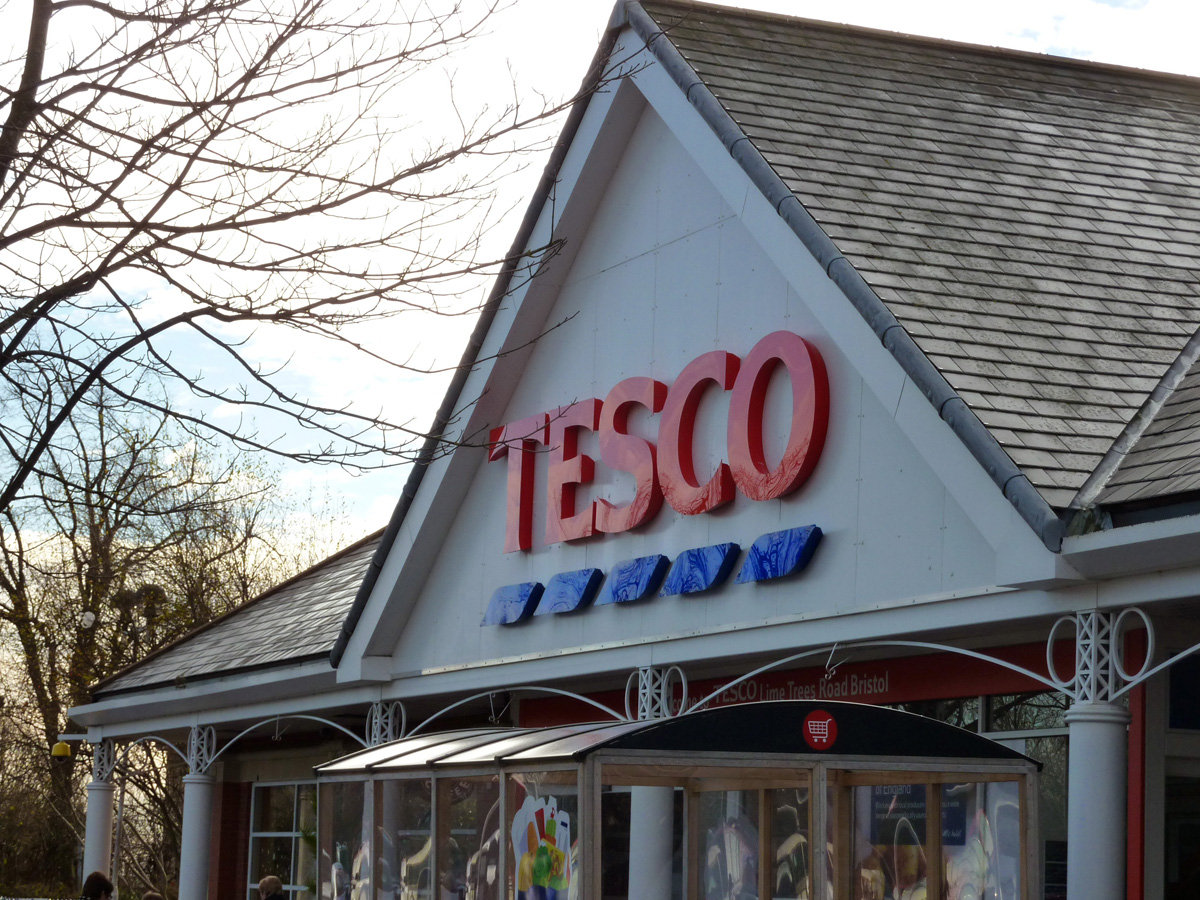
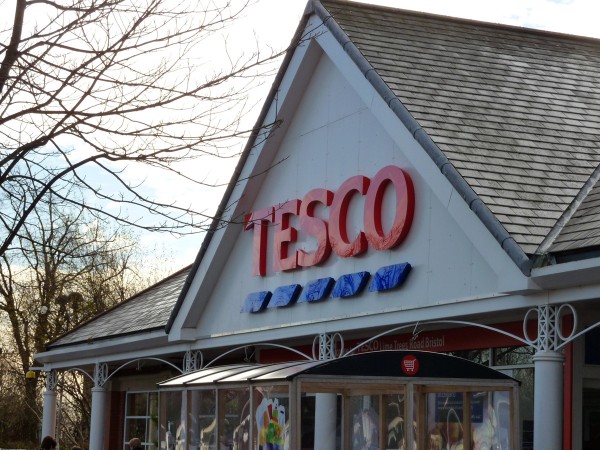 A row erupted in mid-October between Tesco, the UK’s biggest supermarket, and Unilever, the Anglo-Dutch company. Unilever is the world’s largest consumer goods manufacturer with many well-known brands, including home care products, personal care products and food and drink. Unilever, which manufactures many of its products abroad and uses many ingredients from abroad in those manufactured in the UK, wanted to charge supermarkets 10% more for its products. It blamed the 16% fall in the value of sterling since the referendum in June (see the blog Sterling’s slide).
Tesco refused to pay the increase and so Unilever halted deliveries of over 200 items. As a result, several major brands became unavailable on the Tesco website. The dispute was dubbed ‘Marmitegate’, after one of Unilever’s products.
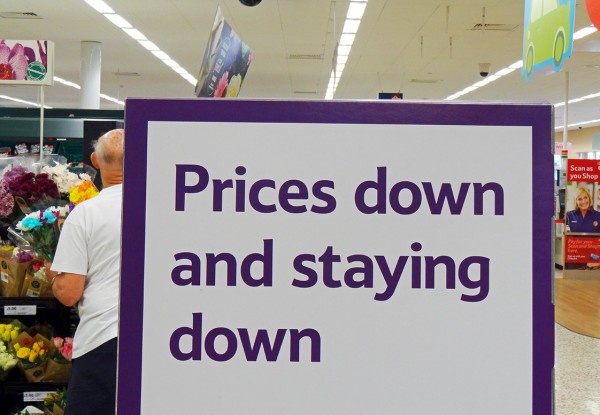 This is a classic case of power on both sides of the market: a powerful oligopolist, Unilever, facing a powerful oligopsonist, Tesco. With rising costs for Unilever resulting from the falling pound, either Unilever had to absorb the costs, or Tesco had to be prepared to pay the higher prices demanded by Unilever, passing some or all of them onto customers, or there had to be a compromise, with the prices Tesco pays to Unilever rising, but by less than 10%. A compromise was indeed reached on 13 October, with different price increases for each of Unilever’s products depending on how much of the costs are in foreign currencies. Precise details of the deal remained secret.
An interesting dynamic in the dispute was that Tesco and Unilever were acting as ‘champions’ for retailers and suppliers respectively. Other supermarkets were also facing price rises by Unilever. 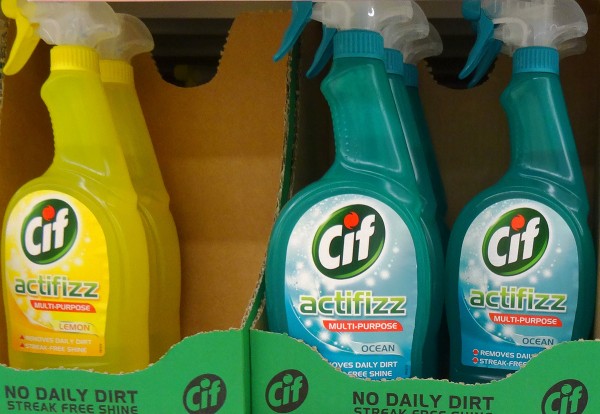 Their reactions were likely to depend on what Tesco did. Similarly, other suppliers were facing rising costs because of the falling pound. Their reactions might depend on how successful Unilever was in passing on its cost increases to retailers.
This example of ‘countervailing power’, or ‘bilateral oligopoly’, helps to illustrate just how much the consumer can gain when a powerful seller is confronted by a powerful buyer. The battle was been likened to that between two ‘gorillas’ of the industry. Its ramifications throughout industry will be interesting.
Podcasts and Webcasts
 Tesco-Unilever row: Can unique shop explain ‘Marmitegate’? BBC News, Dougal Shaw (13/10/16)
Tesco, Unilever in Brexit price clash Reuters, David Pollard (13/10/16)
Brexit price-rise warning to shoppers BBC News, Simon Jack (10/10/16)
Tesco in Brexit Pricing Spat With Unilever Wall Street Journal (13/10/16)
Tesco battles Unilever over prices Financial Times on YouTube (14/10/16)
Tesco vs Unilever: Who won? ITV News, Joel Hills (14/10/16)
Articles
Tesco removes Marmite and other Unilever brands in price row BBC News (13/10/16)
Marmite Brexit Shortage ‘Just The Beginning’ Of ‘Gorilla’ Grocery Battle As Pound Slumps Huffington Post, Louise Ridley (13/10/16)
Unilever sales increase despite dozens of its brands being removed from Tesco shelves Independent, Ben Chapman (13/10/16)
Tesco-Unilever price row: Why pound value slump has caused Marmite to disappear from shelves Independent, Zlata Rodionova (13/10/16)
Tesco pulls Marmite from online store amid Brexit price row with Unilever The Telegraph, Peter Dominiczak, Steven Swinford and Ashley Armstrong (13/10/16)
Tesco runs short on Marmite and household brands in price row with Unilever The Guardian, Sarah Butler (13/10/16)
Tesco pulls products over plunging pound Financial Times, Mark Vandevelde, Scheherazade Daneshkhu and Paul McClean (13/10/16)
Brexit means…higher prices The Economist, Buttonwood’s notebook (13/10/16)
Tesco, Unilever settle prices row after pound’s Brexit dive Reuters, James Davey and Martinne Geller (14/10/16)
Questions
- To what extent can Tesco and Unilever be seen a price leaders of their respective market segments?
- What would you advise other supermarkets to do over their pricing decisions when faced with increased prices from suppliers, and why?
- What would you advise manufacturers of other consumer goods sold in supermarkets to do in the light of the Tesco/Unilever dispute, and why?
- What determines the price elasticity of demand for branded products, such as Marmite, Persil, Dove soap, Hellmann’s mayonnaise, PG Tips tea and Wall’s ice cream?
- What factors will determine in the end just how much extra the consumer pays when supermarkets are faced with demands for higher prices from major suppliers?
- Give some other examples of firms in industries where there is a high degree of countervailing power.
- What are the macroeconomic implications of a depreciating exchange rate?
- If, over the long term, the pound remained 16% below its level in June 2016, would you expect the consumer prices index in the long term to be approximately 16% higher than it would have been if the pound had not depreciated? Explain why or why not.
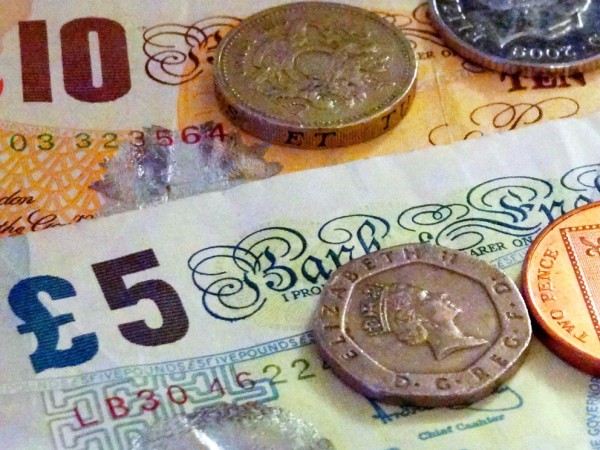
The pound has fallen to its lowest rate against the euro since July 2013 and the lowest rate against the US dollar since 1985. Since August 2015, the pound has depreciated by 23.4% against the euro and 22.2% against the dollar. And since the referendum of 23 June, it has depreciated by 15.6% against the euro and 17.6% against the dollar.
On Sunday 2 October, at the start of the Conservative Party conference, the Prime Minister announced that Article 50, which triggers the Brexit process, would be invoked by the end of March 2017. Worries about what the terms of Brexit would look like put further pressure on the pound: the next day it fell by around 1% and the next day by a further 0.5%.
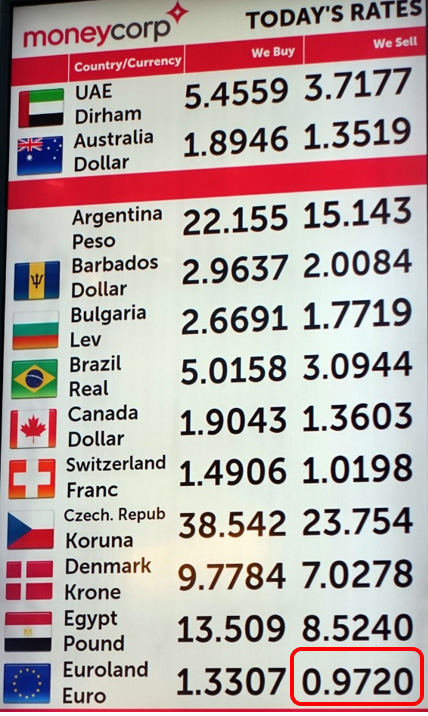
Then, on 6 October, it was reported that President Hollande was demanding tough Brexit negotiations and the pound dropped significantly further. By 7 October, it was trading at around €1.10 and $1.22. At airports, currency exchange agencies were offering less than €1 per £ (see picture).
With the government implying that Brexit might involve leaving the Single Market, the pound continued falling. On 12 October, the trade-weighted index reached its lowest level since the index was introduced in 1980: below its trough in the depth of the 2008 financial crisis and below the 1993 trough following Britain’s ejection from the European Exchange Rate Mechanism in September 1992.
So just why has the pound fallen so much, both before and after the Brexit vote? (Click here for a PowerPoint of the chart.) And what are the implications for the economy?
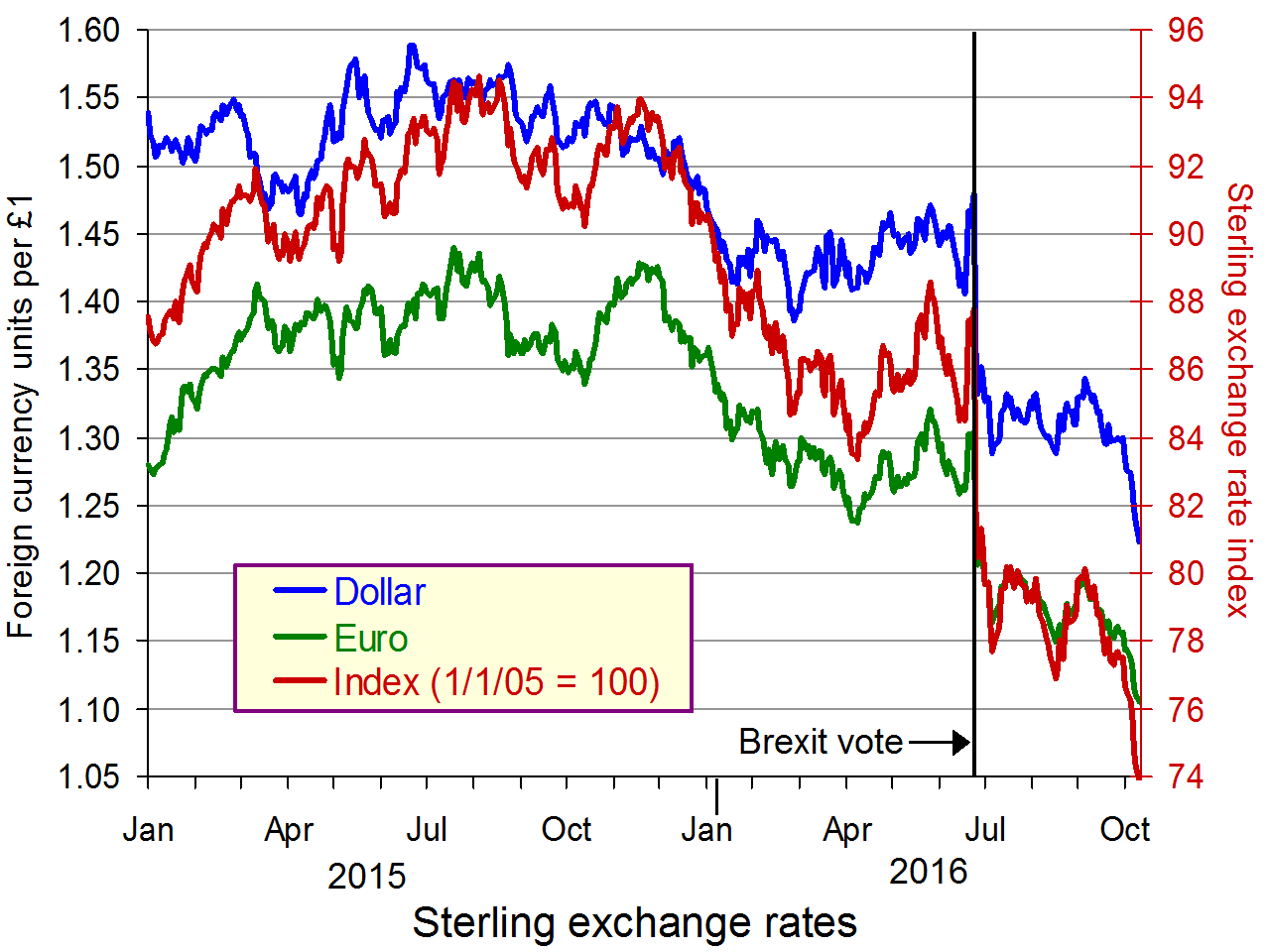 The articles explore the reasons for the depreciation. Central to these are the effects on the balance of payments from a possible decline in inward investment, lower interest rates leading to a net outflow of currency on the financial account, and stimulus measures, both fiscal and monetary, leading to higher imports.
Worries about the economy were occurring before the Brexit vote and this helped to push sterling down in late 2015 and early 2016, as you can see in the chart. This article from The Telegraph of 14 June 2016 explains why.
Despite the short-run effects on the UK economy of the Brexit vote not being as bad as some had predicted, worries remain about the longer-term effects. And these worries are compounded by uncertainty over the Brexit terms.
A lower sterling exchange rate reduces the foreign currency price of UK exports and increases the sterling price of imports. Depending on price elasticities of demand, this should improve the current account of the balance of payments.
These trade effects will help to boost the economy and go some way to countering the fall in investment as businesses, uncertain over the terms of Brexit, hold back on investment in the UK.
Articles
Pound Nears Three-Decade Low as May Sets Date for Brexit Trigger Bloomberg, Netty Idayu Ismail and Charlotte Ryan (3/10/16)
Sterling near 31-year low against dollar as May sets Brexit start dat Financial Times, Michael Hunter and Roger Blitz (3/10/16)
Sterling hits three-year low against the euro over Brexit worries The Guardian, Katie Allen (3/10/16)
Pound sterling value drops as Theresa May signals ‘hard Brexit’ at Tory conference Independent, Zlata Rodionova (3/10/16)
Pound falls as Theresa May indicates Brexit date BBC News (3/10/16)
The pound bombs and stocks explode over fears of a ‘hard Brexit’ Business Insider UK, Oscar Williams-Grut (3/10/16)
Pound Will Feel Pain as Brexit Clock Ticks Faster Wall Street Journal, Richard Barley (3/10/16)
British Pound to Euro Exchange Rate’s Brexit Breakdown Slows After Positive Manufacturing PMI Halts Decline Currency Watch, Joaquin Monfort (3/10/16)
7 ways the fall in the value of the pound affects us all Independent (4/10/16)
The pound and the fury: Brexit is making Britons poorer, and meaner The Economist, ‘Timekeeper’ (11/10/16)
Is the pound headed for parity v US dollar and euro? Sydney Morning Herald, Jessica Sier (5/10/16)
Flash crash sees the pound gyrate in Asian trading BBC News (7/10/16)
Flash crash hits pound after Hollande remarks Deutsche Welle (7/10/16)
Sterling mayhem gives glimpse into future Reuters, Swaha Pattanaik (7/10/16)
Sterling takes a pounding The Economist, Buttonwood (7/10/16)
Government must commit to fundamental reform The Telegraph, Andrew Sentance (7/10/16)
Data
Interest & exchange rates data – Statistical Interactive Database Bank of England
Questions
- Why has sterling depreciated? Use a demand and supply diagram to illustrate your argument.
- What has determined the size of this depreciation?
- What is meant by the risk premium of holding sterling?
- To what extent has the weaker pound contributed to the better economic performance than was expected immediately after the Brexit vote?
- What factors will determine the value of sterling over the coming months?
- Who gain and who lose from a lower exchange rate?
- What is likely to happen to inflation over the coming months? Explain and consider the implications for monetary and fiscal policy.
- What is a ‘flash crash’. Why was there a flash crash in sterling on Asian markets on 7 October 2016? Is such a flash crash in sterling likely to occur again?
 In a recent blog, Falling sterling – bad for some; good for others, we looked at the depreciation of sterling following the Brexit vote. We saw how it will have beneficial effects for some, such as exporters, and adverse effects for others, such as consumers having to pay a higher price for imports and foreign holidays. The article linked below examines these effects in more depth.
Just how much the quantity of exports will increase depends on two main things. The first is the amount by which the foreign currency price falls. This depends on what exporters choose to do. Say the pound falls from €1.30 to €1.18. Do exporters who had previously sold a product selling in the UK for £100 and in the eurozone for €130, now reduce the euro price to €118? Or do they put it down by less – say, to €125, thereby earning £105.93 (£(125/1.18)). Their sales would increase by less, but their profit margin would rise.
The second is the foreign currency price elasticity of demand for exports in the foreign markets. The more elastic it is, the more exports will rise for any given euro price reduction.
 It is similar with imports. How much the sales of these fall depends again on two main things. The first is the amount by which the importing companies are prepared to raise sterling prices. Again assume that the pound falls from €1.30 to €1.18 – in other words, the euro rises from 76.92p (£1/1.3) to 84.75p (£1/1.18). What happens to the price of an import to the UK from the eurozone whose euro price is €100? Does the importer raise the price from £76.92 to £84.75, or by less than that, being prepared to accept a smaller profit margin?
The second is the sterling price elasticity of demand for imports in the UK. The more elastic it is, the more imports will fall and, probably, the more the importer will be prepared to limit the sterling price increase.
The article also looks at the effect on aggregate demand. As we saw in the previous blog, a depreciation boosts aggregate demand by increasing exports and curbing imports. The effects of this rise in aggregate demand depends on the degree of slack in the economy and the extent, therefore, that (a) exporters and those producing import substitutes can respond in terms of high production and employment and (b) other sectors can produce more as multiplier effects play out.
Finally, the article looks at the effect of the depreciation of sterling on asset prices. UK assets will be worth less in foreign currency terms; foreign assets will be worth more in sterling. Just how much the prices of internationally traded assets, such as shares and some property, will change depends, again, on their price elasticities of demand. In terms of assets, there has been a gain to UK balance sheets from the depreciation. As Roger Bootle says:
Whereas the overwhelming majority of the UK’s liabilities to foreigners are denominated in sterling, the overwhelming bulk of our assets abroad are denominated in foreign currency. So the lower pound has raised the sterling value of our overseas assets while leaving the sterling value of our liabilities more or less unchanged.
Article
How a lower pound will help us to escape cloud cuckoo land, The Telegraph, Roger Bootle (31/7/16)
Questions
- What determines the amount that exporters from the UK adjust the foreign currency price of their exports following a depreciation of sterling?
- What determines the amount by which importers to the UK adjust the sterling price of their products following a depreciation of sterling?
- What determines the amount by which sterling will depreciate over the coming months?
- Distinguish between stabilising and destabilising speculation? How does this apply to exchange rates and what determines the likelihood of there being destabilising speculation against sterling exchange rates?
- How is UK inflation likely to be affected by a depreciation of sterling?
- Why does Roger Bootle believe that the UK has been living in ‘cloud cuckoo land’ with respect to exchange rates?
- Why has the UK managed to sustain a large current account deficit over so many years?
 It has also been claimed that cutthroat competition in the supermarket industry, especially from discounter retailers Aldi and Lidl, made Tesco particularly keen to prevent price rises. Some arguments suggest that these discounters will be best placed to benefit from the currency devaluation as they sell more own brands, have a limited range, the leanest supply chains and benefit from substantial economies of scale. On the other hand, they source more of their products from abroad and it has been suggested that: