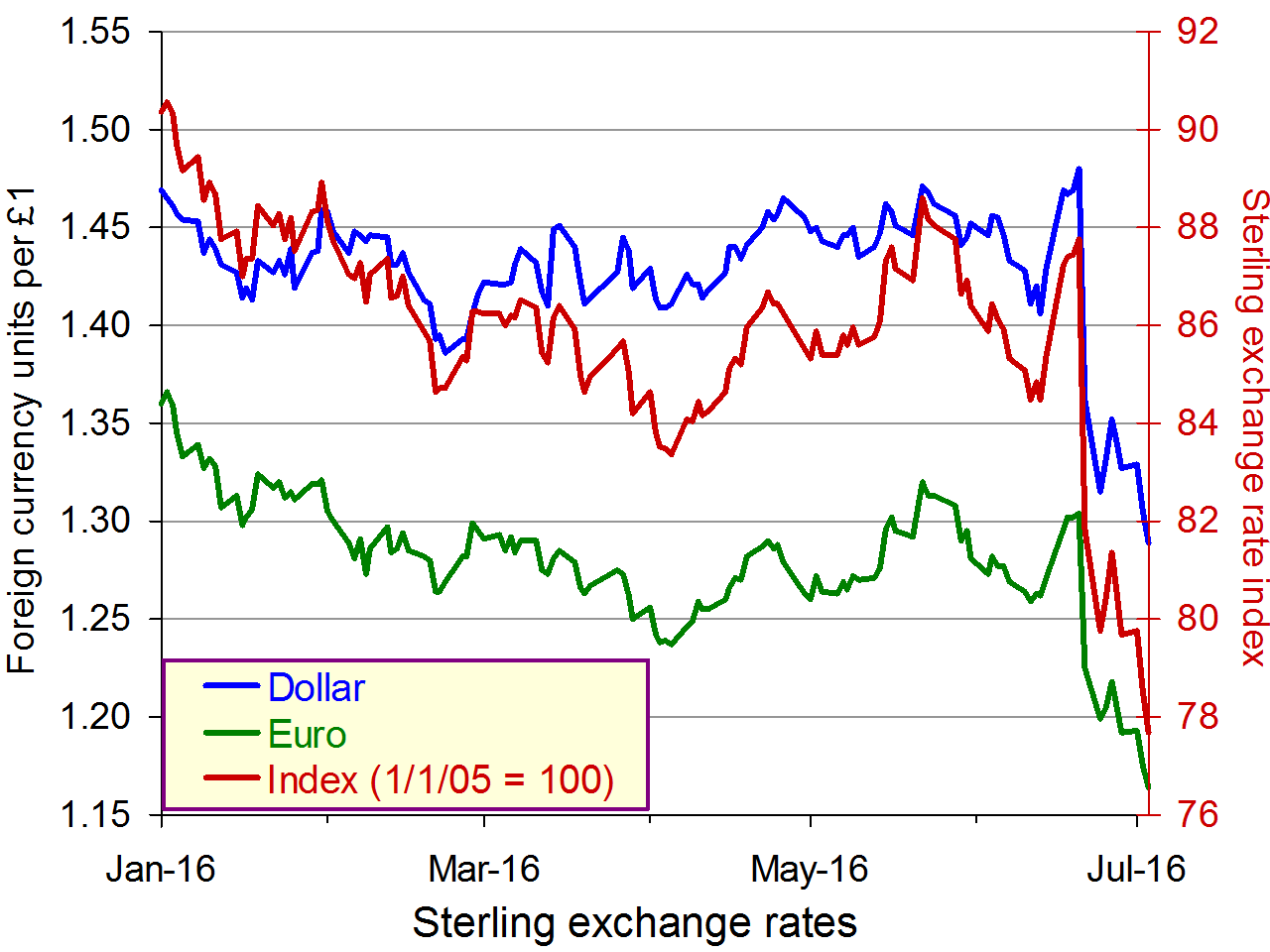
 Since the Brexit vote in the referendum, sterling has been falling. It is now at a 31-year low against the US dollar. From 23 June to 6 July it depreciated by 12.9% against the US dollar, 10.7% against the euro and 17.0% against the yen. The trade-weighted sterling exchange rate index depreciated by 11.6%.
Why has this happened? Partly it reflects a decline in confidence in the UK economy by investors; partly it is in response to policy measures, actual and anticipated, by the Bank of England.
As far as investors are concerned, the anticipation is that there will be net direct investment outflows from the UK. This is because some companies in the UK are considering relocating part or all of their business from the UK to elsewhere in Europe. For example, EasyJet is drawing up plans to move its headquarters to continental Europe. It is also because investors believe that foreign direct investment in the UK is likely to fall as companies prefer to invest elsewhere, such as Ireland or Germany.
 Thus although the effect of net direct investment outflows (or reductions in net inflows) will be on the long-term investment part of the financial account of the balance of payments, the immediate effect is felt on the short-term financial flows part of the account as investors anticipate such moves and the consequent fall in sterling.
As far as monetary policy is concerned, the fall in sterling is in response to four things announced or signalled by Mark Carney at recent news conferences (see Monetary and fiscal policies – a U-turn or keeping the economy on track?).
First is the anticipated fall in Bank Rate at the next meeting of the Monetary Policy Committee on 13/14 July. Second is the possibility of further quantitative easing (QE). Third is an additional £250bn of liquidity that the Bank is prepared to provide through its normal open-market operations. Fourth is the easing of capital requirements on banks (reducing the countercyclical buffer from 0.5% to 0%), which would allow additional lending by banks of up to £150bn.
 Lower interest rates, additional liquidity and further QE would all increase the supply of sterling on the foreign exchange markets. The anticipation of this, plus the anticipation of lower interest rates, would decrease the demand for sterling. The effect of these supply and demand changes is a fall in the exchange rate.
But is a fall in the exchange rate a ‘good thing’? As far as consumers are concerned, the answer is no. Imports will be more expensive, as will foreign holidays. People’s pounds will buy less of things priced in foreign currency and thus people will be poorer.
As far as exporters are concerned, however, the foreign currency they earn will exchange into more pounds than before. Their sterling revenues, therefore, are likely to increase. They might also choose to reduce the foreign currency price of exports, thereby increasing the quantity sold – the amount depending on the price elasticity of demand. The increase in exports and reduction in imports will help to reduce the current account deficit and also boost aggregate demand.
Articles
Pound slumps to 31-year low following Brexit vote The Guardian, Katie Allen , Jill Treanor and Simon Goodley (24/6/16)
Sterling’s post-Brexit fall is biggest loss in a hard currency Reuters, Jamie McGeever (7/7/16)
Brexit Accelerates the British Pound’s 100 Years of Debasement Bloomberg, Simon Kennedy and Lukanyo Mnyanda (5/7/16)
Pound sterling falls below $1.31 hitting new 31-year low Independent, Hazel Sheffield (5/7/16)
Viewpoints: How low will sterling go? BBC News, Leisha Chi (6/7/16)
How low will the pound fall? Financial Times (7/7/16)
Allianz’s El-Erian says UK must urgently get its act together or dollar parity could beckon Reuters, Guy Faulconbridge (7/7/16)
What does a falling pound mean for the British economy? The Telegraph, Peter Spence (6/7/16)
Data
Spot exchange rates: Statistical Interactive Database – interest & exchange rates data Bank of England
Questions
- What determines how much the exchange rate depreciates for a given shift in the demand for sterling or the supply of sterling?
- Why might the short-term effects on exchange rates of the Brexit vote be different from the long-term effects?
- Why has the pound depreciated by different amounts against different currencies?
- What are likely to be the effects on the financial and current accounts of the balance of payments of the Bank of England’s measures?
- Find out what has happened to business confidence since the Brexit vote. What effect does the level of confidence have on the exchange rate and why?
 On 20 February, the UK Prime Minister, David Cameron, announced the date for the referendum on whether the UK should remain in or leave the EU. It will be on 23 June. The announcement followed a deal with EU leaders over terms of UK membership of the EU. He will argue strongly in favour of staying in the EU, supported by many in his cabinet – but not all.
Two days later, Boris Johnson, the Mayor of London, said that he would be campaigning for the UK to leave the EU.
In the meantime, Mr Johnson’s announcement, the stance of various politicians and predictions of the outcome of the referendum are having effects on markets.
One such effect is on the foreign exchange market. As the Telegraph article below states:
The pound suffered its biggest drop against the dollar in seven years after London Mayor Boris Johnson said he will campaign for Britain to leave the European Union [‘Brexit’].
Sterling fell by as much as 2.12pc to $1.4101 against the dollar on Monday afternoon, putting it on course for the biggest one day drop since February 2009. Experts said the influential Mayor’s decision made a British exit from the bloc more likely.
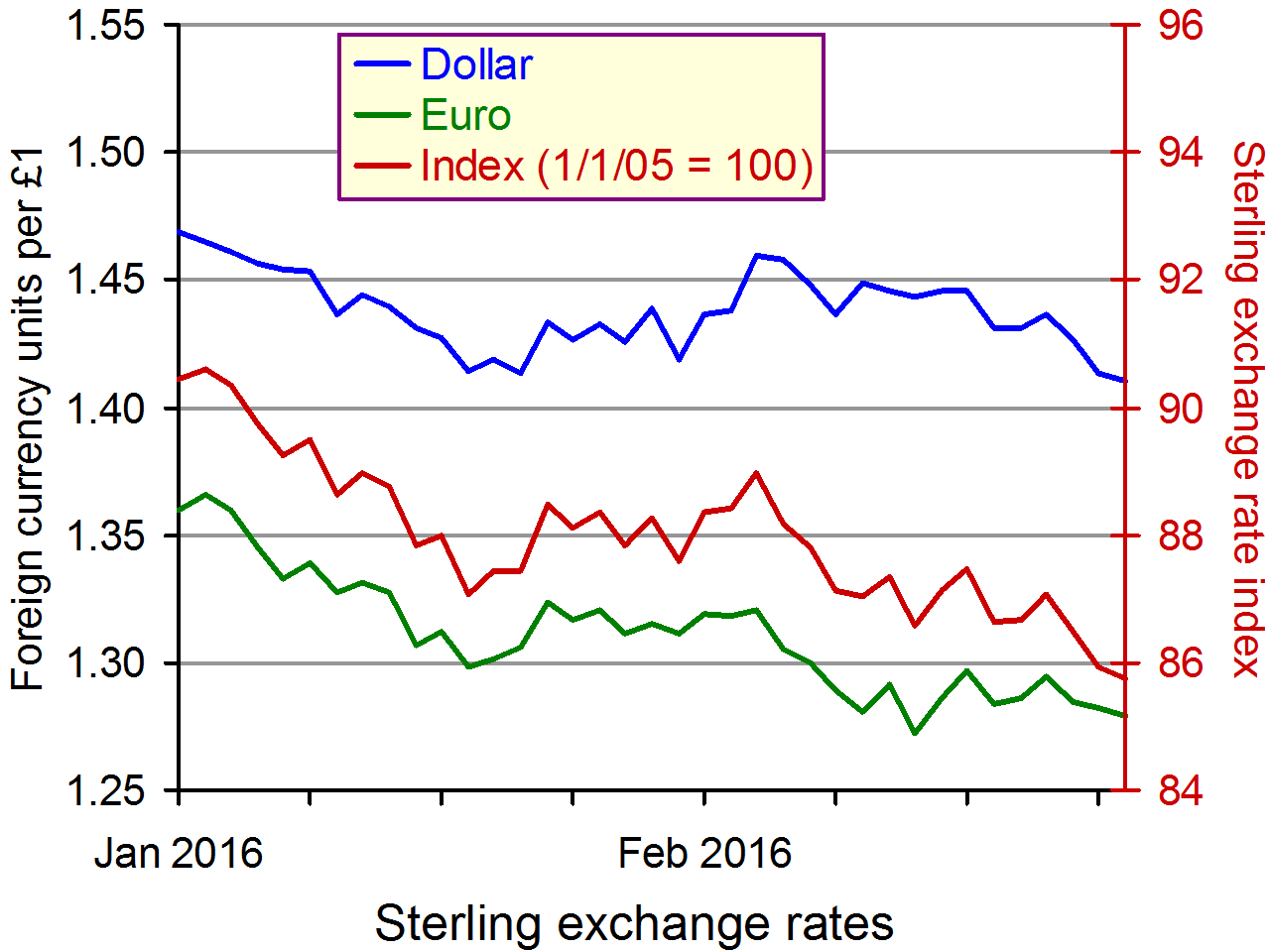
The pound also fell by as much as 1.2pc to €1.2786 against the euro and hit a two-year low against Japan’s yen.
This follows depreciation that has already taken place this year as predictions of possible Brexit have grown. The chart shows that from the start of the year to 23 February the sterling trade weighted index fell by 5.3% (click here for a PowerPoint).
But why has sterling depreciated so rapidly? How does this reflect people’s concerns about the effect of Brexit on the balance of payments and business more generally? Read the articles and try answering the questions below.
Articles
 Pound in Worst Day Since Banking Crisis as `Brexit’ Fears Bite Bloomberg, Eshe Nelson (21/2/16)
Pound hits 7-year low on Brexit fears Finiancial Times, Michael Hunter and Peter Wells (22/2/16)
Pound in freefall as Boris Johnson sparks Brexit fears The Telegraph, Szu Ping Chan (22/2/16)
Pound falls below $1.39 as economists warn Brexit could hammer households The Telegraph, Peter Spence (24/2/16)
Why is the pound falling and what does it mean for households and businesses? The Telegraph, Szu Ping Chan (23/2/16)
Pound heading for biggest one-day fall since 2009 on Brexit fears BBC News (22/2/16)
Cameron tries to sell EU deal after London mayor backs Brexit Euronews, Guy Faulconbridge and Michael Holden (22/2/16)
EU referendum: Sterling suffers biggest fall since 2010 after Boris Johnson backs Brexit International Business Times, Dan Cancian (22/2/16)
Exchange rate data
Spot exchange rates against £ sterling Bank of England
Questions
- What are the details of the deal negotiated by David Cameron over the UK’s membership of the EU?
- Why did sterling depreciate in (a) the run-up to the deal on UK EU membership and (b) after the announcement of the date of the referendum?
- Why did the FTSE100 rise on the first trading day after the Prime Minister’s announcement?
- What is the relationship between the balance of trade and the exchange rate?
- What are meant by the ‘six-month implied volatility in sterling/dollar’ and the ‘six-month risk reversals’?
- Why is it difficult to estimate the effect of leaving the EU on the UK’s balance of trade?
 Are emerging markets about to experience a credit crunch? Slowing growth in China and other emerging market economies (EMEs) does not bode well. Nor does the prospect of rising interest rates in the USA and the resulting increase in the costs of servicing the high levels of dollar-denominated debt in many such countries.
According to the Bank for International Settlements (BIS) (see also), the stock of dollar-denominated debt in emerging market economies has doubled since 2009 and this makes them vulnerable to tighter US monetary policy.
Weaker financial market conditions combined with an increased sensitivity to US rates may heighten the risk of negative spillovers to EMEs when US policy is normalised. …
Despite low interest rates, rising debt levels have pushed debt service ratios for households and firms above their long-run averages, particularly since 2013, signalling increased risks of financial crises in EMEs.
But there is another perspective. Many emerging economies are pursuing looser monetary policy and this, combined with tighter US monetary policy, is causing their exchange rates against the dollar to depreciate, thereby increasing their export competitiveness. At the same time, more rapid growth in the USA and some EU countries, should also help to stimulate demand for their exports.
Also, in recent years there has been a large growth in trade between emerging economies – so-called ‘South–South trade’. Exports from developing countries to other developing countries has grown from 38% of developing countries’ exports in 1995 to over 52% in 2015. With technological catch-up taking place in many of these economies and with lower labour and land costs, their prospects look bright for economic growth over the longer term.
These two different perspectives are taken in the following two articles from the Telegraph. The first looks at the BIS’s analysis of growing debt and the possibility of a credit crunch. The second, while acknowledging the current weakness of many emerging economies, looks at the prospects for improving growth over the coming years.
Articles
‘Uneasy’ market calm masks debt timebomb, BIS warns The Telegraph, Szu Ping Chan (6/12/15)
Why emerging markets will rise from gloom to boom The Telegraph, Liam Halligan (5/12/15)
Questions
- How does an improving US economy impact on emerging market economies?
- Will the impact of US monetary policy on exchange rates be adverse or advantageous for emerging market economies?
- What forms does dollar-denominated debt take in emerging economies?
- Why has south–south trade grown in recent years? Is it consistent with the law of comparative advantage?
- Why is growth likely to be higher in emerging economies than in developed economies in the coming years?
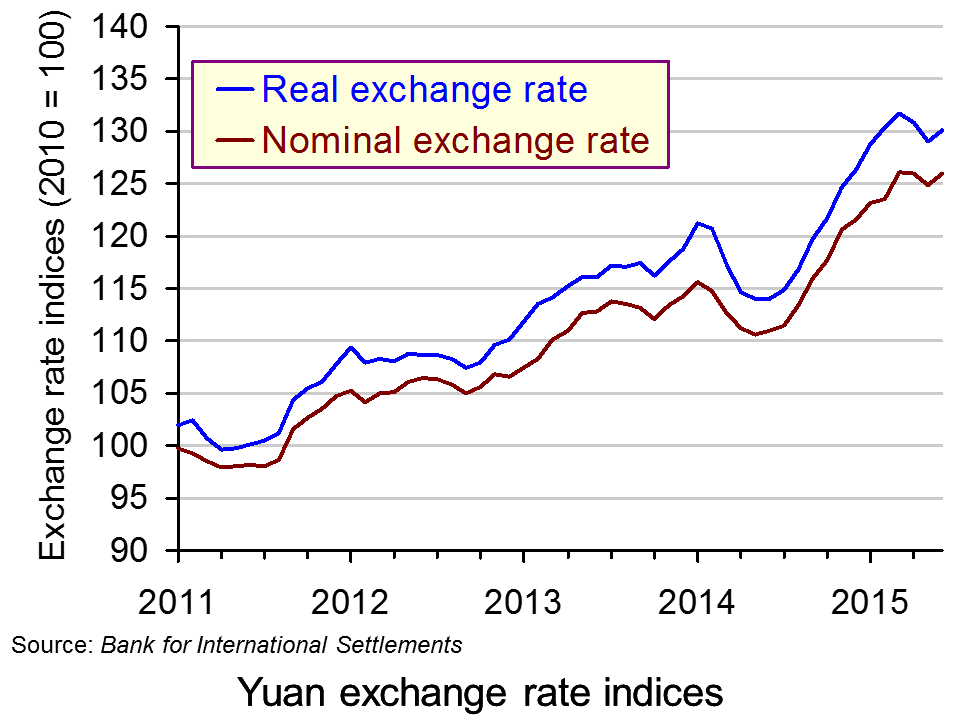
 On August 11th, China devalued its currency, the yuan, by 1.9%. The next day it devalued it by a further 1.6% and on the next day by a further 1.1%. Even though the total devaluation was relatively small, especially given a much bigger revaluation over the previous three years (see chart below), traders in world markets greeted the news with considerable pessimism. Stock markets around the world fell. For example, the US Dow Jones was down by 1.1%, the FTSE 100 was down by 2.5% and the German DAX by 5.8%.
There are three major concerns of investors about the devaluation. The first is that a weaker yuan will make other countries’ exports more expensive in China, thereby making it harder to export to China. At the same time Chinese imports into the rest of the world will be cheaper, thereby making it harder for domestic producers to compete with Chinese imports.
 The second is that cheaper Chinese imports will put downward pressure on prices at a time when inflation rates in the major economies are already below target rates. The fear of deflation has not gone away and this further deflationary twist will intensify such fears and possibly dampen demand.
The third is that the devaluation is taken as a sign that the Chinese authorities are worried about a slowing Chinese economy and are using the devaluation to boost Chinese exports. The rapidly expanding Chinese economy has been one of the major motors of the global economy in recent years and hence a slowing Chinese economy is cause for serious concern at a time when the global economy is still only very slowly recovering from the shock of the financial crisis of 2007–8
But just how worried should the rest of the world be about the falling yuan? And will it continue to fall, or could this be seen as a ‘one-off’ correction? What effect will it have on the macroeconomic policies of the USA, the eurozone and other major countries/regions? The following articles analyse Chinese policy towards its currency and the implications for the rest of the world.
China weakens yuan for a third straight day on Thursday CNBC, Nyshka Chandran (13/8/15)
Markets reel as investors fear worst of Chinese slowdown is yet to come The Telegraph, Peter Spence (12/8/15)
China cannot risk the global chaos of currency devaluation The Telegraph, Ambrose Evans-Pritchard (12/8/15)
Beware a China crisis that could crash down on us all The Telegraph, Liam Halligan (15/8/15)
The curious case of China’s currency The Economist, Buttonwood’s notebook (11/8/15)
China’s yuan currency falls for a second day BBC News (12/8/15)
China slowdown forces devaluation BBC News, Robert Peston (11/8/15)
What the yuan devaluation means around the world BBC News, Lerato Mbele, Daniel Gallas and Yogita Limaye (12/8/15)
China allows yuan currency to drop for third day BBC News, various reporters (13/8/15)
The Guardian view on global currencies: it’s the economy, stupid The Guardian, Editorial (14/8/15)
China’s currency gambit and Labour’s debate about quantitative easing: old and new ways to cope with economic crisis The Guardian, Paul Mason (16/8/15)
Questions
- By what percentages have the nominal and real yuan exchange rate indices appreciated since the beginning of 2011? Use data from the Bank for International Settlements.
- Explain the difference between nominal and real exchange rate indices.
- Compare the changes in the yuan exchange rate indices with that of the yuan/dollar exchange rate (see Bank of England Interactive Database). Explain the difference.
- How is the yuan exchange rate with other currencies determined?
- How have the Chinese authorities engineered a devaluation of the yuan? To what extent could it be described as a ‘depreciation’ rather than a ‘devaluation’?
- Why have world stock markets reacted so negatively to the devaluation?
- Why, in global terms, is the devaluation described as deflationary?
- How much should the rest of the world be worried by the devaluation of the yuan?
- Explain the statement by Robert Peston that ‘Beijing has done the monetary tightening that arguably the US economy needs’.
- Comment on the following statement by Stephen King of HSBC (see the second Telegraph article below): ‘The world economy is sailing across the ocean without any lifeboats to use in case of emergency.’
 Newspaper headlines this week read that the UK’s balance of trade deficit has widened to £34.8bn, the largest since 2010. And when you exclude services, the trade in goods deficit, at £119.9bn is the largest ever in nominal terms and is also likely to be the largest as a percentage of GDP.
So far so bad. But when you look a little closer, the picture is more mixed. The balance of trade deficit (i.e. on both goods and services) narrowed each quarter of 2014, although the monthly figure did widen in December 2014. In fact the trade in goods deficit increased substantially in December from £9.3bn to £10.2bn.
At first sight the widening of the trade deficit in December might seem surprising, given the dramatic drop in oil prices. Surely, with demand for oil being relatively inelastic, a large cut in oil prices should significantly reduce the expenditure on oil? In fact the reverse happened. The oil deficit in December increased from £598m to £940m. The reason is that oil importing companies have been stockpiling oil while low prices persist. Clearly, this is in anticipation that oil prices will rise again before too long. What we have seen, therefore, is a demand that is elastic in the short run, even though it is relatively inelastic in the medium run.
But the trade deficit is still large. Even when you strip out oil, the deficit in December still rose – from £8.7bn to £9.2bn. There are two main reasons for this deterioration.
The first is a strong pound. The sterling exchange rate index rose by 1.8% in December and a further 0.4% in January. With quantitative easing pushing down the value of the euro and loose monetary policies in China and Australia pushing down the value of their currencies, sterling is set to appreciate further.
The second is continuing weakness in the eurozone and a slowing of growth in some major developing countries, including China. This will continue to dampen the growth in UK exports.
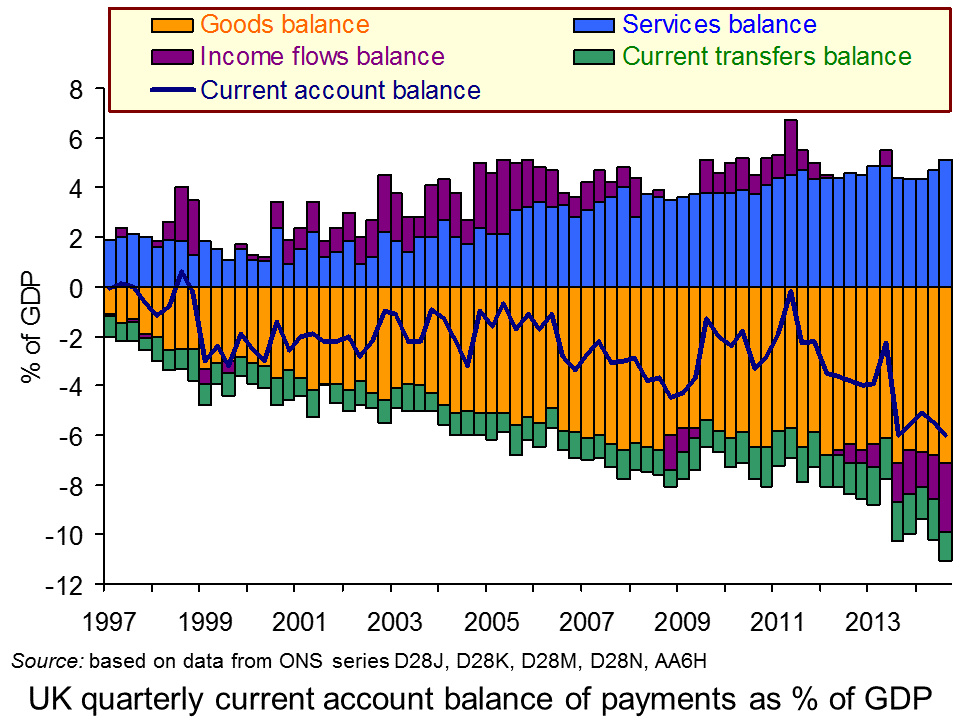 But what of the overall current account? Figures are at present available only up to 2014 Q3, but the picture is bleak (see the chart). As the ONS states:
The current account deficit widened in Q3 2014, to 6.0% of nominal Gross Domestic Product GDP, representing the joint largest deficit since Office for National Statistics (ONS) records began in 1955.
This deterioration in performance can be partly attributed to the recent weakness in the primary income balance [see]. This also reached a record deficit in Q3 2014 of 2.8% of nominal GDP; a figure that can be primarily attributed to a fall in UK residents’ earnings from investment abroad, and broadly stable foreign resident earnings on their investments in the UK
The primary income account captures income flows into and out of the UK economy, as opposed to current transfers (secondary income) from taxes, grants, etc. The large deficit reflects a decline in the holding by UK residents of foreign assets from 92% of GDP in 2008 to 67% by the end of 2014. This, in turn, reflects the poorer rate of return on many of these assets. By contrast, the holdings of UK assets by foreign residents has increased. They have been earning a higher rate of return on these assets than UK residents have on foreign assets. And so, despite UK interest rates having fallen, as the quote above says, foreign residents’ earnings on their holding of UK assets has remained broadly stable.
Articles
UK trade deficit last year widest since 2010 BBC News (6/2/15)
UK’s trade deficit widens to 2010 high as consumers take advantage of falling oil The Telegraph, Peter Spence (6/2/15)
UK trade deficit widens to four-year high The Guardian, Katie Allen (6/2/15)
UK trade deficit hits four-year high Financial Times, Ferdinando Giugliano (6/2/15)
Data
Balance of Payments ONS (topic link)
Summary: UK Trade, December 2014 ONS (6/2/15)
Current account, income balance and net international investment position ONS (23/1/15)
Pink Book – Tables ONS
Questions
- Distinguish between he current account, the capital account and the financial account of the balance of payments.
- If the overall balance of payments must, by definition, balance, why does it matter if the following are in deficit: (a) trade in goods; (b) the current account; (b) income flows?
- What would cause the balance of trade deficit to narrow?
- Discuss what policies the government could pursue to reduce the size of the current account deficit? Distinguish between demand-side and supply-side policies.
- Why has the sterling exchange rate index been appreciating in recent months?
- What do you think is likely to happen to the sterling exchange rate index in the coming months? Explain.