 Every summer a number of air shows take place in the UK, such as those at Farnborough, Cosford and the Royal International Air Tattoo. Some of these events prove to be extremely popular and successful. For example, over 50,000 people attended the event at Cosford on Sunday 9th June to watch a five-and-a-half-hour flying display, including the Red Arrows, a Vulcan bomber and a RAF Battle of Britain Memorial Flight, which featured Spitfire, Hurricane and Lancaster aircrafts.
The event was so popular that some people who had paid £25 for a ticket failed to make it to the show ground because they were stuck in a 9 mile traffic jam! The popularity of these events does raise an interesting economic question. Why do so many people pay to attend when it is possible to watch much of the air show from outside the showground? If people can enjoy the benefits of watching an event whether or not they have paid then we might expect the majority of them not to pay.
Air shows seem to have some of the characteristics of a public good: i.e. to some extent the consumption benefits are both non-rival and non-excludable. By non-rival it is meant that one person’s use or consumption of the good does not decrease the quantity available for somebody else to use or consume. If one person watches the Red Arrows fly by, it does not decrease the ability of others to watch them. Contrast this with a product that has the characteristic of being ‘rival’ such as a hamburger. If someone eats a hamburger, it reduces the amount that is available for others to enjoy. The good is ‘used up’ during consumption. Other people cannot eat the same hamburger!!! Many sporting and music events share this characteristic of non-rivalry. For example if somebody is watching a band playing live at Glastonbury it does not stop somebody else from enjoying the benefits of watching the band. The performance of the band is not ‘used up’ like the hamburger when a person watches the show.
The major difference between Glastonbury and an air show is that the event organisers at Glastonbury can prevent people who have not paid for a ticket from enjoying the show. The event is excludable, as fans have to enter the show arena in order to see the bands. However, as one contributor to an internet discussion site commented:
Air show organisers are at a particular disadvantage compared to other show organisers because the key elements of their show can be seen for miles.
Another contributor added that:
Unfortunately being an air show by its very nature it’s very public – the planes are in the air for everyone to see for free for miles around.
In other words, air shows have the characteristic of being non-excludable, as people can benefit regardless of whether they have paid or not.
These public good properties seem to be causing problems for an air show in Welshpool that appears to have an issue with a number of non-payers watching the event. The organisers recently stated that:
We can’t stop people watching from the hillsides, but perhaps we can make them understand that they need to come to the show and pay.
The previous year the organisers had sent people out with buckets to collect voluntary donations from those sitting on the hillside. However they found that:
People were not for giving much at all and it was noticeable how much copper was in the buckets we’d used and there were hardly any notes.
One solution being proposed in order to generate more revenue is to increase the entry fee, which is currently £5, in order to compensate for those who are not paying.
Articles
Bob Jones Memorial Air Show urges people to buy tick BBC News (9/6/13)
How to make an airshow pay PistonHeads, (9/6/13)
Free or should you pay Talk Photography, (9/6/13)
An organisers view Airshow, (9/6/13)
Cosford Air Show pledge over traffic chaos Shropshire Star, (10/6/13)
RAF Cosford Air Show – Home RAF Cosford Air Show, (12/6/13).
Questions
- What practical problems does a show such as Glastonbury face in trying to make the event excludable?
- In the blog it explains how one person watching a band live does not have a negative impact on the pleasure other people will derive from watching the same band: i.e. it is non-rival. Is this always true? Can you think of any circumstances when watching a live band might become a rival good?
- What term do economists use for goods that are non-rival but are excludable? Think of at least three examples.
- What ideas might the organisers of an air show adopt to encourage people to pay and enter the show ground area?
- Can you think of any strategies that might be used to increase the number and size of the voluntary donations made by those who watch the airshow for free from a hill-side?
- What are the organisers assuming about the price elasticity of demand for the air show at its current price if they claim that increasing prices will lead to an increase in revenue?
 The UK electricity supply market is an oligopoly. Over 95% of the market is supplied by the ‘big six’: British Gas (Centrica), EDF Energy, E.ON, npower (RWE), Scottish Power (Iberdrola) and SSE. The big six also generate much of the electricity they supply; they are vertically integrated companies. Between them they generate nearly 80% of the country’s electricity. There are a further two large generators, Drax Power Limited and GDF Suez Energy UK, making the generation industry an oligopoly of eight key players.
Ofgem, the energy market regulator, has just published a report on the wholesale electricity market, arguing that it is insufficiently liquid. This, argues the report, acts as a barrier to entry to competitor suppliers. It thus proposes measures to increase liquidity and thereby increase effective competition. Liquidity, according to the report, is:
… the ability to quickly buy or sell a commodity without causing a significant change in its price and without incurring significant transaction costs. It is a key feature of a well-functioning market. A liquid market can also be thought of as a ‘deep’ market where there are a number of prices quoted at which firms are prepared to trade a product. This gives firms confidence that they can trade when needed and will not move the price substantially when they do so.
 A liquid wholesale electricity market ensures that electricity products are available to trade, and that their prices are robust. These products and price signals are important for electricity generators and suppliers, who need to trade to manage their risks. Liquidity in the wholesale electricity mark et therefore supports competition in generation and supply, which has benefits for consumers in terms of downward pressure on bills, better service and greater choice.
So how can liquidity be increased? Ofgem is proposing that the big six publish prices for two years ahead at which they are contracting to purchase electricity from generators in long-term contracts. These bilateral deals with generators are often with their own company’s generating arm. Publishing prices in this way will allow smaller suppliers to be able to seek out market opportunities. The generating companies will not be allowed to refuse to contract to supply smaller companies at the prices they are being forced to publish.
In addition, Ofgem is proposing that generators would have to sell 20% of output in the open market instead of through bilateral deals. As it is, however, some 30% of output is currently auctioned on the wholesale spot market (i.e. the market for immediate use).
But it is pricing transparency plus small suppliers being able to gain access to longer-term contracts that are the two key elements of the proposed reform.
Articles
UK utilities face having to disclose long-term deals Reuters, Karolin Schaps and Rosalba O’Brien (12/6/13)
Ofgem set to ‘break stranglehold’ in the energy market BBC News, John Moylan (12/6/13)
 Ofgem plan ‘to end energy stranglehold’ BBC Today Programme, John Moylan and Ian Marlee (12/6/13)
Ofgem outlines proposals to ‘break stranglehold’ of big six energy suppliers on electricity market The Telegraph (12/6/13)
Ofgem widens investigation into alleged rigging of gas and power markets The Guardian, Terry Macalister (6/6/13)
Ofgem moves to break stranglehold of ‘big six’ energy suppliers Financial Times, Guy Chazan (12/6/13)
Ofgem to crackdown on Big Six energy suppliers in bid to cut electricity prices Independent, Simon Read (12/6/13)
Reports and data
Opening up Electricity Market to Effective Competition Ofgem Press Release (12/6/13)
Wholesale power market liquidity: final proposals for a ‘Secure and Promote’ licence condition – Draft Impact Assessment Ofgem (12/6/13)
Electricity statistics Department of Energy & Climate Change
The Dirty Half Dozen Friends of the Earth (Oct 2011)
Questions
- What barriers to entry exist in (a) the wholesale and (b) the retail market for electricity?
- Distinguish between spot and forward markets. Why is competition in forward markets particularly important for small suppliers of electricity?
- How will ‘liquidity’ be increased by the measures Ofgem is proposing?
- To what extent does vertical integration in the energy industry benefit consumers of electricity?
- What is a price reporting agency (PRA)? What anti-competitive activities have been taking place in the short-term energy market and why may PRAs not be ‘fit for purpose’?
- Do you think that the measures Ofgem is proposing will ensure that the big generators trade fairly with small suppliers? Explain.
- What are the dangers in the proposals for the large generators?
 The Clean Energy Bill has been on the agenda for some time and not just in the UK. With climate change an ever growing global concern, investment in other cleaner energy sources has been essential. However, when it comes to investment in wind farms, developers have faced significant opposition. The balancing act for the government appears to be generating sufficient investment in wind farms, while minimising the negative externalities.
The phrase often thrown around with regards to wind farms, seems to be ‘not in my backyard’. That is, people recognise the need for them, but don’t want them to be built in the local areas. The reason is to do with the negative externalities. Not only are the wind farms several metres high and wide, creating a blight on the landscape, but they also create a noise, both of which impose a third party effect on the local communities. These factors, amongst others, have led to numerous protests whenever a new wind farm is suggested. The problem has been that with such challenging targets for energy, wind farms are essential and thus government regulation has been able to over-ride the protests of local communities.
However, planning guidance in the UK will now be changed to give local opposition the ability to override national energy targets. In some sense, more weight is being given to the negative externalities associated with a new wind farm. This doesn’t mean that the government is unwilling to let investment in wind farms stop. Instead, incentives are being used to try to encourage local communities to accept new wind farms. While acknowledging the existence of negative externalities, the government is perhaps trying to put a value on them. The benefits offered to local communities by developers will increase by a factor of five, thus aiming to compensate those affected accordingly. Unsurprisingly, there have been mixed opinions, summed up by Maria McCaffery, the Chief Executive of trade association RenewableUK:
Maria McCaffery, chief executive of trade association RenewableUK, said the proposals would signal the end of many planned developments and that was “disappointing”.
Developing wind farms requires a significant amount of investment to be made upfront. Adding to this cost, by following the government’s advice that we should pay substantially more into community funds for future projects, will unfortunately make some planned wind energy developments uneconomic in England.
That said, we recognise the need to ensure good practice across the industry and will continue to work with government and local authorities to benefit communities right across the country which are hosting our clean energy future.
The improved benefits package by the energy industry is expected to be in place towards the end of the year. The idea is that with greater use of wind farms, energy bills can be subsidised, thereby reducing the cost of living. Investment in wind farms (on-shore and off-shore) is essential. Current energy sources are non-renewable and as such new energy sources must be developed. However, many are focused on the short term cost and not the long term benefit that such investment will bring. The public appears to be in favour of investment in new energy sources, especially with the prospect of subsidised energy bills – but this positive outlook soon turns into protest when the developers pick ‘your back yard’ as the next site. The following articles consider this issue.
Residents to get more say over wind farms The Guardian, Fiona Harvey and Peter Walker (6/6/13)
Local communities offered more say over wind farms BBC News (6/6/13)
Locals to get veto power over wind farms The Telegraph, Robert Winnett (6/6/13)
Wind farms are a ‘complete scam’, claims the Environment Secretary who says turbines are causing ‘huge unhappiness’ Mail Online, Matt Chorley (7/6/13)
New planning guidance will make it harder to build wind farms Financial Times, Jim Pickard, Pilita Clark and Elizabeth Rigby (6/6/13)
Will more power to nimbys be the death of wind farms? Channel 4 News (6/6/13)
Locals given more ground to block wind farms Independent, Tom Bawden (6/6/13)
Questions
- What are the negative externalities associated with wind farms?
- Conduct a cost-benefit analysis as to whether a wind farm should be constructed in your local area. Which factors have you given greatest weight to?
- In question 2 above, were you concerned about the Pareto criterion or the Hicks-Kaldor criterion?
- If local communities can be compensated sufficiently, should wind farms go ahead?
- If the added cost to the development of wind farms means that some will no longer go ahead, is this efficient?
- Why is there a need to invest in new energy sources?
- To what extent is climate change a global problem requiring international (and not national) solution?
 The latest growth data for the UK is somewhat difficult to interpret. It’s positive, but not that positive. The Conservatives say it shows that the economy is moving in the right direction. Labour suggests it is evidence that the Coalition’s policies are not working. With a return to positive growth, the UK has avoided the triple dip recession and here we take a closer look at the economic performance of other key nations.
In the final quarter of 2012, the US economy grew at 0.4%, but in the 3 months to March 2013, economic growth in America picked up to 2.5%. Consumer spending significantly increased, growing at an annualized rate of 3.2%, according to the Commerce Department. This figure helped boost the growth rate of the US economy, as consumer spending accounts for around two thirds of economic activity.
 However, the growth figure was lower than expected, in part due to lower government spending. Furthermore, there are suggestions that the positive consumer spending figures are merely a positive blip and spending will fall as the US economy moves through 2013.
If this does prove to be the case in the USA, it will do little to further boost UK economic growth, which was recorded at 0.3% for the first 3 months of 2013. The Chancellor has said that the growth figures are encouraging and are evidence that the government’s policies are working.
Today’s figures are an encouraging sign the economy is healing … Despite a tough economic backdrop, we are making progress. We all know there are no easy answers to problems built up over many years, and I can’t promise the road ahead will always be smooth, but by continuing to confront our problems head on, Britain is recovering and we are building an economy fit for the future.
While the USA and UK have recorded positive growth, expectations of growth throughout Europe remain uncertain. Spain has revised its forecasts downwards for 2013, expecting the economy to shrink by over 1%. Even after 2013, growth is expected to remain very weak, forecast to be 0.5% in 2014 and 0.9% in 2015. To make matters worse, Spain’s unemployment continues to move in the wrong direction, with data for the first 3 months of 2013, recording an unemployment rate of 27.2% – the highest on record.
However, it’s not just Spanish unemployment that is on the rise. Figures for March show that in France, 3.2 million people were out of work, a 1.2 % rise compared to February. In the UK, 2.56 million people were recorded as unemployed, representing just under 8% of the working population. The German economy continues to outperform its European partners, but eurozone growth continues to look weak for the rest of 2013.
Despite much bad news in Europe, growth in other parts of the world remains buoyant. South Korea has recorded economic growth that is at its highest level in 2 years. Economic growth was just under 1%, but construction and investment both increased, perhaps a sign of an economy starting its recovery.
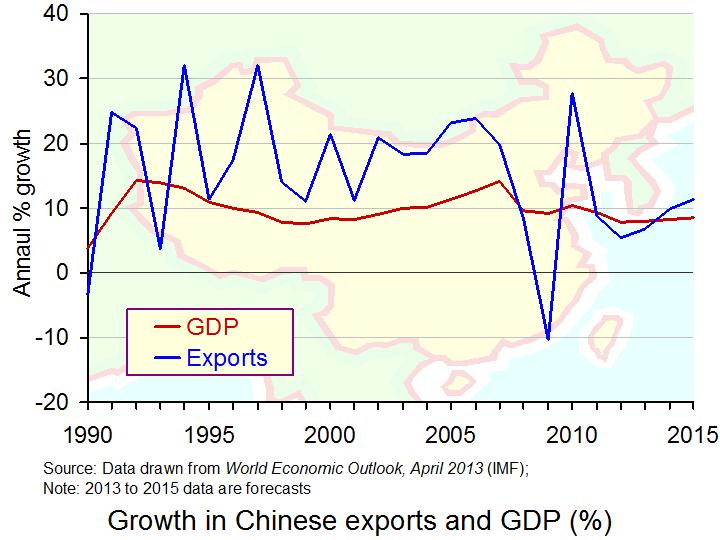 The Chinese economy has seemed relatively unaffected by the economic downturn, yet its economic growth has slowed. Averaging over 10% per annum for the last decade, the growth for January – March 2013 was only 7.7%. This is a decline on the previous 3 months and is lower than expected. If the Chinese economy does begin to slow (relatively speaking), this could present the global economic recovery with an unwelcome obstacle.
Many Western economies are reliant on exports to boost their growth figures and with such high demand in China, this is a key export market for many countries. If the Chinese economy continues to slow, consumer spending may even fall and this could mean a reduction in Chinese imports: that is, a reduction in other countries’ exports to China. However, for China’s competitors, the news is better, as with China’s move from a low to middle-income country, other countries will now see an opportunity to grasp a competitive advantage in the production of cheaper products. David Rees from Capital Economics said:
Trade data show that Chinese imports of commodities, and industrial metals in particular, have been falling in recent months … That is bad news for those emerging markets in Latin America, the Middle East, and Africa that predominately export commodities to China. It is not all bad news … To the extent that China’s structural slowdown reflects its transition from low to middle-income status, opportunities will present themselves for other EMs as China moves up the value chain. We are particularly upbeat on the manufacturing-based economies of South East Asia, along with Mexico, Poland, and Turkey.
News is better in Japan, where growth forecasts have been raised to 2.9% over the same period and the economy is expected to grow by 1.5% throughout both 2013 and 2014. Furthermore, suggestions that inflation may also reach 0.7% have boosted confidence. This might be the end of Japan’s troubles with deflation.
So, we have something of a mixed picture across the world, although the IMF predicts a global rate of growth of 3.5% for 2013, which would be an improvement on 2012 figures. The following articles consider the global situation.
Spain slashes economic growth forecast Sky News (26/4/13)
UK avoids triple-dip recession with better than expected 0.3% GDP growth The Guardian, Heather Stewart (26/4/13)
US economy grows 2.5% on buoyant consumer spending BBC News (26/4/13)
Poor French and Spanish jobs data but UK economy returns to growth – as it happened The Guardian, Graeme Wearden and Nick Fletcher (25/4/13)
UK economy avoids tiple-dip recession with 0.3pc GDP growth The Telegraph, Szu Ping Chan (25/4/13)
South Korea economic growth hits two year high BBC News (25/4/13)
S. Korea economy grows at the fastest pace in two years Bloomberg, Eunkyung Seo (25/4/13)
Spain revises down its economic forecast BBC News (26/4/13)
US economy sees broad growth Financial Times, Robin Harding (25/4/13)
Germany’s private sector shrinks as Eurozone decline continues – as it happened The Guardian, Graeme Wearden and Nick Fletcher (23/4/13)
China economic growth lower than forecast BBC News (15/4/13)
China’s slowing economy: what you need to know Bloomberg Business Week, Dexter Roberts (25/4/13)
Modest Growth Pickup in 2013, Projects IMF International Monetary Fund (23/1/13)
Questions
- How is economic growth measured?
- What is meant by a triple-dip recession?
- What has caused the small increase in growth in the UK? Do you think this signifies the start of the economic recovery?
- In the USA, what has caused the growth rate to reach 2.5% and why is it lower than expected?
- Why are growth rates in countries across the world relevant for UK forecasts of economic growth?
- Which factors have allowed the Chinese economy to achieve average growth rates above 10% for the past decade?
- Using an AD/AS diagram, illustrate the desired impact of the Coalition’s policies to boost economic growth.
- With unemployment rising in countries like Spain and France, how might Eurozone growth be affected in the coming months?
- Japanese growth is looking positive and inflation is expected to reach about 0.7%. Why is it that Japan has suffered from deflation for so many years and why is this a problem?
 An excellent learning exercise for students of economics is to take a journal article that uses data to model the economy and then try to replicate the authors’ results. You may well be given an assignment like this in future years of your degree.
One such exercise is used on the University of Massachusetts Amherst’s doctoral programme in economics. Thomas Herndon is a student on that degree and chose to examine a well-known and highly influential paper, Growth in a Time of Debt by Carmen Reinhart then of the University of Maryland and Kenneth Rogoff of Harvard University and former chief economist of the IMF. Professors Reinhart and Rogoff used new data on 44 countries spanning about 200 years.

A key finding of their paper, published in 2010 in the American Economic Review Papers and Proceedings, is that once a country’s government debt exceeds 90% of GDP, growth rates fall considerably: the median across countries by about 1% and the mean considerably more.
The paper has been hugely influential. It has been used to justify the austerity programmes being pursued in many countries, including the UK and the eurozone. Cutting the government deficit to GDP ratio, and ultimately the government debt to GDP ratio, has been seen as a way of achieving higher growth over the longer term, and justifies the adverse effect on short-term growth from the dampening of aggregate demand.
Well, this seemed an interesting paper for Thomas Herndon to examine, and he was keen to show just how Reinhart and Rogoff’s data led to their conclusions. But try as he might, he could not replicate their results. His initial reaction was to think he had made an error, but each time he checked he came back with the same conclusion: they must have made errors in their calculations.
His supervisor at Amherst, Professor Michael Ash, after Thomas had checked and checked again, realised that something was wrong. He encouraged Thomas to write to Reinhart and Rogoff to request sight of their dataset. They duly obliged and it was then that Thomas spotted various errors. These are explained in the articles below, but the overall effect was to alter the conclusion. Although high debt may undermine growth to some extent, the effect is much less than Reinhart and Rogoff concluded, and there are several exceptions to this rule.
On 15 April 2013, Thomas, along with his supervisor, Michael Ash and his colleague, Robert Pollin, published a response to the Reinhart and Rogoff paper. In the abstract to their paper, Does High Public Debt Consistently Stifle Economic Growth? A Critique of Reinhart and Rogoff they state that:
… coding errors, selective exclusion of available data, and unconventional weighting of summary statistics lead to serious errors that inaccurately represent the relationship between public debt and GDP growth among 20 advanced economies in the post-war period. They find that when properly calculated, the average real GDP growth rate for countries carrying a public-debt-to-GDP ratio of over 90 percent is actually 2.2 percent, not –0:1 percent as published in Reinhart and Rogoff. That is, contrary to RR, average GDP growth at public debt/GDP ratios over 90 percent is not dramatically different than when debt/GDP ratios are lower.
The authors also show how the relationship between public debt and GDP growth varies significantly by time period and country. Overall, the evidence we review contradicts Reinhart and Rogoff’s claim to have identified an important stylized fact, that public debt loads greater than 90 percent of GDP consistently reduce GDP growth.
So could this be you in the future? Will you take a famous paper and, by re-examining and reworking the data, find that its conclusions are wrong? Could you end up changing the world? Exciting stuff!
Podcasts
Austerity: A Spreadsheet Error? BBC, More or Less, Tim Harford (20/4/13)
Austerity justification study ‘inaccurate’ BBC Today Programme, Robert Pollin (18/4/13)
Articles
UMass Student Exposes Serious Flaws in Harvard Economists’ Influential Study The Atlantic Wire, J.K. Trotter (18/4/13)
Shocking Paper Claims That Microsoft Excel Coding Error Is Behind The Reinhart-Rogoff Study On Debt Business Insider, Mike Konczal (16/4/13)
How a student took on eminent economists on debt issue – and won Economic Times of India (19/4/13)
Meet the 28-Year-Old Grad Student Who Just Shook the Global Austerity Movement New York Magazine, Kevin Roose (19/4/13)
An economist’s mea culpa: I relied on Reinhart and Rogoff Confessions of a Supply-Side Liberal blog, Miles Kimball (22/4/13)
The Rogoff-Reinhart data scandal reminds us economists aren’t gods The Guardian, Heidi Moore (18/4/13)
Reinhart, Rogoff… and Herndon: The student who caught out the profs BBC News Magazine, Ruth Alexander (20/4/13)
George Osborne’s case for austerity has just started to wobble The Guardian, Polly Toynbee (18/4/13)
The error that could subvert George Osborne’s austerity programme The Guardian, Charles Arthur and Phillip Inman (18/4/13)
The Excel depression Sydney Morning Herald, Paul Krugman (19/4/13)
Europe: Retreat from austerity BBC News, Gavin Hewitt (23/4/13)
Guest post by Thomas Herndon
The Grad Student Who Took Down Reinhart And Rogoff Explains Why They’re Fundamentally Wrong Business Insider, Thomas Herndon (22/4/13)
Papers
Growth in a Time of Debt NBER working paper, Carmen M. Reinhart and Kenneth S. Rogoff (January 2010)
Does High Public Debt Consistently Stifle Economic Growth? A Critique of Reinhart and Rogo�ff PERI Working Paper 322, Thomas Herndon, Michael Ash and Robert Pollin (April 2013)
Questions
- What were the particular errors made by Reinhart and Rogoff?
- How has their paper been used as a basis for the design of macroeconomic policy?
- What are the limitations of using even accurate time-series data as the basis for policy measures?
- How might the work of Herndon change the direction of future macroeconomic policy?
- In his guest post in Business Insider (see link above), Herndon wrote: ‘The implication for policy is that, under particular circumstances, public debt can play a key role in overcoming a recession.’ What might this role be?
- Why might we have to be cautious in drawing policy conclusions from Herndon’s work?