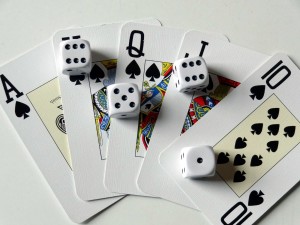
 John Von Neumann was a mathematician and one of his many accolades was applying mathematics and his observations of traditional games to create a new discipline – Game Theory. This involves a mathematical approach to decision making whereby different strategies can be assessed. It a tool that not only can be used in Economics, but also can be applied to a broad range of areas and fields of study.
Just as I arrived at work, I was listening to Radio 4 and heard the introduction to the programme In our Time. This one in particular caught my attention because of the name mentioned – Von Neumann, and after arriving in my office I then listened to the discussions surrounding game theory.
The main link is to the discussion from BBC Radio 4, led by Melvyn Bragg, with guests: Ian Stewart, a Professor of Mathematics from the University of Warwick; Andrew Colman, a Professor of Psychology at the University of Leicester and Richard Bradley, a Professor of Philosophy from the LSE. I’ll keep it brief and simply say enjoy!
Podcast
 Game Theory (also at) BBC Radio 4, In our Time, Melvyn Bragg (10/5/12) (Programme details)
Articles
Game Theory cannot predict broadcasting future Financial Times, Andrew Edgecliffe-Johnson (4/5/12)
Game Theory, in the real world Phys Org (2/5/12)
Questions
- What is game theory? How is mathematics relevant here?
- The discussion talks about co-operative and non co-operative games. What is the difference between them?
- In the game – walking down the street – draw out the matrix and show whether a Nash equilibrium exists.
- Draw out the matrix for the game ‘Rock, Paper, Scissors’. How can game theory be applied to this game? What is the best strategy to win this game? Can there be a winner?
- Draw out the matrix for the problem of littering when it is non co-operative. Is there a Nash equilibrium?
- What is the Prisoner’s Dilemma? Give some examples of it. Explain why it is an example of a dominant strategy game.
- How is game theory relevant to broadcasting? Think about the role of auctions and also the information given in the Financial Times article.
- Explain how game theory is relevant to the Cold War.
Ministers from around the world met in Durban in the first two weeks of December 2011 to hammer out a deal on tackling climate change. The aim was that this would replace the Kyoto Treaty, due to expire at the end of 2012.
International climate change agreements are particularly difficult to achieve, as there are several market failures involved. Also, there is considerable ‘gaming’, as each country seeks to negotiate a deal that benefits the world as a whole but which minimises the disadvantages to their own particular country.
The conference ended on the 11 December with a last-minute deal. Both developed and developing countries would for the first time work on a legally binding agreement to limit emissions. This would be drawn up by 2015 and to come into force after 2020. The following articles assess the significance of the agreement and whether it represents real progress or little more than a deal to work on a deal.
Articles
‘Modest’ gains as UN climate deal struck Independent (11/12/11)
Landmark deal saves climate talks Irish Examiner (11/12/11)
Durban climate change: the agreement explained The Telegraph, Louise Gray (11/12/11)
Durban climate conference agrees deal to do a deal – now comes the hard part Guardian, Fiona Harvey and Damian Carrington (13/12/11)
Climate deal: A guarantee our children will be worse off than us Guardian, Damian Carrington (11/12/11)
Durban climate deal: the verdict Guardian, Damian Carrington (12/12/11)
Australia hails Cop 17 agreement News 24 Australia (11/12/11)
Climate talks reach new global accord Financial Times, Andrew England and Pilita Clark (11/12/11)
Durban Climate Talks Produce Imperfect Deals Voice of America, Gabe Joselow (11/12/11)
Critics slam climate agreement t Sydney Morning Herald, Arthur Max (11/12/11)
Deal at last at UN climate change talks Euronews on YouTube (11/12/11)
World still in arrears on climate change pledges Reuters Africa, Barbara Lewis (11/12/11)
New UN climate deal struck, critics say gains modest Hindustan Times (11/12/11)
Climate change: ambition gap Guardian (12/12/11)
Canada leaves Kyoto to avoid heavy penalties Financial Times, Bernard Simon (13/12/11)
Durban Platform Leaves World Sleepwalking Towards Four Degrees Warming Middle East North Africa Financial Network, Ben Grossman-Cohen and Georgette Thomas (Oxfam) (13/12/11)
A deal in Durban The Economist (11/12/11)
Assessing the Climate Talks — Did Durban Succeed? Harvard University – Belfer Center for Science and International Affairs – An Economic View of the Environment, Robert Stavins (12/12/11)
Questions
- What was agreed at the Durban Climate Change Conference?
- Why is it difficult to get agreement on measures to tackle climate change? How is game theory relevant to explaining the difficulties in reaching an agreement?
- How would you set about establishing the ‘optimal’ amount of emissions reductions?
- Why will the market fail to provide the optimal amount of emissions reductions?
- Why was it felt not possible for a legally binding international agreement to come into force before 2020?
Well they say that a day is a long-time in politics – that an awful lot can happen within 24 hours. The two days of the G20 summit have seemed like a lifetime. The meeting took place in Cannes from 3 to 4 November, 2011. It was the sixth such meeting of the G20: the 19 largest developed and developing countries plus the European Union.
As chair of the meeting, President Sarkozy of France had planned to address the two key global issues of securing a sustained global recovery and strengthening the global banking system. He also wanted to address other issues, such as climate change, commodity price volatility, social inclusion, corruption and corporate governance. But although these issues are covered in the final communiqué, what took centre-stage for the whole summit was the crisis in Greece and its impact on the eurozone.
The drama began on Monday 31 October. The Greek Prime Minister, George Papandreou, decided to call a referendum on the agreement reached at the eurozone summit in Brussels the previous week. In return for banks being required to take a loss of 50% in converting existing Greek bonds into new ones, Greece would have to continue with its tough austerity measures: measures that have caused the Greek economy to implode.
With worries that (a) the referendum would create several weeks of uncertainty, (b) that the agreement might then be rejected, (c) that the government might fall, stock markets plunged. French and German markets fell by over 5%. The Athens stock market fell by 7 per cent. The yield on Italian bonds passed 6%, amidst fears that if Greece defaulted, so too might Italy. But if the eurozone could survive a Greek default, it might not survive an Italian one. Even though several members of Mr. Papandreou’s Pasok party demanded his resignation, he stuck to his guns that an agreement had to have the consent of the Greek people. That was Tuesday.
The next day, Wednesday, was the start of the two-day G20 conference. What was to have been a meeting addressing wider issues of the global economy, was now having to focus on the Greek crisis. President Sarkozy and Chancellor Merkel made it clear that the next tranche of bailout money to Greece would not be paid until the deal agreed in Brussels was accepted by Greece. They gave the first indications that they might accept Greece’s withdrawal from the eurozone.
On Thursday afternoon, Mr Papandreou signalled that he would back down from the referendum if the opposition New Democracy party would join him in supporting the Brussels deal. He would not resign. But the opposition leader, Antonis Samaras, said that his party would not join with Mr Papandreou and that the Prime Minister should indeed resign. He did not resign, but abandoned the calll for a referendum.
With the Greek crisis dominating the meeting, little concrete agreement was reached. One important outcome, however, was the recognition that the financing of the IMF should be strengthened. As the final communiqué states:
We will ensure the IMF continues to have resources to play its systemic role to the benefit of its whole membership, building on the substantial resources we have already mobilized since London in 2009. We stand ready to ensure additional resources could be mobilised in a timely manner and ask our finance ministers by their next meeting to work on deploying a range of various options including bilateral contributions to the IMF, SDRs, and voluntary contributions to an IMF special structure such as an administered account. We will expeditiously implement in full the 2010 quota and governance reform of the IMF.
But despite this recognition of the key role of the IMF, the agreement was essentially that an agreement would be needed!
Articles
Eurozone crisis: yet another twist to Greek farce keeps leaders on edge of seats The Telegraph (4/11/11)
G20 summit: the main issues at Cannes The Telegraph (3/11/11)
Quick! More sandbags (filled with cash) The Economist, Charlemagne’s notebook (4/11/11)
The burning fuse The Economist, Charlemagne’s notebook (4/11/11)
G20 leaders agree to boost IMF resources BBC News (4/11/11)
G20 summit fails to allay world recession fears Guardian, Patrick Wintour and Larry Elliott (4/11/11)
G20 summit: roll call of doom for a dysfunctional family Guardian, Angelique Chrisafis (3/11/11)
Euro zone finds no new money for debt crisis at G20 The Economic Times of India (4/11/11)
Shares jump after referendum ditched New Zealand Herald (5/11/11)
Bunds rise on EFSF worries, Italy under pressure Reuters (4/11/11)
Eurozone crisis: The possible resolutions BBC News (4/11/11)
The G20 aren’t running to Europe’s rescue BBC News blogs, Stephanie Flanders (4/11/11)
Is the euro about to capsize? BBC News, Laurence Knight (4/11/11)
Final Communiqué
Meeting of Finance Ministers and Central Bank Governors: final communiqué G20–G8 France 2011 (4/11/11)
Questions
- Why might the ‘game’ between the eurozone leaders and George Papandreou be seen as a prisoner’s dilemma game? What are the payoffs?
- Why might increasing the bailout for Greece represent a moral hazard for the eurozone leaders?
- Trace through market reactions between the 31 October and the 4 November and explain the movements.
- How crucial is the IMF in achieving global stability and economic growth?
- Assess the success of the Cannes G20 conference.
The possibility of currency and trade wars and how to avert them were major topics at the G20 meeting in Seoul on 11 and 12 November 2010. Some countries, such as the USA and the UK have been running large current account deficits. Others, such as China, Germany and Japan have been running large current account surpluses. But balance of payments accounts must balance. Thus there have been equal and opposite imbalances on the financial plus capital accounts. Large amounts of finance and capital have flowed from the trade-surplus to the trade-deficit countries. In particular China holds a vast amount of US dollar assets: a debt for the USA.
The trade and finance imbalances are linked to exchange rates. The USA has accused China of keeping its exchange rate artificially low, which boosts Chinese exports and further exacerbates the trade and finance imbalances. The USA is keen to see an appreciation of the Chinese yuan (also known as the renminbi). The Chinese response is that the USA is asking China to take medicine to cure America’s disease.
So was the meeting in Seoul successful in achieving a global response to trade and exchange rate problems? Has it averted currency and trade wars? Or were national interests preventing a concrete agreement? The articles look at the outcomes of the talks.
Articles
G20 pledge to avoid currency war gets lukewarm reception Guardian, Phillip Inman and Patrick Wintour (12/11/10)
G20 fails to agree on trade and currencies Financial Times, Chris Giles, Alan Beattie and Christian Oliver (12/11/10)
Main points of the G20 Seoul summit document Reuters (12/11/10)
Factbox: Outcome of the Seoul G20 summit Reuters (12/11/10)
No deal: Seoul’s G20 summit fails to deliver on currencies, trade imbalances The Australian, Laurence Norman and Ian Talley, Dow Jones Newswires (12/11/10)
G20 to tackle US-China currency concerns BBC News (12/11/10)
The expectations game BBC News blogs: Stephanomics, Stephanie Flanders (12/11/10)
Obama: Imbalances threaten growth BBC News (12/11/10)
Obama leaves G-20 empty-handed on currency spat msnbc (12/11/10)
The ghost at the feast The Economist, Newsbook blog (12/11/10)
Forget summit failures, look at G20 record Financial Times, Christian Oliver, Chris Giles and Alan Beattie (12/11/10)
Obama warns nations not to rely on exports to US BBC News (13/11/12)
G20 summit distracted by ‘currency wars’ Guardian, Mark Weisbrot (12/11/10)
Current account targets are a way back to the future Financial Times podcasts, Martin Wolf (2/11/10) (Click here for transcript)
Ben Bernanke hits back at Fed critics BBC News (19/11/10)
Why should you care about currency wars? BBC News, Stephanie Flanders (9/11/10)
G20 sites
G20 Korea, home page
Korean G20 site
2010 G-20 Seoul summit Wikipedia
Questions
- What are the causes of the large trade imbalances in the world?
- What problems arise from large trade imbalances?
- What is meant by beggar-my-neighbour policies?
- Are moves towards freer trade a zero-sum game? Explain.
- Are moves towards protectionism a zero-sum game? Explain.
- Are attempts to get a realignment of currencies a zero-sum game? Explain.
- How successful has the G20 been over the past two or three years?
- Would it be desirable for governments to pursue current account targets?
In 2003, the Office of Fair Trading launched an investigation into possible collusion between tobacco manufacturers and retailers to fix prices. The investigation sought to establish whether the firms had breached the Chapter I prohibition of the Competition Act 1998. Chapter I is concerned with Restrictive Practices.
The allegation was that two tobacco manufacturers, Imperial Tobacco and Gallaher, had colluded with 11 retailers to fix the retail prices and thereby reduce competition. The details of the allegations are given in a 2008 press release.
As a result of its investigations, the OFT has decided to impose fines of £225m. “The OFT has concluded that each manufacturer had a series of individual arrangements with each retailer whereby the retail price of a tobacco brand was linked to that of a competing manufacturer’s brand. These arrangements restricted the ability of these retailers to determine their selling prices independently and breached the Competition Act 1998.” As the Times Online article states:
The OFT said that the companies were guilty of “price-linking” or “price matching”. It said that Imps and Gallaher had come to an arrangement with each retailer that if one or other manufacturer increased or decreased prices the retailer would alter the price of the competitor brand in line, up or down accordingly – a practice known in competition law circles as “vertical price collusion”.
Articles
‘Unlawful’ tobacco pricing leads to £225m fine by OFT BBC News (16/4/10)
OFT levies £225m fine for cigarette price fixing Guardian, Richard Wray (17/4/10)
Tobacco giants face £225m fine for price-fixing Independent, Alistair Dawber
(17/4/10)
OFT case will send smoke signals Financial Times, Michael Peel, Elizabeth Rigby and Pan Kwan Yuk (16/4/10)
Imperial and Morrison set to appeal OFT fine Financial Times, Michael Peel, Pan Kwan Yuk and Elizabeth Rigby (16/4/10)
OFT faces challenge to £225m price-fixing ruling Times Online, Robert Lea (17/4/10)
OFT gets tough on tobacco as price-fixing net is cast wider Independent, Nick Clark (26/4/08)
OFT Press Release
OFT imposes £225m fine against certain tobacco manufacturers and retailers over retail pricing practices OFT Press Release (16/4/10)
Questions
- What are the allegations against the tobacco manufacturers and retailers?
- Why has the OFT judged that such behaviour is in breach of the 1988 Competition Act, and hence against the public interest?
- What are the arguments put by the tobacco companies and retailers in their defence?
- Is giving companies an amnesty if they alert the OFT an example of a prisoners’ dilemma game? What credible threats or promises may the companies have in such a situation?
 John Von Neumann was a mathematician and one of his many accolades was applying mathematics and his observations of traditional games to create a new discipline – Game Theory. This involves a mathematical approach to decision making whereby different strategies can be assessed. It a tool that not only can be used in Economics, but also can be applied to a broad range of areas and fields of study.