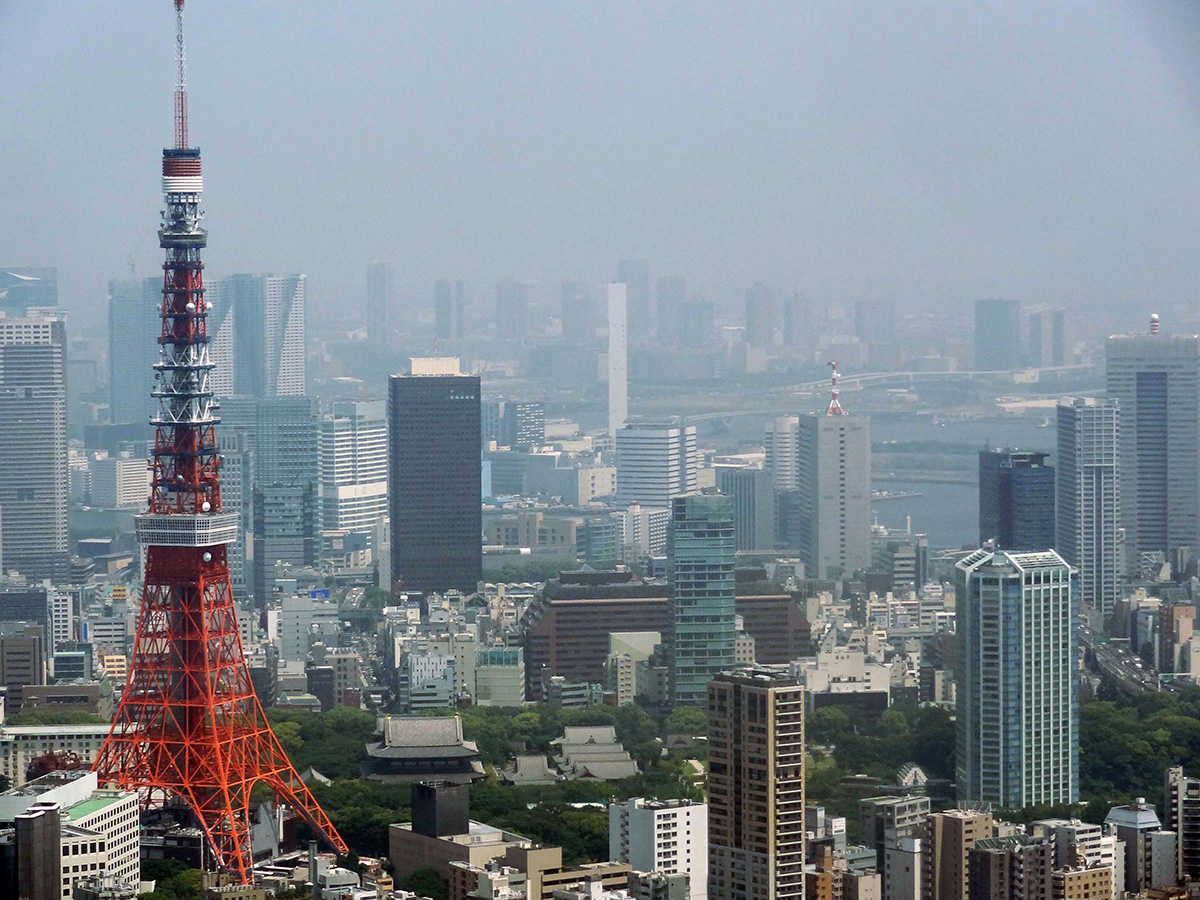
 Since coming to office two years ago, Shinzo Abe’s government has been determined to revive the Japanese economy. The policy has involved ‘three arrows‘: expansionary fiscal policy, expansionary monetary policy and supply-side reforms. But figures just out show that the Japanese economy is back in recession. The economy shrank by 0.4% in quarter 3, having shrunk by 1.9% in quarter 2.
This has come as a huge disappointment for Mr Abe, who has staked his political reputation on escaping from deflation and achieving sustained economic growth. In response, he has called a general election to put a revised economic plan to the electorate.
The main cause of the reversal into recession has been an increase in the sales tax on all goods, which has dampened spending. The tax rise, planned by the previous government, was to help reduce the deficit and start tackling the huge public-sector debt, which, at over 230% of GDP, is by far the highest in the developed world. Another rise in sales tax is due in October 2015 – from 8% to 10%. Mr Abe hopes to cancel the rise and it is this that he may put to the electorate.
So what is the outlook for Japan? Will quarter 4 show economic growth, or will pessimism have set in? Will the Bank of Japan introduce even more quantitative easing, or will it wait for the latest increase in QE to take effect (see the blog post, All eased out: at least for the USA and UK)?
The following articles look at the implications of the latest news, both for Japan and globally, and at the options for the government and central bank.
Articles
Japanese economy falls into surprise recession Independent, Maria Tadeo (17/11/14)
Japan’s economy makes surprise fall into recession BBC News (17/11/14)
Coming to a crunch: Time is running out for Abenomics The Economist (20/11/14)
Japan’s economy: Delay the second consumption tax hike The Economist (17/11/14)
Defying Expectations, Japan’s Economy Falls Into Recession New York Times, Jonathan Soble (16/11/14)
Japan shocks as economy slips into recession CNBC, Li Anne Wong (17/11/14)
Japan Unexpectedly Enters Recession as Abe Weighs Tax: Economy Bloomberg, Keiko Ujikane and Toru Fujioka (17/11/14)
The world should be wary: Japan’s economic woes are contagious The Guardian, Larry Elliott (17/11/14)
Why is Japan heading to the polls? BBC News (18/11/14)
Previous news items on this site
A new economic road for Japan? (January 2013)
A J-curve for Japan? (May 2013)
Japan’s three arrows (June 2013)
Abenomics – one year on (December 2013)
Japan’s recovery (January 2014)
Japan’s CPI: An Update (May 2014)
All eased out: at least for the USA and UK (November 2014)
Data
Quarterly Estimates of GDP Japanese Cabinet Office
Japan and the IMF IMF Country Reports
Economic Outlook Annex Tables OECD
Questions
- Give details of the Japanese government’s three arrows.
- Discuss the pros and cons of the rise in the sales tax. Is it possible for the rise in the sales tax to increase the size of the public-sector deficit?
- What have been the effects of Japanese government policies on (a) prices of goods and services; (b) living standards; (c) asset prices?
- Who have been the gainers and losers of the policies?
- How is the Japanese situation likely to effect the value of the yen? How is this, in turn, likely to affect its trading partners? Could this set off a chain reaction?
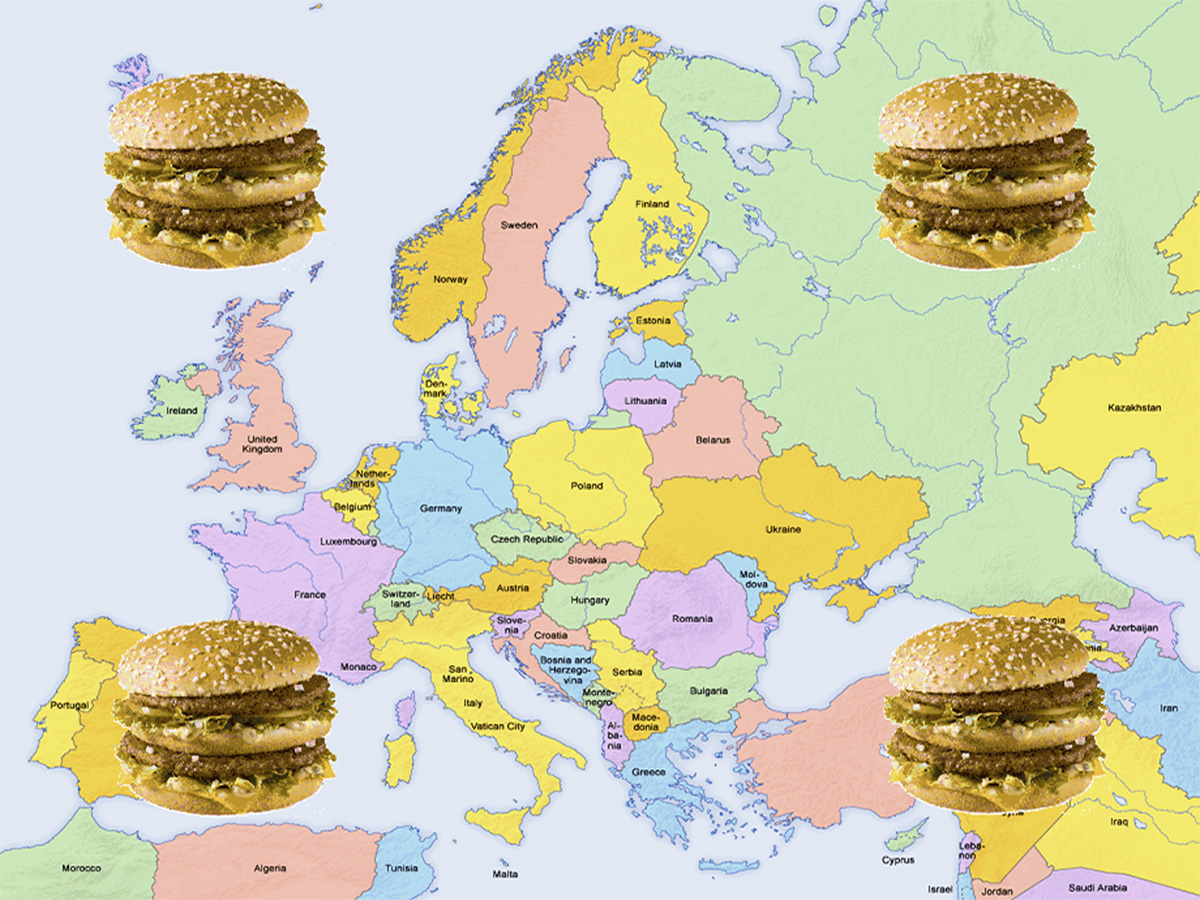
 At least once a year The Economist publishes its ‘hamburger standard’ exchange rates for currencies. It is a light-hearted attempt to see if currencies are exchanging at their purchasing-power parity rates. The test is the price at which a ‘Big Mac’ McDonald’s hamburger sells in different countries!
According to this simplified version of the purchasing-power parity theory, exchange rates should adjust so that a Big Mac costs the same in dollars everywhere (see Economics 8th edition Box 25.4).
These Big Mac exchange rates can be used to compare various prices and incomes between countries. The article linked below from The Guardian compares minimum wages between European countries in Big Mac terms.
There are 25 countries across Europe which have minimum wages. A clear pattern of minimum wage rates can be seen: although actual exchange rates understate the purchasing power of incomes in poorer European countries compared to richer ones, minimum wages, even in purchasing-power standard terms, are still higher in the richer countries.
Luxembourg’s minimum wage buys you just about three Big Macs in an hour, while most of northern Europe (and France) between 2–2.5 Big Macs. Moving south, the minimum wage nets about one Big Mac an hour. As we progress east, it begins to cost more than an hour of work on the minimum wage in order to afford a Big Mac.
Of course, there are other factors determining the dollar price of a Big Mac other than the failure of exchange rates to reflect purchasing-power parities. Nevertheless, using the Big Mac index in this way does give a useful preliminary snap shot of differences in what minimum wages can buy in different countries.
Articles
Comparing the minimum wage across Europe using the price of a Big Mac The Guardian datablog, Alberto Nardelli (25/9/14)
Minimum wage statistics Eurostat (Sept/14)
Data
Earnings Database Eurostat
Questions
- What is meant by ‘purchasing-power parity exchange rates’?
- Why may actual exchange rates not accurately reflect the purchasing power of currencies within countries?
- Using the link to Eurostat article above, compare Big Mac minimum wages with (a) actual minimum wages and (b) minimum wages expressed in purchasing-power standard terms.
- Using the links to the Eurostat article and Eurostat data, describe how the proportion of employees earning minimum wages varies across European countries. What factors determine this proportion?
- Using the same links, describe how the monthly minimum wage as a proportion of average monthly earnings varies across European countries. Explain these differences.
 In August 2012, the ECB president, Mario Draghi, said that the ECB would ‘do whatever it takes‘ to hold the single currency together and support the weaker economies, such as Greece, Portugal and Spain. At the same time, he announced the introduction of outright monetary purchases (OMTs), which would involve purchasing eurozone countries’ bonds in the secondary markets. There were no limits specified to such purchases, but they would be sterilised by the sale of other assets. In other words, they would not increase the eurozone money supply. But despite the fanfare when OMTs were announced, they have never been used.
Today, the eurozone economy is struggling to grow. The average annual growth rate across the eurozone is a mere 0.5%, albeit up from the negative rates up to 2013 Q3. GDP is still over 2% below the peak in 2008. Inflation is currently standing at 0.8%, well below the 2% target. The ECB’s interest rate (‘main refinancing operations rate’) is 0.25%.
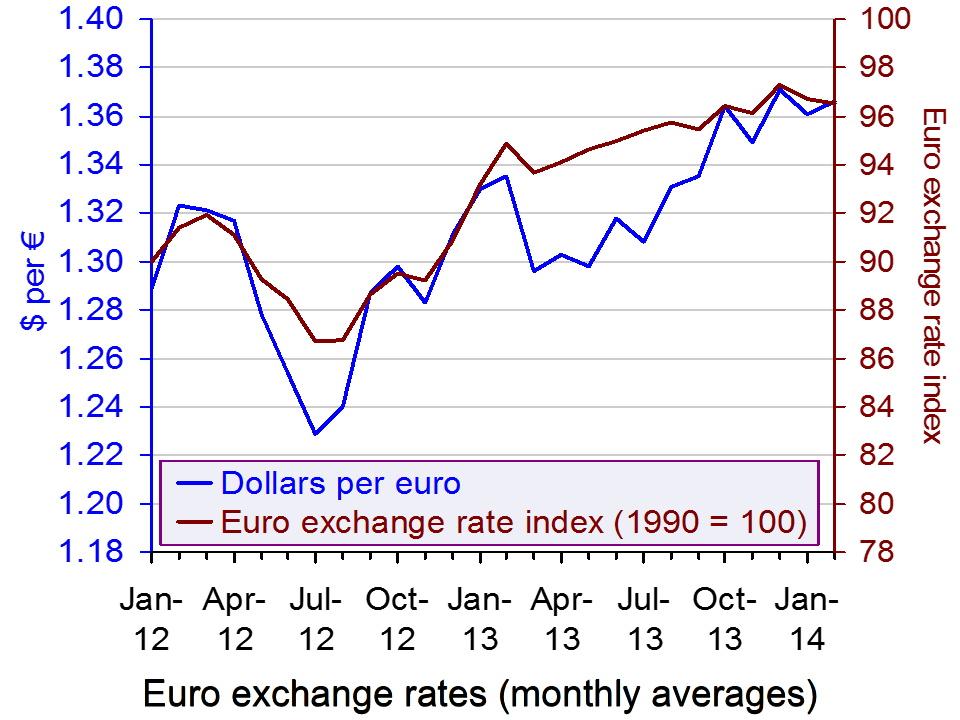
The recovery is hindered by a strong euro. As the chart shows, the euro has been appreciating against the dollar. The euro exchange rate index has also been rising. This has made it harder for the eurozone countries to export.
So what can the ECB do to stimulate the eurozone economy? Other central banks, such as the Bank of England, the US Federal Reserve and the Bank of Japan have all had substantial programmes of quantitative easing. The ECB has not. Perhaps OMTs could be used without sterilisation. The problem here is that there are no eurozone bonds issued by the ECB and hence none that could be purchased, only the bonds of individual member countries. Buying bonds of weaker countries in the eurozone would be seen as favouring these countries and might create a moral hazard.
Reducing interest rates is hardly an option given that they are at virtually zero already. And expansionary fiscal policy in the weaker countries has been ruled out by having to stick to the bailout conditions for these countries, which require the pursuit of austerity policies.
One possibility would be to intervene in the foreign currency market by buying US and other countries’ bonds. This would drive down the euro and provide a stimulus to exports. This option is considered in the Jeffrey Frankel article.
Articles
Why the European Central Bank should buy American The Guardian, Jeffrey Frankel (13/3/14)
Draghi holds course in face of deflation threat Reuters, Paul Carrel and Leika Kihara (13/3/14)
ECB’s Draghi: Strong Euro Pulling Down Euro Zone Inflation Wall Street Journal, Christopher Lawton and Todd Buell (13/3/14)
Draghi Bolstering Guidance Seen as Convincing on Rates Bloomberg, Jeff Black and Andre Tartar (13/3/14)
ECB president Mario Draghi counters euro upswing Financial Times, Claire Jones (13/3/14)
Turning Japanese? Euro zone exporters must hope not Reuters, Neal Kimberley (14/3/14)
Prospect of ECB QE drives eurozone bond rally Financial Times, Laurence Mutkin (12/3/14)
Data
Statistical Data Warehouse ECB
Winter forecast 2014 – EU economy: recovery gaining ground European Commission: Economic and Financial Affairs DG
AMECO online European Commission: Economic and Financial Affairs DG
Questions
- Why is the ECB generally opposed to quantitative easing of the type used by other central banks?
- What is meant by ‘sterilisation’? Why does sterilisation prevent OMTs being classed as a form of quantitative easing?
- Would it be possible for OMTs to be used without sterilisation in such as way as to avoid a moral hazard for the highly indebted eurozone countries?
- Is the eurozone in danger of experiencing deflation?
- What are the dangers of deflation?
- Why does the ECB not cut its main refinancing rate below zero?
- If the ECB buys US bonds, what effect would this have on the euro/dollar exchange rate?
- Would purchasing US bonds affect the eurozone money supply? Explain.
- What other means are there of the ECB stimulating the eurozone economy? How effective would they be likely to be?
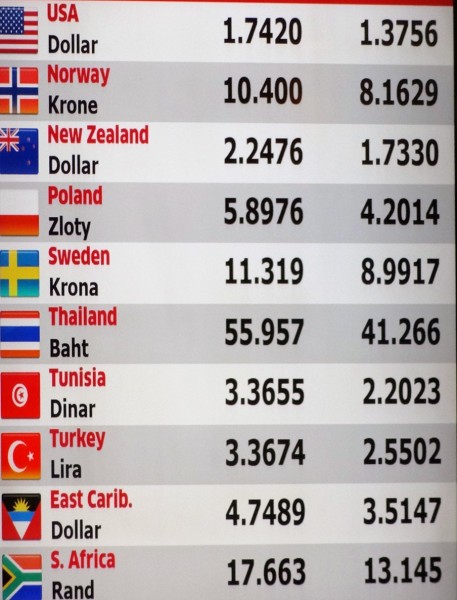 According to latest evidence from the Bank for International Settlements, in April 2013 some £3.2 trillion ($5.3 trillion) of foreign exchange was traded daily on global foreign exchange (forex) markets. About 40% of forex dealing goes through trading rooms in London. This market is highly profitable for the UK economy. But all is not well with the way people trade. There is a scandal about rate fixing.
Exchange rates on the forex market are freely determined by demand and supply and fluctuate second by second, 24 hours a day, except for weekends. Nevertheless, once a day rates are fixed for certain trades. At 4pm GMT a set of reference rates is set for corporate customers by banks and other traders. The rates are set at the free market average over the one minute from 16:00 to 16:01. The allegation is that banks have been colluding, through text messaging and chat rooms, to manipulate the market over that one minute.
Since the early summer of 2013, the Financial Conduct Authority (FCA) in the UK, along with counterparts in the USA, Switzerland, Hong Kong and elsewhere, has been looking into these allegations. Last week (4/3/14), the Bank of England suspended a member of its staff as part of its own investigation into potential rigging of the foreign exchange market. The allegation is not that the staff member(s) were involved in the rigging but that they might have known about it.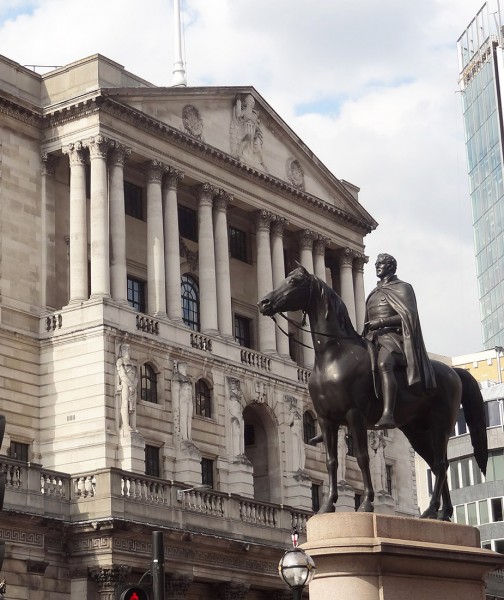 The Bank said that, “An oversight committee will lead further investigations into whether bank officials were involved in forex market manipulation or were aware of manipulation, or at least the potential for such manipulation.”
Meanwhile, the House of Commons Treasury Select Committee has been questioning Bank of England staff, including the governor, Mark Carney, about the scandal. Speaking to the Committee, Martin Wheatley, head of the FCA said that the investigation over rigging had been extended to 10 banks and that the allegations are every bit as bad as they have been with Libor.
Forex rigging ‘as serious as’ Libor scandal: Carney Yahoo News, Roland Jackson (11/2/14)
Forex manipulation: How it worked HITC (Here Is The City), Catherine Boyle (11/3/14)
Bank of England Chief Grilled Over Forex Scandal ABC News, Danica Kirka (11/3/14)
Carney Faces Grilling as Currency Scandal Snares BOE Bloomberg, Scott Hamilton and Suzi Ring (10/3/14)
UK financial body urges quick action over foreign exchange ‘fixing’ Reuters, Huw Jones (11/3/14)
Timeline -The FX “fixing” scandal Reuters, Jamie McGeever (11/3/14)
Forex in the spotlight Financial Times (16/2/14)
Forex scandal: What is that all about? BBC News (11/3/14)
 Bank of England in shake-up after rate manipulation criticism BBC News (11/3/14)
Mark Carney faces Forex questions from MPs BBC News, Hugh Pym (11/3/14)
Bank of England’s Paul Fisher: ‘It’s not our job to go hunting for market wrongdoing’ Independent, Russell Lynch , Ben Chu (11/3/14)
Questions
- For what reasons would sterling appreciate against the dollar?
- Most of forex trading is for speculative purposes, rather than for financing trade or investment. Why is this and does it benefit international trade?
- If foreign exchange rates fluctuate, is it not a good thing that banks collude to agree the 4pm fixed rate? Explain.
- What was the Libor scandal? Why are some people arguing that the current forex scandal is worse?
- What can the FCA do to prevent collusion over exchange rates?
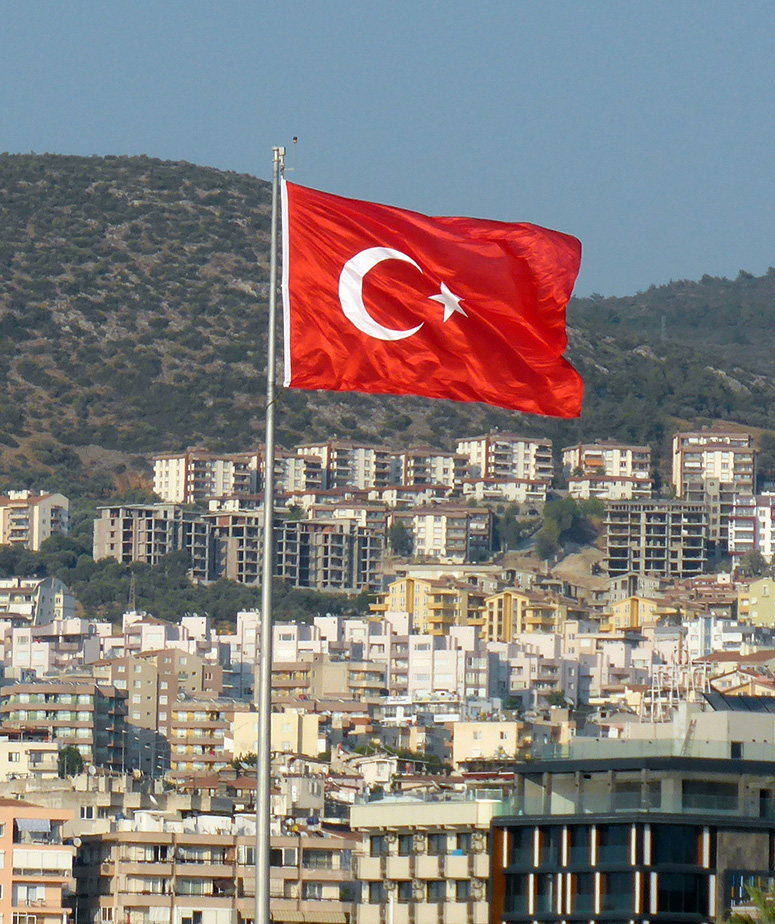 World markets were taken by surprise by a large rise in Turkish interest rates on 28/1/14. In an attempt to combat a falling lira and rising inflation, the Turkish central bank raised its overnight lending rate from 7.75% to 12%. Following the decision, the lira appreciated by over 3%.
Since the start of this year, the Turkish lira had depreciated by 7.1% and since the start of 2013 by 22.8%. Along with the currencies of several other emerging economies, such as India and Brazil, speculators had been selling the Turkish currency. This has been triggered by worries that the Fed’s tapering off its quantitative easing programme would lead to a fall, and perhaps reversal, of the inflow of finance into these countries; in the worst-case scenario it could lead to substantial capital flight.
Consumer price inflation in Turkey is currently 7.4%, up from 6.2% a year ago. The central bank, in a statement issued alongside the interest rate rise, said that it would continue with a tight monetary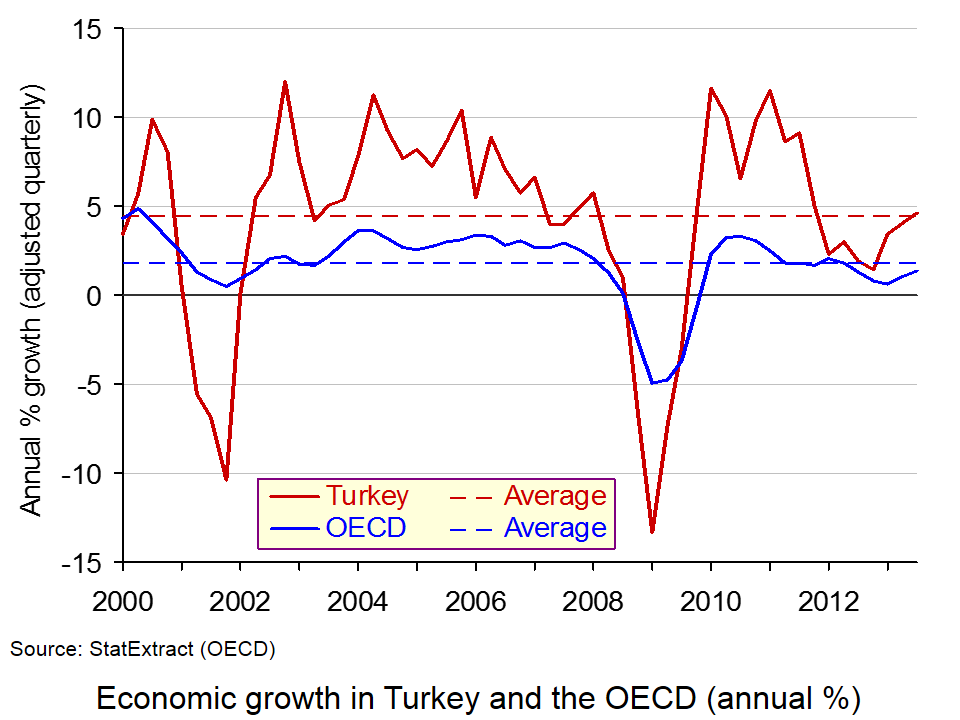 policy until the inflation outlook showed a clear improvement.
The Turkish Prime Minister, Tayyip Erdogan, has been opposed to rises in interest rates, fearing that the dampening effect on aggregate demand would reduce economic growth, which, as the chart shows, has been recovering recently (click here for a PowerPoint of the chart). A slowing of growth could damage his prospects in forthcoming elections.
World stock markets, however, rallied on the news, seeing the rise in interest rates as a symbolic step in emerging countries stemming outflows of capital.
Articles
Turkey raises interest from 7.75pc to 12pc The Telegraph (28/1/14)
Emerging markets forced to tighten by US and Chinese monetary superpowers The Telegraph, Ambrose Evans-Pritchard (28/1/14)
Turkey Gets Aggressive on Rates The Wall Street Journal, Joe Parkinson (28/1/14)
Turkish central bank raises lending rate to 12% BBC News (28/1/14)
Asian stock markets stage relief rally after Turkey rate rise BBC news (29/1/14)
Turkey raises rates to halt lira’s slide Financial Times, Daniel Dombey (29/1/14)
Turkey Rate Increase Stems Lira Drop as Basci Defies Erdogan Bloomberg Businessweek, Onur Ant and Taylan Bilgic (29/1/14)
Fragile economies under pressure as recovery prompts capital flight The Observer, Angela Monaghan (2/2/14)
Data
Main Economic Indicators (including Turkish data) OECD
Data on Turkey, World Economic Outlook database IMF
Turkey price indices Central Bank of the Republic of Turkey
Questions
- Why did the Turkish central bank decide to raise interest rates by such a large amount?
- Why has the Turkish lira been depreciating so much over the past few months? How has this been linked to changes in Turkey’s balance of payments and what parts of the balance of payments account have been affected?
- Why did global stock markets rally on the news from Turkey?
- What will be the impact of the central bank’s actions on (a) inflation; (b) economic growth?
- How has the USA’s quantitative easing programme affected developing countries?
 Since coming to office two years ago, Shinzo Abe’s government has been determined to revive the Japanese economy. The policy has involved ‘three arrows‘: expansionary fiscal policy, expansionary monetary policy and supply-side reforms. But figures just out show that the Japanese economy is back in recession. The economy shrank by 0.4% in quarter 3, having shrunk by 1.9% in quarter 2.