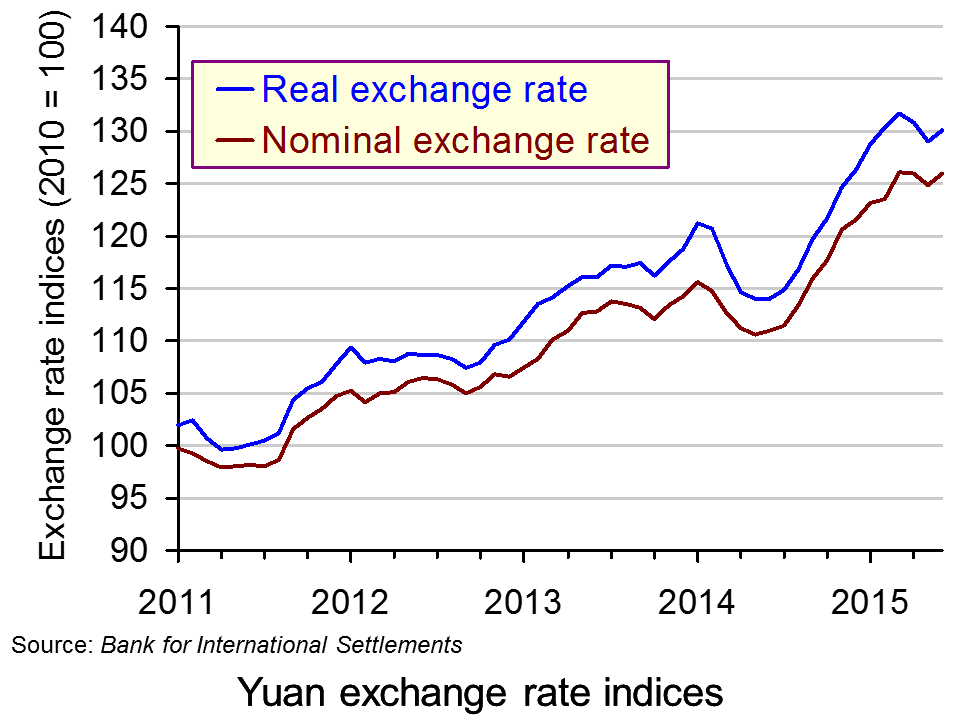
 On August 11th, China devalued its currency, the yuan, by 1.9%. The next day it devalued it by a further 1.6% and on the next day by a further 1.1%. Even though the total devaluation was relatively small, especially given a much bigger revaluation over the previous three years (see chart below), traders in world markets greeted the news with considerable pessimism. Stock markets around the world fell. For example, the US Dow Jones was down by 1.1%, the FTSE 100 was down by 2.5% and the German DAX by 5.8%.
There are three major concerns of investors about the devaluation. The first is that a weaker yuan will make other countries’ exports more expensive in China, thereby making it harder to export to China. At the same time Chinese imports into the rest of the world will be cheaper, thereby making it harder for domestic producers to compete with Chinese imports.
 The second is that cheaper Chinese imports will put downward pressure on prices at a time when inflation rates in the major economies are already below target rates. The fear of deflation has not gone away and this further deflationary twist will intensify such fears and possibly dampen demand.
The third is that the devaluation is taken as a sign that the Chinese authorities are worried about a slowing Chinese economy and are using the devaluation to boost Chinese exports. The rapidly expanding Chinese economy has been one of the major motors of the global economy in recent years and hence a slowing Chinese economy is cause for serious concern at a time when the global economy is still only very slowly recovering from the shock of the financial crisis of 2007–8
But just how worried should the rest of the world be about the falling yuan? And will it continue to fall, or could this be seen as a ‘one-off’ correction? What effect will it have on the macroeconomic policies of the USA, the eurozone and other major countries/regions? The following articles analyse Chinese policy towards its currency and the implications for the rest of the world.
China weakens yuan for a third straight day on Thursday CNBC, Nyshka Chandran (13/8/15)
Markets reel as investors fear worst of Chinese slowdown is yet to come The Telegraph, Peter Spence (12/8/15)
China cannot risk the global chaos of currency devaluation The Telegraph, Ambrose Evans-Pritchard (12/8/15)
Beware a China crisis that could crash down on us all The Telegraph, Liam Halligan (15/8/15)
The curious case of China’s currency The Economist, Buttonwood’s notebook (11/8/15)
China’s yuan currency falls for a second day BBC News (12/8/15)
China slowdown forces devaluation BBC News, Robert Peston (11/8/15)
What the yuan devaluation means around the world BBC News, Lerato Mbele, Daniel Gallas and Yogita Limaye (12/8/15)
 China allows yuan currency to drop for third day BBC News, various reporters (13/8/15)
The Guardian view on global currencies: it’s the economy, stupid The Guardian, Editorial (14/8/15)
China’s currency gambit and Labour’s debate about quantitative easing: old and new ways to cope with economic crisis The Guardian, Paul Mason (16/8/15)
Questions
- By what percentages have the nominal and real yuan exchange rate indices appreciated since the beginning of 2011? Use data from the Bank for International Settlements.
- Explain the difference between nominal and real exchange rate indices.
- Compare the changes in the yuan exchange rate indices with that of the yuan/dollar exchange rate (see Bank of England Interactive Database). Explain the difference.
- How is the yuan exchange rate with other currencies determined?
- How have the Chinese authorities engineered a devaluation of the yuan? To what extent could it be described as a ‘depreciation’ rather than a ‘devaluation’?
- Why have world stock markets reacted so negatively to the devaluation?
- Why, in global terms, is the devaluation described as deflationary?
- How much should the rest of the world be worried by the devaluation of the yuan?
- Explain the statement by Robert Peston that ‘Beijing has done the monetary tightening that arguably the US economy needs’.
- Comment on the following statement by Stephen King of HSBC (see the second Telegraph article below): ‘The world economy is sailing across the ocean without any lifeboats to use in case of emergency.’
 The CPI index fell by 0.1% in the 12 months to April 2015. This is partly the result of lower air and sea fares, as the upward ‘blip’ in these fares at Easter last year was not present in mid-April this year as Easter fell outside the period when the statistics are collected. What is more significant is that fuel, commodity and retail food prices have fallen over the past 12 months, and the exchange rate has risen, especially against the euro.
But how do we define what’s happened and how significant is it? It might seem highly significant as it’s the first time in 55 years that the CPI has fallen over a 12-month period. In fact, the effect is likely to be temporary, as fuel prices are now rising again and commodity prices generally are beginning to rise too. What is more, the pound seems to have peaked against the euro. Thus although aggregate demand remains relatively dampened, the main causes of falling prices and potential rises in the coming months are largely to be found on the cost side. This then brings us on to the definition of a falling CPI.
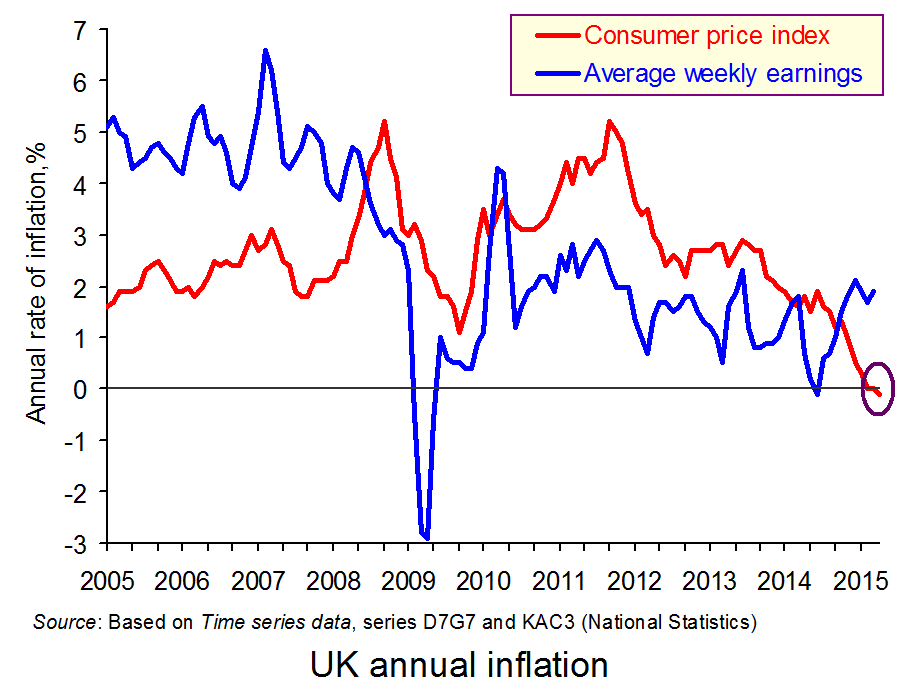 A falling CPI over a 12-month period can be defined as negative inflation. This is unambiguous. But is this ‘deflation’? The problem with the term ‘deflation’ is that it is ambiguous. On the one hand it can be defined simply as negative inflation. In that case, by definition, the UK has experienced deflation. But on the other, it is used to describe a situation of persistent falling prices as a result of declining aggregate demand.
If an economy suffers from deflation in this second sense, the problem can be very serious. Persistent falling prices are likely to discourage consumers from spending on durables (such as fridges, TVs, cars and furniture) and firms from buying capital equipment. After all, why buy an item now if, by waiting, you can get it cheaper later on? This mentality of waiting to spend leads to falling aggregate demand and hence falling output. It also leads to even lower prices. In other words deflation can get worse: a deflationary spiral.
If we define deflation in this second, much more serious sense, then the UK is not suffering deflation – merely temporary negative inflation. In fact, with prices now falling (slightly) and wages rising at around 2% per year, there should be an increase in aggregate demand, which will help to drive the recovery.
Videos
Should Britain Panic Over Negative Inflation? Sky News, Ed Conway (20/5/15)
UK inflation negative for first time since 1960; BoE says temporary Reuters, Andy Bruce and William Schomberg (19/5/15)
UK inflation negative for the first time since 1960 CNBC, Dhara Ranasinghe (19/5/15)
Articles
UK inflation rate turns negative BBC News (19/5/15)
Why there’s little to fear as the spectre of deflation descends on UK The Telegraph, Szu Ping Chan (19/5/15)
UK inflation turns negative The Guardian, Katie Allen (19/5/15)
Is the UK in the early stages of deflation? The Guardian, Larry Elliott (19/5/15)
Is the UK in deflation or negative inflation? Q&A The Guardian, Katie Allen and Patrick Collinson (19/5/15)
Market View: Economists unconcerned on temporary deflation FT Adviser, Peter Walker (19/5/15)
Questions
- Is negative inflation ever a ‘bad thing’?
- Explain the movement in UK inflation rates over the past five years.
- How do changes in exchange rates impact on (a) inflation; (b) aggregate demand? Does it depend on what caused the changes in exchange rates in the first place?
- Why is the current period of negative inflation likely to be short-lived?
- Would you describe the negative inflation as negative cost-push inflation?
- What factors could change that might make negative inflation more persistent and raise the spectre of deflation (in its bad sense)?
- If inflation remains persistently below 2%, what can the Bank of England do, given current interest rates, to bring inflation back to the 2% target?
- What is meant by ‘core inflation’ and what has been happening to it in recent months?
- What global factors are likely to have (a) an upward; (b) a downward effect on UK inflation?
 Newspaper headlines this week read that the UK’s balance of trade deficit has widened to £34.8bn, the largest since 2010. And when you exclude services, the trade in goods deficit, at £119.9bn is the largest ever in nominal terms and is also likely to be the largest as a percentage of GDP.
So far so bad. But when you look a little closer, the picture is more mixed. The balance of trade deficit (i.e. on both goods and services) narrowed each quarter of 2014, although the monthly figure did widen in December 2014. In fact the trade in goods deficit increased substantially in December from £9.3bn to £10.2bn.
At first sight the widening of the trade deficit in December might seem surprising, given the dramatic drop in oil prices. Surely, with demand for oil being relatively inelastic, a large cut in oil prices should significantly reduce the expenditure on oil? In fact the reverse happened. The oil deficit in December increased from £598m to £940m. The reason is that oil importing companies have been stockpiling oil while low prices persist. Clearly, this is in anticipation that oil prices will rise again before too long. What we have seen, therefore, is a demand that is elastic in the short run, even though it is relatively inelastic in the medium run.
But the trade deficit is still large. Even when you strip out oil, the deficit in December still rose – from £8.7bn to £9.2bn. There are two main reasons for this deterioration.
The first is a strong pound. The sterling exchange rate index rose by 1.8% in December and a further 0.4% in January. With quantitative easing pushing down the value of the euro and loose monetary policies in China and Australia pushing down the value of their currencies, sterling is set to appreciate further.
The second is continuing weakness in the eurozone and a slowing of growth in some major developing countries, including China. This will continue to dampen the growth in UK exports.
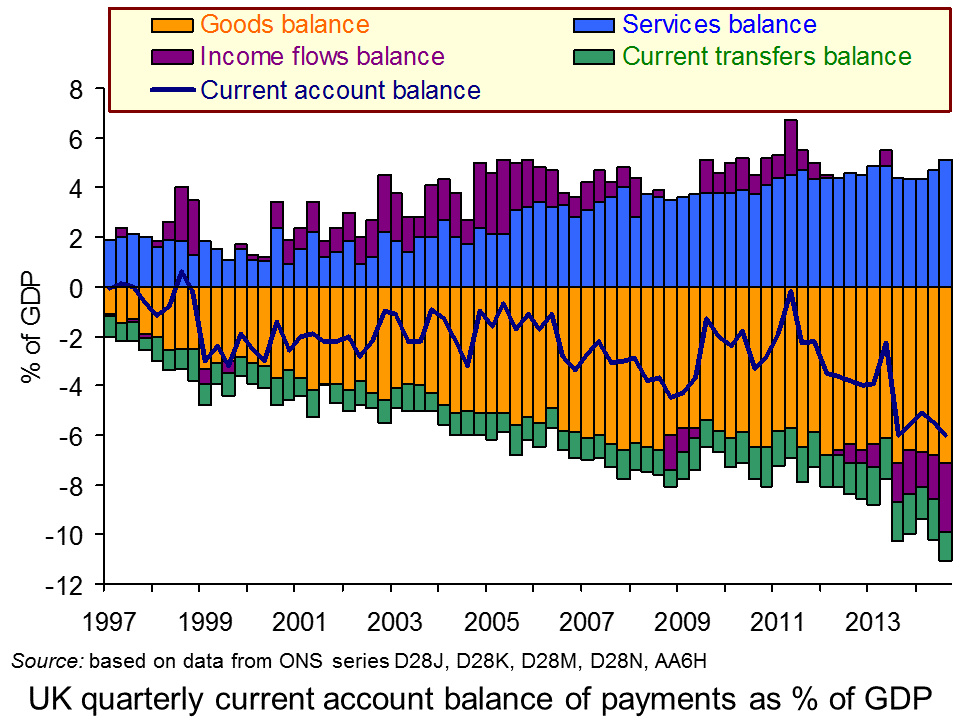 But what of the overall current account? Figures are at present available only up to 2014 Q3, but the picture is bleak (see the chart). As the ONS states:
The current account deficit widened in Q3 2014, to 6.0% of nominal Gross Domestic Product GDP, representing the joint largest deficit since Office for National Statistics (ONS) records began in 1955.
This deterioration in performance can be partly attributed to the recent weakness in the primary income balance [see]. This also reached a record deficit in Q3 2014 of 2.8% of nominal GDP; a figure that can be primarily attributed to a fall in UK residents’ earnings from investment abroad, and broadly stable foreign resident earnings on their investments in the UK
The primary income account captures income flows into and out of the UK economy, as opposed to current transfers (secondary income) from taxes, grants, etc. The large deficit reflects a decline in the holding by UK residents of foreign assets from 92% of GDP in 2008 to 67% by the end of 2014. This, in turn, reflects the poorer rate of return on many of these assets. By contrast, the holdings of UK assets by foreign residents has increased. They have been earning a higher rate of return on these assets than UK residents have on foreign assets. And so, despite UK interest rates having fallen, as the quote above says, foreign residents’ earnings on their holding of UK assets has remained broadly stable.
Articles
UK trade deficit last year widest since 2010 BBC News (6/2/15)
UK’s trade deficit widens to 2010 high as consumers take advantage of falling oil The Telegraph, Peter Spence (6/2/15)
UK trade deficit widens to four-year high The Guardian, Katie Allen (6/2/15)
UK trade deficit hits four-year high Financial Times, Ferdinando Giugliano (6/2/15)
Data
Balance of Payments ONS (topic link)
Summary: UK Trade, December 2014 ONS (6/2/15)
Current account, income balance and net international investment position ONS (23/1/15)
Pink Book – Tables ONS
Questions
- Distinguish between he current account, the capital account and the financial account of the balance of payments.
- If the overall balance of payments must, by definition, balance, why does it matter if the following are in deficit: (a) trade in goods; (b) the current account; (b) income flows?
- What would cause the balance of trade deficit to narrow?
- Discuss what policies the government could pursue to reduce the size of the current account deficit? Distinguish between demand-side and supply-side policies.
- Why has the sterling exchange rate index been appreciating in recent months?
- What do you think is likely to happen to the sterling exchange rate index in the coming months? Explain.
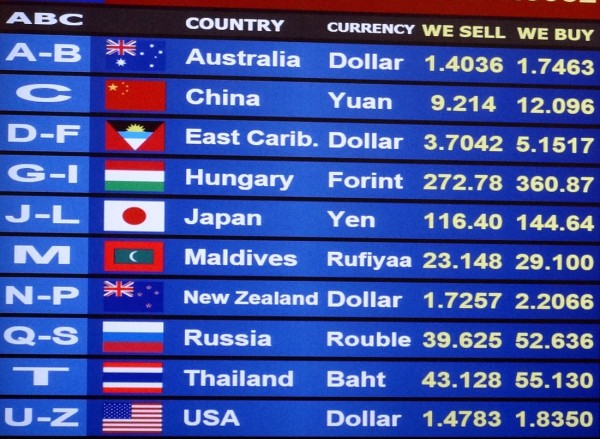 One effect of an expansionary monetary policy is a depreciation of the exchange rate. Take the case of countries using a combination of a reduction in central bank interest rates and quantitative easing (QE). A fall in interest rates will encourage an outflow of finance; and part of the money created through quantitative easing will be used to purchase foreign assets. Both create an increased demand for foreign currencies and drive down the exchange rate.
The latest case of expansionary monetary policy is that employed by the ECB. After months of promising to ‘do whatever it takes’ and taking various steps towards full QE, the ECB finally announced a large-scale QE programme on 22 January 2015.
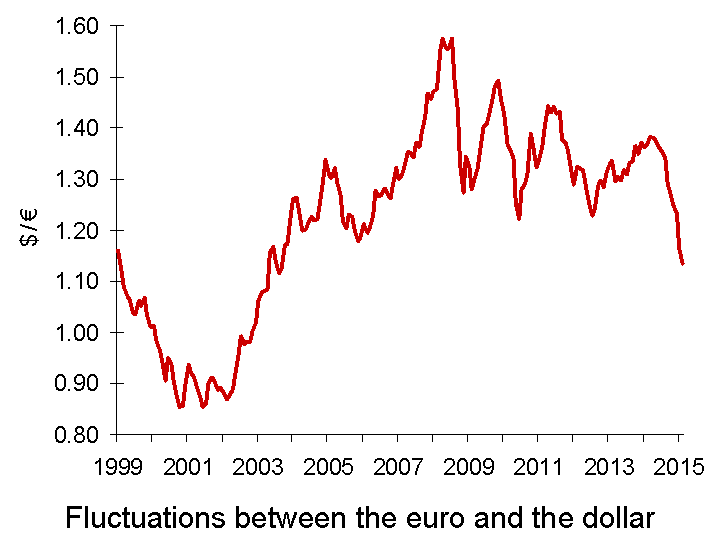 With people increasingly predicting QE and with the ECB reducing interest rates, so the euro depreciated. Between March 2014 and 21 January 2015, the euro depreciated by 20.2% against the dollar and the euro exchange rate index depreciated by 9.7%. With the announced programme of QE being somewhat larger than markets expected, in the week following the announcement the euro fell a further 2.3% against the dollar, and the euro exchange rate index also fell by 2.3%. The euro is now at its lowest level against the US dollar since April 2003 (see chart).
The depreciation of the euro will be welcome news for eurozone exporters. It makes their exports cheaper in foreign currency terms and thus makes their exports more competitive.  Similarly Japanese exporters were helped by the depreciation of the yen following the announcement on 31 October 2014 by the Bank of Japan of an increase in its own QE programme. The yen has depreciated by 7.7% against the dollar since then.
But every currency cannot depreciate against other currencies simultaneously. With any bilateral exchange rate, the depreciation of one currency represents an appreciation of the other. So just as the euro and yen have depreciated against the dollar, the dollar has appreciated against the euro and yen. This has made US goods less competitive relative to eurozone and Japanese goods.
The danger is that currency wars will result, with monetary policy being used in various countries to achieve competitive depreciations. Already, the Swiss have been forced, on 15 January, to remove the cap with the euro at SF1 – €0.833. Since then the Swiss franc has appreciated by some 15% to around SF1 – €0.96. Will the Swiss now be forced to relax their monetary policy?
The Danish and Canadian central banks have cut their interest rates, hoping to stem an appreciation of their currencies. On 28 January, the Monetary Authority of Singapore sold Singapore dollars to engineer a depreciation. The Singapore dollar duly fell by the most in over four years.
But are these policies simply beggar-my-neighbour policies? Is it a zero-sum game, where the gains to the countries with depreciating currencies are exactly offset by losses to the those with appreciating ones? Or is there a net gain from overall looser monetary policy at a time of sluggish growth? Or is there a net loss from greater currency volatility, which will create greater uncertainty and dampen cross-border investment? The following article explore the issues.
Articles
Massive Devaluation of the Euro Seeking Alpha, Sagar Joshi (26/1/15)
Devaluation and discord as the world’s currencies quietly go to war The Observer (25/1/15)
Why is dollar strong vs. 18 trillion of USA’s debt? Pravda, Lyuba Lulko (26/1/15)
Central Bankers Ramp Up Currency Wars Wall Street Journal, Anjani Trivedi, Josie Cox and Carolyn Cui (28/1/15)
The Raging Currency Wars Across Europe The Market Oracle, Gary_Dorsch (29/1/15)
Why ECB action is likely to stoke global currency wars Financial Times, Ralph Atkins (22/1/15)
Euro slides as ECB launches QE Financial Times (22/1/15)
Will Australia join the Currency Wars? The Daily Reckoning, Australia, Greg Canavan (23/1/15)
Australia’s central bank cuts rates to record low; currency plunges and stocks spike The Telegraph (3/2/15)
Singapore loosens monetary policy Financial Times, Jeremy Grant (28/1/15)
Currency Wars Have a Nuclear Option Bloomberg, Mark Gilbert (12/2/15)
Questions
- Explain how quantitative easing results in depreciation. What determines the size of the depreciation?
- How is the USA likely to react to an appreciation of the dollar?
- In the UK, who will benefit and who will lose from the depreciation of the euro?
- What are the global benefits and costs of a round of competitive depreciations?
- How does the size of the financial account of the balance of payments affect the size of a depreciation resulting from QE?
- What determines a country’s exchange-rate elasticity of demand for exports? How does this elasticity of demand affect the size of changes in the current account of the balance of payments following a depreciation?
- Might depreciation of their currencies reduce countries’ commitment to achieving structural reforms? Or might it ‘buy them time’ to allow them to introduce such reforms in a more carefully planned way and for such reforms to take effect? Discuss.
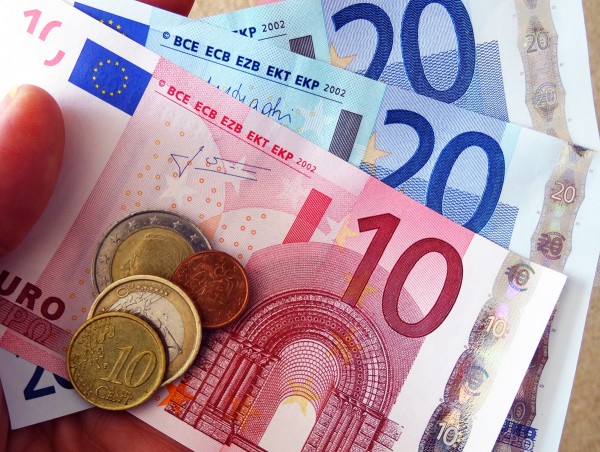 After promises made back in July 2012 that the ECB will ‘do whatever it takes’ to protect the eurozone economy, the ECB has at last done just that. It has launched a large-scale quantitative easing programme. It will create new money to buy €60 billion of assets every month in the secondary market.
Around €10 billion will be private-sector securities that are currently being purchased under the asset-backed securities purchase programme (ABSPP) and the covered bond purchase programme (CBPP3), which were both launched late last year. The remaining €50 billion will be public-sector assets, mainly bonds of governments in the eurozone. This extended programme of asset purchases will begin in March this year and continue until at least September 2016, bringing the total of asset purchased by that time to over €1.1 trillion.
The ECB has taken several steps towards full QE over the past few months, including €400 billion of targeted long-term lending to banks, cutting interest rates to virtually zero (and below zero for the deposit rate) and the outright purchase of private-sector assets. But all these previous moves failed to convince markets that they would be enough to stimulate recovery and stave off deflation. Hence the calls for full quantitative easing became louder and it was widely anticipated that the ECB would finally embark on the purchase of government bonds – in other words, would finally adopt a programme of QE similar to those adopted in the USA (from 2008), the UK (from 2009) and Japan (from 2010).
Rather than the ECB buying the government bonds centrally, each of the 19 national central banks (NCBs), which together with the ECB constitute the Eurosystem, will buy their own nation’s bonds.  The amount they will buy will depend on their capital subscriptions the eurozone. For example, the German central bank will buy German bonds amounting to 25.6% of the total bonds purchased by national central banks. France’s share will be 20.1% (i.e. French bonds constituting 20.1% of the total), Spain’s share will be 12.6% and Malta’s just 0.09%.
Central banks of countries that are still in bail-out programmes will not be eligible to purchase their countries’ assets while their compliance with the terms of the bailout is under review (as is the case currently with Greece).
The risk of government default on their bonds will be largely (80%) covered by the individual countries’ central banks, not by the central banks collectively. Only 20% of bond purchases will be subject to risk sharing between member states according to their capital subscription percentages: the ECB will directly purchase 8% of government bonds and 12% will be bonds issued by European institutions rather than countries. As the ECB explains it:
With regard to the sharing of hypothetical losses, the Governing Council decided that purchases of securities of European institutions (which will be 12% of the additional asset purchases, and which will be purchased by NCBs) will be subject to loss sharing. The rest of the NCBs’ additional asset purchases will not be subject to loss sharing. The ECB will hold 8% of the additional asset purchases. This implies that 20% of the additional asset purchases will be subject to a regime of risk sharing.
As with the QE programmes in the USA, the UK and Japan, the transmission mechanism is indirect. The assets purchased will be from financial institutions, who will thus receive the new money. The bond purchases and the purchases of assets by financial institutions with the acquired new money will drive up asset prices and hence drive down long-term interest rates. This, hopefully, will stimulate borrowing and increase aggregate demand and hence output, employment and prices.
The ECB will buy bonds issued by euro area central governments, agencies and European institutions in the secondary market against central bank money, which the institutions that sold the securities can use to buy other assets and extend credit to the real economy. In both cases, this contributes to an easing of financial conditions.
In addition, there is an exchange rate transmission mechanism. To the extent that the extra money is used to purchase non-eurozone assets, so this will drive down the euro exchange rate. This, in turn, will boost the demand for eurozone exports and reduce the demand for imports to the eurozone. This, again, represents an increase in aggregate demand.
The extent to which people will borrow more depends, of course, on confidence that the eurozone economy will expand. So far, the response of markets suggests that such confidence will be there. But we shall have to wait to see if the confidence is sustained.
But even if QE does succeed in stimulating aggregate demand, there remains the question of the competitiveness of eurozone economies. Some people are worried, especially in Germany, that the boost given by QE will reduce the pressure on countries to engage in structural reforms – reforms that some people feel are vital for long-term growth in the eurozone
The articles consider the responses to QE and assess its likely impact.
Articles
ECB publications
Previous blog posts
Data
Questions
- Why has the ECB been reluctant to engage in full QE before now?
- How has the ECB answered the objections of strong eurozone countries, such as Germany, to taking on the risks associated with weaker countries?
- What determines the amount by which aggregate demand will rise following a programme of asset purchases?
- In what ways and to what extent will non-eurozone countries benefit or lose from the ECB’s decision?
- Are there any long-term dangers to the eurozone economy of the ECB’s QE programme? If so, how might they be tackled?
- Why did the euro plummet on the ECB’s announcement? Why had it not plummeted before the announcement, given that the introduction of full QE was widely expected?