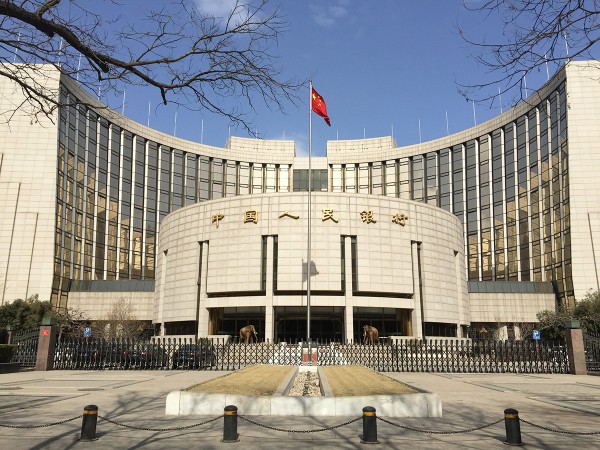
 In recent months the Chinese central bank (the People’s Bank of China) has taken a number of measures to boost aggregate demand and arrest the slowing economic growth rate. Such measures have included quantitative easing, cuts in interest rates, a devaluation of the yuan and daily injections of liquidity through open-market operations. It has now announced that from 1 March it will reduce the reserve requirement ratio (RRR) for banks by a half percentage point.
The RRR is the percentage of liabilities that banks are required to hold in the form of cash reserves – money that could otherwise have been used for lending. This latest move will bring the compulsory ratio for the larger banks down from 17.5% to 17%. This may sound like only a small reduction, but it will release some ¥650bn to ¥690bn (around $100bn) of reserves that can be used for lending.
The cut from 17.5% to 17% is the fourth this year. Throughout 2014 and 2015 it was stable at 20%.
The hope is that this lending will not only help to boost economic growth but also stimulate demand for the consumption of services. The measure can thus be seen as part of a broader strategy as the authorities seek to re-balance the economy away from its reliance on basic manufacturing towards a more diversified economy. It is also hoped that the extra demand will help to boost jobs and thus provide more opportunities for people laid off from traditional manufacturing industries.
It is expected that further reductions in the RRR will be announced later in the year – perhaps a further 1.5 to 2 percentage points.
 But what will be the effect of the releasing of reserves? Will the boost be confined to $100bn or will there be a money multiplier effect? It is certainly hoped by the authorities that this will stimulate the process of credit creation. But how much credit is created depends not just on banks’ willingness to lend, but also on the demand for credit. And that depends very much on expectations about future rates of economic growth.
One issue that concerns both the Chinese and overseas competitors is the effect of the measure on the exchange rate. By increasing the money supply, the measure will put downward pressure on the exchange rate as it will boost the demand for imports.
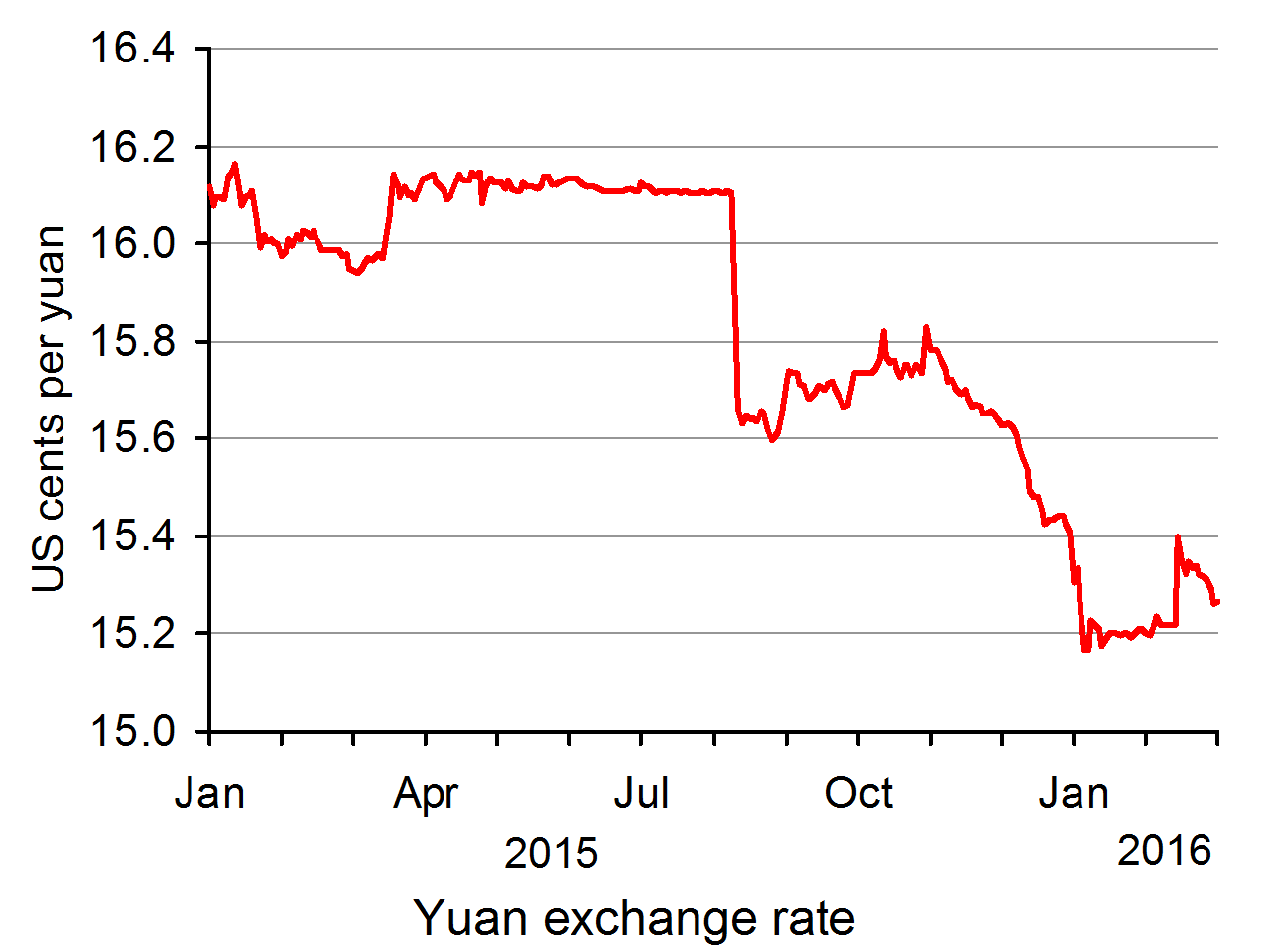 The Chinese authorities have been intervening in the foreign exchange market to arrest a fall in the yuan (¥) because of worries about capital outflows from China. The yuan was devalued by 2.9% in August 2015 from approximately ¥1 = ¢16.11 to approximately ¥1 = ¢15.64 (see chart) and after a modest rally in November 2015 it began falling again, with the Chinese authorities being unwilling to support it at the November rate. By January 2016, it had fallen a further 2.8% to approximately ¢15.20 (click here for a PowerPoint file of the chart).
But despite the possible downward pressure on the yuan from the cut in the reserve requirement, it will probably put less downward pressure than a cut in interest rates. This is because an interest rate cut has a bigger effect on capital outflows as it directly reduces the return on deposits in China. The central bank had already cut its benchmark 1-year lending rate from 6% to 4.35% between November 2014 and October 2015 and seems reluctant at the current time to cut it further.
China central bank resumes easing cycle to cushion reform pain Reuters, Pete Sweeney (29/2/16)
China cuts reserve requirements for banks to boost economy PressTV (29/2/16)
China Moves to Bolster Lending by Easing Banks’ Reserve Ratio New York Times, Neil Gough (29/2/16)
Economists React: China’s ‘Surprise’ Bank Reserve Cut Wall Street Journal (29/2/16)
 China Cuts Banks’ Reserve Requirement Ratio Bloomberg, Enda Curran (29/2/16)
China Reserve-Ratio Cut Signals Growth Is Priority Over Yuan Bloomberg, Andrew Lynch (29/2/16)
China reserve ratio cut not a signal of impending large-scale stimulus: Xinhua Reuters, Samuel Shen and John Ruwitch (2/3/16)
China injects cash to boost growth and counter capital outflows Financial Times, Gabriel Wildau (29/2/16)
China’s Economic Policy Akin To Pushing On A String Seeking Alpha, Bruce Wilds (2/3/16)
China cuts banks’ reserve ratio for fifth time in a year: Why and what’s next Channel NewsAsia, Tang See Kit, (1/3/16)
Questions
- Explain what is mean by the required reserve ratio (RRR).
- Explain how credit creation takes place.
- What will determine the amount of credit creation that will take place as a result of the $100bn of reserves in Chinese banks released for lending by the cut in the RRR from 17.5% to 17%.
- What prompted the recent cuts in the RRR?
- Why may China’s recent monetary policy measures be like pushing on a string?
- Is the reduction in the RRR a purely demand-side measure, or will it have supply-side consequences?
- Explain how different types of monetary policy affect the exchange rate.
- Should other countries welcome the cut in China’s RRR? Explain.
 On 20 February, the UK Prime Minister, David Cameron, announced the date for the referendum on whether the UK should remain in or leave the EU. It will be on 23 June. The announcement followed a deal with EU leaders over terms of UK membership of the EU. He will argue strongly in favour of staying in the EU, supported by many in his cabinet – but not all.
Two days later, Boris Johnson, the Mayor of London, said that he would be campaigning for the UK to leave the EU.
In the meantime, Mr Johnson’s announcement, the stance of various politicians and predictions of the outcome of the referendum are having effects on markets.
One such effect is on the foreign exchange market. As the Telegraph article below states:
The pound suffered its biggest drop against the dollar in seven years after London Mayor Boris Johnson said he will campaign for Britain to leave the European Union [‘Brexit’].
Sterling fell by as much as 2.12pc to $1.4101 against the dollar on Monday afternoon, putting it on course for the biggest one day drop since February 2009. Experts said the influential Mayor’s decision made a British exit from the bloc more likely.
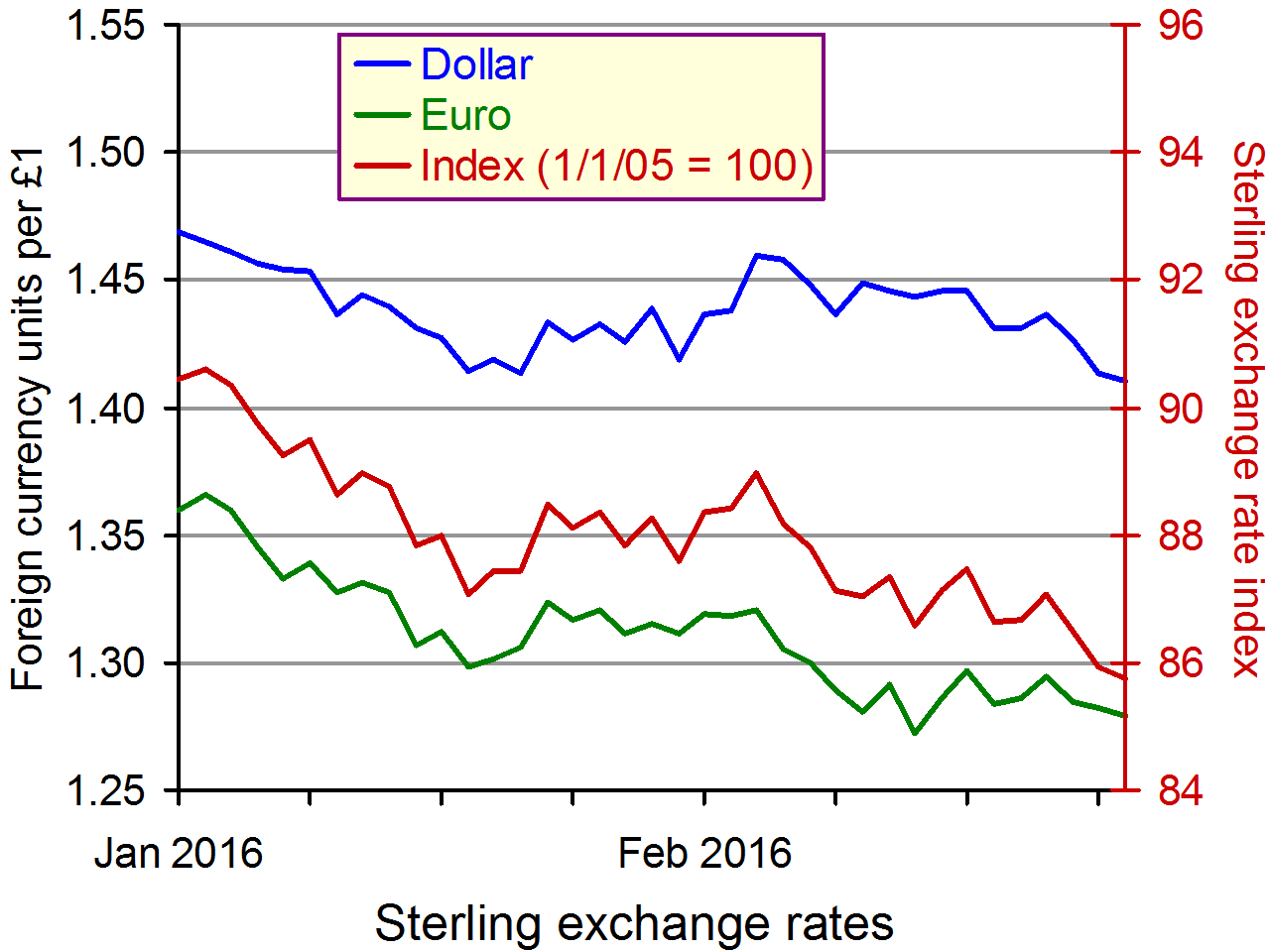
The pound also fell by as much as 1.2pc to €1.2786 against the euro and hit a two-year low against Japan’s yen.
This follows depreciation that has already taken place this year as predictions of possible Brexit have grown. The chart shows that from the start of the year to 23 February the sterling trade weighted index fell by 5.3% (click here for a PowerPoint).
But why has sterling depreciated so rapidly? How does this reflect people’s concerns about the effect of Brexit on the balance of payments and business more generally? Read the articles and try answering the questions below.
Articles
Pound in Worst Day Since Banking Crisis as `Brexit’ Fears Bite Bloomberg, Eshe Nelson (21/2/16)
Pound hits 7-year low on Brexit fears Finiancial Times, Michael Hunter and Peter Wells (22/2/16)
Pound in freefall as Boris Johnson sparks Brexit fears The Telegraph, Szu Ping Chan (22/2/16)
Pound falls below $1.39 as economists warn Brexit could hammer households The Telegraph, Peter Spence (24/2/16)
Why is the pound falling and what does it mean for households and businesses? The Telegraph, Szu Ping Chan (23/2/16)
Pound heading for biggest one-day fall since 2009 on Brexit fears BBC News (22/2/16)
Cameron tries to sell EU deal after London mayor backs Brexit Euronews, Guy Faulconbridge and Michael Holden (22/2/16)
EU referendum: Sterling suffers biggest fall since 2010 after Boris Johnson backs Brexit International Business Times, Dan Cancian (22/2/16)
Exchange rate data
Spot exchange rates against £ sterling Bank of England
Questions
- What are the details of the deal negotiated by David Cameron over the UK’s membership of the EU?
- Why did sterling depreciate in (a) the run-up to the deal on UK EU membership and (b) after the announcement of the date of the referendum?
- Why did the FTSE100 rise on the first trading day after the Prime Minister’s announcement?
- What is the relationship between the balance of trade and the exchange rate?
- What are meant by the ‘six-month implied volatility in sterling/dollar’ and the ‘six-month risk reversals’?
- Why is it difficult to estimate the effect of leaving the EU on the UK’s balance of trade?
 Are emerging markets about to experience a credit crunch? Slowing growth in China and other emerging market economies (EMEs) does not bode well. Nor does the prospect of rising interest rates in the USA and the resulting increase in the costs of servicing the high levels of dollar-denominated debt in many such countries.
According to the Bank for International Settlements (BIS) (see also), the stock of dollar-denominated debt in emerging market economies has doubled since 2009 and this makes them vulnerable to tighter US monetary policy.
Weaker financial market conditions combined with an increased sensitivity to US rates may heighten the risk of negative spillovers to EMEs when US policy is normalised. …
Despite low interest rates, rising debt levels have pushed debt service ratios for households and firms above their long-run averages, particularly since 2013, signalling increased risks of financial crises in EMEs.
But there is another perspective. Many emerging economies are pursuing looser monetary policy and this, combined with tighter US monetary policy, is causing their exchange rates against the dollar to depreciate, thereby increasing their export competitiveness. At the same time, more rapid growth in the USA and some EU countries, should also help to stimulate demand for their exports.
Also, in recent years there has been a large growth in trade between emerging economies – so-called ‘South–South trade’. Exports from developing countries to other developing countries has grown from 38% of developing countries’ exports in 1995 to over 52% in 2015. With technological catch-up taking place in many of these economies and with lower labour and land costs, their prospects look bright for economic growth over the longer term.
These two different perspectives are taken in the following two articles from the Telegraph. The first looks at the BIS’s analysis of growing debt and the possibility of a credit crunch. The second, while acknowledging the current weakness of many emerging economies, looks at the prospects for improving growth over the coming years.
Articles
‘Uneasy’ market calm masks debt timebomb, BIS warns The Telegraph, Szu Ping Chan (6/12/15)
Why emerging markets will rise from gloom to boom The Telegraph, Liam Halligan (5/12/15)
Questions
- How does an improving US economy impact on emerging market economies?
- Will the impact of US monetary policy on exchange rates be adverse or advantageous for emerging market economies?
- What forms does dollar-denominated debt take in emerging economies?
- Why has south–south trade grown in recent years? Is it consistent with the law of comparative advantage?
- Why is growth likely to be higher in emerging economies than in developed economies in the coming years?
 The Federal Reserve chair, Janet Yellen, has been giving strong signals recently that the US central bank will probably raise interest rates at its December 16 meeting or, if not then, early in 2016. ‘Ongoing gains in the labor market’ she said, ‘coupled with my judgement that longer-term inflation expectations remain reasonably well anchored, serve to bolster my confidence in a return of inflation to 2%.’ This, as for many other central banks, is the target rate of inflation.
In anticipation of a rise in US interest rates, the dollar has been appreciating. Its (nominal) exchange rate index has risen by 24% since April 2014 (see chart below).
In the light of the sluggish eurozone economy, the ECB president, Mario Draghi, has been taking a very different stance. He has indicated that he stands ready to cut interest rates further and increase quantitative easing.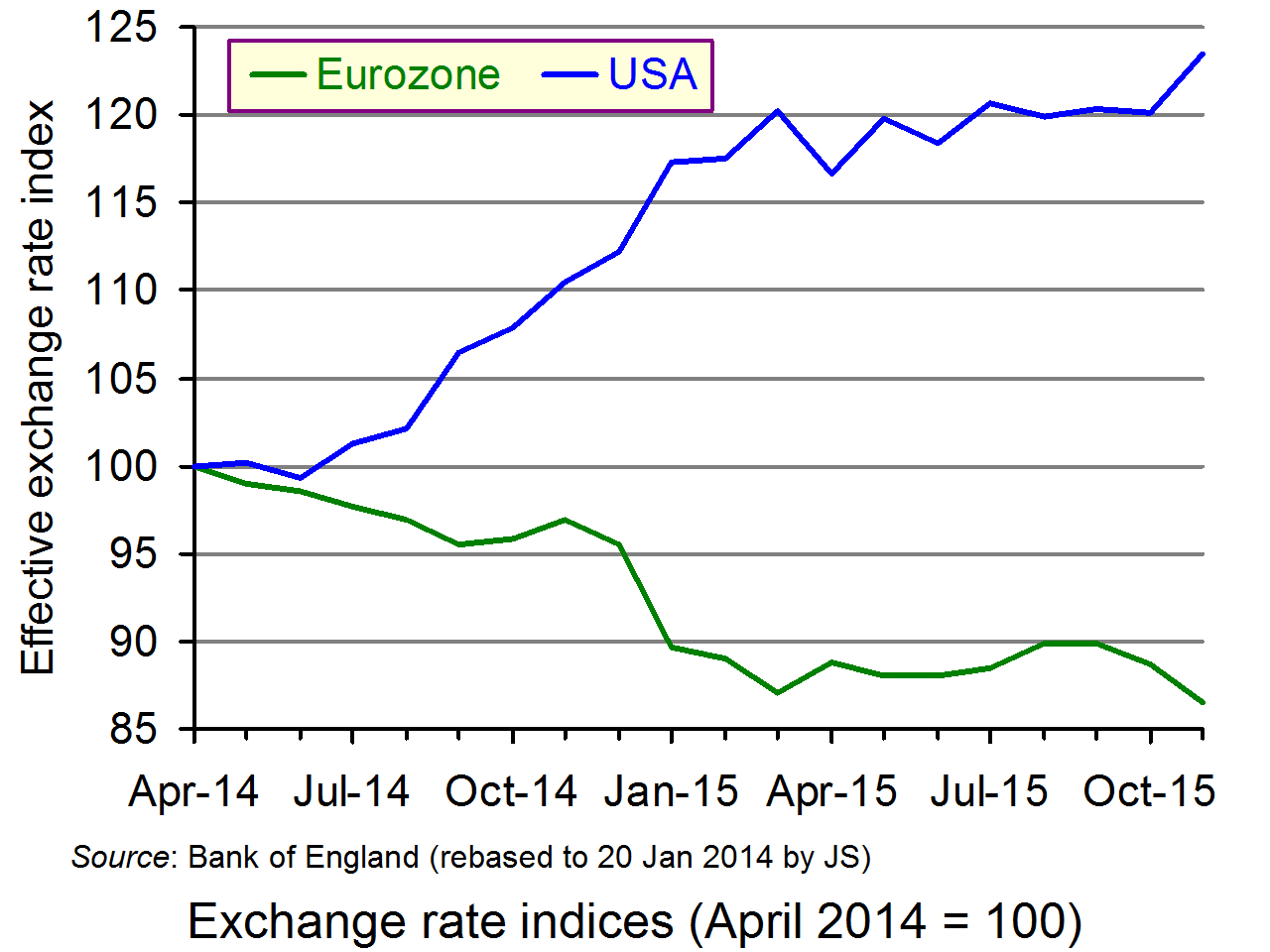 At the meeting on 3 December, the ECB did just that. It announced a further cut in the deposit rate, from –0.2 to –0.3 and an extension of the €60 billion per month QE programme from September 2016 to March 2017 (bringing the total by that time to €1.5 trillion – up from €1.1 trillion by September 2016).
Stock market investors had been expecting more, including an increase in the level of monthly asset purchases above €60 billion. Consequently stock markets fell. Both the German DAX and the French CAC 40 stock market indices fell by 3.6%. The euro also appreciated against the dollar by 2.7% on the day of the announcement. Nevertheless, since April 2014, the euro exchange rate index has fallen by 13%. Against the US dollar, the euro has depreciated by a massive 31%.
So what will be the consequences of the very different monetary policies being pursued by the Fed and the ECB? Are they simply the desirable responses to a lack of convergence of the economic performance of the US and eurozone economies? In other words, will they help to bring greater convergence between the two economies?
Or will the desirable effects of convergence be offset by other undesirable effects for the USA and the eurozone and also for the rest of the world?
|
|
| • |
Will huge amounts of dollar-denominated debt held by many emerging economies make it harder to service these debts with an appreciating dollar? |
| • |
How much will US exporters suffer from the dollar’s rise and what will the US authorities do about it? |
| • |
Will currency volatility lead to currency wars and, if so, what will be their economic effects? |
| • |
Will the time lags involved in the effects of the continuing programme of QE in the eurozone eventually lead to overheating? Already euro money supply is rising, on both narrow and broad measures. |
The following articles address these issues.
Articles
The Fed and the ECB: when monetary policy diverges The Guardian, Mohamed El-Erian (2/12/15)
European stocks slide after ECB dashes hopes of major QE expansion The Guardian, Heather Stewart and Graeme Wearden (3/12/15)
Mario Draghi riles Germany with QE overkill The Telegraph, Ambrose Evans-Pritchard (3/12/15)
How the eurozone missed its shot at a recovery The Telegraph, Peter Spence (3/12/15)
Yellen Signals Economy Nearly Ready for First Interest-Rate Hike Bloomberg, Christopher Condon (3/12/15)
Exchange rate data
Effective exchange rate indices Bank for International Settlements
Exchange rates Bank of England
Questions
- What would be the beneficial effects to the US and eurozone economies of their respective monetary policies?
- Explain the exchange rate movements that have taken place between the euro and the dollar over the past 19 months. How do these relate to the various parts of the balance of payments accounts of the two economies?
- Is it possible for the USA to halt the rise in the dollar while at the same time raising interest rates? Explain.
- Why are some members of the ECB (e.g. the German and Dutch) against expanding QE? Assess their arguments.
- What will be the impact of US and eurozone monetary policies on emerging economies?
- What will be the impact of US and eurozone monetary policies on the UK?
- Why did the euro appreciate after the Mario Draghi’s press statement on 3 December? What has happened to the dollar/euro exchange rate since and why?
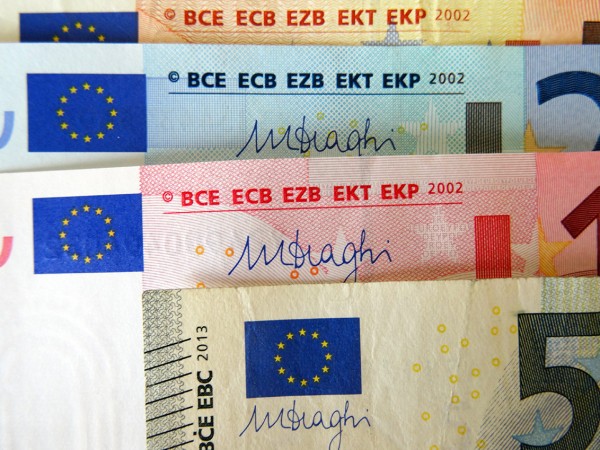 Mario Draghi, the ECB President, has indicated that the ECB is prepared to engage in further monetary stimulus. This is because of continuing weaknesses in the global economy and in particular in emerging markets.
Although the ECB at its meeting in Malta on 22 October decided to keep both interest rates and asset purchases (€60 billion per month) at current levels, Mario Draghi stated at the press conference that, at its next meeting on December 3rd, the ECB would be prepared to cut interest rates and re-examine the size, composition and duration of its quantitative easing programme. He stopped short, however, of saying that interest rates would definitely be cut or quantitative easing definitely increased. He said the following:
“The Governing Council has been closely monitoring incoming information since our meeting in early September. While euro area domestic demand remains resilient, concerns over growth prospects in emerging markets and possible repercussions for the economy from developments in financial and commodity markets continue to signal downside risks to the outlook for growth and inflation. Most notably, the strength and persistence of the factors that are currently  slowing the return of inflation to levels below, but close to, 2% in the medium term require thorough analysis.
In this context, the degree of monetary policy accommodation will need to be re-examined at our December monetary policy meeting, when the new Eurosystem staff macroeconomic projections will be available. The Governing Council is willing and able to act by using all the instruments available within its mandate if warranted in order to maintain an appropriate degree of monetary accommodation.”
Mario Draghi also argued that monetary policy should be supported by fiscal policy and structural policies (mirroring Japan’s three arrows). Structural policies should include actions to improve the business environment, including the provision of an adequate public infrastructure. This is vital to “increase productive investment, boost job creation and raise productivity”.
As far as fiscal policies are concerned, these “should support the economic recovery, while remaining in compliance with the EU’s fiscal rules”. In other words, fiscal policy should be expansionary, while staying within the limits set by the Stability and Growth Pact.
His words had immediate effects in markets. Eurozone government bond yields dropped to record lows and the euro depreciated 3% against the US dollar over the following 24 hours.
Webcasts
ECB Press Conference on YouTube, Mario Draghi (22/10/15)
Draghi reloads bazooka FT Markets, Ferdinando Guigliano (22/10/15)
Articles
Mario Draghi: ECB prepared to cut interest rates and expand QE The Guardian, Heather Stewart (22/10/15)
Draghi signals ECB ready to extend QE Financial Times, Claire Jones and Elaine Moore (22/10/15)
Dovish Mario Draghi sends bond yields to new lows Financial Times, Katie Martin (23/10/15)
What Draghi Said on QE, Policy Outlook, Global Risks and Inflation Bloomberg, Deborah Hyde (22/10/15)
ECB set to ‘re-examine’ stimulus policy at next meeting BBC News (22/10/15)
The global economy warrants a big dose of caution The Guardian, Larry Elliott (25/10/15)
ECB Press Conference
Introductory statement to the press conference (with Q&A) ECB, Mario Draghi (President of the ECB), Vítor Constâncio (Vice-President of the ECB) (22/10/15)
Questions
- Why is the ECB considering further expansionary monetary policy?
- What monetary measures can a central bank use to stimulate aggregate demand?
- Explain the effects of Mario Draghi’s announcement on bond and foreign exchange markets.
- What are the objectives of ECB monetary policy according to the its mandate?
- Should the ECB consider using quantitative easing to provide direct funding for infrastructure projects?
- What constraints does the EU’s Stability and Growth Pact impose on eurozone countries?
- What are the arguments for and against (a) the Bank of England and (b) the US Federal Reserve engaging in further QE?
- If the ECB does engage in an expanded QE programme, what will determine its effectiveness?
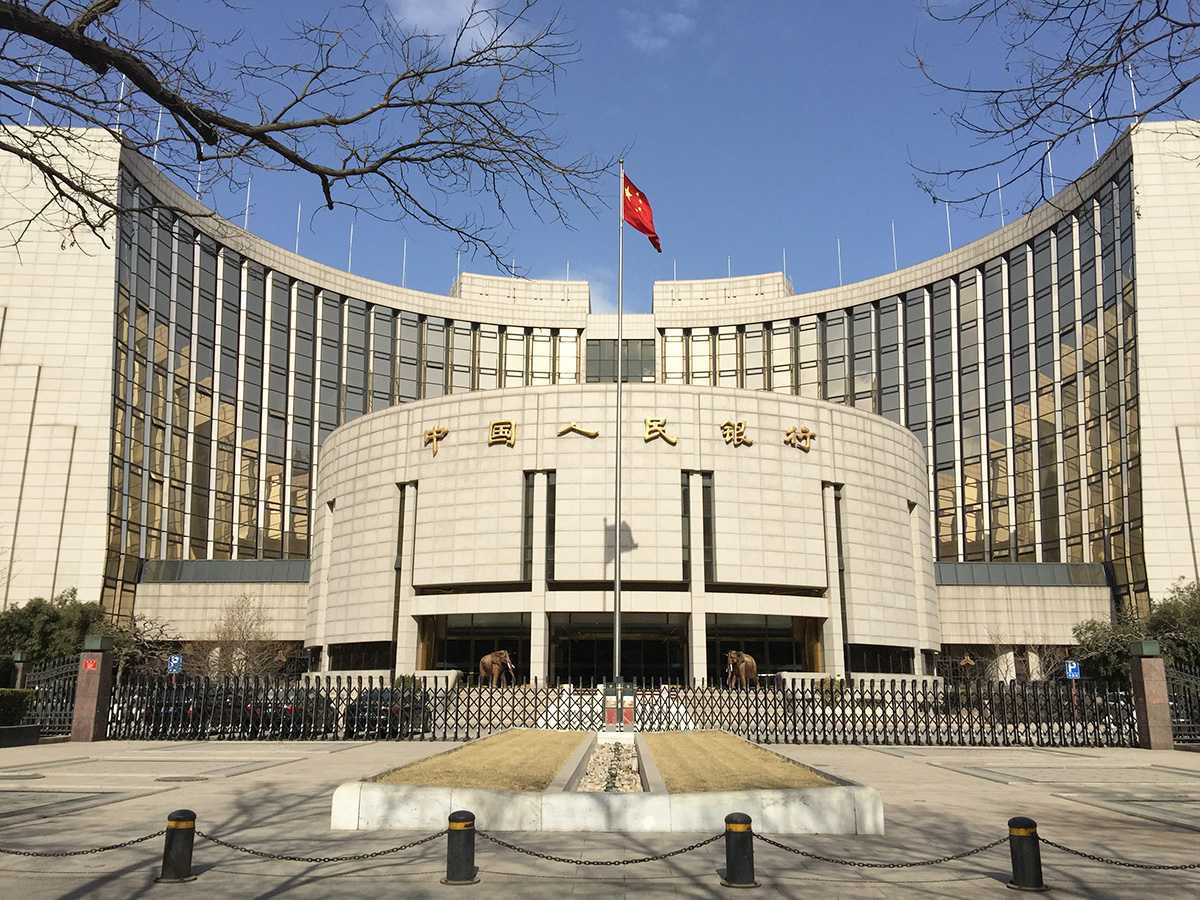 In recent months the Chinese central bank (the People’s Bank of China) has taken a number of measures to boost aggregate demand and arrest the slowing economic growth rate. Such measures have included quantitative easing, cuts in interest rates, a devaluation of the yuan and daily injections of liquidity through open-market operations. It has now announced that from 1 March it will reduce the reserve requirement ratio (RRR) for banks by a half percentage point.
 But what will be the effect of the releasing of reserves? Will the boost be confined to $100bn or will there be a money multiplier effect? It is certainly hoped by the authorities that this will stimulate the process of credit creation. But how much credit is created depends not just on banks’ willingness to lend, but also on the demand for credit. And that depends very much on expectations about future rates of economic growth.