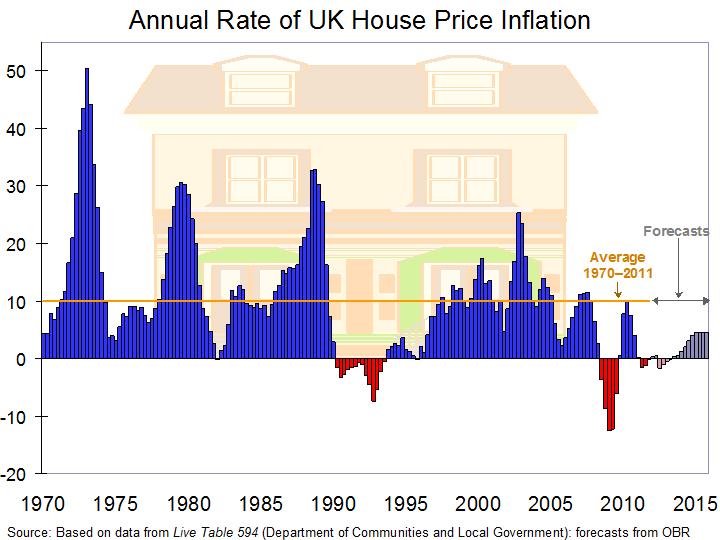
 The housing market has long been seen as a crucial element in stimulating the British economy. For this reason various incentives had been introduced to encourage people to buy properties. (Click here for a PowerPoint of the chart.)
One such strategy was the stamp duty holiday. Stamp Duty Land Tax is paid by the purchaser of a property against a purchase price and the cost of it will rise through each price band. The stamp duty holiday meant that first-time buyers were free from the 1% stamp duty on homes that cost under £250,000. However, this holiday is due to end from March 2012, as according to the government, the holiday has been ineffective. Indeed, in the Autumn statement documents, the government said:
‘The government is publishing analysis showing that the stamp duty land tax relief for first-time buyers has been ineffective in increasing the number of first time buyers entering the market.’
The government has said that instead it will focus on other strategies that provide better value for money. Such schemes include a mortgage guarantee scheme and the FirstBuy scheme launched last year, both of which aim to help those struggling to finance the purchase of their first properties.
According to the Land Registry, property prices have fallen by over 1% over the past year, so fewer properties will face the stamp duty land tax, but this data does little to instill confidence in the housing market being the stimulus that the economy needs. By stimulating the housing market, construction jobs should be created and this in turn should create a much needed multiplier effect helping to boost other sectors within the economy. The following articles consider this latest development.
Stamp duty rush boosts January valuations Mortgage Strategy, Tessa Norman (11/2/12)
New deals for buyers as stamp duty holiday ends BBC News, Susannah Streeter (11/2/12)
Autumn Statement: Stamp duty concession to end BBC News (29/11/11)
First-time buyers boost mortgage market activity FT Adviser, Michael Trudeau (9/2/12)
When shared ownership turns sour Guardian, Rupert Jones (10/2/12)
Questions
- Why does the housing market play such a crucial role in the economy?
- What is the multiplier effect? How will new jobs in the construction industry help other sectors in the economy?
- Why has the stamp duty holiday been ‘ineffective’ in stimulating the housing market?
- How have the other schemes introduced by the government created incentives in the housing market?
- Why have January valuations improved? Use a demand and supply diagram to illustrate your explanation.
The snow the UK has seen over the past two winters created massive disruption, but that is only one reason for hoping for a milder winter to come. With the cold weather, the UK economy faced threats of gas shortages, as households turned on their heating. However, despite the freezing temperatures, many households were forced to turn off their heating regularly, due to the excessive bills they would face. This trend is expected to be even more prevalent if the 2011/12 winter is as cold, as fuel tariffs are predicted to rise. The Bank of England has said that gas and electricity prices could rise this year by 15% and 10% respectively. British Gas’s Parent company, Centrica said:
“In the UK the forward wholesale prices of gas and power for delivery in winter 2011/12 are currently around 25% higher than prices last winter, with end-user prices yet to reflect this higher wholesale market price environment.”
These predictions might see the average UK household paying an extra £148 over the next year. Although these are only estimates, we are still very likely to see many households being forced to turn off their heating. One thing which therefore is certain: a warmer winter would be much appreciated!
Articles
Switch energy tariff to help beat bill rises Guardian, Miles Brignall (14/5/11)
Quarter of households predicted to turn off heating BBC News, Brian Milligan (14/5/11)
Power bills set to soar by 50% in four years Scotsman (14/5/11)
Domestic fuel bills poised to rise by up to £200 Financial Times, Elaine Moore (13/5/11)
Data
Energy price statistics Department of Energy & Climate Change
Energy statistics publications Department of Energy & Climate Change
Questions
- Which factors have contributed to rising energy prices? Illustrate these changes on a demand and supply diagram.
- To what extent do these higher prices contribute to rising inflation?
- What impact might these price rises have on (a) poverty and (b) real income distribution in the UK?
- Why are energy prices currently being investigated by Ofgem? What powers does the regulator have and what actions could be taken?
Despite better economic growth in the first quarter of 2011, confidence remains low and according to Halifax, this has contributed to a decline in house prices from March to April by 1.4% to give their lowest average price since July 2009. Halifax has blamed this steady decline on a lack of confidence and the uncertain economic climate. However, despite this latest decline, Halifax have suggested that the trend may be coming to an end. Martin Ellis, from Halifax had this to say:
“Signs of a modest tightening in housing market conditions, a relatively low burden of servicing mortgage debt and an increase in the number of people in employment are all likely to be providing support for house prices, curbing the pace of decline. There are signs that house sales are stabilising, albeit at a level lower than the historical average.”
There are many factors that contribute towards house prices: the number of properties on the market, the number of buyers, the availability of mortgages and finance, interest rates and the future economic climate. How these factors change will have a crucial influence on the future house price trend. The following articles consider the causes and likely consequences of this latest housing market data.
House prices fall at fastest rate in 18 months Telegraph (9/5/11)
House prices ‘fell by 1.4% in April’ the Halifax says BBC News (9/5/11)
House prices post biggest fall in 1-1 ½ years Reuters, Fiona Shaikh (9/5/11)
House prices dive to a two-year low Independent, Nicky Burridge (9/5/11)
UK housing market remains weak Wall Street Journal, Jason Douglas (9/5/11)
U.K April house prices fall most in seven months, Halifax says Bloomberg, Svenja O’Donnell (9/5/11)
Questions
- What are the main causes behind this decline in house prices?
- The articles talk about the volatility of house prices over recent months. What is the explanation for this?
- If interest rates are increased by the MPC, is it more or less likely to cause house prices to decline further? Explain your answer.
- Why dies Martin Ellis, of Halifax, believe that the decline in house prices might reverse this year?
- How does the housing market affect the wider UK economy? Is these latest data likely to jeopardise the fragile recovery?
Oil is a commodity like any other – its price is affected by demand and supply. Back in 2003, with the impending war in Ira and strikes in Venezuela, oil prices increased and continued to do so as further supply concerns developed in Saudi Arabia, Russia and Nigeria. This upward trend continued until 2008, when with the growing banking turmoil and demand for oil falling, the price began to decline. However, the crisis in Libya is only making matters worse. Its credit-rating has been downgraded with the potential for it to be lowered further and concerns are deepening about the country’s crude exports. As Libya is the world’s 12th largest exporter of oil, these supply concerns have started to push up oil prices once more.
With inflation rates already high and political turmoil pushing oil prices up further, consumers and firms are feeling the squeeze. These changes have also been reflected on stock markets across the world. Analyst, Michael Hewson at CMC Markets said:
‘Given the fact that we have seen massive gains in stock markets over the last few months, investors have been nervous about a possible correction for some time… The tensions in the Middle East with Libya imploding and concerns that the unrest could spread to Saudi Arabia could provide a catalyst for (this) correction.’
The disruption in the Middle East has caused companies such as Eni of Italy and Repsol YPF of Spain to shut down production, leading to output losses of some 22% of Libya’s production. As supply contracts from this region, prices will inevitably rise. However, the Saudi oil Minister has said that he is ready to boost production to offset any decline, but that at present there is no oil crisis. So, what can we expect to happen to oil prices in the coming months? It will all depend on changes in demand and supply.
Articles
Libyan crisis threatens to spark oil crisis Financial Times, Javier Blas and David Blair (22/2/11)
Libya protests: oil prices rise as unrest continues BBC News (22/2/11)
Oil producers, users sign charter as prices spike Associated Press (21/2/11)
Oil shock fears as Libya erupts Telegraph, Ambrose Evans-Pritchard (22/2/11)
Arab protests pose energy threat BBC News, Damian Kahya (22/2/11)
All eyes on Bahrain as Gulf tremors frighten oil markets Telegraph, Ambrose Evans-Pritchard (22/2/11)
Saudi Arabia seeks to calm market with words not oil Reuters (22/2/11)
Saudi Arabia says oil market needs no intervention Associated Press (21/2/11)
Peace in Bahrain is key to stopping oil prices from surging Live Oil Prices (22/2/11)
Data
Commodity Prices Index Mundi
Crude Oil Price Chart WTI
Questions
- What are the key factors that influence the supply of oil? How will each factor affect the supply curve?
- What are the key factors that influence the demand for oil? How will each factor affect the demand curve?
- Putting your answers to questions 1 and 2 together and using your knowledge of recent events in the oil market, explain the changes in oil prices.
- How are oil prices affected by OPEC?
- How have rising oil prices affected the stock market? What’s the explanation for this relationship?
- How might higher prices affect the economic recovery? Think about the impact on consumers and firms.
With news of the economy contracting in the previous quarter, it was perhaps a surprise to some that BSkyB has seen growth in its customer numbers to above 10 million: much of this increase due to growth in broadband numbers. In the second half of 2010, BSkyB reported that revenues increased by 15% to £3.2bn and their pre-tax profits were also on the way up to £467m. These latest figures are likely to put increasing pressure on News Corp’s takeover bid for the shares they do not own in BSkyB (61%), as share prices increase by 2%. Last summer, a bid of 700p per share was rejected and while both companies did agree to work together to determine if a future merger was viable, these higher share prices put BSkyB in a much stronger position.
However, before anything else happens, Rupert Murdoch’s company is waiting for regulatory approval from Ofcom for this takeover. BBC reports sugges that Ofcom has made an:
“unambiguous recommendation that News Corp’s plan to acquire all of BSkyB should be referred to the Competition Commission for further investigation.”
The Culture Secretary, Jeremy Hunt, has spoken of his intention to refer this potential merger to the Competition Commission, following Ofcom’s recommendation. There are concerns about the impact on competition and Rupert Murdochs’ increased influence over public opinion, if this merger were to go ahead. Any delays in finalizing a deal could benefit BSkyB, if their financial performance continues. Analysts suggest that the delay could be 6 months, while any investigation takes place. If profits continue to rise, share prices may also go up, requiring higher and higher bids by News Corp. Watch this space!
BSkyB profits soar 26% to £520m putting pressure on NewsCorp to increase takeover bid Daily Mail (27/1/11)
BSkyB reports big jump in profits BBC News (27/1/11)
BSkyB spends £7m on News Corp bid Guardian, Mark Sweney (27/1/11)
BSkyB result to highlight pressure on News Corp Reuters, Kate Holton (26/1/11)
HD TV, broad demand boosts BSkyB Telegraph (27/1/11)
News Corp bud for Sky should go to Competition Commission, recommends Ofcom Telegraph (27/1/11)
Call off the hunt Financial Times (20/1/11)
Numis raises BSkyB on expected News Corp deal delay Reuters (21/1/11)
Questions
- Explain what type of merger it would be between News Corp and BSkyB.
- What are the arguments (a) for the merger and (b) against the merger? Consider the impact on the public, the competitors, the workers etc.
- What is the role of Ofcom and the Competition Commission? How do their responsibilities differ?
- As demand for Sky’s products increases, what could we expect to see in terms of price? Now explain why your answer may not happen!
- Why have BSkyB’s share prices been affected? Is it the demand of supply of shares that has changed? Illustrate your answer on a diagram.