 Each year in November, the Living Wage Foundation publishes figures for the hourly living wage that is necessary for people to meet basic bills. The rate for London is calculated by the Greater London Authority and for the rest of the UK by the Centre for Research in Social Policy at Loughborough University.
The 2013 update was published on 4 November. The Living Wage was estimated to be £8.80 in London and £7.65 in the rest of the UK.
Two things need to be noted about the Living Wage rate. The first is that the figure is an average and thus does not take into account the circumstances of an individual household. Clearly households differ in terms of their size, the number of wage earners and dependants, the local costs of living, etc. Second, the figures have been reduced from what is regarded as the ‘reference’ living wage, which is estimated to be £9.08 outside London. The reason for this is that people earning higher incomes have seen their living standards squeezed since 2009, with prices rising faster than average post-tax-and-benefit wages. Thus, the Living Wage is capped to reflect the overall decline in living standards. As the Working Paper on rates outside London explains:
From 2012 onwards, two kinds of limit have been put on the amount that the Living Wage as applied can rise in any one year. The first limits the increase in the net income (after taxes and benefits) requirement for each household on which the living wage calculation is based, relative to the rise in net income that would be achieved by someone on average earnings. The second limits the increase in the living wage itself (representing gross income) relative to the increase in average earnings.
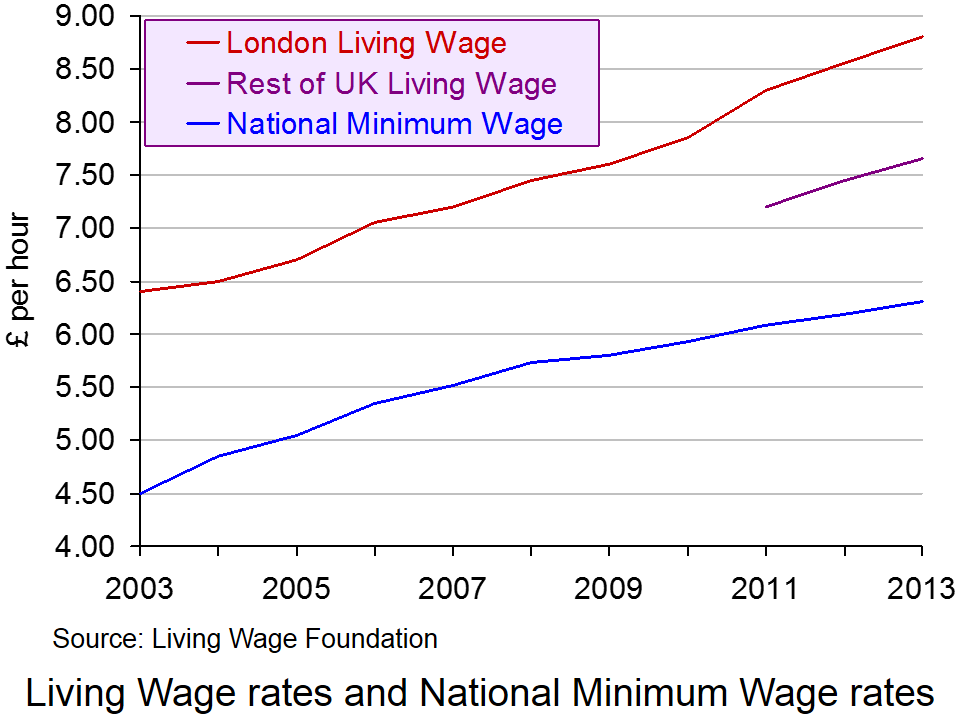 Nevertheless, despite this capping of the living wage, it is still significantly higher than the UK National Minimum Wage, which currently stands at £6.31 for those aged 21 and over. This can be seen from the chart (click here for a PowerPoint).
Paying the Living Wage is voluntary for employers, but as The Guardian reports:
A total of 432 employers are now signed up to the campaign, up from 78 this time last year, including Legal & General, KPMG, Barclays, Oxfam, Pearson, the National Portrait Gallery and First Transpennine Express, as well as many smaller businesses, charities and town halls. Together they employ more than 250,000 workers and also commit to roll out the living wage in their supply chain.
But as The Observer reports:
The number of people who are paid less than a ‘living wage’ has leapt by more than 400,000 in a year to over 5.2 million, amid mounting evidence that the economic recovery is failing to help millions of working families.
A report for the international tax and auditing firm KPMG also shows that nearly three-quarters of 18-to-21-year-olds now earn below this level – a voluntary rate of pay regarded as the minimum to meet the cost of living in the UK. The KPMG findings highlight difficulties for ministers as they try to beat back Labour’s claims of a “cost of living crisis”.
According to the report, women are disproportionately stuck on pay below the living wage rate, currently £8.55 in London and £7.45 elsewhere. Some 27% of women are not paid the living wage, compared with 16% of men. Part-time workers are also far more likely to receive low pay than full-time workers, with 43% paid below living-wage rates compared with 12% of full-timers.
But although paying a living wage may be desirable in terms of equity, many firms, especially in the leisure and retailing sectors, claim that they simply cannot afford to pay the living wage and, if they were forced to, would have to lay off workers.
The point they are making is that it is not economical to pay workers more than their marginal revenue product. But this raises the question of whether a higher wage would encourage people to work more efficiently. If it did, an efficiency wage may be above current rates for many firms. It also raises the question of whether productivity gains could be negotiated in exchange for paying workers a living wage
These arguments are discussed in the following podcast.
Podcast
 Higher ‘productivity’ will increase living wage BBC Today Programme, Priya Kothari and Steve Davies (4/11/13)
Articles
UK living wage rises to £7.65 an hour The Guardian (4/11/13)
More than 5 million people in the UK are paid less than the living wage The Observer, Toby Helm (2/11/13)
Increasing numbers of Scots are paid less than living wage Herald Scotland (2/11/13)
Labour would give tax rebates to firms that pay living wage Independent, Jane Merrick (3/11/13)
Employers praise Ed Miliband’s living wage proposal Independent, Andy McSmith (3/11/13)
Miliband’s living wage tax break will raise prices, warns CBI chief The Telegraph, Tim Ross (3/11/13)
Living Wage rise provides a boost for low paid workers BBC News (4/11/13)
Information and Reports
What is the Living Wage? Living Wage Foundation
The Living Wage Centre for Research in Social Policy, Loughborough University
Living wage Mayor of London
One in five UK workers paid less than the Living Wage KPMG News Release (3/11/13)
Number of workers paid less than the Living Wage passes 5 million KPMG News Release (3/11/13)
Living Wage Research for KPMG Markit (October 2012)
Questions
- How is the Living Wage calculated?
- What are the reasons for announcing a Living Wage figure that is lower than a reference living wage? Assess these reasons.
- If there are two separate figures for the Living Wage for London and the rest of the UK, would it be better to work out a living wage for each part, or even location, of the UK?
- Why might it be in employers’ interests to pay at least the Living Wage? Does this explain why more and more employers are volunteering to pay it?
- Assess the Labour Party’s pledge, if they win the next election, that ‘firms which sign up to the living wage will receive a tax rebate of up to £1000 for every low-paid worker who gets a pay rise, funded by tax and national insurance revenue from the higher wages’.
- Which is fairer: to pay everyone at least the Living Wage or to use tax credits to redistribute incomes to low-income households?

As Elizabeth noted in Fuelling the Political Playing Field, there has been much debate recently about energy prices in the UK. Four of the ‘Big Six’ energy companies have now announced price rises. They average 9.1% – way above the rate of consumer price inflation and even further above the average rate of wage increases. What is more, they are considerably above the rate of increase in wholesale energy prices, which, according to Ofgem, have risen by just 1.7% in the past year.
The bosses of the energy companies have appeared before the House of Commons Energy and Climate Change Select Committee to answer for their large price increases. The energy companies claim that the increases are necessary to cover not only rising wholesale prices, but also green levies by the government and ‘network charges’ for investments in infrastructure.  However, it is hard to see how, even taking into account all three of these possible sources of cost increases, the scale of price increases can be justified.
Another possible explanation for the price hikes is that they are partly the result of a system of transfer pricing (see). The energy industry is vertically integrated. Energy companies are not only retailers to customers, but also generators of electricity and wholesale shippers of gas. It is possible that, by the producing/shipping arms of these companies charging higher prices to their retailing arms, the retailers’ costs do indeed go up more than the wholesale market cost. The result, however, is higher profits for the producing arms of these businesses. In other words, a higher transfer price allows profits to be diverted from each company’s retailing arm to its producing arm.
 This is an argument for making the wholesale market more competitive and for stopping the by-passing of this market by producing arms of companies selling directly to their retailing arms. What the companies are being accused of is an abuse of market power and possibly of colluding with each other, at least tacitly, to support the continuation of such a practice.
So is the answer a price freeze, as proposed by the Labour Party? Is it an investigation of the energy market by the Competition Commission? Or is it, at least as a first step, much more openness by the energy companies and transparency about their pricing practices? Or is it to encourage consumers to switch between energy companies, including the smaller ones, which at present account for less than 5% of energy supply? The videos, podcasts and articles consider these issues.
Webcasts and Podcasts
Energy bosses blame high bills on wholesale prices Channel 4 News, Gary Gibbon (29/10/13)
Why are energy bosses being questioned? BBC News, Stephanie McGovern (29/10/13)
Key questions Big Six energy companies must answer The Telegraph, Ann Robinson (29/10/13)
Energy bosses offer excuses for prices rises The Telegraph (29/10/13)
Energy bosses face MPs over price rises BBC News, John Moylan (29/10/13)
Energy boss ‘can’t explain’ competitors’ price hikes The Telegraph (29/10/13)
Ovo boss: Competition Commission would take too long BBC News (30/10/13)
Dale Vince: Energy market is ‘dysfunctional’ BBC Today Programme (30/10/13)
Tony Cocker: Public mistrust energy industry BBC Today Programme (30/10/13)
Ed Davey: Energy deals not just for ‘internet savvy’ BBC Today Programme (31/10/13)
Articles
Energy giants ‘charge as much as they can get away with’ The Telegraph, Peter Dominiczak (29/10/13)
UK energy markets need perestroika Financial Times (27/10/13)
Britain’s energy utilities must embrace glasnost Reuters, John Kemp (29/10/13)
Small energy firms ‘escape levies’ BBC News (30/10/13)
Is the energy market structurally flawed? BBC news, Robert Peston (30/10/13)
The energy market needs a Competition Commission investigation Fingleton Associates, John Fingleton (12/10/13)
Energy firms raised prices despite drop in wholesale costs The Guardian, Rowena Mason (29/10/13)
Only full-scale reform of our energy market will prevent endless price rises The Observer, Phillip Lee (26/10/13)
Energy Giants Blame Rising Bills On Green ‘Stealth Taxes’ Huffington Post, Asa Bennett (29/10/13)
Big Six energy firms ‘like cartel’ Belfast Telegraph (30/10/13)
Energy boss says he hasn’t done sums on green levies The Telegraph, Georgia Graham (30/10/13)
Graphic: How your energy bills have soared in ten years The Telegraph, Matthew Holehouse (30/10/13)
British energy suppliers’ explanations for price hikes just don’t add up The Guardian, Larry Elliott (31/10/13)
The 18th energy market investigation since 2001: Will this one be different? The Carbon Brief, Ros Donald (31/10/13)
Energy: Is there enough competition in the market? BBC News, Hugh Pym (26/11/13)
Information and Reports
Wholesale [electricity] market Ofgem
Wholesale [gas] market Ofgem
Response on wholesale energy costs Ofgem Press Release (29/10/13)
Response to Government’s Annual Energy Statement Ofgem Press Release (31/10/13)
Real Energy Market Reform The Labour Party
Questions
- Why may the costs of energy paid by the energy retailers to energy producers/shippers have risen more than the wholesale price?
- Explain what is meant by transfer pricing. How could transfer pricing be used to divert profits between the different divisions of a business?
- How can transfer pricing be designed by multinational companies to help them minimise their tax bills?
- Why is policing transfer pricing arrangements notoriously difficult?
- What evidence is there to show that switching between retailers by customers can help to drive retail energy prices down?
- How did the old electricity pool system differ from the current wholesale system?
- Should electricity companies be forced to pool the electricity they generate and not sell it to themselves through bilateral deals?
- Comment on the following: “The current electricity trading arrangements ‘create the very special incentive for the oligopolists. …The best of all possible worlds is where nobody invests. As supply and demand close up, the price spikes upwards, and supernormal profits result.'”
 Over the past few years lobster prices in Maine have tumbled. Eight years ago the price paid to fishermen was around $4.60 per pound. Today it’s around $2.20. The problem is one of booming lobster populations and the dominance of lobster in catches. Last year’s haul was double that of a decade ago and, in some waters, six times higher.
You would think that larger catches would be good news for fishermen. But prices now are so low that they barely cover variable costs. Individual fishermen fish harder and longer to bring in even bigger catches to make up for the lower price. This, of course, compounds the problem and pushes the price even lower.
So what are the answers for the fishermen of Maine? One solution is to diversify their catch, but with lobster so plentiful and other fish stocks depleted, this is not easy.
Another solution is to cooperate. The Reuters article below quotes John Jordan, a lobsterman and president of Calendar Islands Maine Lobster Co.:
‘If you had an industry that actually cooperated, you wouldn’t be bringing in more product if you couldn’t sell what you already had, right?’
Restricting the catch would require lobster distributors to cooperate and set quotas for what the fishermen would be permitted to sell. But with over 5000 fishermen, this is not easy.
Another solution is to expand the market. One way is for the distributors or other agencies to market lobster and lobster products more aggressively. For example,  this year the State of Maine has established a $2 million marketing collaborative. Another solution is to find new markets.
Jordan’s company and others are frantically seeking new ways to sneak lobster into unexpected corners of the food market, from gazpacho to puff pastries and quiche.
In the meantime, for consumers the question is whether the low prices paid to the fishermen of Maine will feed through into low prices in the fishmonger, supermarket and restaurant. So far that does not seem to be happening, as the final two articles below explain.
Webcasts
US lobster fishermen’s ‘problem of plenty’ BBC News, Jonny Dymond (5/10/13)
Maine lobstermen in a pinch over low prices, record catch: Part 1, Part 2, Part 3 Aljazeera America, Adam May (11/10/13)
Articles
Something fishy is going on in the nation’s lobster capital CNBC, Heesun Wee (1/9/13)
Booming lobster population pinches profits for Maine’s fishery Reuters, Dave Sherwood (25/8/13)
Lobster’s worth shelling out for The Observer,
Rachel Cooke (21/9/13)
Clawback The New Yorker, James Surowiecki (26/8/13)
Why The Glut Of Cheap Lobster Won’t Lower Price Of Lobster Rolls Gothamist, John Del Signore (20/7/12)
Questions
- Why have lobster prices paid to fishermen fallen? Illustrate your argument with a demand and supply diagram
- What has determined the size of the fall in prices? What is the relevance of price elasticity of demand and price elasticity of supply to your answer?
- How is the fallacy of composition relevant to the effects on profits of an increase in the catch by (a) just one fisherman and (b) all fishermen? What incentive does this create for individual fishermen in a competitive market?
- What can lobster fishermen do to restore profit margins through collaborative action?
- In what ways is there a conflict between economics and ecology in the lobster fishing industry?
- How does stored lobster affect (a) the price elasticity of supply and (b) the price volatility of lobster?
- How could cooperation between lobster fishermen and lobster processors and distributors benefit all those involved in the cooperation?
- Why may restaurants choose to maintain high prices for lobster dishes for ‘psychological reasons’? Are there any other reasons?
 For the second time in nine months, the USA has approached a fiscal cliff. This is where the federal government is forced to make government expenditure cuts and/or impose tax rises. There are two types of cliff face. The first is a legal limit on the size of the federal government debt and hence deficit. The second is failure to agree on a budget.
On January 1st this year, a fiscal cliff was narrowly averted by a last-minute agreement to raise the size of the permitted debt. On the 1st October (the beginning of the financial year), however, the US economy ‘fell over the cliff’. This time is was a failure by Congress to reach agreement over the federal budget. The sticking point was an unwillingness of the Republican majority in the House of Representatives to agree to a budget without the government making concessions on its healthcare reform. The government was unwilling to do that and so no budget was passed.
With no budget, much of government has to shut down! In practice, this means that all non-essential workers will cease to be paid.  That includes workers in housing, parts of healthcare, the civil law part of the justice system, immigration, regulatory agencies, the passport service, parks and museums. Even workers in essential areas, such as civilian workers in the military, police and social services, are likely to see their pay delayed until the problem is resolved. The articles below look at some of the implications of this partial shut-down.
It is hoped that, within a few days, agreement on a budget will be reached. But that will not be the end of the story because a second fiscal cliff looms. And that is of the first type. There is currently a legal limit to Federal Government debt of $16.699 trillion. Because that limit was reached earlier this year, from May 18 the government has been able to use various ‘extraordinary measures‘ to carry on borrowing. These measures will run out, however, around 17 October. From then, if a new higher debt ceiling has not been agreed by Congress, the government will be unable to pay some of its bills. For example, on 1 November it will get a bill of $67billion for social security, medicare and veterans benefits. As the second Independent article below explains:
In a government shutdown, the federal government is not allowed to make any new spending commitments. By contrast, if we hit the debt-ceiling then the Treasury Department won’t be able to borrow money to pay for spending that Congress has already approved. In that case, either Congress will have to lift the debt ceiling or the federal government will have to default on some of its bills, possibly including payments to bondholders or Social Security payouts. That could trigger big disruptions in the financial markets — or a long-term rise in borrowing costs.
Not surprisingly, financial markets are nervous. Although the direct effect of lost output will be relatively small, provided agreements on the budget and the debt are reached fairly soon, the impact on confidence in the US system of government could be more damaging. Not only could this curb recovery in the USA, it could have a significant effect on global recovery, given the size and importance of the US economy to the rest of the world.
Webcasts
What does the shutdown mean for normal Americans? BBC News, Keith Doyle (1/10/13)
How the government shut down is being reported in the US BBC News (1/10/13)
Shutdown could slam frail U.S. economy Reuters, Bobbi Rebell (1/10/13)
Shutdown Will Cost U.S. Economy $300 Million a Day, IHS Says Bloomberg, Jeanna Smialek & Ian Katz (1/10/13)
How will the US government shutdown affect the global economy? The Guardian, Larry Elliott and Guy Grandjean (1/10/13)
How would a government shutdown affect the rebounding economy? Aljazeera, Duarte Geraldino (30/9/13)
How will the US government shutdown affect the economy? BBC News, Richard Lister (1/10/13)
Shutdown continues as Obama and Republicans fail to agree BBC News, Rajini Vaidynathan (2/10/13)
Former US Secretary of Labor Robert Reich on shutdown BBC News, Robert Reich (2/10/13)
Government shutdown: What’s the cost? CBS News, Rebecca Kaplan (1/10/13)
US shutdown will have ‘minimal impact’ on global economy One News (New Zealand), Dan Zirker (2/10/13)
What is the US debt ceiling? BBC News, Hugh Pym (14/10/13)
Articles
US wakes up to government shutdown as Congress fails to strike budget deal Independent, Nikhil Kumar (1/10/13)
US begins government shutdown as budget deadline passes BBC News (1/10/13)
David Cameron warns on world growth as US government shuts down The Telegraph, Damien McElroy (1/10/13)
Shutdown showdown: A glossary Aljazeera, Ben Piven (30/9/13)
Everything you need to know about how the partial shutdown will work in US Independent, Brad Plumer (1/10/13)
What’s the economic impact of a US government shutdown? BBC News, Kim Gittleson (1/10/13) (follow links at top of screen for further articles)
US government shutdown isn’t the worst of it BBC News, Linda Yueh (30/9/13)
Onset of the storm BBC News, Robert Peston (1/10/13)
The gathering storm? BBC News, Robert Peston (30/9/13)
Government shutdown: what’s really going on – and who’s to blame? The Guardian, Dan Roberts (30/9/13)
Government shutdown threat is getting very old, very fast CNN, Julian Zelizer (30/9/13)
US fiscal cliff fears rattle the markets The Australian, Adam Creighton (1/10/13)
U.S. Government Shutdown Sinks Dollar Forbes, Dean Popplewell (1/10/13)
US Government Shutdown: European Markets Not Fretting Over Temporary Closure International Business Times, Ishaq Siddiqi (1/10/13)
The States to plunge into abyss of debt, off fiscal cliff Pravda, Irina Sabinina (1/10/13)
Shutting down the United States government nothing new The Vancouver Sun, Andrew Coyne (1/10/13)
Christine Lagarde urges US that debt crisis threatens world economy The Guardian, Larry Elliott (3/10/13)
U.S. failure to lift debt ceiling could damage world – IMF Reuters (3/10/13)
Data
US government shutdown: in numbers The Guardian (see also)
US Budget: Historical Tables White House Office of Management and Budget (includes estimates to 2018 as well as historical data)
Questions
- If a debt ceiling is reached, what does this imply for the budget deficit?
- How serious are the two current fiscal cliffs?
- How would a continuation of the partial government shut-down impact on the US private sector?
- What multiplier effects on the rest of the world are likely to arise from a cut in US government expenditure or a rise in taxes? What determines the size of these multiplier effects?
- Explain the likely effect of the current crisis on the exchange rate of the dollar into other currencies.
- Why might the looming problem of reaching the debt ceiling drive up long-term interest rates in the USA and beyond?
 As we saw in the news item The difficult exit from cheap money, central banks around the world have been operating an extremely loose monetary policy since the beginning of 2009. Their interest rates have been close to zero and trillions of dollars of extra money has been injected into the world economy through various programmes of quantitative easing.
For the past few months the Federal Reserve has been purchasing bonds under its most recent programme dubbed QE3, and thereby increasing narrow money, by $85 billion per month. Since the start of its QE programme in 2009, it has pumped around $2.8 trillion of extra money into the US and world economies. This huge increase in money supply has boosted the demand for assets worldwide and world stock markets have risen. Much of the money has flowed into developing countries, such as India, and has acted as a boost to their economies.
 Once the US economy is growing strongly again, the aim is to taper off, and ultimately end or even reverse, the QE programme. It was expected that the Fed would decide to start this tapering off process at its meeting on 18 September – perhaps reducing bond purchases initially by some $10 billion. (Note that this would still be an increase in money supply, just a slightly smaller one.) Over the past few days, US bond prices have been falling (and yields increasing) in anticipation of such a move.
As it turned out, the Fed decided to delay tapering off. It will continue with its assets purchase programme of $85 billion per month for the time being. The reason given was that the US economy was still too fragile and needed the monthly injections of money to stay at the current level.
Normally it might be expected that the announcement of a more fragile recovery would cause the US stock market, and others worldwide, to fall. In fact the opposite occurred, with investors relieved that the extra money, which allows extra asset purchases, would continue at the same rate.
But this then raises the question of just what will be the effect when tapering off does actually occur. Will stock markets then go into a tailspin? Or will they merely stop rising so fast. That depends very much on the role of speculation.
Webcasts
Bernanke’s Own Words on Asset Purchases, Economy Bloomberg (18/9/13)
Bernanke: Fed to delay bond tapering PBS Newshour on YouTube (full speech plus questions) (18/9/13)
No tapering announced by Fed CNBC on Yahoo Finance (18/9/113)
The impact of US stimulus moves at home and abroad BBC News, Stephanie Flanders (18/9/13)
Is the upturn reaching Americans? BBC World, Stephanie Flanders (17/9/13)
Shares hit high as Federal Reserve maintains stimulus BBC News, Stephanie Flanders (18/9/13)
US Fed decision to delay tapering was a relief ET Now (India), Bimal Jalan (19/9/13)
Articles
Federal Reserve surprises markets by delaying QE tapering The Telegraph, Katherine Rushton (18/9/13)
Federal Reserve delays QE tapering: the full statement The Telegraph (18/9/13)
Q&A: What is tapering? BBC News (18/9/13)
Fed delay is no reason to celebrate The Guardian, Larry Elliott (19/9/13)
Federal Reserve tapering decision has baffled the markets The Guardian, Larry Elliott (19/9/13)
Taper tiger The Economist (21/9/13)
Everything You Need to Know About the Fed’s Decision Not to Taper QE3 The Atlantic, Matthew O’Brien (18/9/13)
Fed’s dovish turn leaves Wall Street economists mulling taper timing: poll Reuters, Chris Reese (18/9/13)
Good news and bad news from the Fed BBC News, Stephanie Flanders (19/9/13)
Is the Fed frightened of its shadow? BBC News, Robert Peston (19/9/13)
The Federal Reserve and Janet Yellen face a tough task with insufficient tools The Guardian, Mohamed A. El-Erian (14/10/13)
Questions
- Why might a slowing down in the increase in US money supply cause asset prices to fall, rather than merely to rise less quickly?
- Why has the US QE programme led to a rise in asset prices overseas?
- Distinguish between stabilising and destabilising speculation. Which type of speculation has been occurring as a result of the US QE programme?
- How has QE affected unemployment in the UK and USA? How is the participation rate and the flexibility of labour markets relevant to the answer?
- Explain the following two statements by Stephanie Flanders and Robert Peston respectively. “The market conditions argument has a circularity to it: talk of tapering leads to higher market rates, which in turn puts the taper itself on hold.” “The Fed simply hinting that less money would be created, means that there will be no reduction in the amount of money created (for now at least).”
- Why have US long-term interest rates, including mortgage rates, risen since May of this year?
- What impact have higher US long-term interest rates had on economies in the developing world? Explain.
 Each year in November, the Living Wage Foundation publishes figures for the hourly living wage that is necessary for people to meet basic bills. The rate for London is calculated by the Greater London Authority and for the rest of the UK by the Centre for Research in Social Policy at Loughborough University.