 In two recent speeches, the Governor of the Bank of England, Mark Carney, and the Bank’s Chief Economist, Andy Haldane, have reflected on the growing inequality in the UK and other countries. They have also answered criticisms that monetary policy has exacerbated the problem. As, Andy Haldane puts it:
It is clear monetary policy has played a material role in lifting all boats since the financial crisis broke. …[But] even if monetary policy has lifted all boats, and could plausibly do so again if needed, that does not mean it has done so equally. In particular, concerns have been expressed about the potential distributional effects of monetary policy.
Jan Vlieghe [member of the Monetary Policy Committee] has recently looked at how monetary policy may have affected the fortunes of, among others, savers, pension funds and pensioners. The empirical evidence does not suggest these cohorts have been disadvantaged to any significant degree by the monetary policy stance. For most members in each cohort, the boost to their asset portfolios and the improved wages and profits due to a stronger economy more than offset the direct loss of income from lower rates [of interest on savings accounts].
Andy Haldane’s speech focused largely on regional inequality. He argued that productivity has grown much more rapidly in the more prosperous regions, such as London and the South East. This has resulted in rising inequality in wages between different parts of the UK. Policies that focus on raising productivity in the less prosperous regions could play a major role in reducing income inequality.
Mark Carney’s speech echoed a lot of what Andy Haldane was saying. He argued that expansionary monetary policy has, according to Bank of England modelling, “raised the level of GDP by around 8% relative to trend and lowered unemployment by 4 percentage points at their peak”. And the benefits have been felt by virtually everyone. Even savers have generally gained:
That’s in part because, to a large extent, the thrifty saver and the rich asset holder are often one and the same. Just 2% of households have deposit holdings in excess of £5000, few other financial assets and don’t own a home.
But some people still gained more from monetary policy than others – enough to contribute to widening inequality.
Losers from the lost decade
 Mark Carney looked beyond monetary policy and argued that the UK has experienced a ‘lost decade’, where real incomes today are little higher than 10 years ago – the first time this has happened for 150 years. This stalling of average real incomes has been accompanied by widening inequality between various groups, where a few have got a lot richer, especially the top 1%, and many have got poorer. Although the Gini coefficient has remained relatively constant in recent years, there has been a widening gap between the generations.
For both income and wealth, some of the most significant shifts have happened across generations. A typical millennial earned £8000 less during their twenties than their predecessors. Since 2007, those over 60 have seen their incomes rise at five times the rate of the population as a whole. Moreover, rising real house prices between the mid-1990s and the late 2000s have created a growing disparity between older home owners and younger renters.
This pattern has been repeated around the developed world and has led to disillusionment with globalisation and a rise in populism. 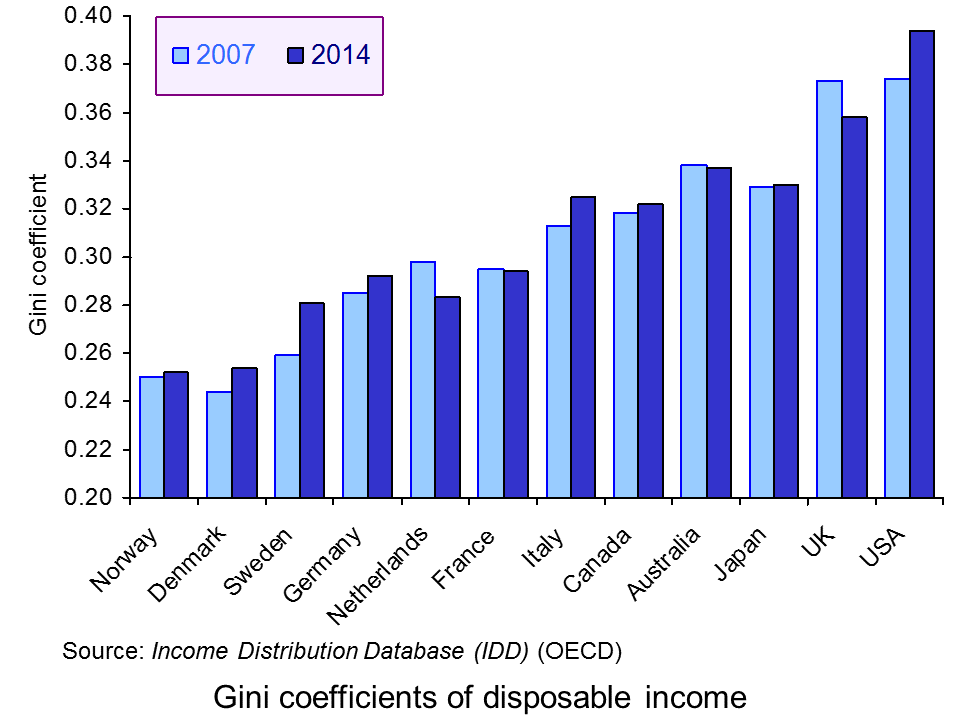 Globalisation has been “associated with low wages, insecure employment, stateless corporations and striking inequalities”. (Click here for a PowerPoint of the chart.)
And populism has been reflected in the crisis in Greece, the Brexit vote, Donald Trump’s election, the rise of the National Front in France, the No vote in the Italian referendum on reforming the constitution and the rise in anti-establishment parties and sentiment generally. Mainstream parties are beginning to realise that concerns over globalisation, inequality and a sense of disempowerment must be addressed.
Solutions to inequality
As far as solutions are concerned, central must be a rise in general productivity that increases potential real income.
Boosting the determinants of long-run prosperity is the job of government’s structural, or supply-side policies. These government policies influence the economy’s investment in education and skills; its capacity for research and development; the quality of its core institutions, such as the rule of law; the effectiveness of its regulatory environment; the flexibility of its labour market; the intensity of competition; and its openness to trade and investment.
But will this supply-side approach be enough to bring both greater prosperity and greater equality? Will an openness to trade be accepted by populist politicians who blame globalisation and the unequal gains from international trade for the plight of the poor? Carney recognises the problem and argues that:
For the societies of free-trading, networked countries to prosper, they must first re-distribute some of the gains from trade and technology, and then re-skill and reconnect all of their citizens. By doing so, they can put individuals back in control.
For free trade to benefit all requires some redistribution. There are limits, of course, because of fiscal constraints at the macro level and the need to maintain incentives at the micro level. Fostering dependency on the state is no way to increase human agency, even though a safety net is needed to cushion shocks and smooth adjustment.
Redistribution and fairness also means turning back the tide of stateless corporations.
… Because technology and trade are constantly evolving and can lead to rapid shifts in production, the commitment to reskilling all workers must be continual.
In a job market subject to frequent, radical changes, people’s prospects depend on direct and creative engagement with global markets. Lifelong learning, ever-greening skills and cooperative training will become more important than ever.
But whether these prescriptions will be accepted by people across the developed world who feel that the capitalist system has failed them and who look to more radical solutions, whether from the left or the right, remains to be seen. And whether they will be adopted by governments is another question!
Webcast
 Roscoe Lecture Bank of England on YouTube, Mark Carney (5/12/16)
Speeches
One Car, Two Car, Red Car, Blue Car Bank of England, Andrew Haldane (2/12/16)
The Spectre of Monetarism: Roscoe Lecture, Liverpool John Moores University Bank of England, Mark Carney (5/12/16)
Articles: Andrew Haldane speech
Bank of England chief economist says monetary stimulus stopped ‘left behind’ from drowning Independent, Ben Chu (2/12/16)
BoE’s Andrew Haldane warns of regional growth inequality BBC News (2/12/16)
‘Regions would have faced contraction’ without rate cuts and money printing Belfast Telegraph (2/12/16)
Bank of England chief: UK can be transformed if it copies progress on Teesside Gazette Live, Mike Hughes (2/12/16)
Articles: Mark Carney speech
Governor’s ‘dynamite’ warning on wages and globalisation Sky News, Ed Conway (6/12/16)
Mark Carney warns Britain is suffering first lost decade since 1860 as people across Europe lose trust in globalisation The Telegraph, Szu Ping Chan and Peter Foster (5/12/16)
Mark Carney: we must tackle isolation and detachment caused by globalisation The Guardian, Katie Allen (6/12/16)
Bank of England’s Carney warns of strains from globalization Reuters, William Schomberg and David Milliken (6/12/16)
CARNEY: Britain is in ‘the first lost decade since the 1860s’ Business Insider UK, Oscar Williams-Grut (7/12/16)
Carney warns about popular disillusion with capitalism BBC News (5/12/16)
Some fresh ideas to tackle social insecurity Guardian letters (7/12/16)
Report
Monitoring poverty and social exclusion 2016 (MPSE) Joseph Rowntree Foundation, Adam Tinson, Carla Ayrton, Karen Barker, Theo Barry Born, Hannah Aldridge and Peter Kenway (7/12/16)
Data
OECD Income Distribution Database (IDD): Gini, poverty, income, Methods and Concepts OECD
The effects of taxes and benefits on household income Statistical bulletins ONS
Questions
- Has monetary policy aggravated the problem of inequality? Explain.
- Comment on Charts 11a and 11b on page 19 of the Haldane speech.
- Does the process of globalisation help to reduce inequality or does it make it worse?
- If countries specialise in the production of goods in which they have a comparative advantage, does this encourage them to use more or less of relatively cheap factors of production? How does this impact on factor prices? How does this affect income distribution?
- How might smaller-scale firms “by-pass big corporates and engage in a form of artisanal globalisation; a revolution that could bring cottage industry full circle”?
- Why has regional inequality increased in the UK?
- What types of supply-side policy would help to reduce inequality?
- Explain the following statement from Mark Carney’s speech: “For free trade to benefit all requires some redistribution. There are limits, of course, because of fiscal constraints at the macro level and the need to maintain incentives at the micro level”.
- Mark Carney stated that “redistribution and fairness also means turning back the tide of stateless corporations”. How might this be done?
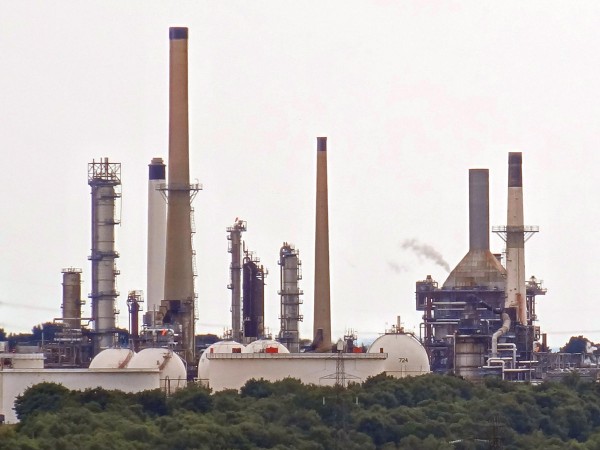 OPEC members agreed on 30 November 2016 to reduce their total oil output by 1.2m barrels per day (b/d) from January 2017 – the first OPEC cut since 2008. The biggest cut (0.49m b/d) is to be made by Saudi Arabia.
Russia has indicated that it too might cut output – by 0.3m b/d. If it carries through with this, it will be the first deal for 15 years to include Russia. OPEC members hope that non-OPEC countries will also cut output by 0.3m b/d. There will be a meeting between OPEC and non-OPEC members on 9 December in Doha to hammer out a deal. If all this goes ahead, the total cut would represent nearly 2% of world output.
 The OPEC agreement took many commentators by surprise, who had expected that Iran’s unwillingness to cut its output would prevent any deal being reached. As it turned out, Iran agreed to freeze its output at current levels.
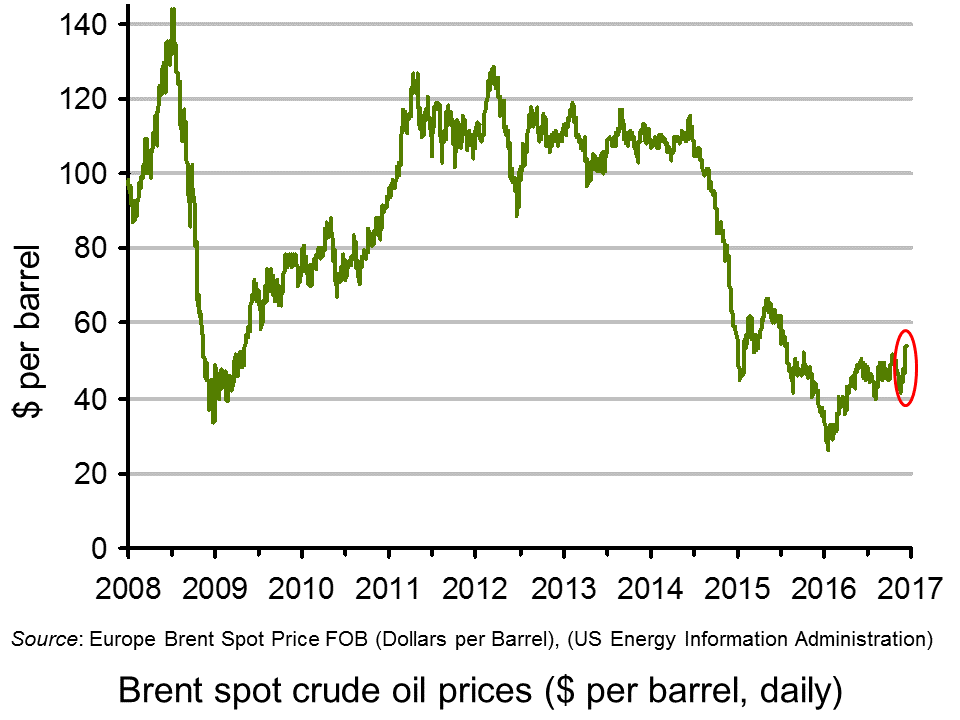
Although some doubted that the overall deal would stick, there was general confidence that it would do so. Markets responded with a huge surge in oil prices. The price of Brent crude rose from $46.48 per barrel on 29 November to $54.25 on 2 December, a rise of nearly 17% (click here for a PowerPoint of the chart)..
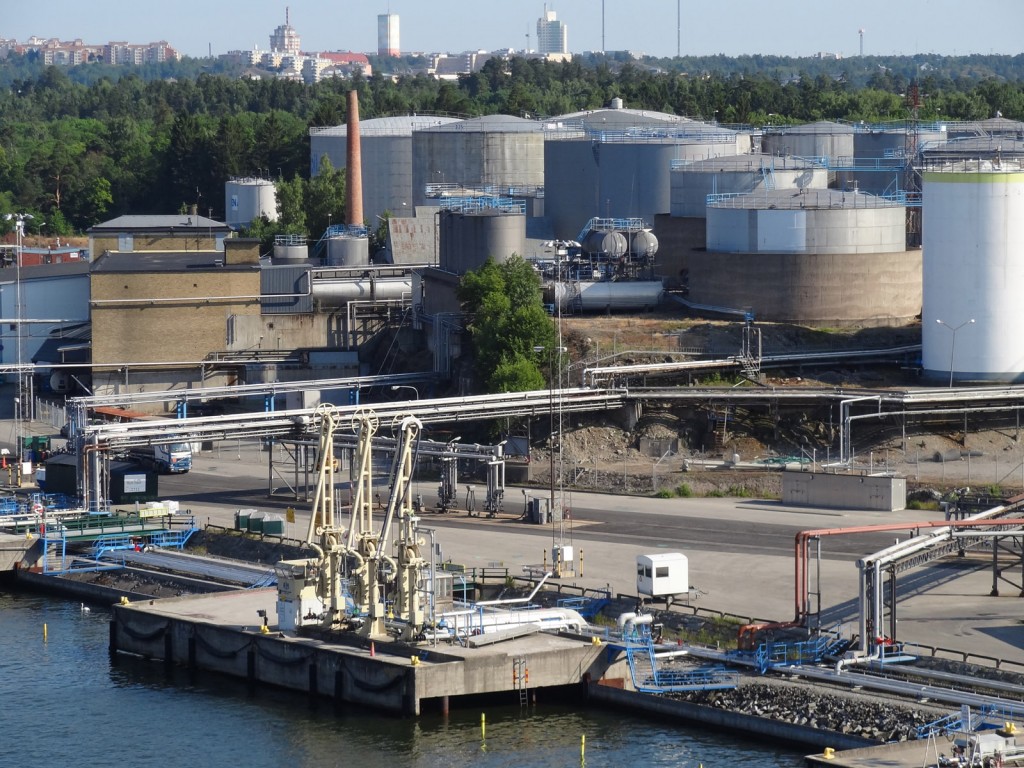 The deal represented a U-turn by Saudi Arabia, which had previously pursued the policy of not cutting output, so as to keep oil prices down and drive many shale oil producers out of business (see the blog, Will there be an oil price rebound?)
But if oil prices persist above $54 for some time, many shale oil fields in the USA will become profitable again and some offshore oil fields too. At prices above $50, the supply of oil becomes relatively elastic, preventing prices from rising significantly. As The Observer article states:
It is more likely that a $60 cap will emerge as the Americans, who stand outside the 13-member OPEC grouping, unplug the spigots that have kept their shale oil fields from producing in the last year or two.
… The return to action of once-idle derricks on the Texas and Dakota plains is the result of efficiency savings that have seen large jobs losses and a more streamlined approach to drilling from the US industry, after the post-2014 price tumble rendered many operators unprofitable. Only a few years ago, many firms struggled to make a profit at $70 a barrel. Now they can be competitive at much lower prices, with many expecting $50 for West Texas Intermediate – a lighter crude that typically earns $5 a barrel less than Brent.
OPEC as a cartel is much weaker than it used to be. It produces only around 40% of global oil output. Cheating from its members and increased production from non-OPEC countries, let alone huge oil stocks after two years when production has massively exceeded consumption, are likely to combine to keep prices below $60 for the foreseeable future.
Webcasts
OPEC Cuts Daily Production by 1.2 Million Barrels MarketWatch, Sarah Kent (30/11/16)
How Putin, Khamenei and Saudi prince got OPEC deal done Reuters, Rania El Gamal, Parisa Hafezi and Dmitry Zhdannikov (2/12/16)
Fuel price fears as OPEC agrees to cut supply Sky News, Colin Smith (30/11/16)
OPEC Confounds Skeptics, Agrees to First Oil Cuts in 8 Years Bloomberg, Jamie Webster (30/11/16)
Game of oil: Behind the OPEC deal Aljazeera, Giacomo Luciani (3/12/16) (first 10½ minutes)
Russia won’t stick with its side of the OPEC cut bargain CNBC, Silvia Amaro (1/12/16)
Articles
Oil soars, Brent hits 16-month high after OPEC output deal Reuters, Devika Krishna Kumar (1/12/16)
OPEC reaches a deal to cut production The Economist (3/12/16)
Opec doesn’t hold all the cards, even after its oil price agreement The Observer, Phillip Inman (4/12/16)
Saudi Arabia discussed oil output cut with traders ahead of Opec Financial Times, David Sheppard and Anjli Raval (4/12/16)
The return of OPEC Reuters, Jason Bordoff (2/12/16)
‘Unfortunately, We Tend To Cheat,’ Ex-Saudi Oil Chief Says Of OPEC Forbes, Tim Daiss (4/12/16)
After OPEC – What’s Next For Oil Prices? OilPrice.com (2/12/16)
The OPEC Oil Deal Sells Fake News for Real Money Bloomberg, Leonid Bershidsky (1/12/16)
Data and information
Brent crude prices, daily US Energy Information Administration
OPEC home page Organization of the Petroleum Exporting Countries
OPEC 171st Meeting concludes OPEC Press Release (30/11/16)
Questions
- What determines the price elasticity of supply of oil at different prices?
- Why is the long-term demand for oil more elastic than the short-term demand?
- What determines the likelihood that the OPEC agreement will be honoured by its members?
- Is it in Russia’s interests to cut its production as part of the agreement?
- Are higher oil prices ‘good news’ for the global economy and a boost to economic growth – a claim made by Saudi Arabia?
- What role does oil storage play in determining the effect on the oil price of a cut in output?
- What are oil prices likely to be in five years’ time? Explain your reasoning.
- Is it in US producers’ interests to invest in new shale oil production? Explain.
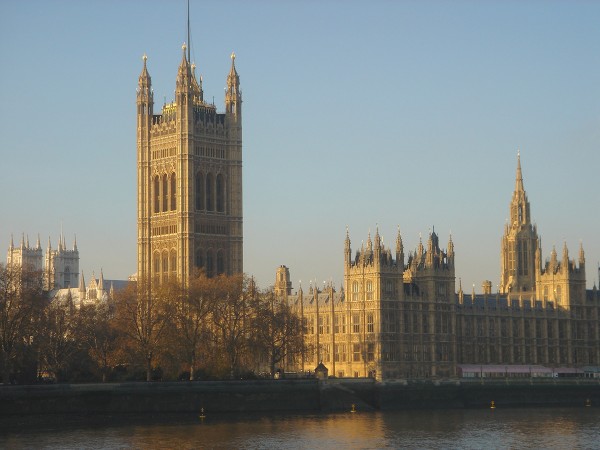 In his 2016 Autumn Statement, the new Chancellor of the Exchequer, Philip Hammond, announced that he was abandoning his predecessor’s target of achieving a budget surplus in 2019/20 and beyond. This was partly in recognition that tax revenues were likely to be down as economic growth forecasts were downgraded by the Office for Budget Responsibility. But it was partly to give himself more room to boost the economy in response to lower economic growth. In other words, he was moving from a strictly rules-based fiscal policy to one that is more interventionist.
Although he still has the broad target of reducing government borrowing over the longer term, this new flexibility allowed him to announce increased government spending on infrastructure.
The new approach is outlined in the updated version of the Charter for Budget
Responsibility, published alongside the Autumn Statement. The government’s fiscal mandate would now include the following:
|
|
| • |
a target to reduce cyclically-adjusted public-sector net borrowing to below 2% of GDP by 2020/21; |
| • |
a target for public-sector net debt as a percentage of GDP to be falling in 2020/21. |
It also states that:
 In the event of a significant negative shock to the UK economy, the Treasury will review the appropriateness of the fiscal mandate and supplementary targets as a means of returning the public finances to balance as early as possible in the next Parliament.
In the Autumn Statement, the new approach to fiscal policy is summarised as follows:
This new fiscal framework ensures the public finances continue on the path to sustainability, while providing the flexibility needed to support the economy in the near term.
With his new found freedom, the Chancellor was able to announce spending increases, despite deteriorating public finances, of £36bn by 2021/22 (see Table 1 in the Autumn Statement).
Most of the additional expenditure will be on infrastructure. To facilitate this, the government will set up a new National Productivity Investment Fund (NPIF)  to channel government spending to various infrastructure projects in the fields of housing, transport, telecoms and research and development. The NPIF will provide £23bn to such projects between 2017/18 and 2021/22.
But much of the additional flexibility in the new Fiscal Mandate will be to allow automatic fiscal stabilisers to operate. The OBR forecasts an increase in borrowing of £122bn over the 2017/18 to 2021/22 period compared with its forecasts made in March this year. Apart from the additional £23bn spending on infrastructure, most of the rest will be as a result of lower tax receipts from lower economic growth. This, in turn, is forecast to be the result of lower investment caused by Brexit uncertainties and lower real consumer spending because of the fall in the pound and the consequent rise in prices.
But rather than having to tighten fiscal policy to meet the previous borrowing target, the new Fiscal Mandate will permit this rise in borrowing. The lower tax payments will help to reduce the dampening effect on the economy.
So are we entering a new era of fiscal policy? Is the government now using discretionary fiscal policy to boost aggregate demand, while also attempting to increase productivity? Or is the relaxation of the Fiscal Mandate just a redrawing of the rules to give a bit more flexibility over the level of stimulus the government can give the economy?
Videos
Autumn Statement 2016: Philip Hammond’s speech (in full) GOV.UK (23/11/16)
Philip Hammond’s autumn statement – video highlights The Guardian (23/11/16)
Key points from the chancellor’s first Autumn Statement BBC News, Andrew Neil (23/11/16)
Autumn Statement: higher borrowing, lower growth Channel 4 News, Helia Ebrahimi (23/11/16)
Autumn Statement: Chancellor’s growth and borrowing figures BBC News (23/11/16)
Markets react to Autumn Statement Financial Times on YouTube, Roger Blitz (23/11/16)
Hammond’s Autumn Statement unpicked Financial Times on YouTube, Gemma Tetlow (23/11/16)
Autumn Statement 2016: The charts that show the cost of Brexit Sjy News, Ed Conway (24/11/16)
BBC economics editor Kamal Ahmed on the Autumn Statement. BBC News (23/11/16)
Autumn statement: debate Channel 4 News, Financial Secretary to the Treasury, Jane Ellison, and Labour’s Shadow Business Secretary, Clive Lewis (23/11/16)
Autumn Statement: Workers’ pay growth prospects dreadful, says IFS BBC News, Kevin Peachey and Paul Johnson (24/11/16)
Articles
Autumn Statement 2016: Expert comment on fiscal policy Grant Thornton, Adam Jackson (23/11/16)
Philip Hammond loosens George Osborne’s fiscal rules to give himself more elbow room as Brexit unfolds CityA.M., Jasper Jolly (23/11/16)
Britain’s New Fiscal Mandate Opens Way To Invest For Economic Growth Forbes, Linda Yueh (23/11/16)
Autumn Statement 2016: experts respond The Conversation (23/11/16)
Chancellor’s ‘Reset’ Leaves UK Economy Exposed And Vulnerable Huffington Post, Alfie Stirling (23/11/16)
Britain’s Autumn Statement hints at how painful Brexit is going to be The Economist (26/11/16)
Chancellor’s looser finance targets highlight weaker UK economy The Guardian, Phillip Inman (24/11/16)
Hammond’s less-than-meets-the-eye plan that hints at the future Financial Times, Martin Sandbu (23/11/16)
Economists’ views on Philip Hammond’s debut Financial Times, Paul Johnson, Bronwyn Curtis and Gerard Lyons (24/11/16)
Government Publications
Autumn Statement 2016 HM Treasury (23/11/16)
Charter for Budget Responsibility: autumn 2016 update HM Treasury
Reports, forecasts and analysis
Economic and fiscal outlook – November 2016 Office for Budget Responsibility (23/11/16)
Autumn Statement 2016 analysis Institute for Fiscal Studies (November 2016)
Questions
- Distinguish between discretionary fiscal policy and rules-based fiscal policy.
- Why have forecasts of the public finances worsened since last March?
- What is meant by automatic fiscal stabilisers? How do they work when the economic growth slows?
- What determines the size of the multiplier from public-sector infrastructure projects?
- What dangers are there in relaxing the borrowing rules in the Fiscal Mandate?
- Examine the arguments for relaxing the borrowing rules more than they have been?
- If the economy slows more than has been forecast and public-sector borrowing rises faster, does the Chancellor have any more discretion in giving a further fiscal boost to the economy?
- Does the adjustment of borrowing targets as the economic situation changes make such a policy a discretionary one rather than a rules-based one?
 Young people are increasingly finding it impossible to buy their own home. The reasons are easy to find: income rises of young people have failed to match rises in house prices, and access to loans has become more restrictive since the financial crisis. In 2002, 58.6% of 25-34 year-olds owned their own home; today, the figure is just 36.7%.
Conventional wisdom is that the source of the problem is on the supply side: a lack of house building. But according to the Redfern Review, led by the chief executive of Taylor Wimpey, Pete Redfern, the source of the problem lies mainly on the demand side. Overall demand for housing has been rapidly rising, stoked by low interest rates and the Help to Buy scheme, which is available to existing home owners as well as first-time buyers. However, purchases by first-time buyers have fallen as their incomes have declined relative to those of older people.
Of course, increasing supply, especially of cheaper starter homes, would help young people, but, according to the Redfern Review, such schemes take a long time to make much of a difference (although building modular homes could be much quicker). In the meantime, help could be provided on the demand side by making the Help to Buy scheme available only to first-time buyers and by increasing the help to them provided under the scheme, and also by encouraging lenders to make access to mortgages easier.
But a problem for most young people is high levels of debt, including student loans. Such debt and a lack of savings makes it difficult to raise a deposit, let alone afford mortgage repayments. And on the rental side, accommodation is becoming less and less affordable as rents rise faster than incomes, further exacerbating the difficulty of clawing down debt and saving for a deposit.
A long-term solution must involve increased supply – as the Redfern Review recognises. But in the short-term, providing more help to first-time buyers and those paying high rents could make a significant difference.
Webcast
Tackling UK housing crisis ‘will take generations’ ITV News, Joel Hills (16/11/16)
Articles
Review of home ownership in UK shows severe decline in young buyers PropertyWire (16/11/16)
Housing crisis: Lack of new building not to blame for soaring house prices finds Labour-commissioned report Independent, Ben Chu and Ashley Cowburn (16/11/16)
Redfern Review: Focus on First Time Buyers and Launch Housing Commission Money Expert, Danny Lord (16/11/16)
First-time buyers need more help, review finds BBC News (16/11/16)
Redfern Review echoes Homes for Scotland’s call for joined-up approach to housing Scottish Housing News, Nicola Barclay (17/11/16)
Redfern review into housing: worth building on? The Guardian, Nils Pratley (15/11/16)
UK housing review downplays developers’ role in crisis, critics say The Guardian, Graham Ruddick (16/11/16)
Report
The Redfern Review into the decline of homeownership (16/11/16)
Data
Economic Data freely available online: UK house prices The Economics Network
UK House Price to income ratio and affordability Economics Help blog (21/9/15)
House Price Index Nationwide
UK House Price Index: reports ONS/Land Registry
House Price Index: Statistical Bulletin ONS (Sept. 2016)
Questions
- Do a data search to find out what has happened since 1990 to (a) average UK house prices; (b) average incomes; (c) the distribution of income since 1990; (d) first-time buyer affordability of houses.
- Use a supply and demand diagram to illustrate current average house prices compared with house prices in 2000.
- How does the price elasticity of supply of houses affect the impact of a rise in demand on house prices? Illustrate your answer with a diagram.
- What determines the price elasticity of supply of houses?
- What particular problems do young people face in being able to afford to buy a house or flat?
- How would making it easier for young people to be able to raise finance to purchase their first home affect the price of starter homes?
- What policies could be adopted by the government to make rents more affordable? Discuss the advantages and disadvantages of such policies.
 A row erupted in mid-October between Tesco, the UK’s biggest supermarket, and Unilever, the Anglo-Dutch company. Unilever is the world’s largest consumer goods manufacturer with many well-known brands, including home care products, personal care products and food and drink. Unilever, which manufactures many of its products abroad and uses many ingredients from abroad in those manufactured in the UK, wanted to charge supermarkets 10% more for its products. It blamed the 16% fall in the value of sterling since the referendum in June (see the blog Sterling’s slide).
Tesco refused to pay the increase and so Unilever halted deliveries of over 200 items. As a result, several major brands became unavailable on the Tesco website. The dispute was dubbed ‘Marmitegate’, after one of Unilever’s products.
 This is a classic case of power on both sides of the market: a powerful oligopolist, Unilever, facing a powerful oligopsonist, Tesco. With rising costs for Unilever resulting from the falling pound, either Unilever had to absorb the costs, or Tesco had to be prepared to pay the higher prices demanded by Unilever, passing some or all of them onto customers, or there had to be a compromise, with the prices Tesco pays to Unilever rising, but by less than 10%. A compromise was indeed reached on 13 October, with different price increases for each of Unilever’s products depending on how much of the costs are in foreign currencies. Precise details of the deal remained secret.
An interesting dynamic in the dispute was that Tesco and Unilever were acting as ‘champions’ for retailers and suppliers respectively. Other supermarkets were also facing price rises by Unilever.  Their reactions were likely to depend on what Tesco did. Similarly, other suppliers were facing rising costs because of the falling pound. Their reactions might depend on how successful Unilever was in passing on its cost increases to retailers.
This example of ‘countervailing power’, or ‘bilateral oligopoly’, helps to illustrate just how much the consumer can gain when a powerful seller is confronted by a powerful buyer. The battle was been likened to that between two ‘gorillas’ of the industry. Its ramifications throughout industry will be interesting.
Podcasts and Webcasts
Tesco-Unilever row: Can unique shop explain ‘Marmitegate’? BBC News, Dougal Shaw (13/10/16)
Tesco, Unilever in Brexit price clash Reuters, David Pollard (13/10/16)
Brexit price-rise warning to shoppers BBC News, Simon Jack (10/10/16)
Tesco in Brexit Pricing Spat With Unilever Wall Street Journal (13/10/16)
Tesco battles Unilever over prices Financial Times on YouTube (14/10/16)
Tesco vs Unilever: Who won? ITV News, Joel Hills (14/10/16)
Articles
Tesco removes Marmite and other Unilever brands in price row BBC News (13/10/16)
Marmite Brexit Shortage ‘Just The Beginning’ Of ‘Gorilla’ Grocery Battle As Pound Slumps Huffington Post, Louise Ridley (13/10/16)
Unilever sales increase despite dozens of its brands being removed from Tesco shelves Independent, Ben Chapman (13/10/16)
Tesco-Unilever price row: Why pound value slump has caused Marmite to disappear from shelves Independent, Zlata Rodionova (13/10/16)
Tesco pulls Marmite from online store amid Brexit price row with Unilever The Telegraph, Peter Dominiczak, Steven Swinford and Ashley Armstrong (13/10/16)
Tesco runs short on Marmite and household brands in price row with Unilever The Guardian, Sarah Butler (13/10/16)
Tesco pulls products over plunging pound Financial Times, Mark Vandevelde, Scheherazade Daneshkhu and Paul McClean (13/10/16)
Brexit means…higher prices The Economist, Buttonwood’s notebook (13/10/16)
Tesco, Unilever settle prices row after pound’s Brexit dive Reuters, James Davey and Martinne Geller (14/10/16)
Questions
- To what extent can Tesco and Unilever be seen a price leaders of their respective market segments?
- What would you advise other supermarkets to do over their pricing decisions when faced with increased prices from suppliers, and why?
- What would you advise manufacturers of other consumer goods sold in supermarkets to do in the light of the Tesco/Unilever dispute, and why?
- What determines the price elasticity of demand for branded products, such as Marmite, Persil, Dove soap, Hellmann’s mayonnaise, PG Tips tea and Wall’s ice cream?
- What factors will determine in the end just how much extra the consumer pays when supermarkets are faced with demands for higher prices from major suppliers?
- Give some other examples of firms in industries where there is a high degree of countervailing power.
- What are the macroeconomic implications of a depreciating exchange rate?
- If, over the long term, the pound remained 16% below its level in June 2016, would you expect the consumer prices index in the long term to be approximately 16% higher than it would have been if the pound had not depreciated? Explain why or why not.