 The LSE’s Centre for Economic Performance has just published a paper looking at the joint impact of Covid-19 and Brexit on the UK economy. Apart from the short-term shocks, both will have a long-term dampening effect on the UK economy. But they will largely affect different sectors.
Covid-19 has affected, and will continue to affect, direct consumer-facing industries, such as shops, the hospitality and leisure industries, public transport and personal services. Brexit will tend to hit those industries most directly involved in trade with Europe, the UK’s biggest trading partner. These industries include manufacturing, financial services, posts and telecommunications, mining and quarrying, and agriculture and fishing.
Despite the fact that largely different sectors will be hit by these two events, the total effect may be greater than from each individually. One of the main reasons for this is the dampening impact of Covid-19 on globalisation. 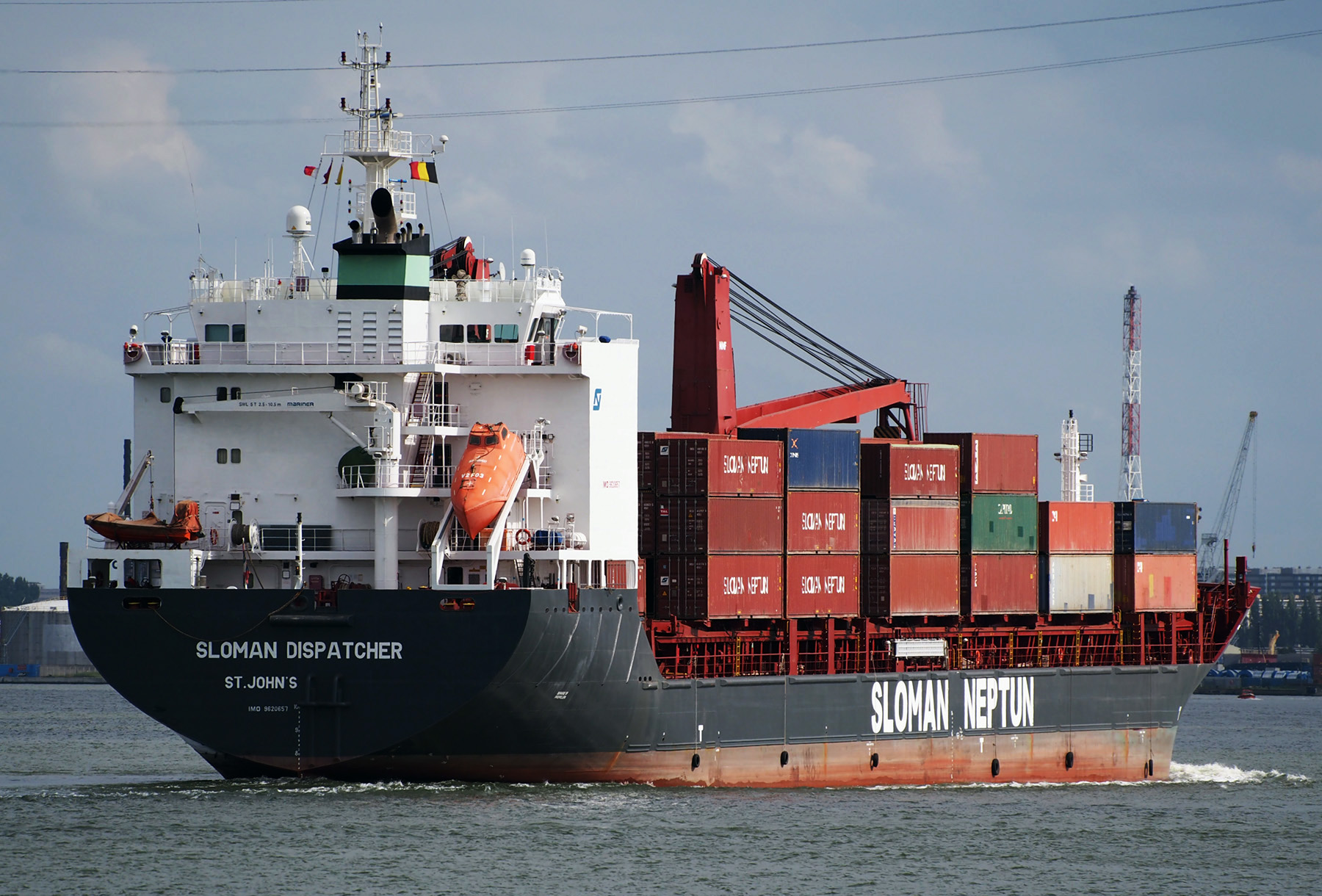 Travel restrictions are likely to remain tighter to more distant countries. And countries are likely to focus on trading within continents or regions rather than the whole world. For the UK, this, other things being equal, would mean an expansion of trade with the EU relative to the rest of the world. But, unless there is a comprehensive free-trade deal with the EU, the UK would not be set to take full advantage of this trend.
Another problem is that the effects of the Covid-19 pandemic have weakened the economy’s ability to cope with further shocks, such as those from Brexit. Depending on the nature (or absence) of a trade deal, Brexit will impose higher burdens on trading companies, including meeting divergent standards and higher administrative costs from greater form filling, inspections and customs delays.
Papers
Articles
Questions
- Referring to the LSE paper, give some examples of industries that are likely to be particularly hard hit by Brexit when the transition period ends? Explain why.
- Why have university finances been particularly badly affected by both Covid-19 and Brexit? Are there any other sectors that have suffered (or will suffer) badly from both events?
- Is there a scenario where globalisation in trade could start to grow again?
- Has Covid-19 affected countries’ comparative advantage in particular products traded with particular countries and, if so, how?
- The authors of the LSE report argue that ‘government policies to stimulate demand, support workers to remain in employment or find new employment, and to support businesses remain essential’. How realistic is it to expect the government to provide additional support to businesses and workers to deal with the shock of Brexit?
 Is there a ‘magic money tree’? Is it desirable for central banks to create money to finance government deficits?
The standard thinking of conservative governments around the world is that creating money to finance deficits will be inflationary. Rather, governments should attempt to reduce deficits. This will reduce the problem of government expenditure crowding out private expenditure and reduce the burden placed on future generations of having to finance higher government debt.
If deficits rise because of government response to an emergency, such as supporting people and businesses during the Covid-19 pandemic, then, as soon as the problem begins to wane, governments should attempt to reduce the higher deficits by raising taxes or cutting government expenditure. This was the approach of many governments, including the Coalition and Conservative governments in the UK from 2010, as econommies began to recover from the 2007/8 financial crisis.
 ‘Modern Monetary Theory‘ challenges these arguments. Advocates of the theory support the use of higher deficits financed by monetary expansion if the money is spent on things that increase potential output as well as actual output. Examples include spending on R&D, education, infrastructure, health and housing.
Modern monetary theorists still accept that excess demand will lead to inflation. Governments should therefore avoid excessive deficits and central banks should avoid creating excessive amounts of money. But, they argue that inflation caused by excess demand has not been a problem for many years in most countries. Instead, we have a problem of too little investment and too little spending generally. There is plenty of scope, they maintain, for expanding demand. This, if carefully directed, can lead to productivity growth and an expansion of aggregate supply to match the rise in aggregate demand.
Government deficits, they argue, are not intrinsically bad. Government debt is someone else’s assets, whether in the form of government bonds, savings certificates, Treasury bills or other instruments. Provided the debt can be serviced at low interest rates, there is no problem for the government and the spending it generates can be managed to allow economies to function at near full capacity.
The following videos and articles look at modern monetary theory and assess its relevance. Not surprisingly, they differ in their support of the theory!
Videos
Articles
- Modern monetary theory: the rise of economists who say huge government debt is not a problem
The Conversation, John Whittaker (7/7/20)
- Modern Monetary Theory: How MMT is challenging the economic establishment
ABC News, Gareth Hutchens (20/7/20)
- What is Modern Monetary Theory and is it THE answer?
Sydney Morning Herald, Jessica Irvine (2/7/20)
- MMT: what is modern monetary theory and will it work?
MoneyWeek, Stuart Watkins (14/7/20)
- MMT: the magic money tree bears fruit
MoneyWeek, Stuart Watkins (17/7/20)
- Modern Monetary Theory is no Magic Money Tree
Adam Smith Institute, Matt Kilcoyne (20/5/20)
- “Modern Monetary Theory” Goes Mainstream
Forbes, Nathan Lewis (10/7/20)
- How Boris Johnson’s Conservatives have become Magic Money Tree huggers
The Scotsman, Bill Jamieson (16/7/20)
- Ignore the impacts of debt-fuelled stimulus at your peril
Livewire, David Rosenbloom (14/7/20)
- Modern Monetary Theory, explained
Vox.com, Dylan Matthews (16/4/19)
Questions
- Compare traditional Keynesian economics and modern monetary theory.
- Using the equation of exchange, MV = PY, what would a modern monetary theorist say about the effect of an expansion of M on the other variables?
- What is the role of fiscal policy in modern monetary theory?
- What evidence might suggest that money supply has been unduly restricted?
- When, according to modern monetary theory, is a rising government deficit (a) not a problem; (b) a problem?
- Is there any truth in the saying, ‘There’s no such thing as a magic money tree’?
- Provide a critique of modern monetary theory.
 Boris Johnson gave a speech on 30 June outlining his government’s approach to recovery from the sharpest recession on record. With the slogan ‘Build, build, build’, he said that infrastructure projects were the key to stimulating the economy. Infrastructure spending is a classic Keynesian response to recession as it stimulates aggregate demand allowing slack to be taken up, while also boosting aggregate supply, thereby allowing recovery in output while increasing potential national income.
A new ‘New deal’
He likened his approach to that of President Franklin D Roosevelt’s New Deal. This was a huge stimulus between 1933 and 1939 in an attempt to lift the US economy out of the Great Depression. There was a massive programme of government spending on construction projects, such as hospitals, schools, roads, bridges and dams, including the Hoover Dam and completing the 113-mile Overseas Highway connecting mainland Florida to the Florida Keys. Altogether, there were 34 599 projects, many large-scale. In addition, support was provided for people on low incomes, the unemployed, the elderly and farmers. Money supply was expanded, made possible by leaving the Gold Standard in 1934.
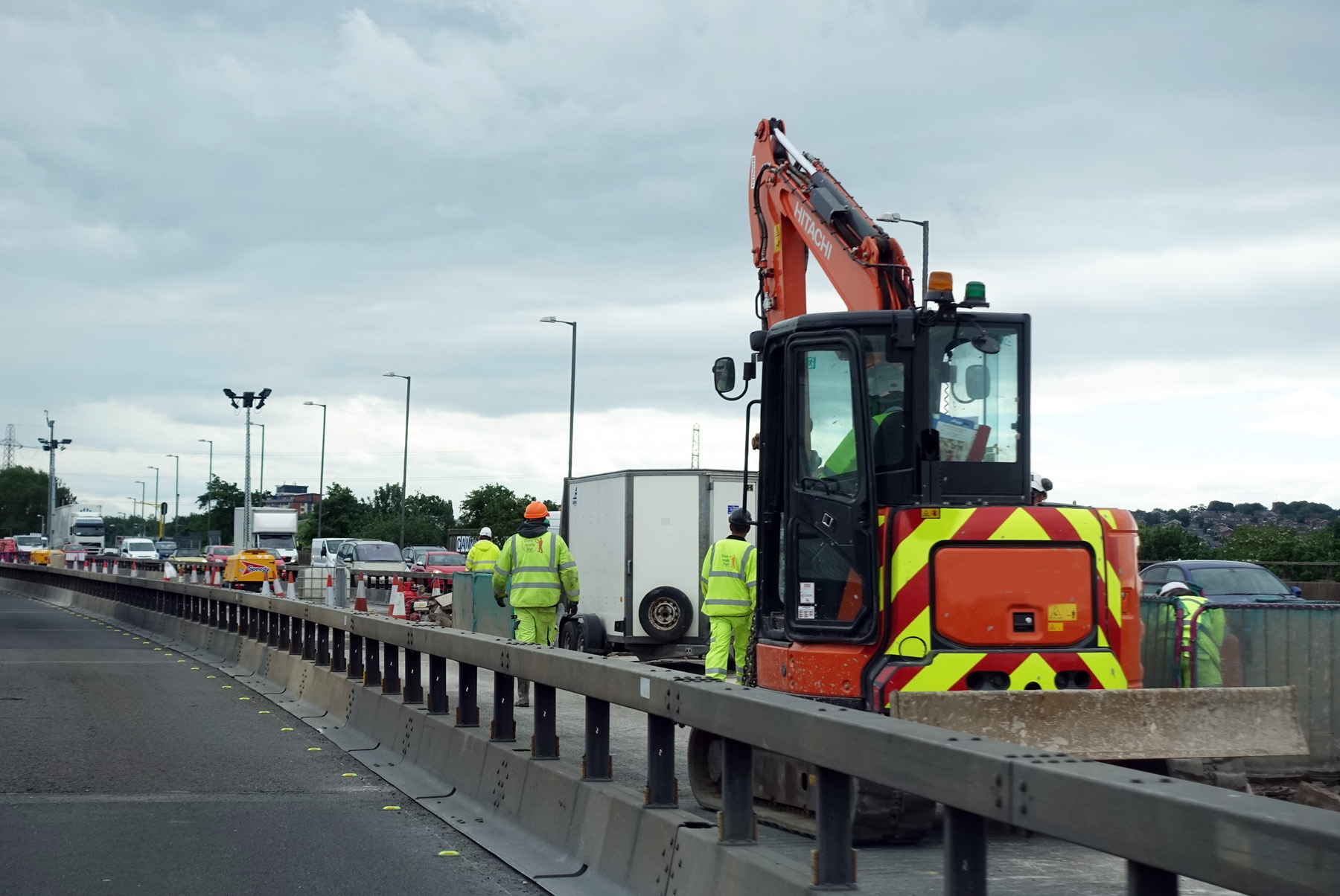 There was some debate as to whether the New Deal could be classed as ‘Keynesian’. Officially, the administration was concerned to achieve a balanced budget. However, it had a separate ’emergency budget’, from which New Deal spending was financed. According to estimates by the Federal Reserve Bank of St Louis, the total extra spending amounted to nearly 40% of US GDP as it was in 1929.
By comparison with the New Deal, the proposals of the Johnson government are extremely modest. Mostly it amounts to bringing forward spending already committed. The total of £5 billion is just 0.2% of current UK GDP.
Focusing on jobs
A recent report published by the Resolution Foundation, titled ‘The Full Monty‘, argues that as the Job Retention Scheme, under which people have been furloughed on 80% pay, is withdrawn, so unemployment is set to rise dramatically. The claimant count has already risen from 1.2m to 2.8m between March and May with the furlough scheme in place.
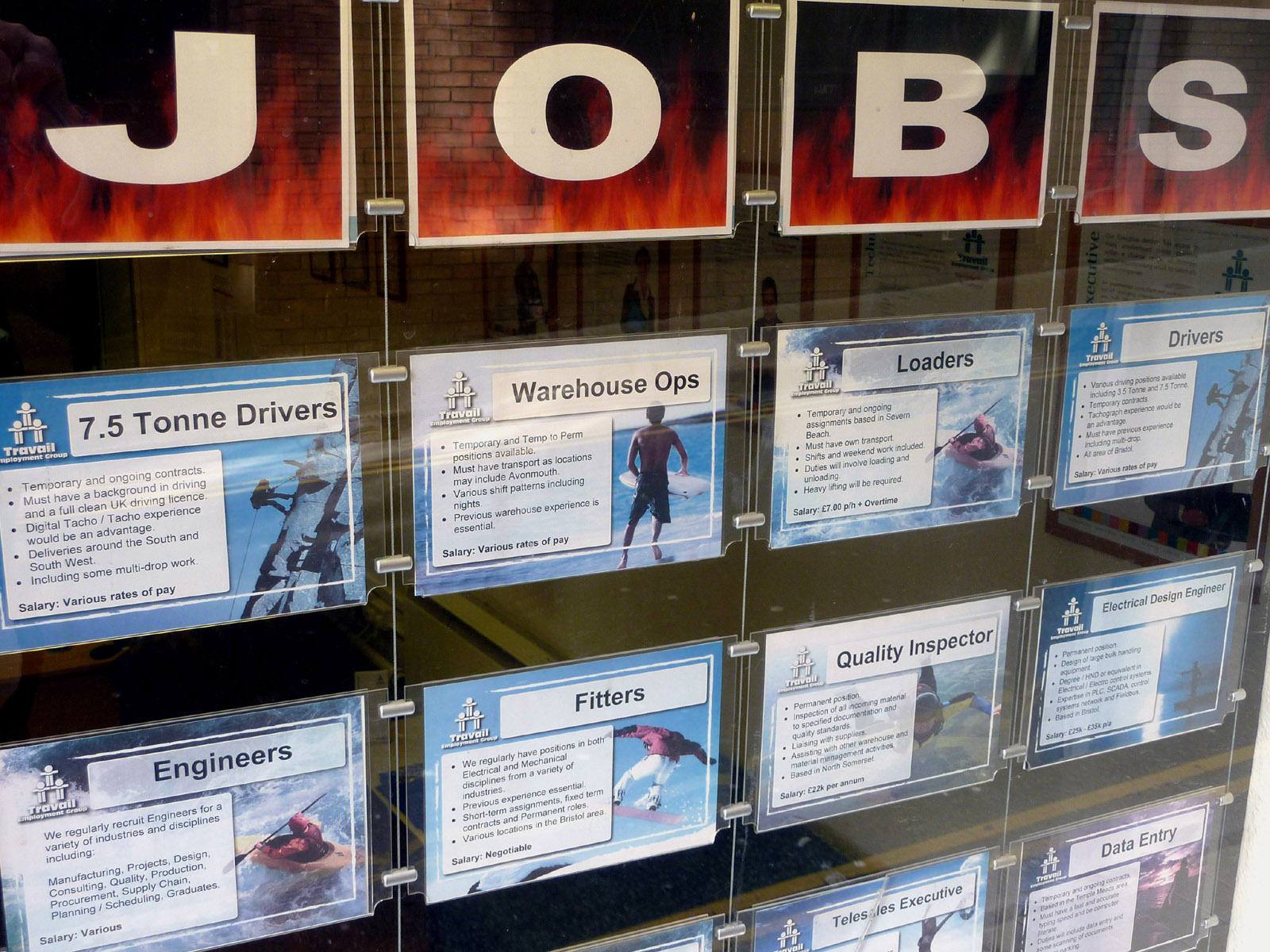 Policy should thus focus on job creation, especially in those sectors likely to experience the largest rise in unemployment. Such sectors include non-food retail, hospitality (pubs, restaurants, hotels, etc.), public transport, the arts, entertainment and leisure and a range of industries servicing these sectors. What is more, many of the people working in these sectors are young and low paid. Many will find it difficult to move to jobs elsewhere – partly because of a lack of qualifications and partly because of a lack of alternative jobs. The rising unemployment will raise inequality.
The Resolution Foundation report argues that policy should be focused specifically on job creation.
Policy makers should act now to minimise outflows from the hard-hit sectors – a wage subsidy scheme or a National Insurance cut in those sectors would reduce labour costs and discourage redundancies. Alongside this, the Government must pursue radical action to create jobs across the country, such as in social care and housing retrofitting, and ramp up support for the unemployed.
Dealing with hyteresis
The economy is set to recover somewhat as the lockdown is eased, but it is not expected to return to the situation before the pandemic. Many jobs will be lost permanently unless government support continues.
Even then, many firms will have closed and others will have reassessed how many workers they need to employ and whether less labour-intensive methods would be more profitable. They may take the opportunity to consider whether technology, such as AI, can replace labour; or they may prefer to employ cheap telecommuters from India or the Philippines rather than workers coming into the office.
Policies to stimulate recovery will need to take these hysteresis effects into account if unemployment is to fall back to pre-Covid rates.
Videos
Articles
- Coronavirus: Boris Johnson pledges ‘new deal’ to build post-virus
BBC News (30/6/20)
- Boris Johnson hails his economic plan as a new ‘New Deal.’ Try ‘small deal’ instead
MarketWatch, Pierre Briançon (30/6/20)
- Boris Johnson announces state-led post-coronavirus relaunch
Financial Times, George Parker, Jim Pickard and Chris Giles (30/6/20)
- How does Boris Johnson’s ‘new deal’ compare with Franklin D Roosevelt’s?
The Guardian, Richard Partington (30/6/20)
- Coronavirus: Ministers urged to stave off ‘second wave’ of unemployment with major job creation plan
PoliticsHome, Matt Honeycombe-Foster (29/6/20)
- Biggest job creation package in peacetime needed to deflect increase in UK unemployment, think tank reports
Independent, Alan Jones (29/6/20)
- UK needs ‘biggest-ever peacetime job creation plan’ to stop mass unemployment
The Guardian, Richard Partington (29/6/20)
- The International Labour Organization was founded after the Spanish flu – its past lights the path to a better future of work
The Conversation, Huw Thomas, Frederick Harry Pitts and Peter Turnbull (17/6/20)
- Seven charts on the coronavirus jobs market
BBC News, By Lora Jones and Daniele Palumbo (16/6/20)
- Covid, hysteresis, and the future of work
Vox, Richard Baldwin (29/5/20)
- The economy won’t snap back after Covid-19
Financial Times, Tim Harford (5/6/20)
- Addressing The Covid-19 Shock -Keeping People In Work And Businesses Afloat
Forbes, Linda Yueh (20/3/20)
- Cutting labour taxes brings back the jobs lost to COVID-19
Vox, Christian Bredemeier, Falko Juessen and Roland Winkler (28/6/20)
Report
Questions
- What are the arguments for and against substantial increased government expenditure on infrastructure projects?
- Should the UK government spend more or less on such projects than the amount already pledged? Justify your answer.
- What are the arguments for and against directing all extra government expenditure towards green projects?
- Look through the Resolution Foundation report and summarise the findings of each of its sections.
- What are the arguments for and against directing all extra government expenditure towards those sectors where there is the highest rate of job losses?
- What form could policies to protect employment take?
- How should the success of policies to generate employment be measured?
- What form does hysteresis play on the post-Covid-19 labour market? What four shocks mean that employment will not simply return to the pre-Covid situation?
 Three international agencies, the IMF, the European Commission and the OECD, all publish six-monthly forecasts for a range of countries. As each agency’s forecasts have been published this year, so the forecasts for economic growth and other macroeconomic indicators, such as unemployment, have got more dire.
The IMF was the first to report. Its World Economic Outlook, published on 14 April, forecast that in the UK real GDP would fall by 6.5% in 2020 and rise by 4% in 2021 (not enough to restore GDP to 2019 levels); in the USA it would fall by 5.9% this year and rise by 4.7% next year; in the eurozone it would fall by 7.5% this year and rise by 4.7% next.
The European Commission was next to report. Its AMECO database was published on 6 May. This forecast that UK real GDP would fall by 8.3% this year and rise by 6% next; in the USA it would fall by 6.5% this year and rise by 4.9% next; in the eurozone it would fall by 7.7% this year and rise by 6.3% next.
The latest to report was the OECD on 10 June. The OECD Economic Outlook was the most gloomy. In fact, it produced two sets of forecasts.
The first, more optimistic one (but still more gloomy than the forecasts of the other two agencies) was based on the assumption that lockdowns would continue to be lifted and that there would be no second outbreak later in the year. This ‘single-hit scenario’ forecast that UK real GDP would fall by 11.5% this year and rise by 9% next (a similar picture to France and Italy); in the USA it would fall by 7.3% this year and rise by 4.1% next; in the eurozone it would fall by 9.1% this year and rise by 6.5% next.
The second set of OECD forecasts was based on the assumption that there would be a second wave of the virus and that lockdowns would have to be reinstated. Under this ‘double-hit scenario’, the UK’s GDP is forecast to fall by 14.0% this year and rise by 5.0 per cent next; in the USA it would fall by 8.5% this year and rise by 1.9% next; in the eurozone it would fall by 11.5% this year and rise by 3.5% next.
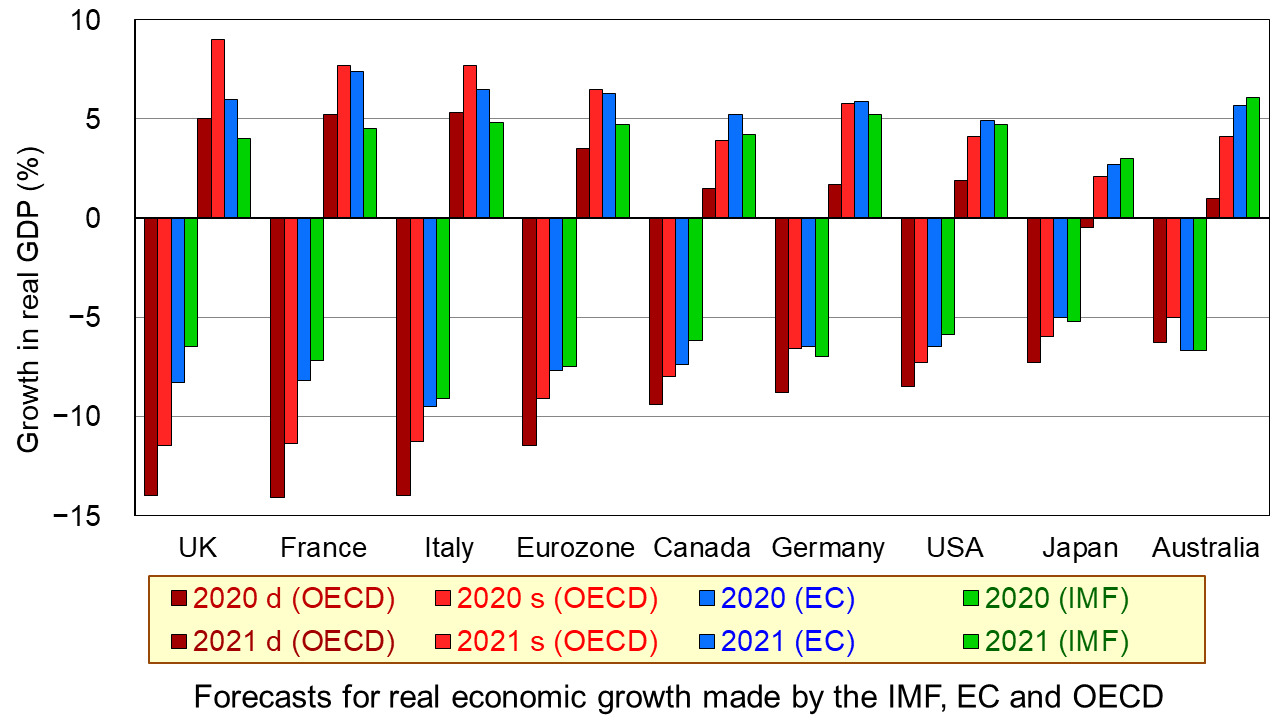
The first chart shows the four sets of forecasts (including two from the OECD) for a range of countries. The first four bars for each country are the forecasts for 2020; the other four bars for each country are for 2021. (Click here for a PowerPoint of the chart.)
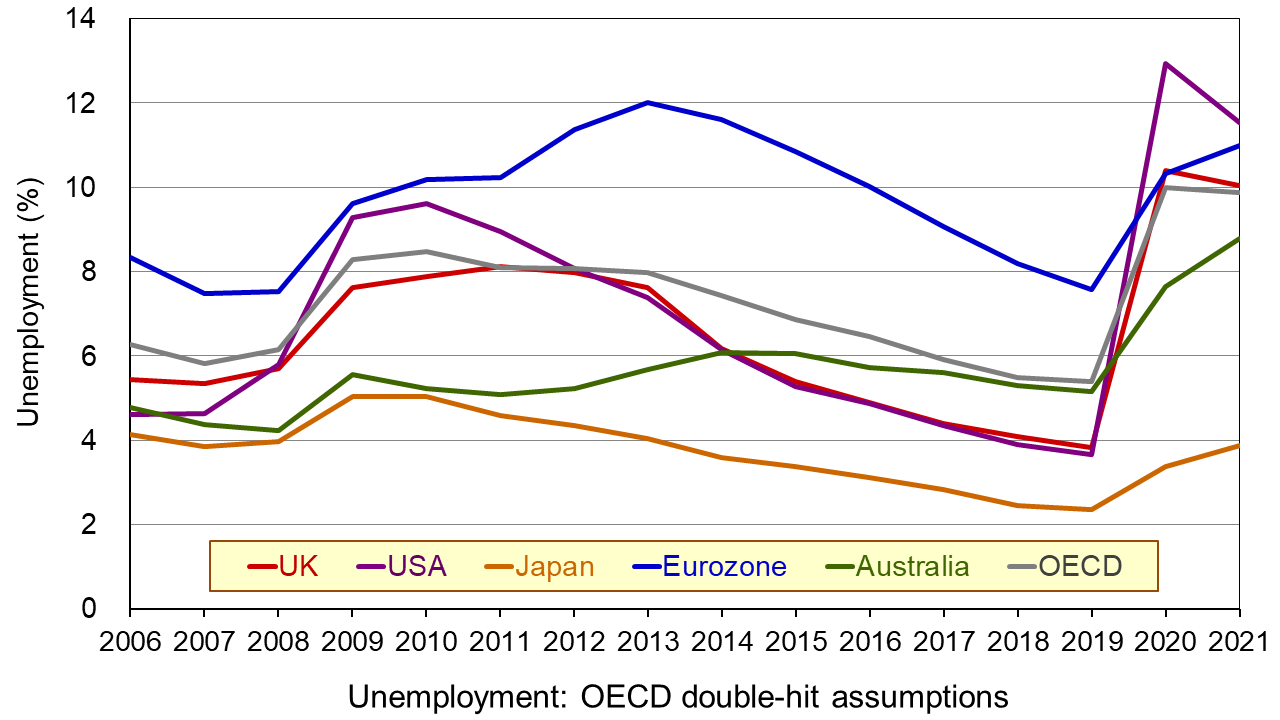
The second chart shows unemployment rates from 2006. The figures for 2020 and 2021 are OECD forecasts based on the double-hit assumption. You can clearly see the dramatic rise in unemployment in all the countries in 2020. In some cases it is forecast that there will be a further rise in 2021. (Click here for a PowerPoint of the chart.)
As the OECD states:
In both scenarios, the recovery, after an initial, rapid resumption of activity, will take a long time to bring output back to pre-pandemic levels, and the crisis will leave long-lasting scars – a fall in living standards, high unemployment and weak investment. Job losses in the most affected sectors, such as tourism, hospitality and entertainment, will particularly hit low-skilled, young, and informal workers.
But why have the forecasts got gloomier? There are both demand- and supply-side reasons.
Aggregate demand has fallen more dramatically than originally anticipated. Lockdowns have lasted longer in many countries than governments had initially thought, with partial lockdowns, which replace them, taking a long time to lift. With less opportunity for people to go out and spend, consumption has fallen and saving has risen. Businesses that have shut, some permanently, have laid off workers or they have been furloughed on reduced incomes. This too has reduced spending. Even when travel restrictions are lifted, many people are reluctant to take holidays at home and abroad and to use public transport for fear of catching the virus. This reluctance has been higher than originally anticipated. Again, spending is lower than before. Even when restaurants, bars and other public venues are reopened, most operate at less than full capacity to allow for social distancing. Uncertainty about the future has discouraged firms from investing, adding to the fall in demand.
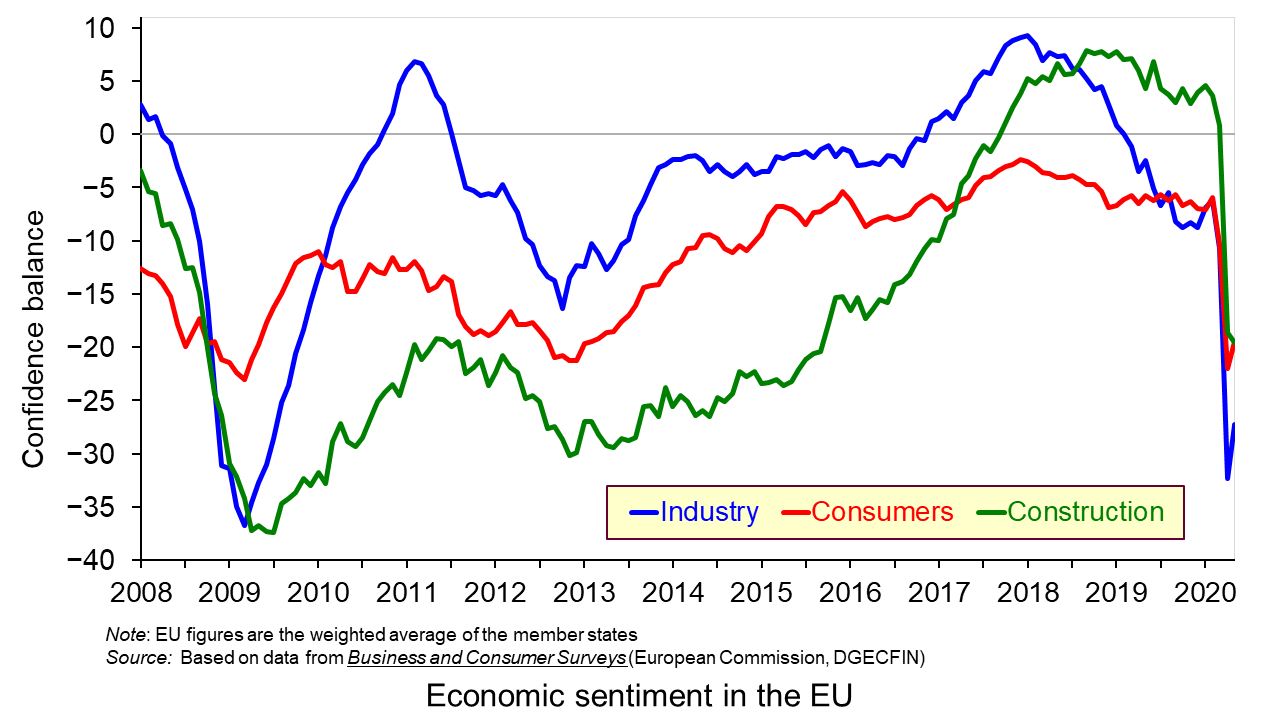
On the supply side, there has been considerable damage to capacity, with firms closing and both new and replacement investment being put on hold. Confidence in many sectors has plummeted as shown in the third chart which looks at business and consumer confidence in the EU. (Click here for a PowerPoint of the above chart.) Lack of confidence directly affects investment with both supply- and demand-side consequences.
Achieving a sustained recovery will require deft political and economic judgements by policymakers. What is more, people are increasingly calling for a different type of economy – one where growth is sustainable with less pollution and degradation of the environment and one where growth is more inclusive, where the benefits are shared more equally. As Angel Gurría, OECD Secretary-General, states in his speech launching the latest OECD Economic Outlook:
The aim should not be to go back to normal – normal was what got us where we are now.
Articles
OECD publications
Questions
- Why has the UK economy been particularly badly it by the Covid-19 pandemic?
- What will determine the size and timing of the ‘bounce back’?
- Why will the pandemic have “dire and long-lasting consequences for people, firms and governments”?
- Why have many people on low incomes faced harsher consequences than those on higher incomes?
- What are the likely environmental impacts of the pandemic and government measures to mitigate the effects?
 With promises by the newly elected Conservative government to increase investment expenditure on health, education, innovation and infrastructure, it was expected that Rishi Sunak’s first Budget would be strongly expansionary. In fact, it turned out to be two Budgets in one – both giving a massive fiscal boost.
An emergency Budget
The first part of the Budget was a short-term emergency response to the explosive spread of the coronavirus. An extra £12 billion is to be spent on the NHS and other public services. Whether this will be anything like enough to cope with the effects of the pandemic as businesses fail and people lose their jobs remains to be seen. (See the blog A global supply-side shock: the impact of the coronavirus (COVID-19) outbreak.)
A key issue is just how quickly the money can be spent. How quickly can you train health professionals or produce more ventilators or provide extra hospital beds?
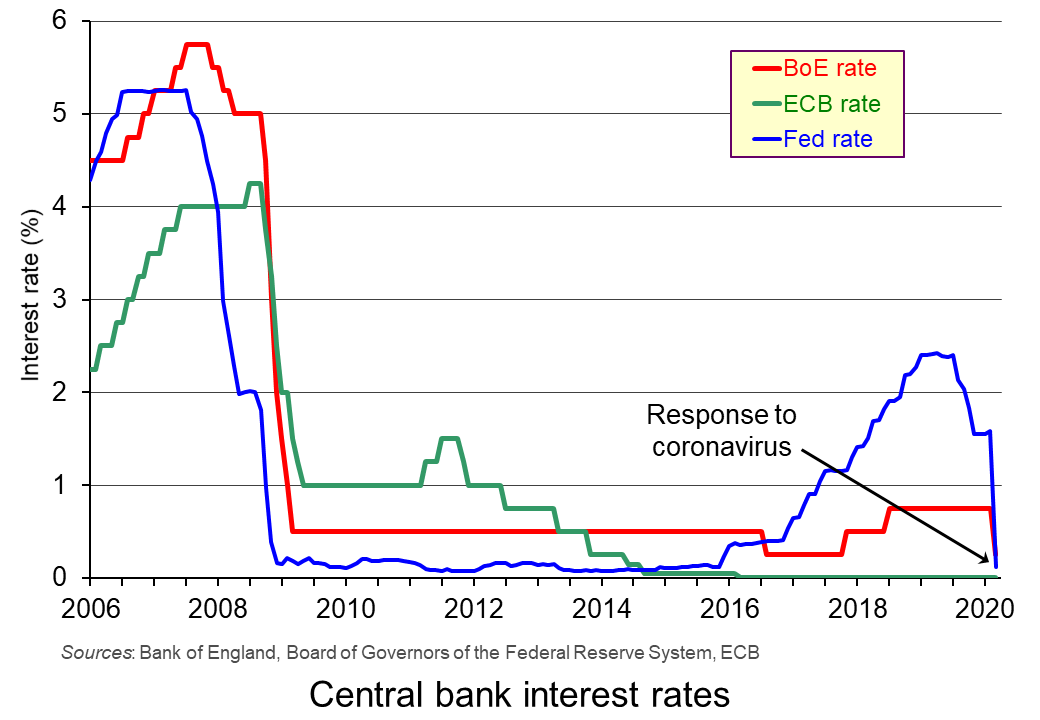 This emergency part of the Budget was co-ordinated with the Bank of England’s decision to cut Bank Rate from 0.75% to 0.25%.
This combined fiscal and monetary response to the crisis was further enhanced by the agreement of central banks on 15 March to boost world liquidity by increasing the supply of US dollars through large-scale quantitative easing. The US central bank, the Federal Reserve, also cut its main federal funds rate by one percentage point from 1–1.25% to 0–0.25%.
The planned Budget
 The second part of the Budget is to raise government investment by 9% in real terms over the next four years, bringing overall government expenditure to 41% of GDP, financed largely by extra borrowing. As the IFS observes, “That is above its pre-crisis level and bigger than at any point between the mid 1980s and the start of the financial crisis.”
But despite this rise in the proportion of government spending to GDP, in other respects the spending plans are less expansionary than they may appear. Increases in current spending on health, education and defence had already been promised. This leaves other departments, such as social security, facing cuts, or at least no increase. And when compared with 2010/11 levels, if you exclude health, government current spending per head of the population will around 14% lower, or 19% lower once you account for spending that replaces EU funding.
The Chancellor’s hope is that, by focusing on investment, there will be a supply-side effect as well as a demand-side boost. If increases in aggregate demand are balanced by increases in aggregate supply, such a policy would not be inflationary in the long run. But in the light of the considerable uncertainty of the effects of the coronavirus, the plans may well require significant adjustment in the Autumn Budget – or earlier.
Articles
Podcasts and Videos
Official documentation
Questions
- To what extent is this Budget ‘Keynesian’?
- Is the extra government expenditure likely to crowd out private expenditure? Explain.
- Demonstrate the desired long-term economic effect of the infrastructure policy using either an AD/AS diagram or a DAD/DAS diagram.
- How is the coronavirus pandemic likely to affect potential GDP in (a) the short run (b) the long run?
- Why is public-sector debt likely to soar over the next four years while annual government debt interest payments are likely to continue their gentle decline?
- What is missing from the Budget that you feel ought to have been included? Explain why.
