 The strength of the housing market is often a key indicator of the strength of the economy. But, the opposite is also true: a weak economy often filters through to create a weak housing market. With the current weak economy, a boost in confidence is needed and signs suggest that the housing market is beginning to recover.
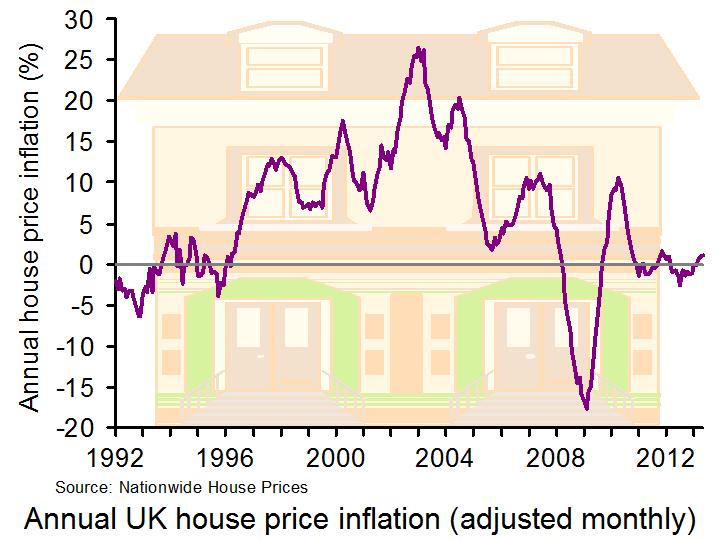
While the picture of the housing market today is nothing like the pre-crisis view, things are beginning to look up. For a couple of years now, house price inflation in the UK has been very close, if not equal to zero. However, data from Nationwide Building Society suggests that in May, house prices rose by 0.4% and the once stagnant year-on-year change in house prices rose to 1.1% (see chart below: click here for a PowerPoint of the chart). This is the fastest it has grown since the end of 2011.
Commentators have suggested that this latest data is an indication that ‘the market is gaining momentum’. A further confirmation of this rejuvenated market came with the data that property sales were 5% up each month this year, than the average monthly level for 2012. Despite this improvement, they still remain well below the pre-crisis levels.
 Which factors have contributed to this tentative recovery? Most households require a mortgage to purchase a house and, given the central role that the housing market played in the financial crisis with companies engaging in excessive lending as a means of expanding their mortgage books, the availability of mortgages fell. The number of mortgage approvals is likely to feed through to affect the number of house sales and these have improved in the first few months of 2013. Interest rates offered by lenders have also fallen, making mortgages more affordable, thus boosting demand. Furthermore, government assistance is available to help individuals put a deposit down on a house, by offering them an equity loan. Further measures are due to come into effect in January 2014, with the aim of providing a further boost to the housing market. The chief economist at Nationwide, Robert Gardner said:
Widespread expectations that the economy will continue to recover gradually in the quarters ahead, that interest rates will remain low, and the ongoing impact of policy measures aimed at supporting the availability and lowering the cost of credit all provide reasons for optimism that activity will continue to gain momentum in the quarters ahead.
Despite the optimism, the situation is different across the UK, with some areas benefiting more than others. London and the South-East are driving this 0.4% rise, whereas other areas may be in need of further assistance to keep pace (see The UK housing market: good in parts).
Although these latest data may be a sign of things to come, it is also possible that things could go the opposite way. Incomes remain low; employment data are hardly encouraging; and the spectre of inflation is always there. Perhaps most importantly, consumer confidence remains fragile and until that gains momentum, uncertainty will continue to plague the UK marketplace. The following articles consider this issue.
Articles
UK house prices again up in May, says Nationwide The Guardian, Hilary Osborne (30/5/13)
Housing market could boost retail industry, Kingfisher says The Telegraph, Graham Ruddick (30/5/13)
UK house prices see modest rise, says Nationwide BBC News (30/5/13)
 Hugh’s Review: House prices in spotlight BBC News, Hugh Pym with Yolande Barnes of Savills and Matthew Pointon of Capital Economics (31/5/13)
House prices are racing ahead as stimulus for the market kicks in Independent, Russell Lynch (31/5/13)
’Pick up’ in house prices recorded in sign of market confidence, says Nationwide Independent, Vicky Shaw (30/5/13)
House prices at highest level for nearly two years as confidence in UK economy grows and mortgages get cheaper This is Money, Matt West (30/5/13)
Stamp duty is ‘choking’ housing market as it rises seven times faster than inflation over last 15 years Mail Online, Tara Brady (28/5/13)
Nationwide launches Help to Buy mortgages The Telegraph, William Clarke (29/5/13)
UK home prices rise most in 18 months, Nationwide says Bloomberg, Jennifer Ryan (30/5/13)
House price data
Links to house price data The Economics Network
Statistical data set – Property transactions Department of Communities and Local Government
Nationwide house price index Nationwide Building Society
Halifax House Price Index Lloyds Banking Group
Lending to individuals – November 2012 Bank of England
Questions
- How is the equilibrium determined in the housing market? Using a demand and supply diagram, illustrate the equilibrium. Make sure you think about the shapes of the curves you’re drawing.
- Which factors affect the demand for and supply of housing?
- Why are there regional variations in house prices?
- Why is the housing market a good indicator of the strength of the economy?
- Why have house prices risen throughout 2013? Is the trend likely to continue?
- If the housing market does indeed gain momentum, how might this affect the rest of the economy? Which sectors in particular are likely to benefit?
- Explain why the government’s intervention in the housing market could be seen to have a multiplier effect?
- Concerns have been raised that the government’s schemes to help the housing market may create a house price bubble. Why might this be the case?
 In the blog The global economy we considered the economic performance of countries across the globe, including the UK. In the first estimate of UK economic growth for the first quarter of 2013, the economy grew at 0.3%, thus avoiding a triple-dip recession. This first estimate is always subject to change, but in this case, the data was confirmed.
The April 2013 figure provided by the ONS of 0.3% growth has been confirmed, once again indicating the slow recovery of the UK economy. Despite these more positive signs for the economy, the IMF has raised concerns of the weak performance of the UK and has urged the government to invest more in projects to stimulate growth. Although the economy has started to grow, economic growth has continued to remain weak since the onset of the financial crisis and recession. Martin Beck, an economist at Capital Economics said:
With employment and average earnings both dropping in the first quarter on their level in the previous quarter, the foundations for a sustained recovery, even one driven by consumers, still look pretty rickety.
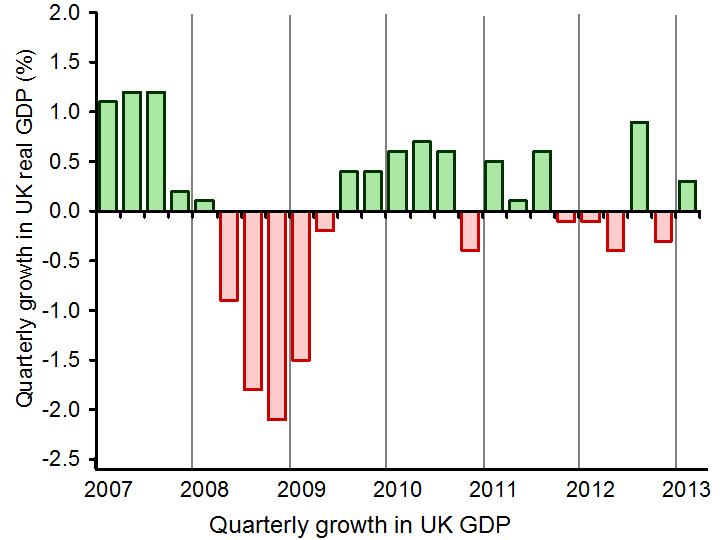 Initial estimates by the ONS are always updated and there is still time for the 0.3% growth figure to be changed, as more data becomes available. (Click here for a PowerPoint of the chart.) This latest figure, although unchanged, has given a more concrete indication of where the UK economy is continuing to struggle. Consumer spending increased by only 0.1%, investment and exports declined, but in further signs of a weak economy, the building up of stocks by companies was a big contributor to the UK economic growth – a contribution of 0.4 percentage points. The service sector continued to growth with a 0.6 percentage point contribution to GDP.
So, what does the future look like for the UK? Although the estimate of 0.3% figure did prevent a triple-dip recession and the IMF did comment on the ‘improving health’ of the economy, signs of recovery remain weak.
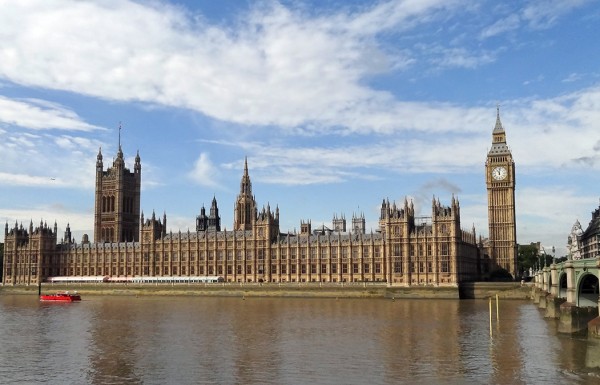 Crucial to the recovery will be government spending, but more than this, the government spending must be in key growth industries. Data suggests that the UK invests less than other G8 countries as a percentage of GDP and this is perhaps one of the key factors that has prevented the UK recovery from gathering pace. The future of the UK economy remains uncertain and government policy will be crucial in determining this future course. The following articles consider the latest growth data.
Signs of weakness mar UK economic growth Reuters, Olesya Dmitracova and William Schomberg (23/5/13)
UK first quarter growth unchanged BBC News (23/5/13)
Concerns over underlying health of UK economy as 0.3% growth confirmed The Guardian, Philip Inman (23/5/13)
Statisticians confirm 0.3% UK growth for first quarter of 2013 Financial Times, Claire Jones and Sarah O’Connor (23/5/13)
UK GDP: concerns about underlying economy as 0.3pc growth confirmed The Telegraph, Philip Aldrick (23/5/13)
Britsh economy returns to growth in first quarter The Economic Times (23/5/13)
U.K. households not loosening purse strings Wall Street Journal, Ainsley Thomson and Ilona Bllington (23/5/13)
IMF: UK should push for economic growth BBC News (22/5/13)
Questions
- Why are numerous estimates of GDP made by the ONS?
- How is GDP measured? Is it an accurate measure of economic growth? What about economic development?
- Why does 0.3% growth in the first quarter of GDP not necessarily imply that the UK economy is recovering?
- Why have certain aspects of the UK economy performed better or worse than others?
- What areas should the government invest in, according to the IMF?
- Why would government spending in investment create economic growth? Is this likely to be short term or long term?
 A simple model in economics is that of demand and supply. Through the price mechanism, signals are sent between consumers and producers and this interaction results in an equilibrium market price and quantity. However, what happens when the market for a good or service is in disequilibrium?
When a market is in equilibrium, demand equals supply. However, as we discussed in a previous blog concerning baby milk in China (see Milking the economy), markets are not always in equilibrium. If demand exceeds supply, a shortage will emerge and to eliminate this, the price must rise. If, on the other hand, supply exceeds demand, there will be an excess supply and thus the price must fall to restore equilibrium.
The market in question here is toilet paper in Venezuela! A severe shortage of this product has emerged in recent months, with shops running out of supplies. In a bid to relieve this shortage, the country’s Minister of Commerce has received approval for a $79 million credit, which can be used to import this basic product in short supply. Fifty million rolls will be imported to help fill the shortage that has emerged. The shortage is not just a problem for toilet paper, but also across a range of basic consumer goods. The article from Reuters comments that:
The government says the toilet paper shortages, like others, are the results of panicked buying and unscrupulous merchants hoarding the goods to artificially inflate prices.
Opposition critics say the problem is caused by the currency controls, created a decade ago by late socialist leader Hugo Chavez, and years of nationalizations that weakened private industry and left businesses unwilling to invest.
With shortages across a variety of products, the President has begun to work closely with business leaders to address this situation. The following articles consider this basic market, the intervention and consequences.
Venezuela hopes to wipe out toilet paper shortage by importing 50m rolls The Guardian (16/5/13)
Venezuela ends toilet paper shortage BBC News (22/5/13)
With even toilet paper scarce, Venezuelan president warms to business Reuters, Eyanir Chinea (22/5/13)
Toilet paper shortage in Venezuela to end after lawmakers back plans to import 39 million rolls Huffington Post, Sara Nelson (22/5/13)
Venezuela’s toilet paper shortage ended; 3 other basic goods that went scarce in the country International Business Times, Patricia Rey Mallen (22/5/13)
Questions
- Using a demand and supply diagram, explain how equilibrium is determined in a free market.
- Illustrate the shortage described in the aticles on your above demand and supply diagram. How should the price mechanism adjust?
- What types of government intervention have led to the shortages of such basic consumer goods?
- How have currency controls created a problem for Venezuela?
- With an increase in imported products, what impact might there be on Venezuela’s exchange rate and on its balance of payments?
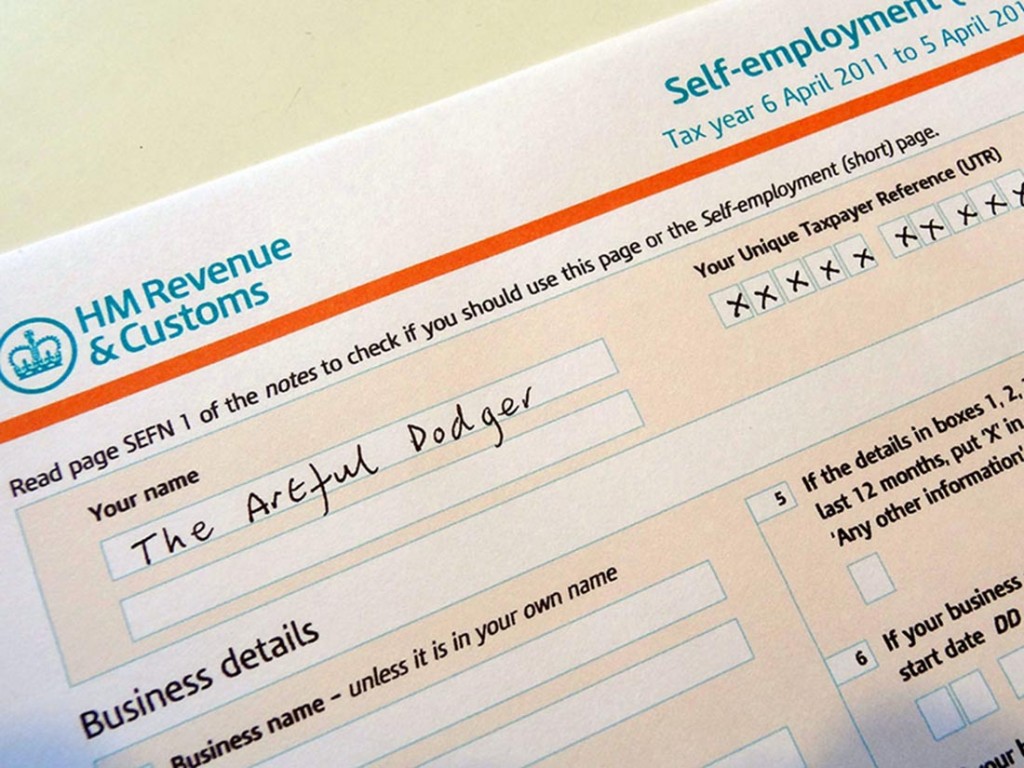 If you ask most people whether they like paying tax, the answer would surely be a resounding ‘no’. If asked would you like to pay less tax, most would probably say ‘yes’. Evidence of this can be seen in the behaviour of individuals and of companies, as they aim to reduce their tax bill, through both legal and illegal methods.
Our tax revenues are used for many different things, ranging from the provision of merit goods to the redistribution of income, so for most people they don’t object to paying their way. However, maintaining profitability and increasing disposable income is a key objective for companies and individuals, especially in weak economic times. Some high profile names have received media coverage due to accusations of both tax avoidance and tax evasion. Starbucks, Amazon, Googe and Apple are just some of the big names that have been accused of paying millions of pounds/dollars less in taxation than they should, due to clever (and often legal) methods of avoiding tax.
 The problem of tax avoidance has become a bigger issue in recent years with the growth of globalisation. Multinationals have developed to dominate the business world and business/corporation tax rates across the global remain very different. Thus, it is actually relatively easy for companies to reduce their tax burden by locating their headquarters in low tax countries or ensuring that business contracts etc. are signed in these countries. By doing this, any profits are subject to the lower tax rate and are thus such companies are accused of depriving the government of tax revenue. Apple is currently answering questions posed by a US Senate Committee, having been accused of structuring its business to create ‘the holy grail of tax avoidance’.
Many may consider the above and decide that these companies have done little wrong. After all, many schemes aimed at tax avoidance are legal and are often just a clever way of using the system. However, in a business environment dominated by the likes of Google, Apple and Amazon, the impact of tax avoidance may not just be on the government’s coffers. Indeed John McCain, one of the Committee members asked:
…Couldn’t one draw the conclusion that you and Apple have an unfair advantage over domestic based corporations and companies, in other words, smaller companies in this country that don’t have the same ability that you do to locate in Ireland or other countries overseas?
The concern is that with such ability to avoid huge amounts of taxation, large companies will inevitably compete smaller ones out of the market. Local businesses, without the ability to re-locate to other parts of the world, pay their full tax bills, but multinationals legally (in most cases) manage to avoid paying their own share. With a harsh economic climate continuing globally, these large companies that aim to further increase their profitability through such means as tax avoidance will naturally bear the wrath of smaller businesses and individuals that are struggling to get by. It’s likely that this topic will remain in the media for some time. The following articles consider some of the companies accused of participating in tax avoidance schemes and the consequences of doing so.
Is Apple’s tax avoidance rational? BBC News, Robert Peston (21/5/13)
Apple’s Tim Cook defends tax strategy in Senate BBC News (21/5/13)
Senator accuses Apple of ‘highly questionable’ billion-dollar tax avoidance scheme The Guardian, Dominic Rushe (21/5/13)
Apple’s Tim Cook faces tax avoidance questions Sky News (21/5/13)
EU leaders look to end Apple-style tax avoidance schemes Reuters, Luke Baker and Mark John (21/5/13)
Apple Chief Tim Cook defends tax practices and denies avoidance Financial Times, James Politi (21/5/13)
Apple CEO Tim Cook tells Senate: tiny tax bill isn’t our fault, it’s yours Independent, Nikhil Kumar (21/5/13)
Miliband promises action on Google tax avoidance The Telegraph (19/5/13)
Google is cheating British tax payers out of millions…what they are doing is just immoral’: Web giant accused of running ‘scandalous’ tax avoidance scheme by whistleblower Mail Online, Becky Evans (19/5/13)
Multinational CEOs tell David Cameron to rein in tax avoidance rhetoric The Guardian, Simon Bowers, Lawrie Holmes and Rajeev Syal (20/5/13)
Fury at corporate tax avoidance leads to call for a global response The Guardian, Tracy McVeigh (18/5/13)
Questions
- What is the difference between tax evasion and tax avoidance? Is it rational to engage in such schemes?
- What are tax revenues used for?
- Why are multinationals more able to engage in tax avoidance schemes?
- Is the problem of tax avoidance a negative consequence of globalisation?
- How might the actions of large multinationals who are avoiding paying large amounts of tax affect the competitiveness of the global market place?
- Is there justification for a global policy response to combat the issue of tax avoidance?
- What are the costs and benefits to a country of having a low rate of corporation tax?
- How would a more ‘reasonable’ tax on foreign earnings allow the ‘free movement of capital back to the US’?
 A key debate for some months has been the UK’s membership of the European Union. The debate has centred around the desire to return some powers back to the UK, but this has extended into the possibility of a referendum on our membership of the preferential trading area. So, let’s take a step back and consider why any country would want to be a member of a preferential trading area.
Preferential trading areas can be as basic as a free trading area or as advanced as a currency, or even political union. The eurozone is clearly a currency union, but the European Union, of which the UK is a member, is a common market. A common market has no tariffs and quotas between the members, but in addition there are common external tariffs and quotas. The European union also includes the free movement of labour, capital and goods and services. Membership of a preferential trading area therefore creates benefits for the member countries. One such benefit is that of trade creation. Members are able to trade under favourable terms with other members, which yields significant benefits. Countries can specialise in the production of goods/services in which they have a comparative advantage and this enables greater quantities of output to be produced and then traded.
Other benefits include the greater competition created. By engaging in trade, companies are no longer competing just with domestic firms, but with foreign firms as well. This helps to improve efficiency, cut costs and thus lower prices benefiting consumers. However, from a firm’s point of view there are also benefits: they have access to a much wider market in which they can sell their goods without facing tariffs. This creates the potential for economies of scale to be achieved. Were the UK to completely exit the EU, this could be a significant loss for domestic firms and for consumers, who would no longer see the benefits of no tariffs on imported goods. Membership of a preferential trading area also creates benefits in terms of potential technology spillovers and is likely to have a key effect on a country’s bargaining power with the rest of the world. As is a similar argument to membership of a trade union, there is power in numbers.
There are costs of membership of a preferential trading area, but they are typically outweighed by the benefits. However, estimates suggest that the cost of EU regulation is the equivalent of 10% of UK GDP. Furthermore, while the UK certainly does trade with Europe, data suggests that only 13% of our GDP is dependent on such exports. The future is uncertain for the European Union and Britain’s membership. There are numerous options available besides simply leaving this preferential trading area, but they typically have one thing in common. They will create uncertainty and this is something that markets and investors don’t like. Vince Cable warned of this, saying:
There are large numbers of potential investors in the UK, who would bring employment here, who have been warned off because of the uncertainty this is creating.
The impact of the UK’s decision will be significant and not just for those living and working in the economy. The world is no interdependent that when countries exist (or typically enter) a preferential trading area the wider economic effects are significant. While any change in the UK’s relationship with the EU will take many months and years to occur and then further time to have an effect, the uncertainty created by the suggestion of a change in the relationship has already sent waves across the world. The following articles consider the wider single market and the current debate on UK membership.
European Union: if the ‘outs’ get their way, we’ll end up like Ukraine Guardian, Vince Cable (16/5/13)
Conservative MP James Wharton champions bill to guarantee EU referendum Independent, Andrew Grice (16/5/13)
Nick Clegg shifts ground over EU referendum The Guardian, Patrick Wintour (15/5/13)
Cameron tells EU rebels to back referendum law Reuters, Peter Griffiths (16/5/13)
The EU and the UK – the single market BBC Democracy (4/3/13)
Single market dilemmas on Europe BBC News, Stephanie Flanders (14/5/13)
Lord Wolfson: I back the single market – but not at any cost The Telegraph, Lord Wolfson (19/1/13)
EU focuses on returning single market to health Financial Times, James Fontanella-Khan (8/5/13)
Questions
- What other examples of preferential trading areas are there? How close are they to the arrangement of the European Union?
- In each of the above examples, explain the type of preferential trading area that it is.
- What are the benefits and costs of being a member of a preferential trading area such as the EU? How do these differ to being a member of a) a free trade area and (b) a customs union?
- What options are open to the UK in terms of re-negotiating its relationship with the EU? In each case, explain how the benefits and costs identified in question 3 would change.
- Why is the UK’s decision so important for the global economy? Would it be in the interests of other economies? Explain your answer.
 The strength of the housing market is often a key indicator of the strength of the economy. But, the opposite is also true: a weak economy often filters through to create a weak housing market. With the current weak economy, a boost in confidence is needed and signs suggest that the housing market is beginning to recover.