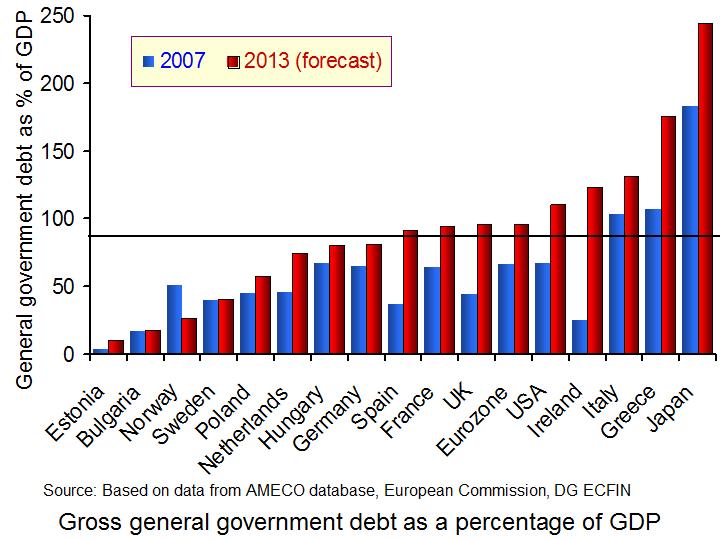
 High levels of government debt and the adverse effect this has on the economy has been a key influencing factor in the fiscal consolidation efforts across the world. A key factor providing evidence in support of the connection between high government debts and low economic growth was a paper by two Harvard economists. However, the data used in their research has been called into question.
As we saw in a previous post, It could be you, Carmen Reinhart and Kenneth Rogoff presented a paper back in January 2010. Their research suggested that when a country’s debt increases above 90% of GDP, economic growth will slow considerably. (Click here for a PowerPoint of the above chart.) As you might expect, given the timing of this research, policymakers were intrigued. For those governments in favour of cuts in government spending and increases in taxation to bring the government debt down, this research was dynamite. It seemed to provide the evidence needed to confirm that if left to grow, government debt will have a significantly adverse effect on growth. Here was evidence in favour of austerity.
But, did a simple error create misleading information? A student at the University of Massachusetts Amherst was trying to replicate the results found by Reinhart and Rogoff, but was unable to do so. Thomas Herndon contacted the Harvard professors and they sent him the spreadsheets they had used in their calculations. Looking through it, an error in calculating the average GDP was spotted. However, the student and his supervisors also engaged in further research and came across other inconsistencies. This led to a draft working paper being published in April. The paper did find the same correlation between high debt levels and low growth, but the outstanding results found by Reinhart and Rogoff disappeared. Responding to the error, the Harvard professors said:
We are grateful to Herndon et al. for the careful attention to our original Growth in a Time of Debt AER paper and for pointing out an important correction to Figure 2 of that paper. It is sobering that such an error slipped into one of our papers despite our best efforts to be consistently careful. We will redouble our efforts to avoid such errors in the future. We do not, however, believe this regrettable slip affects in any significant way the central message of the paper or that in our subsequent work.
So, how might this correction and the implications affect government policy? Are we likely to see a reversal in austerity measures? Only time will tell.
Articles
Seminal economic paper on debt draws criticism Wall Street Journal, Brenda Cronin (16/4/13)
Reinhart, Rogoff … and Herndon: The student who caught out the Profs BBC News, Ruth Alexander (20/4/13)
Reinhart and Rogoff publish formal correction Financial Times, Robin Harding (8/5/13)
The 90% question The Economist (20/4/13)
Reinhart and Rogoff correct austerity research error BBC News (9/5/13)
Harvard’s Reinhart and Rogoff publish formal collection CNBC, Robin Harding (9/5/13)
Rogoff and Reinhart should show some remorse and reconsider austerity The Guardian, Heidi Moore (26/4/13)
The buck does not stop with Reinhart and Rogoff Financial Times, Lawrence Summers (5/5/13)
Meet Carmen Reinhart and Kenneth Rogoff, the Harvard professors who thought they had austerity licked – and Thomas Herndon, the student who proved them wrong Independent, Tim Walker (22/4/13)
Papers
Growth in a time of debt American Economic Review (May 2010)
Does high public debt consistently stifle economic growth? A critique of Reinhart and Rogoff Political Economy Research Institute, Herndon, Ash and Pollin (April 2013)
Questions
- How do high government debts arise?
- In order to reduce government debts, cuts in government spending and increases in taxation are advocated. How does theory suggest that these changes in fiscal policy will affect economic growth?
- What are the arguments (a) in favour of and (b) against austerity measures?
- How might the correction made by Reinhart and Rogoff affect policymakers and their austerity plans?
- What are the key messages from Reinhart and Rogoff’s paper?
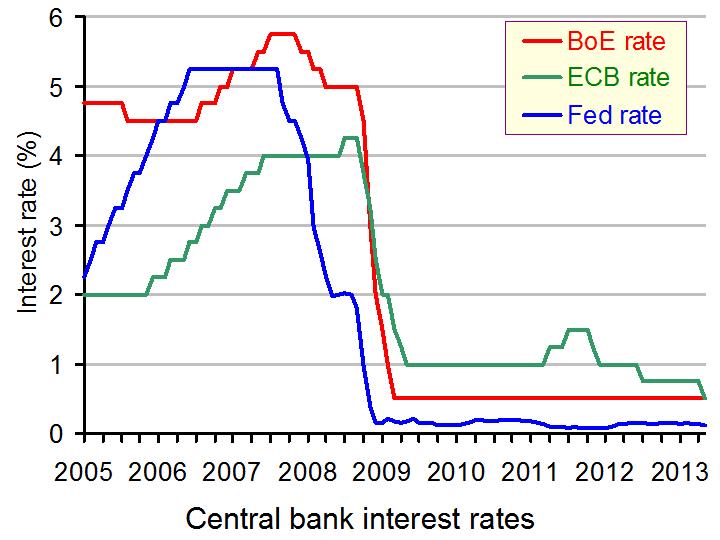 Interest rates have, for some years, been the main tool of monetary policy and of steering the macroeconomy. Across the world interest rates were lowered, in many cases to record lows, as a means of stimulating economic growth. Interest rates in the UK have been at 0.5% since March 2009 and on 2nd May 2013, the ECB matched this low rate, having cut its main interest rate from 0.75%. (Click here for a PowerPoint of the chart.)
Low interest rates reduce the cost of borrowing for both firms and consumers and this in turn encourages investment and can boost consumer expenditure. After all, when you borrow money, you do it to spend! Lower interest rates will also reduce the return on savings, again encouraging spending and for those on variable rate mortgages, mortgage payments will fall, increasing disposable income. However, these above effects are dependent on the banks passing the ECB’s main interest rate on its customers and this is by no means guaranteed.
Following the cut in interest rates, the euro exchange rate fell almost 2 cents against the dollar.
Interest rates in the eurozone have been at 0.75%, but a 0.25 point cut was widely expected, with the ongoing debt crisis in the Eurozone continuing to adversely affect growth and confidence. A lack of trust between banks has also contributed to a lack of lending, especially to small and medium sized enterprises. The ECB has injected money into financial institutions with the aim of stimulating lending, but in many cases, banks have simply placed this extra money back with the ECB, rather than lending it to other banks or customers. The fear is that those they lend to will be unable to repay the money. In response to this, there have been suggestions of interest rates becoming negative – that is, if banks want to hold their money with the ECB they will be charged to do it. Again, the idea is to encourage banks to lend their money instead.
Small and medium sized businesses have been described as the engine of growth, but it is these businesses who have been the least able to obtain finance. Without it, they have been unable to grow and this has held back the economic recovery. Indeed, GDP in the Eurozone has now fallen for five consecutive quarters, thus prompting the latest interest rate cut. A key question, however, will be how effective this quarter of a percent cut will be. If banks were unwilling to lend and firms unwilling to invest at 0.75%, will they be more inclined at 0.5%? The change is small and many suggest that it is not enough to make much of a difference. David Brown of New View Economics said:
The ECB rate cut is no surprise as it was well flagged by Draghi at last month’s meeting. Is it enough? No. The marginal effect of the cut is very limited, but at least it should have some symbolic rallying effect on economic confidence.
This was supported by Howard Archer at HIS Global Insight, who added:
Admittedly, it is unlikely that the trimming of interest rates from 0.75% to 0.5% will have a major growth impact, especially given fragmented credit markets, but any potential help to the eurozone economy in its current state is worthwhile.
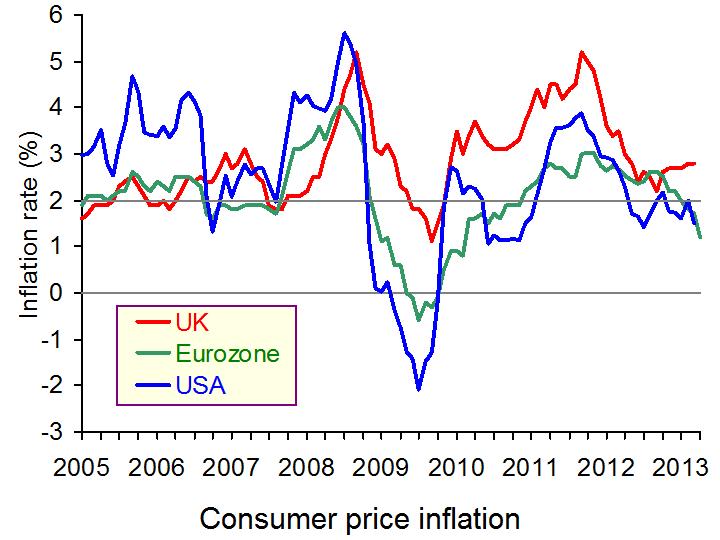 Inflation in the eurozone is only at 1.2%, which is significantly below the ceiling of 2%, so this did give the ECB scope for the rate to be cut. (Click here for a PowerPoint of the chart.) After all, when interest rates fall, the idea is to boost aggregate demand, but with this, inflation can emerge. Mr Draghi said ‘we will monitor very closely all incoming information, and assess any impact on the outlook for price stability’. The primary objective of the ECB is the control of inflation and so had inflation been somewhat higher, we may have seen a different decision by the ECB. However, even then, 5 consecutive quarters of negative growth is hard to ignore.
So, if these lower interest rates have little effect on stimulating an economic recovery, what about a movement away from austerity? Many have been calling for stimulus in the economy, arguing that the continuing austerity measures are stifling growth. The European Council President urged governments to promote growth and job creation. Referring to this, he said:
Taking these measures is more urgent than anything … After three years of firefights, patience with austerity is wearing understandably thin.
However, Mr. Draghi urged for policymakers to stick with austerity and continue to focus on bringing debt levels down, while finding other ways to stimulate growth, including structural reform. The impact of this latest rate cut will certainly take time to filter through the economy and will very much depend on whether the 0.5% interest rate is passed on to customers, especially small businesses. Confidence and trust within the financial sector is therefore key and it might be that until this emerges, the eurozone itself is unlikely to emerge from its recession.
ECB ready to enter unchartered waters as bank cuts interest rate to fresh low of 0.5pc The Telegraph, Szu Ping Chan (2/5/13)
Draghi urges Eurozone governments to stay the course on austerity Financial Times, Michael Steen (2/5/13)
Eurozone interest rates cut to a record low of 0.5% The Guardian, Heather Stewart (2/5/13)
ECB’s Draghi ‘ready to act if needed’ BBC News (2/5/13)
Eurozone interest rates cut again as ECB matches Bank of England Independent, Russell Lynch (3/5/13)
Margio Draghi urges no let-up in austerity reforms after Eurozone rate cut – as it happened The Guardian, Graeme Wearden (2/5/13)
ECB cuts interest rate to record-low 0.5% in desperate measure to drag Eurozone out of recession Mail Online, Simon Tomlinson and Hugo Duncan (2/5/13)
ECB cuts interest rates, open to further action Reuters, Michael Shields (2/5/13)
Eurozone loosens up austerity, slowly Wall Street Journal (2/5/13)
ECB cuts interest rate, not enough to pull the region out of recession The Economic Times of India (2/5/13)
Euro steady ahead of ECB interest rate announcement Wall Street Journal, Clare Connaghan (2/5/13)
 European Central Bank (ECB) cuts interest rates BBC News (2/5/13)
All eyes on ECB as markets expect rate cut Financial Times, Michael Steen (2/5/13)
Questions
- How is a recession defined?
- Using an aggregate demand/aggregate supply diagram, illustrate and explain the impact that this cut in interest rates should have.
- On which factors will the effectiveness of the cut in interest rates depend?
- Using the interest rate and exchange rate transmission mechanisms to help you, show the impact of interest rates on the various components of aggregate demand and thus on national output.
- What would be the potential impact of a negative interest rate?
- Why did the low inflation rate give the ECB scope to cut interest rates?
- What are the arguments for and against austerity measures in the Eurozone, given the 5 consecutive quarters of negative growth?
 The latest growth data for the UK is somewhat difficult to interpret. It’s positive, but not that positive. The Conservatives say it shows that the economy is moving in the right direction. Labour suggests it is evidence that the Coalition’s policies are not working. With a return to positive growth, the UK has avoided the triple dip recession and here we take a closer look at the economic performance of other key nations.
In the final quarter of 2012, the US economy grew at 0.4%, but in the 3 months to March 2013, economic growth in America picked up to 2.5%. Consumer spending significantly increased, growing at an annualized rate of 3.2%, according to the Commerce Department. This figure helped boost the growth rate of the US economy, as consumer spending accounts for around two thirds of economic activity.
 However, the growth figure was lower than expected, in part due to lower government spending. Furthermore, there are suggestions that the positive consumer spending figures are merely a positive blip and spending will fall as the US economy moves through 2013.
If this does prove to be the case in the USA, it will do little to further boost UK economic growth, which was recorded at 0.3% for the first 3 months of 2013. The Chancellor has said that the growth figures are encouraging and are evidence that the government’s policies are working.
Today’s figures are an encouraging sign the economy is healing … Despite a tough economic backdrop, we are making progress. We all know there are no easy answers to problems built up over many years, and I can’t promise the road ahead will always be smooth, but by continuing to confront our problems head on, Britain is recovering and we are building an economy fit for the future.
While the USA and UK have recorded positive growth, expectations of growth throughout Europe remain uncertain. Spain has revised its forecasts downwards for 2013, expecting the economy to shrink by over 1%. Even after 2013, growth is expected to remain very weak, forecast to be 0.5% in 2014 and 0.9% in 2015. To make matters worse, Spain’s unemployment continues to move in the wrong direction, with data for the first 3 months of 2013, recording an unemployment rate of 27.2% – the highest on record.
However, it’s not just Spanish unemployment that is on the rise. Figures for March show that in France, 3.2 million people were out of work, a 1.2 % rise compared to February. In the UK, 2.56 million people were recorded as unemployed, representing just under 8% of the working population. The German economy continues to outperform its European partners, but eurozone growth continues to look weak for the rest of 2013.
Despite much bad news in Europe, growth in other parts of the world remains buoyant. South Korea has recorded economic growth that is at its highest level in 2 years. Economic growth was just under 1%, but construction and investment both increased, perhaps a sign of an economy starting its recovery.
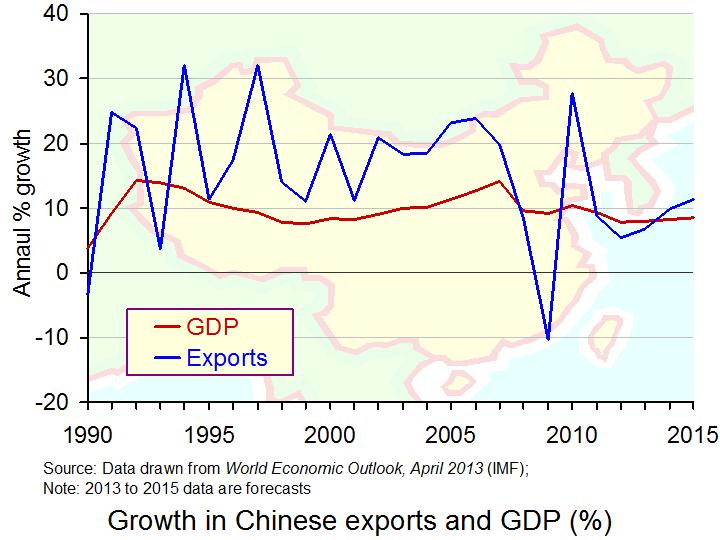 The Chinese economy has seemed relatively unaffected by the economic downturn, yet its economic growth has slowed. Averaging over 10% per annum for the last decade, the growth for January – March 2013 was only 7.7%. This is a decline on the previous 3 months and is lower than expected. If the Chinese economy does begin to slow (relatively speaking), this could present the global economic recovery with an unwelcome obstacle.
Many Western economies are reliant on exports to boost their growth figures and with such high demand in China, this is a key export market for many countries. If the Chinese economy continues to slow, consumer spending may even fall and this could mean a reduction in Chinese imports: that is, a reduction in other countries’ exports to China. However, for China’s competitors, the news is better, as with China’s move from a low to middle-income country, other countries will now see an opportunity to grasp a competitive advantage in the production of cheaper products. David Rees from Capital Economics said:
Trade data show that Chinese imports of commodities, and industrial metals in particular, have been falling in recent months … That is bad news for those emerging markets in Latin America, the Middle East, and Africa that predominately export commodities to China. It is not all bad news … To the extent that China’s structural slowdown reflects its transition from low to middle-income status, opportunities will present themselves for other EMs as China moves up the value chain. We are particularly upbeat on the manufacturing-based economies of South East Asia, along with Mexico, Poland, and Turkey.
News is better in Japan, where growth forecasts have been raised to 2.9% over the same period and the economy is expected to grow by 1.5% throughout both 2013 and 2014. Furthermore, suggestions that inflation may also reach 0.7% have boosted confidence. This might be the end of Japan’s troubles with deflation.
So, we have something of a mixed picture across the world, although the IMF predicts a global rate of growth of 3.5% for 2013, which would be an improvement on 2012 figures. The following articles consider the global situation.
Spain slashes economic growth forecast Sky News (26/4/13)
UK avoids triple-dip recession with better than expected 0.3% GDP growth The Guardian, Heather Stewart (26/4/13)
US economy grows 2.5% on buoyant consumer spending BBC News (26/4/13)
Poor French and Spanish jobs data but UK economy returns to growth – as it happened The Guardian, Graeme Wearden and Nick Fletcher (25/4/13)
UK economy avoids tiple-dip recession with 0.3pc GDP growth The Telegraph, Szu Ping Chan (25/4/13)
South Korea economic growth hits two year high BBC News (25/4/13)
S. Korea economy grows at the fastest pace in two years Bloomberg, Eunkyung Seo (25/4/13)
Spain revises down its economic forecast BBC News (26/4/13)
US economy sees broad growth Financial Times, Robin Harding (25/4/13)
Germany’s private sector shrinks as Eurozone decline continues – as it happened The Guardian, Graeme Wearden and Nick Fletcher (23/4/13)
China economic growth lower than forecast BBC News (15/4/13)
China’s slowing economy: what you need to know Bloomberg Business Week, Dexter Roberts (25/4/13)
Modest Growth Pickup in 2013, Projects IMF International Monetary Fund (23/1/13)
Questions
- How is economic growth measured?
- What is meant by a triple-dip recession?
- What has caused the small increase in growth in the UK? Do you think this signifies the start of the economic recovery?
- In the USA, what has caused the growth rate to reach 2.5% and why is it lower than expected?
- Why are growth rates in countries across the world relevant for UK forecasts of economic growth?
- Which factors have allowed the Chinese economy to achieve average growth rates above 10% for the past decade?
- Using an AD/AS diagram, illustrate the desired impact of the Coalition’s policies to boost economic growth.
- With unemployment rising in countries like Spain and France, how might Eurozone growth be affected in the coming months?
- Japanese growth is looking positive and inflation is expected to reach about 0.7%. Why is it that Japan has suffered from deflation for so many years and why is this a problem?
 The market for any good or service is affected by countless factors. On the demand-side, things such as incomes, relative prices, expectations of price changes and tastes determine the shape and position of the demand curve. For the supply curve, it’s factors including costs of production, the profitability of alternative goods and in some cases, the weather or natural disasters. It is this last factor, which has presented Weetabix with problems.
An established breakfast cereal and brand, Weetabix is well-known for producing a range of high quality products. However, production of some of its most popular products has been stopped, as the quality of the British wheat used to make the various cereals was called into question. Last year, we had little summer to speak of and this led to the ‘worst harvest we have seen in decades’, so much so that the quality of the wheat was not sufficient to be used in making the breakfast cereal. This has caused production to cease on certain products and shortages have already begun to emerge, with some shops completely selling out and facing no prospect of being re-stocked.
 Weetabix is now owned by a Chinese state-owned company, but still prides itself on using locally sourced wheat. However, with the weather affecting the harvest, wheat from abroad has had to be used, aiming to reduce the gap between demand and supply. The UK is typically an exporter of wheat, but with the poor harvest has come a drop in the amount of wheat produced and thus exported by some 2m tonnes – this is back to a similar level as was seen in the 1980s. A spokesman for Weetabix said:
Normally they’re proud to claim Weetabix is not just British wheat but from within 50 miles of Burton Latimer … They have had to source a bit from outside the UK, but Weetabix is still proud to say it sources its wheat within the UK … weather permitting.
Supply will be increased once wheat from abroad is used, but it is expected that this will take a couple of weeks. In the meantime, if you’re a consumer of the traditional Weetabix, you don’t need to worry, as it’s the less-known cereals that have been affected. The following articles consider this external factor and how it affects the supply of a product.
Weetabix products hit by poor wheat harvest BBC News (22/4/13)
Weetabix supplies hit by dismal harvest The Guardian, Rupert Neate (22/4/13)
Weetabix move to scale back production and re-engineer process is a commendable one The Grocer (20/4/13)
Britain’s disastrous wheat harvest halts production of Weatbix Minis and Oatibix Mail Online, Leon Watson (22/4/13)
Bad weather threatens wheat harvest Channel 4 News, Tom Clarke (3/4/13)
Weetabix halts production of Minis after poor harvest Farmers Weekly, Philip Case (22/4/13)
Questions
- With a poor harvest, which way would you expect the supply curve to shift? Illustrate this on a diagram.
- How should this shift in supply affect the market price and quantity of wheat, assuming all else remains the same?
- How can this example can be used to explain the interdependence between markets?
- With shortages possibly emerging, what might happen to demand today? Illustrate your answer on a demand and supply diagram.
- Does sourcing wheat from local areas give Weetabix a competitive advantage? If so, how might it be affected if it does choose to import wheat?
 Unemployment is a key macroeconomic objective for governments across the world. The unemployment rate for the UK now stands at 7.9% according to the ONS, which recorded 2.56 million people out of work. But why is unemployment of such importance? What are the costs?
The economy is already in a vulnerable state and with unemployment rising by 70,000 people between December and February 2013, the state of the economic recovery has been questioned. Indeed, following the news of the worsening unemployment data, the pound fell significantly against the dollar, suggesting a lack of confidence in the British economy.
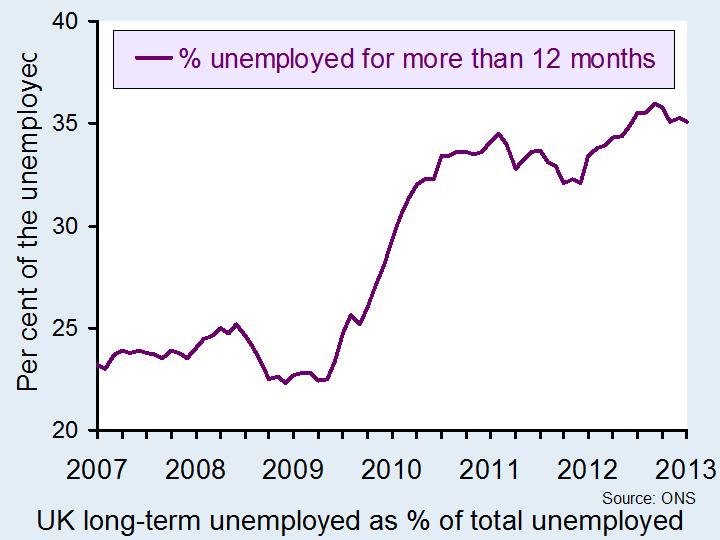 Although the increase in the number of people out of work is concerning, perhaps of more concern should be the number of long-term unemployed. The ONS suggests that more than 900,000 have now been out of work for more than a year. Not only does this pose costs for the individual in terms of lost earnings and skills, but it also imposes costs on friends and family and the wider economy. (Click here for a PowerPoint of the first chart, which shows the percentage of unemployed people out for work longer than 12 months.)
The chief executive of the Prince’s Trust focused on the costs of youth unemployment in particular, saying:
Thousands of these young people are long-term unemployed, often facing further challenges such as poverty and homelessness. We must act now to support these young people into work and give them the chance of a better future.
(Click here for a PowerPoint of the second chart, which shows how much higher the unemployment rate is for young people aged 18 to 24 than it is for the working age population as a whole.)
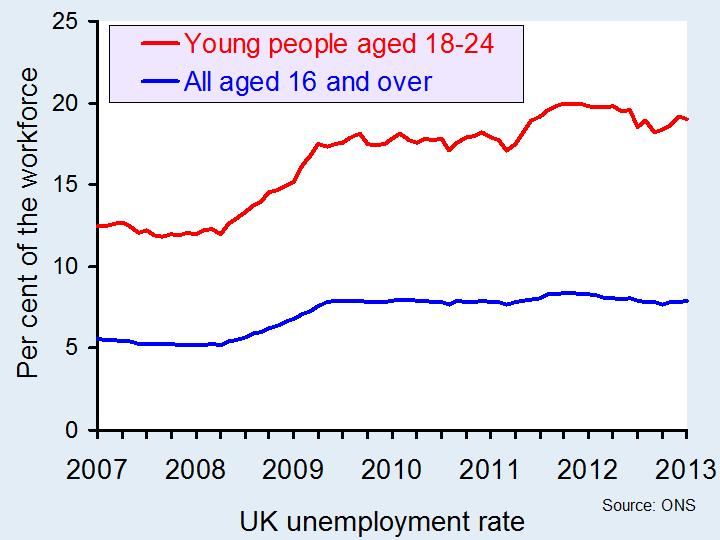 Furthermore, with so many people unemployed, we are operating below full-employment and thus below our potential output. Furthermore, the longer people are out of work, the more likely it is that they will lose their skills and thus require re-training in the future or find that there are now fewer jobs available to them based on their lower skill level.
In addition to this there are monetary costs for the government through lower tax receipts, in terms of income tax, national insurance contributions and even VAT receipts. With more people unemployed, the numbers claiming various unemployment-related benefits will rise, thus imposing a further cost on the government and the taxpayer. Another cost to the government of this latest data is likely to be the expectations of the future course of the economy. Numerous factors affect business confidence and unemployment data is certainly one of them. The concern is that business confidence affects many other variables as well and until we receive more positive data, the economy recovery is likely to remain uncertain. The following articles consider this topic.
UK unemployment rise adds to pressure on Osborne’s austerity strategy The Guardian, Phillip Inman (18/4/13)
Unemployment figures are ‘worrying’, David Cameron’s spokesman says The Telegraph, Peter Dominiczak (17/4/13)
UK unemployment rises to 2.56 million BBC News (17/4/13)
Unemployment jumps to 7.9% as rise in the number of young people out of work takes figure ‘dangerously’ close to a million Mail Online, Leon Watson (17/4/13)
Unemployment up as stay-at-home mothers head back to the job-centre Independent, Ben Chu (17/4/13)
Jobs data points to finely balanced market Financial Times, Brian Groom (18/4/13)
Hugh’s review: making sense of the stats BBC News (19/4/13)
Questions
- How is unemployment measured?
- What are the costs to the individual of being unemployed?
- What are the wider non-monetary costs to society?
- Explain the main financial costs to the wider economy of a rising unemployment rate.
- Illustrate the problem of unemployment by using a production possibility frontier.
- Could there be a negative multiplier effect from a rise in unemployment?