 Induced hydraulic fracturing or “fracking”, is a technique used to make fractures in shale beds, normally deep underground, through the injection of liquids under high pressure. The idea is to release oil or gas. Fracking has transformed the oil industry by allowing vast reserves to be tapped.
Although the main ingredient of the fracking liquid is water, it is also necessary to include sand and a gelling agent to increase the viscosity of the liquid and bind in the sand. The commonest gelling agent is guar gum, a gel made from powdered guar seeds, which are grown in the semi-desert regions of India and Pakistan. Guar gum is also widely used in the food industry as a binding, thickening, texturising and moisture control agent.

With the rapid growth in fracking, especially in the USA, the demand for guar gum has rocketed – and so has its price. In just one year the price of guar beans, from which the seeds are extracted, has risen ten fold from about 30 rupees (about 34 pence) to around 300 rupees per kilo. This has transformed the lives of many poor farmers. Across the desert belt of north-west India, fields are being planted with guar.

But will it last? What will the oil and gas extraction companies do in response to the higher price? What will the food industry do? What will happen to the demand and supply of guar gum over the longer term? Is it risky for farmers in India and Pakistan to rely on a single crop, or should they take advantage of the high prices while they last? These types of questions are central to many mono-crop economies.
Webcast
 The little green bean in big fracking demand CNN, Mallika Kapur (10/9/12)
Articles
Frackers in frantic search for guar bean substitutes Reuters, Braden Reddall (13/8/12)
After first-half surge, US drillers find respite in guar wars Reuters (20/7/12)
Guar Gum Exports From India to Drop on Halliburton Stocks BloombergBusinessweek, Prabhudatta Mishra (3/9/12)
Frackers Seek Guar Bean Substitutes The Ithaca Independent, Ed Sutherland (13/8/12)
Synthetic Fracking Ingredient to Replace Guar Bean Greener Ideas, Madison E. Rowe (15/8/12)
From emu farms to guar crops: Why the desert is fertile for Ponzi schemes The Economic Times of India, Vikram Doctor (10/9/12)
Guar gum replacer cuts cost by up to 40% Food Manufacture, Lorraine Mullaney (4/9/12)
Less Guar Needed: TIC Gums Introduces Ticaloid Lite Powder TIC Gums (27/8/12)
Immediate Supply of Guar Gum Available in the US PRLog (1/9/12)
Questions
- Why have guar bean, powder and gum prices risen so rapidly? Use a demand and supply diagram to illustrate your answer.
- How is the price elasticity of supply of guar likely to differ between the short term and the long term? What will be the implications of this for guar prices and the livelihood of guar growers?
- How is the price elasticity of demand for guar likely to differ between the short term and the long term? What will be the implications of this for guar prices and the livelihood of guar growers?
- What would you advise guar growers to do and why?
- What is the role of speculation in determining the price of guar?
- What is a ‘ponzi scheme’? Why is the ‘desert so fertile for ponzi schemes’? (Note that the symbol for a rupee is Rs or ₹, that 100,000 rupees are referred to as 1 Lakh and that 100 Lakh are referred to as 1 Crore.)
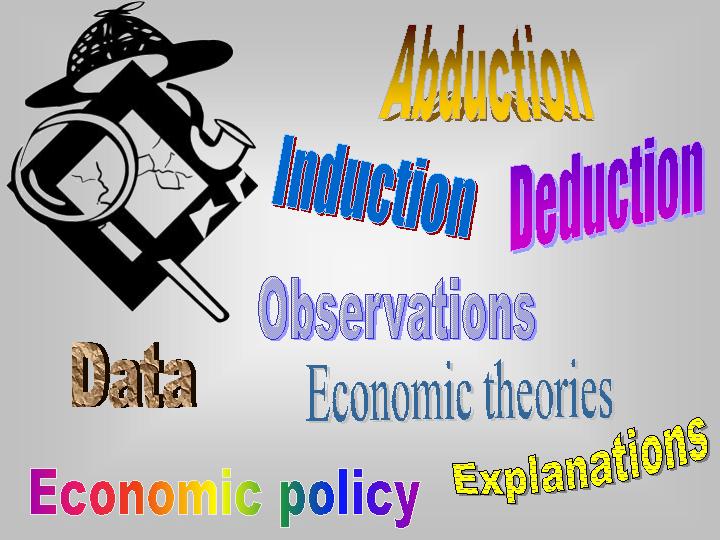 Many of you reading this will be embarking on an economics degree. During your studies you’ll be developing the skills that economists bring to observing and analysing the world around us and considering the policy options to achieve various social and economic objectives. You’ll be learning how to become an ‘economic detective’ and to do ‘forensic economics’.
Identifying the nature of economic problems; collecting and examining the evidence; using the economist’s ‘toolkit’ of concepts and ideas to make sense of the evidence; looking for explanations; constructing hypotheses and theories; considering what can be done to tackle the problems and prevent them occurring in the future – these are the sorts of things you will be doing; and they involve detective work.
The podcast below looks at the methods of Sherlock Holmes. These are the sorts of methods successful economists use. John Gray identifies three types of reasoning. The first two are probably familiar to you, or soon will be.
1. Induction involves looking at evidence and then using it to construct general theories. So, for example, if you observe on many occasions that when the prices of various goods rise, the quantity demanded falls, you can then hypothesise that whenever the price of a good rises, the quantity demanded will fall; in other words, you induce that price and quantity demanded are inversely related – that demand curves are downward sloping. This is known as the ‘Law of demand’. Induction, of course, is only as good as the evidence. Nevertheless, inductive methods are logical and it can be demonstrated how the theories follow from the evidence.
2. Deduction involves using theories to draw conclusions about specific cases. So, for example, you could use the law of demand to deduce that when the price of a specific good rises, the quantity demanded of that good will fall. You would also assume that nothing else had changed that could influence the demand for the good. In other words, you assume ‘ceteris paribus‘ or ‘other things being equal’. As long as you have not made any logical errors, deduction is foolproof. As John Gray puts it:
Deduction is infallible as long as the premises are true, while induction yields probabilities that can always be falsified by events
But there is a third type of reasoning and this is where the true economic detective comes in. This is known as ‘abduction’. This is the type of logic that is used when evidence is thin or where there are lots of scraps of seemingly contradictory evidence. And this is the type of logic employed so successfully by Sherlock Holmes.
 3. Abduction involves making informed guesses or estimates from limited evidence. It is using the scraps of evidence as clues as to what might be really going on. It is how many initial hypotheses are formed. Then the researcher (or detective) will use the clues to search for more evidence that can be used for induction that will yield a more robust theory. The clues may lead to a false trail, but sometimes they may allow the researcher to develop a new theory or amend an existing one. A good researcher will be alert to clues; to seeing patterns in details that might previously have been dismissed or gone unnoticed.
Before the banking crisis of 2007/8 and the subsequent credit crunch and recession in the developed world, many economists were picking up clues and trying to use them to develop a theory of systemic risk in financial markets. They were using the skills of an economic detective to try to discover not only what was currently going on but also what might be the consequences for the future. Some used abduction successfully to predict the impending crisis; most did not.
If you are embarking on an economics degree and will possibly go on to a career as an economist, then part of your training will be as a detective. With good detective skills – looking for clues, seeing connections, identifying what more evidence is required and where to find it, and then using it to provide explanations and policy prescriptions – you could make a very successful and sought-after economist. Being a good economist is not just about learning theories and techniques, although this is vitally important; it’s also about being imaginative and thinking ‘outside the box’. Good luck!
Podcast
Sherlock Holmes and the Romance of Reason BBC: A Point of View, John Gray (17/8/12) (Click here for a transcript.)
Articles and information
Detective work: forensic economics Business:Life, Tim Harford (2/5/12)
The Search for 100 Million Missing Women Slate, Stephen J. Dubner and Steven D. Levitt (24/5/05)
Abduction Stanford Encyclopedia of Philosophy, Igor Douven (9/2/11)
Abductive reasoning Wikipedia
Questions
- Explain the difference between induction and abduction.
- Identify the various ‘threshold concepts’ in economics. Does an understanding of these concepts help an economist do better detective work?
- How might forensic economics be used for crime fighting?
- Why might elegant and sophisticated economic theory be dangerous in the ‘messy’ and statistically ‘noisy’ real world?
- In trying to establish an explanation for “100 Million Missing Women”, what use was made of abduction, induction and deduction?
 Rail companies will be permitted to raise average regulated rail fares next year by 6.2%. Not surprisingly, this has been met with dismay and anger by rail travellers, especially long-distance commuters, who could see their annual season tickets going up by several hundred pounds.
Some fares, such as advance tickets, are unregulated. Others, such as anytime, off-peak and season tickets, are regulated by the government. The formula for working out permitted price rises for regulated fares is RPI plus 3%, where RPI is the July annual inflation rate based on the retail price index.
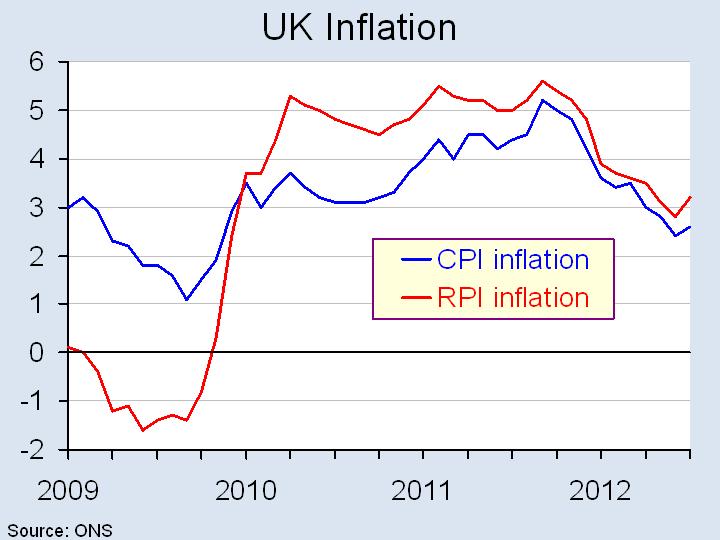
The RPI figure was announced by the ONS on 14 August and was a surprisingly high 3.2% – up from 2.8% in June: see Table 21 in the ONS’s CPI And RPI Reference Tables, July 2012. (Click here for a PowerPoint of the chart on the left.) Hence average fares can rise by 3.2% + 3% = 6.2%.
Rail travellers are angry on three counts:
First, the RPI measure of inflation is generally around 0.5% higher than the CPI measure (which is used for working out public-sector pay increases and the uprating of pensions and benefits). The July figure for CPI inflation was 2.6%.
Second, the extra 3% added on top of RPI means that that rail fares are going up more rapidly than other prices, and incomes too. The reason given for this is to shift the burden of funding the railways from the taxpayer to the traveller.
Third, the formula applies to average fares. Rail companies can raise particular regulated fares by up to 5 percentage points more than the formula provided they raise other fares by less than the formula. Thus some fares are set to rise by 11.2% – including some of the most expensive season tickets.
The government justified the increases by arguing that the higher fares will allow more investment by the rail companies, which could result in lower costs in the future. Nevertheless, two thirds of the revenue from the above-inflation increases will go to the government and only one third to the rail companies.
Webcasts
Inflation shock as rail fares set to soar Channel 4 News, Ciaran Jenkins (14/8/12)
Protests as rail fare price rises announced The Telegraph (14/8/12)
How do our rail fares compare with the rest of Europe? BBC News (14/8/12)
Rail fare increase will make life better, says minister BBC News (14/8/12)
Passenger Focus: Train companies ‘using dark arts’ BBC News, David Sidebottom (14/8/12)
Articles
Rail fares set to increase by 6.2% Financial Times, Mark Odell (14/8/12)
Rail fares set to rise by 6.2% in January Guardian, Gwyn Topham (14/8/12)
Rail fare hike of 6.2% sparks angry reaction BBC News (14/8/12)
Soaring rail fares will do nothing for the recovery The Telegraph (14/8/12)
Commuters plead with Osborne to prevent 10 per cent rise in rail fares Independent, Oliver Wright (15/8/12)
Rail fare rises: how to keep your ticket prices as low as possible Guardian, Mark King (14/8/12)
Documents and information
Fares Review Conclusions 2003 Strategic Rail Authority (June 2003)
Fares Office of Rail Regulation
Fares on National Rail Association of Train Operating Companies
Questions
- What are the arguments for and against the general principle of using an RPI+X formula for regulating rail fares?
- What are the arguments for and against allowing train operating companies to raise regulated rail fares by an average of RPI plus 3%, with 2 of the 3 percent above RPI inflation going to the government?
- In what ways are travellers likely to respond to the higher prices?
- Why are some travellers likely to have a much lower price elasticity of demand for rail travel than others? What determines this price elasticity of demand?
- What externalities exist in rail transport? How should this impact on the government’s rail pricing strategy?
- How is infrastructure development funded for (a) rail, (b) roads and (c) airports? Does this lead to an efficient allocation of transport investment?
- How does rail pricing in the UK compare with that in other European countries? Should other European countries follow the UK’s policy of above inflation fare increases to fund rail investment?
 Eurozone leaders met at a summit in Brussels on 28 and 29 June. Expectations ahead of the summit were low that any significant progress would be made on supporting eurozone banks and governments, on achieving more effective bank regulation or stimulating economic growth.
For once, EU leaders surprised markets by reaching a more comprehensive agreement than anticipated. The agreement has five key elements:
1. The use of funds from the soon-to-be launched eurozone bailout fund, the European Stability Mechanism (ESM), to lend to banks directly. Previously, funds had been made available to national governments to lend to their banks. This, however, increased the debts of the national governments, such as Spain, which made it harder for them to meet deficit and debt targets.
2. The setting up of a new banking supervisory body to impose common standards, such as capital adequacy requirements, on banks across the eurozone.
3. The use of the eurozone bailout fund to buy government bonds on the secondary market, provided governments are sticking to agreed deficit reduction measures. This would help to reduce interest rates on government bonds in countries such as Spain, Italy and Greece, currently having to pay interest rates 5 or 6 percentage points above those on German bonds.
4. A €120bn growth package to target EU money at small businesses, youth unemployment and infrastructure improvements. Most of the money would be from existing funds, such as EU Structural Funds, which are currently unused. There would be some additional funds, however, including €10bn to boost the lending capacity of the European Investment Bank.
5. A 10-year ‘roadmap’ towards greater fiscal union, including the creation of a eurozone treasury, which could limit overall spending by national governments.
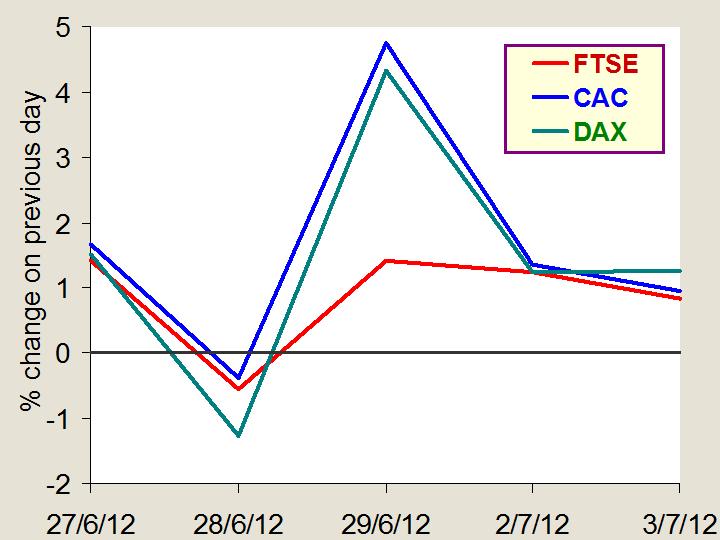 Generally the agreement has been greeted positively, with stock markets in the eurozone and across the world rising significantly. But will the measures be enough to reassure investors over the coming weeks? Will they cure the problems of the eurozone or are they just one more, albeit larger, sticking plaster?
The following webcasts, podcasts and articles look at the agreement and the resulting prospects for the eurozone.
Webcasts and podcasts
Eurozone bends the rules to save single currency euronews (29/6/12)
Markets Like Euro Crisis Deal, Merkel Defensive Associated Press (29/6/12)
Eurozone crisis: ‘Breakthrough’ at summit BBC News, Gavin Hewitt (29/6/12)
EU summit outcome exceeds – low – expectations euronews (29/6/12)
Italy and Spain are main beneficiaries after EU summit euronews (30/6/12)
EU bank aid deal ‘better than expected, worse than needed’ euronews (29/6/12)
New eurozone deal ‘not enough’ BBC Today Programme, James Shugg (29/6/12)
Eurozone: ‘Massive concession’ from Angela Merkel BBC Today Programme, Gavin Hewitt and Robert Peston (29/6/12)
Articles
Eurozone bank bailout deal throws lifeline to Spain and Italy Guardian, Ian Traynor and Phillip Inman (29/6/12)
Spain lifeline after EU allows direct access to eurozone bailout funds Guardian (29/6/12)
Less disunion The Economist, Charlemagne’s notebook (29/6/12)
Eurozone agrees on bank recapitalisation BBC News (29/6/12)
Merkel defends compromise deal on eurozone banks BBC News (29/6/12)
A first, tentative step to salvation for the eurozone Independent, Leading article (29/6/12)
Analysis – Sharing a vision may be Europe’s biggest challenge Reuters, Alan Wheatley (3/7/12)
Eurozone bank agreement welcomed FT Adviser, Rebecca Clancy & Bradley Gerrard (2/7/12)
The real victor in Brussels was Merkel Financial Times, Wolfgang Münchau (1/7/12)
Finns, Dutch cast first doubt on EU summit deal EurActiv (3/7/12)
A Euro deal from Brussels BBC News, Stephanie Flanders (29/6/12)
Document
Conclusions of the European Council (28/29 June 2012) European Council (29/6/12)
Questions
- What are the advantages of the ESF lending to banks directly? Are there any problems associated with the proposal?
- To what extent will the measures solve the problems of the eurozone? What else might need to be done?
- Are there any potential moral hazards contained in the proposals and how are they likely to be tackled?
- Explain the concept of ‘seniority’ in the following statement: “the debt owed by Spain to the EFSF, if and when it is transferred to the ESM, will not gain seniority”. Why might this be good for private financiers?
- If governments’ bonds are to be purchased by the ESM, what conditions are likely to be attached?
 Recently there have been calls from business leaders and Conservative politicians to scrap the UK’s 50% income tax rate, which is paid on taxable incomes over £150,000. The 50% income tax rate is thus paid by top earners, who comprise around just 1% of taxpayers.
And yet the government receives about 30% of income tax revenue from this 1% – and this was before the introduction of the 50% rate in April 2010. (In fact, with the marginal national insurance rate of 2%, top earners are paying an effective marginal rate of 52%.)
One argument used by those who favour reducing the 50% rate is that the rich would pay more income tax, not less. There are four reasons given for this. The first is that people would be encouraged to work harder and/or seek promotion if they knew they would keep more of any rise in income. The second is that fewer rich people would be encouraged to leave the country or to relocate their businesses abroad. The third is that more people would be encouraged to work in or set up businesses in the UK. The fourth is that there would be less temptation to evade taxes by not declaring all income earned or to find clever ways of avoiding tax.
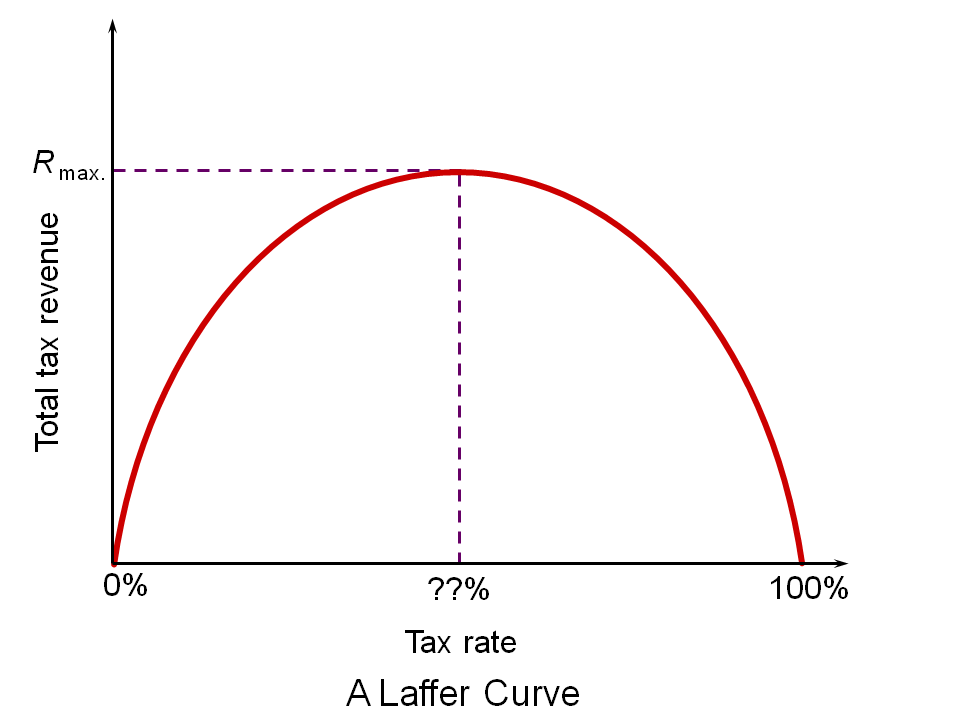
These arguments were put forward in the 1980s by Art Laffer, an adviser to President Reagan. His famous ‘Laffer curve’ (see Economics (8th edition) Box 10.3 or Economics (7th edition) Box 10.4) illustrated that tax revenues are maximised at a particular tax rate. The idea behind the Laffer curve is very simple. At a tax rate of 0%, tax revenue will be zero – but so too at a rate of 100%, since no-one would work if they had to pay all their income in taxes. As the tax rate rises from 0%, so tax revenue would rise. And so too, as the tax rate falls from 100%, the tax rate would rise. It follows that there will be some tax rate between 0% and 100% that maximises tax revenue.
Those arguing that a cut in the top rate of income tax would increase tax revenue are arguing that the 50% rate is beyond the peak of the Laffer curve. But this is an empirical issue. In other words, to assess the argument you would need to look at the evidence as, theoretically, the peak of the Laffer curve could be below or above 50%. Indeed, some argue that the peak is more likely to be at around 75%.
The following podcasts and articles consider the arguments. As you will see, the authors are not all agreed! Consider carefully their arguments and try to identify any flaws in their analysis.
Update
On 27 June 2012, Arthur Laffer appeared on the BBC Today Programme to discuss the Laffer curve and its implications for UK income tax policy. You can hear it from the link below
Podcasts
Should the 50p tax rate be ditched? BBC Today Programme, John Redwood and Paul Johnson (3/3/12)
Arthur Laffer: Tax rate should ‘provide for growth’ BBC Today Programme (27/6/12)
Articles
Where’s the High Point on the Laffer Curve? And Where Are We? Business Insider, Angry bear Blog (3/3/12)
Tax cuts: we can have our cake and eat it The Telegraph, Ruth Porter (22/2/12)
‘Scrap the 50p tax rate’ say 500 UK entrepreneurs Management Today, Rebecca Burn-Callander (1/3/12)
The Laffer Curve Appears in the UK Forbes, Tim Worstall (22/2/12)
Memo to 50p tax trashers: Laffer Curve peaks at over 75 per cent Left Foot Forward, Alex Hern (1/3/12)
Questions
- Explain how a cut in income tax could lead to an increase in tax revenue.
- Distinguish between the income effect and the substitution effect of a tax cut. Which would have to be bigger if a tax cut were to increase tax revenue?
- If, in a given year, the top rate of tax were raised and tax revenue fell, would this prove that the economy was now past the peak of the Laffer curve?
- What would cause the Laffer curve to shift/change shape? To what extent could the government affect the shape of the Laffer curve?
- If the government retains the 50% top tax rate, what can it do to increase the revenue earned from people paying the top rate?
- What other objectives might the government have for having a high marginal income tax rate on top earners?
- Investigate the marginal income tax and national insurance (social protection) rates in other countries. How progressive are UK income taxes compared with those in other countries?
 Induced hydraulic fracturing or “fracking”, is a technique used to make fractures in shale beds, normally deep underground, through the injection of liquids under high pressure. The idea is to release oil or gas. Fracking has transformed the oil industry by allowing vast reserves to be tapped.