 As the Coronavirus pandemic continues to escalate in the UK, the government has been forced to introduce a range of drastic measures, including severe restrictions on movement of people to ensure social distancing. Supermarkets have also been forced to act as they experienced panic buying and struggled to keep up with supply. They responded by starting to impose limits on the number of certain items an individual consumer could purchase and by reducing the range of products they made available. In addition, supermarkets contacted the government to suggest that competition law should be relaxed to allow the rival chains to coordinate their response to the ongoing situation.

WM Morrison, the forth largest supermarket retailer in the UK, was one of the key players lobbying for this change. Their chief executive, David Potts, argued that “There will be legislation that works perfectly in peacetime and not so well in wartime.”
The supermarket industry is in fact a market where the UK competition authorities have expressed considerable concerns in the past regarding a lack of competition (see for example the 2008 market investigation and the recent decision to block the merger between Sainsbury’s and Asda). The supermarkets also previously made similar demands for a relaxation of competition law in the event of a no-deal Brexit.
Despite this, the government has agreed to temporarily relax elements of competition law to help supermarkets respond to the Coronavirus crisis with the Environment Secretary, George Eustice, stating that:
By relaxing elements of competition laws temporarily, our retailers can work together on their contingency plans and share the resources they need with each other during these unprecedented circumstances.
In moves supported by the Competition and Markets Authority, laws enabling them to do so will soon be passed through Parliament. Supermarkets will be allowed to:
- share data with each other on stock levels
- cooperate to keep shops open
- share distribution depots and delivery vans
- pool staff with one another to help meet demand.
It is also expected that the Groceries Code Adjudicator will take a pragmatic approach to rules previously in place to prevent the big supermarket chains abusing their power over suppliers. These rules previously prevented supermarkets from stopping orders from a given supplier without reasonable warning. However, it is now accepted that they may need to do so in order to focus on supplying a restricted range of essential products.
Such relaxation of competition laws has been rare, with previous examples being measures taken in 2006 for the maintenance and repair of warships and in 2012 during the fuel crisis. In contrast, typically competition law is extremely hot on preventing agreements between firms. This is due to the fact that they distort competition and prevent the considerable benefits that can arise for consumers when firms compete to offer the best deals.
In the extreme situation the UK is currently in, the government’s stance appears to be that there are sufficient other benefits from restricting competition between supermarkets and allowing some degree of cooperation. It is then important that the form of cooperation between the supermarkets is restricted to narrow areas that will help to ensure the continuity of supply. In particular, it would be worrying if the supermarkets started discussing the prices they charge. Already food prices may rise due to increased demand and a potential shortage of supply. Furthermore, many consumers will see their income reduced. Therefore, it is important that coordination between supermarkets doesn’t result in further increases in prices.
It is therefore reassuring that the Government made clear that the relaxation of competition law:
will be a specific, temporary relaxation to enable retailers to work together for the sole purpose of feeding the nation during these unprecedented circumstances. It will not allow any activity that does not meet this requirement.
The Competition and Markets Authority has also stressed that they will not:
tolerate unscrupulous businesses exploiting the crisis as a ‘cover’ for non-essential collusion. This includes exchanging information on longer-term pricing or business strategies, where this is not necessary to meet the needs of the current situation.
Once the current crisis is over, it will also be important that the competition authority closely monitors the supermarket sector to ensure that cooperation between the supermarkets ends and normal competitive conduct is resumed.
Articles
Questions
- Outline the effects agreements between firms to raiser prices have on economic welfare.
- What are the pros and cons of allowing cooperation between the supermarkets in response to the Coronavirus crisis?
 With promises by the newly elected Conservative government to increase investment expenditure on health, education, innovation and infrastructure, it was expected that Rishi Sunak’s first Budget would be strongly expansionary. In fact, it turned out to be two Budgets in one – both giving a massive fiscal boost.
An emergency Budget
The first part of the Budget was a short-term emergency response to the explosive spread of the coronavirus. An extra £12 billion is to be spent on the NHS and other public services. Whether this will be anything like enough to cope with the effects of the pandemic as businesses fail and people lose their jobs remains to be seen. (See the blog A global supply-side shock: the impact of the coronavirus (COVID-19) outbreak.)
A key issue is just how quickly the money can be spent. How quickly can you train health professionals or produce more ventilators or provide extra hospital beds?
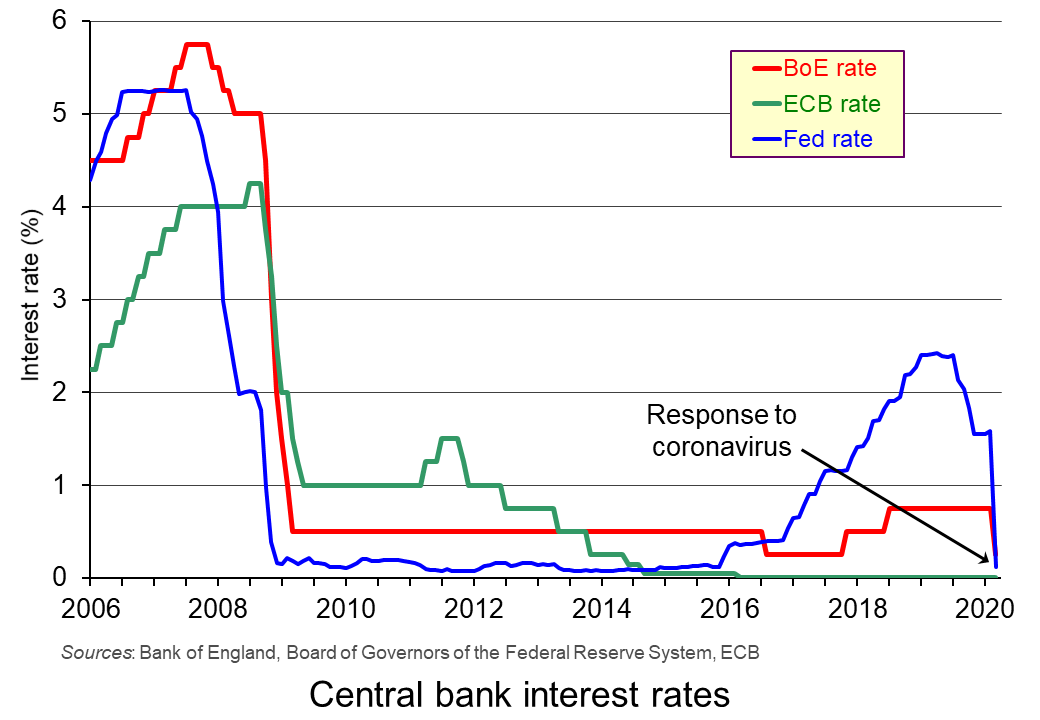 This emergency part of the Budget was co-ordinated with the Bank of England’s decision to cut Bank Rate from 0.75% to 0.25%.
This combined fiscal and monetary response to the crisis was further enhanced by the agreement of central banks on 15 March to boost world liquidity by increasing the supply of US dollars through large-scale quantitative easing. The US central bank, the Federal Reserve, also cut its main federal funds rate by one percentage point from 1–1.25% to 0–0.25%.
The planned Budget
 The second part of the Budget is to raise government investment by 9% in real terms over the next four years, bringing overall government expenditure to 41% of GDP, financed largely by extra borrowing. As the IFS observes, “That is above its pre-crisis level and bigger than at any point between the mid 1980s and the start of the financial crisis.”
But despite this rise in the proportion of government spending to GDP, in other respects the spending plans are less expansionary than they may appear. Increases in current spending on health, education and defence had already been promised. This leaves other departments, such as social security, facing cuts, or at least no increase. And when compared with 2010/11 levels, if you exclude health, government current spending per head of the population will around 14% lower, or 19% lower once you account for spending that replaces EU funding.
The Chancellor’s hope is that, by focusing on investment, there will be a supply-side effect as well as a demand-side boost. If increases in aggregate demand are balanced by increases in aggregate supply, such a policy would not be inflationary in the long run. But in the light of the considerable uncertainty of the effects of the coronavirus, the plans may well require significant adjustment in the Autumn Budget – or earlier.
Articles
Podcasts and Videos
Official documentation
Questions
- To what extent is this Budget ‘Keynesian’?
- Is the extra government expenditure likely to crowd out private expenditure? Explain.
- Demonstrate the desired long-term economic effect of the infrastructure policy using either an AD/AS diagram or a DAD/DAS diagram.
- How is the coronavirus pandemic likely to affect potential GDP in (a) the short run (b) the long run?
- Why is public-sector debt likely to soar over the next four years while annual government debt interest payments are likely to continue their gentle decline?
- What is missing from the Budget that you feel ought to have been included? Explain why.
 The government has announced outlines of the new system of immigration controls from January 2021 when the Brexit transition period is scheduled to finish. It plans to introduce an Australian-style points-based system. This will apply to all EU and Non-EU citizens. The aim is to attract skilled workers, while preventing non-skilled or low-skilled workers from entering the UK for employment.
But even skilled workers will need to meet three criteria in order to obtain a work visa: (i) having the offer of a job paying a minimum of £25,600 per annum, except in designated jobs where there is a shortage of labour; (ii) being able to speak English; (iii) having qualifications equivalent to A levels.
To apply for a work visa, applicants must have at least 70 points according to the following table:
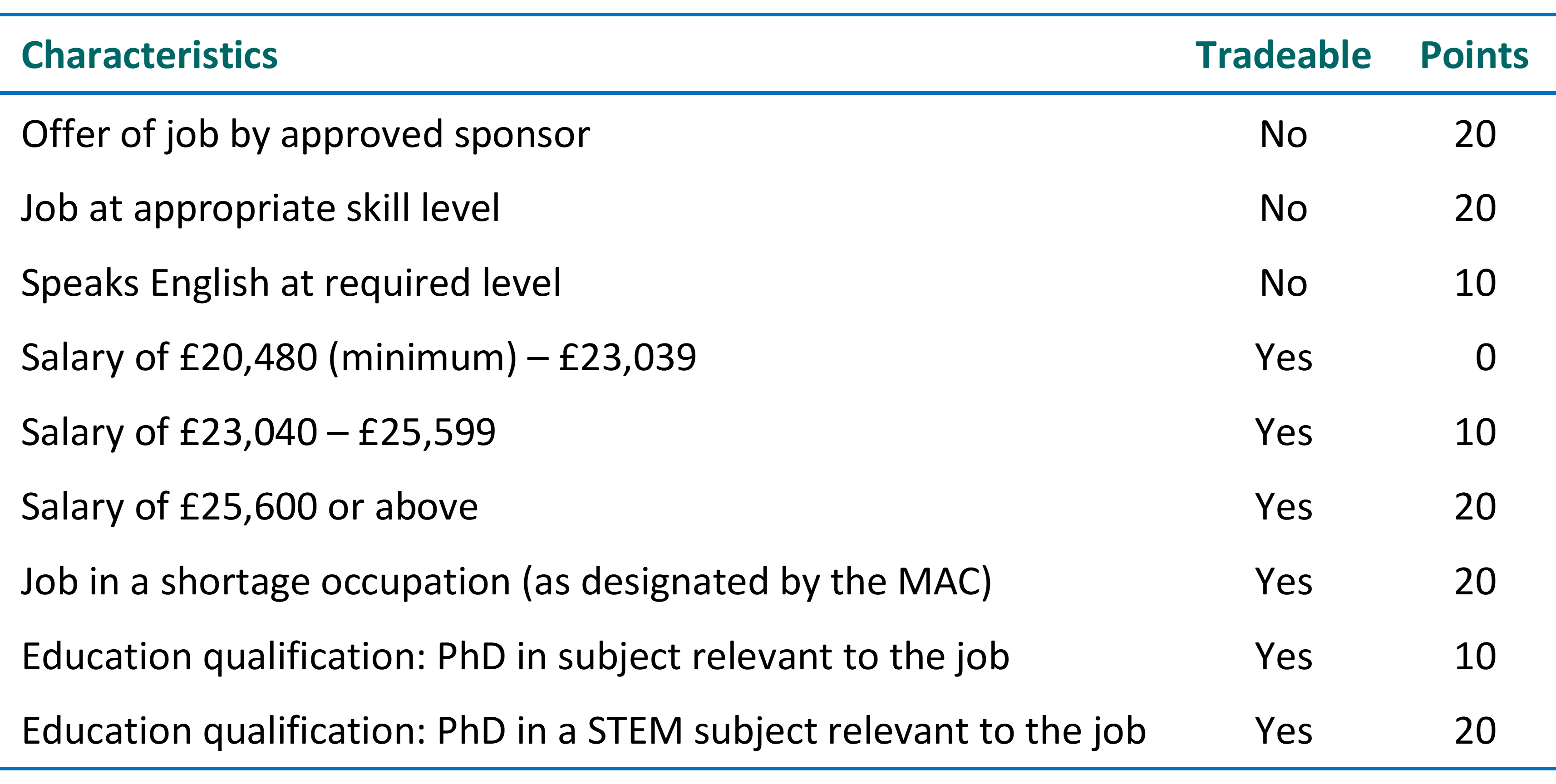
In certain jobs where there is a shortage of labour, designated by the Migration Advisory Committee (MAC), immigrants will be able to earn a lower income, provided it is above £20,480 per annum. They will earn 20 points for such jobs, which can offset not meeting the £25,600 threshold. Such jobs could include those in healthcare and farming. There will also be temporary visas for seasonal workers, such as fruit pickers.
The government argues that the new system will encourage employers to substitute technology for labour, with greater investment in equipment and computers. This would increase labour productivity and wages without reducing employment.
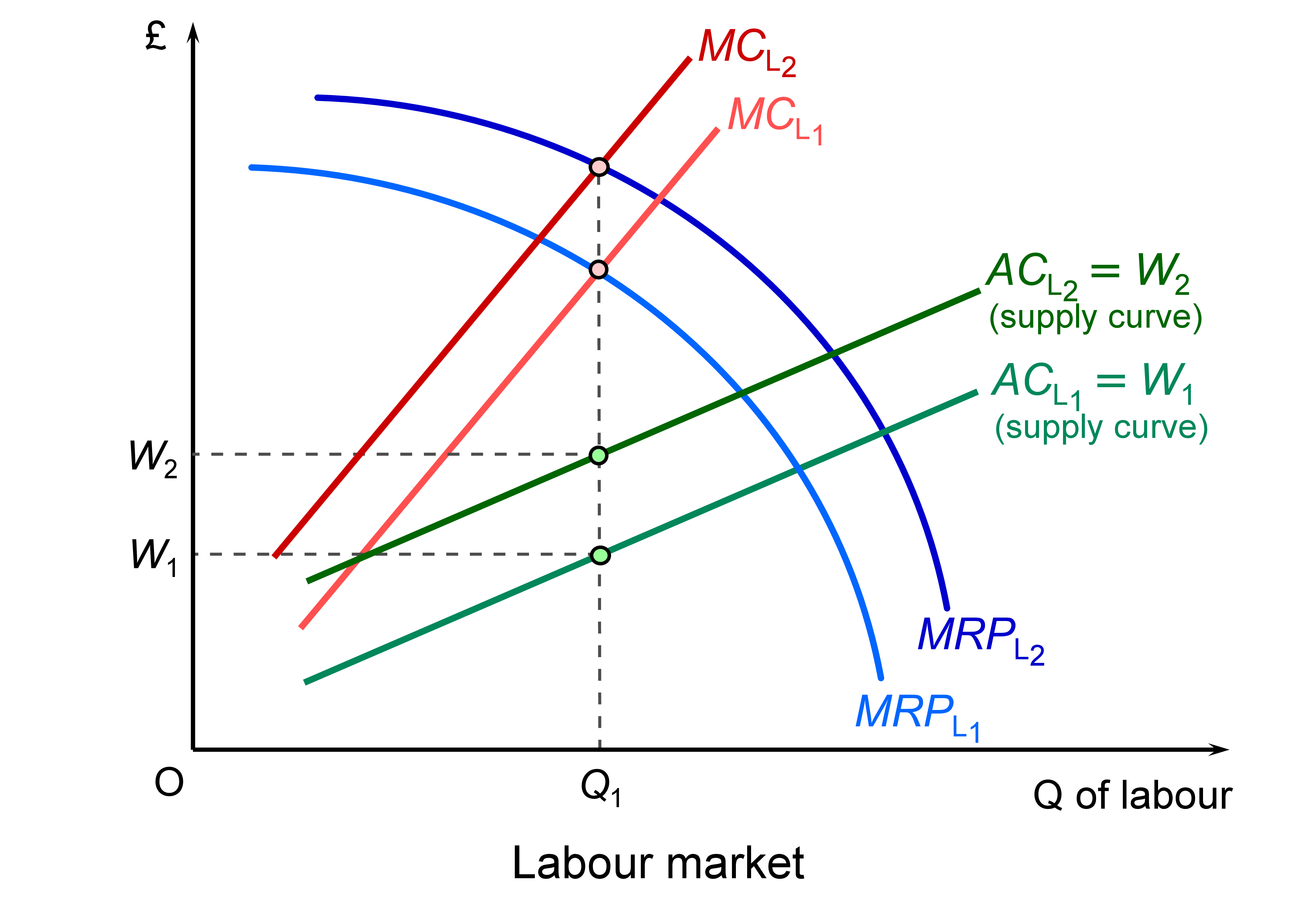 This is illustrated in the diagram, which illustrates a low-paid job which will be impacted by the restrictions. If there is a rise in productivity through technological change, the marginal revenue product of labour curve shifts upwards from MRPL1 to MRPL2 and offsets the leftward shift in labour supply (caused by the decline in immigration) from ACL1 to ACL2 and the marginal cost of labour from MCL1 to MCL2. Employment is where the marginal cost of labour equals the marginal revenue product of labour. This remains at Q1. Wages are given by the supply curve of labour and rise from W1 to W1. (Click here for a PowerPoint of the diagram.)
Even if the upward shift in the MRPL curve is not sufficient to offset the leftward shift in the labour supply curve, wages will still rise, but there will be a fall in employment.
In higher-paid skilled jobs where people meet the points requirement, there will be little effect on wages and employment, except where people are generally discouraged by a points system, even if they have the points themselves.
The government also argues that there is a large pool of UK residents who can take up jobs that would otherwise have been filled by immigrants. The Home Secretary referred to the 8.48 million people who are economically inactive who could fill jobs no longer filled by immigrants. However, as the data show, most  of these people are not available for work. Some 2.3 million are students, 1.9 million are carers at home looking after relatives, 2.1 million are long-term sick and 1.1 million are retired. Only 1.9 million (22.1% of the economically inactive) would like a job and not all these would be able to take up one (e.g. the long-term sick).
One the biggest problems concerns low-paid sectors where it is very difficult to substitute capital for labour through use of technology. Examples include social care, health care, the leisure and hospitality industry and certain jobs in farming. There could be severe shortages of labour in such industries. It remains to be seen whether such industries will be given exemptions or more relaxed conditions by the government in line with advice from the Migration Advisory Committee.
More details will emerge of the points system in the coming months. It will be interesting to see how responsive the government will be to the concerns of employers and workers.
Videos
Articles
Questions
- Find out how the proposed points-based system for immigration differs from the current system that applies to non-EU citizens.
- What will be the likely impact of reducing immigration of unskilled and low-skilled people?
- What barriers are there to substituting capital for labour in the caring and leisure sectors?
- What would be the macroeconomic effects of a substantial reduction in immigration?
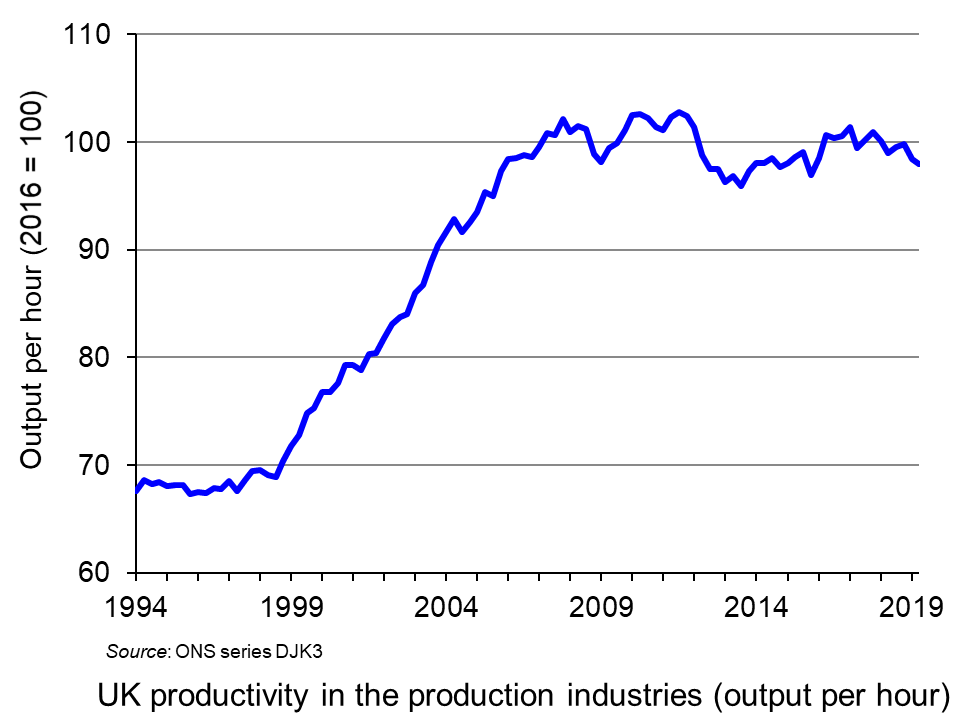 A lack of productivity growth has been a major problem for the UK economy over the past decade (click here for a PowerPoint of the chart). Is it possible that the new decade may see a pick-up in the growth in output per hour worked?
One possible solution to low productivity growth is to reduce working hours and even to move to a four-day week, but not to reduce total pay. If people work fewer hours, they may well be more productive in the hours they do work. In fact, not only may output per hour increase, but so too may output per worker, despite fewer hours being worked. What is more, the quality of output may increase with people being less tired and more motivated.
Several companies have experimented with a four-day week, including Microsoft in Japan, which employees 2300 workers. It found that, despite a 20% reduction in hours worked, output per hour worked increased by 40%, with total output thereby increasing. Workers were generally happier and more motivated and asked for fewer days off.
And it is not just a question of output: fewer hours can result in lower costs. The effect on costs will depend on the nature of new work patterns, including whether everyone has the same extra day off.
But a four-day week is only one way of cutting working hours for full-time employees. Another is to reduce the length of the working day. The argument is that people may work more efficiently if the standard working day is cut from eight to, say, five hours. As the first Thrive Global article article (linked below) states:
Just because you’re at your desk for eight hours doesn’t mean you’re being productive. Even the best employees probably only accomplish two to three hours of actual work. The five-hour day is about managing human energy more efficiently by working in bursts over a shorter period.
If people have more leisure time, this could provide a boost to the leisure and other industries. According to a Henley Business School study:
An extra day off could have a knock-on effect for the wider society. We found 54% of employees said they would spend their day shopping, meaning a potential boost for the high street, 43% would go to the cinema or theatre and 39% would eat out at restaurants.
What is more, many people would be likely to use the extra time productively, undertaking training, volunteering or other socially useful activities. Also family life is likely to improve, with people spending less time at work and commuting and having more time for their partners, children, other relatives and friends. In addition, people’s physical and mental health is likely to improve as they achieve a better work-life balance.
 So, should firms be encouraged to reduce hours for full-time workers with no loss of pay? Many firms may need no encouragement at all if they can see from the example of others that it is in their interests. But many firms may find it difficult, especially if their suppliers and/or customers are sticking with ‘normal’ working hours and want to do business during those hours. But, over time, as more firms move in this direction, so it will become increasingly in the interests of others to follow suit.
In the meantime, should the government introduce incentives (such as tax breaks) or regulations to limit the working week? Indeed, it was part of the Labour manifesto for the December 2019 election that the country should, over time, move to a four-day week. Although this was a long-term goal, it would probably have involved the use of some incentives to encourage employers to move in that direction or the gradual introduction of limits on the number of hours or days per week that people could work in a particular job. It is unlikely that the new Conservative government will introduce any specific measures, but would probably not want to discourage firms from reducing working hours, especially if it is accompanied by increased output per worker.
But despite the gains, there are some problems with reduced working hours. Many small businesses, such as shops, restaurants and firms offering technical support, may not have the flexibility to offer reduced hours, or may find it hard to increase productivity when there is a specific amount of work that needs doing, such as serving customers.
Another problem concerns businesses where the output of individuals is not easy to measure because they are part of a team. Reducing hours or the working week may not make such people work harder if they can ‘get way with it’. Not everyone is likely to be motivated by fewer hours to work harder.
Then there is the problem if reduced hours don’t work in boosting productivity. It may then be very difficult to reintroduce longer hours.
But, despite these problems, there are many firms where substantial gains in productivity could be made by restructuring work in a way that reduces hours worked. We may see more and more examples as the decade progresses.
Podcast
Articles
- Economics of a four-day working week: research shows it can save businesses mone
The Conversation, Miriam Marra (11/11/19)
- Less hours for work, more time on Earth: Why a four-day working week is good for you
Independent, Steve Taylor (16/12/19)
- Microsoft Japan Launched A Four-Day Workweek To Much Success: Is This The Key To Attracting Talent In The Tight U.S. Job Market?
Forbes, Jack Kelly (5/11/19)
- Will The Five-Hour Work Day Catch On In America?
Forbes, Jack Kelly (28/10/19)
- My Company Implemented a 5-Hour Workday — and the Results Have Been Astounding
Thrive Global, Stephan Aarstol (3/10/19)
- Why Does a Four-Day Work Week Achieve Better Results?
Thrive Global, Stephanie Lin (16/12/19)
- Four-Day Working Week Improves Staff’s Mental Health By 87%, Company Finds
Unilad, Niamh Shackleton (10/12/19)
- Hull business launches four-day working week as well as your birthday off and ‘Beer Fridays’
Hull Live, Phil Winter (5/12/19)
- A four-day work week? Sounds nice, but here’s the real deal
Sydney Morning Herald, Tony Featherstone (21/11/19)
- The four-day debate: Fantasy or feasible?
The Hindu, Business Live, Kamal Karanth (20/11/19)
- Finland’s ministry of transport floats tech-enabled four-day week
Computer Weekly, Gerard O’Dwyer (20/11/19)
- Should You Consider a 4 Day Work Week?
Small Business Trends, Rob Starr (5/12/19)
Report
Questions
- Distinguish between different ways of measuring labour productivity.
- Give some examples (from the linked references) of employers which have tried introducing a four-day week or reduced hours for full-time workers. What has been the outcome in each case?
- In what ways may reducing working hours reduce a firm’s total costs?
- What are the advantages and disadvantages of the government imposing (at some point in the future) a maximum working week or a four-day week?
- What types of firm might struggle in introducing a four-day week or a substantially reduced number of hours for full-time employees?
- What external benefits and costs might arise from a shorter working week?
 The monetary policy mandates of central banks have an impact on all our lives. While the terminology might not be familiar to many outside economics, their impact is, however, undeniably important. This is because they set out the objectives for the operation of monetary policy. Adjustments to interest rates or the growth of the money supply, which affect us all, reflect the mandate given to the central bank.
Since 1977 the mandate given to the Federal Reserve (the US central bank) by Congress has been to promote effectively the goals of maximum employment, stable prices, and moderate long-term interest rates. This mandate has become known as the dual mandate because it emphasises both employment and stable prices. Since 2012, the Federal Reserve’s Open Market Committee has issued an annual statemenent of its long-run goals. The latest was published in January 2019. Since this time, the Federal Reserve has explicitly set the ‘longer-run goal for inflation’ at 2 per cent. It has also emphasised that it would be ‘concerned’ if the inflation rate was persistently above or below this level.
In November 2018 the Federal Reserve began a review of its monetary policy strategy, its tools and how it communicates monetary policy. The review is being conducted within the guidelines that its statutory mandate gives and as well as the longer-term inflation goal of 2 per cent. However, one of the issues being addressed by the review is how the operation of monetary policy can avoid the rate of inflation frequently undershooting 2 per cent, as it has done since the financial crisis of the late 2000s and the introduction of the 2 per cent inflation rate target.
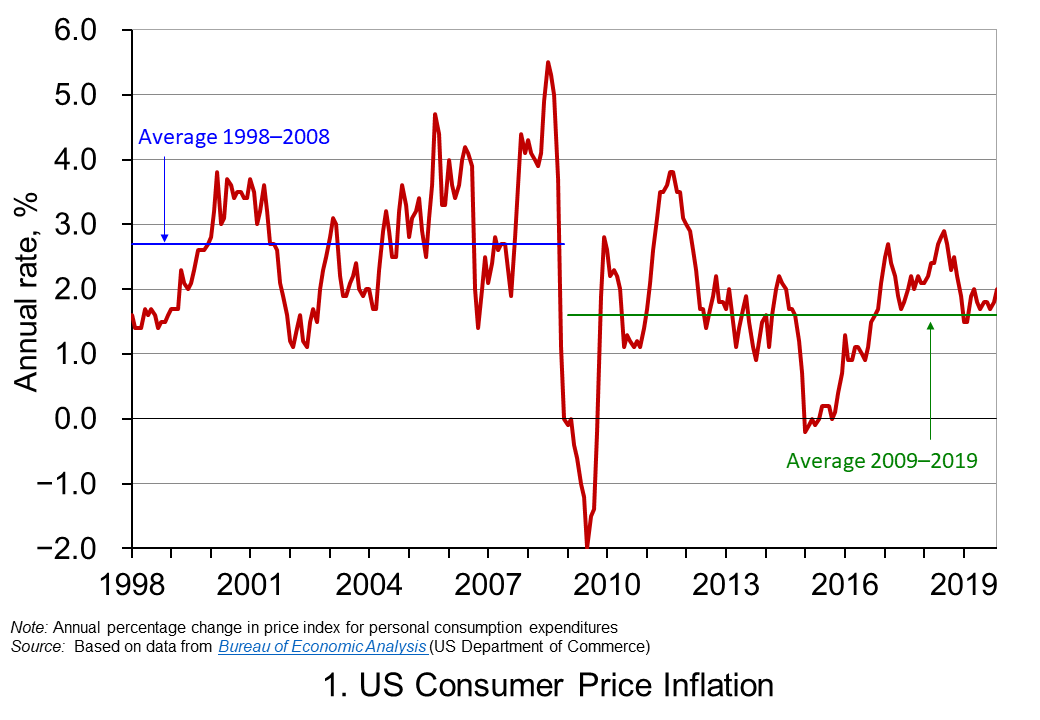 Chart 1 shows the annual rate of consumer price inflation in the US since 1998. It helps to illustrate the concern that low inflation rates can become entrenched. The chart shows that, while the average inflation rate from 1998 to 2008 was 2.7 per cent, from 2009 the average has been only 1.6 per cent. Interestingly, the average since 2012, when the explicit 2 per cent goal was introduced, to the present day is also 1.6 per cent. (Click here to download the PowerPoint chart.)
The concern going forward is that the natural or neutral rate of interest, which is the policy rate at which the rate of inflation is close to its target level and the level of output is close to its potential level, is now lower than in the recent past. Hence, when the next downturn occurs there is likely to be less room for cutting interest rates. Hence, the review is looking, in essence, to future-proof the conduct of monetary policy.
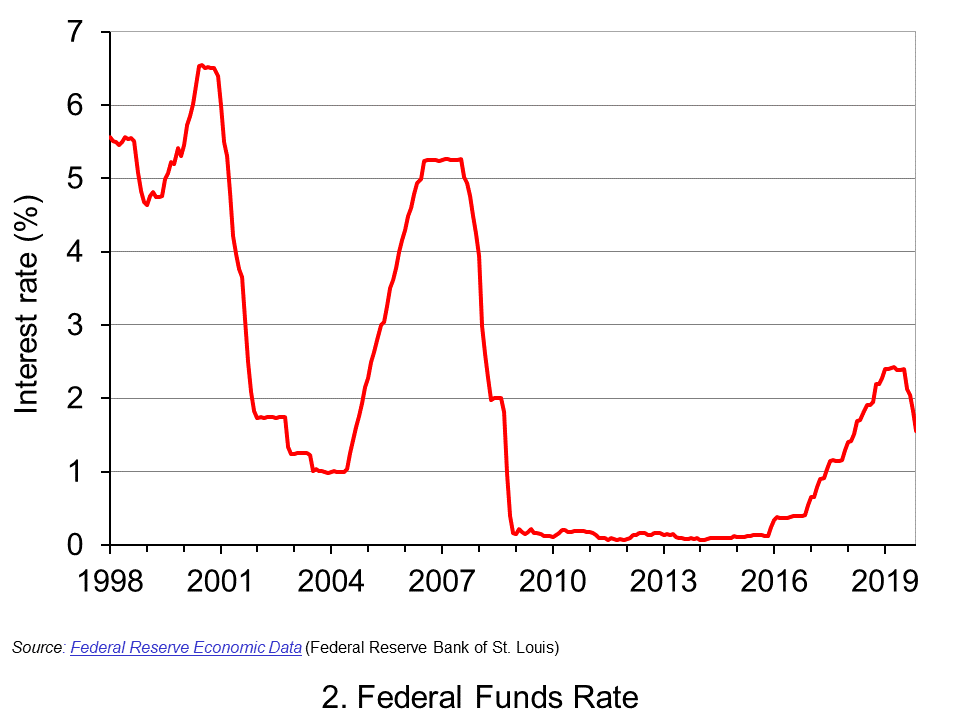 Chart 2 shows the Federal Fund rate since 1998. This is the rate at which commercial banks lend to each other the reserve balances they hold at the Federal Reserve in order to meet their reserve requirements. The Federal Reserve can affect this rate through buying or selling government securities. If it wants to drive up rates, it can sell holdings of government securities and reduce the money supply. If it wants to drive rates down, it can buy government securities and increase the money supply. The effects then ripple through to other interest rates and, in turn, aggregate demand and inflation. (Click here to download a copy of the PowerPoint chart.)
We can see from Chart 2 the dramatic cuts made by the Federal Reserve to interest rates as the financial crisis unfolded. The subsequent ‘normalisation’ of the Federal Funds rate in the 2010s saw the Federal Funds Rate rise to no higher than between 2.25 and 2.5 per cent. Then in 2019 the Federal Reserve began to cut rates again. This was despite historically-low unemployment rates. In November 2019 the unemployment rate fell to 3.5 per cent, its lowest since 1969. This has helped fuel the argument among some economists and financiers, which we saw earlier, that that the natural (or neutral) interest rate is now lower.
If the natural rate is lower, then this raises concerns about the effectiveness of monetary policy in future economic downturns. In this context, the review is considering ways in which the operation of monetary policy would be able to prevent the rate of inflation consistently undershooting its target. This includes a discussion of how the Fed can prevent inflationary expectations becoming anchored below 2 per cent. This is important because, should they do so, they help to anchor the actual rate of inflation below 2 per cent. One possibility being considered is an inflation make-up strategy. In other words, a period of below-target inflation rates would need to be matched by a period where inflation rates could exceed the 2 per cent target in order that the long-term average of 2 per cent is met.
An inflation make-up policy would work like forward guidance in that people and markets would know know that short-term interest rates would be kept lower for longer. This would then help to force longer-term interest rates lower as well as providing people and businesses with greater certainty that interest rates will be lower for longer. This could help to encourage spending, raise economic growth and prevent inflation from overshooting its target for any extensive period of time.
An inflation make-up strategy would, in part, help to cement the idea that the inflation target is effectively symmetrical and that 2 per cent is not an upper limit for the inflation rate. But, it would do more than that: it would allow the Fed to deliberately exceed the 2 per cent target.
An inflation make-up strategy does raise issues. For example, how would the Fed determine the magnitude of any inflation make-up and for how long would a looser monetary stance be allowed to operate? In other words, would an inflation make-up strategy be determined by a specific rule or formula? Or, would the principle be applied flexibly? Finally, could a simpler alternative be to raise the target rate itself, given the tendency to undershoot the 2 per cent target rate? If so, what should that the rate be?
We should know by the end of 2020 whether the Federal Reserve will adopt, when necessary, an inflation make-up monetary policy.
Articles
Questions
- What do you understand by the monetary policy mandate of a central bank?
- Explain the ways in which the monetary policy mandate of the central bank affects our everyday lives.
- Why are inflation-rate expectations important in determining actual inflation rates?
- Why is the Federal Reserve concerned about its ability to use monetary policy effectively during future economic downturns?
- Discuss the economic arguments for and against central banks operating strict inflation-rate targets.
- Does the case for adopting an inflation make-up monetary policy mandate show that the argument for inflation-rate targeting has been lost?
- What do you understand by the idea of a natural or neutral policy interest rate? Would the actual rate be expected to be above or below this if the rate of inflation was below its target level?
