 As an avid sport’s fan, Sky Sports and Eurosport are must haves for me! In the days leading up to the end of January, it was a rather tense time in my house with the prospect of Eurosport being removed from anyone who was a Sky TV subscriber. Thankfully the threat has now gone and tranquility returns, but what was going on behind the scenes?
Whether you have Sky TV, BT, Virgin or any other, we generally take it for granted that we can pick and choose the channels we want, pay our subscription to our provider and happily watch our favourite shows. However, behind the scenes there is a web of deals. While Sky own many channels, such as Sky Sports; BT own others and there are a range of other companies that own the rest. Some companies pay Sky for their channels to be shown, while Sky pays other companies for access to their channels.
One such company is Discovery, which owns a range of channels including TLC, Eurosport, DMAX and Animal planet. Discovery then sells these channels to providers, such as Sky and Virgin, who pay a price for access. The problem was that Sky and Discovery had failed to reach an agreement for these channels and as the deadline of 31st January 2017 loomed, it became increasingly possible that Discovery would simply remove its channels from Sky. This would mean that Sky customers would no longer have access to these channels, while customers with other providers would continue to watch them, as companies such as Virgin still had an agreement in place.
 The issue was money. Hours before the deadline, a deal was finally reached such that Discovery will now keep its programmes on Sky for ‘years to come’. Discovery has indicated the final deal was better than had originally been proposed, while Sky indicate that the deal accepted by Discovery was the same as had previously been offered! Although no details of the financial agreement have been released, it seems likely that either Sky increased the price they were willing to pay or Discovery lowered the price it was asking for. Both companies stood to lose if the dispute was not settled, but it’s interesting to consider which company was at more risk. Following the announcement that a deal had been struck, Discovery shares rose by 2.5 per cent, while Sky’s share remained unchanged.
While Sky said that viewing figures on Discovery’s channels had been falling and that it had been over-paying for years, it seems likely that if a deal had not been reached, millions of Sky customers may have considered switching to other providers, who were still able to show Discovery channels. Although Sky has been looking to cut its costs and one way is to cut the price it pays for channels, failure to reach an agreement may have cost it a significant sum in lost revenue, as channels such as Eurosport are hugely popular.
Discovery claimed that the price Sky was paying them was not fair and that it was paying them less for its channels that it did 10 years ago. Susanna Dinnage, Discovery’s Managing Director in the UK said:
“We believe Sky is using what we consider to be its dominant market position to further its own commercial interest over those of viewers and independent broadcasters. The vitality of independent broadcasters like Discovery and plurality in TV is under threat.”
 Sky claimed that Discovery was demanding close to £1bn for its programmes and that given that these channels were losing viewers, this price was unrealistic. A spokesman said:
“Despite our best efforts to reach a sensible agreement, we, like many other platforms and broadcasters across Europe, have found the price expectations for the Discovery portfolio to be completely unrealistic. Discovery’s portfolio of channels includes many which are linear-only where viewing is falling …
Sky has a strong track record of understanding the value of the content we acquire on behalf of our customers, and as a result we’ve taken the decision not to renew this contract on the terms offered …
We have been overpaying Discovery for years and are not going to anymore. We will now move to redeploy the same amount of money into content we know our customers value.”
Here we have a classic case of two firms in negotiation; each with a lot to lose, but both wanting the best outcome. There are hundreds of channels with millions of programmes and hence it is a competitive market. So why was it that Discovery could pose such a threat to the huge broadcaster? The following articles consider the dispute and the eleventh hour agreement.
Discovery strikes deal to keep channels on Sky BBC News (1/2/17)
Discovery channel strikes last-minute deal with Sky to stay on TV, saving Animal Planet and Eurosport Independent, Aatif Sulleyman (1/2/17)
Eurosport stays o Sky after late deal is struck with hours to spare between broadcasting giant and Discovery Mail Online, Kieran Gill (1/2/17)
Discovery averts UK blackout with Sky in last-minute deal Bloomberg, Rebecca Penty, Joe Mayes and Gerry Smith (1/2/17)
Is Sky losing Discovery? Eurosport, Animal Planet and other fan favourite set to stay International Business Times, Owen Hughes (1/2/17)
Discovery goes to war with Sky over channel fees with blackout threat The Telegraph, Christopher Williams (25/1/17)
Questions
- Can you use game theory to outline the ‘game’ that Sky and Discovery were playing?
- Is the ‘threat’ of stopping access to channels credible?
- Although we don’t know the final financial settlement, why would Sky have had a reason to increase the price it paid to Discovery?
- Why would it be in Discovery’s interests to accept the deal that Sky offered?
- Susanna Dinnage suggested that Sky was using its dominant market position. What does this mean and how does this suggest that Sky might be able to behave?
- What type of market structure is the pay-TV industry? Think about it in terms of broadcasters, channels and programmes as you might get very different answers!
 In the light of the Brexit vote and the government’s position that the UK will leave the single market and customs union, there has been much discussion of the need for the UK to achieve trade deals. Indeed, a UK-US trade deal was one of the key issues on Theresa May’s agenda when she met Donald Trump just a week after his inauguration.
But what forms can a trade deal take? What does achieving one entail? What are likely to be the various effects on different industries – who will be the winners and losers? And what role does comparative advantage play? The articles below examine these questions.
Given that up until Brexit, the UK already has free trade with the rest of the EU, there is a lot to lose if barriers are erected when the UK leaves. In the meantime, it is vital to start negotiating new trade deals, a process that can be extremely difficult and time-consuming.
A far as new trade arrangements with the EU are concerned, these cannot be agreed until after the UK leaves the EU, in approximately two years’ time, although the government is keen that preliminary discussions take place as soon as Article 50 is triggered, which the government plans to do by the end of March.
Articles
Trade deals are difficult to negotiate and Britain lacks the skills for the job The Conversation, Nigel Driffield (27/1/17)
Why a U.S.-U.K. Trade Deal Could be Harder than it Sounds Newsweek, Josh Lowe (26/1/17)
UK-US trade deal will have ‘very small upsides’ for Britain, says former Bank of England economist Independent, Rob Merrick (26/1/17)
Trump says he wants a U.K. trade deal. Don’t hold your breath CNN Money, Alanna Petroff (23/1/16)
Reality Check: Can there be a quick UK-USA trade deal? BBC News, Jonty Bloom (16/1/17)
Questions
- What elements would be included in a UK-US trade deal?
- Explain the gains from trade that can result from exploiting comparative advantage.
- Explain the statement in the article that allowing trade to be determined by comparative advantage is ‘often politically unacceptable, as governments generally look to protect jobs and tax revenues, as well as to protect activities that fund innovation’.
- Why is it difficult to work out in advance the likely effects on trade of a trade deal?
- What would be the benefits and costs to the UK of allowing all countries’ imports into the UK tariff free?
- What are meant by ‘trade creation’ and ‘trade diversion’? What determines the extent to which a trade deal will result in trade creation or trade diversion?
 GDP is often used as a measure of wellbeing, even though it is really only a measure of the market value of a nation’s output or an indicator of economic activity. But although higher consumption can improve living standards, it is only one contributor to wellbeing, whether at individual or social level.
There are essentially four types of problems from using GDP as a measure of how society is doing.
The first is that it does not include (as negative figures) many external costs, such as pollution, stress and family breakdown related to work.
The second is that it includes things that are produced to counteract the adverse effects of increased production, such as security, antidepressants, therapy and clean-up activities.
The third is that it ignores things that are produced and do contribute to wellbeing and yet are not traded in the market. Examples include volunteer work, the ‘output’ of clubs and societies, work within the home, production from allotments and various activities taking place in the ‘underground economy’ to avoid taxation.
 The fourth is the sustainability of economic growth. If we deplete natural resources, the growth of today may be at the cost of the wellbeing of future generations.
Then there is the question of the distribution of the benefits of production. Although GDP figures can be adjusted for distribution, crude GDP growth figures are not. If a few wealthy get a lot richer and the majority do not, or even get poorer, a growth in GDP will not signify a growth in wellbeing of the majority.
Then there is the question of the diminishing marginal utility of income. If an extra pound to a rich person gives less additional wellbeing than an extra pound to a poor person, then any given growth rate accompanied by an increase in inequality will contribute less to wellbeing than the same growth rate accompanied by a decrease in inequality.
The first article below criticises the use of crude indicators, such as the growth in GDP or stock market prices to signify wellbeing. It also looks at some alternative indicators that can capture some of the contributions to wellbeing missed by GDP figures.
Articles
Want to know how society’s doing? Forget GDP – try these alternatives The Guardian, Mark Rice-Oxley (27/1/17)
The Increasingly Inadequate Measurement Of Productivity The Market Mogul, Chris Woods (20/1/17)
Why GDP fails as a measure of well-being CBS News, Mark Thoma (27/1/16)
Limitations of GDP as Welfare Indicator The Sceptical Economist, zielonygrzyb (31/7/12)
Questions
- Should GDP be abandoned as an indicator?
- How could GDP be refined to capture more of the factors affecting wellbeing?
- Go through each of the indicators discussed in the first article above and consider their suitability as an indicator of wellbeing.
- “Everywhere you look, there are better benchmarks than these tired old financial yardsticks.” Identify three such indicators not considered in the first article and discuss their suitability as measures of economic performance.
- How might the benefit you gain from free apps be captured?
- Consider the suitability of these alternatives to GDP.
 The government has launched its promised industrial strategy by publishing a Green Paper which details the measures the government plans to take. This represents a move away from a laissez-faire approach to business and a move towards greater intervention.
There are 10 elements or ‘pillars’ of the policy. These include investing in science and technology, skills training and infrastructure – energy, transport, digital and water. They also include support to businesses, developing local institutions and encouraging trade and inward investment.
The drivers of the policy are planned to be a mixture of financial support, government procurement, new structures or organisations and laws and regulations. Details will be fleshed out in the coming months as the policy is enacted.
Reactions to the announcement have been mixed. An industrial policy is generally seen as an important element for improving the supply side of the economy by improving productivity and encouraging capacity growth. However, much of the criticism of the policy is that it does not go far enough. The following articles assess the policy – both its design and likely success.
Articles
Theresa May’s long-awaited “industrial strategy” looks a bit thin The Economist (28/1/17)
Factbox: The 10 pillars of Britain’s Modern Industrial Strategy Reuters, William James (23/1/17)
Theresa May give details of action plan for British industry BBC News (23/1/17)
Industry plan is break with ‘laissez-faire’ approach of the past Sky News, Ian King (23/1/17)
Skills and infrastructure top priority in industrial strategy, say UK firms The Guardian, Graham Ruddick (21/1/17)
The Guardian view on industrial strategy: hot air but no liftoff The Guardian (23/1/17)
The industrial strategy acknowledges a fundamental truth about growth New Statesman, Michael Jacobs (23/1/17)
European bosses underwhelmed by UK industrial revival plan Reuters, Ludwig Burger (27/1/17)
Is the UK finally getting serious about industrial strategy? Economia, David Bailey (25/1/17)
Government policy documents
Building our Industrial Strategy: Our 10 pillars HM Government (23/1/17)
Building our Industrial Strategy: Green Paper HM Government (23/1/17)
Questions
- Distinguish between interventionist and market-orientated supply-side policy. In terms of this distinction, how would you categorise the UK government’s industrial strategy?
- How will the strategy address the UK’s productivity puzzle?
- Go through each of the 10 pillars and assess how they will help to address weaknesses in the UK economy.
- How can government ‘missions’ to address major social challenges help to drive innovation? (See New Statesman article above.)
- How may Brexit help or hinder the government’s industrial strategy?
- The Economist article describes the strategy as looking thin. Do you agree?
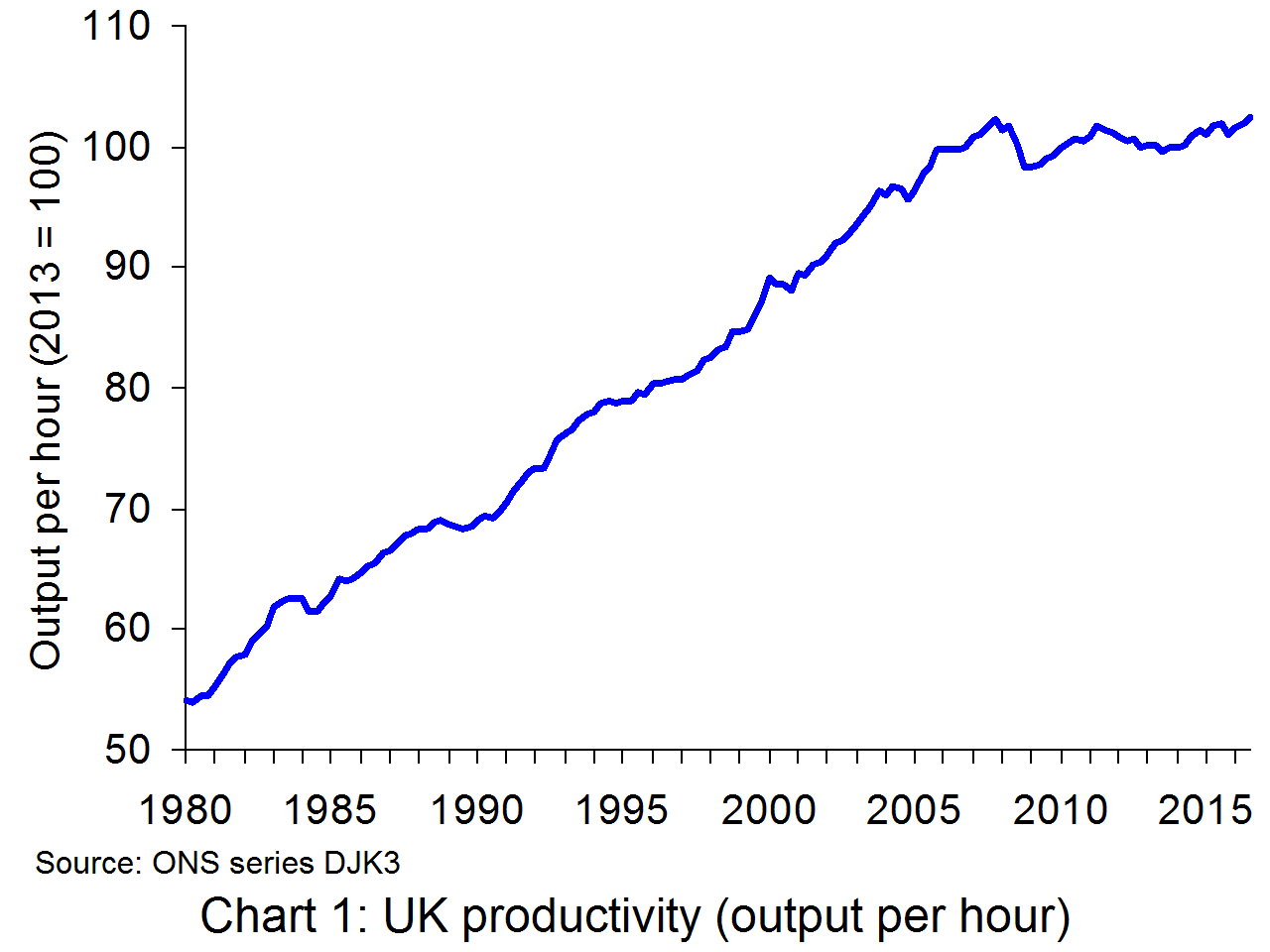 UK productivity growth remains well below levels recorded before the financial crisis, as Chart 1 illustrates. In fact, output per hour worked in 2016 Q3 was virtually the same as in 2007 Q4. What is more, as can be seen from Chart 2, UK productivity lags well behind its major competitors (except for Japan).
But why does UK productivity lag behind other countries 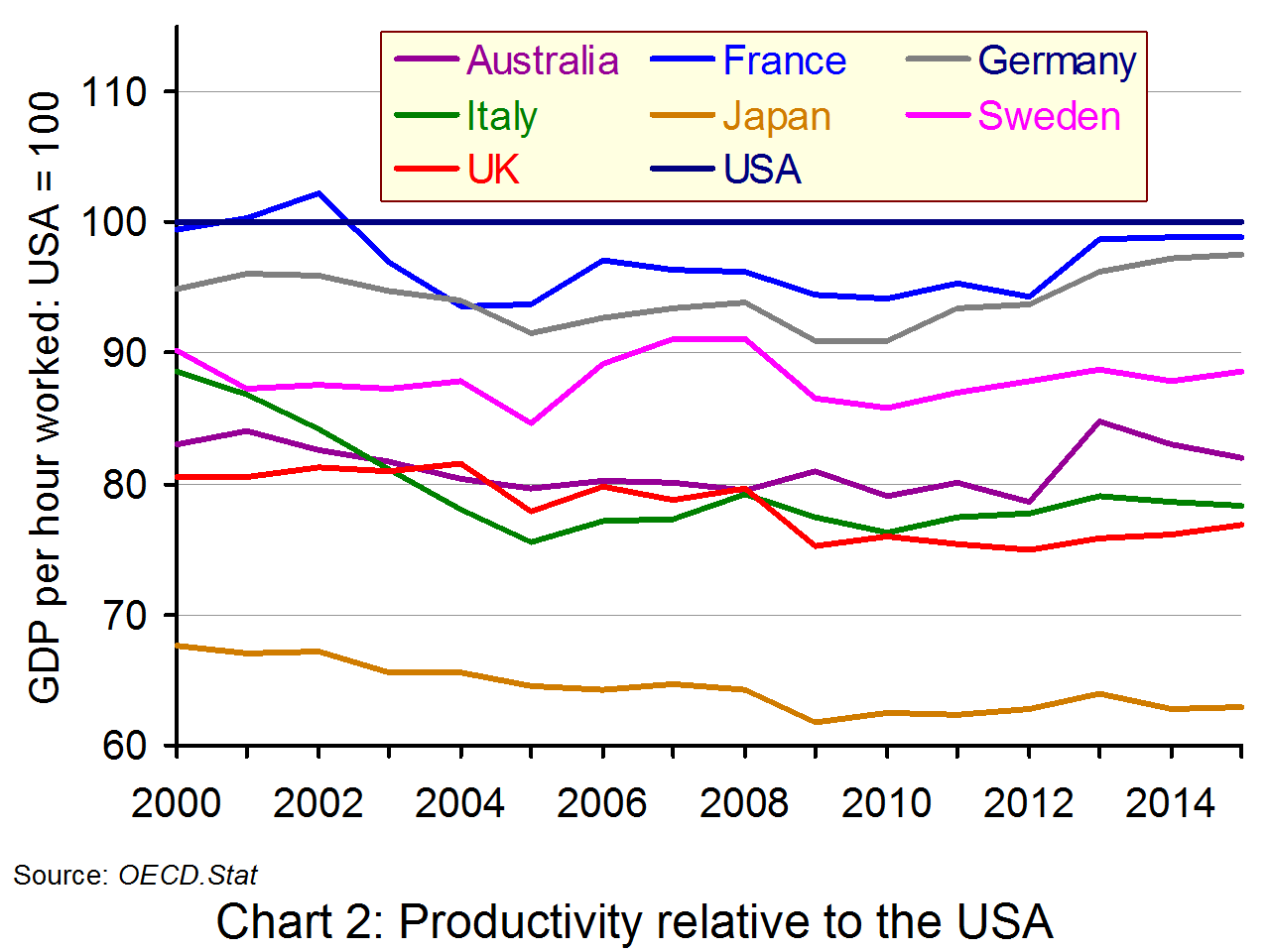 and why has it grown so slowly since the financial crisis? In its July 2015 analysis, the ONS addressed this ‘productivity puzzle’.
Among the many reasons suggested are low levels of investment, the impact of the financial crisis on bank’s willingness to lend to new businesses, higher numbers of people working beyond normal retirement age as a result of population and pensions changes, and firms’ ability to retain staff because of low pay growth. While these and other factors may be relevant, they do not provide a complete explanation for the weakness in productivity.
The lack of investment in technology and lack of infrastructure investment have been key reasons for the sluggish growth in productivity. Many companies are prepared to continue using relatively labour-intensive techniques because wage growth has been so low and this reduces the incentive to invest in labour-saving technology.
Another factor has been long hours and, for many office workers, being constantly connected to their work, checking and responding to emails and messages away from the office. The Telegraph article below reports Ann Francke, chief executive of the Chartered Management Institute, as saying:
“This is having a deleterious effect on the health of managers, which has a direct impact on productivity. UK workers already have the longest hours in Europe and yet we’re less productive.”
Another problem has been ultra low interest rates, which have reduced the burden of debt for poor performing companies and has allowed them to survive. It may also have prevented finance from being reallocated to more dynamic companies which would like to develop new products and processes.
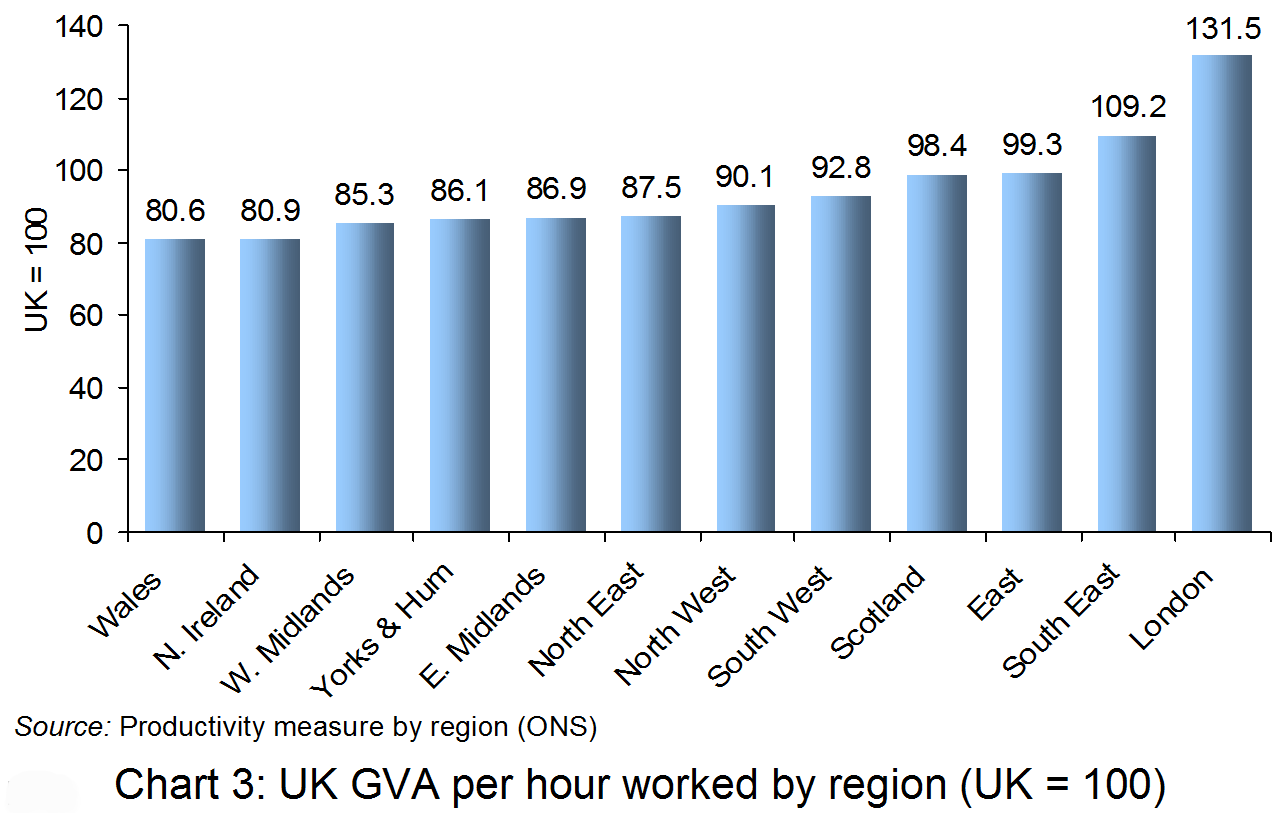
Another feature of UK productivity is the large differences between regions. This is illustrated in Chart 3. Productivity in London in 2015 (the latest full year for data) was 31.5% above the UK average, while that in Wales was 19.4% below.
This again reflects investment patterns and also the concentration of industries in particular locations. Thus London’s financial sector, a major part of London’s economy, has experienced relatively large increases in productivity and this has helped to push productivity growth in the capital well above other parts of the country.
Another factor, which again has a regional dimension, is the poor productivity performance of family-owned businesses, where ownership and management is passed down the generations within the family without bringing in external managerial expertise.
The government is very aware of the UK’s weak productivity performance. Its recently launched industrial policy is designed to address the problem. We look at that in a separate post.
Articles
UK productivity edges up but growth still flounders below pre-crisis levels The Telegraph, Julia Bradshaw (6/1/17)
Weak UK productivity spurs warnings of living standards squeeze The Guardian, Katie Allen (6/1/17)
Productivity gap yawns across the UK BBC News, Jonty Bloom (6/1/17)
The UK productivity puzzle Fund Strategy. John Redwood (26/1/17)
Productivity puzzle remains for economists despite UK growth in third quarter of 2016 City A.M., Jasper Jolly (6/1/17)
Portal site
Solve the Productivity Puzzle Unipart
Report
Productivity: no puzzle about it TUC (Feb 2015)
Data
Labour Productivity: Tables 1 to 10 and R1 ONS (6/1/17)
International comparisons of UK productivity (ICP) ONS (6/10/16)
Gross capital formation (% of GDP) The World Bank
Questions
- In measuring productivity, the ONS uses three indicators: output per worker, output per hour and output per job. Compare the relative usefulness of these three measures of productivity.
- How would you explain the marked difference in productivity between regions and cities within the UK?
- How do flexible labour markets impact on productivity?
- Why is investment as a percentage of GDP so low in the UK compared to that in most other developed countries (see)?
- Give some examples of industrial policy measures that could be adopted to increase productivity growth.
- Examine the extent to which very low interest rates and quantitative easing encourage productivity-enhancing investment.