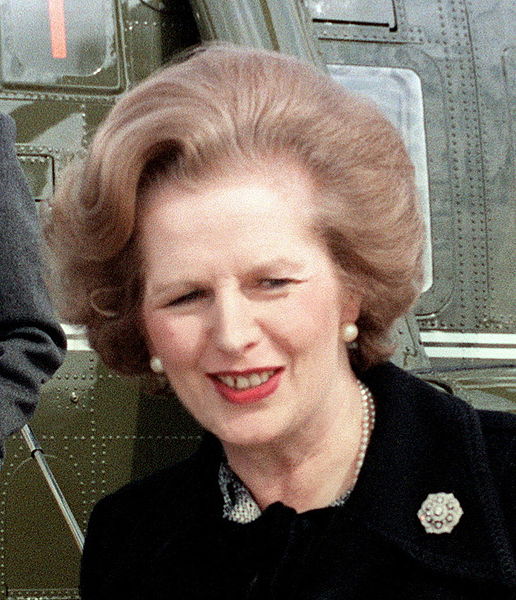
 Much has been written on Margaret Thatcher following her death at the age of 87 on April 8. But getting a calm assessment of both her time in office and her legacy is not easy. And it’s clear why: she created both stronger loyalty and stronger opposition than any other UK Prime Minister.
As economists, however, we should try to be as dispassionate as possible in assessing the effects of policies. There is always a normative question of the relative desirability of different economic outcomes – and you will have your own views on the relative importance of objectives such as economic growth, greater equality and greater social cohesion – but to determine cause and effect, or at least correlation, requires a careful examination of the evidence. Also, drawing lessons for future policy requires a careful modelling of the economy and the effects of changing economic variables.
The following articles have been selected from the hundreds that have appeared in the press in the past few days. Whilst they cannot be claimed to be totally ‘objective’, taken together they give a good overview of her economic policies and her economic legacy.
You may well have been surprised by the amount of coverage of her death and at the fervour of her supporters and critics. But this bears witness to the huge effect she had on both the political scene and on the UK economy – for good or bad.
Articles
Margaret Thatcher’s timeline: From Grantham to the House of Lords, via Arthur Scargill and the Falklands War Independent (8/4/13)
Overhauls Are Still Felt, Debated Decades Later Wall Street Journal, Charles Forelle (9/4/13)
Margaret Thatcher’s Four Ages of Monetary Policy EconoMonitor, David Smith (10/4/13)
How Mrs Thatcher smashed the Keynesian consensus The Economist (9/4/13)
Margaret Thatcher: The economy now and then BBC News, Stephanie Flanders (10/4/13)
Did Margaret Thatcher transform Britain’s economy for better or worse? The Guardian, Larry Elliott (8/4/13)
A look back at Margaret Thatcher’s economic record Washington Post, Dylan Matthews (8/4/13)
Margaret Thatcher’s legacy for business and economics—the world weighs in Quartz, Gwynn Guilford (8/4/13)
Data
Economic Data freely available online The Economics Network, see especially sites 1, 2, 3, 6 and 9
Questions
- Summarise the macroeconomic policies followed by the Thatcher government from 1979 to 1990.
- Chart economic growth, unemployment and inflation over Margaret Thatcher’s time in office. How does the performance of each of these indicators compare with the period from 1990 to 2007 and from 2008 to the present day?
- What is meant by ‘monetarism’? Did the Thatcher government follow pure monetarist policies?
- What is meant by the ‘Big Bang’ as applied to the financial sector in 1986? Assess the long-term consequences of the Big Bang.
- What elements of ‘Thatcherism’ were retained by the Labour government from 1997 to 2010?
- To what extent can the current Coalition government be described as ‘Thatcherite’?
 Inflation is measured as the percentage increase in the Consumer Prices Index (CPI) over the previous 12 months. The index is constructed from a basket of goods that is supposed to represent the buying habits of an average UK household. This basket is updated each year as tastes change and as technology moves forward. The basket contains approximately 700 items, with 180,000 individual prices collected each month.
As certain goods become more popular and trends change, the ONS have the responsibility of identifying these changes and updating the basket of goods. The CPI then looks at how the weighted average price of this basket of goods changes from one month to the next. As the CPI gives us the main measure of UK inflation, it is essential that the basket of goods used does represent current consumer demands. If the basket of goods used 20 years ago was still in place, we wouldn’t see thing like mobile phones and ipads being included. This is one sector that has seen significant growth in recent years and the basket of goods has been adapted in response. A new addition to the measure is e-books, which have seen a significant growth in popularity.
 However, just as new products have been added to the CPI measure, other goods have been removed. In the most recent update, we’ve seen the removal of champagne and Freeview boxes from the basket of goods. With rapid changes in technological products, such as the ipad, kindle and e-books, products that were new additions only a few years ago are now old news, being replaced by the latest gadgets. Other changes to the basket of goods are less about reflecting consumer trends and more about making certain categories more representative, such as fruits and hot drinks.
So, can the changes in the basket of goods tell us anything about the impact of the recession on buying habits? One notable exclusion from the basket of goods is champagne sold in restaurants and bars. In an economic downturn, you’d expect luxury products to see a decline in consumption and the trend in champagne consumption certainly seems to support the theory. The trends suggest that consumers have instead switched to cheaper alternatives, with things like white rum bought from shops increasing.
Many people may look at the basket of goods and think that it doesn’t reflect what you buy in your average shop. But, the purpose of the CPI is to try to reflect the average consumer and the different items in the basket are given different weightings to give some indication of the amount spent on each good. The articles below look at the changes in the CPI basket of goods and what, if anything, we can take from it.
Inflation basket: E-books added by ONS BBC News (12/3/13)
Inflation basket – what does it say about you? Channel 4 News (12/3/13)
The fizz has fallen flat – champagne cut from inflation basket Independent, Martin Hickman (13/3/13)
E-books added to inflation basket, as champagne dropped The Telegraph, Philip Aldrick (13/3/13)
UK inflation basket: e-books in, champagne out The Guardian, Marking King (13/3/13)
Champagne tipped out of inflation basket Financial Times, Hannah Kuchler (13/3/13)
Champagne out, ebooks in as inflation basket updated Reuters (13/3/13)
Questions
- What is inflation and why is it such an important variable?
- How is the CPI calculated? Is it different from the RPI?
- What impact has technological change had on the basket of goods used to calculate the CPI?
- Can you identify any other economic or business trends from the products that are in and out of the CPI basket of goods?
- Given the importance of technology and the speed of change, do you think the review of the basket of goods should become more or less frequent?
- Has the economic downturn had any effect on the basket of goods used to calculate the CPI?
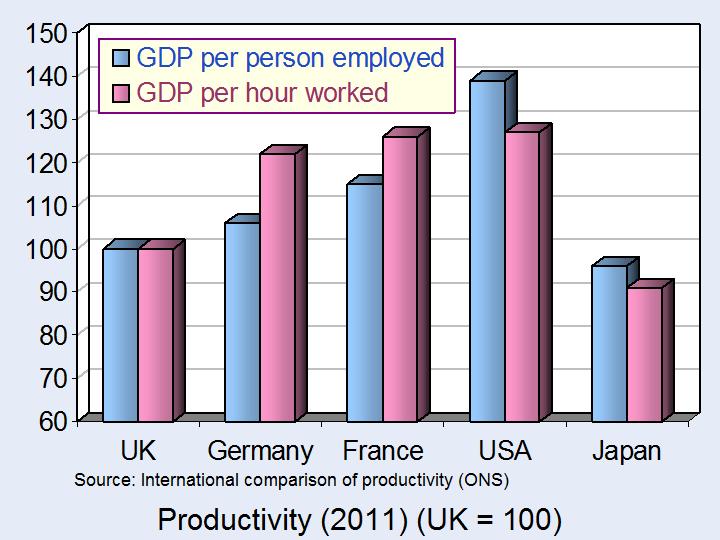 Recent figures from the ONS suggest that the UK lags well behind its competitors in terms of labour productivity. In terms of output per hour worked, Germany produces 22% more than the UK, France produces 26% more, the USA produces 27% more, the Netherlands 31% more and Ireland 43% more. The first chart illustrates some of these figures.
(Click here for a PowerPoint of this chart.)
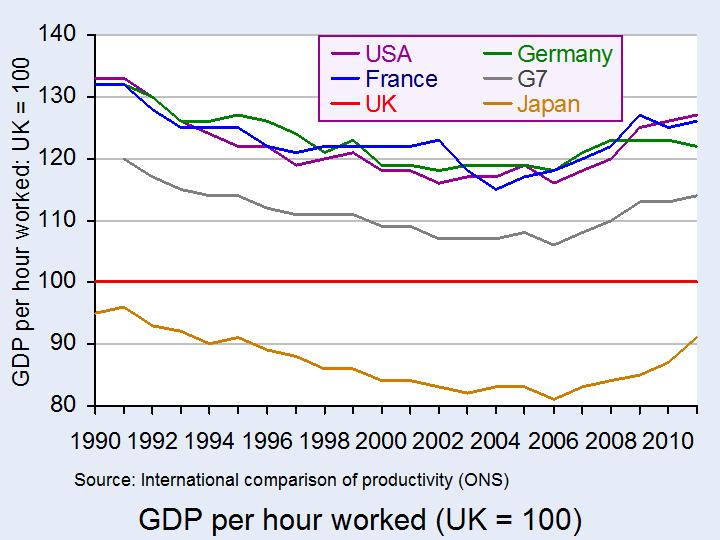
And in the past few years the problem has been getting worse. This is shown in the second chart. This, however, is a relatively recent phenomenon. Until 2006, the gap was narrowing, but since then it has widened. (Click here for a PowerPoint of the second chart.)
 What has caused this widening of the gap? Part of the problem is a historical lack of investment in the UK. Between 2005 and 2012, the UK invested on average 15.7% of GDP. The USA invested 16.5%, Germany 17.9% and France 20.1%. And part of the problem has been the cut back in private-sector investment in response to the recession (which has been deeper in the UK) and in public-sector investment as part of the government’s austerity measures.
Part of the problem has been lower levels of inward investment. Inward direct investment to the UK in 2011 was only 24 per cent of that in 2007. In France, Germany, Italy and the USA, the figures were 43, 50, 66 and 105 per cent respectively.
Part of the problem has been the size of the financial sector in the UK. This is considerably larger as a proportion of the economy than in most the UK’s major competitors. And it was this sector most hard hit by the crisis of 2007/8.
 With this poor productivity performance, you might expect unemployment to have soared. In fact, the UK has one of the lowest unemployment rates of the developed countries and in recent months it has been falling while other countries have seen their unemployment rates rise.
In fact, low productivity and high employment are compatible. If people produce less than their counterparts abroad, then more people will be needed to produce the same level of output. The problem, of course, is that this only works if wages are kept down. Indeed, wages have fallen in real terms and now stand at the level of 10 years ago.
The problem of falling real wages is that this translates into a lack of demand – especially when people are trying to reduce their debts. Not only does this result in a lack of economic growth, it discourages firms from investing – and investment is one of the prime drivers of future productivity growth!
The following articles explore the problem of low productivity and its relationship with employment and with both short-term and long-term economic growth.
Articles
UK has widest productivity gap since 1993 City A.M., Ben Southwood (14/2/13)
Productivity ‘key to UK’s economic future’ SnowdropKCS (7/2/13)
Low wages and lack of investment – why UK’s productivity has slumped Wales Online, David Williamson (2/3/13)
Recovery in jobs gives a fillip before the news on growth Independent, Russell Lynch (23/1/13)
U.K. Triple-Dipping as Productivity Falls Slate, Matthew Yglesias (25/1/13)
UK productivity puzzle baffles economists BBC News, By Andrew Walker (18/10/12)
 Is low productivity a structural problem in the UK? BBC Today Programme, Bridget Rosewell and Andrew Sentance (4/1/13)
We Need to Talk About the Middle Huffington Post, Stewart Wood (14/2/13)
UK Wages Slump to Lowest Level in a Decade – ONS International Business Times, Shane Croucher (13/2/13)
Britain’s low-wage economy serves as a bind on the country The Guardian, Philip Inman (13/2/13)
Real wages fall back to 2003 levels in UK The Guardian, Hilary Osborne (13/2/13)
Data
International Comparisons of Productivity – Final Estimates for 2011 ONS (13/2/13)
International Comparisons of Productivity, datasets ONS (13/2/13)
Changes in real earnings in the UK and London, 2002 to 2012 ONS (13/2/13)
Questions
- Which is a better measure of productivity – output per worker or output per hour worked? Why, do you think, does the USA produce 39% more per worker, but only 27% more per hour worked?
- What policies should the government adopt in order to encourage a growth in productivity?
- If productivity growth increased, what would be the likely effect on employment? Explain.
- Why has unemployment not risen in recent months?
 Each year world political and business leaders meet at the World Economic Forum in the Swiss resort of Davos. The aim is to assess the progress of the global economy and to look at challenges ahead and what can be done about them.
Cynics claim that the round of presentations, discussions, Champagne receptions and fine dining rarely leads to anything concrete. Those who are less cynical argue that the Forum gives a unique opportunity for considering policy options and helping to shape a global consensus.
This year the mood was more optimistic. Many believe that the worst of the financial crisis is behind us. Stock markets are buoyant; the banking system seems more secure; the eurozone has not collapsed; growth prospects seem a little brighter.
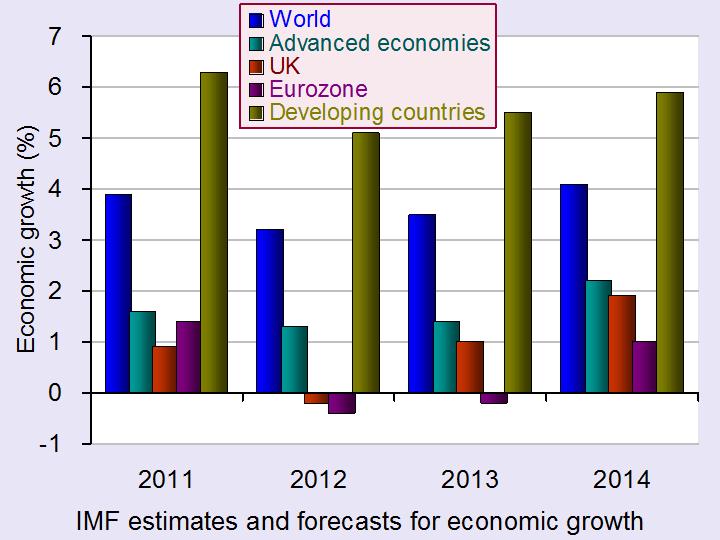 But perhaps ‘optimistic’ is an overstatement. ‘Less pessimistic’ might be a better description. As Christine Lagarde, head of the IMF, pointed out in her speech:
The recovery is still weak, and uncertainty is still high. As the IMF announced just a few hours ago in our World Economic Outlook, we expect global growth of only 3½ percent this year, not much higher than last year. The short-term pressures might have alleviated, but the longer-term pressures are still with us. (Click here for transcript).
In both her speech and her press conference, she went on to outline the policies the IMF feels should be adopted to achieve sustained global growth.
The articles below summarise the outcomes of the Forum and some of the views expressed.
Articles
Too soon for sighs of relief Deutsche Welle, Andreas Becker (27/1/13)
Davos 2013: The icy economic chill begins to thaw The Telegraph, Louise Armitstead (26/1/13)
IMF Projects Modest Pick-up in Economic Growth in 2013 IMF videos, Olivier Blanchard, IMF Chief Economist (23/1/13)
Managing Director’s New Year Press Briefing IMF videos, Christine Lagarde, IMF Managing Director
Mark Carney in Davos: what’s up next for the global economy Maclean’s (Canada), Erica Alini (26/1/13)
World Economic Forum ends on warning note over ‘complacency’ The Guardian, Graeme Wearden (26/1/13)
Angela Merkel tells Davos austerity must continue The Guardian, Graeme Wearden and Larry Elliott (24/1/13)
Davos 2013: A ‘sigh of relief’ at the World Economic Forum BBC News, Stephanie Flanders (27/1/13)
Happy talk The Economist (27/1/13)
Davos Man and his defects The Economist, Schumpeter (26/1/13)
Davos: are the captains of capitalism finally paying attention? The Observer (27/1/13)
Official site
The Global Agenda 2013 The World Economic Forum
IMF projections
Modest Growth Pickup in 2013, Projects IMF IMF Survey Magazine: In the News (23/1/13)
World Economic Outlook Update IMF (23/1/13)
Questions
- Why was the mood at the WEF less pessimistic than in 2012?
- What threats remain to sustained global recovery?
- What policies are being recommended by Christine Lagarde of the IMF? Explain the reasoning behind the recommendations.
- What disagreements are there between global leaders on the scope for fiscal and monetary policies to stimulate economic growth?
- In her press conference, Christine Lagarde stated that “the teams here have concluded that the fiscal multipliers were higher in the context of that unbelievable international crisis”. Do you agree with this statement? Explain.
 What lies ahead for economic growth in 2013 and beyond? And what policies should governments adopt to aid recovery? These are questions examined in four very different articles from The Guardian.
The first is by Nouriel Roubini, Professor of Economics at New York University’s Stern School of Business. He was one of the few economists to predict the collapse of the housing market in the USA in 2007 and the credit crunch and global recession that followed. He argues that continuing attempts by banks, governments and individuals to reduce debt and leverage will mean that the advanced economies will struggle to achieve an average rate of economic growth of 1%. He also identifies a number of other risks to the global economy.
 In contrast to Roubini, who predicts that ‘stagnation and outright recession – exacerbated by front-loaded fiscal austerity, a strong euro and an ongoing credit crunch – remain Europe’s norm’, Christine Lagarde, head of the IMF and former French Finance Minister, predicts that the eurozone will return to growth. ‘It’s clearly the case’, she says, ‘that investors are returning to the eurozone, and resuming confidence in that market.’ Her views are echoed by world leaders meeting at the World Economic Forum in Davos, Switzerland, who are generally optimistic about prospects for economic recovery in the eurozone.
The third article, by Aditya Chakrabortty, economics leader writer for The Guardian, looks at the policies advocated at the end of World War II by the Polish economist, Michael Kalecki and argues that such policies are relevant today. Rather than responding to high deficits and debt by adopting tough fiscal austerity measures, governments should adopt expansionary fiscal policy, targeted at expanding infrastructure and increasing capacity in the economy. That would have an expansionary effect on both aggregate demand and aggregate supply. Sticking with austerity will result in continuing recession and the ‘the transfer of wealth and power into ever fewer hands.’
 But while in the UK and the eurozone austerity policies are taking hold, the new government in Japan is adopting a sharply expansionary mix of fiscal and monetary policies – much as Kalecki would have advocated. The Bank of Japan will engage in large-scale quantitative easing, which will become an open-ended commitment in 2014, and is raising its inflation target from 1% to 2%. Meanwhile the Japanese government has decided to raise government spending on infrastructure and other government projects.
So – a range of analyses and policies for you to think about!
Risks lie ahead for the global economy The Guardian, Nouriel Roubini (21/1/13)
Eurozone showing signs of recovery, says IMF chief The Guardian, Graeme Wearden (14/1/13)
Austerity? Call it class war – and heed this 1944 warning from a Polish economist The Guardian, Aditya Chakrabortty (14/1/13)
Bank of Japan bows to pressure with ‘epoch-making’ financial stimulus The Guardian, Phillip Inman (22/1/13)
Questions
- What are the dangers facing the global economy in 2013?
- Make out a case for sticking with fiscal austerity measures.
- Make out a case for adopting expansionary fiscal policies alongside even more expansionary monetary policies.
- Is is possible for banks to increase their capital-asset and liquidity ratios, while at the same time increasing lending to business and individuals? Explain.
- What are the implications of attempts to reduce public-sector deficits and debt on the distribution of income? Would it be possible to devise austerity policies that did not have the effect you have identified?
- What will be the effect of the Japanese policies on the exchange rate of the yen with other currencies? Will this be beneficial for the Japanese economy?