 Tight fiscal policies are being pursued in many countries to deal with high public-sector deficits that resulted from the deep recession of 2008/9. This has put the main onus on monetary policy as the means of stimulating recovery. As a result we have seen record low interest rates around the world, set at only slightly above zero in the main industrialised countries for the past 4½ years. In addition, there have been large increases in narrow money as a result of massive programmes of quantitative easing.
Yet recovery remains fragile in many countries, including the UK and much of the rest of Europe. And a new problem has been worries by potential investors that loose monetary policy may be soon coming to an end. As the June blog The difficult exit from cheap money pointed out:
The US economy has been showing stronger growth in recent months and, as a result, the Fed has indicated that it may soon have to begin tightening monetary policy. It is not doing so yet, nor are other central banks, but the concern that this may happen in the medium term has been enough to persuade many investors that stock markets are likely to fall as money eventually becomes tighter. Given the high degree of speculation on stock markets, this has led to a large-scale selling of shares as investors try to ‘get ahead of the curve’.
Central banks have responded with a new approach to monetary policy. This is known as ‘forward guidance’. The idea is to manage expectations by saying what the central bank will do over the coming months.
The USA was the first to pursue this approach. In September 2012 the Fed committed to bond purchase of $40bn per month (increased to $85bn per month in January 2013) for the foreseeable future; and record low interest rates of between 0% and 0.25% would continue. Indeed, as pointed out above, it was the ‘guidance’ last month that such a policy would be tapered off at some point, that sent stock markets falling in June.
The Fed has since revised its guidance. On 10 July, Ben Bernanke, the Fed Chairman said that monetary policy would not be tightened for the foreseeable future. With fiscal policy having been tightened, QE would continue and interest rates would not be raised until unemployment had fallen to 6.5%.
Japan has been issuing forward guidance since last December. Its declared aim has been to lower the exchange rate and raise inflation. It would take whatever fiscal and monetary policies were deemed necessary to achieve this (see A J-curve for Japan? and Japan’s three arrows).
Then on 4 July both the Bank of England and the ECB adopted forward guidance too. Worried that growth in the US economy would lead to an end to loose monetary policy before too long and that this would drive up interest rates worldwide, both central banks committed to keeping interest rates low for an extended period of time. Indeed, the ECB declared that the next movement in interest rates would more likely be down than up. Mario Draghi, the ECB president said that the ending of loose monetary policy is ‘very distant’.
The effect of this forward guidance has been to boost stock markets again. The hope is that by managing expectations in this way, the real economy will be affected too, with increased confidence leading to higher investment and faster economic growth.
Articles
Q&A: What is ‘forward guidance’ BBC News, Laurence Knight (4/7/13)
Forward guidance crosses the Atlantic The Economist, P.W. (4/7/13)
ECB has no plans to exit loose policies, says Benoit Coeure The Telegraph, Szu Ping Chan (25/6/13)
ECB issues unprecedented forward guidance The Telegraph, Denise Roland (4/7/13)
Independence day for central banks BBC News, Stephanie Flanders (4/7/13)
The Monetary Policy Committee’s search for guidance BBC News, Stephanie Flanders (16/7/13)
The Monetary Policy Committee’s search for guidance (II) BBC News, Stephanie Flanders (17/7/13)
Bank of England surprise statement sends markets up and sterling tumbling The Guardian, Jill Treanor and Angela Monaghan (4/7/13)
Forward guidance only works if you do it right Financial Times, Wolfgang Münchau (7/7/13)
Fed’s Forward Guidance Failing to Deliver Wall Street Journal, Nick Hastings (15/7/13)
Talking Point: Thoughts on ECB forward guidance Financial Times, Dave Shellock (11/7/13)
Forward guidance in the UK is likely to fail as the Fed taper approaches City A.M., Peter Warburton (12/7/13)
Forward guidance more than passing fashion for central banks Reuters, Sakari Suoninen (11/7/13)
Markets await Mark Carney’s ‘forward guidance’ The Guardian, Heather Stewart (17/7/13)
Beware Guidance The Economist, George Buckley (25/7/13)
UK interest rates held until unemployment falls BBC News (7/8/13)
Central Bank Statements
How does forward guidance about the Federal Reserve’s target for the federal funds rate support the economic recovery? Federal Reserve (19/6/13)
Remit for the Monetary Policy Committee HM Treasury (20/3/13)
Bank of England maintains Bank Rate at 0.5% and the size of the Asset Purchase Programme at £375 billion Bank of England (4/7/13)
Monthly Bulletin ECB (see Box 1) (July 2013)
Inflation Report Press Conference: Opening remarks by the Governor Bank of England (7/8/13)
MPC document on Monetary policy trade-offs and forward guidance Bank of England (7/8/13)
 Interest rates to be held until unemployment drops to 7% BBC News, Statement by Mark Carney, Governor of the Band of England (7/8/13)
Questions
- Is forward guidance a ‘rules-based’ or ‘discretion-based’ approach to monetary policy?
- Is it possible to provide forward guidance while at the same time pursuing an inflation target?
- If people know that central banks are trying to manage expectations, will this help or hinder central banks?
- Does the adoption of forward guidance by the Bank of England and ECB make them more or less dependent on the Fed’s policy?
- Why may forward guidance be a more effective means of controlling interest rates on long-term bonds (and other long-term rates too) than the traditional policy of setting the repo rate on a month-by-month basis?
- What will determine the likely success of forward guidance in determining long-term bond rates?
- Is forward guidance likely to make stock market speculation less destabilising?
 Over the past few years, the term ‘bail-out’ has been a common phrase. But, what about the term ‘bail-in’? The latest bank to face financial ruin is the Co-operative Bank, but instead of turning to the tax-payer for a rescue, £1.5 billion will come from bond holders being offered shares in the bank. This will mean that the bank will become listed on the stock market.
Back in 2009, the Co-operative Bank bought Britannia Building Society and it seems that this was the start of its downfall. It took over many bad mortgage loans and loans to companies, and these played a large part in its current financial difficulties.
In order to rescue the bank and raise the capital needed to absorb current and future losses, without turning to the tax-payer, bond-holders of £1.3 billion of loans to the bank will be asked to swap them for shares and bonds, thus leading to significant losses for them. These bond-holders include 7000 private investors.
Since the financial crisis five years ago, the conventional banking model has seen much criticism and many suggested that the mutual structure of the Co-operative provided a better model, creating trust, due to its many stakeholders, who are not as focused on profitability and returns as those shareholders of a listed bank. However, the problems of the Co-operative seem to have put paid to that idea. The bail-in will mean that the bank is now listed on the stock market and thus will have shareholders expecting returns and profitability. This will undoubtedly change the focus of the bank. Euan Sutherland, the new Chief Executive said:
We are very clear that the bank will remain true to responsible and community-based banking and retain its ethical investment stance … Clearly there are lessons to learn and clearly there will be a time to look back and do that but, to be honest, in the last six weeks, where I have been involved with the Co-operative group, we have focused on driving a very solid future for this bank.
The good news is that the savings of those in the Co-operative are safe and taxpayers will not have to fork out any more money.
Yet, the co-operative structure of the bank has long been praised by customers and government alike. But is it perhaps this structure, which has led to its collapse? Furthermore, will the change in structure that will see it listed on the stock market, lead to a change in its approach to banking? The following articles consider the latest bank to run into difficulties.
Webcast
Co-op Bank unveils rescue plan to tackle the £1.5bn hole BBC News (17/6/13)
Articles
Co-op Bank travails show weakness of mutual model Financial Times, Sarah Gordon (21/6/13)
Co-operative Bank to list on stock market in rescue deal The Guardian, Jill Treanor (17/6/13)
Troubled Co-operative Bank unveils rescue plan to plug £1.5bn hole in balance sheet Independent, Nick Goodway (17/6/13)
Co-op Bank announces plan to plug £1.5bn hole Which? (17/6/13)
The Co-operative Bank and the challenge of finding co-op capital The Guardian, Andrew Bibby (13/6/13)
Co-op Bank seeks to fill £1.5bn capital hole Sky News (17/6/13)
Does Co-op Group deserve to keep control of Co-op Bank? BBC News, Robert Peston (9/7/13)
Questions
- Why did the Co-operative Bank move into financial trouble?
- What are the key characteristics of a Mutual? Are they disadvantages or advantages?
- What is a ‘bail-in’? Who will gain and who will lose?
- The Co-operative Bank will now be listed on the stock market. What does this mean?
- What are the advantages and disadvantages of floating a company on the stock market?
- Why are all banks required to hold capital to absorb losses?
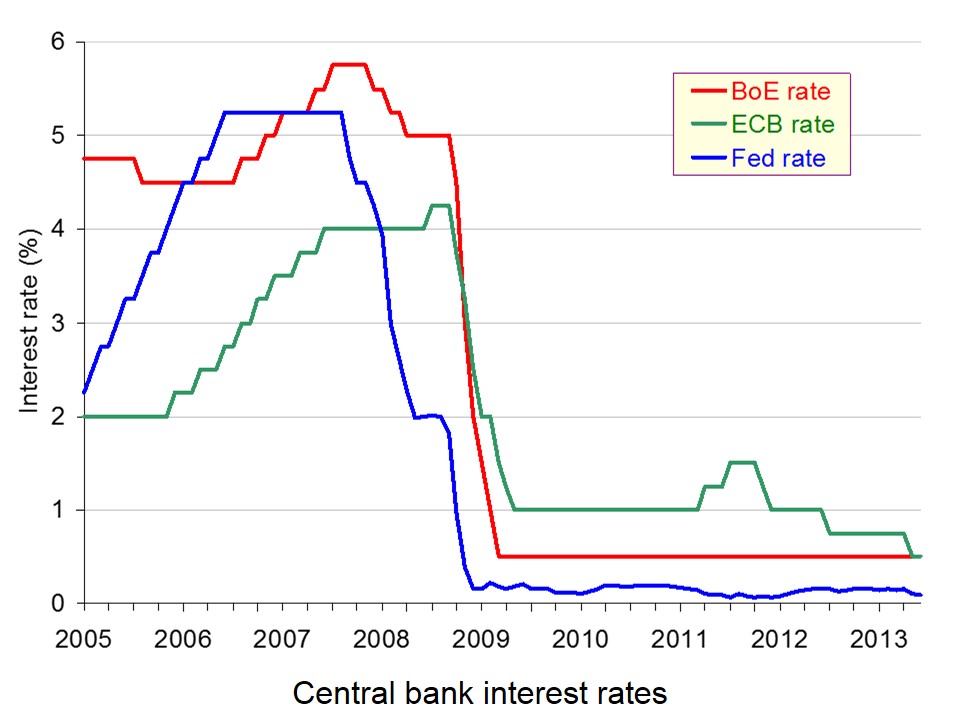 Since the beginning of 2009, central banks around the world have operated an extremely loose monetary policy. Their interest rates have been close to zero (click here for a PowerPoint of the chart) and more than $20 trillion of extra money has been injected into the world economy through various programmes of quantitative easing.
The most recent example of loose monetary policy has been in Japan, where substantial quantitative easing has been the first of Japan’s three arrows to revive the economy (the other two being fiscal policy and supply-side policy).
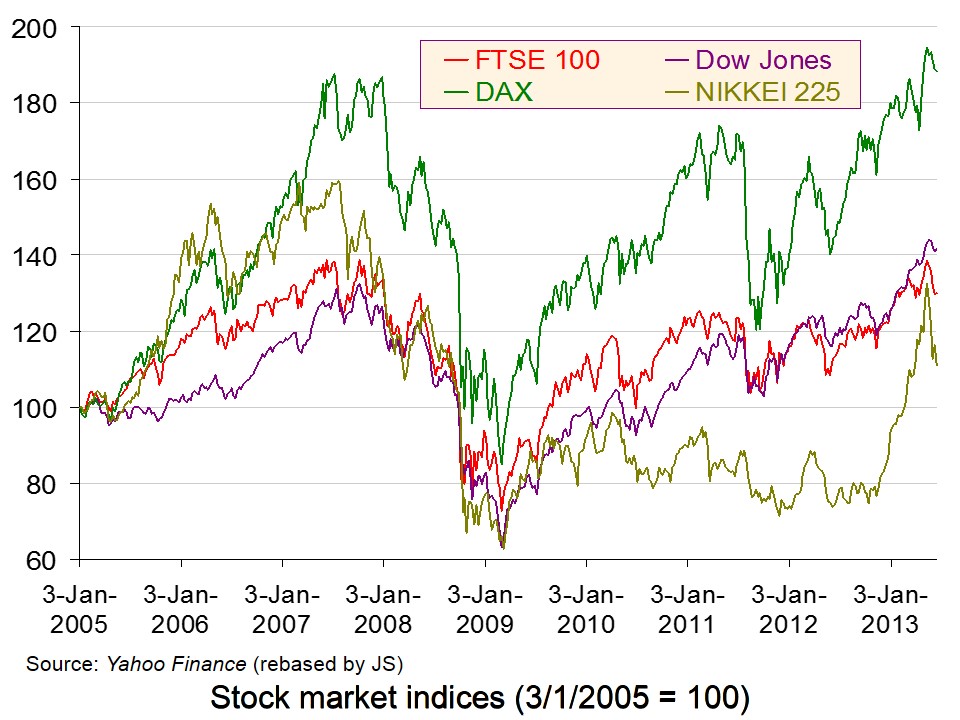 One consequence of a rise in money supply has been the purchase of a range of financial assets, including shares, bonds and commodities. As a result, despite the sluggish or negative growth in most developed countries, stock markets have soared (see chart). From March 2009 to May 2013, the FTSE 100 rose by 91% and both the USA’s Dow Jones Industrial average and Germany’s DAX rose by 129%. Japan’s NIKKEI 225, while changing little from 2009 to 2012, rose by 78% from November 2012 to May 2013 (click here for a PowerPoint of the chart).
The US economy has been showing stronger growth in recent months and, as a result, the Fed has indicated that it may soon have to begin tightening monetary policy. It is not doing so yet, nor are other central banks, but the concern that this may happen in the medium term has been enough to persuade many investors that stock markets are likely to fall as money eventually becomes tighter. Given the high degree of speculation on stock markets, this has led to a large-scale selling of shares as investors try to ‘get ahead of the curve’.
From mid-May to mid-June, the FTSE 100 fell by 6.2%, the Dow Jones by 2.6%, the DAX by 4.5% and the NIKKEI by 15%. In some developing countries, the falls have been steeper as the cheap money that entered their economies in search of higher returns has been leaving. The falls in their stock markets have been accompanied by falls in their exchange rates.
 The core of the problem is that most of the extra money that was created by central banks has been used for asset purchase, rather than in financing extra consumer expenditure or capital investment. If money is tightened, it is possible that not only will stock and bond markets fall, but the fragile recovery may be stifled. In other words, tighter money and higher interest rates may indeed affect the real economy, even though loose monetary policy and record low interest rates had only a very modest effect on the real economy.
This poses a very difficult question for central banks. If even the possibility of monetary tightening some time in the future has spooked markets and may rebound on the real economy, does that compel central banks to maintain their loose policy? If it does, will this create an even bigger adjustment problem in the future? Or could there be a ‘soft landing’, whereby real growth absorbs the extra money and gradually eases the inflationary pressure on asset markets?
Articles
How the Fed bosses all BBC News, Robert Peston (12/6/13)
The great reversal? Is the era of cheap money ending? BBC News, Linda Yueh (12/6/13)
The Great Reversal: Part II (volatility and the real economy) BBC News, Linda Yueh (14/6/13)
The end of the affair The Economist (15/6/13)
Out of favour The Economist, Buttonwood (8/6/13)
The Federal Reserve: Clearer, but less cuddly The Economist (22/6/13)
Global financial markets anxious to avoid many pitfalls of ‘political risk’ The Guardian, Heather Stewart (13/6/13)
Dow Falls Below 15,000; Retailers Add to Slump New York Times, (12/6/13)
Global market sell-off over stimulus fears The Telegraph, Rachel Cooper (13/6/13)
Nikkei sinks over 800 points, falls into bear market Globe and Mail (Canada), Lisa Twaronite (13/6/13)
Global shares drop, dollar slumps as rout gathers pace Reuters, Marc Jones (13/6/13)
The G8, the bond bubble and emerging threats BBC News, Stephanie Flanders (17/6/13)
Global monetary policy and the Fed: vive la difference BBC News, Stephanie Flanders (20/6/13)
The Federal Reserve’s dysfunctional relationship with the markets The Guardian, Heidi Moore (19/6/13)
Global stock markets in steep falls after Fed comment BBC News (20/6/13)
Federal Reserve’s QE withdrawal could signal real trouble ahead The Guardian, Nils Pratley (20/6/13)
Central banks told to head for exit Financial Times, Claire Jones (23/6/13)
Stimulating growth threatens stability, central banks warn The Guardian (23/6/13)
BIS Press Release and Report
Making the most of borrowed time: repair and reform the only way to growth, says BIS in 83rd Annual Report BIS Press Release (23/6/13)
83rd BIS Annual Report 2012/2013 Bank for International Settlements (23/6/13)
Data
Yahoo! Finance: see links for FTSE 100, DAX, Dow Jones, NIKKEI 225
Link to central bank websites Bank for International Settlements
Statistical Interactive Database – Interest & exchange rates data Bank of England
Questions
- Why have stock markets soared in recent years despite the lack of economic growth?
- What is meant by ‘overshooting’? Has overshooting taken place in stock markets (a) up to mid-May this year; (b) since mid-May? How would you establish whether overshooting has taken place?
- What role is speculation currently playing in stock markets? Would you describe this speculation as destabilising?
- What has been the impact of quantitative easing on (a) bond prices; (b) bond yields?
- Argue the case for and against central banks continuing with the policy of quantitative easing for the time being.
- Find out how much the Indian rupee and the Brazilian real have fallen in recent weeks. Explain your findings.
 Here are a series of videos examining the case for and against austerity policy. Is such policy necessary to re-balance countries’ economies and retain or regain the confidence of investors? Or does such policy harm not just short-run growth but long-run growth too? Does it reduce investment and thereby aggregate supply?
These videos follow on from the news item Keynes versus the Classics: a new version of an old story. In the first video, Mark Blyth, author of Austerity: the History of a Dangerous Idea, argues that austerity policy has not worked and never can. George Osborne, by contrast, argues that although it has been a ‘hard road to recovery’, austerity policy is working.
International bodies take a more nuanced stand. The IMF, while supporting the objective of reducing the government deficit, argues that the pace of the cuts in the UK should be slowed until more robust growth returns. The OECD, in examining the global economy, is more supportive of countries maintaining the pace of deficit reduction, but argues that the ECB needs to take stronger monetary measures to boost bank lending in the eurozone.
With austerity having increasingly alarming effects on unemployment and social cohesion, especially within certain eurozone countries, such as Greece, Portugal and Spain, it is not surprising that there are growing demands for rethinking macroeconomic policy.
There is general agreement that more needs to be done to promote economic growth, and a growing consensus that an increase in infrastructure expenditure is desirable. But whether such expenditure should be financed by increased borrowing (with the extra deficit being reduced subsequently as a result of the extra growth), or whether it should be financed by reductions in expenditure elsewhere, is a continuing focus of debate.
Austerity: the History of a Dangerous Idea The Guardian, Mark Blyth (27/5/13) (see also)
IMF: UK austerity will be a ‘drag on growth’ BBC News. Hugh Pym (22/5/13)
George Osborne: ‘Hard road to recovery for UK economy’ BBC News (22/5/13)
Economy and austerity BBC News, Sajid Javid and Stephen Timms (1/5/13)
IMF’s Olivier Blanchard urges UK austerity rethink BBC News (16/4/13)
OECD ‘supportive of Osborne austerity plans’ BBC news (29/5/13)
Stimulus vs. austerity measures in EU CNN, Mohamed El-Erian (29/5/13)
‘No time to wobble’ on deficit reduction YouTube, Sir Roger Carr (CBI president) (16/5/13)
Deficit-Cutting: Not If, But When Wall Street Journal Live, David Wessel (8/5/13)
Questions
- What are the arguments for maintaining a policy of deficit reduction through tight fiscal policy?
- What are the three principles put forward by Mark Blyth for designing an appropriate macroeconomic policy?
- How does the fallacy of composition relate to the effects of all countries pursuing austerity policy simultaneously?
- Is the IMF for or against austerity? Explain.
- Assess the policies advocated by the OECD to stimulate economic growth in the eurozone.
 Unemployment is a key macroeconomic objective for governments across the world. The unemployment rate for the UK now stands at 7.9% according to the ONS, which recorded 2.56 million people out of work. But why is unemployment of such importance? What are the costs?
The economy is already in a vulnerable state and with unemployment rising by 70,000 people between December and February 2013, the state of the economic recovery has been questioned. Indeed, following the news of the worsening unemployment data, the pound fell significantly against the dollar, suggesting a lack of confidence in the British economy.
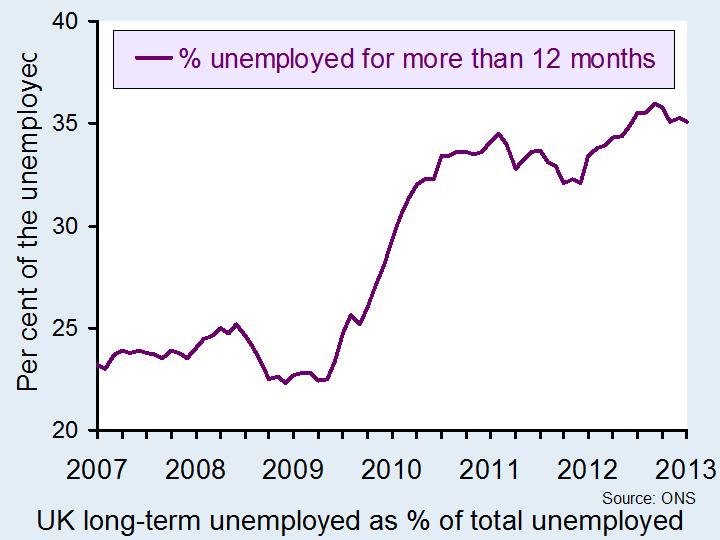 Although the increase in the number of people out of work is concerning, perhaps of more concern should be the number of long-term unemployed. The ONS suggests that more than 900,000 have now been out of work for more than a year. Not only does this pose costs for the individual in terms of lost earnings and skills, but it also imposes costs on friends and family and the wider economy. (Click here for a PowerPoint of the first chart, which shows the percentage of unemployed people out for work longer than 12 months.)
The chief executive of the Prince’s Trust focused on the costs of youth unemployment in particular, saying:
Thousands of these young people are long-term unemployed, often facing further challenges such as poverty and homelessness. We must act now to support these young people into work and give them the chance of a better future.
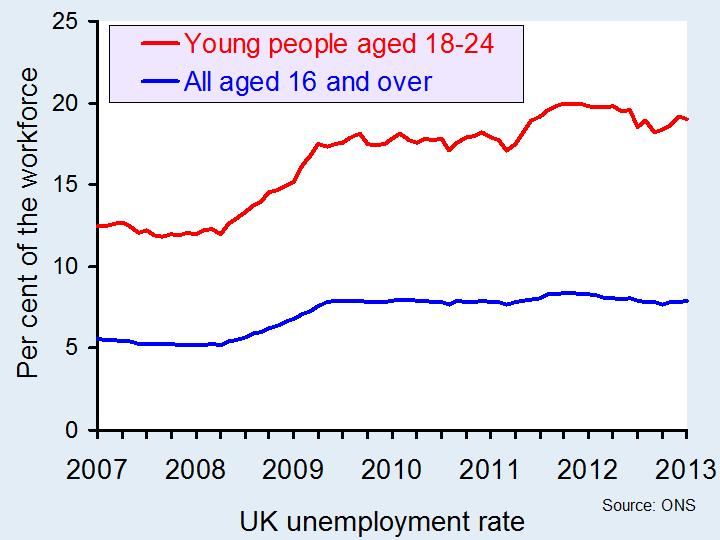
(Click here for a PowerPoint of the second chart, which shows how much higher the unemployment rate is for young people aged 18 to 24 than it is for the working age population as a whole.)
 Furthermore, with so many people unemployed, we are operating below full-employment and thus below our potential output. Furthermore, the longer people are out of work, the more likely it is that they will lose their skills and thus require re-training in the future or find that there are now fewer jobs available to them based on their lower skill level.
In addition to this there are monetary costs for the government through lower tax receipts, in terms of income tax, national insurance contributions and even VAT receipts. With more people unemployed, the numbers claiming various unemployment-related benefits will rise, thus imposing a further cost on the government and the taxpayer. Another cost to the government of this latest data is likely to be the expectations of the future course of the economy. Numerous factors affect business confidence and unemployment data is certainly one of them. The concern is that business confidence affects many other variables as well and until we receive more positive data, the economy recovery is likely to remain uncertain. The following articles consider this topic.
UK unemployment rise adds to pressure on Osborne’s austerity strategy The Guardian, Phillip Inman (18/4/13)
Unemployment figures are ‘worrying’, David Cameron’s spokesman says The Telegraph, Peter Dominiczak (17/4/13)
UK unemployment rises to 2.56 million BBC News (17/4/13)
Unemployment jumps to 7.9% as rise in the number of young people out of work takes figure ‘dangerously’ close to a million Mail Online, Leon Watson (17/4/13)
Unemployment up as stay-at-home mothers head back to the job-centre Independent, Ben Chu (17/4/13)
Jobs data points to finely balanced market Financial Times, Brian Groom (18/4/13)
Hugh’s review: making sense of the stats BBC News (19/4/13)
Questions
- How is unemployment measured?
- What are the costs to the individual of being unemployed?
- What are the wider non-monetary costs to society?
- Explain the main financial costs to the wider economy of a rising unemployment rate.
- Illustrate the problem of unemployment by using a production possibility frontier.
- Could there be a negative multiplier effect from a rise in unemployment?
 Tight fiscal policies are being pursued in many countries to deal with high public-sector deficits that resulted from the deep recession of 2008/9. This has put the main onus on monetary policy as the means of stimulating recovery. As a result we have seen record low interest rates around the world, set at only slightly above zero in the main industrialised countries for the past 4½ years. In addition, there have been large increases in narrow money as a result of massive programmes of quantitative easing.