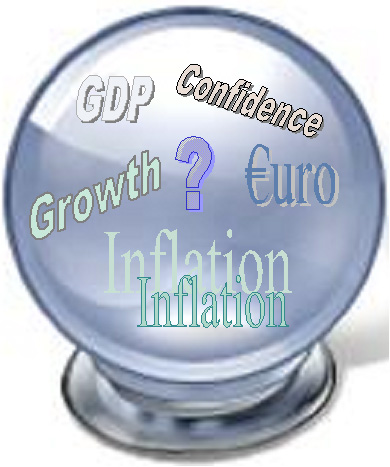
 The New Year is a time for reflection and prediction. What will the New Year bring? What does the longer-term future hold? Here are two articles from The Guardian that look into the future.
The first, by Larry Elliott, considers a number of scenarios and policy options. Although not totally doom laden, the article is not exactly cheery in its predictions. Perhaps ‘life will go on’ and the global economy will muddle through. But perhaps a new recession is around the corner or, even worse, the world is at a tipping point when things are fundamentally changing. Unless policy-makers are careful, clever and co-ordinated, perhaps a new dark age may be looming. But who knows?
Which brings us to the second article, by Gaby Hinsliff. This argues that people are pretty hopeless at predicting. “History is littered with supposed dead certs that didn’t happen – Greece leaving the euro, the premature collapse of the coalition – and wholly unimagined events that came to pass.” And economists and financial experts are little better.
Two years ago, The Observer challenged a panel of City investors to pick a portfolio of stocks and rated their performance against that of Orlando, a ginger cat who selected his portfolio by tossing a toy mouse at a sheet of paper. Inevitably, the cat triumphed.
But is this fair? If capital markets are relatively efficient, stock prices today already reflect knowable information about the future, but clearly not unknowable information.
It’s the same with economies. When information is already to hand, such as a pre-announced tax change, then its effects, ceteris paribus, can be estimated – at least roughly.
 But it’s the ‘ceteris paribus‘ assumption that’s the problem. Other things are not equal. The world is constantly changing and there are all sorts of unpredictable events that will influence the outcomes of economic policy and of economic decisions more generally. And central to the problem are people’s attitudes and confidence. Mood can swing quite dramatically, from irrational exuberance to deep pessimism. And such mood changes – often triggered by some exogenous factor, such as an international dispute, an election or unexpected economic news – can rapidly gather momentum and have significant effects.
Predicting the long-term future is both easier and more difficult: easier, in that short-term cyclical effects are less relevant; more difficult in that changes that have not yet happened, such as technological changes or changes in working practices, may themselves be key determinants of the future global economy.
One of the most salutary lessons is to look at predictions made in the past about the world today and at just how wrong they have proved to be. Perhaps we need to call on Orlando more frequently.
Why ‘life will go on’ thesis about global economy might not pass muster in 2015 The Guardian, Larry Elliott (28/12/14)
Who knows what the new year holds? Certainly none of us The Guardian, Gaby Hinsliff (26/12/14)
Questions
- Give some examples of factors that could have a major influence on the global economy, but which are unpredictable.
- Is economic forecasting still worthwhile? Explain.
- Look at some macroeconomic forecasts made in the past about the world today. You might want to look at forecasts of agencies such as the IMF, the OECD, the World Bank and the European Commission. You can find links in the Economics Network’s Economic Data freely available online. Explain why such forecasts have differed from the actual outcome.
- Why, if capital markets were perfect, might Orlando be just as good as a top investment manager at predicting the future course of share prices?
- In what ways is economic forecasting similar to and different from weather forecasting in its methods, its use of data and its reliability?
 Many of you reading the articles on this website will be just about to start, or will have just started, studying economics at university. For some of you this will involve building on the knowledge you obtained prior to university, whereas for others it will be the first time you have ever studied the subject before. Will studying economics change the way you behave? Should it come with a health warning?
Can studying economics change the way you think and behave? The subject is often sold to prospective students on the grounds that it can. For example it is stated on the Economics Network’s Why Study Economics? website that
The economic way of thinking can help us make better choices
However, is it possible that studying economics could change people’s behaviour in a way that would be to the detriment of society? Some observers have argued that it can. They have suggested that students might be influenced by some of the assumptions that are made in traditional economic theory.
As social scientists, economists are always trying to analyse human behaviour. However, people vary in many different ways and have very diverse preferences. If we want to build a theory that predicts how people will behave and respond in different situations, then some type of simplifying assumptions are inevitable.
Traditionally one of the key simplifying assumptions that economists have used in their theories of human behaviour is that people make decisions in their own self-interest. There is some debate about exactly what self-interest means. For example it could be argued that giving £10 to charity is acting in your own self-interest if it gives you more pleasure than spending that £10 on yourself. However, in many of the economic theories that you first study in economics a narrow meaning of self-interest tends to be used. This is clearly illustrated by the following quote from Milgrom and Roberts. Referring to economic theory they state that:
It is often assumed that people behave as if they were entirely motivated by narrow, selfish concerns

It is important to make it clear that economists are not assuming that people behave in a selfish manner all of the time. Instead, they are assuming that the people in their theories are acting in a selfish manner. The value of making this assumption is whether the predictions about human behaviour that follow from using it are supported by evidence from the real world.
Some researchers have argued that when people study economic theory built on this assumption it makes them more likely to behave in a selfish way. The evidence for this comes from a range of research papers. Here are some findings:
Economics students were more likely than those studying other subjects to recommend the most expensive plumber to a student society if that plumber offered the student a side payment.
Students took part in an experiment in a computer room where they could either keep the money they had been given or donate it to a public good. On average the economics students kept more of the money.
Economics professors gave less money to charity than professors of other subjects such as psychology and sociology.
Some studies also found that selfish people were more likely to choose economics as a subject to study and became more selfish after they had studied it for some time.
If you are about to begin your study of economics then perhaps you should take care that your behaviour outside the classroom is not being unduly influenced by some of the assumptions you are learning about inside the classroom. On a more practical note perhaps you should avoid sharing a restaurant bill or buying rounds of drinks when in the company of other economists!!!
However on a brighter note, the evidence in these papers can be interpreted in a number of different ways. There are even some studies that found economics students were less selfish than those on other courses.
Re-Post: Does Studying Economics Make You Selfish? The Splintered Mind (21/11/12)
Does studying economics make you more selfish? BBC (22/10/13)
Does Studying Economics Breed Greed? Huffington Post (22/10/13)
The Dismal Education The New York Times (16/12/11)
Does Economics Make You a Bad Person? Conversable Economist (31/3/14)
Economists aren’t all bad FT Magazine (11/4/14)
Questions
- What is an economic model? Why is it necessary to make simplifying assumptions?
- How are economic models judged? How important is it for the assumptions to accurately describe the real world?
- Try to find some jokes that have been made about the use of assumptions in economic theory.
- Can you think of any alternative explanations for the results found in the research papers referred to in the case?
- Try to find a research paper that finds evidence that economics students are less selfish than other students.
- What is a public good? Explain why someone with selfish preferences would not contribute to the public good.
 Profits are maximised where marginal cost equals marginal revenue. And in a perfectly competitive market, where price equals marginal revenue, profits are maximised where marginal cost equals price. But what if marginal cost equals zero? Should the competitive profit-maximising firm give the product away? Or is there simply no opportunity for making a profit when there is a high degree of competition?
This is the dilemma considered in the articles linked below. According to Jeremy Rifkin, what we are seeing is the development of technologies that have indeed pushed marginal cost to zero, or close to it, in a large number of sectors of the economy. For example, information can be distributed over the Internet at little or no cost, other than the time of the distributor who is often willing to do this freely in a spirit of sharing. What many people are becoming, says Rifkin, are ‘prosumers’: producing, sharing and consuming.
Over the past decade millions of consumers have become prosumers, producing and sharing music, videos, news, and knowledge at near-zero marginal cost and nearly for free, shrinking revenues in the music, newspaper and book-publishing industries.
What was once confined to a limited number of industries – music, photography, news, publishing and entertainment – is now spreading.
A new economic paradigm – the collaborative commons – has leaped onto the world stage as a powerful challenger to the capitalist market.
A growing legion of prosumers is producing and sharing information, not only knowledge, news and entertainment, but also renewable energy, 3D printed products and online college courses at near-zero marginal cost on the collaborative commons. They are even sharing cars, homes, clothes and tools, entirely bypassing the conventional capitalist market.
So is a collaborative commons a new paradigm that can replace capitalism in a large number of sectors? Are we gradually becoming sharers? And elsewhere, are we becoming swappers?
Articles
Capitalism is making way for the age of free The Guardian, Jeremy Rifkin (31/3/14)
The End of the Capitalist Era, and What Comes Next Huffington Post, Jeremy Rifkin (1/4/14)
Has the Post-Capitalist Economy Finally Arrived? Working Knowledge, James Heskett (2/4/14)
Questions
- In what aspects of your life are you a prosumer? Is this type of behaviour typical of what has always gone on in families and society?
- If marginal cost is zero, why may average cost be well above zero? Illustrate with a diagram.
- Could a monopolist make a profit if marginal cost was zero? Again, illustrate with a diagram.
- Is it desirable for there to be temporary monopoly profits for inventors of new products and services?
- What is meant by a ‘collaborative commons’? Do you participate in such a commons and, if so, how and why?
- Should tweets and Facebook posts be regarded as output?
- What is meant by an internet-of-things infrastructure?
- What are the incentives for authors to contribute to Wikipedia?
- Could marginal cost ever be zero for new physical products?
- Think about the things you buy in the supermarket. Could any of these be produced at zero marginal cost?
- How can capitalists make profits as ‘aggregators of network services and solutions’?
- Provide a critique of Rifkin’s arguments.
 Britain has faced some its worst ever weather, with thousands of homes flooded once again, though the total number of flooded households has fallen compared to previous floods. However, for many households, it is just more of the same – if you’ve been flooded once, you’re likely to be flooded again and hence insurance against flooding is essential. But, if you’re an insurance company, do you really want to provide cover to a house that you can almost guarantee will flood?
The government has pledged thousands to help households and businesses recover from the damage left by the floods and David Cameron’s latest step has been to urge insurance companies to deal with claims for flood damage as fast as possible. He has not, however, said anything regarding ‘premium holidays’ for flood victims.
The problem is that the premium you are charged depends on many factors and one key aspect is the likelihood of making a claim. The more likely the claim, the higher the premium. If a household has previous experience of flooding, the insurance company will know that there is a greater likelihood of flooding occurring again and thus the premium will be increased to reflect this greater risk. There have been concerns that some particularly vulnerable home-owners will be unable to find or afford home insurance.
The key thing with insurance is that in order for it to be provided privately, certain conditions must hold. The probability of the event occurring must be less than 1 – insurance companies will not insure against certainty. The probability of the event must be known on aggregate to allow insurance companies to calculate premiums. Probabilities must be independent – if one person makes a claim, it should not increase the likelihood of others making claims.
Finally, there should be no adverse selection or moral hazard, both of which derive from asymmetric information. The former occurs where the person taking out the insurance can hide information from the company (i.e. that they are a bad risk) and the latter occurs when the person taking out insurance changes their behaviour once they are insured. Only if these conditions hold or there are easy solutions will the private market provide insurance.
On the demand-side, consumers must be willing to pay for insurance, which provides them with protection against certain contingencies: in this case against the cost of flood damage. Given the choice, rational consumers will only take out an insurance policy if they believe that the value they get from the certainty of knowing they are covered exceeds the cost of paying the insurance premium. However, if the private market fails to offer insurance, because of failures on the supply-side, there will be major gaps in coverage.
Furthermore, even if insurance policies are offered to those at most risk of flooding, the premiums charged by the insurance companies must be high enough to cover the cost of flood damage. For some homeowners, these premiums may be unaffordable, again leading to gaps in coverage.
Perhaps here there is a growing role for the government and we have seen proposals for a government-backed flood insurance scheme for high-risk properties due to start in 2015. However, a loop hole may mean that wealthy homeowners pay a levy for it, but are not able to benefit from the cheaper premiums, as they are deemed to be able to afford higher premiums. This could see many homes in the Somerset Levels being left out of this scheme, despite households being underwater for months. There is also a further role for government here and that is more investment in flood defences. If that occurs though, where will the money come from? The following articles consider flooding and the problem of insurance.
Articles
 Insurers urged to process flood claims quickly BBC News (17/2/14)
Flood area defences put on hold by government funding cuts The Guardian, Damian Carrington and Rajeev Syal (17/2/14)
Flooding: 200,000 houses at risk of being uninsurable The Telegraph (31/1/12)
Govt flood insurance plan ‘will not work’ Sky News (14/2/14)
Have we learned our lessons on flooding? BBC News, Roger Harrabin (14/2/14)
ABI refuses to renew statement of principles for flood insurance Insurance Age, Emmanuel Kenning (31/1/12)
Wealthy will have to pay more for flood insurance but won’t be covered because their houses are too expensive Mail Online, James Chapman (7/2/14)
Buyers need ‘flood ratings’ on all houses, Aviva Chief warns The Telegraph, James Quinn (15/2/14)
Wealthy homeowners won’t be helped by flood insurance scheme The Telegraph(11/2/14)
Costly insurance ‘will create flood-risk ghettos and £4.3tn fall in house values’ The Guardian, Patrick Wintour (12/2/14)
Leashold homes face flood insurance risk Financial Times, Alistair Gray (10/2/14)
Questions
- Consider the market for insurance against flood damage. Are risks less than one? Explain your answer.
- Explain whether or not the risk of flooding is independent.
- Are the problems of moral hazard and adverse selection relevant in the case of home insurance against flood damage?
- To what extent is the proposed government-backed flood insurance an equitable scheme? Should the government be stepping in to provide insurance itself?
- Should there be greater regulation when houses are sold to provide better information about the risk of flooding?
- Why if the concept of opportunity cost relevant here?
- How might household values be affected by recent floods, in light of the issues with insurance?
 World leaders are meeting at the World Economic Forum in Davos, in the Swiss Alps. This annual conference is an opportunity for politicans, economists and businesspeople from around the world to discuss the state of the world economy and to consider policy options.
To coincide with the conference, the BBC’s Newsnight has produced the following slide show, which presents some economic facts about the world economy. The slide show provides no commentary and there is no commentary either in this blog – just some questions for you to ponder.
Using the economics you’ve learned so far, try answering these questions, which focus on the reasons for the patterns in the figures, the likely future patterns and the policy implications.
Slide show
Davos: 22 facts people should know BBC Newsnight (23/1/14)
Data
For additional international data to help you answer the questions, see:
Economic Data freely available online Economics Network
Questions
- Go through each of the slides in the Newsnight presentation and select the ones of most interest to you. Then, as an economist, provide an explanation for them.
- Identify some patterns over time in the statistics. Then project forward 20 years and discuss whether the patterns are likely to have changed and, if so, why.
- What policies could governments adopt to reverse any undesirable trends you have identified? How likely are these policies to be implemented and how successful are they likely to be?
 But it’s the ‘ceteris paribus‘ assumption that’s the problem. Other things are not equal. The world is constantly changing and there are all sorts of unpredictable events that will influence the outcomes of economic policy and of economic decisions more generally. And central to the problem are people’s attitudes and confidence. Mood can swing quite dramatically, from irrational exuberance to deep pessimism. And such mood changes – often triggered by some exogenous factor, such as an international dispute, an election or unexpected economic news – can rapidly gather momentum and have significant effects.