 It is one year since the election of Shinzo Abe in Japan. He immediately embarked on a radical economic policy to stimulate the Japanese economy, which had suffered from years of stagnation. There have been three parts (or three arrows) to his policy: fiscal policy and monetary policy to stimulate aggregate demand and supply-side policy to increase productivity.
As the previous post explains:
 “The first arrow is monetary policy. The Bank of Japan has engaged in extensive quantitative easing through bond purchases in order to drive down the exchange rate (see A J-curve for Japan?), stimulate expenditure and increase the rate of inflation. A target inflation rate of 2% has been set by the Bank of Japan. Part of the problem for the Japanese economy over the years has been stagnant or falling prices. Japanese consumers have got used to waiting to spend in the hope of being able to buy at lower prices. Similarly, Japanese businesses have often delayed stock purchase. By committing to bond purchases of whatever amount is necessary to achieve the 2% inflation target, the central bank hopes to break this cycle and encourage people to buy now rather than later.
 The second arrow is fiscal policy. Despite having the highest debt to GDP ratio in the developed world, Japan is embarking on a large-scale programme of infrastructure investment and other public works. The package is worth over $100bn. The expansionary fiscal policy is accompanied by a longer-term plan for fiscal consolidation as economic growth picks up. In the short term, Japan should have no difficulty in financing the higher deficit, given that most of the borrowing is internal and denominated in yen.
 The third arrow is supply-side policy. On 5 June, Shinzo Abe unveiled a series of goals his government would like to achieve in order to boost capacity and productivity. These include increasing private-sector investment (both domestic and inward), infrastructure expenditure (both private and public), increasing farmland, encouraging more women to work by improving day-care facilities for children, and deregulation of both goods, capital and labour markets. The prime minister, however, did not give details of the measures that would be introduced to achieve these objectives. More details will be announced in mid-June.”
In the webcast and article below, Linda Yueh, the BBC’s Chief Business Correspondent, considers how effective the policies are proving and the challenges that remain.
Webcast
 Has Abenomics fixed Japan’s economic fortunes? BBC News, Linda Yueh (16/12/13)
Articles
Why Abenomics holds lessons for the West BBC News, Linda Yueh (13/12/13)
Japanese business confidence hits six-year high, Tankan survey shows The Guardian (16/12/13)
Data
World Economic Outlook Database IMF (Oct 2013)
Bank of Japan Statistics Bank of Japan
Economic Outlook Annex Tables OECD
Country statistical profile: Japan 2013 OECD (15/11/13)
Questions
- Demonstrate on (a) an aggregate demand and supply diagram and (b) a Keynesian 45° line diagram the effects of the three arrows (assuming they are successful) in meeting their objectives.
- Why has Japan found it so hard to achieve economic growth over the past 20 years?
- How has the Japanese economy performed over the past 12 months?
- What lessons can be learnt by the UK and eurozone countries from Japan’s three arrows?
- Why is the second arrow problematic, given the size of Japan’s general government debt? Does the proportion of Japanese debt owed overseas affect the argument?
- In what ways do the three arrows (a) support each other; (b) conflict with each other?
- Why is the structure of the labour market in Japan acting as a break on economic growth? What policies are being, or could be, pursued to tackle these structural problems?
 ‘Deflation could be replacing debt as the main problem – and there’s nothing to suggest the ECB is up to the job.’ So begins the linked article below by Barry Eichengreen, Professor of Economics and Political Science at the University of California, Berkeley.
The good news in this is that worries about debt in eurozone countries are gradually receding. Indeed, this week Ireland officially ended its reliance on a bailout (of €67.5 billion) from the EU and IMF and regained financial sovereignty (see also).
The bad news is that this does not mark the end of austerity. Indeed, many eurozone countries could get stuck in a deflationary trap, with austerity policies continuing to depress aggregate demand. Eurozone inflation is less than 1% and falling.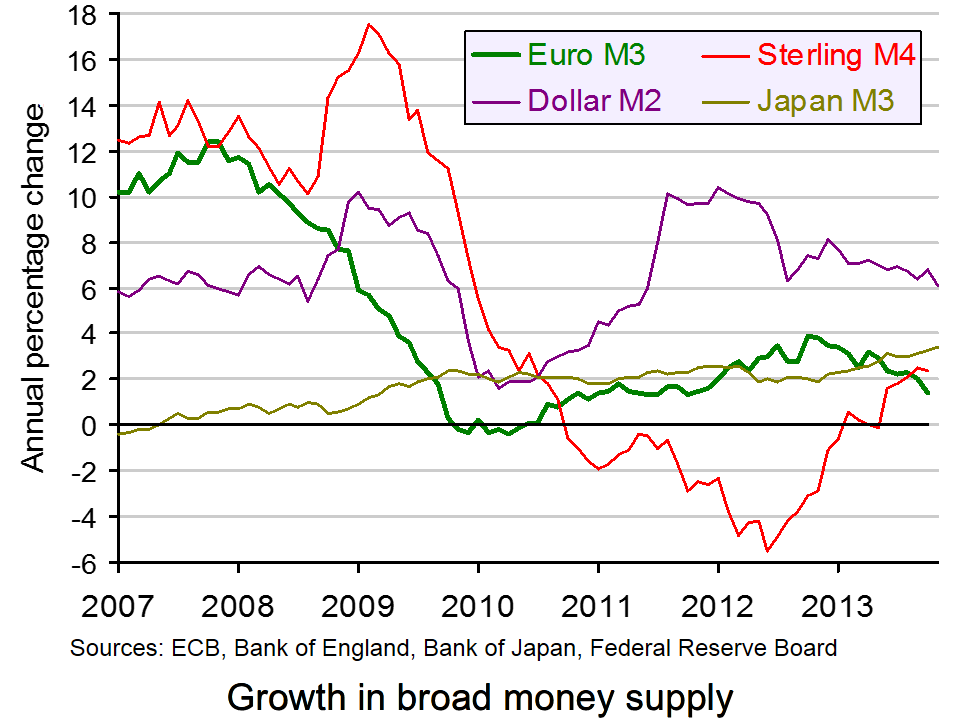 Broad money supply growth is now below that of the US dollar, the yen and sterling (see chart: click here for a PowerPoint).
The ECB has been far more cautious than central banks in other countries in acting to prevent recession and deflation. Unlike the USA, Japan and the UK, which have all engaged in extensive quantitative easing, the ECB had been reluctant to do so for fear of upsetting German opinion and taking the pressure off southern European countries to reform.
But as Eichengreen points out, the dangers of inaction could be much greater. What is more, quantitative easing is not the only option. The ECB could copy the UK approach of ‘funding for lending’ – not for housing, but for business.
Europe’s economic crisis could be mutating again The Guardian, Barry Eichengreen (10/12/13)
Questions
- What problems are created by falling prices?
- What effect would deflation have on debt and the difficulties in repaying that debt?
- What measures have already been adopted by the ECB to stimulate the eurozone economy? (Search previous articles on this site.)
- Why have such measures proved inadequate?
- What alternative policies are open to the ECB?
- What are the arguments for the ECB being given a higher inflation target (such as 3 or 4%)?
- What are the arguments for and against relaxing fiscal austerity in the eurozone at the current time?
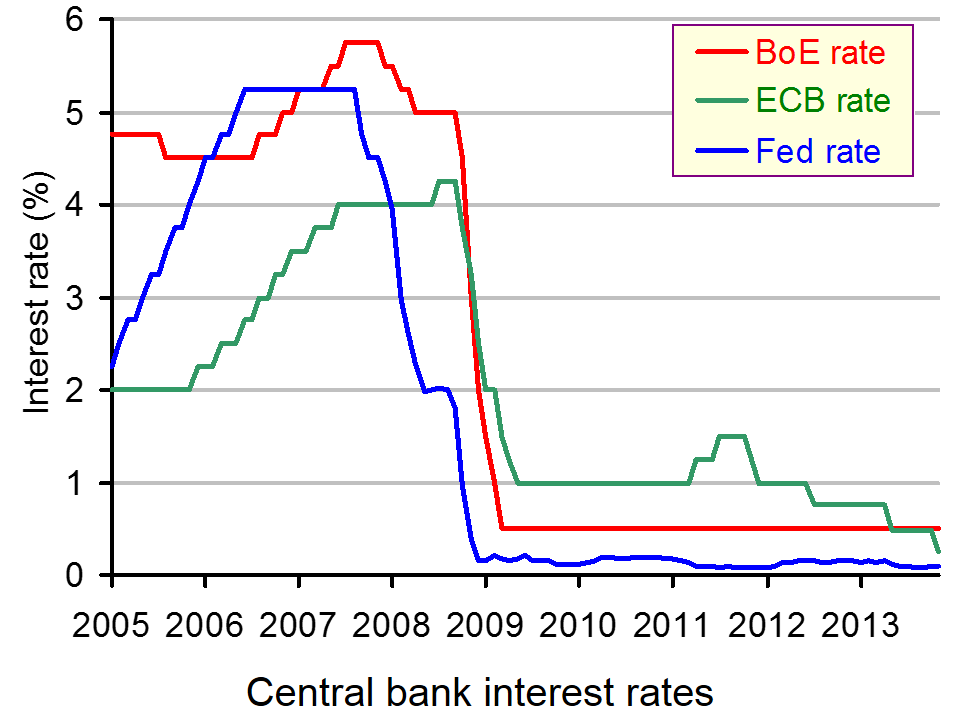 A constant feature of the UK economy (and of many other Western economies) has been record low interest rates. Since March 2009, Bank Rate has stood at 0.5%. Interest rates have traditionally been used to keep inflation on target, but more recently their objective has been to stimulate growth. However, have these low interest rates had a negative effect on the business environment?
Interest rates are a powerful tool of monetary policy and by affecting many of the components of aggregate demand, economic growth can be stimulated. This low-interest rate environment is an effective tool to stimulate consumer spending, as it keeps borrowing costs low and in particular can keep mortgage repayments down. However, this policy has been criticised for the harm it has been doing to savers – after all, money in the bank will not earn an individual any money with interest rates at 0.5%! Furthermore, there is now a concern that such low interest rates have led to ‘zombie companies’ and they are restricting the growth potential and recovery of the economy.
A report by the Adam Smith Institute suggests that these ‘zombie companies’ have emerged in part by the low-interest environment and are continuing to absorb resources, which could otherwise be re-allocated to companies with more potential, productivity and a greater contribution to the economic recovery. During a recession, there will undoubtedly be many business closures, as aggregate demand falls, sales and profits decline until eventually the business becomes unviable and loans cannot be repaid. Given the depth and duration of the recent recessionary period, the number of business closures should have been very large. However, the total number appears to be relatively low – around 2% or 100,000 and the report suggests that the low interest rates have helped to ‘protect’ them.
Low interest rates have enabled businesses to meet their debt repayments more easily and with some banks being unwilling to admit to ‘bad loans’, businesses have benefited from loans being extended or ‘rolled over’. This has enabled them to survive for longer and as the report suggests, may be preventing a full recovery. The report’s author, Tom Papworth said:
Low interest rates and bank forbearance represent a vast and badly targeted attempt to avoid dealing with the recession. Rather than solving our current crisis, they risk dooming the UK to a decade of stagnation … We tend to see zombies as slow-moving and faintly laughable works of fiction. Economically, zombies are quite real and hugely damaging, and governments and entrepreneurs cannot simply walk away.
The problem they create is that resources are invested into these companies – labour, capital, innovation. This creates an opportunity cost – the resources may be more productive if invested into new companies, with greater productive potential. The criticism is that the competitiveness of the economy is being undermined by the continued presence of such companies and that this in turn is holding the UK economy back. Perhaps the interest rate rise that may happen this time next year may be what is needed to encourage the re-allocation of capital. However, a 0.5 percentage point rise in interest rates would hardly be the end of the world for some of these companies. Perhaps a more focused approach looking at restructuring is the key to their survival and the allocation of resources to their most productive use. The following articles and the report itself consider the case of the trading dead.
Report
The Trading Dead The Adam Smith Institute, Tom Papworth November 2013
Articles
Zombie firms threaten UK’s economic recovery, says thinktank The Guardian, Gyyn Topam (18/11/13)
Zombie companies ‘probably have no long term future’ BBC News (18/11/13)
Rate rise set to put stake through heart of zombie companies Financial Times, Brian Groom (14/11/13)
Why we can still save the zombie firms hindering the UK economic rival City A.M., Henry Jackson (18/11/13)
Breathing new life into zombies The Telegraph, Rachel Bridge (9/11/13)
Questions
- Which components of aggregate demand are affected (and how) by low interest rates?
- Why do low interest rates offer ‘protection’ to vulnerable businesses?
- How is the reallocation of resources relevant in the case of zombie companies?
- If interest rates were to increase, how would this affect the debts of vulnerable businesses? Would a small rate irse be sufficient and effective?
- What suggestions does the report give for zombie companies to survive and become more productive?
- Is there evidence of zombie companies in other parts of the world?
 The Consumer Prices index (CPI) measures the rate of inflation and in October, this rate fell to 2.2%, bringing inflation to its lowest level since September 2012. For many, this drop in inflation came as a surprise, but it brings the rate much closer to the Bank of England’s target and thus reduces the pressure on changing interest rates.
The CPI is calculated by calculating the weighted average price of a basket of goods and comparing how this price level changes from one month to the next. Between September and October prices across a range of markets fell, thus bringing inflation to its lowest level in many months. Transport prices fell by their largest amount since mid-2009, in part driven by fuel price cuts at the big supermarkets and this was also accompanied by falls in education costs and food. The Mail Online article linked below gives a breakdown of the sectors where the largest price falls have taken place. One thing that has not yet been included in the data is the impact of the price rises by the energy companies. The impact of his will obviously be to raise energy costs and hence we can expect to see an impact on the CPI in the coming months, once the price rises take effect.
 With inflation coming back on target, pressures on the Bank of England to raise interest rates have been reduced. When inflation was above the target rate, there were concerns that the Bank of England would need to raise interest rates to cut aggregate demand and thus bring inflation down.
However, the adverse effect of this would be a potential decline in growth. With inflation falling to 2.2%, this pressure has been removed and hence interest rates can continue to remain at the record low, with the objective of stimulating the economy. Chris Williamson from Markit said:
The easing in the rate of inflation and underlying price pressures will provide greater scope for monetary policy to be kept looser for longer and thereby helping ensure a sustainable upturn in the economy … Lower inflation reduces the risk of the Bank of England having to hike rates earlier than it may otherwise prefer to, allowing policy to focus on stimulating growth rather than warding off rising inflationary pressures.
The lower rate of inflation also has good news for consumers and businesses. Wages remain flat and thus the reduction in the CPI is crucial for consumers, as it improves their purchasing power. As for businesses, a low inflation environment creates more certainty, as inflation tends to be more stable. Businesses are more able to invest with confidence, again benefiting the economy. Any further falls in the CPI would bring inflation back to its target level of 2% and then undoubtedly concerns will turn back to the spectre of deflation, though with the recent announcements in energy price rises, perhaps we’re getting a little ahead of ourselves! Though we only need to look to countries such as Spain and Sweden where prices are falling to realise that it is certainly a possibility. The following articles consider the data and the impact.
UK inflation falls in October: what the economists say The Guardian, Katie Allen (12/11/13)
British inflation hits 13-month low, easing pressure on central bank Reuters, David Milliken and William Schomberg (12/11/13)
UK inflation falls to 2.2% in October BBC News (1211/13)
UK inflation falls to 13-month low: reaction The Telegraph (12/11/13)
Fall in inflation to 2.2% welcome by government The Guardian, Katie Allen (12/11/13)
Inflation falls to lowest level for a year as supermarket petrol price war helps ease the squeeze on family finances Mail Online, Matt Chorley (12/11/13)
Inflation falls to its lowest level for more than a year as consumers benefit from petrol pump price war Independent, John-Paul Ford Rojas (12/11/13)
UK inflation slows to 2.2%, lowest level in a year Bloomberg, Scott Hamilton and Jennifer Ryan (12/11/13)
Are we facing deflation? Let’s not get carried away The Telegraph, Jeremy Warner (12/11/13)
Questions
- How is the CPI calculated?
- Use an AD/AS diagram to illustrate how prices have been brought back down. Is the reduction in inflation due to demand-side or supply-side factors?
- What are the benefits of low inflation?
- The Telegraph article mentions the possibility of deflation. What is deflation and why does it cause such concern?
- Explain why a fall in the rate of inflation eases pressure on the Bank of England.
- How does the rate of inflation affect the cost of living?
- Is a target rate of inflation a good idea?
 Nearly two years ago, France lost its triple A credit-rating and the news has only got worse. Unemployment has risen and economic growth in France has remained low and this is one of the reasons why France’s credit rating has been downgraded further from AA+ to AA. A high credit rating doesn’t guarantee market confidence, but it does help to keep the cost of borrowing for the government low. Thus, this downgrading could spell trouble for French borrowing costs.
Standard and Poor’s (S&P), who downgraded the French credit rating, is expecting government debt to rise to 86% of gross domestic product and believes that unemployment will remain above 10% until 2016. While the French government has put various reforms in place to boost the struggling economy, S&P don’t believe they are sufficient and have been very public in criticising the government’s effort. They were quoted as saying:
We believe the French government’s reforms to taxation, as well as to product, services and labour markets, will not substantially raise France’s medium-term growth prospects and that on-going high unemployment is weakening support for further significant fiscal and structural policy measures.
Following the downgrading, the return for those investors purchasing French debt did begin to rise, echoing the theory that the cost of borrowing would rise.  The yield on French government 10-year bonds increased from 2.158% to 2.389%. The outlook given to France by S&P was ‘stable’, implying that there is a relatively low chance that S&P would change France’s credit-rating again in the next two years.
Many were surprised at the downgrading of France’s credit rating, but this may be the nudge that President Hollande needs to push through extensive labour market reforms with the aim of reducing unemployment and generating growth in the economy. Despite this latest move by S&P, the other credit rating agencies have yet to take similar action. Perhaps they are more convinced by the Finance Minister, Pierre Moscovici who claims that France’s debt is ‘one of the safest and most liquid in the world.’ He commented that:
 They are underestimating France’s ability to reform, to pull itself up … During the last 18 months the government has implemented major reforms aimed at improving the French economic situation, restoring its public finances and its competitiveness.
It will take some time for the full impact of this development in France’s economy to become apparent. The cost of borrowing has already risen only time will tell what will happen to market confidence over the coming weeks. However, what is certain is that pressure is already mounting on Francois Hollande. The following articles consider the French economy.
France told to reform labour market after second credit rating downgrade The Guardian, Phillip Inman (8/13/13)
France’s credit rating cut by S&P to AA BBC News (8/11/13)
S&P lowers France rating on reform doubts, markets unfazed Reuters, Nicholas Vinocur (8/11/13)
Hollande approval rating slumps as France downgraded The Telegraph, James Titcomb (8/11/13)
S&P cuts France’s credit rating by one notch to double-A Wall Street Journal, William Horobin (8/11/13)
Five charts that show the state of the French economy The Telegraph (8/11/13)
France rating downgrade heaps pressure on Francois Hollande Financial Times, Michael Stothard (8/11/13)
Questions
- What does a double A rating mean for the French economy?
- Which factors will be considered when a ratings agency decides to change a country’s credit rating?
- France’s unemployment rate is one of the key factors that S&P has considered. Why is France’s unemployment rate so high? Which type(s) of unemployment are increasing?
- Use a diagram to illustrate the unemployment that France is facing.
- If a country does see its credit rating downgraded, what might this mean for government borrowing costs? Explain why this might cause further problems for a country?
- Markets have been ‘unfazed’ by the downgrade. How do you think markets will react to over the coming weeks? Explain your answer.
- What action could the French government take to ensure that S&P is the only ratings agency that downgrades their credit rating?
 It is one year since the election of Shinzo Abe in Japan. He immediately embarked on a radical economic policy to stimulate the Japanese economy, which had suffered from years of stagnation. There have been three parts (or three arrows) to his policy: fiscal policy and monetary policy to stimulate aggregate demand and supply-side policy to increase productivity.
 “The first arrow is monetary policy. The Bank of Japan has engaged in extensive quantitative easing through bond purchases in order to drive down the exchange rate (see A J-curve for Japan?), stimulate expenditure and increase the rate of inflation. A target inflation rate of 2% has been set by the Bank of Japan. Part of the problem for the Japanese economy over the years has been stagnant or falling prices. Japanese consumers have got used to waiting to spend in the hope of being able to buy at lower prices. Similarly, Japanese businesses have often delayed stock purchase. By committing to bond purchases of whatever amount is necessary to achieve the 2% inflation target, the central bank hopes to break this cycle and encourage people to buy now rather than later.
 The second arrow is fiscal policy. Despite having the highest debt to GDP ratio in the developed world, Japan is embarking on a large-scale programme of infrastructure investment and other public works. The package is worth over $100bn. The expansionary fiscal policy is accompanied by a longer-term plan for fiscal consolidation as economic growth picks up. In the short term, Japan should have no difficulty in financing the higher deficit, given that most of the borrowing is internal and denominated in yen.
 The third arrow is supply-side policy. On 5 June, Shinzo Abe unveiled a series of goals his government would like to achieve in order to boost capacity and productivity. These include increasing private-sector investment (both domestic and inward), infrastructure expenditure (both private and public), increasing farmland, encouraging more women to work by improving day-care facilities for children, and deregulation of both goods, capital and labour markets. The prime minister, however, did not give details of the measures that would be introduced to achieve these objectives. More details will be announced in mid-June.”