 It is rising inflation that typically causes problems for countries, whether it is demand-pull or cost-push. However, one country that has not been subject to problems of rising prices is Japan. Instead, this economy has been suffering from the gloom of deflation for many years and many argue that this is worse than high inflation.
Falling prices are popular among consumers. If you see a product whose price has fallen from one day to the next, you can use your income to buy more goods. What’s the problem with this? The Japanese economy has experienced largely stagnant growth for two decades and a key cause has been falling prices. When the prices of goods begin to fall over and over again, people start to form expectations about the future direction of prices. If I expect the price of a good to fall next week, then why would I buy now, if I can buy the same good next week at a lower price?  But, when next week arrives and the price has fallen as expected, why would I purchase the product, if I think that the price fall is set to continue? The problem of deflation is that with continuously falling prices, consumers stop spending. Aggregate demand therefore declines and economic growth all but disappears. This is the problem that the Japanese economy has been faced with for more than 20 years.
However, the latest data from Japan shows core consumer prices growing faster than expected in December 2013, compared to the previous year. This figure was above market forecasts and was the fastest rate of growth in the past 5 years. These data, together with those on unemployment have given the economy a much needed boost.
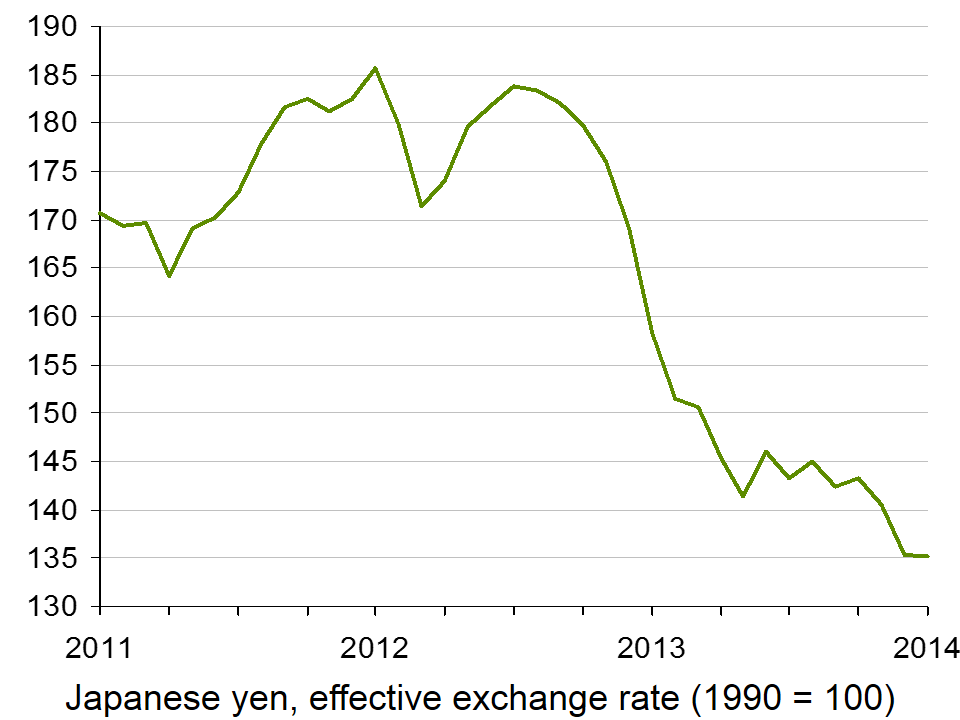 Recent government policy has been focused on boosts in government spending, with an aim of reducing the value of the currency (click here for a PowerPoint of the chart). Such policies will directly target aggregate demand and this in turn should help to generate an increase in national output and push up prices. If the price trend does begin to reverse, consumers will start to spend and again aggregate demand will be stimulated.
The future of the economy remains uncertain, though the same can be said of many Western economies. However, the signs are good for Japan and if the recovery of other economies continues and gathers pace, Japan’s export market will be a big contributor to recovery. The following articles consider the Japanese economy.
Japan inflation rises at fastest pace in over five years BBC News (31/1/14)
Benchmark Japan inflation rate hits 1.3% Financial Times, Jonathan Soble (31/1/14)
Japan’s inflation accelerates as Abe seeks wage gains Bloomberg, Chikako Mogi, Masahiro Hidaka and James Mayger (31/1/14)
Japan inflation quickens to over 5-year high, output rebounds Reuters, Leika Kihara and Stanley White (31/1/14)
Japaense inflation rises at fastest pace in over five years at 1.3% in December 2013 Independent, Russel Lynch (31/1/14)
 Why Abenomics holds lessons for the West BBC News, Linda Yueh (18/12/13)
Questions
- Why is deflation a problem?
- Using an AD/AS diagram, illustrate the problem of expectations and how this contributes to stagnant growth.
- How will a lower currency help Japan?
- What is the likely effect of a sales tax being imposed?
- Does the fact that unemployment has declined support the fact that consumer prices are beginning to rise?
- What government policies would you recommend to a government faced with stagnant growth and falling prices?
- How important are expectations in creating the problem of deflation?
 World markets were taken by surprise by a large rise in Turkish interest rates on 28/1/14. In an attempt to combat a falling lira and rising inflation, the Turkish central bank raised its overnight lending rate from 7.75% to 12%. Following the decision, the lira appreciated by over 3%.
Since the start of this year, the Turkish lira had depreciated by 7.1% and since the start of 2013 by 22.8%. Along with the currencies of several other emerging economies, such as India and Brazil, speculators had been selling the Turkish currency. This has been triggered by worries that the Fed’s tapering off its quantitative easing programme would lead to a fall, and perhaps reversal, of the inflow of finance into these countries; in the worst-case scenario it could lead to substantial capital flight.
Consumer price inflation in Turkey is currently 7.4%, up from 6.2% a year ago. The central bank, in a statement issued alongside the interest rate rise, said that it would continue with a tight monetary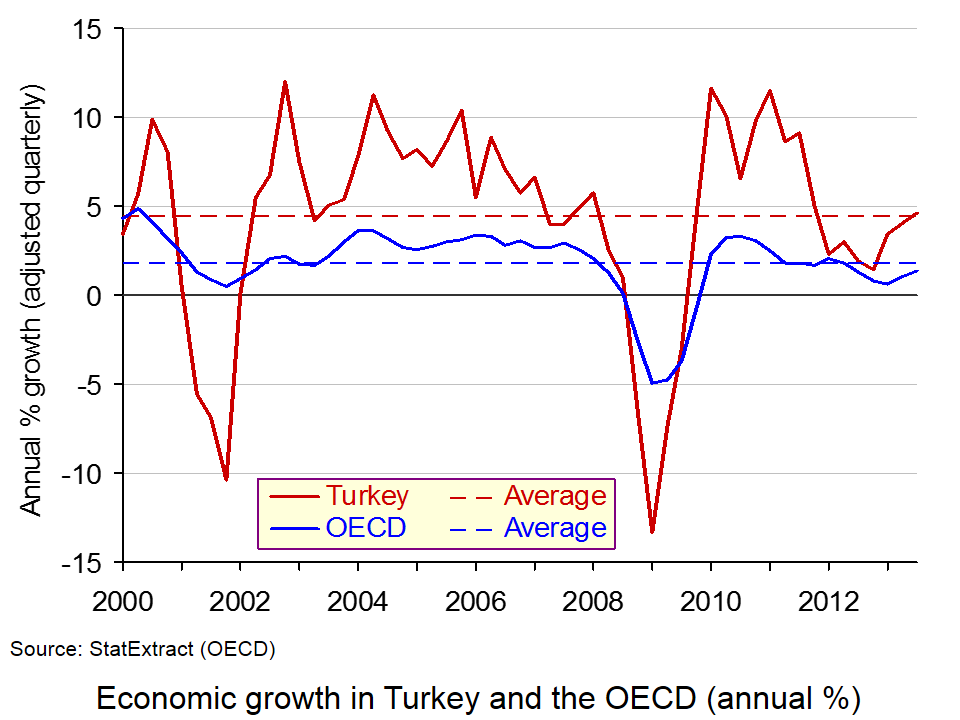 policy until the inflation outlook showed a clear improvement.
The Turkish Prime Minister, Tayyip Erdogan, has been opposed to rises in interest rates, fearing that the dampening effect on aggregate demand would reduce economic growth, which, as the chart shows, has been recovering recently (click here for a PowerPoint of the chart). A slowing of growth could damage his prospects in forthcoming elections.
World stock markets, however, rallied on the news, seeing the rise in interest rates as a symbolic step in emerging countries stemming outflows of capital.
Articles
Turkey raises interest from 7.75pc to 12pc The Telegraph (28/1/14)
Emerging markets forced to tighten by US and Chinese monetary superpowers The Telegraph, Ambrose Evans-Pritchard (28/1/14)
Turkey Gets Aggressive on Rates The Wall Street Journal, Joe Parkinson (28/1/14)
Turkish central bank raises lending rate to 12% BBC News (28/1/14)
Asian stock markets stage relief rally after Turkey rate rise BBC news (29/1/14)
Turkey raises rates to halt lira’s slide Financial Times, Daniel Dombey (29/1/14)
Turkey Rate Increase Stems Lira Drop as Basci Defies Erdogan Bloomberg Businessweek, Onur Ant and Taylan Bilgic (29/1/14)
Fragile economies under pressure as recovery prompts capital flight The Observer, Angela Monaghan (2/2/14)
Data
Main Economic Indicators (including Turkish data) OECD
Data on Turkey, World Economic Outlook database IMF
Turkey price indices Central Bank of the Republic of Turkey
Questions
- Why did the Turkish central bank decide to raise interest rates by such a large amount?
- Why has the Turkish lira been depreciating so much over the past few months? How has this been linked to changes in Turkey’s balance of payments and what parts of the balance of payments account have been affected?
- Why did global stock markets rally on the news from Turkey?
- What will be the impact of the central bank’s actions on (a) inflation; (b) economic growth?
- How has the USA’s quantitative easing programme affected developing countries?
 Christine Lagarde, managing director of the IMF, has warned of the danger of deflation in the eurozone. She also spoke of the risks of a slowdown in the developing world as the Fed tapers off its quantitative easing programme – a programme that has provided a boost to many emerging economies.
Speaking at the World Economic Forum, in the Swiss Alps, she did acknowledge signs of recovery across the world, but generally her speech focused on the risks to economic growth.
Some of these risks are old, such as a lack of fundamental bank reform and a re-emergence of risky behaviour by banks. Banks have taken steps towards recapitalisation, and the Basel III rules are beginning to provide greater capital buffers. But many economists believe that the reforms do not go far enough and that banks are once again beginning to behave too recklessly.
 Some of the risks are new, or old ones resurfacing in a new form. In particular, the eurozone, with inflation of just 0.8%, is dangerously close to falling into a deflationary spiral, with people holding back on spending as they wait for prices to fall.
Another new risk concerns the global impact of the Fed tapering off its quantitative easing programme (see Tapering off? Not yet). This programme has provided a considerable boost, not just to the US economy, but to many emerging economies. Much of the new money flowed into these economies as investors sought better returns. Currencies such as the Indian rupee, the Brazilian real and the Turkish lira are now coming under pressure. The Argentinean peso has already been hit by speculation and fell by 11% on 24/1/14, its biggest one-day fall since 2002. Although a fall in emerging countries’ currencies will help boost demand for their exports, it will drive up prices in these countries and put pressure on central banks to raise interest rates.
Christine Lagarde was one of several speakers at a session titled, Global Economic Outlook 2014. You can see the complete session by following the link below.
Articles
Lagarde warns of risks to global economic recovery TVNZ (27/1/14)
Lagarde Cautions Davos on Global Deflation Risk Bloomberg News, Ian Katz (26/1/14)
Davos 2014: Eurozone inflation ‘way below target’ BBC News (25/1/14)
IMF fears global markets threat as US cuts back on cash stimulus The Guardian, Larry Elliott and Jill Treanor (25/1/14)
Davos 2014: looking back on a forum that was meant to look ahead The Guardian, Larry Elliott (26/1/14)
Speeches at the WEF
Global Economic Outlook 2014 World Economic Forum (25/1/14)
Questions
- Why is deflation undesirable?
- What are the solutions to deflation? Why is it difficult to combat deflation?
- What are the arguments for the USA tapering off its quantitative easing programme (a) more quickly; (b) less quickly?
- How is tapering off in the USA likely to affect the exchange rates of the US dollar against other currencies? Why will the percentage effect be different from one currency to another?
- What are Japan’s three policy arrows (search previous posts on this site)? Should the eurozone follow these three policies?
 A recession is typically characterised by high unemployment, low or negative growth and low inflation, due to a lack of aggregate demand. However, since 2009, inflation levels in the UK have only added to the pressures facing the government and the Bank of England. Not only had there been a problem of lack of demand, but the inflation target was no longer being met.
Inflation had increased to above 5% – a figure we had not been accustomed to for many years. With interest rates at record lows with the aim of boosting aggregate demand, demand-pull inflation only added to cost-push pressures. However, data released by the ONS shows that inflation, as measured by the CPI, has now fallen back to its 2% target. Having been at 2.1% in November 2013, the figure for December 2013 fell by 0.1 percentage points.
 The data for December include some of the energy price rises from the big six, but do not include the full extent of price decreases and discounting initiated by retailers in the lead up to Christmas. The key factors that have helped to keep prices down include some of the discounting throughout December and falling food prices, in particular bananas, grapes and meat.
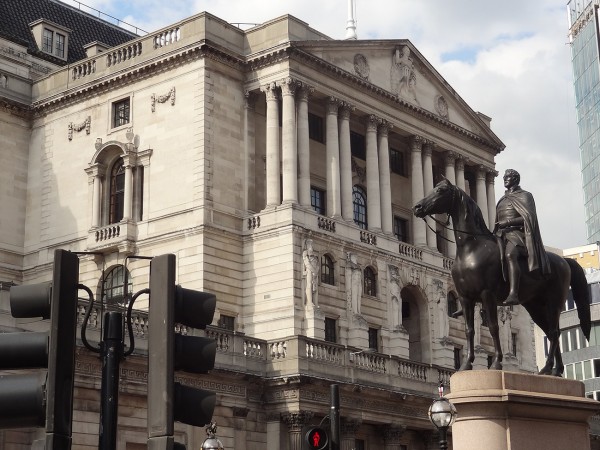
With inflation back on target, pressures have been removed from the Bank of England to push up interest rates. Mark Carney has said that interest rates will remain at 0.5% until unemployment falls to 7%. 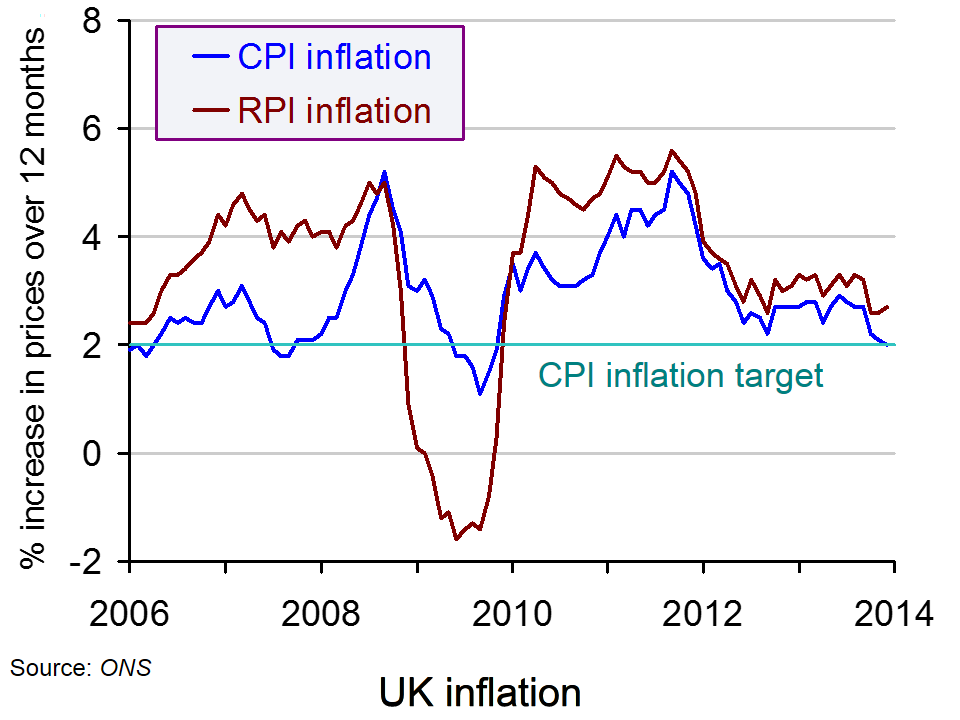 With unemployment fast approaching this target, there has been speculation that interest rates would rise, but with inflation falling back on target, these pressures have been reduced. (Click here for a PowerPoint of the chart.) Referring to this, Jeremy Cook, the chief economist at World First said:
The lack of inflation will help stay their hand especially if the pace of job creation seen in the second half of last year also shows.
These thoughts were echoed by Rob Wood, the chief UK economist at Berenberg Bank:
Inflation is the BoE’s ‘get out of jail free’ card for this year … The lack of inflation pressure gives them room to delay a first hike until next year.
Many economists now believe that the CPI rate of inflation is likely to remain at or below the target, in particular if productivity growth improves. This belief is further enhanced by the fact that tax rates are stable, the pound is relatively strong and the previous upward pressure on commodity prices from China is now declining. Some economists believe that CPI inflation could fall to 1.5% this year and the Treasury has said that it is ‘another sign that the Government’s long-term economic plan is working’. The following articles consider this latest macroeconomic data.
UK inflation falls to Bank of England’s 2pc target in December The Telegraph, Szu Ping Chan (14/1/14)
UK inflation falls to 2% target rate in December BBC News (14/1/14)
Carney’s lucky streak continues as UK inflation slows to 2% Financial Times, Claire Jones (14/1/14)
UK inflation fall gives Bank of England a lift Wall Street Journal, Richard Barley(14/1/14)
Inflation falls to Bank of England target Reuters, William Schomberg and Ana Nicolaci da Costa (14/1/14)
Inflation hits Bank of England’s target of 2% in December Independent, John Paul Ford Rojas (14/1/14)
Questions
- What is the relationship between interest rates and aggregate demand?
- Which factors have led to the reduction in the rate of inflation?
- Why have the latest data on inflation rates reduced the pressure on the Bank of England to increase interest rates?
- Why do stable tax rates, a strong pound and reduced pressure from China on commodity prices suggest that the CPI measures of inflation is likely to remain at similarly low levels?
- Why has the RPI increased while the CPI has fallen?
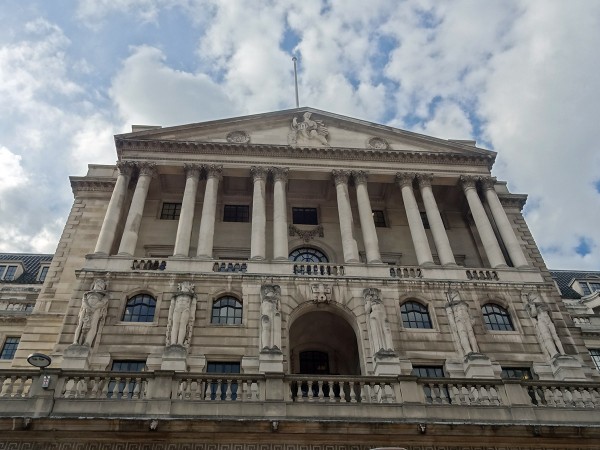 Interest rates in the UK have been at 0.5% since mid-2009, when they were reduced with the objective of stimulating the economy, through encouraging consumption and investment. Over the past 12 months, economic recovery has begun and with the housing market rising by 8.4% over the past year, what can we expect from interest rates?
Interest rates are a powerful tool of monetary policy and affect many of the components of aggregate demand. As such, they are also a key tool in achieving low and stable inflation rates and keeping unemployment low. Unemployment has been falling, as the economic recovery has taken hold, but is still above the 7% level that the Bank of England has said is needed before rates are increased. However, with the improvements in the housing market,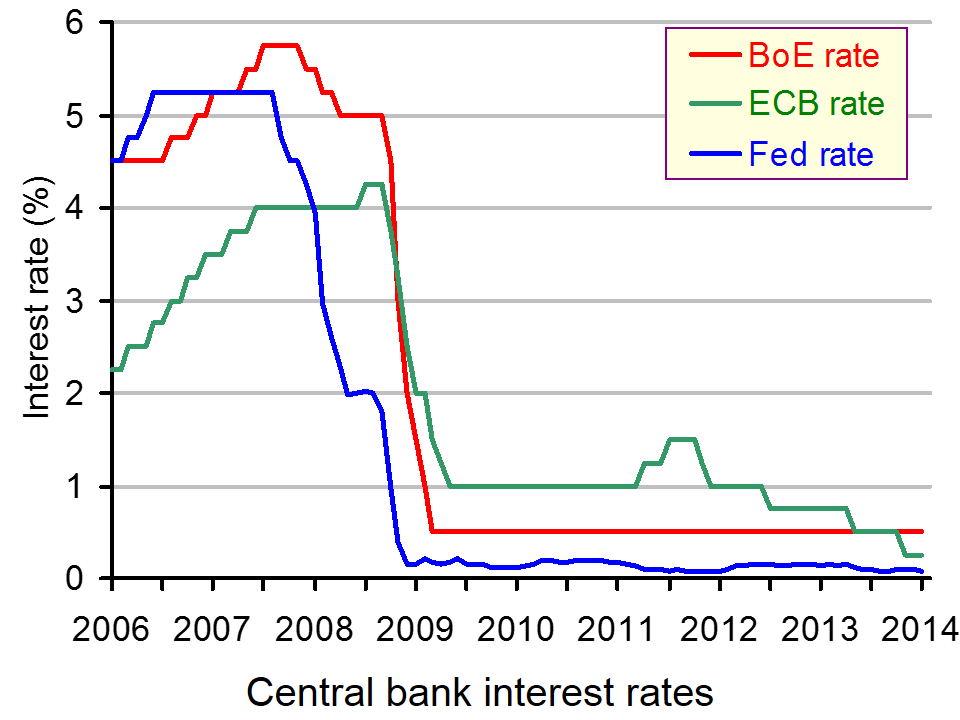 some are now expecting interest rates to go up sooner than previously thought. (Click here for a PowerPoint of the chart.)
28 economists were questioned about the future of interest rates in the UK and 93% of those asked were of the opinion that interest rates will still be at 0.5% by the end of 2014. Furthermore, more than 50% think that interest rates will not begin to go up until the second half of 2015 and 15% suggest that they will not increase until 2016.
What happens to interest rates will depend on many things, including changes in productivity, unemployment trends, wage growth and inflation. It is also likely to depend on economic changes in countries around the world. The following articles consider the future of interest rates.
UK interest rates to stay at 0.5% in 2014 – economists BBC News (3/1/14)
It is high time we raised interest rates and returned to normality The Telegraph, Jeremy Warner (2/1/14)
BoE will ‘move goalposts’ on interest rates Financial Times, Chris Giles and Claire Jones (1/1/14)
Interest rate rise with no wage increase ‘will push heavily-indebted to edge’ The Guardian, Heather Stewart (2/12/14)
BoE may lower jobless rate guidance, but not this month – Reuters poll Reuters, Suzanne Plunkett (3/1/14)
Questions
- Explain how each component of aggregate demand will be affected by changes in interest rates.
- How do interest rates affect unemployment?
- Interest rates are used to keep inflation on target. Explain how this is done.
- What might be the effect on the macroeconomic objectives if interest rates are increased?
- What are the arguments (a) for increasing Bank rate and (b) for maintaining it at the current 0.5% level?
 It is rising inflation that typically causes problems for countries, whether it is demand-pull or cost-push. However, one country that has not been subject to problems of rising prices is Japan. Instead, this economy has been suffering from the gloom of deflation for many years and many argue that this is worse than high inflation.
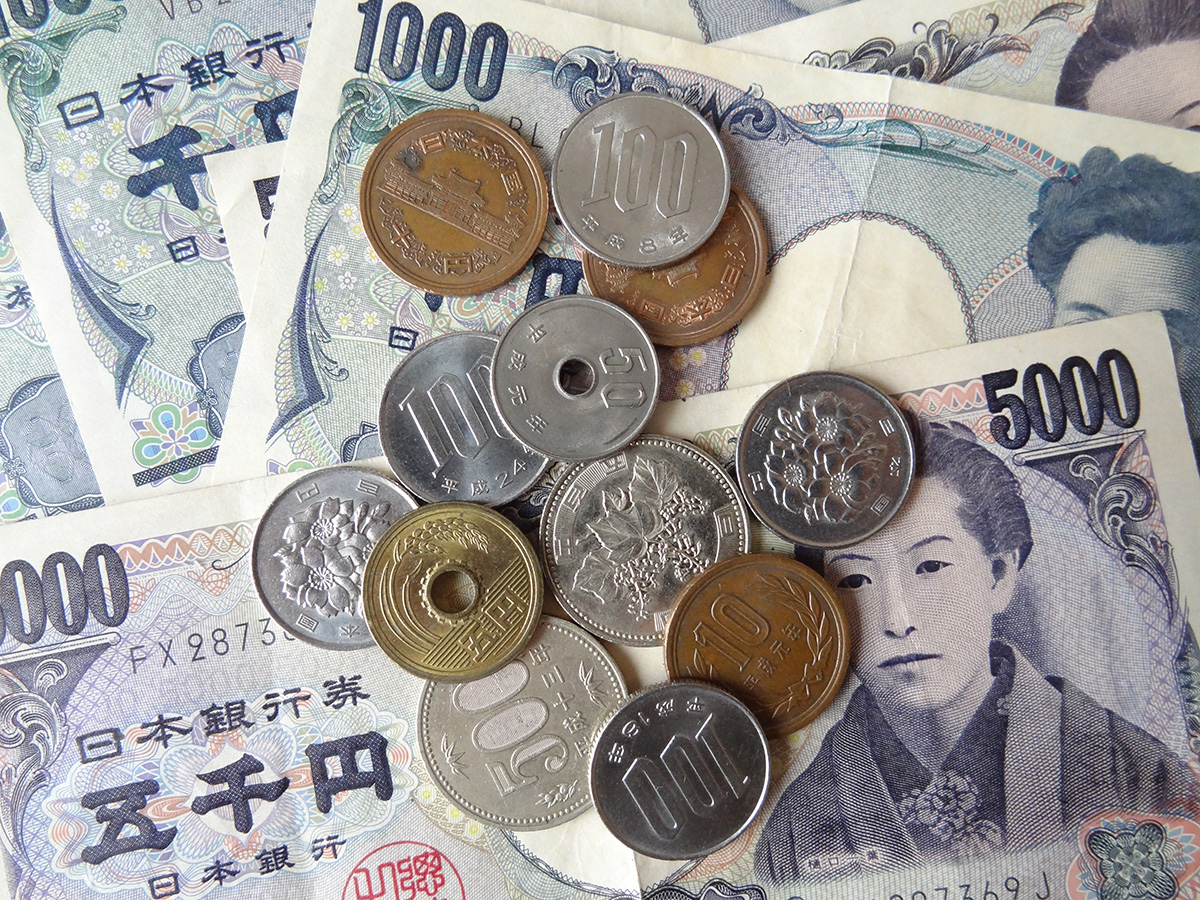 But, when next week arrives and the price has fallen as expected, why would I purchase the product, if I think that the price fall is set to continue? The problem of deflation is that with continuously falling prices, consumers stop spending. Aggregate demand therefore declines and economic growth all but disappears. This is the problem that the Japanese economy has been faced with for more than 20 years.