 The second largest economy in the world, with a record expansion to its current economic status: China. With a phenomenal population, massive migration to the cities and incredible infrastructure development, China has fast become a key economic player, with environmental and pollution problems to match.
The price of China’s economic development may be too high for some people. Increases in incomes, growth and employment may be good news, but is the cost too high? Do economic growth and progress mean poor health and if so, is this a price worth paying
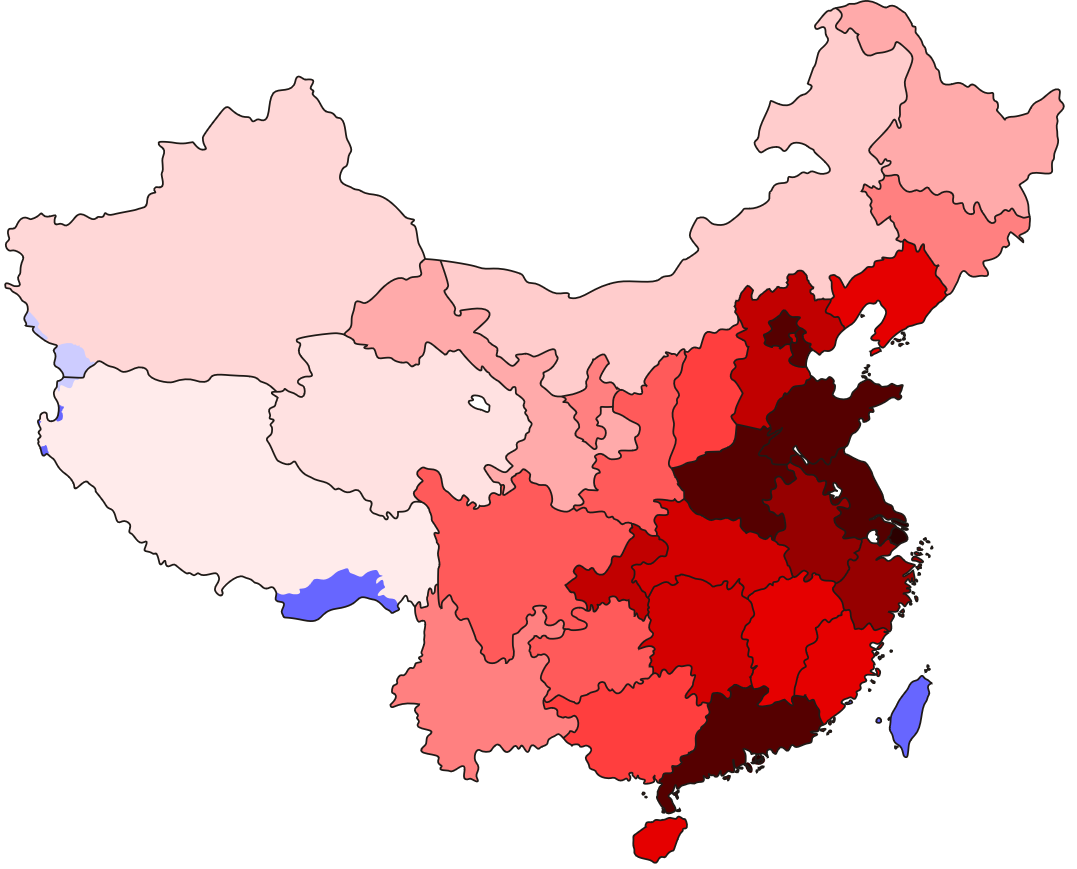 Another big topic within China is the impact on inequality. With growth accelerating in urban areas, population movement from the rural to the urban has been a common feature across China, but this has also created greater inequality. This population movement has separated families and played a role in creating barriers of access to health and education.
The following article from the BBC considers a range of indicators within China and you may also want to review some earlier blog postings on the Sloman News Site which analyse the Chinese economy.
Cement and pig consumption reveal China’s huge changes BBC News (21/9/15)
Questions
- What are the key drivers of China’s development?
- What are the costs and benefits of rural-urban migration?
- To what extent do you think there may be a trade-off between quality and quantity when it comes to infrastructure projects? Or is Chinese labour simply more efficient relative to countries such as the UK?
- How should we measure economic development? If access to education and health care is limited in the more rural areas, but widely available in the larger cities, does this suggest a country that is developing?
- What are the main externalities that China must tackle? Are they domestic issues or global ones? What about the solutions?
- If a key driver of Chinese growth and development is government investment in infrastructure projects, is this true and sustainable growth or do you think it might slowly disappear if the government doesn’t continue to invest?
- Do you think the relative success of China can be replicated in other emerging nations and in particular in nations within Africa?
 Productivity has been a bit of a problem for the UK economy for a number of years. Earlier posts from 2015 have discussed the trend in Tackling the UK’s poor productivity and The UK’s poor productivity record. Although the so-called ‘productivity gap’ has been targeted by the government, with George Osborne promising to take steps to encourage more long-term investment in infrastructure and create better incentives for businesses to improve productivity, the latest data suggest that the problem remains.
The ONS has found that the UK continues to lag behind the other members of the G7, but perhaps more concerning is that the gap has grown to its biggest since 1991. The data showed that output per hour worked was 20 percentage points lower in the UK than the average for the other G7 countries. The economic downturn did cause falls in productivity, but the UK has not recovered as much as other advanced nations. One of the reasons, according to the Howard Archer, chief UK economist at IHS Global Insight is that it ‘had been held back since the financial crisis by the creation of lots of low-skilled, low-paid jobs’. These are the jobs where productivity is lowest and this may be causing the productivity gap to expand. Other cited reasons include the lack of investment which Osborne is attempting to address, fewer innovations and problems of finance.
Despite these rather dis-heartening data, there are some signs that things have begun to turn around. In the first quarter of 2015, output per hour worked did increase at the fastest annual growth rate in 3 years and Howard Archer confirmed that this did show ‘clear sign that UK productivity is now seeing much-needed improvement.’ There are other signs that we should be optimistic, delivered by the Bank of England. Sir John Cunliffe, Deputy Governor for financial stability said:
“firms have a greater incentive to find efficiency gains and to switch away from more labour-intensive forms of production. This should boost productivity.”
The reason given for this optimism is the increase in the real cost of labour relative to the cost of investment. So, a bit of a mixed picture here. UK productivity remains a cause for concern and given its importance in improving living standards, the Conservative government will be keen to demonstrate that its policies are closing the productivity gap. The latest data is more promising, but that still leaves a long way to go. The following articles consider this data and news.
Articles
UK productivity shortfall at record high Financial Times, Emily Cadman (18/9/15)
UK productivity lags behind rest of 7 BBC News (17/9/15)
UK’s poor productivity figures show challenge for the government The Guardian, Katie Allen (18/9/15)
UK productivity lags G7 peers in 2014-ONS Reuters (18/9/15)
UK productivity second lowest in G7 Fresh Business Thinking, Jonathan Davies (18/9/15)
UK is 33% less productive than Germany Economia (18/9/15)
UK productivity is in the G7 ‘slow lane’ Sky News (18/9/15)
Data
AMECO Database European Commission, Economic and Financial Affairs
Labour Productivity, Q1 2015 ONS (1/7/15)
International Comparisons of Productivity, 2014 – First Estimates ONS (18/9/15)
Questions
- How could we measure productivity?
- Why should we be optimistic about productivity if the real cost of labour is rising?
- If jobs are being created at slower rate and the economy is still expanding, why does this suggest that productivity is rising? What does it suggest about pay?
- Why is a rise in productivity needed to improve living standards?
 Interest rates are the main tool of monetary policy and have a history of being an effective tool in creating macroeconomic stability. There has been much discussion since the end of the financial crisis concerning when interest rates would rise in the US (and the UK) and for the US, the case is stronger, given its rate of growth, which has averaged at 2.2% per annum since June 2009.
As in the UK, the question of ‘will rates rise?’ has a clear and certain answer: Yes. The more challenging question is ‘when?’. Much of the macroeconomic data for the US is promising, with positive economic growth (and relatively strong in comparison to the UK and Eurozone), a low unemployment rate and inflation of 0.3%. This last figure is ‘too low’, but it comes in at a much more attractive 1.2% if you exclude food and energy costs and there is an argument for doing this, given the price of oil. The data on unemployment and growth might suggest that the economy is at a stage where a rate rise could be managed, but the inflation data indicates that low interest rates might be needed to keep inflation above 0%. Furthermore, there are concerns that the low unemployment figure is somewhat misleading, given that under-employment is quite high at 10.3% and there are still many who are long-term unemployed, having been out of work for more than 6 months.
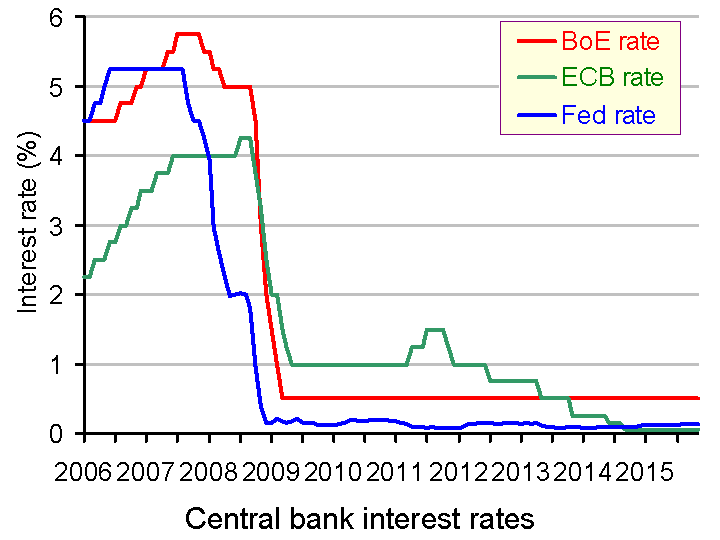
Interest rates can be a powerful tool in affecting the components of aggregate demand (AD) and hence the macroeconomic variables. If interest rates fall, it can help to stimulate AD by reducing borrowing costs for consumers and businesses, reducing the incentive to save, cutting variable rate mortgage payments and depreciating the exchange rate. Collectively these effects can stimulate an economy and hence create economic growth, reduce unemployment and push up prices. However, interest rates have been at almost 0% since the financial crisis, so the only way is up. Reversing the aforementioned effects could then spell trouble, if the economy is not in a sufficiently strong position.
For many, the strength of the US economy, while relatively good, is not yet good enough to justify a rate rise. It may harm investment, growth and unemployment and none of these variables are sufficiently high to warrant a rate rise, especially given the slowdown in the emerging markets. Karishma Vaswani, from BBC News said:
“The current global hand-wringing and head-holding over whether the US Fed will or won’t raise interest rates later has got investors here in Asia worried about what this means for their economies.
The Fed has become the favourite whipping boy of Asia’s central bankers, with cries from India to Indonesia to “just get on with it”.”
There are many, including Professor John Taylor from Stanford University and a former senior Treasury official, a rate rise is well over-due. The market is expecting one and has been for some time and these expectations aren’t going away, so ‘just get on with it.’ Janet Yellen, the Chair of the Federal Reserve is in a tricky situation. She knows that whatever is decided, markets around the world will react – no pressure then! The following articles consider the interest rate debate.
Articles
FTSE slides ahead of Fed interest rates decision The Telegraph, Tara Cunningham (17/9/15)
US’s interest rate rise dilemma BBC News, Andrew Walker (17/9/15)
US interest rate rise: how it could affect your savings and your mortgage Independent (17/9/15)
All eyes on Federal Reserve as it prepares for interest rate announcement The Guardian, Rupert Neate (16/9/15)
Federal Reserve meeting: Will US interest rates rise and should they? The Telegraph, Peter Spence (16/9/15)
Markets push US rate rise bets into 2016 as China woes keep Fed on hold: as it happened The Telegraph, Szu Ping Chan (17/9/15)
Federal Reserve puts rate rise on hold The Guardian (17/9/15)
US central bank leave interest rates unchanged BBC News (17/5/15)
Fed leaves interest rates unchanged Wall Street Journal, Jon Hilsenrath (17/9/15)
Asian markets mostly rally, US Futures waver ahead of Fed interest rate decision International Business Times, Aditya Tejas (17/9/15)
Data
Selected US interest rates Board of Governors of the Federal Reserve System (see, for example, Federal Funds Effective rate (monthly))
Questions
- What happened to US interest rates in September?
- Present the main arguments for keeping interest rates on hold.
- What were the arguments in favour of raising interest rates and do they differ depending on whether interest rates rise slowly or very rapidly?
- How did stock markets around the world react to Janet Yellen’s announcement? Is it good news for the UK?
- Using a diagram to support your explanation, outline why interest rates are such a powerful tool of monetary policy and how they affect the main macroeconomic objectives.
- Do you think other central banks will take note of the Fed’s decision, when they make their interest rate decisions in the coming months? Explain your answer.
 China has a key role in the global economy. Recording double digit growth for a number of years and posting impressive export figures, China’s has been an economy on an upward trajectory. But its growth has been slowing and this might spell trouble for the global economy, as was discussed in the following blog. For many, China is the pendulum and the direction it moves in will have a big influence on many other countries.
There are some suggestions that China’s rapid growth has been somewhat artificial, in particular following the financial crisis, where we saw massive investment by state-owner enterprises, banks and local government. This has led to a severe imbalance within the Chinese economy, with high levels of debt. One of the key factors that has enabled China to grow so quickly has been strong exports. China has typically had a large current account surplus, often balanced by large current account deficits in many Western countries.
The exchange rate is a key component in keeping strong export growth and the devaluation of the Chinese currency in August (see What a devalued yuan means to the rest of the world) is perhaps a suggestion that export growth in China is lower than desired. Devaluing the currency will boost the competitiveness of Chinese exports and this in turn may lead to a growth in the current account surplus, which had fallen quite significantly from around 10% to 2%.
The problem is that China is currently imbalanced and this is likely to create problems around the world. With globalisation, the free movement of capital and people, deflation in the West and falling world asset prices, the situation in China is crucial. Although you will find many articles about China and blogs on this site about its devaluation, its growth and policy, the BBC News article below considers the conflicts that exist between three key economic objectives:
1. currency stability
2. the free movement of capital
3. independent monetary policy
and the need for some international co-operation and co-ordination to enable China’s economy to return to internal and external balance.
China’s impossible trinity BBC News, Duncan Weldon (8/9/15)
Questions
- What is meant by internal balance?
- What is external balance?
- Would you suggest that China is suffering from an imbalanced economy? If so, which type of imbalance and why is this a problem for China and for the world economy?
- The article refers to the trilemma. Why can an country not achieve all 3 parts of the trilemma? You should explain why each combination of 2 aspects is possible, but why the third is problematic.
- Use a diagram to explain why a fall in the exchange rate will boost the competitiveness of exports and why this can create economic growth.
- Why is a devalued Chinese currency bad news for the rest of the world?
- How could international co-operation and co-ordination help China?
 Labour markets can be a key indicator of the strength of an economy, with emphasis placed on measures including the unemployment rate and the rate of job creation. Over the past few decades, we have seen many changes in the UK labour market, with more women, more part-time jobs, flexible hours and a shift towards services. After the financial crisis, unemployment declined and more and more people were entering the labour market. But one criticism of this was zero-hours contracts. They are nothing new and were considered in earlier blogs.
Zero hours contracts are essentially what they say: a contract where you are guaranteed to work for zero hours. This means that under such a contract, there is no guarantee that you will have employment on any given day/week and hence this creates uncertainty. However, on the other side, there can be more flexibility with such a contract and with growth in female participation and part-time work, flexibility is essential for many people. James Sproule, Director of Policy at the Institute of Directors said:
“Zero hours contracts offer businesses and employees an important degree of flexibility. For skilled professionals, a degree of flexibility can boost their earning power, while flexibility also suits students and older people – the main users of zero-hours contracts – who cannot commit to a set number of hours each and every week.”
The ONS has found that businesses are using more zero-hours contracts, with a 6% rise. This reflects a growth in January from 1.4 million to 1.5 million zero-hours contracts, though this increase was not statistically significant. Over the past year, the use of these contracts has increased by 19%, from 624,000 people employed on them in 2014 to 744,000 people in 2015.
Although there has undoubtedly been an increase in the number of people employed on zero-hours contracts, there is also more recognition of these contracts. Therefore, part of the increase in the numbers could be down to this recognition and not just due to more and more people moving onto these contracts. With this greater flexibility, comes more opportunities for more people to enter the labour market. While this is a good thing, it can hide some other aspects. For example, if more people are working, it may suggest a fall in the rate of unemployment and a rise in employment, but perhaps this is misleading if some of those in employment are under-employed. The data revealed that:
On average, someone on a zero-hours contract usually works 25 hours a week, with around 40% of them wanting more hours, most from their current job, rather than in a different or additional one.
 Furthermore, for some people there may be very few other options. However, there was also evidence that the possibility of zero-hours contracts has created opportunities for those who may otherwise not have entered the labour market: perhaps women re-entering the labour market and students in full time education. They also offer businesses greater flexibility and this may be a key way for the UK to improve efficiency and productivity. Jon Ingham from Glassdoor, an employment analyst said:
“It’s no great surprise to see the number of people on these contracts is on the up … It’s safe to say that employees who accept a zero hours contract do not do so as a career choice. For most it’s because they have limited options. For some it might be beneficial to have the flexibility to fit around their lifestyle but for others it’s a substandard contract which offers little in the way of benefits or security.”
The change in the structure of the labour market has been on-going and this may be a small change in amongst a much larger structural change. As the economy continues its recovery, we may see a return to the more typical working contract, but it appears that there will always be this greater demand for flexibility in working patterns and hence perhaps the zero-hours contracts do have a place in Britain. The following articles consider the implications of this data.
ONS Report
Employee contracts that do not guarantee a minimum number of hours: 2015 udpate Office for National Statistics September 2015
Articles
Number of workers on zero-hours contracts up by 19% The Guardian, Phillip Inman (2/9/15)
Zero-hours contracts hold their place in UK labour market Financial Times, Sarah O’Connor (2/9/15)
Zero-hours contracts jump 19% in a year Sky News (2/9/15)
19 per cent rise in people on zero hours contracts recorded across Britain over the last year Independent (2/9/15)
Use of zero-hours contracts rises by 6% BBC News (2/9/15)
Insecure ‘zero-hours’ jobs on the rise in Britain – ONS Reuters (2/9/15)
Questions
- What is a zero-hours contract?
- Outline the main advantages and disadvantages of zero-hours contracts to both workers and businesses. You should think about different types of workers in your answer.
- How do you think the increase in zero-hours contracts has affected the unemployment rate in the UK?
- What is meant by under-employment? Would you class this as inefficient?
- What other changes have we seen in the UK labour market over the past 30 years? Have these changes made the labour market more or less flexible?
- Zero-hours contracts create greater flexibility. Do you think that they create greater functional, numerical of financial flexibility?
- If a company introduces a system of zero-hours contracts, is this in accordance with the marginal productivity theory of profit maximisation from employment?
- Using the ONS data, find out how the use of zero-hours contracts varies by occupation and explain why.
 The second largest economy in the world, with a record expansion to its current economic status: China. With a phenomenal population, massive migration to the cities and incredible infrastructure development, China has fast become a key economic player, with environmental and pollution problems to match.