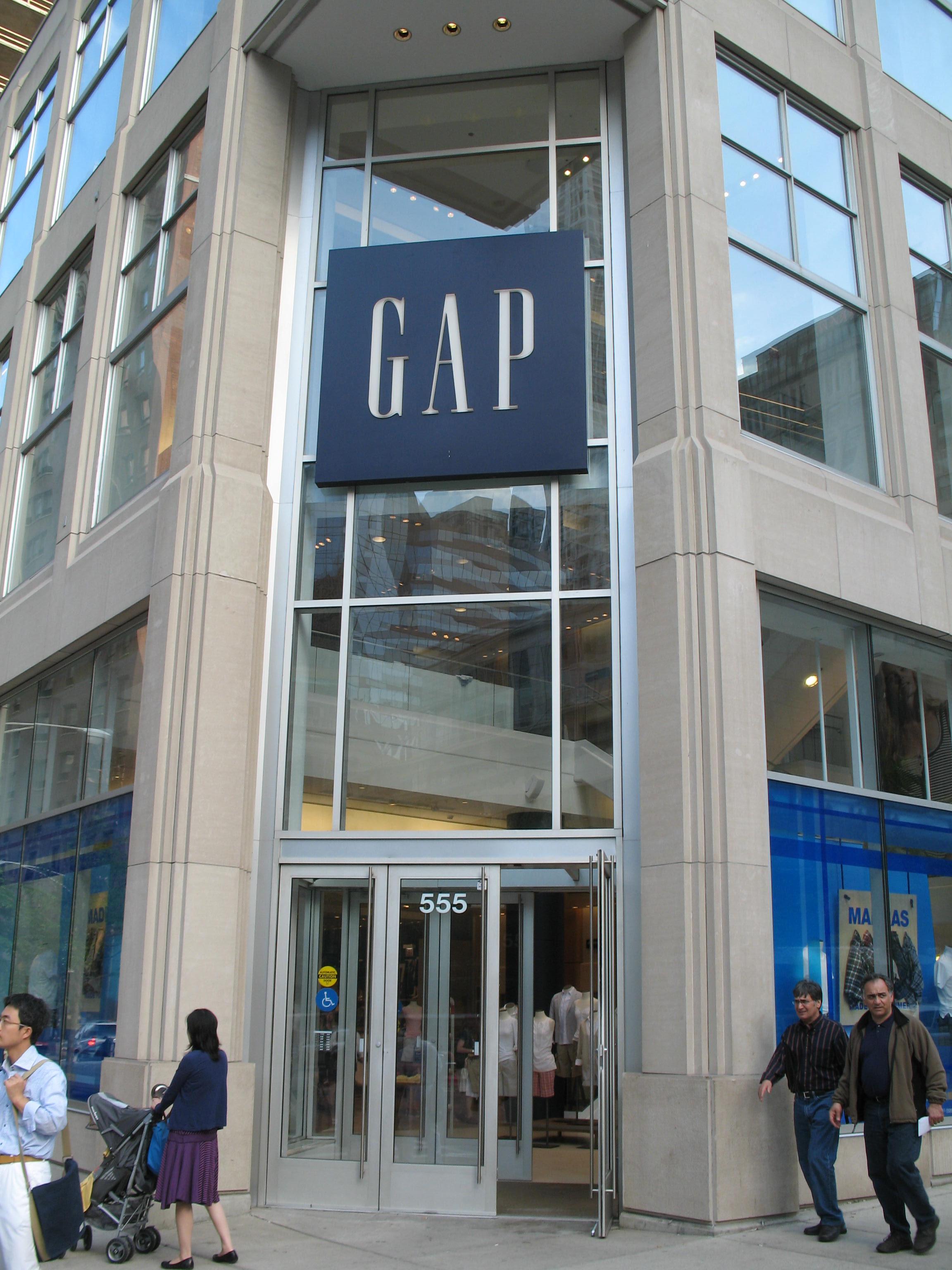
 The Gap has been a fixture of UK High Streets for many years and has had both ups and downs. In a highly competitive market, it faces fierce rivals from other high street retailers and also from an increasingly important online presence. Same-shop sales for Gap fell in July by 7% and the brand is now finding itself in a tricky position.
Although the Gap does sell products at a variety of prices, even sales growth in its most affordable line was not sufficient to offset declines elsewhere. It’s not just the UK where this decline is observed, with 175 Gap specialty shops in America being shut down over the next year. This will inevitably mean job losses. So why is Gap struggling so much, after being such a popular brand?
Its competitors are arguably offering a very similar product, but at a lower price. Consumers, being increasingly aware of prices and having many more options to make price comparisons, are perhaps using this information to make better choices. If they don’t believe that they are getting something extra from paying a slightly higher price at Gap, then they’d prefer to get the same thing elsewhere, from somewhere like Forever 21 or H&M. Some also suggest that the product itself is out of date and with the world of high fashion being such an important part of life for many people, an out-of-date product is bad news. That, together with consumers finding more and more things that they can spend their money on, beyond clothes has led to a tricky position for the Gap.
A key part of maintaining a presence on high streets has been sales and special offers – this has been a key element in keeping customers coming, but it is certainly not a long term strategy. Research analysts have been investigating some of the key aspects of the Gap and various comments have been made, including:
“Uniformity is no longer cool… The trick now is convincing your customer that they’re getting something unique.” (Simeon Siegel), Nomura Securities.
“Of top priority is delivering more consistent and compelling product collections.” Kari Shellhorn, Gap spokeswomen.
“Whether it’s colour or print or it’s pattern, the Gap brand hasn’t been kept up to date … Until they have their product right, I think we’ll continue to see them have promotions.” Dana Telsey, Telsey Advisory Group.
The future of Gap is certainly in the balance and with an increasingly competitive market when it comes to retail, an effective strategy to maintain and increase its market share will be essential.
Why Gap is in a tight squeeze BBC News, Gianna Palmer (20/8/15)
Gap Inc sees some potential for next year but Q2 2015 remains weak Forbes, Investing, Trefis Team (24/8/15)
Questions
- What sort of figure would you expect Gap’s clothes to have and why?
- Into which market structure would you place the retail industry? What does this tell us about how a company such as Gap can hope to make profits?
- If you were advising Gap, what strategies would you propose as a means of boosting revenue and cutting costs?
- The BBC News article states that the fortunes of Gap have been hurt by a strong US dollar. Why may this be the case?
 In the year to June 2014, Qantas, the Australian airline, posted record losses of $2.8 billion. The airline was seen to be in some serious trouble and engaged in various cost-cutting measures. This, together with help from falling oil prices appears to have reversed this company’s fortunes. It posted profits of $557 million in the year to the end of June 2015.
The airline industry was hit by the financial crisis and subsequent worldwide recession. Holidays are a luxury item, such that when incomes are rising, there is a greater demand for travel abroad. Conversely, when incomes fall (as we see in a recession) demand will fall and this can hurt the revenues and profits of airlines such as Qantas.  Qantas, in particular, had been struggling with a high degree of competition from other airlines, who are also competing on key long-haul routes, for example Emirates, Etihad and Singapore. Further competition came at home from Virgin Australia, who had significant backing from other large airlines and Qantas found itself unable to compete with such low prices and restrictions on foreign ownership.
However, with significant layoffs, cancelling some unprofitable routes and various other cost-cutting measures, Qantas will return $505 million of profits to its shareholders and will purchase 8 Boeing 787-9 Dreamliners. This will certainly boost confidence in the company and its Chief Executive, Alan Joyce’s comments may well add to this. He said:
“We are halfway through the biggest and fastest transformation in our history … Without that transformation, we would not be reporting this strong profit, recommencing shareholder returns, or announcing our ultra-efficient Dreamliner fleet for Qantas International.”
Although the investment in so many new planes is a large outlay, it is expected that they will improve the efficiency of its fleet, reducing its fuel bill significantly, especially over its longest routes. As these profit figures only represent a job that is half done, it will be interesting to see how Qantas fares with the recovery of the global economy.
Qantas to buy eight Boeing dreamliners after posting profit of $557m The Guardian (20/8/15)
Qantas returns to full-year profit and pledges new growth phase BBC News (20/8/15)
Qantas soars past overhaul to return to profit Wall Street Journal, Rebecca Thurlow (20/8/15)
Qantas injects another $55 million into Jetstar Japan Sydney Morning Herald, Jamie Freed (24/8/15)
Is Qantas set to keep on soaring? Sydney Morning Herald, John Collett (21/8/15)
Qantas to expand fleet after rapid profit turnaround Reuters (20/8/15)
Qantas turnaround gains altitude with swing to profit Financial Times, Jamie Smyth (20/8/15)
Questions
- Into which market structure would you place the airlines industry?
- Consider the different strategies that were adopted by Qantas and in each case, explain whether it would have had an impact on the firm’s costs or revenues.
- Why was Virgin Australia proving to be such fierce competition for Qantas?
- The Wall Street Journal Article refers to Qantas finding it difficult ‘to attract a White Knight’. What is meant by a White Knight?
- What has been the impact of falling global oil prices on the airline industry? Use a diagram to explain your answer.
 HSBC is a familiar feature of many high streets in the UK and this is hardly surprising, given that it is the largest bank in Europe. But could this be about to change? With uncertainty surrounding the UK’s in-out vote on the EU, the future of the banking levy and HSBC’s desire to reduce the size of its operations, the UK high street might start to look quite different.
In the UK, 26,000 staff are employed in its retail banking sector, with 48,000 workers across the whole of its UK banking operations. HSBC has plans to downsize its business globally, with expected job losses in the UK of 8000 workers and a total of 25,000 jobs across the world. This would reduce its workforce by around 10%. This could have big implications for the UK economy. Although many of the job losses would not be enforced, given that HSBC does have a relatively high staff turnover, it is likely to mean some forced redundancies. With job creation being one of the big drivers of the UK economy in the last couple of years, this could put a dampner on the UK’s economic progress.
A further change we are likely to see will be the renaming of high street branches of HSBC, as new government rules are requiring HSBC to separate its investment and retail banking operations. Much of this stems from the aftermath of the financial crisis and governments trying to reign in the actions of the largest banks. Ring fencing has aimed to do this as a means of protecting the retail banking sector, should the investment banking part of the bank become problematic.
 However, perhaps the biggest potential shock could be the possibility of HSBC leaving the UK and moving to a new base in Hong Kong. A list of 11 criteria has been released by HSBC, outlining the factors that will influence its decision on whether to stay or go.
The UK’s decision on Europe is likely to be a key determinant, but other key factors against remaining in the UK are ‘the tax system and government policy in support of [the] growth and development of [the] financial services sector’. HSBC pays a large banking levy, as it is based not just on UK operations, but on its whole balance sheet.
HSBC’s Chief Executive, Stuart Gulliver, has said that the discussion on the potential move to Hong Kong is based on the changing world.
“We recognise that the world has changed and we need to change with it. That is why we are outlining the following… strategic actions that will further transform our organisation… Asia [is] expected to show high growth and become the centre of global trade over the next decade… Our actions will allow us to capture expected future growth opportunities.”
 Leaving the EU will have big effects on consumers and businesses, given that it is the UK’s largest market, trading partner and investor. Whether or not decisions of key businesses such as HSBC will have an impact on the referendum’s outcome will only be known as we get closer to the day of the vote (which is still some way off!). It will, however, be interesting to see if other companies raise similar issues in the coming year, as the referendum on the EU draws nearer. We should also look out for any potential change in the UK’s banking levy and what impact, if any, this has on HSBC’s decision to stay or go and on the future of any other banks.
Has HSBC already decided to leave the UK? The Telegraph, Ben Wright (10/6/15)
HSBC plans to cut 8,000 jobs in the UK in savings drive BBC News (9/6/15)
The Guaridan view on HSBC: a bank beyond shame The Guardian (10/6/15)
HSBC brand to vanish from UK high streets Financial Times, Emma Dunkley (9/6/15)
HSBC job cuts should come as little surprise Sky News, Ian King (9/6/15)
HSBC in charts: Where the bank plans to generate growth Financial Times, Jeremy Grant (9/6/15)
HSBC’s local rethink can’t shore up global act Wall Street Journal, Paul Davies (9/6/15)
Can George Osborne persuade HSBC to stay in the UK? BBC News, Kamal Ahmed (9/6/15)
Questions
- What is the UK’s banking levy and why does it affect a company like HSBC disproportionately?
- Look at the list of 11 criteria that HSBC have produced about staying in the UK or moving to Hong Kong. With each criterion, would you place it in favour of the UK or Hong Kong?
- Why is the banking sector ‘not a fan’ of the government policy of ring fencing?
- What impact would the loss of 8000 UK jobs have on the UK economy?
- Why does it matter to a bank such as HSBC if the UK is a member of the EU?
 The eurozone has been suffering from deflation: that is, negative inflation. But, the latest data show an increase in the rate of inflation in April from 0% to 0.3%. This is still a very low rate, with a return to deflation remaining a possibility (though perhaps unlikely); but certainly an improvement.
The eurozone economy has been stagnant for some time but the actions of the European Central Bank (ECB) finally appear to be working. Prices across the eurozone have risen, including services up by 1.3%, food and drink up by 1.2% and energy prices, albeit still falling, but at a slower rate. All of this has helped to push the annual inflation rate above 0%. For many, this increase was bigger than expected. Howard Archer, Chief European Economist at HIS Global Insight said:
“Renewed dips into deflation for the eurozone are looking increasingly unlikely with the risks diluted by a firming in oil prices from their January lows, the weakness of the euro and improved eurozone economic activity.”
Economic policy in the eurozone has focused on stimulating the economy, with interest rates remaining low and a €1.1 trillion bond-buying programme by the ECB. But, why is deflation such a concern? We know that one of the main macroeconomic objectives of a nation is low and stable inflation. If prices are low (or even falling) is it really as bad as economists and policy-makers suggest?
The problem of deflation occurs when people expect prices to continue falling and thus delay spending on durables, hoping to get the products cheaper later on. As such, consumption falls and this puts downward pressure on aggregate demand. This decision by consumers to put off spending will cause aggregate demand to shift to the left, thus pushing national income down, creating higher unemployment and adding to problems of economic stagnation. If this expectation continues, then so will the inward shifts in AD. In the eurozone, this has been a key problem, but it now appears that aggregate demand has stopped falling and is now slowly recovering, together with the economy.
 It is important to note how interdependent all aspects of an economy are. The euro responded as news of better inflation data emerged, together with expectations of a Greek deal being reached. Enrique Diaz-Alvarez, chief risk officer at Ebury said:
“The move [rise in euro] got going with the big upside surprise in eurozone inflation data — especially core inflation, which bounced up from 0.6 per cent to 0.9 per cent. This is exactly what the ECB wants to see, as it is proof that QE is having the desired effect and removes the threat of deflation in the eurozone from the foreseeable future.”
One of the key factors that has kept inflation down in the eurozone (and also the UK) is falling oil prices. It is for this reason that many have been suggesting that this type of deflation is not bad deflation. With oil prices recovering, the general price level will also recover and so economies will follow suit. The following articles consider the fortunes of the eurozone.
Eurozone inflation shouldn’t shift ECB’s QE focus Wall Street Journal, Richard Barley (2/6/15)
Eurozone deflation threat recedes Financial Times, Claire Jones (2/6/15)
Eurozone inflation rate rises to 0.3% in May BBC News (2/6/15)
Eurozone back to inflation as May prices beat forecast Reuters, Jan Strupczewski (2/6/15)
Boost for ECB as Eurozone prices turn positive in May Guardian, Phillip Inman (2/6/15)
Eurozone inflation higher than expected due to quantitative easing International Business Times, Bauke Schram (2/6/15)
Euro lifted by Greek deal hopes and firmer inflation data Financial Times, Roger Blitz and Michael Hunter (2/6/15)
Questions
- What is the difference between the 0.3% and 0.9% figures quoted for inflation in the eurozone?
- What is deflation and why is it such a concern?
- Illustrate the impact of falling consumer demand in an AD/AS diagram.
- How has the ECB’s QE policy helped to tackle the problem of deflation? Do you think that this programme needs to continue or now the economy has begun to improve, should the programme end?
- To what extent is the economic stagnation in the eurozone a cause for concern to countries such as the UK and USA? Explain your answer.
- Why has the euro risen, following news of this positive inflation data?
 You may be used to these types of blogs by now … On my commute to work on the 18th May, I listened to Start the Week on BBC radio 4 and happened upon a fascinating discussion on inequality.
Of those discussing the issue, one certainly needs no introduction: Joseph Stiglitz, a prominent economist, author and commentator on economics, in particular on inequality. He was joined by Steve Hilton, who has worked for David Cameron for many years in providing advice on a range of issues, including inequality and strategy and has written on existing institutions and their effectiveness. The final panellist was Masha Gessen, who has written extensively on Russia and in particular on the journey of the infamous Boston Bomber.
Though the discussion covers a variety of areas relevant to economics, one key area that is addressed is inequality and the policies that are being used to address the causes and the symptoms. You can access the 45-minute discussion at the link below.
 Joseph Stiglitz and Steve Hilton on inequality BBC Radio 4 (18/5/15)
Questions
- How would you measure inequality?
- Why is it important to distinguish between the causes and symptoms of poverty when designing government policy?
- To what extent do you believe that education is an essential requirement for growth and development?
- Why has inequality grown in some of the most developed nations?
- How is it possible that inequality in the developed world has grown, while global inequality has fallen?
- Why does the report argue that the reforms they suggest would help boost growth?
- Do you agree that existing institutions are not suitable for society today?