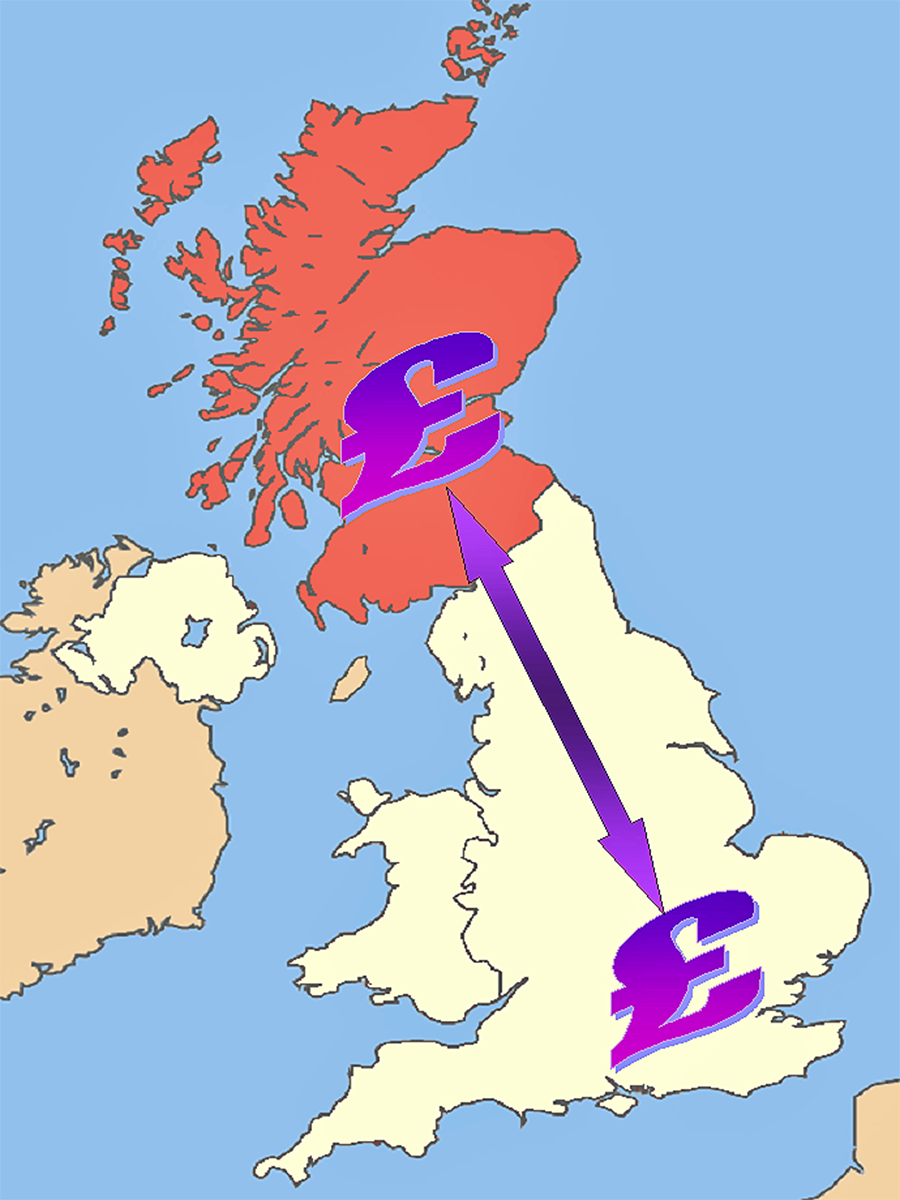
 Scottish voters will be crucial in the upcoming election, with the SNP poised to take many of Labour’s seats north of the border. The future of Scotland will depend on which party comes to power and what decisions are made with regards to its finances.
Nicola Sturgeon wants government spending and taxation powers transferred to the Scottish Parliament, but would this mean spending cuts and tax rises for the Scottish people? Ed Miliband, Labour’s leader has been vocal in pointing out what this might mean, with cuts to pensions or raising taxes. However, given that it is Labour that is facing the biggest threat from the SNP, it is perhaps hardly surprising.
However, as the first video below shows, there would be an estimated £7.6bn deficit in Scotland, according to the IFS if spending and taxing was to be transferred here. This is because the tax revenues raised in Scotland are lower per person and spending per person is higher than across the whole of the UK. Oil prices are extremely low at present and hence this is reducing tax revenues. When the oil price does rise, revenues will increase and so if the split in finances was to occur this would reduce that deficit somewhat, but it would still leave a rather large hole in Scotland’s finances. The following videos and articles consider the SNP’s plans.
Videos
 SNP fiscal autonomy plan: What would it do to Scotland’s finances? BBC News, Robert Peston (10/4/15)
Labour attacks SNP’s ‘devastating’ economic plans BBC News (10/4/15)
Articles
Ed Miliband attacks SNP plan for Scottish fiscal autonomy The Guardian, Severin Carrell (10/4/15)
Ed Miliband wars pensions will be cut under SNP plans The Telegraph, Auslan Cramb (10/4/15)
SNP fails to account for billions in welfare and pensions pledge, says IFS The Guardian, Severin Carrell (10/4/15)
Questions
- What is a budget deficit?
- What does fiscal autonomy for Scotland actually mean?
- The IFS suggests that there will be a large deficit in Scottish finances if they gain autonomy. How could this gap be reduced?
- Why has Labour claimed that tax rises would occur under the SNP’s plans? What could this mean for Scottish growth?
- Why do lower oil prices reduce tax revenues for Scotland?
- If Scotland had control over its finances, it could influence where government spending goes. Which industries would you invest in if you were in charge?
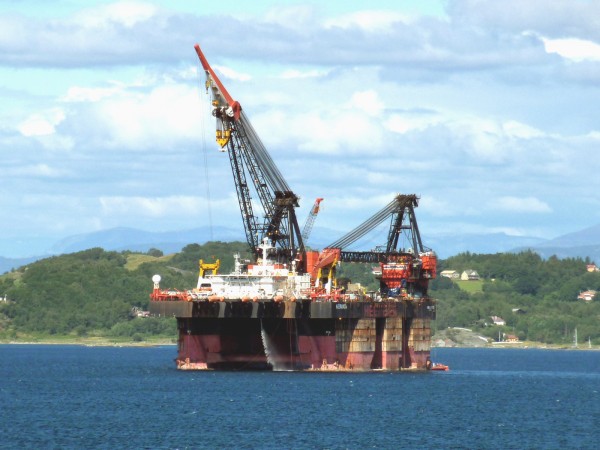 The Budget takes place on 17th March 2015 and as always there is much speculation as to what it will and won’t include. One industry that is eagerly awaiting Osborne’s Budget is the North Sea oil and gas industry. Tax cuts and rises may well play a key role in the Budget, but this is one sector where a possibly large tax cut is expected.
The tax paid by this industry is very high compared to others, potentially reaching 80%. The tax rate was increased some years ago and it is now thought that it may come back down. One key factor is oil prices: with such huge decreases in the price of oil relative to when the tax on the industry was increased, the industry is now asking for these tax rises to be reversed. The industry has suggested that a 10% tax cut is a possibility and this would make a big difference for the industry.
Danny Alexander, the chief secretary to the Treasury, said:
“We’ve been very clear that the direction of travel for tax in the North Sea needs to be downwards … And that needs to be even stronger given the low oil price we see at the moment. We want people to have the confidence to invest for the long term future of the North Sea … And so George Osborne and I have been listening very carefully to what the industry has been saying …People will have to wait and see what we say on Wednesday [Budget day], but I hope very much that it will give the North Sea that confidence that we all want to see for one of Britain’s most important industries.”
We may also see further changes for this industry, such as allowances to encourage further investment, as costs of investment are extremely high and this has led to many years of under-investment. These changes are hoped to regenerate this industry. Any change in tax allowances or tax rates will have an impact on tax revenue and it is not necessarily the case that an increase in tax will lead to a rise in revenue or a fall in revenue. The relationship between tax rates and tax revenues can be very complex. The following articles consider this particular issue and what the Budget will do for this industry.
North sea oil groups set for tax breaks in budget Financial Times, Christopher Adams and George Parker (16/3/15)
What does the Budget 2015 mean for the North sea oil industry? The Telegraph, Andrew Critchlow (16/3/15)
Britain needs oil tax cuts to attract North Sea Investment Reuters, Karolin Schaps and Claire Milhench (16/3/15)
Treasury paves way for major tax cut for North sea BBC News, Kamal Ahmed (16/3/15)
Home of Brent Oil benchmark seeks help as investment slumps Bloomberg, Firat Kayakiran (17/3/15)
Questions
- If a tax is imposed on an industry, what type of effect might this have on costs of production? Use a diagram to support your answer.
- In the BBC News article, North Sea Oil is referred to as a cash cow. What does this mean?
- If taxes are cut for the North Sea Oil industry, how will this affect its costs and what might it doe for investment?
- What will happen to tax revenues if taxes are cut? Use the Laffer curve to help your answer.
- How has the North Sea Oil industry been affected by falling oil prices? Does this offer a justification for a tax cut?
 Many UK coal mines closed in the 1970s and 80s. Coal extraction was too expensive in the UK to compete with cheap imported coal and many consumers were switching away from coal to cleaner fuels. Today many shale oil producers in the USA are finding that extraction has become unprofitable with oil prices having fallen by some 50% since mid-2014 (see A crude indicator of the economy (Part 2) and The price of oil in 2015 and beyond). So is it a bad idea to invest in fossil fuel production? Could such assets become unusable – what is known as ‘stranded assets‘?
In a speech on 3 March 2015, Confronting the challenges of tomorrow’s world, delivered at an insurance conference, Paul Fisher, Deputy Governor of the Bank of England, warned that a switch to both renewable sources of energy and actions to save energy could hit investors in fossil fuel companies.
‘One live risk right now is of insurers investing in assets that could be left ‘stranded’ by policy changes which limit the use of fossil fuels. As the world increasingly limits carbon emissions, and moves to alternative energy sources, investments in fossil fuels and related technologies – a growing financial market in recent decades – may take a huge hit. There are already a few specific examples of this having happened.
… As the world increasingly limits carbon emissions, and moves to alternative energy sources, investments in fossil fuels and related technologies – a growing financial market in recent decades – may take a huge hit. There are already a few specific examples of this having happened.’
Much of the known reserves of fossil fuels could not be used if climate change targets are to be met. And investment in the search for new reserves would be of little value unless they were very cheap to extract. But will climate change targets be met?  That is hard to predict and depends on international political agreements and implementation, combined with technological developments in fields such as clean-burn technologies, carbon capture and renewable energy. The scale of these developments is uncertain. As Paul Fisher said in his speech:
‘Tomorrow’s world inevitably brings change. Some changes can be forecast, or guessed by extrapolating from what we know today. But there are, inevitably, the unknown unknowns which will help shape the future. … As an ex-forecaster I can tell you confidently that the only thing we can be certain of is that there will be changes that no one will predict.’
The following articles look at the speech and at the financial risks of fossil fuel investment. The Guardian article also provides links to some useful resources.
Articles
Bank of England warns of huge financial risk from fossil fuel investments The Guardian, Damian Carrington (3/3/15)
PRA warns insurers on fossil fuel assets Insurance Asset Risk (3/3/15)
Energy trends changing investment dynamics UPI, Daniel J. Graeber (3/3/15)
Speech
Confronting the challenges of tomorrow’s world Bank of England, Paul Fisher (3/3/15)
Questions
- What factors are taken into account by investors in fossil fuel assets?
- Why might a power station become a ‘stranded asset’?
- How is game theory relevant in understanding the process of climate change negotiations and the outcomes of such negotiations?
- What social functions are filled by insurance?
- Why does climate change impact on insurers on both sides of their balance sheets?
- What is the Prudential Regulation Authority (PRA)? What is its purpose?
- Explain what is meant by ‘unknown unknowns’. How do they differ from ‘known unknowns’?
- How do the arguments in the article and the speech relate to the controversy about investing in fracking in the UK?
- Explain and comment on the statement by World Bank President, Jim Yong Kim, that sooner rather than later, financial regulators must address the systemic risk associated with carbon-intensive activities in their economies.
As we saw in Part 1 of this blog, oil prices have fallen by some 46% in the past five months. In that blog we looked at the implications for fuel prices. Here we look at the broader implications for the global economy? Is it good or bad news – or both?
First we’ll look at the oil-importing countries. To some extent the lower oil price is a reflection of weak global demand as many countries still struggle to recover from recession. If the lower price boosts demand, this may then cause the oil price to rise again. At first sight, this might seem merely to return the world economy to the position before the oil price started falling: a leftward shift in the demand for oil curve, followed by a rightward shift back to where it was. However, the boost to demand in the short term may act as a ‘pump primer’. 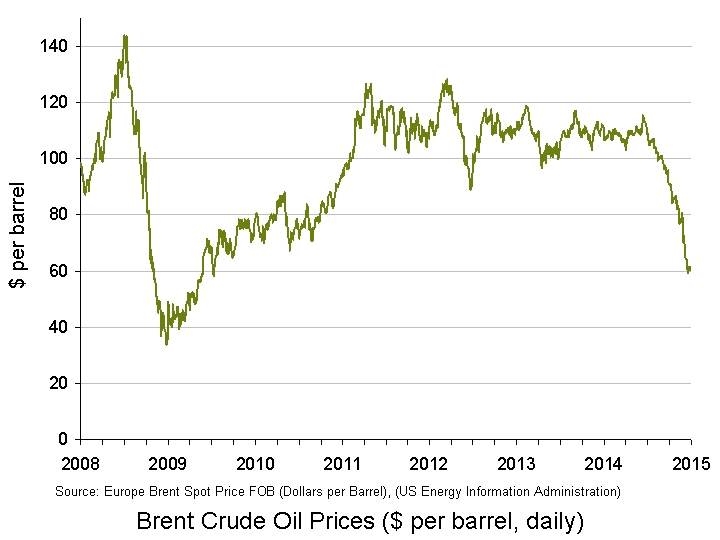 The higher aggregate demand may result in a multiplier effect and cause a sustained increase in output, especially if it stimulates a rise in investment through rising confidence and the accelerator, and thereby increases capacity and hence potential GDP.
But the fall in the oil price is only partly the result of weak demand. It is mainly the result of increased supply as new sources of oil come on stream, and especially shale oil from the USA. Given that OPEC has stated that it will not cut its production, even if the crude price falls to $40 per barrel, the effect has been a shift in the oil supply curve to the right that will remain for some time.
So even if the leftward shift in demand is soon reversed so that there is then some rise in oil prices again, it is unlikely that prices will rise back to where they were. Perhaps, as the diagram illustrates, the price will rise to around $70 per barrel. It could be higher if world demand grows very rapidly, or if some sources of supply go off stream because at such prices they are unprofitable.
The effect on oil exporting countries has been negative. The most extreme case is Russia, where for each $10 fall in the price of oil, its growth rate falls by around 1.4 percentage points (see). Although the overall effect on global growth is still likely to be positive, the lower oil price could lead to a significant cut in investment in new oil wells. North sea producers are predicting a substantial cut in investment. Even shale oil producers in the USA, where the marginal cost of extracting oil from existing sources is only around $10 to £20 per barrel, need a price of around $70 or more to make investment in new sources profitable. What is more, typical shale wells have a life of only two or three years and so lack of investment would relatively quickly lead to shale oil production drying up.
The implication of this is that although there has been a rightward shift in the short-run supply curve, if price remains low the curve could shift back again, meaning that the long-run supply curve is much more elastic. This could push prices back up towards $100 if global demand continues to expand.
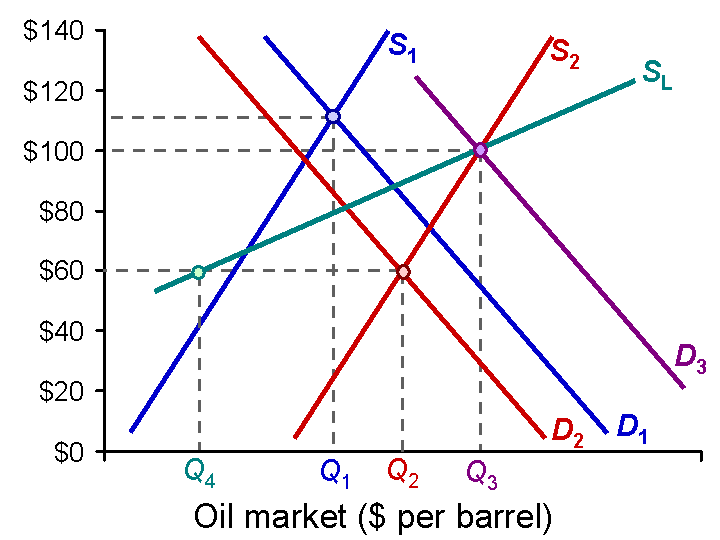 This can be illustrated in the diagram. The starting point is mid-2014. Global demand and supply are D1 and S1; price is $112 per barrel and output is Q1. Demand now shifts to the left and supply to the right to D2 and S2 respectively. Price falls to $60 per barrel and, given the bigger shift in supply than demand, output rises to Q2. At $60 per barrel, however, output of Q2 cannot be sustained. Thus at $60, long-run supply (shown by SL) is only Q4.
But assuming the global economy grows over the coming months, demand shifts to the right: say, to D3. Assume that it pushes price up to $100 per barrel. This gives a short-run output of Q3, but at that price it is likely that supply will be sustainable in the long run as it makes investment sufficiently profitable. Thus curve D3 intersects with both S2 and SL at this price and quantity.
The articles below look at the gainers and losers and at the longer-term effects.
Articles
Where will the oil price settle? BBC News, Robert Peston (22/12/14)
Falling oil prices: Who are the winners and losers? BBC News, Tim Bowler (16/12/14)
Why the oil price is falling The Economist (8/12/14)
The new economics of oil: Sheikhs v shale The Economist (6/12/14)
Shale oil: In a bind The Economist (6/12/14)
Falling Oil Price slows US Fracking Oil-price.net, Steve Austin (8/12/14)
Oil Price Drop Highlights Need for Diversity in Gulf Economies IMF Survey (23/12/14)
Lower oil prices boosting global economy: IMF Argus Media (23/12/14)
Collapse in oil prices: producers howl, consumers cheer, economists fret The Guardian (16/12/14)
North Sea oilfields ‘near collapse’ after price nosedive The Telegraph, Andrew Critchlow (18/12/14)
How oil price fall will affect crude exporters – and the rest of us The Observer, Phillip Inman (21/12/14)
Cheaper oil could damage renewable energies, says Richard Branson The Guardian,
Richard Branson: ‘Governments are going to have to think hard how to adapt to low oil prices.’ John Vidal (16/12/14)
Data
Brent crude prices U.S. Energy Information Administration (select daily, weekly, monthly or annual data and then download to Excel)
Brent Oil Historical Data Investing.com (select daily, weekly, or monthly data and time period)
Questions
- What would determine the size of the global multiplier effect from the cut in oil prices?
- Where is the oil price likely to settle in (a) six months’ time; (b) two years’ time? What factors are you taking into account in deciding your answer?
- Why, if the average cost of producing oil from a given well is $70, might it still be worth pumping oil and selling it at a price of $30?
- How does speculation affect oil prices?
- Why has OPEC decided not to cut oil production even though this is likely to drive the price lower?
- With Brent crude at around $60 per barrel, what should North Sea oil producers do?
- If falling oil prices lead some oil-importing countries into deflation, what will be the likely macroeconomic impacts?
 Oil prices have been plummeting in recent months. Indeed, many commentators are saying that this is the major economics news story of 2014. In June 2014 Brent crude was around $112 per barrel. By December the price has fallen to around $60 – a fall of 46%. But what are the implications for fuel prices?
Just because the crude oil price has fallen by 46%, this does not mean that prices at the pump should do the same. Oil is priced in dollars and the pound has depreciated against the dollar by just over 7% since June, from around £1 = $1.69 to around £1 = $1.57. Thus in sterling terms, crude oil has fallen by only 42%.
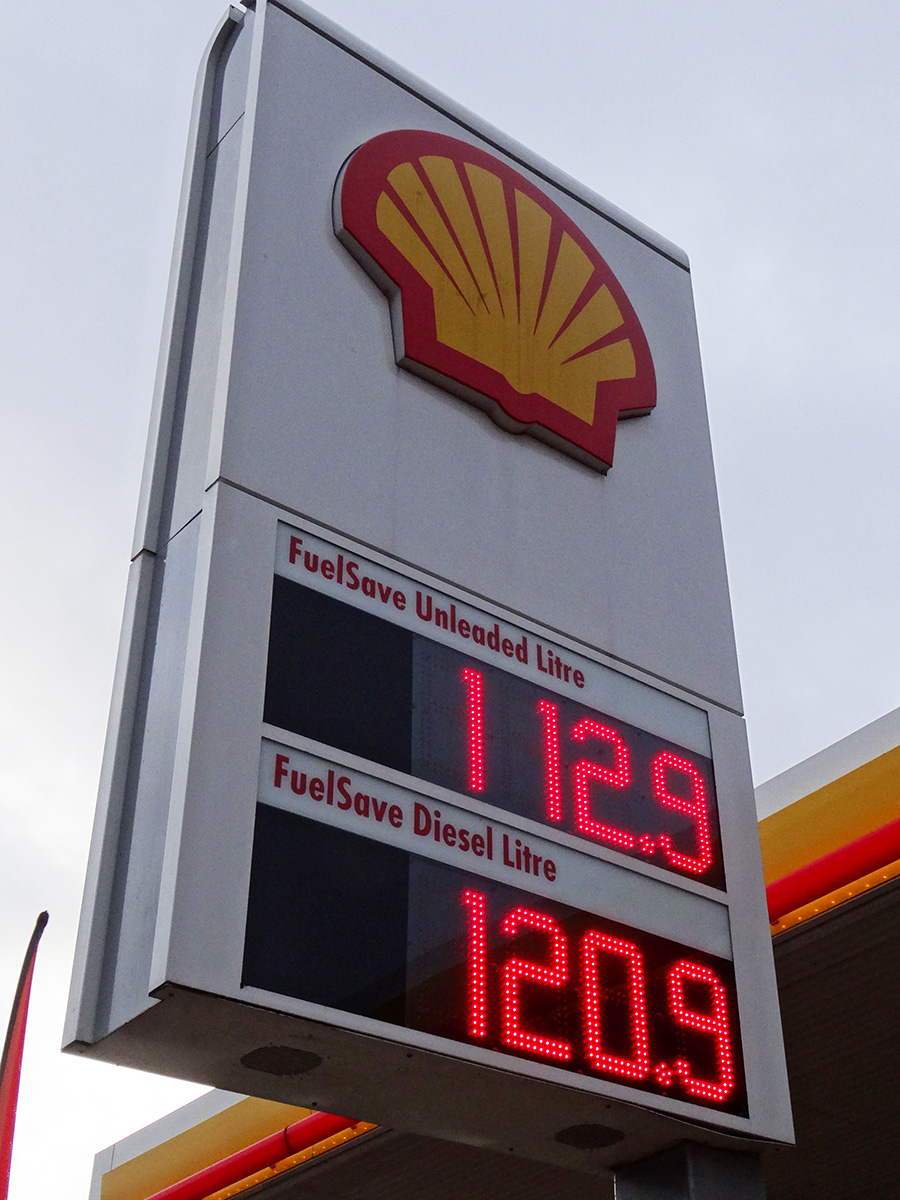
More significantly, the cost of crude is a relatively small percentage of the price of a litre of petrol. At a price of 132p per litre (the July average price), crude accounted for around 27% of the price, or around 36p per litre. At a price of 114p per litre, the price in late December, crude accounts for around 19% of the price, or around 21.5p per litre. The largest element of price is fuel duty, which is charged at a flat rate of 57.95p per litre. In addition there is VAT at 20% of the pre-VAT price (or 16.67% of the retail price). Finally there are the refining, distribution and retail costs and margins, but these together account for only around 16p per litre.
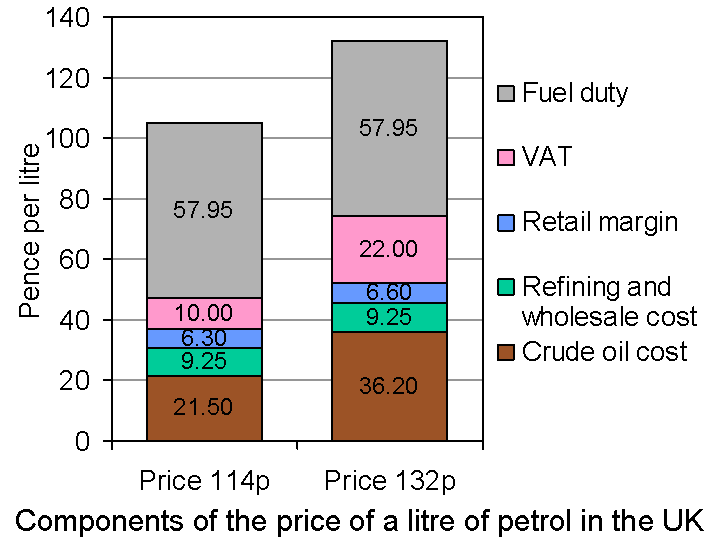 What this means is that the 46% cut in oil prices has led to a cut in petrol prices of only around 14%. If petrol prices were to reach £1 per litre, as some commentators have forecast, crude oil prices would have to fall to under $40 per barrel.
Although petrol and diesel prices have fallen by a smaller percentage than oil prices, this still represents a significant cut in motoring and transport costs. It also represents a significant cut in costs for the petrochemical industry and other industries using large amounts of oil.
For oil-importing countries this is good news as the fall in the oil price represents an increase in real incomes. For oil importing countries, and especially those such as Russia and some OPEC countries where oil constitutes a large proportion of their exports, it is bad news. We explore these effects in Part 2.
Videos
UK petrol prices hit four-year low BBC News, John Moyland (10/12/14)
Petrol prices plunge ahead of Christmas holidays Belfast Telegraph (19/12/14)
Petrol price plummet – could fuel drop to below a pound a litre in the New Year? Channel 5 News on YouTube (17/12/14)
Articles
UK motorists benefit from petrol price drop Financial Times, Michael Kavanagh (23/12/14)
Petrol to drop to £1 a litre, says Goldman Sachs The Telegraph, Szu Ping Chan (9/12/14)
Oil prices: How low will they go in 2015? International Business Times, Shane Croucher (22/12/14)
Plummeting oil price may lead to petrol falling below £1 a litre RAC news (17/12/14)
Pump Prices: Cheap Petrol Comes With A Warning Sky News (19/12/14)
Data and information
Fuel prices in Europe Drive Alive (20/12/14)
Weekly road fuel prices Department of Energy & Climate Change (23/12/14)
Prices at the pump – why are they falling and will this continue? ONS (18/12/14)
Fuel Prices Explained RAC
UKPIA Statistical Review 2014 United Kingdom Petroleum Industry Association
Questions
- Why does the price of petrol fluctuate less in percentage terms than the price of crude oil?
- What factors will affect whether UK petrol prices fall to £1 per litre?
- If crude oil prices fell by 20%, in which of these two cases would there be a bigger percentage fall in petrol prices: (a) petrol price currently 140p; (b) petrol price currently 110p? Explain.
- Distinguish between a specific tax and an ad valorem tax. Which of these is (a) fuel duty; (b) VAT? Illustrate your answer with a supply and demand diagram.
- What determines the price elasticity of demand for petrol and diesel? Is the long-run elasticity likely to be higher or lower than the short-run elasticity? Explain.
- Distinguish between demand-pull and cost-push inflation. Given that oil price changes are correlated to inflation, would you characterise recent falls in inflation as reductions in demand-pull or cost-push pressures, or both: (a) in a specific oil-importing country; (b) globally?