 Paul Volcker was Chair of the US Federal Reserve from 1979 to 1987. He was also Chair of the Economic Recovery Advisory Board under President Barack Obama from February 2009 to January 2011. In the webcast and articles below, he reflects on the current state of the world financial system – from regulation, to the euro crisis, to world imbalances, to the system of floating exchange rates.
He argues that global financial systems are vulnerable to breakdowns. What is needed is reform to the system, and for that there needs to be consensus by politicians, regulators and central banks.
But, in the absence of international consensus on some key points, reform will be greatly weakened, if not aborted. The freedom of money, financial markets and people to move – and thus to escape regulation and taxation – might be an acceptable, even constructive, brake on excessive official intervention, but not if a deregulatory race to the bottom prevents adoption of needed ethical and prudential standards.
Perhaps most important is a coherent, consistent approach to dealing with the imminent failure of “systemically important” institutions. Taxpayers and governments alike are tired of bailing out creditors for fear of the destructive contagious effects of failure – even as bailouts encourage excessive risk-taking.
According to Volcker, countries must be prepared to surrender some sovereignty. Policies must be co-ordinated internationally and there must be stronger regulation by international bodies, such as the IMF and stronger concerted action by global organisations, such as the G20.
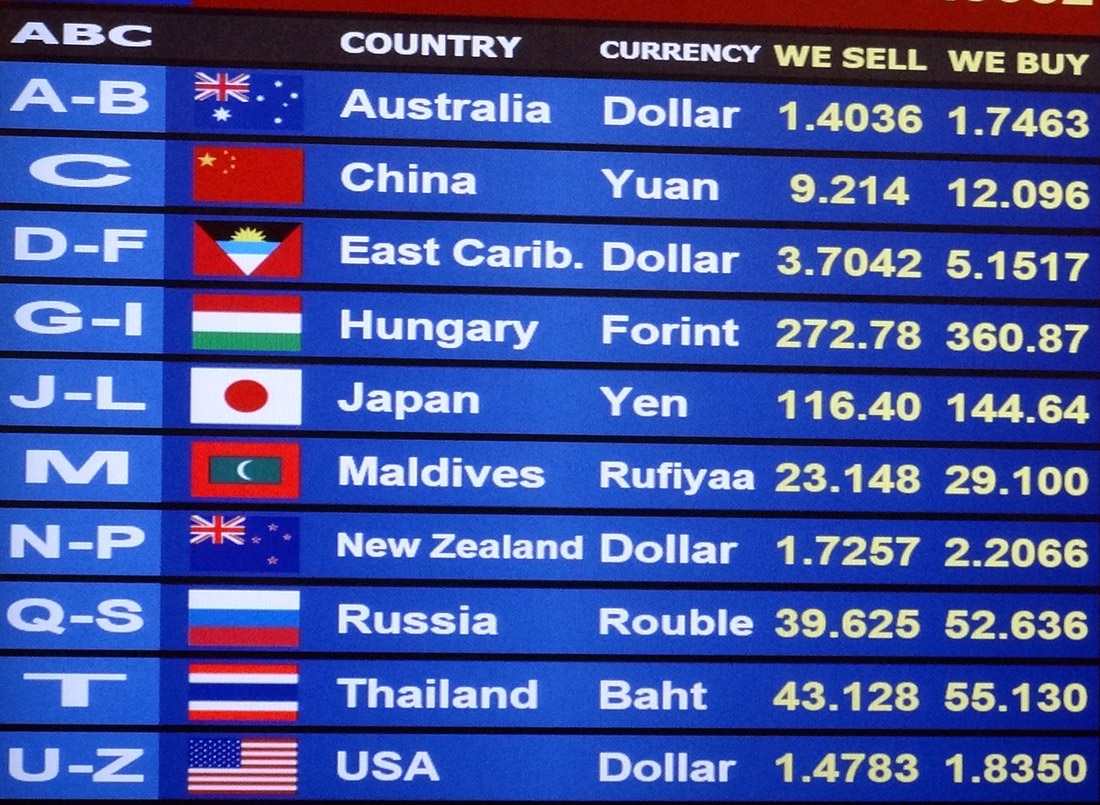 Left to their own devices, in an era of floating exchange rates, countries may pursue policies that exacerbate global imbalances.
Not so long ago, we were comforted by theorising that floating exchange rates would mediate international adjustments in a timely and orderly way. But, in the real world, many countries, particularly but not limited to small, open economies, simply find it impractical or undesirable to permit their currency to float.
We are left with the certainty, however awkward, that active participation in an open world economy requires some surrender of economic sovereignty. Or, to put the point more positively, it requires a willingness to co-ordinate policies more effectively.
Webcast
 Volcker Urges Global Monetary System Overhaul BloombergBusinessweek (31/5/12)
Articles
Is global financial reform possible? Guardian, Paul Volcker (6/6/12)
Volcker Urges Global Financial System Overhaul After Crisis BloombergBusinessweek, Robyn Meredith and Shamim Adam (31/5/12)
Questions
- What reforms, according to Volcker, need to be implemented in order for the euro to function effectively without crises?
- What can the USA do to ease the euro crisis?
- What are Volcker’s views on the regulation of the US banking system?
- How are incentive structures in banks related to speculative activities?
- Should banks be allowed to fail?
- What financial imbalances exist between countries?
- What international monetary reforms are required?
- What light can game theory shed on the difficulty of achieving global policy co-ordination?
- Is an international system of floating exchange rates appropriate given the size of international financial flows?
 The UK’s trade deficit narrowed in March to £2.74bn from £2.95bn in February. The goods deficit fell just slightly to £8.56bn from £8.59bn, but the services surplus rose more substantially to £5.83bn from £5.64bn.
So was this a sign of the UK economy’s relative weakness holding back the demand for imports? Or was it a sign of a recovering export sector, especially in services?
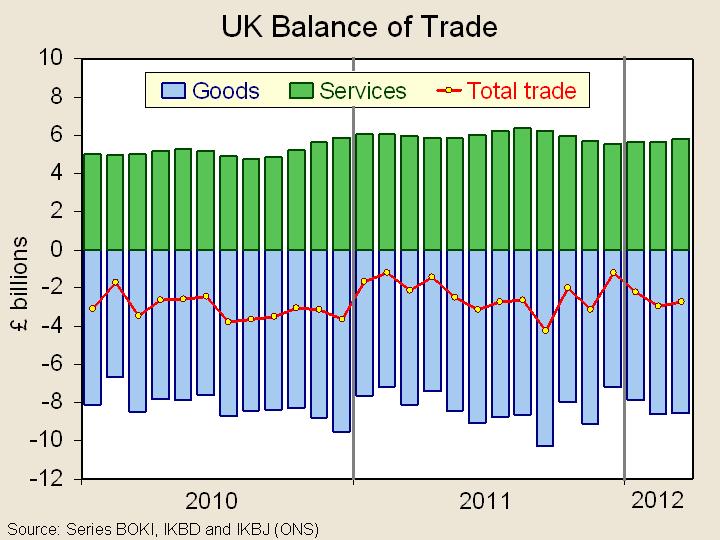 And what of the coming months? What will be the effect of a growing crisis in the eurozone on (a) the sterling exchange rate, (b) the rate of economic growth outside the UK and (c) UK economic growth? And what will be the effect of these on the demand for imports and exports and on the trade balance? The following articles examine the issues.
(For a PowerPoint of the above chart, click on the following link: Balance of trade)
Articles
UK goods trade deficit stable as exports to non-EU countries rebound Reuters (15/5/12)
UK trade deficit narrows in March to £2.7bn BBC News (15/5/12)
Exports close UK trade deficit Guardian (15/5/12)
First trade surplus in cars since 1976 The Telegraph, Emma Rowley (15/5/12)
UK trade deficit narrows in March Fresh Business Thinking, Marcus Leach (15/5/12)
ONS Release
UK Trade, March 2012 ONS Release (15/5/12)
Questions
- Distinguish between the balance on trade in goods, the balance of trade and the balance on current account.
- Why did the UK’s trade deficit fall in March 2012?
- Why did the UK experience its first trade surplus in cars since 1976?
- What is likely to happen to the UK’s balance of trade in the coming months? How is the income elasticity of demand for UK exports and imports relevant to the answer?
- What has been happening recently to the sterling exchange rate? How will this impact on the UK’s balance of trade? How will the size of this impact depend on the price elasticity of demand and supply for imports and exports?
Bank rate in the UK has been at the historically low level of 0.5% since March 2009 and the MPC decision on 13 January was to leave the rate unchanged (see also). But inflation has been well above the Bank of England’s target of 2% since December 2009 and it could well rise further as international commodity prices are soaring. Some economists are thus arguing that Bank rate should rise. This is crucial, they say, to dampen inflationary expectations.
Other economists, however, argue that aggregate demand is likely to remain depressed and that the economy is operating with a large negative output gap. What is more, house prices are falling, as are real wages (see Bosses gain – workers’ pain)
In the following extract from BBC Radio 4’s Today Programme, two economists, Charles Goodhart and Willem Buiter, both former members of the MPC, debate the issue.
Podcast
Should interest rates rise? BBC Today Programme (13/1/11)
Data
Economic and Labour Market Review, Office for National Statistics (For inflation data see Tables Chapter 3, Table 3.01; for interest rates see Tables Chapter 5, Table 5.08)
Monetary Policy Committee Decisions Bank of England
Questions
- What are the arguments for a rise in Bank rate at the current time?
- What are the arguments against a rise in Bank rate at the current time?
- What information would you require to decide which of the arguments was the more powerful?
- Why is it difficult to decide the size of the output gap?
- To what extent do the arguments for and against a rise in Bank rate depend on the factors determining expectations, and what expectations are important here?
- To what extent are exchange rates relevant to the effectiveness of interest rate policy?
Two reports on business confidence in the UK have just been published. The first, by Lloyds TSB Commercial, is its twice-yearly Business in Britain Report. The second is the Quarterly Economic Survey by the British Chambers of Commerce. Both reports paint a mixed picture about business confidence.
First the good news: the export sector is booming. Demand for exports is being boosted by (a) the depreciation of the pound, with the sterling exchange rate index some 20% lower now compared with the start of 2008 and (b) rapid economic growth in China, India and many other developing countries. Not surprisingly many exporting companies are looking to a bright future and are willing to invest.
Now the bad news. Domestic demand for many products is declining, especially services. This is not surprising given the rise in VAT, cuts in public spending and consumers cautious about their employment and income prospects in the coming year. With rapid cost-push inflation from higher oil and commodity prices, real incomes are set to fall and with it the level of real consumer demand (see Bosses gain – workers’ pain).
So where is the economy heading? The mixed picture painted by the two reports mean that the economy is likely to remain on the cusp. But with the export sector being much smaller than the domestic market, worries are likely to persist that economic growth may well slow significantly and the economy might return to recession. The main hope is that the restocking and replacement investment that follow a recession may be enough to provide just enough extra demand to avoid the ‘double dip’.
Articles
UK Business Confidence Hit By Domestic Demand Fears-Survey NASDAQ, Emma Haslett (4/1/11)
More doom and gloom as business confidence falls? Management Today, Nicholas Winning (5/1/11)
Smaller businesses do not share optimism Financial Times, Brian Groom (5/1/11)
New Year business confidence hit by domestic demand fears The Telegraph, James Hurley (5/1/11)
UK’s fragile services sector risks undermining recovery, BCC warns The Telegraph, Philip Aldrick (11/1/11)
Companies fear double-dip recession Oxford Mail, Andrew Smith (10/1/11)
Firms ‘planning investment freezes’ Press Association (4/1/11)
Surveys paint bleak picture for British economy Reuters, David Milliken (11/1/11)
Kern Says U.K. Services Industry Growth Is `Mediocre’ Bloomberg, Watch Video, David Kern (11/1/11)
UK economic growth rate slowing, BCC says BBC News (11/1/11)
Reports
Business in Britain, December 2010 Lloyds TSB Commercial (January 2011)
Quarterly Economic Survey, Q4 2010: Summary British Chambers of Commerce (January 2011)
Quarterly Economic Survey, Q4 2010: Tables British Chambers of Commerce (January 2011)
Data
Interest Rates and Exchange Rates Bank of England (for sterling effective exchange rates)
Economic and Labour Market Review Office for National Statistics (see Tables Chapter 1, worksheets in Table 1.03 for components of aggregate demand)
Business and Consumer Surveys European Commission, Economic and Financial Affairs (see latest ESI – Economic Sentiment Indicator, Table 1)
Questions
- Summarise the findings of the two reports.
- Using the data in Table 1.03 of the Economic and Labour Market Review, calculate the percentage of UK GDP accounted for by each of the main elements of aggregate expenditure.
- Why is the manufacturing sector as a whole experiencing relatively strong economic growth?
- If the service sector shrank by x% and the manufacturing sector grew by x%, what would be likely to happen to the rate of economic growth in the economy? What else would you need to know to establish the precise rate of economic growth?
- The BCC said both the government and the Bank of England must “act forcefully to support growth”. What measures would this include?
- If real wages fall, what could cause real aggregate demand to rise in these circumstances?
- What is likely to drive the level of investment in the coming months?
It is the Bank of England’s responsibility to ensure that inflation remains on target. They use interest rates and the money supply to keep inflation within a 1% band of the inflation target set by the government = 2%. However, for the past 12 months, we have had an inflation rate above the 3% maximum and this looks set to continue. Official figures show that the CPI inflation rate has risen to 3.3% in November, up from 3.2% in October 2010 – above the inflation target. There was also movement on the RPI from 4.5% to 4.7% during the same months. The ONS suggests that this increase is largely down to record increases in food, clothing and furniture prices: not the best news as Christmas approaches. It is not just consumers that are facing rising prices, as factories are also experiencing increasing costs of production, especially with the rising cost of crude oil (see A crude story). Interest rates have not changed, as policymakers believe prices will be ‘reined in’ before too long.
However, the government expects inflation to remain above target over the next year, especially with the approaching increase in VAT from 17.5% to 20%. As this tax is increased, retail prices will also rise and hence inflation is likely to remain high. There is also concern that retailers will use the increase in VAT to push through further price rises. A report by KPMG suggests that 60% of retailers intend not only to increase prices to cover the rise in VAT, but to increase prices over and above the VAT rise.
Despite the planned VAT rise spelling bad news for inflation, it could be the spending cuts that offset this. As next year brings a year of austerity through a decrease in public spending, this could deflate the economy and hence bring inflation back within target. However, there are suggestions that more quantitative easing may be on the cards in order to stimulate growth, if it appears to be slowing next year. The Bank of England’s Deputy Governor, Charles Bean said:
“It is certainly possible that we may well want to undertake a second round of quantitative easing if there is a clear sign that UK output growth and with it inflation prospects are slowing,” Bean told a business audience in London.”
The following articles consider the rising costs experienced by firms, the factors behind the inflation and some of the likely effects we may see over the coming months.
Articles
UK inflation rises to a surprise six-month high The Telegraph, Emma Rowley (14/12/10)
UK inflation rate rises to 3.3% in November BBC News (14/12/10)
Inflation unexpectedly hits 6-month high in November Reuters, David Milliken and Christina Fincher (14/12/10)
Food and clothing push up inflation Associated Press (14/12/10)
Retailers ‘to increase prices by more than VAT rise’ BBC News (14/12/10)
VAT increase ‘will hide price rises’ Guardian, Phillip Inman (14/12/10)
Slower growth may warrant more QE Reuters, Peter Griffiths and David Milliken (13/12/10)
Factories feel squeeze of inflation The Telegraph, Emma Rowley (13/12/10)
Figures show rise in input prices The Press Association (13/12/10)
November producer input prices up more than expected Reuters (13/12/10)
Data
Inflation ONS
Inflation Report Bank of England
Questions
- What is the difference between the RPI and CPI? How are each calculated?
- Why are interest rates the main tool for keeping inflation on target at 2%? How do they work?
- Is the inflation we are experiencing due to demand-pull or cost-push factors? Illustrate this on diagram. How are expectations relevant here?
- Explain why the rise in VAT next year may make inflation worse – use a diagram to help your explanation.
- Explain the process by which rising prices of crude oil affect manufacturers, retailers and hence the retail prices we see in shops.
- How are the inflation rate, the interest rate and the exchange rate linked? What could explain the pound jumping by ‘as much as 0.2pc against the dollar after the report’ was released?
- Explain why the public spending cuts next year may reduce inflation. Why might more quantitative easing be needed and how could this affect inflation in the coming months?
 Paul Volcker was Chair of the US Federal Reserve from 1979 to 1987. He was also Chair of the Economic Recovery Advisory Board under President Barack Obama from February 2009 to January 2011. In the webcast and articles below, he reflects on the current state of the world financial system – from regulation, to the euro crisis, to world imbalances, to the system of floating exchange rates.