 In light of the recent sharp decline in the British pound, this blog is an updated version of Appreciating a depreciating pound which was published in early December 2012. The significance of the depreciation should be seen in the context of the UK as an island-economy which makes trade an important determinant of our economic performance.
The competitiveness of our exports is, in part, affected by the exchange rate. Floating exchange rates are notoriously volatile. However, since the autumn of 2007 we have observed a significant depreciation of the UK exchange rate – a depreciation that seems to have found new momentum of late. A depreciation helps to make our exports more competitive abroad which might help to compensate for weak demand here in the UK.
Rather than look at the British pound (or any currency) against the many foreign currencies separately we can look at the average exchange rate against a whole bundle of currencies. The average rate is calculated by weighting the individual exchange rates by the amount of trade between Britain and the other countries. This trade-weighted exchange rate is known as the effective exchange rate.
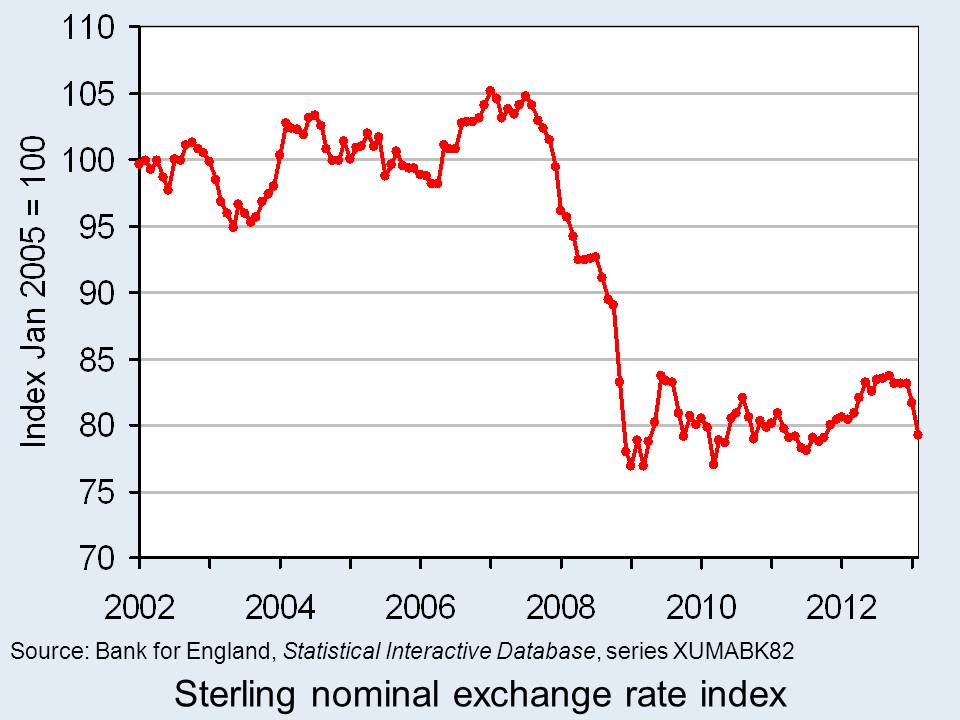
The chart shows the nominal (actual) effective exchange rate for the British pound since 2002. The chart shows clearly how from the autumn of 2007 the effective exchange rate began to fall sharply. Over the period from September 2007 to January 2009, figures from the Bank of England show that the nominal effective exchange rate fell by 25.3 per cent. In simple terms, the British pound depreciated by close to one-quarter. (Click here for a PowerPoint of the chart.)
If we move the clock forward, we observe an appreciation of the British pound between July 2011 (when its value was only 1.6 per cent higher than in January 2009) and September 2012. Over this period, the British pound appreciated by 7.2 per cent. Its value remained relatively stable through much of the remainder of last year. However, we appear to be on another downward path. If we compare the average value in February 2013 with the ‘high’ back in September 2012 we observe a depreciation of 5.4 per cent.
The British pound continues on its roller-coaster ride. Most commentators expect the British pound to fall further. Some see this as an important ingredient for a revival in British economic fortunes. If we compare September 2007 with February 2013, we find that the nominal effective exchange rate for the British pound is 23 per cent lower. This constitutes a major competitive boost for our exporters. However, an important question is whether there is a demand for these goods and services abroad however more attractive the depreciation makes them.
Data
Statistical Interactive Database – interest and exchange rate rates data Bank of England
BIS effective exchange rate indices Bank for International Settlements
Articles
Pound depreciates Vs dollar to lowest level since Aug 16 Bloomberg, Emma Charlton (5/2/13)
Pound advances against euro on Italy speculation; Gilts decline Bloomberg, Lucy Meakin and David Goodman (4/3/13)
Pounding of sterling risks a currency war Scotland on Sunday, Bill Jamieson (17/2/13)
Credit ratings, the pound, currency movements and you BBC News, Kevin Peachey (25/2/13)
The Bank of England can’t just go on doing down the pound Telegraph, Jeremy Warner (21/2/13)
 Sterling will continue to go down BBC News, Jim Rogers (25/2/13)
Questions
- Explain how the foreign demand for goods and assets generates a demand for British pounds. How will this demand be affected by the foreign currency price of the British pound, i.e. the number of foreign currency units per £1?
- Explain how the demand by British residents for foreign goods and assets generates a supply of British pounds. How will this supply be affected by the foreign currency price of the British pound, i.e. the number of foreign currency units per £1?
- What factors are likely to shift the demand and supply curves for British pounds on the foreign exchange markets?
- Illustrate the effect of a decrease in the demand for British goods and assets on the exchange rate (i.e. the foreign currency price of the British pound) using a demand-supply diagram.
- What is the difference between a nominal and a real effective exchange rate? Which of these is a better indicator of the competitiveness of our country’s exports
- What factors are likely to have caused the depreciation of the British pound in 2013?
Two reports on business confidence in the UK have just been published. The first, by Lloyds TSB Commercial, is its twice-yearly Business in Britain Report. The second is the Quarterly Economic Survey by the British Chambers of Commerce. Both reports paint a mixed picture about business confidence.
First the good news: the export sector is booming. Demand for exports is being boosted by (a) the depreciation of the pound, with the sterling exchange rate index some 20% lower now compared with the start of 2008 and (b) rapid economic growth in China, India and many other developing countries. Not surprisingly many exporting companies are looking to a bright future and are willing to invest.
Now the bad news. Domestic demand for many products is declining, especially services. This is not surprising given the rise in VAT, cuts in public spending and consumers cautious about their employment and income prospects in the coming year. With rapid cost-push inflation from higher oil and commodity prices, real incomes are set to fall and with it the level of real consumer demand (see Bosses gain – workers’ pain).
So where is the economy heading? The mixed picture painted by the two reports mean that the economy is likely to remain on the cusp. But with the export sector being much smaller than the domestic market, worries are likely to persist that economic growth may well slow significantly and the economy might return to recession. The main hope is that the restocking and replacement investment that follow a recession may be enough to provide just enough extra demand to avoid the ‘double dip’.
Articles
UK Business Confidence Hit By Domestic Demand Fears-Survey NASDAQ, Emma Haslett (4/1/11)
More doom and gloom as business confidence falls? Management Today, Nicholas Winning (5/1/11)
Smaller businesses do not share optimism Financial Times, Brian Groom (5/1/11)
New Year business confidence hit by domestic demand fears The Telegraph, James Hurley (5/1/11)
UK’s fragile services sector risks undermining recovery, BCC warns The Telegraph, Philip Aldrick (11/1/11)
Companies fear double-dip recession Oxford Mail, Andrew Smith (10/1/11)
Firms ‘planning investment freezes’ Press Association (4/1/11)
Surveys paint bleak picture for British economy Reuters, David Milliken (11/1/11)
Kern Says U.K. Services Industry Growth Is `Mediocre’ Bloomberg, Watch Video, David Kern (11/1/11)
UK economic growth rate slowing, BCC says BBC News (11/1/11)
Reports
Business in Britain, December 2010 Lloyds TSB Commercial (January 2011)
Quarterly Economic Survey, Q4 2010: Summary British Chambers of Commerce (January 2011)
Quarterly Economic Survey, Q4 2010: Tables British Chambers of Commerce (January 2011)
Data
Interest Rates and Exchange Rates Bank of England (for sterling effective exchange rates)
Economic and Labour Market Review Office for National Statistics (see Tables Chapter 1, worksheets in Table 1.03 for components of aggregate demand)
Business and Consumer Surveys European Commission, Economic and Financial Affairs (see latest ESI – Economic Sentiment Indicator, Table 1)
Questions
- Summarise the findings of the two reports.
- Using the data in Table 1.03 of the Economic and Labour Market Review, calculate the percentage of UK GDP accounted for by each of the main elements of aggregate expenditure.
- Why is the manufacturing sector as a whole experiencing relatively strong economic growth?
- If the service sector shrank by x% and the manufacturing sector grew by x%, what would be likely to happen to the rate of economic growth in the economy? What else would you need to know to establish the precise rate of economic growth?
- The BCC said both the government and the Bank of England must “act forcefully to support growth”. What measures would this include?
- If real wages fall, what could cause real aggregate demand to rise in these circumstances?
- What is likely to drive the level of investment in the coming months?
The USA has complained for a long time now that the Chinese currency is undervalued. This makes it hard for American domestic firms to compete with cheap Chinese imports and for US exporters to sell to China. This was a major talking point at the G20 conference in Korea in November 2010: see Seoul traders and the following clip from Reuters: Obama pressures China at G20.
So is the yuan undervalued and, if so, has there been any appreciation to reduce the degree of undervaluation? In 2005, the yuan was pegged at $0.12 (or $1 = ¥8.28). In July 2005 the peg was relaxed and the yuan has appreciated. By mid-December 2010, the yuan was trading at $0.15 (or $1 = ¥6.66) – a 25% appreciation since 2005. In real terms the appreciation has been greater. Chinese inflation is above US inflation. Latest figures for Chinese inflation show consumer prices rising by an annual rate of 5.1%. This compares with 1.2% in the USA. This makes the real appreciation greater.
But despite this appreciation, the USA maintains that the Chinese currency is still considerably undervalued. Estimates for this undervaluation are around 40%. In its latest ‘Big Mac Index’, The Economist calculates this undervaluation at 41.2%. Links to the relevant data are given below. Read the articles and then use the data to answer the questions.
Articles
China’s soaring inflation could hit UK shoppers The Telegraph, Richard Tyler (11/12/10)
China says November inflation rises to 5.1 percent Bloomberg, Cara Anna (11/12/10)
Jump in China inflation keeps focus on tightening Reuters, Aileen Wang and Simon Rabinovitch (11/12/10)
China inflation rise fastest since July 2008, exceeds market forecast The Australian, Aaron Back (11/12/10)
China’s top economic planner says December CPI likely below 5% Xinhuanet (11/12/10)
Yuan rises vs dollar after strong trade data The Economic Times of India (11/12/10)
Who wins if Yuan is significantly revalued? International Business Times (12/12/10)
Currency war reveals growing global fissures AsiaOne (11/12/10)
How China’s Inflation Policy Will Help the Yuan / Dollar Exchange Rate Seeking Alpha, Ed Dolan (29/11/10)
Data
Monthly Data Chinese National Bureau of Statistics
US Inflation Rate in Percent for Jan 2000-Present InflationData.com
BIS effective exchange rate indices Bank for International Settlements
Spot Exchange Rates Bank of England
IMF World Economic Ourlook Data Find The Best
Economic Data freely available online The Economics Network
The Big Mac Index The Economist
Questions
- Using Bank for International Settlements data above (broad indices), plot the nominal and real exchange rate indices for the US dollar and the yuan from 2005 to the present day. How much have (a) the nominal and (b) the real yuan exchange rate indices appreciated against the dollar exchange rate indices? (Note: you can use the Excel data to plot all four series on the same diagram.)
- Why has the Chinese rate of inflation risen?
- How are the anti-inflationary policies being considered by the Chinese authorities likely to impact on (a) the yuan exchange rate (b) the Chinese current account?
- In what ways do the Chinese authorities intervene in the foreign exchange market?
- What are the implications of the People’s Bank of China increasing the amount of yuan that can be traded on currency markets and increasing the amount of yuan-denominated debt?
- What are meant by purchasing power parity (PPP) exchange rates? Is the Big Mac index a good guide to the degree to which a currency is under- or overvalued?
It doesn’t seem that long ago when Greece was in the news regarding its deficit and need for bailing out. Back then, countries such as Spain, Portugal and Ireland were being mentioned as the next countries which might require financial assistance from the EU. It is now the Irish economy that is in trouble, even though the Irish government has not yet requested any financial help. The EU, however, is ‘ready to act’.
The Irish economy experienced an extremely strong boom, but they also suffered from the biggest recession in the developed world, with national income falling by over 20% since 2007. Savers are withdrawing their money; property prices continue to collapse; and banks needed bailing out. Austerity measures have already been implemented – tax rises and spending cuts equal to 5% of GDP took place, but it has still not been enough to stabilise the economy’s finances. All of these problems have contributed to a large and unsustainable budget deficit and a significant lack of funding and that’s where the EU and possibly the IMF come in.
If the Irish economy continues to decline and experiences a financial crisis, the UK would probably be one of the first to step in and offer finance. As our closest neighbour and an important trading partner, the collapse of the Irish economy would adversely affect the UK. A significant proportion of our exports go to the Irish economy and, with Irish taxpayers facing troubled times, UK exporting companies may be the ones to suffer.
One thing that this crisis has done is to provide eurosceptics with an opportunity to argue their case and blame the euro for the collapse of Ireland. With one monetary policy, the Irish economy is tied in to the interest rates set by the ECB and low interest rates fuelled the then booming economy. The common currency also increased capital flows from central European countries, such as Germany, to peripheral countries, such as Ireland, Spain and Portugal. In themselves, capital flows aren’t a problem, but when they are used to fund property bubbles and not productive investments, adverse effects are inevitable, as Ireland found to its detriment.
As prices collapsed and banks simply ran out of money, the government stepped in and rescued not only the depositors of Irish banks, but also their bondholders. Unable to devalue their currency, as it’s the euro, the Irish economy was unable to boost exports and hence aggregate demand and in turn economic growth. Although, the Irish government has not requested any financial help, as the French Finance Minister commented about a potential bailout: “Is it six months or a few days away? I’d say it’s closer to days.” The following articles look at this developing situation in Europe.
EU plays down Irish republic bail-out talks BBC News (17/11/10)
Ireland bailout: the European politicians who will decide Telegraph, Phillip Aldrick (17/11/10)
Don’t blame the Euro for Ireland’s mess Financial Times, Phillipe Legrain (17/11/10)
Britain signals intention to help Ireland in debt crisis New York Times, James Kanter and Steven Erlanger (17/11/10)
Ireland will take aid if ‘bank issue is too big’ Irish Times, Jason Michael (17/11/10)
Irish junior party says partnership strained Reuters (17/11/10)
Ireland resists humiliating bail-out as UK pledges £7 billion Telegraph, Bruno Waterfield (17/11/10)
Markets stable as Ireland bailout looms Associated Press (17/11/10)
The implausible in pursuit of the indefensible? BBC News blogs, Stephanomics, Stephanie Flanders (16/11/10)
Ireland bailout worth ‘tens of billions’ of euros, says central bank governor Guardian, Julia Kollewe and Lisa O’Carroll (18/11/10)
The stages of Ireland’s grief BBC News blogs, Stephanomics, Stephanie Flanders (18/11/10)
Q&A: Irish Republic finances BBC News (19/11/10)
Could Spain and Portugal be next to accept bail-outs? BBC News, Gavin Hewitt (19/11/10)
Questions
- Why will the UK be affected by the collapse of the Irish economy?
- If Ireland were not a member of the eurozone, would the country be any better off? How might a floating exchange rate boost growth?
- The Financial Times article talks about the euro not being to blame for the Irish problems, saying that ‘tight fiscal policy’ should have been used. What does this mean?
- Why is the housing market so important to any nation?
- What are the arguments (a) for and (b) against the euro? Would Ireland benefit from leaving the euro?
- Should the UK government intervene to help Ireland? What are the key factors that will influence this decision? What about the EU – should Ireland ask for help? Should the EU give help?
- Austerity measures have already been implemented, but what other actions could the Irish economy take to increase competitiveness?
With countries around the globe struggling to recover from recession, many seem to believe that the answer lies in a growth in exports. But how can this be achieved? A simple solution is to lower the exchange rate.
Under a pegged exchange rate, the currency could be devalued. Alternatively, if the country’s inflation is lower than that of other countries, merely leaving the exchange rate pegged at its current level will bring about a real devaluation (in purchasing-power parity terms).
Under a floating exchange rate, one answer would be to lower interest rates. This would involve open market operations to support the lower rate and that would increase the money supply. But with central banks’ interest rates at virtually zero, it is not possible to lower them further. In such circumstances a solution would be a deliberate policy of increasing the money supply through “quantitative easing”. For example, the USA is considering a second round of quantitative easing (known as “QE2”). This would tend to push down the exchange rate of the dollar.
But stimulating exports through devaluation or depreciation is a zero-sum game globally. If currency A depreciates against currency B, currency B necessarily appreciates against currency A. Country A’s gain in exports to Country B are an increase in imports for Country B. It is logically impossible for every currency in the world to depreciate! Yet depreciation is exactly the policy being pursued by countries such as Japan, South Korea and Taiwan, all of which have directly intervened in the currency markets to lower their exchange rates. And, in each case of course, other countries’ currencies have an equivalent appreciation against them.
Economists and politicians in the USA argue that the dollar is fundamentally over valued against the Chinese yuan (or ‘renminbi’ as it is sometimes called). They are calling on China to revalue by far more than the 2% increase since June 2010. But what if China refuses to do so? On 29 September the House of Representatives passed a bill giving the executive branch the authority to impose a wide range of tariffs on imports from China. The bill was passed with a huge majority of 348 to 79.
So is this the start of a trade war? Many in the USA argue that China is already waging such a war by giving subsidies to a wide range of exports. And that war is hotting up. China has just announced that it is imposing traiffs ranging from 50% to 104% on various poultry imports from the USA. And if it is a trade war, will there be any winners? The following articles investigate.
Global recovery’s weakness raises possibility of trade war Guardian, Larry Elliott (4/10/10)
Tension mounts as China and US trade insults over currency Independent, Stephen Foley (1/10/10)
Is the world in a trade war? Time Magazine blogs: The Curious Capitalist, Michael Schuman (29/9/10)
Trade War Is Here – and We’ve Disarmed The Huffington Post, Robert Kuttner (3/10/10)
US House Passes Anti-China Trade War Bill GlobalResearch.ca, Barry Grey (1/10/10)
Currencies the key to market’s next move BBC News, Jamie Robertson (3/10/10)
A Message for China New York Times (30/9/10)
Taking On China New York Times, Paul Krugman (30/9/10)
Krugman Makes Two Powerful Arguments Against “Taking on China” Wall Street Pit, Scott Sumner (2/10/10)
Why the U.S. can’t win a trade war with China The Globe and Mail (Canada), Carl Mortished (4/10/10)
China-Japan trade war looms CTV News (Canada), Mark MacKinnon (23/9/10)
IMF chief’s warning of currency war ‘real threat’ BBC News, interview with Dominique Strauss-Khan, head of the IMF (7/10/10)
Could disputes over currency levels lead to a depression? BBC World Service, interview with Robert Zoellick (8/10/10)
China stands firm over yuan move BBC News, Andrew Walker (9/10/10)
What to do about China’s currency? Washington Post (10/10/10)
How to stop a currency war The Economist (14/10/10)
What’s the currency war about? BBC News, Laurence Knight (23/10/10)
Nominally cheap or really dear? The Economist (4/11/10)
Questions
- Why are competitive devaluations globally a zero sum game while global trade wars are a negative sum game?
- What are the arguments for and against using tariffs as a means of stimulating recovery?
- Why has quantitative easing so far had a more discernible effect on asset prices than on the real economy?
- Do a search on “Smoot-Hawley Tariff Act” of 1930 and describe its impact on the global economy in the 1930s. Are there any parallels today?
- How is it possible for massive trade surpluses and deficits to persist and yet for individual countries’ exchange rates and overall balance of payments to be in equilibrium?
- Are global trade imbalances widening, and if so why?
- What would determine the size of the effect on the US balance of trade of an appreciation of the yuan?